There is a particular kind of silence that happens in certain streets. The ones paved with centuries-old cobblestone, lined with walls painted the color of turmeric or washed-out coral, where the sound of a local vendor calling out to neighbors carries further than any tour guide’s voice. I have felt something close to that silence in parts of Europe during my solo backpacking years. I have felt it in the rhythm of life in Ghana, where time is shaped by community rather than schedule. And from everything solo travelers consistently report, the colonial towns of the Americas deliver that feeling in abundance, with a specific, layered quality that comes from centuries of Spanish, Portuguese, and indigenous culture colliding and eventually blending into something new.
If you have been toying with a trip that goes deeper than beach clubs and resort pools, a journey through the historic colonial towns of the Americas might be exactly the shift your travel life needs. This is not a list to collect. It is a guide to help you choose, plan, and arrive somewhere that will genuinely stay with you.
Why Colonial Towns Hit Different
The Spanish crown’s urban planning formula was methodical: a central plaza surrounded by a cathedral on one side, a government palace on another, and a grid of streets radiating outward. What that formula could not control was everything that came after. Centuries of indigenous influence, the forced labor of enslaved people from West Africa, the mixing of foods and faiths and languages, and the slow drift toward independence all left marks on these places that no blueprint anticipated.
The result is cities that feel simultaneously European in structure and deeply, unmistakably themselves. You will notice it in the food, the music, the murals, the way people gather in plazas at dusk. That contrast, the grid and the spirit within it, is exactly what makes these towns worth exploring slowly.
Antigua, Guatemala: The Baroque Town That Survived Everything
Antigua sits in a valley flanked by three volcanoes, one of which, Volcán de Agua, you can see at the end of nearly every street in town. It was the capital of the Spanish colonial territory of Guatemala for over two centuries, and when earthquakes finally forced the government to relocate to what is now Guatemala City in 1773, many residents simply stayed. That partial abandonment preserved Antigua in a way that planned cities rarely are. The ruins stayed as ruins. The original street grid held.
Today, UNESCO recognizes Antigua Guatemala as one of the best-preserved examples of Spanish colonial city planning in all of Latin America, citing its distinctive Baroque style, known locally as Barroco antigueño, which developed adaptations specifically designed to survive the region’s frequent earthquakes, including thick walls and low bell towers.
Walking the town does not require a map or a plan.
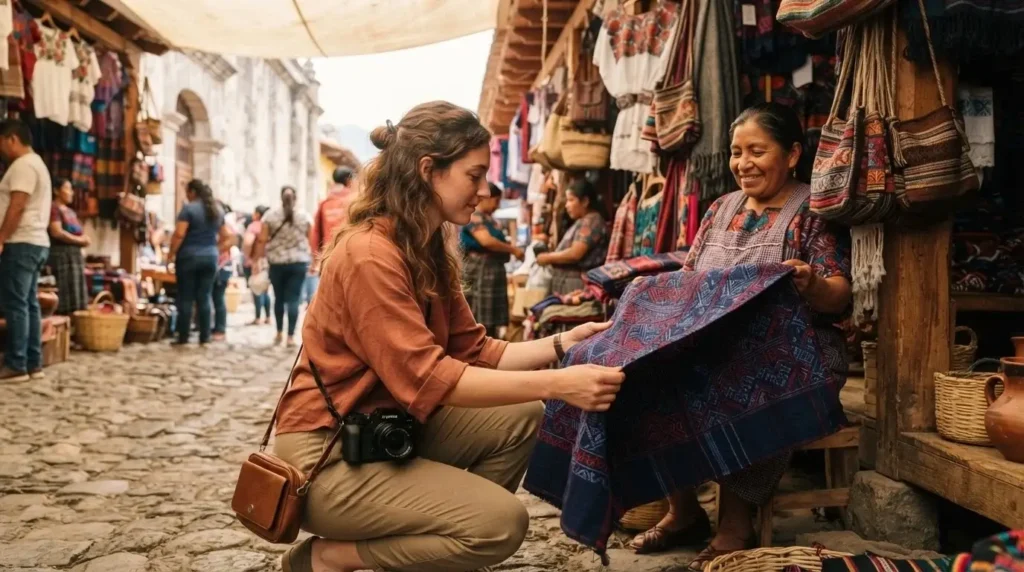
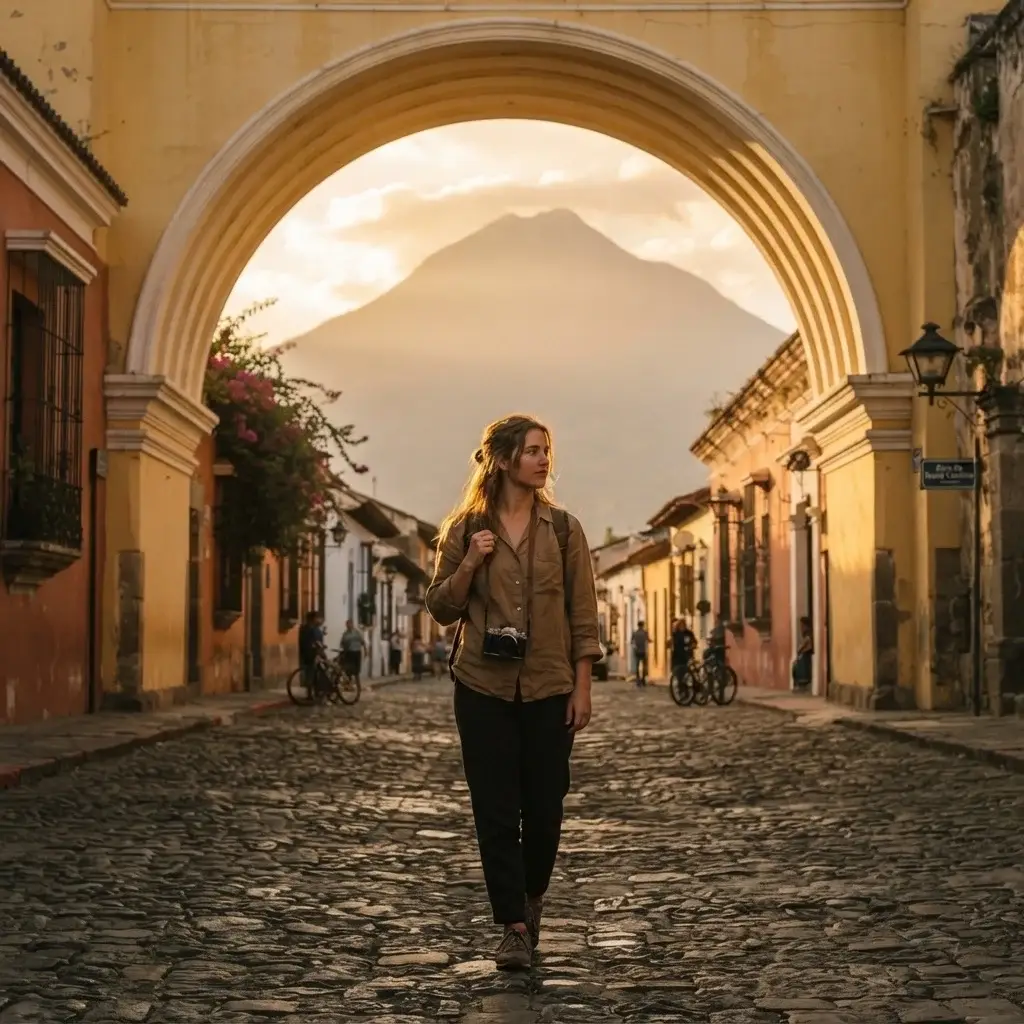
The streets are small enough to explore on foot in an afternoon, and getting satisfyingly lost is part of the experience. The Arco de Santa Catalina, an arch that spans one of the main streets and frames Volcán de Agua behind it, is the kind of image that stays in your memory for years. The Mercado de Artesanías on the western edge of town is where you will find handwoven textiles made by Maya women from surrounding villages. These are not souvenirs in the mass-produced sense. The backstrap-loom weaving traditions here stretch back far beyond the Spanish arrival.
For food, eat at the market. A bowl of pepián, a deep-colored Guatemalan stew made with seeds and dried chiles, costs around 30 to 50 quetzales (roughly USD 4 to 6) at a market stall and will tell you more about the local culinary culture than any restaurant menu will. In the evening, the streets around Parque Central fill with locals and travelers in equal measure, and the atmosphere is lively without being overwhelming.
US, UK, and Canadian citizens enter Guatemala visa-free for up to 90 days. The easiest route in is flying to La Aurora International Airport in Guatemala City, from which Antigua is about 45 minutes by shuttle, with shared services running all day for about USD 10 to 15.
Slow travelers should know: Antigua rewards a stay of at least four to five days. Three if you are pressed, but you will leave wishing for more.
Cartagena, Colombia: Walls That Held an Empire Together
Cartagena de Indias sits on the Caribbean coast of Colombia inside a set of fortifications that are nothing short of staggering. The city was one of the most strategically important ports in all of the Americas during the 16th through 18th centuries, a key junction in the trade routes that funneled silver and gold from South America back to Spain, and a site of profound suffering through the transatlantic slave trade. The walls were built to protect that wealth, and they still stand.
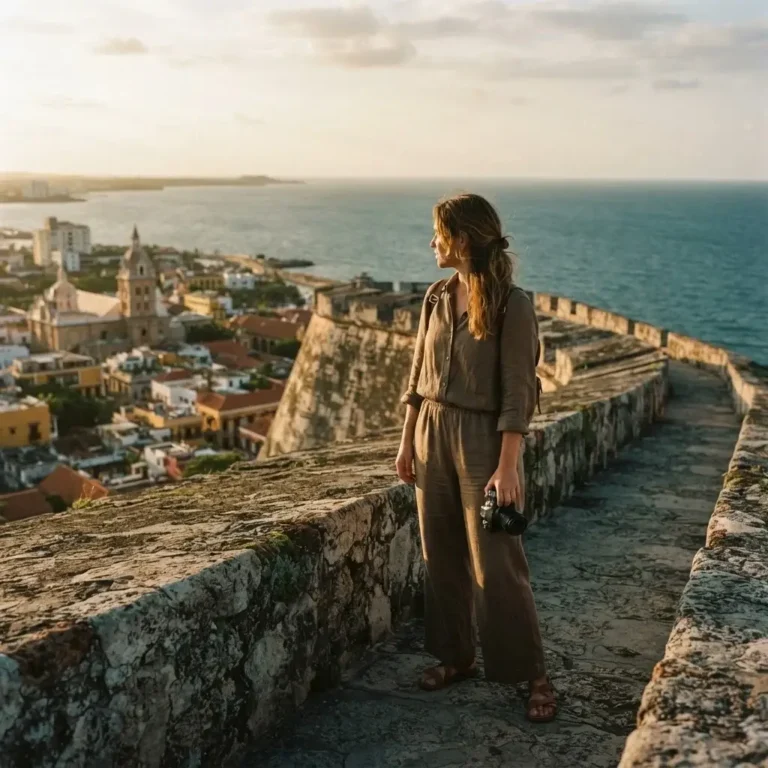
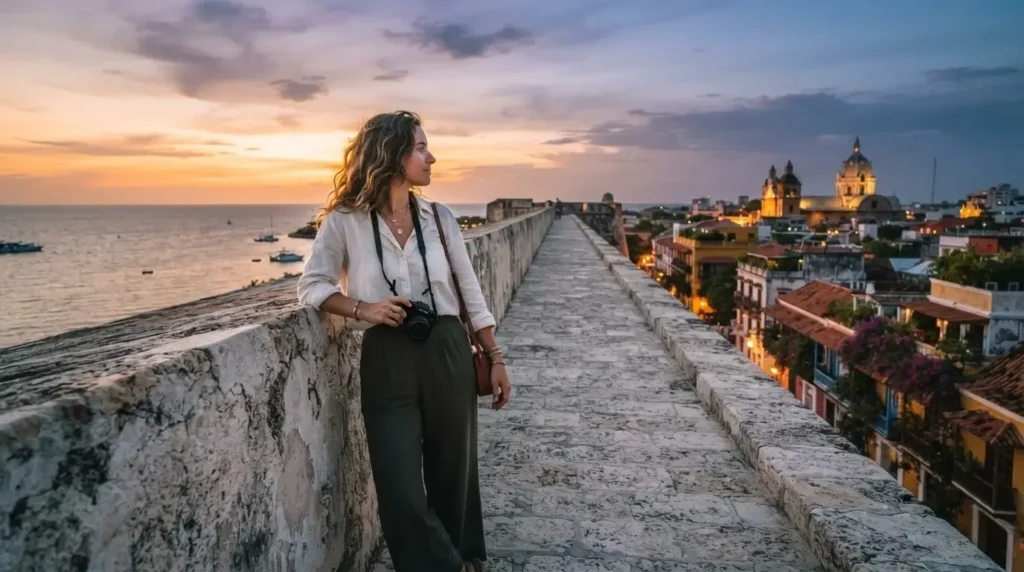
UNESCO has designated Cartagena’s port, fortresses, and historic center a World Heritage Site for having “the most extensive fortifications in South America” and for its role as an essential link in the historic West Indies maritime routes, alongside Havana and Old San Juan. Walking along the top of the city walls at sunset, with the Caribbean on one side and the colored balconies of the old city below you, is one of those travel experiences that is hard to put into language without resorting to superlatives.
The old walled city, known as Ciudad Amurallada, is compact and very walkable. The Getsemaní neighborhood just outside the walls is where much of the real local life happens, with street art, family-run restaurants, and a community that has been slowly pushing back against rapid gentrification. Eat bandeja paisa if you want a full Colombian spread, or start simpler with arepas de choclo, the slightly sweet corn cakes sold at street stalls in the morning for almost nothing. For something cold, agua de panela with lime is the most refreshing thing you will find on a hot Caribbean afternoon.
From a practical and safety standpoint, if you are traveling solo, the walled city itself is very tourist-friendly. Getsemaní is livelier but straightforward to navigate with basic common sense during daylight hours. Evening requires the same alertness you would practice in any urban neighborhood. The US Department of State travel advisory for Colombia currently suggests exercising increased caution in certain regions, but Cartagena’s tourist areas are generally considered safe and well-traveled. US citizens do not need a visa for tourism stays under 90 days.
From within Colombia, Cartagena’s Rafael Nunez Airport is well connected to Bogota, Medellin, and other major cities. Budget flights are common and often inexpensive.
Oaxaca, Mexico: Where History Lives on Every Plate
If you travel to Oaxaca and spend most of your time in restaurants, I am not going to judge you for a single second. Oaxaca is regularly considered one of the most important culinary centers in all of Mexico, and that reputation sits alongside an equally deep history of indigenous and colonial culture that makes the city one of the most textured in the Americas.
The historic city center and its relationship with the ancient Zapotec and Mixtec ruins at Monte Albán together form a UNESCO World Heritage Site, recognized for the layered testimonies of civilizations that predate Spanish arrival by more than a thousand years. Monte Albán is just a short drive from the city center and should not be skipped. The hilltop site, with its leveled summit, ball court, and stone temples, was one of the earliest cities in Mesoamerica, inhabited over a span of roughly 1,500 years.
Back in the colonial historic center, the Zocalo, Oaxaca’s central plaza, is surrounded by the 16th-century Cathedral of Our Lady of the Assumption on one side and a collection of arcaded cafes on the other. The green-tinted stone the Spanish used to build much of the colonial architecture here, quarried locally and called cantera verde, gives Oaxaca a subtle color palette unlike any other Mexican city.
As for the food: mole negro, the complex, dark, multi-chile sauce that can take days to prepare and contains upward of thirty ingredients, is Oaxaca’s most celebrated dish. Try it over turkey or chicken at any market comedor (a small, open kitchen stall) in the Mercado 20 de Noviembre or the Mercado Benito Juarez. A full plate costs roughly 80 to 120 pesos. Tlayudas, the large crisped tortillas layered with bean paste, asiento (unrefined lard), and your choice of meat and cheese, are another staple and one of the most satisfying things to eat standing up at a market counter. Mezcal is Oaxaca’s spirit, and many small distilleries in the surrounding valleys are open to visitors for tours and tastings.
US citizens need no visa for Mexico. Flights into Oaxaca’s Xoxocotlan airport are more limited than other major hubs, so many travelers fly into Mexico City and take the roughly six-hour ADO bus, which is comfortable, reliable, and inexpensive.
Trinidad, Cuba: Frozen in Time, Alive in Music
Trinidad, a small colonial city in central Cuba, has a quality that is genuinely rare: it feels like a place that time forgot, not because it is sleepy or empty, but because the forces of commercial development that have transformed other cities simply did not arrive here the same way. The pastel-painted 19th-century mansions, the cobblestone streets polished smooth by centuries of use, the brass bands playing son cubano from open doorways at dusk – it all adds up to an atmosphere that few places in the Caribbean can match.
UNESCO inscribed Trinidad and the surrounding Valle de los Ingenios as a World Heritage Site in 1988, recognizing both the well-preserved colonial town and the nearby sugar mill valley, which contains evidence of 75 former sugar plantations and the enslaved labor systems that powered them. The history is beautiful and painful in equal measure, and spending even a few hours at the nearby ingenio ruins gives the elegance of Trinidad’s mansions a weight that visitors should not skip past.
In town, the Plaza Mayor is the colonial center around which everything else orbits. From there, streets climb steeply in all directions, giving you elevated views across terracotta rooftops toward the sea. The Museo Historico Municipal in the old Borrell family mansion gives an honest account of the sugar economy and its human cost. At night, the Casa de la Trova and the Casa de la Musica are where live traditional music happens – a bottle of Cuban rum, a plastic chair on the cobblestones, and a live son or bolero band is one of those simple travel pleasures that costs almost nothing and gives everything.
For non-US travelers, a tourist card (tarjeta de turista) is generally available through airlines or at the point of entry for around USD 25. Getting to Trinidad from Havana involves either a five-hour bus journey on the Viazul network or a longer taxi route through the countryside.
Old San Juan, Puerto Rico: Caribbean Colonialism in Bold Color
Old San Juan is the oldest continuously inhabited European settlement in US territory and one of the most visually striking urban environments in the Caribbean. Six blocks wide and fourteen blocks long, the old city sits on a small island connected to the mainland of Puerto Rico by three causeways, surrounded on three sides by the Atlantic and the San Juan Bay.
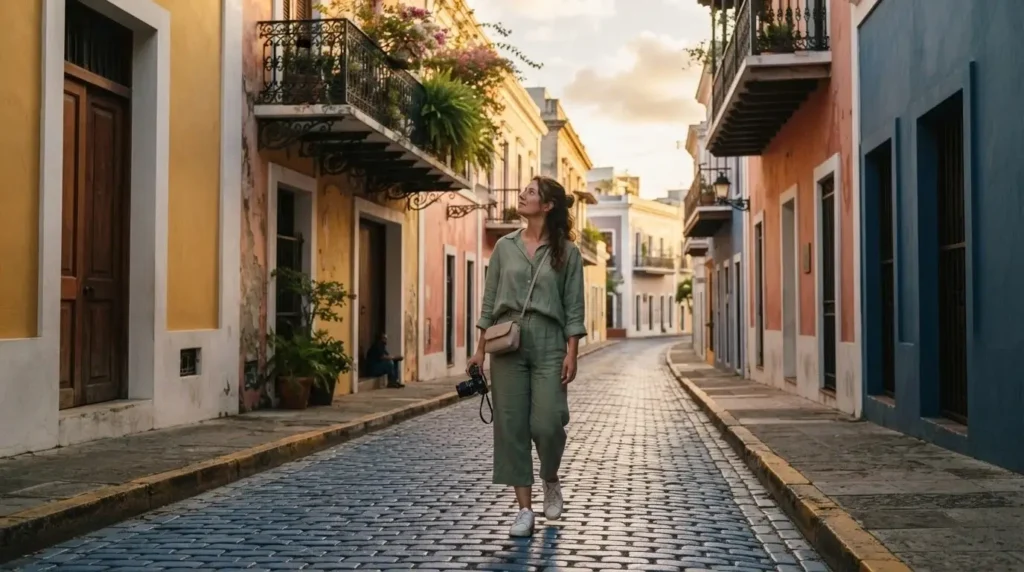
The colors are the first thing you notice: walls painted in hues of saffron, seafoam, and terracotta, worn in exactly the right way, accented by black iron balconies overflowing with geraniums. The blue cobblestones underfoot were made from ballast brought over on Spanish ships, and walking on them, you feel the strange, layered weight of that history. For US travelers in particular, the combination of no passport requirement, direct flights from almost every major US city, and a genuinely historic urban environment makes Old San Juan one of the most accessible colonial experiences in the Western Hemisphere.
The Discover Puerto Rico official tourism site has a strong guide to Old San Juan’s must-see landmarks, including Castillo San Felipe del Morro and Castillo San Cristobal, the two massive Spanish fortifications that bookend the old city. Entry to both forts through the San Juan National Historic Site runs around USD 10. The forts deserve a full half-day each, not a rushed hour.
From a food standpoint, Old San Juan has some of the best eating in the entire Caribbean. Mofongo, the plantain-and-garlic dish that shows up in infinite variations, is the staple you should try first. Seafood empanadillas, the crispy stuffed pastry pockets sold at street counters, are the perfect walking snack. And if you want to sit down for a proper meal, the restaurants along Calle del Cristo and around the Plaza de Armas cover the full spectrum from simple comida criolla to more refined tasting menus.
Colonia del Sacramento, Uruguay: One Day That Earns Its Keep
Most travelers visit Colonia del Sacramento on a day trip from Buenos Aires, arriving by the Buquebus ferry that crosses the Rio de la Plata in around one hour. That is a reasonable plan, but if you linger long enough to see the town after the day-trippers leave, you will understand why a night or two here transforms the experience entirely.
Colonia’s Barrio Histórico is tiny, perhaps the smallest intact colonial center on this entire list, covering just 57 hectares, and UNESCO recognized it in 1995 for its unique blend of Portuguese and Spanish colonial heritage, a distinction it shares with no other settlement in South America. The Portuguese founded it in 1680, the Spanish took it repeatedly over the following century, and the back-and-forth between those two colonial powers left Colonia with a layered architectural identity you can read block by block.
The Calle de los Suspiros, a narrow cobblestone lane lined with low colonial houses, is the visual heart of the old town and the photograph every traveler leaves with. Beyond the photography, the real pleasure here is the pace. Rent a bike or a golf cart for the afternoon (rentals are available at several shops near the main gate for around 300 to 500 Uruguayan pesos per hour), and explore the lighthouse, the ruins of the Portuguese convent, and the wide waterfront promenade that faces Argentina across the river.
Uruguay is one of the most visitor-friendly countries in South America. Most Western passport holders enter visa-free for up to 90 days, and the country consistently ranks among the safest and most stable in Latin America.
How to Choose the Right Town for Your Trip
Not every colonial town suits every travel style, and trying to visit all of them on one trip will leave you rushing through places that deserve patience. Here is how to think about it.
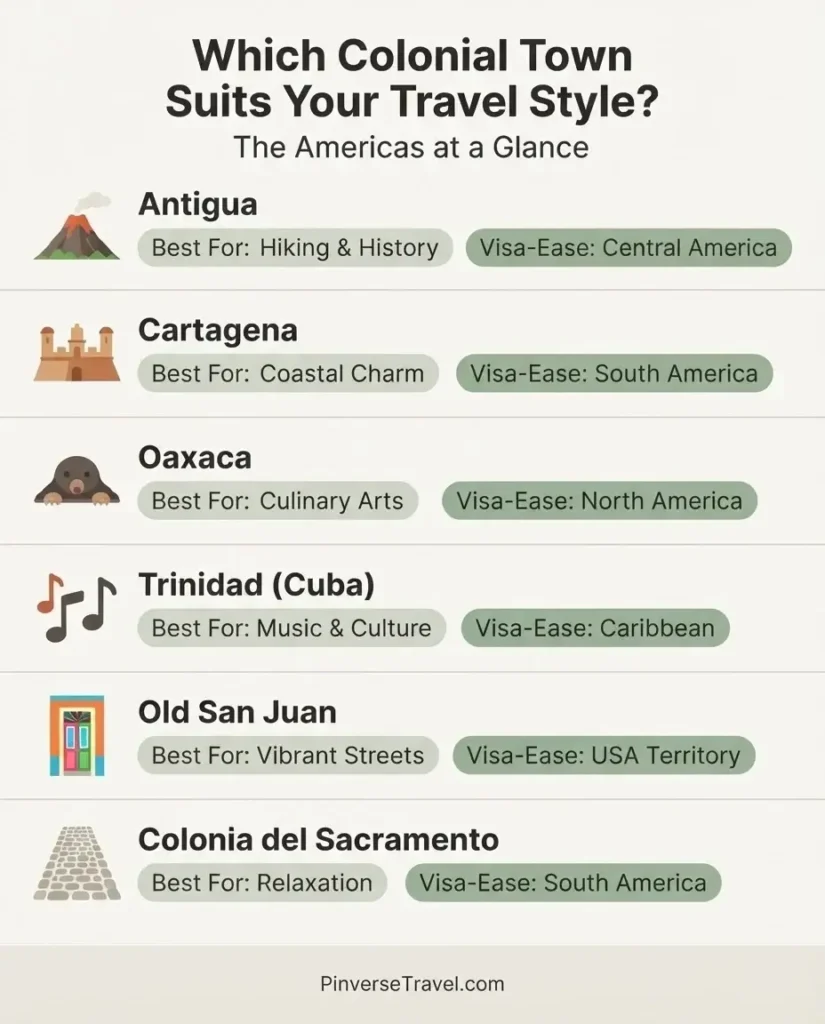
If you are primarily drawn to food and indigenous culture, Oaxaca is the obvious anchor. It combines the colonial urban fabric with some of the richest culinary and craft traditions on the continent. If Caribbean energy appeals to you, music and Caribbean flavor, then Cartagena or Old San Juan give you that layered colonial history with a lively, outward-facing personality that solo travelers tend to find immediately welcoming. If you want the feeling of stepping into a preserved past with minimal outside noise, Trinidad in Cuba has a quality that Cartagena and Antigua have already begun to lose to mass tourism. Antigua is the most developed of these towns from a solo traveler infrastructure standpoint, with strong hostel networks, consistent tour options, and easy onward connections to the rest of Guatemala, which makes it a strong first stop if Latin America is new to you.
Colonia del Sacramento is best treated as what it is: a single extraordinary day or a gentle overnight, not a multi-day base.
Santo Domingo’s Zona Colonial deserves a mention here too. As the oldest colonial city in the Americas, founded in 1496, it is historically significant above all others on this list, and the Dominican Republic is increasingly accessible from North America with direct flights to Santo Domingo from major US cities.
Practical Tips That Actually Make a Difference
Across all of these destinations, a few habits will consistently improve your experience.
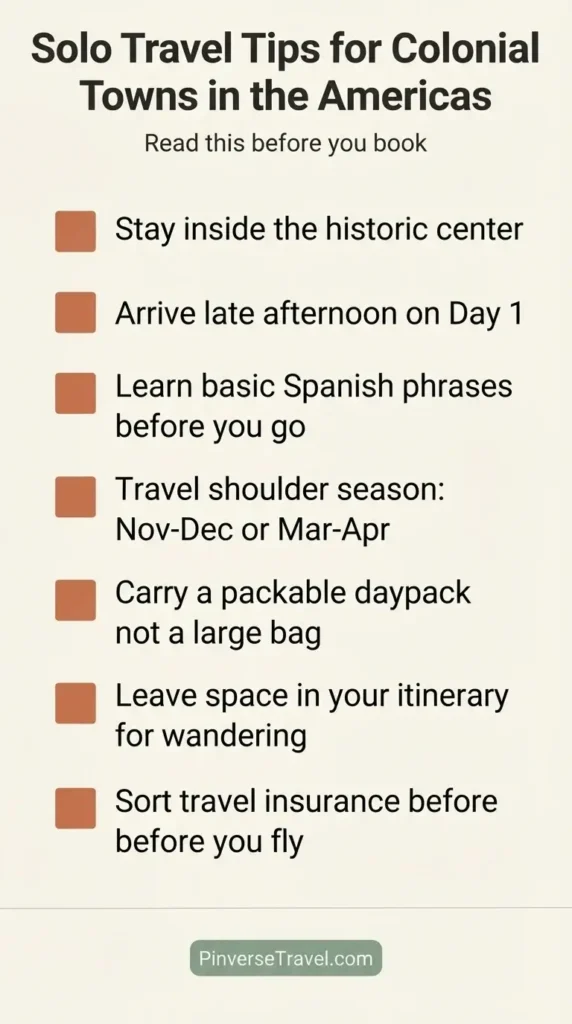
Stay inside or immediately adjacent to the historic center, even if it costs slightly more. The old districts of these cities were designed to be walked, and being within the grid means you can explore at the natural pace that reveals the most. Hotels and hostels a few kilometers outside may save you money but will cost you the ambient, everyday life of these places.
Arrive in the late afternoon on your first day rather than morning. You will have time to orient yourself before dark, catch the golden hour light on the colonial facades, and find where the locals eat dinner without needing a reservation or a research session.
Learn a few words in the local language before you arrive. In Spanish-speaking towns, this is immediately appreciated and will open more doors than any travel gadget or app. Even basic phrases mark you as someone who is there to engage, not just consume.
Do not overschedule.
The traveler who spends three hours at a Oaxacan market and ends up in a conversation about mole recipes with a vendor’s grandmother has had a more meaningful morning than the person who hit four museums before noon. Give yourself permission to follow curiosity at the expense of the itinerary.
Finally, travel in the shoulder season where you can. November to early December and March to early April tend to offer the best balance of comfortable weather and manageable crowd levels across most of these destinations.
The Deeper Reason to Go
My travel philosophy has always been that what a place teaches you about yourself matters more than what you learn about the place. When I left my office job in New York and started building a life around slow travel and cultural immersion, I was not chasing destinations. I was chasing growth, the kind that only comes from putting yourself in an unfamiliar context and figuring out how to be present in it.
The colonial towns of the Americas are exactly that kind of context. They are beautiful and complicated in equal measure. The same elegance that draws you in is built on histories of conquest, slavery, and resistance that the best of these towns do not hide from. Letting yourself engage with that complexity, seeing the cathedral and also asking what it displaced, tasting the food and understanding whose hands it passed through, that is what separates real cultural travel from an Instagram backdrop.
You do not need to be an expert in colonial history to visit these places.
You just need to come curious and stay long enough to listen. The towns will do the rest.