There is a particular kind of excitement that comes with looking at a map of Patagonia for the first time. The sheer scale of it. The way it stretches across the bottom of two countries, funneling down toward the end of the world, framed by glaciers and granite peaks and a sky that looks wider than anywhere else on earth. That excitement is real, and it is absolutely worth chasing.
But I’ll be honest with you: planning a trip to Patagonia can feel genuinely overwhelming if you don’t kroughly 10 to 14 days, crossing the border at least once.now where to start. The region spans both Argentina and Chile. The weather is famously unpredictable. The best areas require advance bookings, and the distances between highlights are enormous. I’ve talked to plenty of travelers who spent months going in circles before they finally committed to a plan.
This guide cuts through all of that. Whether you’re planning to hike the famous W Trek, stand face-to-face with a moving glacier, or simply spend a week in one of the most beautiful landscapes on the planet, here is everything you actually need to know before you go.
What Patagonia Actually Is (And Why It’s Two Trips in One)
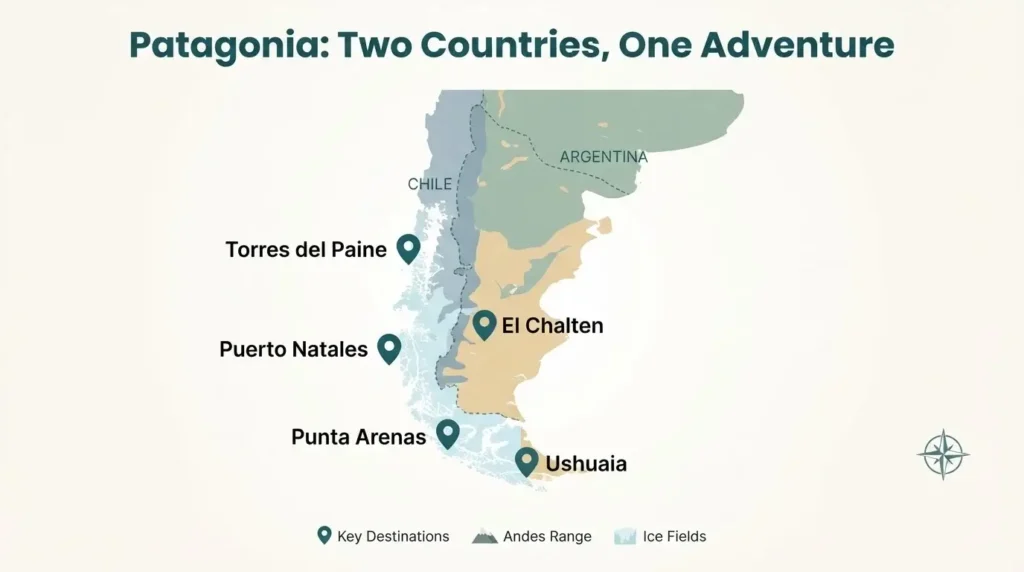
Patagonia is not a country, a city, or a single park. It is a vast geographic region that covers the southern portion of both Argentina and Chile, roughly from the 40th parallel south down to the Strait of Magellan and beyond. When most travelers talk about “going to Patagonia,” they typically mean a circuit through key highlights on both sides of the Andes.
On the Chilean side, the star attraction is Torres del Paine National Park, a UNESCO Biosphere Reserve covering 242,000 hectares of jagged peaks, turquoise lakes, and ancient glaciers. As UNESCO notes on their official Biosphere Reserve profile, the park sits where the Andes meet the Patagonian Steppe, creating an ecosystem found almost nowhere else on earth. The nearby town of Puerto Natales serves as the main base for trekkers heading into the park.
On the Argentine side, the centerpiece is Los Glaciares National Park, a UNESCO World Heritage Site protecting 47 glaciers born from the Southern Patagonian Ice Field. It contains two entirely different but equally spectacular zones: the glacier zone near El Calafate, anchored by the famous Perito Moreno Glacier, and the mountain zone near El Chalten, dominated by the jagged granite summit of Mount Fitz Roy. Most travelers build a loop that connects these highlights over roughly 10 to 14 days, crossing the border at least once.
Understanding this geography upfront changes everything. It means you’re really planning two distinct experiences that happen to share a landscape, and each one comes with its own logistics, booking systems, and practical quirks.
When to Go: The Window That Changes Everything
Patagonia’s travel season runs from November through March, which is the austral (Southern Hemisphere) summer. Days are long, trails are fully accessible, and the famous Patagonian wind is at its most manageable. December and January are peak months, bringing the largest crowds to Torres del Paine and the highest prices across the board.
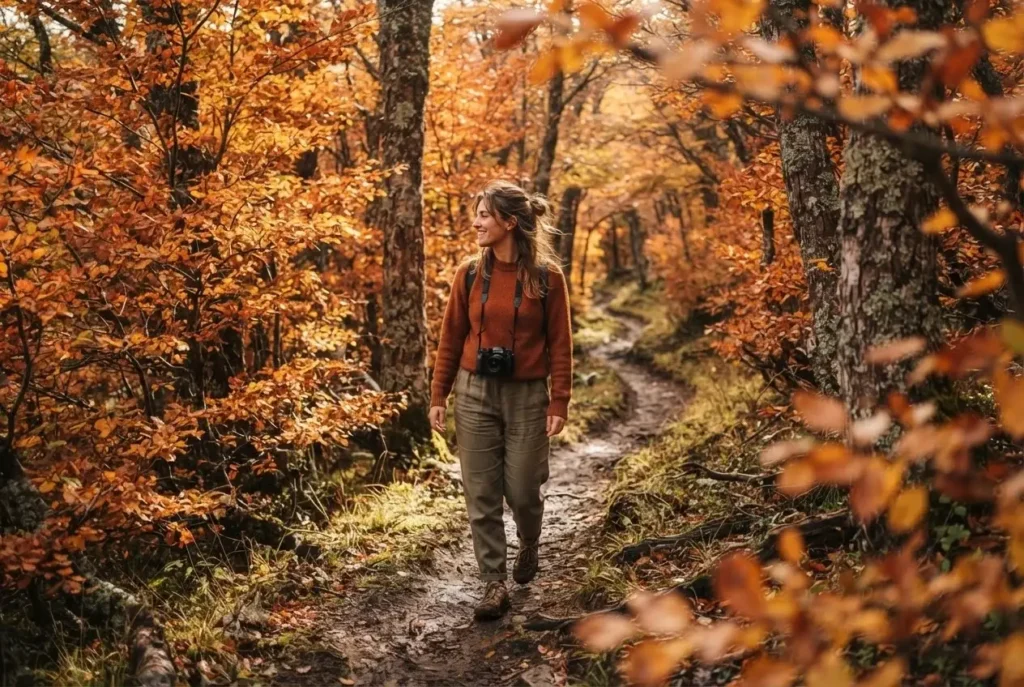
Here is what most travel guides won’t tell you clearly enough: the shoulder season is genuinely excellent. November and late March into April offer slightly cooler temperatures and thinner crowds, but the light in autumn Patagonia is extraordinary. Fall foliage transforms the lenga beech forests into burning shades of orange and red, and the trails are far less congested. Solo travelers especially benefit from shoulder season, when hostels are easier to book, bus seats are available without weeks of advance planning, and the overall pace is calmer.
If you’re on a tight budget, avoiding the peak December and January window can mean meaningfully lower accommodation costs without sacrificing the core experience. That said, always come prepared for Patagonia’s notorious “four seasons in one day” weather pattern.
Rain, wind, sun, and cold can cycle through in a matter of hours regardless of the month. The wind here is not a gentle breeze. Gusts in Torres del Paine can stop you mid-stride on an exposed ridge.
Getting There and Getting Around
The two main entry points into Patagonia are El Calafate on the Argentine side (served by Comandante Armando Tola International Airport, with direct flights from Buenos Aires) and Punta Arenas on the Chilean side (connected to Santiago). Puerto Natales, the gateway to Torres del Paine, is about three hours north of Punta Arenas by bus.
From a solo traveler’s perspective, the best news is that you do not need a car. Buses connect all the major towns, and shared shuttles run directly from Puerto Natales into Torres del Paine during the season. From El Calafate, local buses and organized day trips cover the glacier and surrounding area, while a separate bus service runs the three to four hours north to El Chalten. Book transport as early as possible in peak season as buses fill up quickly.
The Navimag ferry, which sails between Puerto Montt and Puerto Natales through the Chilean fjords over several days, is a famously beautiful option for travelers who want to build in a slower approach from the north. It’s not the fastest route, but the scenery through the fjords is unforgettable according to every traveler who has taken it.
For crossing between Argentina and Chile, US, Canadian, EU, and Australian citizens need no visa for either country for stays up to 90 days. The official Chile Tourism Board entry requirements page confirms that citizens from these countries only need a valid passport. Argentina has equally straightforward entry for these nationalities. Keep your agricultural declaration form handy at both borders, as Chile takes biosecurity seriously and customs officers are thorough.
Torres del Paine: The Iconic Chilean Side
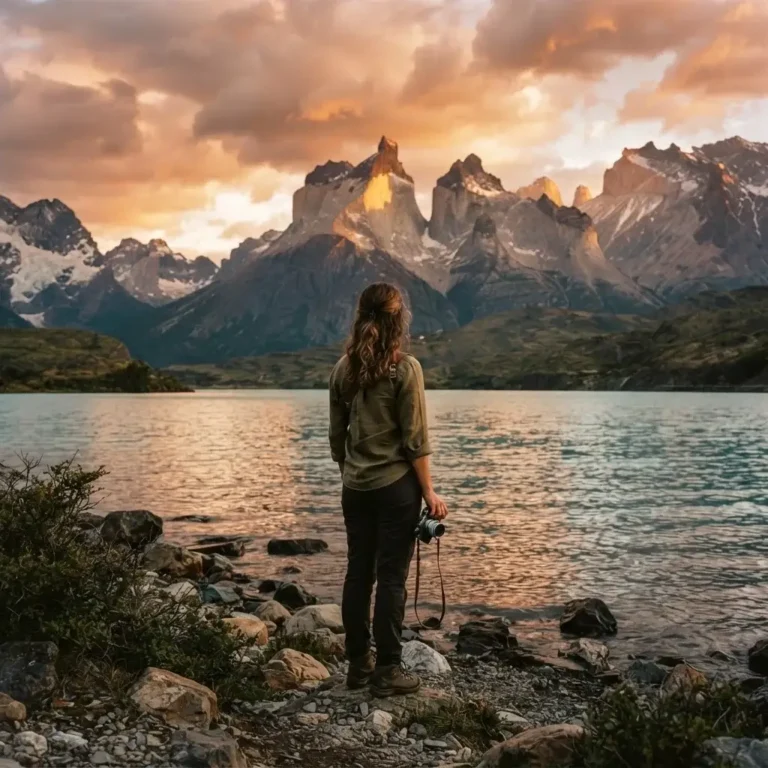
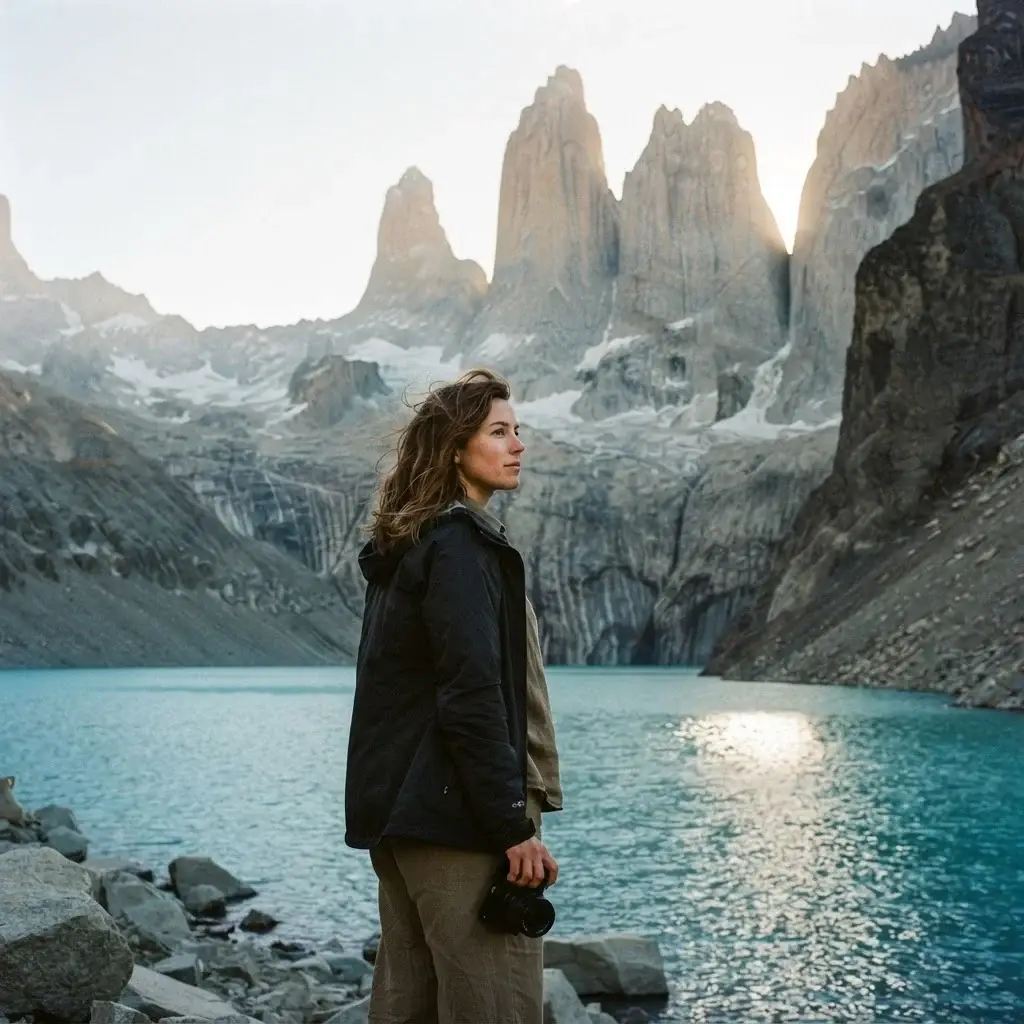
If Patagonia is on your radar, Torres del Paine is almost certainly the reason. The park’s three granite towers, called the Torres, are one of the most photographed landscapes on earth, and standing at the Mirador Base Torres with those three vertical needles reflected in the lake below is the kind of moment that quietly rewires something in you.
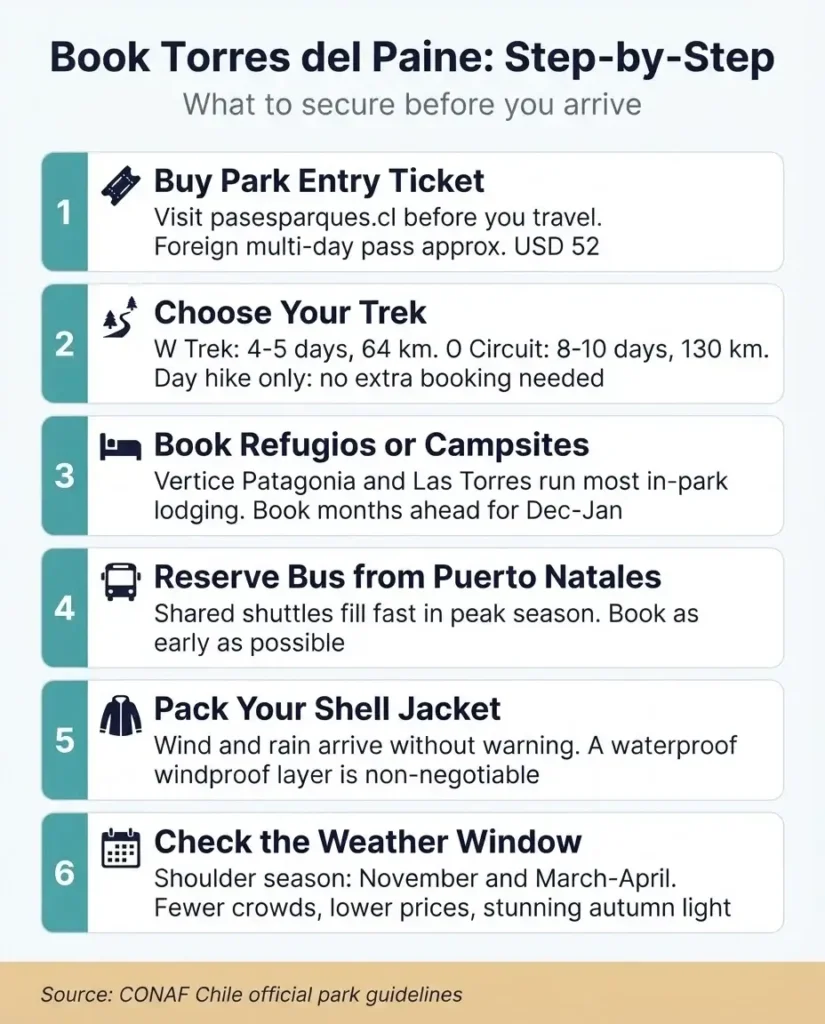
The main trekking options inside the park are the W Trek (roughly 64 km, taking four to five days) and the longer O Circuit (approximately 130 km, taking eight to ten days). The W covers the park’s most dramatic highlights including Valle del Frances, Grey Glacier, and the towers themselves. The O Circuit adds the remote backside of the park, which offers stunning solitude but requires more experience and preparation.
For first-timers without multi-day trekking experience, there is a completely valid approach of entering the park for day hikes rather than committing to a multi-day trek. The hike to Mirador Base Torres is about 20 km round trip and takes most hikers eight to twelve hours. It is strenuous but entirely achievable for anyone with reasonable fitness and proper footwear.
The booking system for Torres del Paine has become more structured in recent years. All visitors must purchase park entrance tickets in advance through CONAF’s online portal. You can buy your tickets at pasesparques.cl, Chile’s official protected areas ticketing system. For foreign visitors over 18, a one-day pass currently costs CLP 34,000 (roughly USD 37) and a multi-day pass runs CLP 48,500 (roughly USD 52), with rates valid through December 2026. If you’re doing the W Trek or O Circuit, you will also need to book your refugios (mountain huts) and campsites well in advance, especially for December and January. Vertice Patagonia and Las Torres Patagonia operate most of the in-park accommodation, and the best spots fill months ahead.
One practical note that competitors rarely mention: bring USD 46 per day as proof of sufficient funds, as Chilean border officers have the right to ask for this under Chile’s entry requirements. It’s rarely enforced at Patagonia’s remote crossings, but it’s worth being aware of.
El Calafate and the Perito Moreno Glacier: Argentine Patagonia’s Crown
El Calafate is a surprisingly pleasant small city with a good selection of hostels, restaurants, and an easy-to-navigate main street. Most travelers use it as a base for two to three days, primarily to visit the Perito Moreno Glacier inside Los Glaciares National Park, Argentina’s largest national park covering over 726,000 hectares.
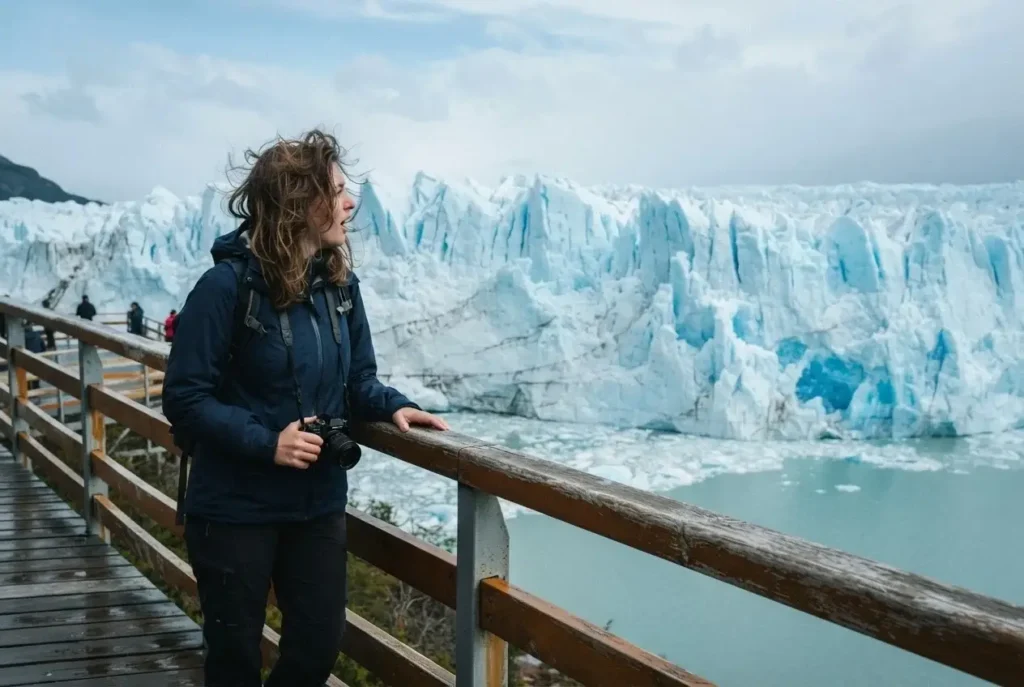
Perito Moreno is one of the only glaciers in the world that is not retreating. It advances toward Lake Argentino continuously, periodically forming an ice dam that eventually ruptures in a spectacular natural collapse. The park has built a network of boardwalks and viewing platforms along the glacier’s face, allowing visitors to stand just meters from a wall of blue-white ice that towers 60 meters above the water’s surface. The creaking, groaning, and occasional thunderous calving of ice slabs the size of apartment buildings is something you genuinely cannot prepare yourself for by looking at photos.
The park entrance for international visitors runs approximately USD 40 to 55 depending on the current exchange rate. From El Calafate, the glacier is about 90 minutes by road. Day-trip buses from town are the simplest option, or you can join a guided tour that includes the boardwalk access and an optional boat ride along the glacier face. Budget conscious travelers should note that the boardwalk views are included in the park entry fee and are extraordinary on their own, without needing to add a paid boat excursion.
What to eat in El Calafate: Try the calafate berry wherever you find it. The small, dark purple berry grows wild throughout southern Patagonia and shows up in jams, ice cream, chocolate, and cocktails. Local legend says that anyone who eats the calafate berry will always return to Patagonia. The local lamb, cordero al palo, roasted whole on a cross over an open fire in the traditional Patagonian way, is one of the most satisfying meals you can have anywhere in South America. Most parrillas (grills) in town serve it, and the slow-cooked result is fall-off-the-bone tender with a smoky depth that is very hard to describe without sounding ridiculous.
El Chalten: The Hiking Capital with Zero Entry Fees
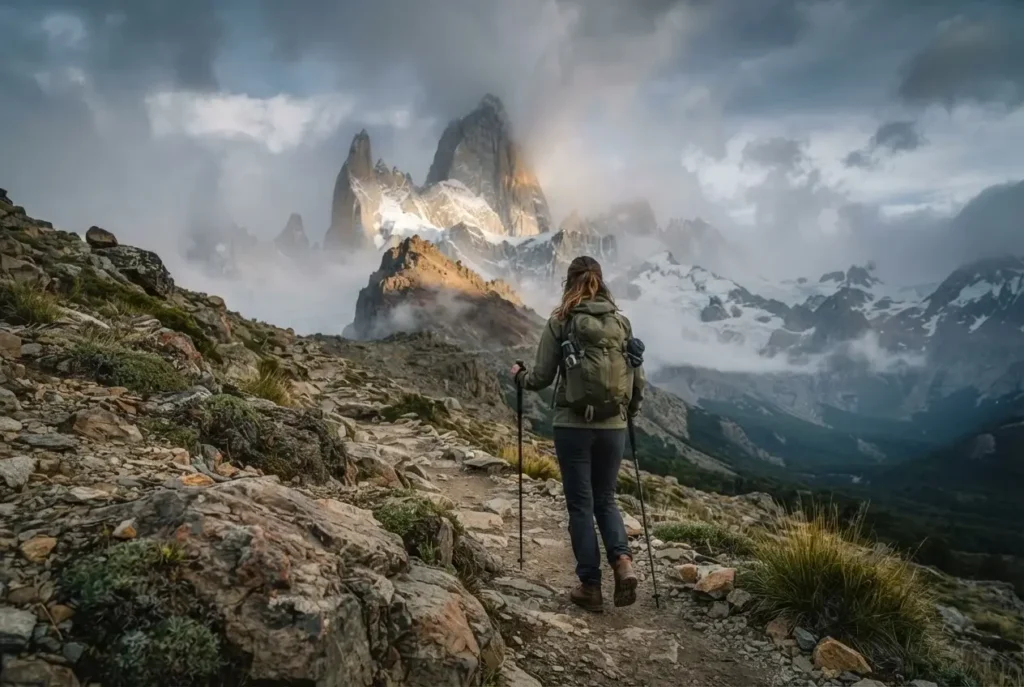
If Torres del Paine requires advance booking and careful planning, El Chalten is its wild, free counterpart on the Argentine side. This small mountain village sits at the northern end of Los Glaciares National Park, directly beneath the jagged silhouette of Mount Fitz Roy, and it operates on a beautifully simple premise: all the hiking trails are free of charge, well-marked, and accessible straight from the village center.
The official El Chalten self-guided trekking site lays out every trail clearly, from two-hour walks to full-day epics. The two most famous routes are the Laguna de Los Tres hike (roughly 22 km round trip, ending at a lake with a direct view of Fitz Roy’s summit) and the Laguna Torre trail (about 18 km round trip, ending at a glacier-fed lake below the needle-like peak of Cerro Torre). Both are rated difficult due to elevation gain in the final sections, but neither requires technical climbing skills or special equipment beyond good hiking boots, layers, and enough food and water for a full day.
What makes El Chalten special for solo travelers is the atmosphere of the village itself. It has the feel of an old mountain town that hasn’t entirely caught on to its own fame yet. There’s a community of guides, climbers, and long-term trekkers passing through. Hostel common rooms turn into genuine social spaces where you’ll naturally end up sharing trail notes with strangers who become temporary companions. It’s the kind of place where the travel-community feeling I’ve experienced in other remote trekking hubs – that easy camaraderie of people united by shared effort and shared landscapes – shows up effortlessly without anyone having to force it.
The food scene in El Chalten is small but surprisingly good. Several breweries have opened in town, and a cold local draft after a full day on the Fitz Roy trail is one of life’s simple pleasures. Empanadas are everywhere, cheap, and deeply satisfying after hours of hiking.
What to Pack: Dressing for Patagonian Weather
Patagonia will test your gear, so packing thoughtfully matters more here than almost anywhere else. The core rule is layers. The wind alone can make a 15°C (59°F) afternoon feel bitterly cold, and a warm sunny morning can turn wet and gusty within an hour.
Here is what experienced Patagonia travelers consistently recommend. Start with a moisture-wicking base layer that moves sweat away from your skin. Add a fleece or midlayer for insulation. Your outer layer is the most important piece: a windproof, waterproof shell jacket that you can rely on in sustained wind and rain is non-negotiable. Many experienced hikers say this jacket alone changes the entire experience. Add a warm hat, gloves, a neck gaiter or buff, and polarized sunglasses (the UV exposure at this latitude is significant, and the wind makes your eyes water on exposed ridges).
For footwear, waterproof hiking boots with solid ankle support are essential for multi-day treks. Well-broken-in is more important than brand new. Trekking poles are worth their weight on the descents from Laguna de Los Tres and on the final approach to Mirador Base Torres.
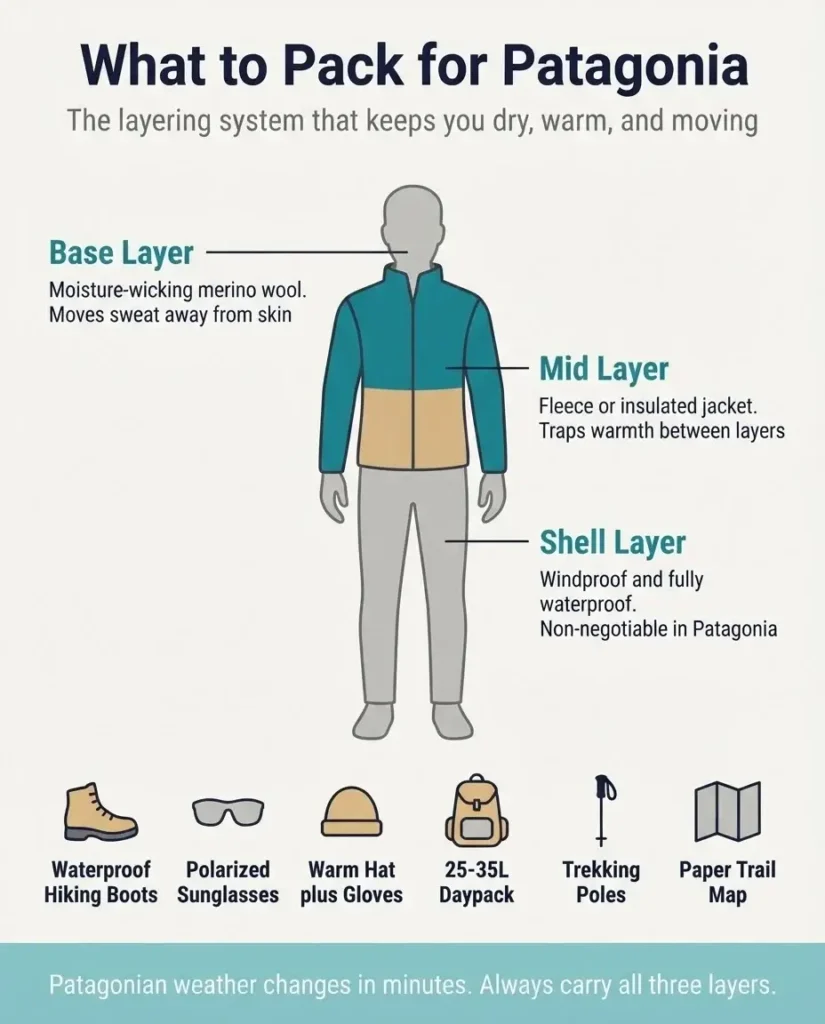
A 25-35 liter daypack covers most day hikes, while a 50-65 liter pack works for multi-day camping. Pack enough snacks for longer days than you plan for. Trail stores inside parks are limited or nonexistent, so carry everything you need from town.
Budget: What Patagonia Actually Costs
Patagonia has a reputation for being expensive, and parts of that reputation are earned. But it is far more accessible to budget-conscious travelers than the intimidating price tag suggests, particularly on the Argentine side.
Accommodation in El Chalten and El Calafate ranges from roughly USD 20 to 40 per night for a hostel dorm. Puerto Natales hostels run similarly. Food in local restaurants is very reasonable in Argentina given the exchange rate dynamics, while Chilean Patagonia tends to run somewhat higher. Cooking your own food in hostel kitchens is easy and common. The cost to enter Torres del Paine (roughly USD 37 to 52 for the park pass) is a fixed overhead, but El Chalten’s trails are free. Flights from Buenos Aires to El Calafate run from roughly USD 80 to 200 each way depending on timing and airline.
A realistic independent budget for a 10-day Patagonia trip, covering both sides, including accommodation, food, transport, and park fees, falls somewhere between USD 900 and USD 1,500 depending on your comfort preferences and how aggressively you self-cater. Peak season December/January pushes this higher. November and March offer the same experience at meaningfully lower cost.
Solo Travel in Patagonia: Honest Advice
From everything solo travelers consistently report, and from the community of solo walkers I’ve encountered in remote trekking destinations across various continents, Patagonia is one of the most welcoming places in the world to travel alone. The trail culture on both the Argentine and Chilean sides is genuinely friendly. On popular routes like the W Trek or the Fitz Roy trail, you are rarely truly alone for long because other trekkers are always around, and the shared challenge of Patagonian weather builds quick connections.
The solo traveler’s main practical advantage in Patagonia is flexibility. You can adjust your plans based on weather windows without coordinating around a group. If the forecast looks good for Mirador Base Torres on Tuesday but bad on Monday, you move your day around. This kind of fluid planning often yields the clearest views and the most rewarding days.
For safety on the trails, always register with park rangers before heading out on longer hikes, carry a paper map as a backup to your phone’s GPS, and let someone at your accommodation know your plans. Cell service inside the parks is nonexistent. The trails in both Los Glaciares and Torres del Paine are well-maintained and clearly marked. The US Department of State Chile travel page rates Chile at Level 1 (exercise normal precautions), the lowest advisory level, and southern Patagonia specifically is considered very safe for independent travelers.
If you are a woman traveling solo, the consistent experience reported by female travelers across forums and travel communities is that Patagonian trekking culture is notably respectful and inclusive. The shared nature of hostel travel and trail culture means you are never truly isolated, and the practical safety concerns are more about wilderness preparedness than personal safety from other people.
What Most People Miss: The Quieter Wonders
Almost every article about Patagonia focuses on the same circuit: Perito Moreno, Torres del Paine, Fitz Roy, done. But if you have time to slow down, there are experiences that make the trip fuller without adding complexity.
The calafate shrubs that line every road in Argentine Patagonia. The guanacos, which are wild camelids related to llamas, that graze right up to the roadside and regard you with complete calm. The condors circling on thermals above the valley outside El Chalten. The Magellanic penguins, which can be seen on day trips from Punta Arenas at the Otway Sound colony. And the mate culture on both sides of the Andes. Mate is the strongly caffeinated herbal drink that Argentines and Chileans pass around in communal gourds. Accepting a round when someone in a hostel common room offers is one of the easiest and most genuine ways to connect with local travelers and long-term expats who call Patagonia home.
Ushuaia, at the southern tip of Argentina on the island of Tierra del Fuego, is worth a couple of days if your routing allows. It bills itself as the “End of the World,” and that feeling is real. Tierra del Fuego National Park sits just outside town. The centolla, or King Crab, caught in the Beagle Channel is extraordinarily good, and the harbour front restaurants serve it simply and perfectly.
The Real Reason to Go
Back when I was still working as a sightseeing guide in New York City, I had a habit of watching the faces of tourists who had traveled a long way to see something that genuinely moved them. There was a particular expression, an almost quiet shock, that appeared when someone encountered something bigger than what they expected. Patagonia produces that expression more reliably than anywhere else I know of.
This is not a trip that rewards rushing. It rewards showing up with patience, flexible plans, and a willingness to sit with the discomfort of weather that doesn’t cooperate and trails that are harder than you expected and boots that are soaked through by day two. Those are exactly the moments that turn a trip into something you carry with you for the rest of your life.
You don’t need to be an experienced mountaineer. You don’t need a massive budget. You need to stop waiting for the right moment, build a reasonable plan, and book the flight. Patagonia will take it from there.