Before I became a full-time traveler, I spent years guiding tourists around New York City. I’d point out St. Patrick’s Cathedral on Fifth Avenue so many times it started to feel like furniture. I knew every fact about it, but I’d never really looked at it. It took leaving my job, trading my tour script for a backpack, and learning to move slowly through a place before I understood what a cathedral could actually make you feel.
You don’t need to be religious to be moved by these buildings. You just need to be curious. And the Americas, from Quebec to Lima, from Colombia’s underground mine to a modernist crown rising out of the Brazilian savanna, have some of the most extraordinary sacred spaces on the planet. Most travel articles about “world cathedrals” spend 95% of their time in Europe. This one doesn’t.
Here’s what solo travelers, cultural explorers, and first-timers genuinely need to know before visiting the most beautiful churches and cathedrals across North, Central, and South America.
A Quick Note Before You Pack: Dress Code and Cathedral Etiquette
This applies everywhere on this list, so let’s get it out of the way. Most cathedrals in the Americas expect visitors to have covered shoulders and covered knees. A light scarf or a thin layer stuffed in your bag solves this problem completely. Photography is usually permitted in the main nave but often restricted around altars, chapels, and during active religious services. When in doubt, put the camera down for a moment and watch what local visitors are doing.
You are absolutely welcome as a non-religious traveler. Most of these cathedrals receive millions of tourists alongside their regular congregations. Just be quiet near anyone who is praying, and give the space the same respect you’d give any significant public building. That’s genuinely all it takes.
St. Patrick’s Cathedral, New York City — The One That’s Easy to Overlook
I’ll start here because St. Patrick’s is the cathedral I walked past too many times before I ever walked in. When you live and work in New York, it becomes part of the skyline noise. But slow down and actually go inside, and you realize what you’ve been dismissing.
This Neo-Gothic cathedral on Fifth Avenue, completed in 1878, is the largest Roman Catholic cathedral in the United States. The interior is all soaring pointed arches, rose windows, and an organ with 9,000 pipes. The Lady Chapel at the far end is probably the most quietly beautiful part of the building. On a weekday morning, before the tourist crowds arrive, it gets genuinely peaceful in there, which is a strange thing to say about a building in midtown Manhattan.
Entry is free, and the cathedral is open daily from 6:45 AM to 8:45 PM according to St. Patrick’s Cathedral’s official site. Audio tours are available for purchase if you want the full historical walkthrough. I’d recommend visiting before 10 AM or after 4 PM to avoid the thickest part of the tourist flow. If you’re in the city for a short time, pair it with a walk north to Central Park or south to Bryant Park.
Cathedral Basilica of Saint Louis, Missouri — The Mosaic Ceiling That Defies Description
Here’s what happens when you tell someone there’s a cathedral in St. Louis worth a detour: they look at you skeptically. Go anyway.
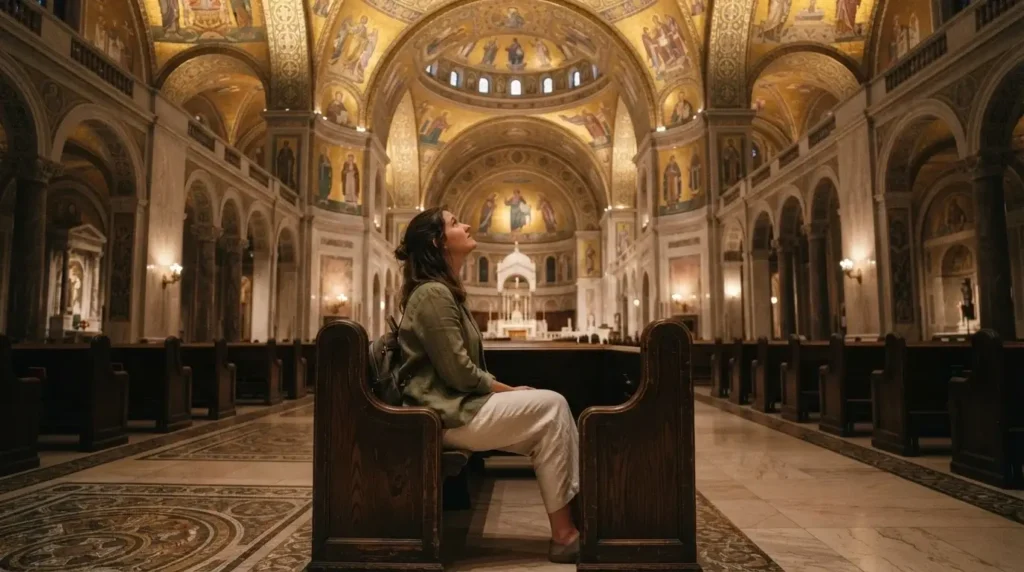
The Cathedral Basilica of Saint Louis took 83 years to complete and holds what is quite possibly the largest mosaic collection in the world. Over 41 million pieces of glass tesserae cover 83,000 square feet of surface area inside this building. The ceiling transforms the light in a way that photographs genuinely cannot capture. Every section of the interior tells a different story in tile, and you can spend a full hour inside without feeling like you’ve rushed anything.
The museum is open Monday through Saturday from 10 AM to 4 PM and Sundays from noon to 4 PM, with a suggested contribution of $2 per person. The Cathedral Basilica museum and tours page has guided tour availability and group visit information. This is one of those places that rewards slow travelers. Don’t breeze through. Find a pew, look up, and stay for a while.
Basilica of Our Lady of Guadalupe, Mexico City — The Most Visited Catholic Shrine in the World
With roughly 20 million pilgrims and visitors annually, the Basilica of Guadalupe in northern Mexico City is not a quiet experience. But it is an extraordinary one.
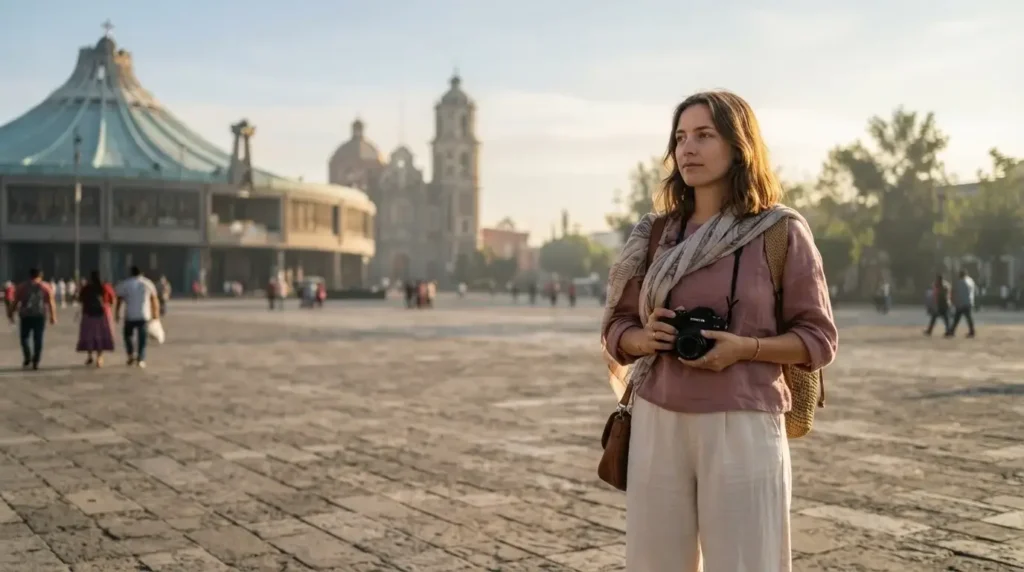
The complex centers around a tilma, a cloak bearing the image of the Virgin Mary that is said to date from 1531. The new basilica, completed in 1976, is a circular modern building designed to give as many people as possible an unobstructed view of that image. A slow-moving walkway beneath it carries visitors past continuously, which is an unusual and slightly surreal experience. The older baroque basilica next door, which began sinking into the soft lakebed soil decades ago and is now visibly tilted, is worth exploring too. The contrast between old and new, solemn and buzzing with energy, is one of the more genuinely interesting things you’ll witness in Mexico City.
Entry to the basilica is free, and it is open daily from 6:00 AM to 9:00 PM. The official website of the basilica is at virgendeguadalupe.org.mx, where you can check for event schedules around major feast days, particularly December 12, when crowds swell to many millions. Get there early in the morning on a regular weekday if you want space to actually look around.
From central Mexico City, take Metro Line 6 to La Villa station, which puts you steps from the complex entrance.
Mexico City Metropolitan Cathedral — The Oldest in Latin America
Right in the heart of the Zocalo, Mexico City’s vast central plaza, stands the largest and oldest cathedral in all of Latin America. Construction began in 1573, roughly 50 years after the Spanish conquest of Tenochtitlan, and the building wasn’t completed until 1813. That 240-year construction span means the cathedral carries elements of Renaissance, Baroque, and Neoclassical architecture all within one structure. You can see the stylistic shifts as you move through it.
From what countless solo travelers and cultural visitors consistently report, the Zocalo itself deserves as much of your time as the cathedral. Stand in the plaza in the early evening, watch the city move around you, then step inside the cathedral as the afternoon light fades. The scale of the interior is genuinely startling. Entry is free. It’s also worth noting that the cathedral sits atop the foundations of the Aztec Templo Mayor, and the ground has been slowly shifting as a result, giving parts of the building a distinctive lean.
Cathedral of Antigua, Guatemala — Ruins That Teach You More Than Restorations
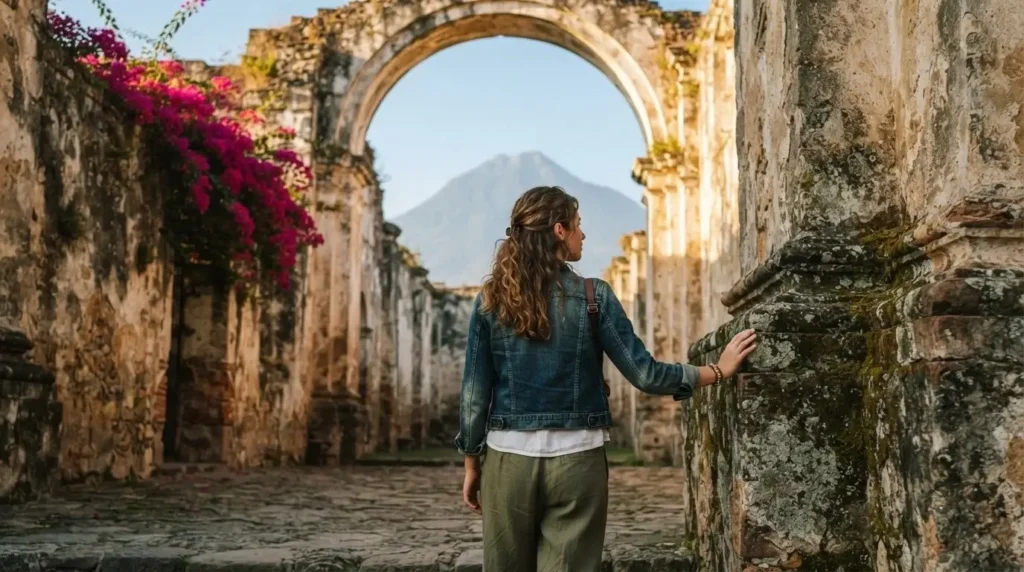
Antigua Guatemala is one of those cities where history isn’t just something you read about. It’s collapsed around you, half-standing, draped in bougainvillea, and somehow more vivid for it.
The city’s colonial churches and cathedral are part of a UNESCO World Heritage Site recognized in 1979. The UNESCO World Heritage listing for Antigua Guatemala describes the city as one of the best-preserved examples of Spanish colonial city planning in the Americas, and the regional Baroque style developed here, called Barroco antigueño, is unlike anything you’ll see in Europe. The style developed specifically to withstand frequent earthquakes, with low towers, massive walls, and deep decorative facades designed to handle seismic movement.
The main cathedral, formally the Cathedral of Santiago, was devastated by earthquakes in 1773 and was never fully rebuilt. What remains is a working church at the front with open-air ruins extending behind it, full of exposed stone columns, arched courtyards, and a quiet you won’t find on the cobblestone streets outside. Admission to the ruins is approximately Q10, which is roughly $1.30 USD.
Antigua is compact enough to walk easily, and the city rewards anyone who moves slowly through it. La Merced Church nearby is another highlight, with its striking yellow and white Baroque facade still largely intact.
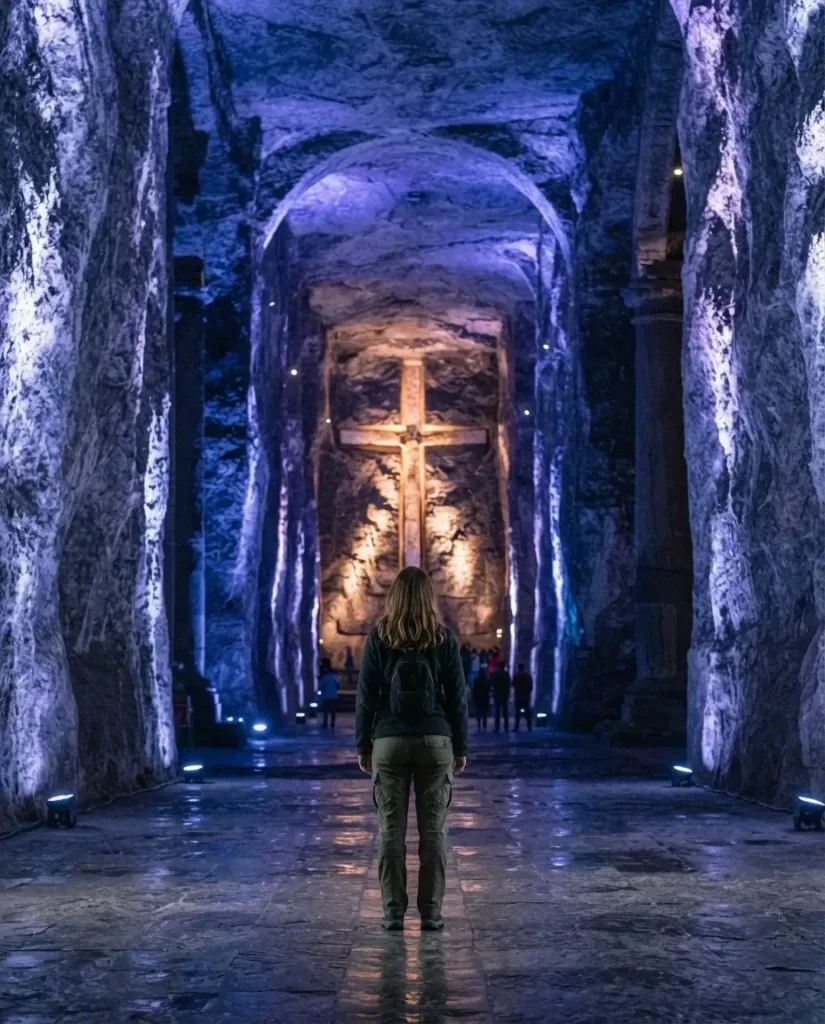
Salt Cathedral of Zipaquira, Colombia — A Church 660 Feet Underground
This one is in a category of its own. The Salt Cathedral of Zipaquira is not a cathedral in the traditional sense of soaring arches and stained glass. It’s a Roman Catholic church built 660 feet (200 meters) underground inside the tunnels of a working salt mine, and it is one of the most genuinely unexpected places I’ve read about travelers experiencing anywhere in South America.
The complex includes multiple underground chapels and stations of the cross carved directly into salt walls, with dramatic lighting that makes the space feel like something from a film set. The centerpiece nave can hold 8,000 people. For context, Colombia’s official cathedral site describes the experience as moving through the history of salt mining and sacred architecture simultaneously. Salt has been extracted from this mountain since the pre-Columbian era.
The official website is catedraldesal.gov.co, where you can check opening hours and book tickets. Entry for international visitors is approximately COP 98,000, around $25 USD, and includes a guided tour. Zipaquira is about 50 kilometers north of Bogota, easily reachable by train or bus from the capital in under two hours. From what solo travelers consistently report, the morning session is less crowded than afternoons, and spending time in the small plaza town of Zipaquira before or after the cathedral visit makes for a fuller day.
Cathedral of Lima, Peru — A Colonial Masterpiece on the Plaza de Armas
The Cathedral of Lima anchors the city’s Plaza Mayor with a massive cream-colored Baroque facade that was constructed, collapsed, and rebuilt multiple times after earthquakes between the 1500s and 1900s. The version you see today draws heavily on work completed in 1924.
What makes this cathedral particularly worth the visit is the attached museum, which includes Francisco Pizarro’s tomb. Pizarro was the Spanish conquistador who overthrew the Inca Empire, and his remains rest here in a chapel to the right of the main entrance. It’s a strange historical weight to stand near, and solo travelers who think carefully about the Spanish conquest and its effects on indigenous populations often find this spot prompts real reflection. The museum and cathedral interior are open Monday to Friday from 9 AM to 5 PM and Saturdays from 10 AM to 1 PM. Admission is approximately S/.10, around $3 USD, which includes the museum.
Lima’s historic center around the Plaza Mayor is a walkable district with a lot to absorb. Pair your cathedral visit with a walk to the nearby Monastery of San Francisco, which has its own famous catacombs, and allow at least a half day for the whole area.
Cathedral of Brasilia, Brazil — Modernism at Its Most Spiritual
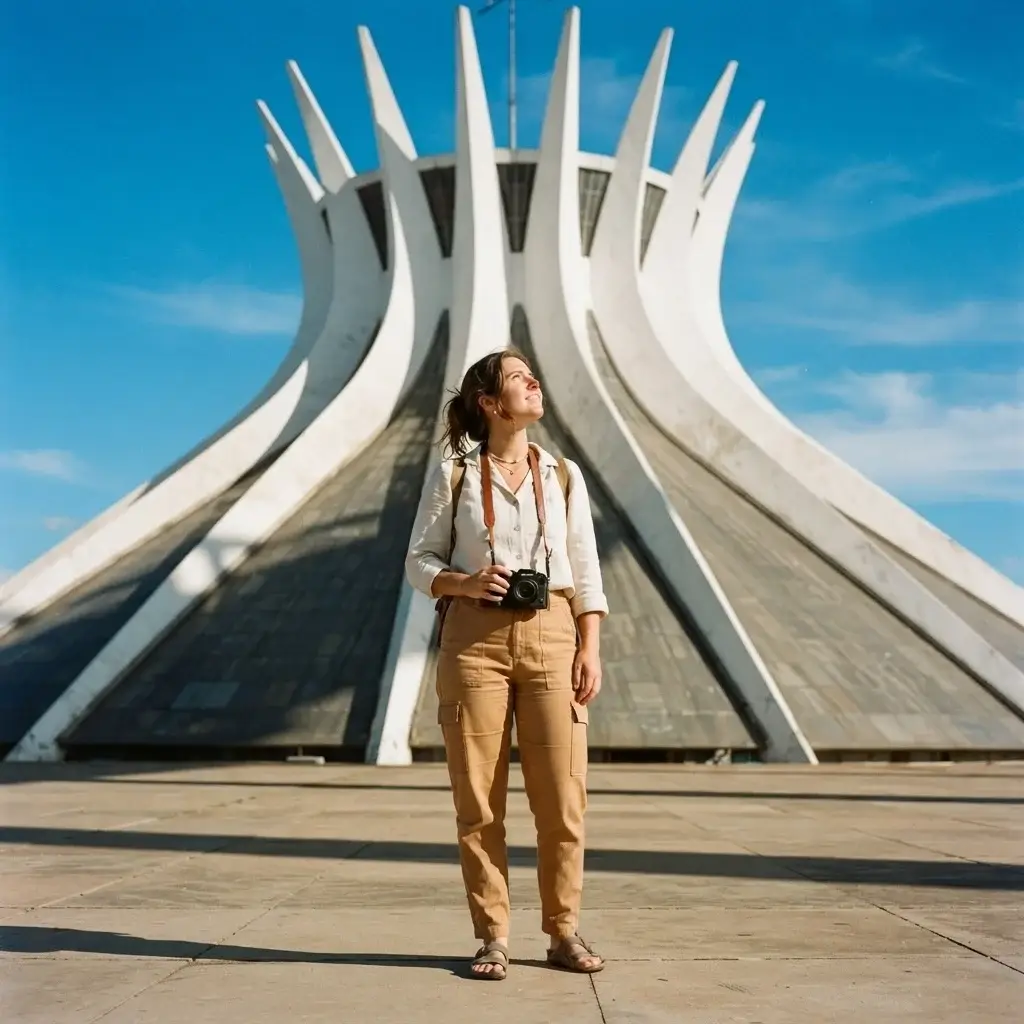
Every other cathedral on this list looks backwards, drawing on centuries of Gothic or Baroque tradition. Oscar Niemeyer’s Cathedral of Brasilia looks straight up. Completed in 1960 and opened publicly in 1970, this building is one of the most architecturally distinctive sacred spaces in the world, not just in the Americas.
The structure consists of 16 curved concrete columns that rise from a circular base and lean inward toward a crown at the top. The columns are connected by stained glass panels in blues, greens, and whites designed by Marianne Peretti. Most of the building is below ground level, so visitors enter through a darkened underground tunnel before emerging into the light-filled nave. It’s an intentional design choice to recreate a transition from darkness to light, and it lands. The effect is striking even for visitors with no connection to its religious symbolism.
For a deeper look at the architectural thinking behind the building, ArchDaily has an excellent technical and historical breakdown of the Cathedral of Brasilia and Oscar Niemeyer’s design process. Admission is free, and the cathedral is open Tuesday to Friday from 9 AM to 5 PM, with the last entry at 4:30 PM. Brasilia is a city that deeply rewards architecture lovers and tends to be underrated as a destination. If you’re planning a Brazil itinerary, it’s worth at least a night.
Notre-Dame de Quebec, Canada — The Oldest Cathedral North of Mexico
Quebec City feels European in a way that no other city in North America quite matches, and the Cathedral-Basilica of Notre-Dame de Quebec is a significant part of why. The original church on this site dates to 1647, making it the oldest Catholic parish north of Mexico in the Americas, and the current building, rebuilt after fires and bombardments, was largely completed by the mid-19th century.
The interior is ornate in a French colonial style, with gilded details, carved wood, and elaborate baldachin above the main altar. The cathedral also houses the tombs of four governors of New France and the bishops of the Diocese of Quebec, giving the building a layered historical weight beyond its architecture. From what solo travelers to Quebec City consistently describe, this cathedral hits differently in winter when the city is covered in snow and the old town’s stone streets are quieter. Summer is beautiful too, but the contrast between the cathedral’s warmth and a January Quebec City morning outside is something many travelers mention as one of those unexpected sensory memories that stays with them.
Visiting hours and guided tour availability are listed on the official Notre-Dame de Quebec cathedral website. Guided tours with knowledgeable local guides are offered during summer months in multiple languages.
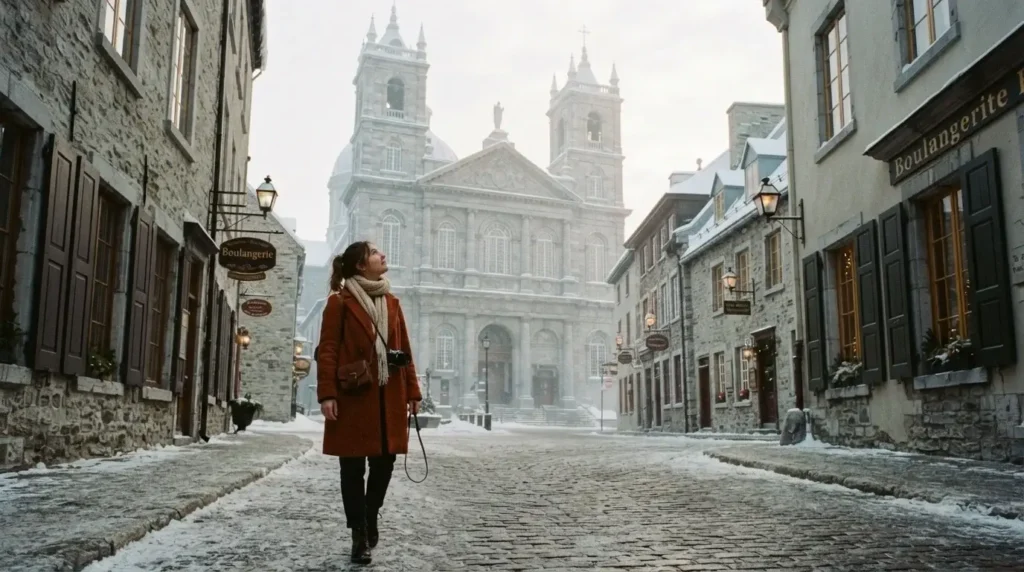
The cathedral is in the heart of Old Quebec, a short walk from the Chateau Frontenac and the city walls.
Practical Tips for Visiting Cathedrals Across the Americas
A few things I’ve noticed across research and conversations with travelers who’ve done this kind of cultural touring:
Arrive early. Almost every cathedral on this list is busiest between 10 AM and 2 PM. If you can be inside before the tour groups arrive, you will have a fundamentally different experience, quieter, more personal, more room to actually feel the space.
Check mass schedules. On Sundays and major Catholic feast days, the energy inside these buildings is completely different. Masses attract local congregants, choirs, and a kind of collective reverence that tourist hours simply don’t replicate. If you’re comfortable sitting respectfully at the back during a service, it’s one of the most authentic cultural experiences you can have in any of these cities.
Combine with neighborhoods. Every cathedral on this list is near a neighborhood worth exploring on foot. The Zocalo in Mexico City, Old Quebec’s Petit-Champlain, Lima’s Barranco district after your visit, and the cobblestone streets of Antigua are all worth lingering in. Don’t treat these as checkboxes. Give yourself the afternoon.
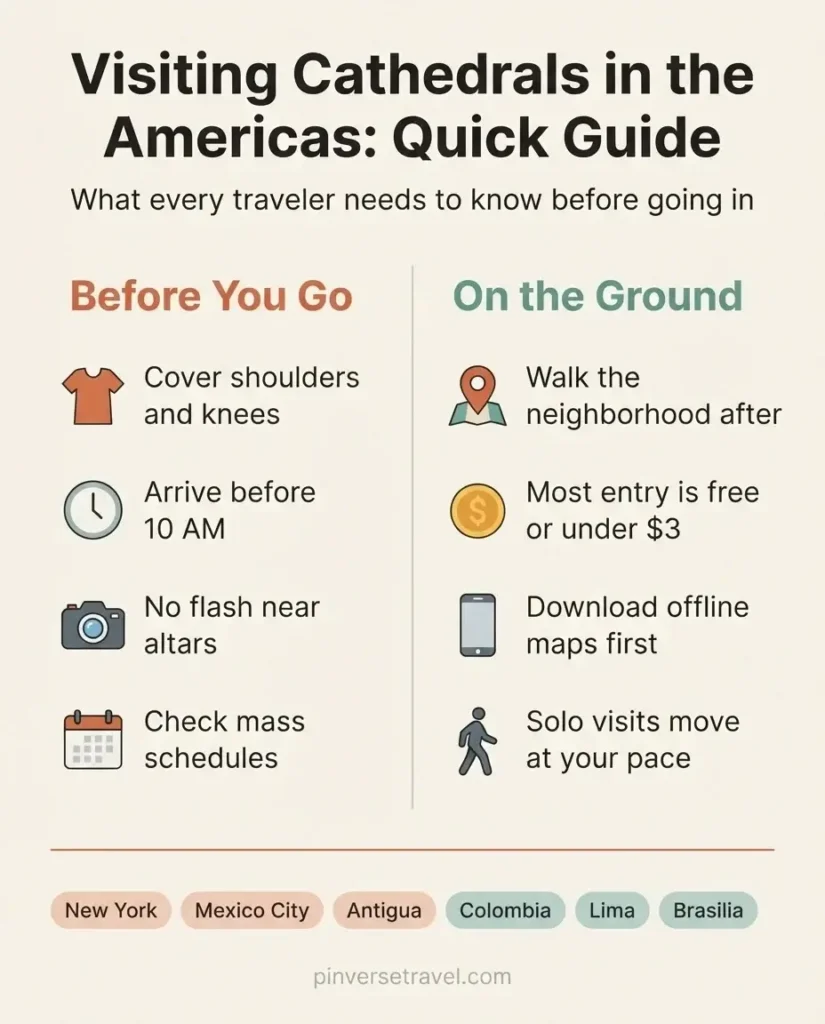
The solo traveler thing: visiting a cathedral alone is, in my honest view, better than visiting in a group. You move at your own pace, sit when you want to sit, look at what captures your attention, and leave when you’re ready. Nobody is waiting for you. There’s a kind of freedom in that which aligns with everything I believe about solo travel.
The Bigger Reason This Kind of Travel Matters
I left a predictable life and a rigid schedule partly because I realized I was moving through the world without really looking at it. Cathedrals, in particular, force you to stop moving and look up. Whether you’re standing under 41 million mosaic tiles in St. Louis or emerging from a dark tunnel into Niemeyer’s crown of light in Brasilia, something shifts. You become aware of how much thought and time and human effort went into creating something that exists only to elevate the spirit.
You don’t have to be religious for that to land. You just have to be present. And if there’s one thing travel teaches you, it’s how to be that.