Van or RV Rental on a Budget: A First-Timer’s Honest Guide

There is a version of this trip that a lot of us have imagined at some point. You are on an open highway with good coffee, a playlist, and no fixed agenda. You park wherever you feel like stopping, wake up to something worth looking at, and move when you are ready. No checkout times. No hotel corridors. Just you, the road, and a vehicle that is also your bedroom.
For years I assumed that version of travel belonged to people who owned their own campervan, had a trust fund, or had figured out some secret I had not. Then I started actually digging into the numbers and talking to solo travelers who had done it on real budgets, and I realized: renting a van or RV for a road trip is more affordable and more accessible than most people believe. It just requires knowing how the pricing actually works, which is not the same as looking at the nightly rate and calling it a day.
This guide is for first-timers. I am going to walk you through the real costs, the best rental options for budget travelers, how to find free and cheap camping nights, what fees catch people off guard, and what you actually need to know before you get behind the wheel. No fluff. No sales pitch. Just what you need to plan this trip with open eyes.
The Van vs. Full RV Question: Decide This First
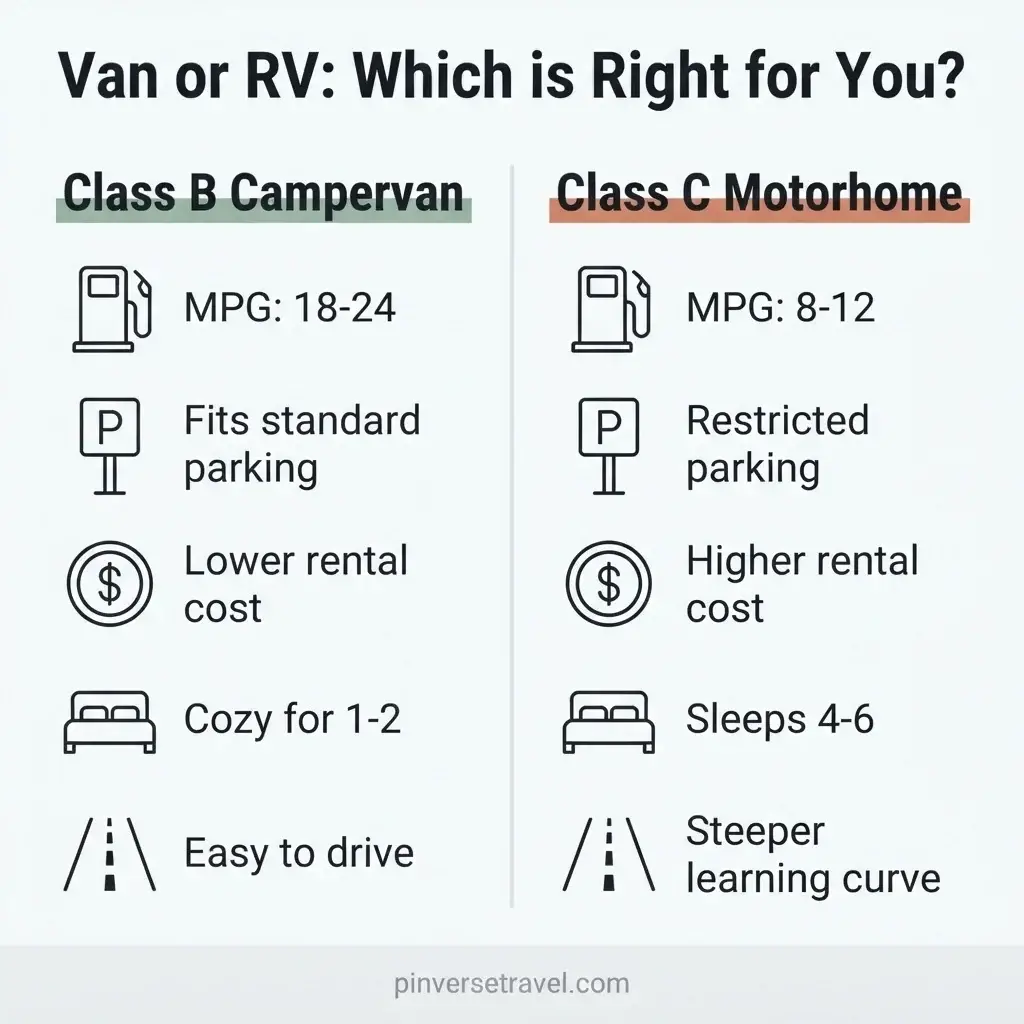
Before you look at a single price, you need to answer one question: do you want a campervan (Class B) or a larger motorhome (Class C or Class A)? This choice affects your cost, your flexibility, your parking options, and your stress level as a first-timer.
A Class B campervan is essentially a converted van. It has a bed, often a small kitchenette, sometimes a toilet, and fits in a normal parking space. It gets better fuel economy (around 18 to 24 miles per gallon), is infinitely easier to maneuver, and is the vehicle most solo travelers and couples choose. It feels less intimidating and gives you more freedom to drive into smaller towns, park at trailheads, and blend into urban environments if you want to. The tradeoff is that the living space is tight, and you will feel that on longer trips.
A Class C motorhome is built on a truck chassis with a cab-over sleeping area above the cab. It sleeps more people, has a proper bathroom with shower, and feels more like a studio apartment on wheels. It is significantly larger to drive, gets around 8 to 12 miles per gallon, and will be restricted from certain roads and campgrounds. For a solo first-timer on a budget, Class C is often more vehicle than you need, and the gas costs alone will eat into your savings quickly.
For most people planning their first budget van or RV trip, especially solo or with one other person, a Class B campervan is the smarter starting point. It costs less to rent, costs less to fuel, and costs less to park. Keep that in mind as you read through everything below.
What It Actually Costs to Rent: The Honest Total
Here is where most guides fail you. They quote a nightly rate and move on. The nightly rate is just the beginning.
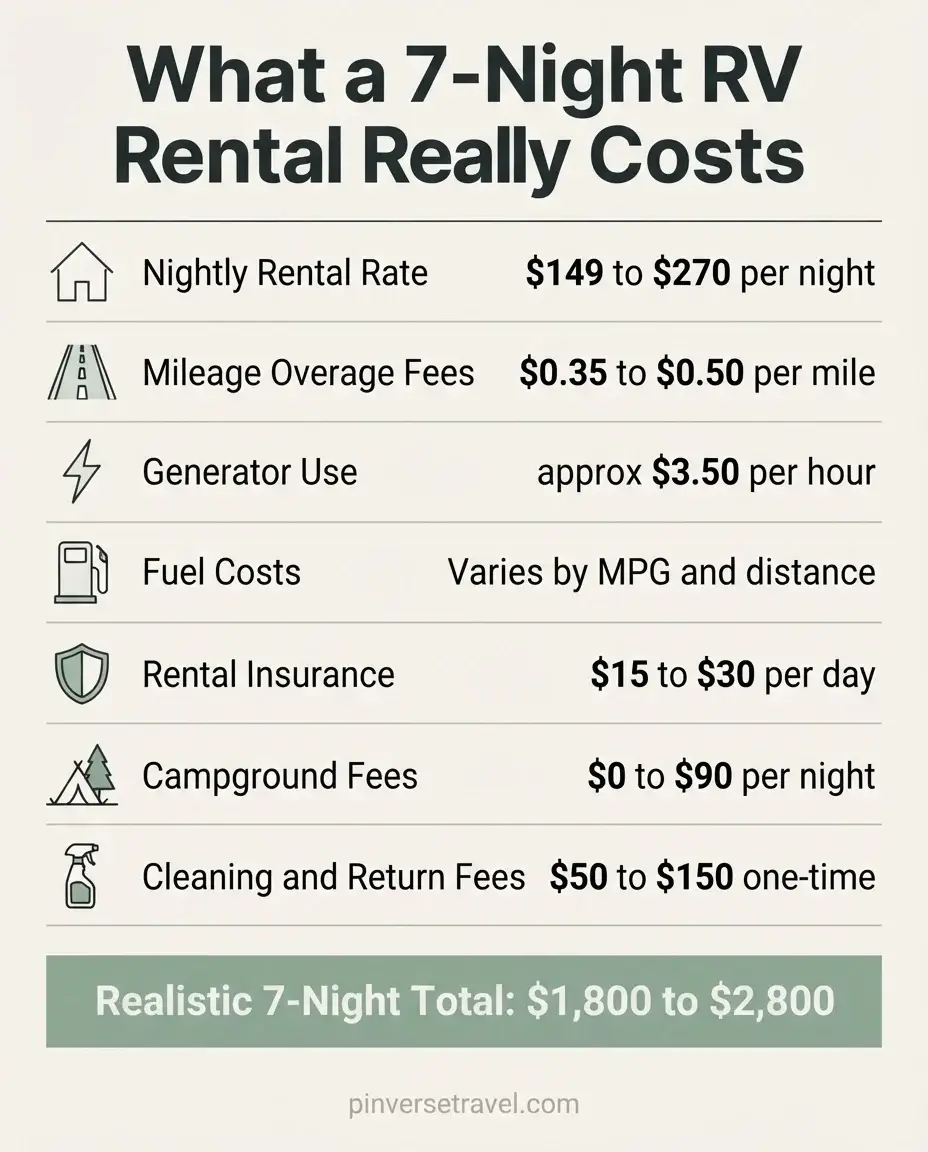
The base nightly rate for a Class B campervan from a company like Native Campervans currently runs between $149 and $250 per night at peak summer prices, with significantly lower rates in shoulder and off-season months. A Class C motorhome through a traditional rental company like Cruise America runs from $180 to $270 per night during summer. You can get a useful breakdown of what different RV types cost directly through the Cruise America pricing guide, which is one of the more transparent ones out there.
But that is only part of the bill. Here is what you also need to budget for:
Mileage fees. Most companies give you a set number of miles per day included in the base rate (often 100 to 150 miles). After that, you pay overage fees ranging from $0.35 to $0.50 per mile. On a 1,200-mile road trip over seven days, if you have 100 free miles per day, that is 500 miles of overage at $0.40 each, which adds $200 to your total before you have bought a single meal.
Generator fees. If you are running your air conditioning or charging devices using the onboard generator rather than a campground hookup, expect fees around $3.50 per hour. On a hot night, that adds up fast. The workaround is booking campsites with electric hookups when the weather demands it, or doing what many experienced van lifers do and keeping generator use minimal.
Cleaning fees. Return the vehicle in a mess and you will pay for it. This fee typically ranges from $50 to $150. Bring your own basic supplies and clean as you go.
Dumping fees. If you return with full holding tanks, expect a fee. Dump your tanks before returning. Dump stations are available at most campgrounds and truck stops, and apps like Sanidumps can locate the nearest one.
Insurance. This is covered in more detail below, but budget $15 to $30 per day for rental insurance if it is not already included.
Fuel. This is your biggest variable. A Class B getting 20 miles per gallon on a 1,000-mile trip means 50 gallons of gas. At around $3.50 per gallon (varies by state and season), that is $175 in fuel. A Class C getting 10 miles per gallon on the same trip doubles that to $350.
Campground fees. These range from $0 to $120 per night depending on where you stay. More on this in a moment because this is where budget travelers have the most control.
When you add all of this up for a seven-night trip in a Class B during shoulder season, a realistic total budget lands somewhere between $1,800 and $2,800 including everything: rental, fuel, camping, and fees. That is real money, but compare it to seven nights of mid-range hotels plus car rental plus dining out, and the math often gets surprisingly competitive, especially if you are cooking your own meals on the road.
Where to Rent: Your Best Options as a Budget Traveler
Traditional Rental Companies
Cruise America is the most widely available traditional rental company in the US, with 130-plus locations in the lower 48 states and Canada. Their fleet is mostly Class C motorhomes, so they skew larger than what a solo traveler typically needs, but they often run one-way relocation deals between cities at significantly discounted rates, which is worth watching if your trip has a flexible start or end point. They also have occasional promotional pricing outside of peak summer.
Native Campervans operates in Denver, Las Vegas, Salt Lake City, Phoenix, and Los Angeles, and caters specifically to the van life aesthetic with well-outfitted Class B vehicles. Their pricing is competitive for the West Coast and Southwest, and the vehicles are popular because they are genuinely comfortable for one or two people.
Note: Escape Campervans, which was a popular budget option, ceased operations in November 2025, so you will want to remove them from any older lists you find online.
Peer-to-Peer Platforms
This is where the best budget deals often live. Platforms like RVshare and Outdoorsy work like Airbnb for RVs and campervans. Private owners list their vehicles, you book directly through the platform, and you often get more variety and better pricing than traditional companies, particularly for shorter trips or last-minute bookings. The platform handles insurance, payment security, and in RVshare’s case, 24/7 roadside assistance is included with every booking.
The trade-off with peer-to-peer is variability. You are trusting individual owners rather than a corporate fleet. Read reviews carefully, ask the owner specific questions about the vehicle’s quirks, and do not skip the pre-trip walkthrough. Get everything documented with photos before you drive away.
For budget travelers, peer-to-peer platforms are worth exploring first because the pricing is often 15 to 30 percent lower than traditional companies, and you can find Class B vans that would otherwise require going through a specialty company.
Shopping Smart
Book 6 to 12 months in advance for summer travel. Rates rise sharply as availability tightens. If you can travel in May, September, or October, you will generally find rates 20 to 40 percent lower than July prices. And always inquire about one-way or relocation deals, where a company needs a vehicle repositioned and will discount heavily to get it moved.
Insurance: Do Not Skip This Step
Rental insurance is one of those topics that nobody loves but everyone needs to understand before handing over a deposit on a $60,000 vehicle.
Your personal car insurance policy almost certainly does not cover a rented motorhome. Check with your provider before assuming it does. Most traditional rental companies include basic liability coverage but offer supplemental protection plans for an additional daily fee that covers collision and comprehensive damage.
On peer-to-peer platforms, the platform’s own insurance policy typically covers the rental. RVshare’s insurance is underwritten through their partnerships and covers both renter and owner for comprehensive and collision, plus Acts of God coverage. Outdoorsy has a similar structure. These policies typically cost $15 to $30 per day and are worth having.
If you are using a credit card to book, check whether your card includes rental vehicle insurance and, critically, whether that coverage extends to RVs and campervans (many explicitly exclude them). Do not assume. Call the card company and ask.
Driving a Van or RV for the First Time: What to Actually Expect
One of the biggest hesitations I hear from first-time renters is the fear of driving something bigger than they are used to. It is a reasonable concern. But the honest reality is that most people adapt to it within the first couple of hours.
A Class B campervan drives more or less like a large van. The mirrors do most of the work for you. Parking takes more attention, but you can fit in a regular parking space. The learning curve is real but short.
A Class C motorhome is a bigger adjustment. You need to think about height clearance (bridges, gas stations, trees), wider turning radius, and the tendency of the vehicle to push sideways in crosswind. Practice backing up in an empty parking lot before your first campground check-in. Back-up cameras are standard on most modern rentals, but always use a spotter when possible, especially in tight campground spots.
The other thing to know: speed matters more than size for safety. Most experienced RV drivers keep their speed between 55 and 65 miles per hour on the highway. You need more braking distance than a car, and the fuel efficiency drops sharply above 65 mph anyway.
Camping Costs: Where Your Budget Lives or Dies
This is the part of the article most guides rush through, but it is also where you have the most power to make or break your budget.
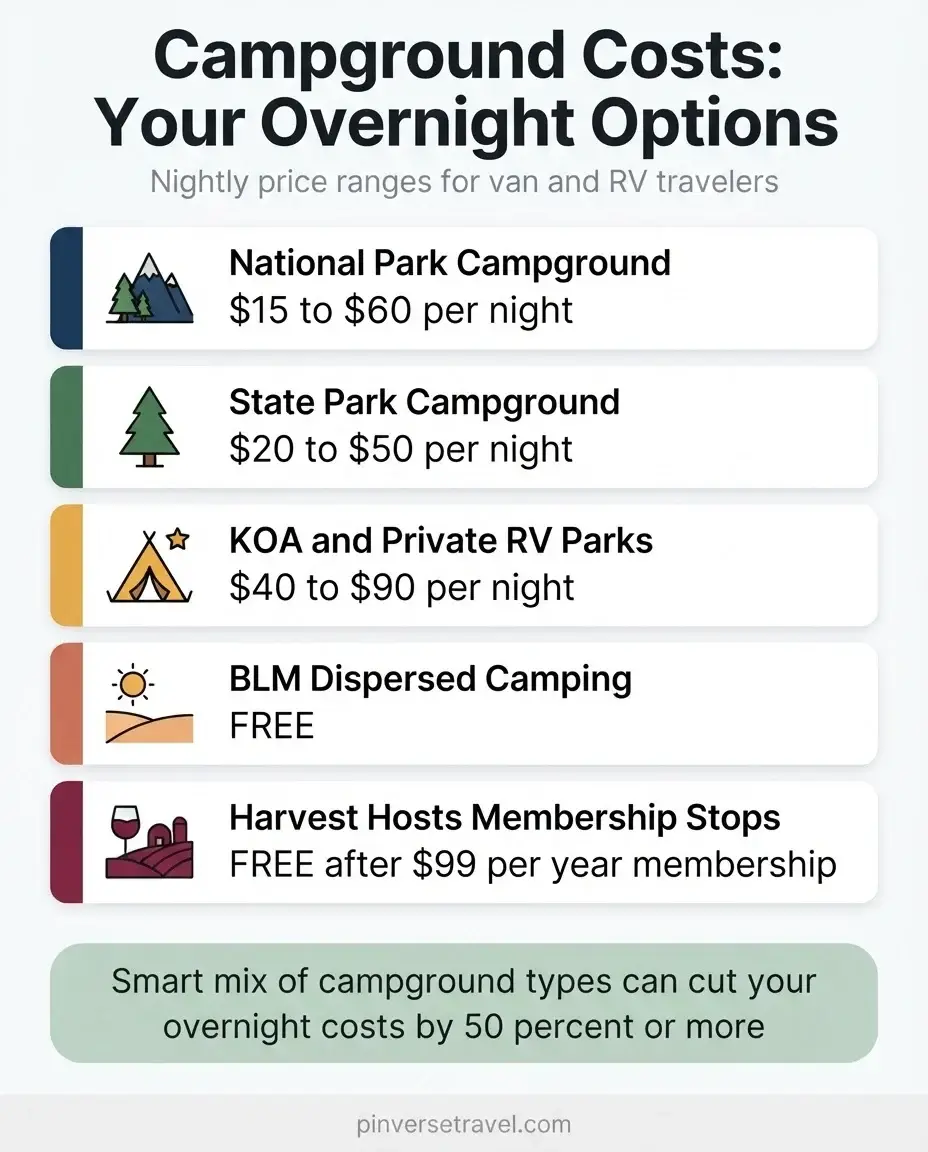
National Park campgrounds are the classic choice for scenic overnights. Costs range from $15 to $60 per night depending on the park and amenities. Most National Park campgrounds book months in advance through Recreation.gov, the official federal reservation system. Do not wait until two weeks before your trip and expect availability in peak season. Yellowstone’s Madison Campground runs about $36 per night with no hookups. Zion’s Watchman Campground runs $30 to $50 per night, with some electric sites. These are beautiful, worth every dollar, and reserved out months in advance.
State park campgrounds are often the underrated middle option: $20 to $50 per night, scenic, and far less competitive than National Parks. They frequently have electric and water hookups and are close enough to major parks to serve as your base.
KOA campgrounds run $40 to $90 per night and offer the most amenities, including Wi-Fi, showers, laundry, and pools. They are a solid choice when you need a full reset night with hookups and hot water.
BLM dispersed camping (boondocking) is free. Completely free. The Bureau of Land Management allows dispersed camping on most of the millions of acres of public land it manages across the western United States, with a 14-day stay limit per location. There are no hookups, no facilities, and no reservations required. You find a spot, you camp, you follow Leave No Trace principles. The rules and areas currently open to dispersed camping are published at the BLM’s official camping page. For solo travelers who are comfortable with some solitude, boondocking on BLM land is genuinely one of the great free experiences available in this country.
National Forest dispersed camping works similarly to BLM land and is often available closer to the mountains and Pacific Northwest regions where BLM land is less common. The rules vary by forest, so check with the specific Ranger District before you go.
Harvest Hosts is a membership network that lets RVers and van lifers camp overnight at wineries, farms, breweries, distilleries, and other unique locations for free, aside from the annual membership fee. The Harvest Hosts membership starts around $99 per year. If you are planning a trip of two weeks or longer, it pays for itself in two or three nights of otherwise free accommodation while giving you some of the most memorable overnight stops you will find anywhere.
Freecampsites.net is a community-sourced directory of free and cheap camping spots across North America, including BLM land, National Forest areas, and other public locations. I recommend bookmarking it early in your planning. Freecampsites.net is searchable by map and includes user reviews with recent updates on conditions and accessibility.
A realistic budget split for a ten-night trip might look like: three nights at National Park or state park campgrounds ($30 to $50 each), two nights at a KOA or private park with full hookups ($60 to $70 each), and five nights of BLM or National Forest dispersed camping or Harvest Hosts stops ($0 each). That brings your ten-night accommodation bill to roughly $220 to $290 instead of $600-plus if you had paid for private hookups every night.
The Fees That Catch First-Timers Off Guard
Beyond the costs already covered, here are the specific surprises that show up in the final bill for unprepared renters.
Generator overage is one of the most common. If your rental includes generator hours, know exactly how many and track them. Running the AC all night in a hot desert campground can burn through your included hours by night three.
Late return fees are charged by the hour on most platforms. Know your return time and plan your last day accordingly. Add buffer time if you are driving from far away.
Pet fees are common and non-refundable. If you are bringing a dog, disclose it upfront, confirm the owner allows it, and budget an extra $50 to $150 deposit.
Pre-trip documentation is your protection. Before you drive away, photograph every scratch, dent, and scuff on the exterior and interior. Send the photos to the rental company or owner with a timestamp. This is your evidence if a pre-existing condition gets blamed on you at return.
A Few Practical Things to Know Before Your First Night
Cooking your own meals is one of the biggest actual savings of van and RV travel, so use the kitchen. Grocery shopping at local supermarkets and cooking simple meals at the campsite can save $50 to $80 per day compared to eating out for every meal.
Water management matters on a van or smaller rental. Class B vans often have limited fresh water capacity. Know how much you have, where you can refill (most campgrounds and many truck stops), and do not run your fresh water tank to empty without a plan.
Cell service will be patchy in many of the most beautiful places you will camp. Download offline maps before you leave, particularly Google Maps or Maps.me with the regions you are traveling through saved for offline use.
The America the Beautiful annual pass ($80 from the National Park Service) covers entrance fees to all federal recreation sites including National Parks, National Forests, and BLM areas. If your trip takes you through more than two or three fee-charging parks, this pass pays for itself immediately. Note that the standard pass covers entrance fees but not campground fees, with discounts on camping reserved for the Senior Pass and Access Pass holders.
Is It Worth It?
That depends on what you are comparing it to and what you are after. If your measure is pure per-night cost versus a budget motel, then no, renting a van or RV is not the cheapest way to sleep. But if your measure is the combination of freedom, experience, cooking your own food, waking up in places that cost nothing to access, and moving on your own schedule with no check-in times, luggage carts, or breakfast buffets, then the math shifts considerably.
From what solo travelers consistently report, the first RV or van rental trip tends to become a recurring choice, not because it is always the cheapest option but because it changes the pace and quality of how you experience a place. You stop rushing between hotels. You linger in spots that genuinely move you. You make decisions based on what you feel like doing rather than what you pre-booked six weeks ago.
That kind of travel has always felt like the point to me. Whether you are navigating a train schedule in Europe, making a plan in a new city, or figuring out your first rental RV, the willingness to actually start is what separates the people who talk about this kind of trip from the people who go.
So get the information, make a real budget, book something small to start with, and go. The open road is not going anywhere.