
Carry-On Only Travel: What Nobody Actually Tells You

There’s a moment in every airport that I think a lot of us know. You’re standing at the baggage claim carousel, eyes glazed, watching the belt go around for the eighteenth time. Everyone else has already grabbed their stuff and left. You’re still waiting. And somewhere on the other side of the security doors, there’s a traveler with a single bag already in a taxi, already checking into their hotel, already starting their trip.
That used to be me at the carousel. Then it stopped being me, and everything about how I travel changed.
Going carry-on only is one of the best decisions I’ve made as a traveler. Not because it’s glamorous or minimalist or some kind of travel flex. Because it’s genuinely freeing. You move faster, spend less, stress less, and somehow you always end up with everything you actually needed. But here’s the thing: most guides make it sound easier than it is at the start, or they give you a generic packing list that doesn’t address the real questions in your head. So let’s do this honestly.
Why Most Carry-On Advice Falls Flat
The standard advice goes something like this: pack neutral colors, use packing cubes, bring only three pairs of shoes. And yes, all of that is true. But it doesn’t address the part where you’re standing in your bedroom three days before a two-week trip, staring at a pile of “essentials” that is absolutely not fitting into a 22-inch suitcase. It doesn’t address the moment on day four when you realize you packed the wrong kind of shirt for the weather. And it definitely doesn’t address the laundry situation.
This guide is meant to fill those gaps. Not just what to pack, but how to think about packing, how to handle the trip once you’re in it, and why the whole thing is worth doing in the first place.
First: Know Your Airline’s Actual Rules
Before you buy a bag or fold a single shirt, look up your specific airline’s carry-on policy. This is the step most people skip, and it causes real problems.
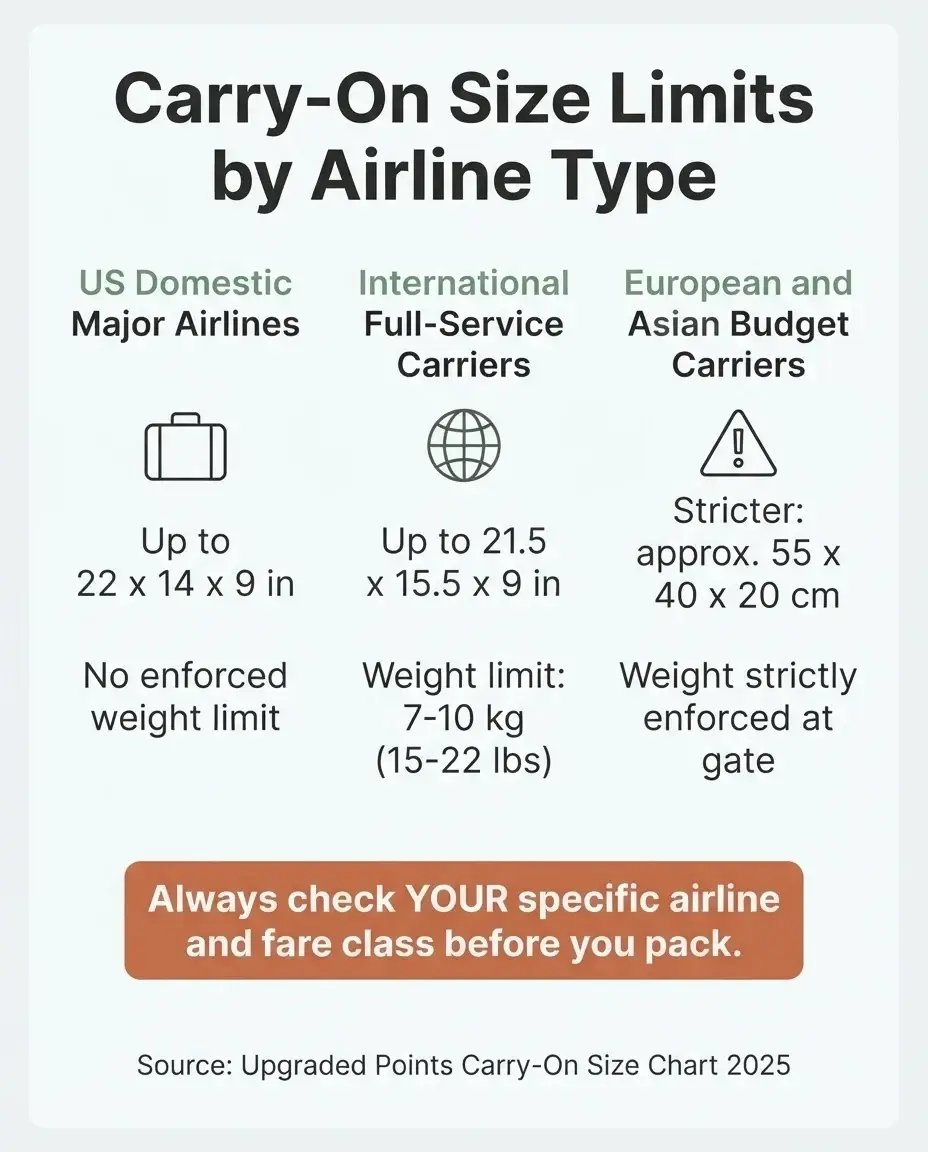
Most major U.S. carriers including United, Delta, and American Airlines accept a carry-on bag up to 22 x 14 x 9 inches, handles and wheels included, with no weight limit enforced on domestic flights. That’s generally fine for the standard carry-on suitcase or travel backpack you’ll find in stores. According to the carry-on size chart at Upgraded Points, which tracks the policies of over 60 airlines, international and budget carriers are a different story entirely. European budget airlines like Ryanair and EasyJet enforce much stricter size limits, often around 55 x 40 x 20 cm, and many Asian carriers add weight limits between 7 and 10 kg (roughly 15 to 22 lbs). Flying internationally on a budget carrier with a bag you use domestically can mean an unexpected gate fee that costs more than a checked bag would have.
Two things to always check: the dimensions for your specific fare class (basic economy can be different from standard), and whether budget airlines in your destination country consider your bag a “carry-on” or a “cabin bag.” These are not always the same thing. Spend five minutes on your airline’s website before you pack. It will save you money and the particular stress of a gate agent measuring your bag.
Your personal item, usually a backpack, purse, or small daypack that fits under the seat in front of you, is your secret weapon. Most airlines allow this in addition to your carry-on at no charge. Use it strategically. Pack your most-needed items in it (travel documents, wallet, phone charger, a change of clothes) so that even if your carry-on ends up gate-checked on a full flight, you have what you need.
Choosing the Right Bag
The bag you choose matters more than almost anything else on this list. It determines how much you can bring, how easy security is, and how tired your body is at the end of a long travel day.
The two main options are a rolling suitcase (hard or soft shell) and a travel backpack. Neither is universally better. A rolling suitcase is easier on your body over flat surfaces, keeps clothes less wrinkled, and is generally easier to pack and access. A travel backpack is more versatile in cities with cobblestones or stairs, fits in overhead bins more easily when things are tight, and can serve as both carry-on and personal item if it’s sized right.
For most solo travelers and first-timers, a soft-sided rolling carry-on between 35-45 liters gives you maximum flexibility without the bulk of a hard shell. If you’re doing mostly urban travel with hostels and public transit, a 40-liter travel backpack that meets airline dimensions is often the more practical choice. Whatever you pick, test it when it’s fully packed. Lift it. Carry it up a flight of stairs. If it feels too heavy empty, it will destroy you full.
The Clothing Question: Less Isn’t About Suffering
Here’s the honest truth about packing clothing: most travelers could cut their wardrobe in half and never feel the difference. We tend to pack for imaginary scenarios. “What if there’s a fancy dinner?” “What if it rains every single day?” “What if I need an entirely different outfit each day?”
The real shift is building a small, intentional wardrobe where everything works together. Garment people call this a capsule wardrobe. You call it “not overpacking.” The principle is the same: choose items that mix and match across multiple outfits so that five pieces become ten combinations.
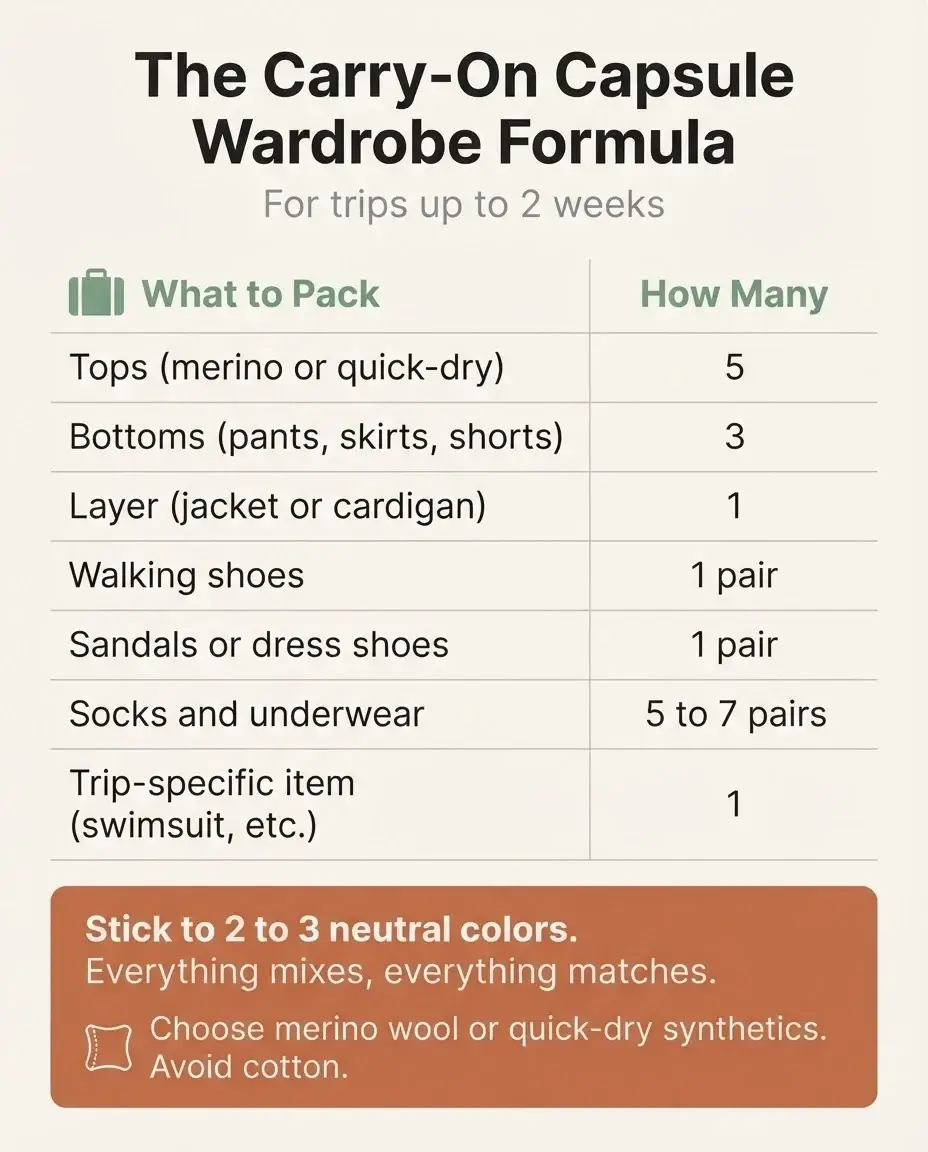
Stick to a two or three-color palette. Neutrals (black, navy, grey, olive, white) make this easy. One pair of versatile shoes can carry you through most of a trip if you choose right. Sandals or sneakers work for daytime exploration, and a pair of simple flats or clean white sneakers can pass as dinner-appropriate in most casual and mid-range restaurants around the world.
The fabric you choose is where most people leave real space and convenience on the table. Merino wool is the most genuinely useful travel fabric I know of, and Pack Hacker’s breakdown of why travelers love merino wool explains the reasons well. Merino is temperature-regulating (warm in the morning, not stifling in the afternoon), naturally odor-resistant thanks to a lanolin coating on each fiber, quick-drying, wrinkle-resistant, and packable. A merino t-shirt can be worn two or three times without smelling, which means you pack fewer tops and wash less often. It’s not cheap, but one good merino piece will earn its cost back in space saved. Quick-dry synthetics like nylon and polyester work similarly for athletic or outdoor wear.
Avoid cotton for anything you plan to re-wear. It absorbs moisture, dries slowly, wrinkles badly, and holds odors. Fine for a single day, not ideal when you’re working with a compact wardrobe.
A rough clothing formula that works for most trips up to two weeks: 5 tops, 3 bottoms, 1 layer (a light jacket or cardigan), comfortable walking shoes, one versatile pair of sandals or dress shoes depending on your destination, 5-7 pairs of socks and underwear (merino if possible), and one set of anything specific your trip requires (swimsuit, hiking pants, one dressier piece). That’s it. That fits in a carry-on with room for everything else.
Packing Organization: Make It a System
Stuffing clothes into a suitcase and hoping for the best is the reason people think carry-on travel doesn’t work. A small amount of organization makes an enormous difference.
Packing cubes are the most consistently useful travel accessory I’ve come across. They compress clothing, keep categories separated, and let you find things without unpacking your entire bag. Wirecutter’s editors at The New York Times have reviewed and ranked the best packing cubes if you want a vetted starting point. Compression cubes, which have a second zip that squeezes air out, give you an extra 20-30% more room and are worth the slight upgrade in price for long trips.
Rolling clothes instead of folding takes up less space and reduces wrinkles, especially for soft items like t-shirts, jeans, and underwear. Fold heavier structured pieces like blazers or dress pants. Place heavy items (shoes, toiletries bag) at the bottom near the wheels when the bag is upright, and lighter rolled clothing on top. Use every cavity: socks inside shoes, chargers inside hats, belts along the edge of the bag.
Keep your personal item packed for the journey itself: headphones, neck pillow if you use one, snacks, the book you’re reading, your laptop if you bring one, your documents. Anything you’ll need during the flight or at the gate.
Toiletries: The Category That Defeats Most People
Toiletries are where carry-on ambitions go to die. Here’s what changes everything: the shift from liquid to solid products.
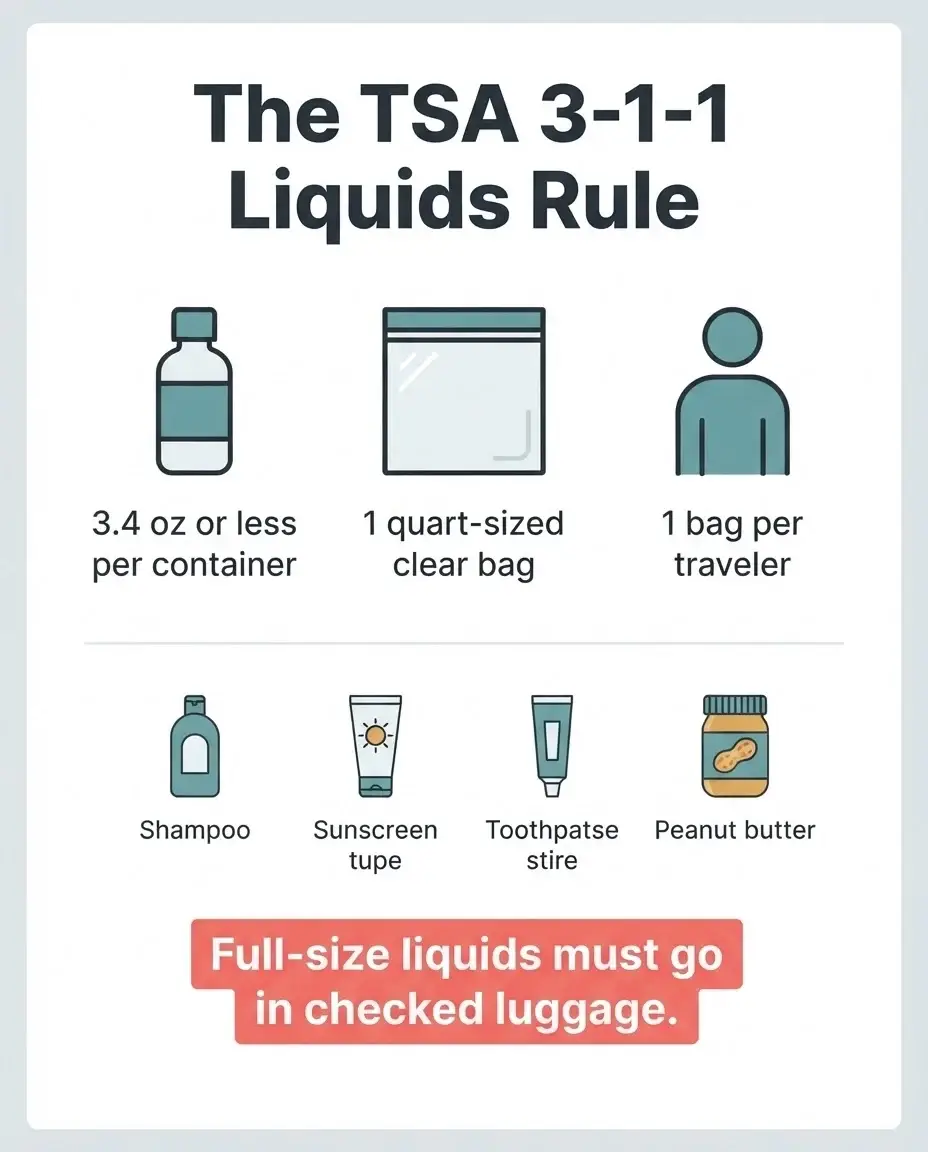
The TSA’s 3-1-1 liquids rule limits you to containers of 3.4 oz (100ml) or less, fitting inside one clear quart-sized bag, one bag per passenger. That’s not much room when you’re counting shampoo, conditioner, face wash, sunscreen, and everything else. The rule applies at U.S. security checkpoints and most international equivalents.
The workaround isn’t to squeeze tiny bottles of everything. It’s to convert as many products as possible to solid or bar form. Shampoo bars and conditioner bars work just as well as their liquid counterparts, take up a fraction of the space, and are not subject to the liquids rule at all. Solid sunscreen sticks, solid face wash, solid moisturizing bars, and even toothpaste tablets exist and actually work. One small toiletry bag of solid products can cover your entire routine.
For anything that genuinely has to be liquid (prescription skincare, contact lens solution, a specific product you rely on), decant it into a small refillable travel bottle rather than carrying the full-size original. A 1 oz bottle of your favorite face oil will last a two-week trip. The 4 oz bottle it came in will not make it through security.
Medication is exempt from the liquids rule and does not need to go in your quart bag. Pack it in your personal item where it’s accessible.
One more thing: if you’re heading somewhere with widely available products (Europe, Southeast Asia, most cities globally), you can buy basics like shampoo, body wash, or sunscreen when you arrive. That’s not cutting corners. That’s traveling smart.
Laundry on the Road: Your Secret to Packing Less
Here’s the thing that unlocks carry-on travel for longer trips: doing laundry. Not dreading it. Not avoiding it. Actually planning for it as part of the trip.
If you pack for seven days and do laundry once during a fourteen-day trip, you can travel for two weeks with exactly the same amount of clothing you’d bring for a week. That math is simple and it changes everything about how you approach packing.
Pack Hacker’s guide to doing laundry while traveling covers the full range of options, from sink washing to hotel machines to laundromats. Here’s the honest version of each. Sink washing works well for underwear, socks, and merino tops. Fill the sink with cool water, add a small amount of detergent (laundry sheets like Earth Breeze are flat, weightless, and great for travel), scrub each item gently against itself, rinse until no soap remains, roll each piece in a clean towel to press out moisture, and hang overnight. With quick-dry fabrics, this reliably produces dry, wearable clothes by morning.
For heavier items like jeans or a full load of laundry, a laundromat is a better choice and genuinely not a burden. In most cities around the world, local laundromats are easy to find, inexpensive, and faster than you’d expect. Sitting in a neighborhood laundromat for 90 minutes is also, quietly, one of the more interesting ways to observe local daily life. I’ve had some of my most memorable conversations in random laundromats abroad.

Pack two or three laundry sheets in your toiletry kit and a universal flat sink plug (some international hotel sinks don’t have stoppers). That’s your entire laundry kit.
Getting Through Security Smoothly
Security with a carry-on is faster than with checked bags in every single way, but only if you’ve set up your bag correctly.
At standard U.S. security checkpoints, your quart bag of liquids and your laptop both need to come out of your bag separately. If you have TSA PreCheck, neither does. TSA PreCheck costs $85 for five years and includes expedited screening where you keep your shoes on, your laptop in your bag, and your liquids bag packed. If you travel more than a couple of times a year, the math on that fee is very straightforward.
Pack your quart bag of liquids near the top or in an outer pocket so you can pull it out in one motion. Pack your laptop in a sleeve that’s easy to slide out. Wear shoes that slip on and off easily on travel days. Don’t wear a belt or heavy jewelry you’ll have to remove. These are small things that add up to a smooth, stress-free security experience instead of a fumbling, everyone-behind-you-is-sighing one.
If you’re flying internationally, check whether your airline requires you to put your carry-on in the overhead bin size checker at the gate. Some carriers do this routinely, especially on budget flights. A bag that’s slightly overpacked or has a bulging pocket can fail that check. When you’re packing, leave a little room. An overstuffed bag is harder to manage and easier to flag.
A Note on Winter Carry-On Travel
Winter is the category that makes people doubt whether carry-on-only travel is possible. It is. It just requires different thinking.
The key is layering, not bulk. One good midlayer fleece, one packable insulated jacket (down or synthetic), a base layer, and a scarf takes you through most cold-weather destinations without needing a massive coat. Wear your heaviest items on the plane. Your puffy jacket becomes your blanket. Your heaviest boots or shoes go on your feet. What you wear onto the plane doesn’t count against your bag.
For very cold destinations (think Scandinavia in January or Canada in February), the same principle applies but you prioritize thermal base layers, which are thin and pack small, and a genuinely warm midlayer over a bulky outer layer. Thermal leggings and a merino wool base layer top compress to almost nothing in a packing cube.
The Mindset Shift That Makes This Work
I want to say something here that most packing guides don’t. The hardest part of carry-on travel is not the packing. It’s the mental adjustment before you leave.
There’s a specific anxiety that comes from trying something you’ve never done before, especially when it comes to a trip you’ve planned and looked forward to. When I first started traveling solo across Europe, I was terrified of making the wrong call. Bringing too little felt like a risk I wasn’t sure I could handle. What helped me wasn’t a packing list. It was reminding myself that almost anything I forgot or misjudged could be solved once I arrived. A store exists in every city. A laundromat exists in every neighborhood. A pharmacy carries basics in every country.
Carry-on travel is not about being perfectly prepared. It’s about trusting that you’re capable of handling small problems on the road. And honestly, the first time you walk off a flight and go straight to your destination instead of spending 40 minutes at baggage claim, you’ll wonder why you ever checked a bag at all.
The freedom is real. The confidence that comes from managing a trip with just what fits on your back is real too. You don’t need the perfect bag or the perfect packing list. You just need to start.

Ready to start planning? If you found this helpful, you might also love my guide to solo travel for first-timers and my honest breakdown of what to pack for warm-weather destinations.


