Flight and Accommodation Hacks Every Budget Traveler Needs

Let me tell you what almost stopped me from ever leaving that gray office in New York. It wasn’t fear of getting lost. It wasn’t language. It was money. Every time I imagined booking a trip, I saw the flight price and the hotel price stacked together, and my brain quietly said “not this year.”
Here’s what I know now, after backpacking Europe solo, working flexible jobs to fund the road, and stretching every dollar until it squeaked. The trip is rarely as expensive as the first number you see. Flights and accommodation are the two biggest line items, and they are also the two most flexible. Learn how to work them, and a trip that felt impossible starts to feel like a plan.
So let’s talk about how budget travelers actually do this. Not luck. Not fantasy deals. Real, repeatable habits.
First, change how you think about “cheap”
Cheap does not mean bad, and expensive does not mean safe. That myth costs people money and confidence in equal measure.
When I first started, I thought a low price meant something was wrong. Now I know the opposite trap is more dangerous. Plenty of nervous travelers overpay for a familiar-sounding hotel or a “safe” airline, then run out of budget three days in and skip the experiences that actually matter. The goal is not to spend the least. The goal is to spend on purpose, so your money lands on the parts of travel that change you, not on a room you only sleep in.
Everything below is built around that idea.
The flight game: paying less without gambling
The single biggest lever is flexibility, not a secret day
You’ve probably heard there’s one magic day to book. There mostly isn’t. Prices shift constantly all day, every day, so waiting for “Tuesday at midnight” is a legend with a grain of truth.
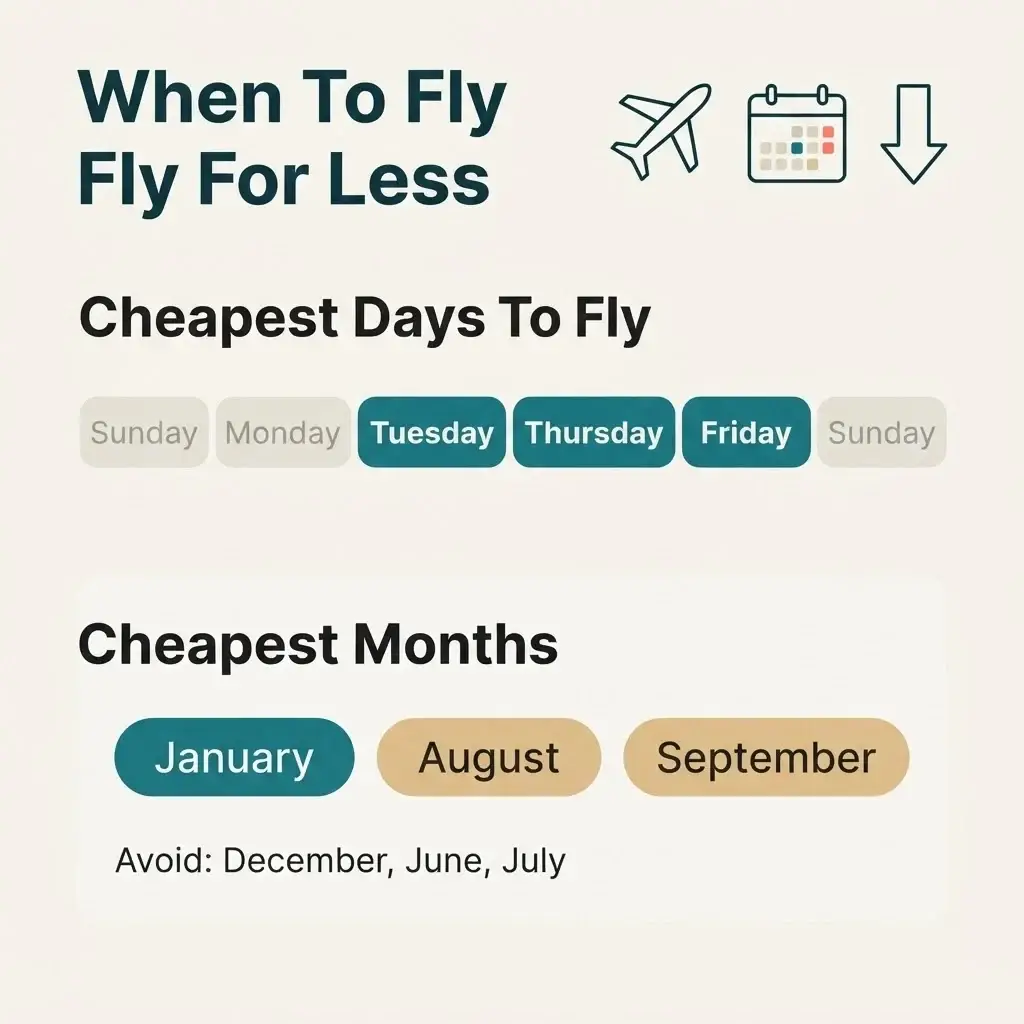
Here’s the grain of truth, backed by real data. According to a breakdown of Expedia’s 2026 Air Hacks Report by the team at NerdWallet’s travel desk, Friday tends to be the cheapest day to fly, while Sunday and Monday are usually the most expensive. Flying out on a Friday instead of a Sunday can save you up to around 8 percent, and Tuesday departures come in lowest by raw average, roughly 14 percent under a Sunday. The month matters even more. August, September, and January are typically the cheapest months to fly, while December, June, and July are the priciest.
So the real hack is not “book on X day.” It’s “be flexible on when you fly.” One shifted departure day or one quieter month can beat every clever booking trick combined.

Search like a person with no fixed plans
This is where most budget travelers leave money on the table. They pick a destination and a date, then search once and accept the number.
Instead, search wide. I lean on the flexible tools inside Google Flights, explained in their own help pages, which let you leave the destination blank and see where you can go cheaply from your home airport, scan a whole calendar for the lowest-priced days, and watch a price graph across weeks or months. Fares there update roughly once every 24 hours, so checking obsessively every hour does nothing. Set an alert and let it work.
A few flexibility moves that consistently save money: check nearby airports, both where you leave from and where you land. Look at flying into one city and out of another. And if a long layover appears, sometimes I treat it as a bonus, a free half-day in a city I wasn’t planning to see. That mindset turned one dull connection on an early Europe trip into a whole afternoon of wandering.
Book in the right window
Too early can cost as much as too late. The sweet spot from the same airfare data is roughly one to three months ahead for domestic trips and two to eight months ahead for international ones. Outside that window, prices tend to creep back up. If you’re paying with points, that flips, grab award seats the moment they open, because good award availability disappears fast.
Understand fare types before you celebrate a low number
A rock-bottom fare that adds a checked bag, a seat fee, and a pricey airport transfer is not actually cheap. Basic economy and hand-baggage-only fares can be a fantastic deal if you genuinely travel light, and a trap if you don’t. Before you book, add the bag you’ll actually bring to the total and compare again.
Traveling carry-on only is the quiet superpower here. It dodges bag fees, skips the baggage carousel, and keeps you mobile. If you’re unsure what you can bring in the cabin, the TSA’s official “What Can I Bring” guide is the plain-English reference I point new travelers to so they pack right the first time and avoid surprises at security.
Error fares are real, but treat them as a bonus
Sometimes an airline publishes a fare by mistake and it’s wildly cheap. These do exist. Trackers like the long-running error-fare site Secret Flying post them as they appear. Two honest cautions: they vanish fast, and airlines occasionally cancel them, so never build a non-refundable trip around one. I think of error fares as a lovely surprise, not a strategy. If one lines up with a place you already wanted to go, wonderful. If not, don’t force it.
One warning on self-transfer tickets
When you book two separate flights to save money and connect them yourself, you own the risk. If the first flight is late and you miss the second, no airline is obligated to help. It can absolutely be worth it, I’ve done it, but only with a generous buffer between flights and ideally nothing checked. Cheap is not cheap if you sleep in a terminal and rebook at full price.
The accommodation game: sleeping cheap without sleeping scared
Flights get the attention, but accommodation is where a trip’s total cost quietly balloons or shrinks. It’s also where solo travelers have the most fear, and the most room to save.
Match the stay type to the trip, not the trend
There’s no single “best” budget stay. There’s the right one for your trip.
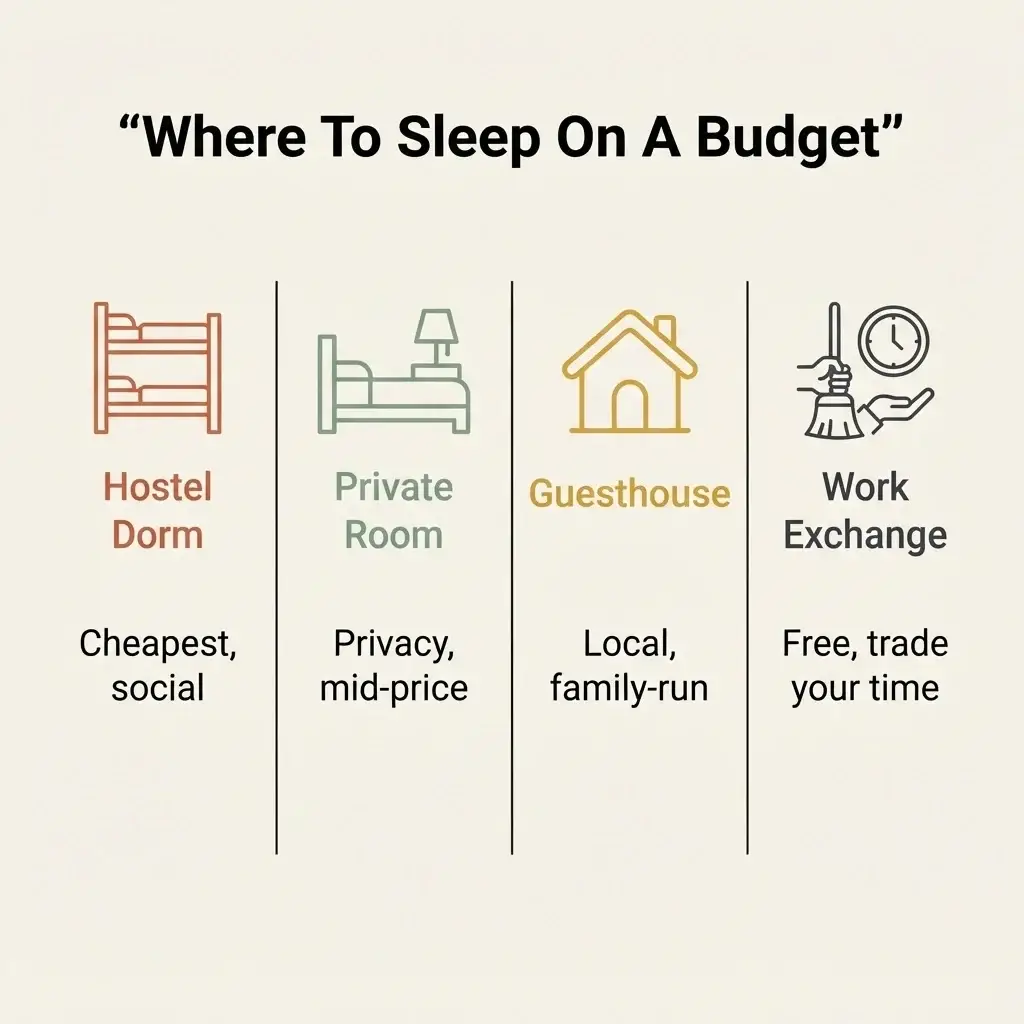
Hostels are the classic budget move, and they’re about far more than price. As the nonprofit Hostelling International explains on stretching your travel budget, a dorm bed can cost a fraction of a hotel room, and the social side is real, hostels are how solo travelers stop feeling solo. If dorms aren’t for you, many hostels also offer private rooms that beat hotel prices while keeping the shared kitchen and common areas.
Private rooms on rental platforms and small family-run guesthouses sit in the middle: more privacy than a dorm, more affordable than a hotel, and often a warmer, more local welcome. When I lived with a family in Ghana, the thing that stayed with me wasn’t the cost, it was the meals, the conversations, the feeling of being let into real daily life. You can chase a smaller version of that anywhere by choosing family-run stays over anonymous chains.
Location is a hidden price tag
The cheapest room far from everything is often the most expensive choice once you add daily transport. A slightly pricier bed near a metro or main bus line can save you money and hours every single day. Before I book, I check how far the place is from a transit stop, because a “bargain” that needs a taxi every night isn’t one.
Kitchens and free breakfast are quiet money-savers
Food is the sneaky budget killer. A stay with a kitchen or included breakfast changes your daily math completely. I still cook a few meals when I travel, not out of pure thrift, but because a morning market run and a home-cooked breakfast is often the most local thing you’ll do all day. Eat where the residents eat, cook what’s fresh and in season, and your food budget and your cultural experience both improve at once.

Trade your time for your bed
Some of the best “hacks” aren’t discounts, they’re exchanges. Work exchanges let you swap a few hours of help for a free place to stay. The original of these, WWOOF, which has connected travelers with organic farms since 1971, gives you meals and accommodation in return for helping on the farm, with no money changing hands. It’s slow travel in its purest form, you live somewhere instead of passing through.
House sitting is another route, especially if you like animals. Platforms like TrustedHousesitters, which matches travelers with pet parents worldwide, let you stay in someone’s home for free while you care for their pets. There’s a membership fee to join, but a few sits usually pay it back many times over. I always tell first-timers: read reviews in both directions, communicate clearly, and treat the home like it’s your grandmother’s. Reliability is the whole currency here.
Book early or late? The honest answer
You’ll see “book late for last-minute deals” everywhere. Sometimes it works, especially in shoulder season when places would rather fill a bed cheap than leave it empty. But as a solo traveler, I rarely gamble on it. Arriving in a new city at night with no confirmed bed is how confidence turns into panic. My rule: book your first two or three nights in advance so you land somewhere safe and settled, then stay flexible after that once you’ve got your bearings. The small premium on those first nights buys peace of mind, and peace of mind is what lets you actually enjoy being there.
Vetting a cheap stay for safety, especially solo
Cheap and safe are not opposites, but you do have to look. I read recent reviews, not just the star average, and I search specifically for words like “safe,” “solo,” and “female” if that applies to me. I check that the location is somewhere I’m comfortable arriving after dark. And I trust the gut feeling that first got me on a plane. If something feels off in the listing, I move on. There is always another bed.
The costs everyone forgets
Two small things wreck more “budget” trips than either flights or hotels.
The first is getting from the airport to your bed. Research the local train, bus, or transit pass before you land, because the taxi line is where budgets go to die. Knowing the public option in advance has saved me more than any flight trick.
The second is staying connected. Roaming charges can quietly cost more than a night’s accommodation. A local SIM or an eSIM you set up before departure keeps you connected for a fraction of the price, and connection is safety when you’re navigating a new place alone.
Putting it together on a real trip
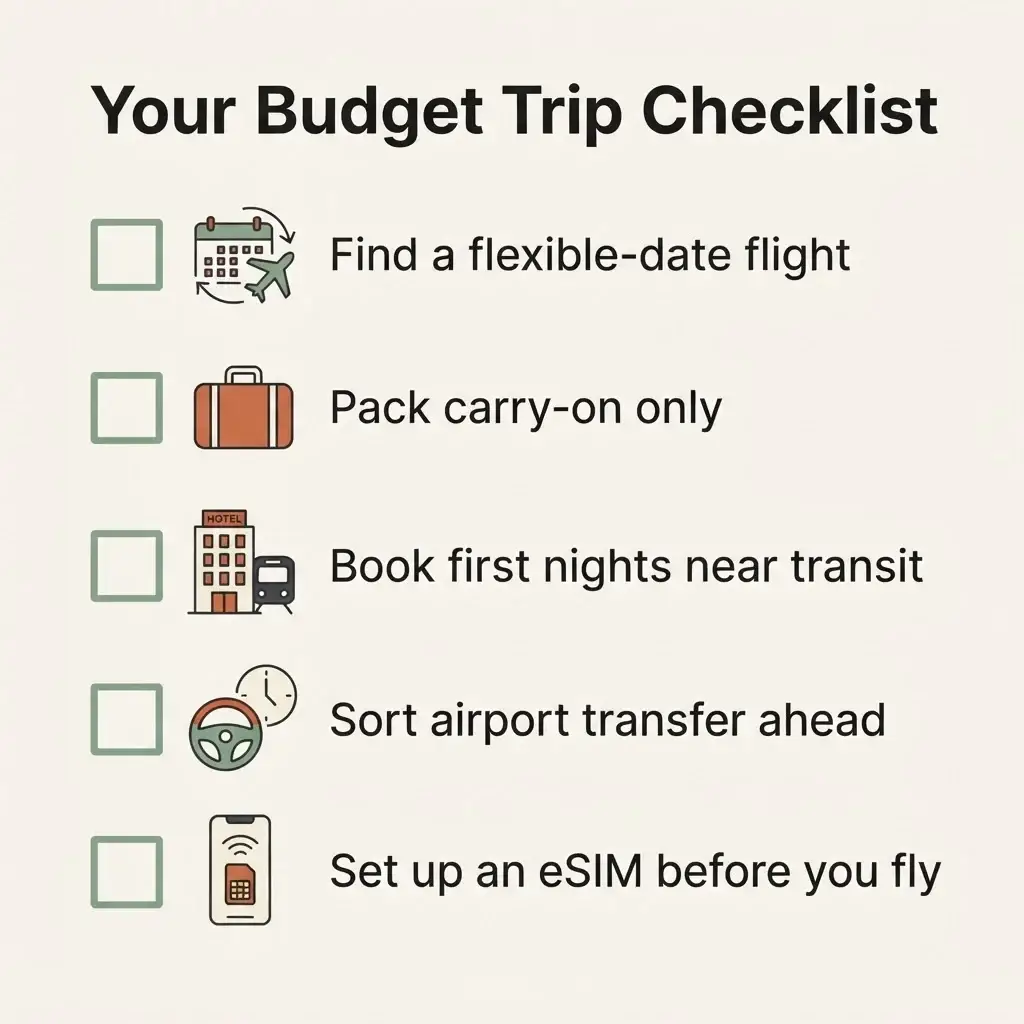
Here’s how these stack in practice. You use flexible search to find a cheap Friday flight in a low-demand month, pack carry-on only to skip bag fees, book your first three nights at a well-reviewed hostel or family guesthouse near a transit line, cook a couple of breakfasts, sort your airport transfer and eSIM before you go, and stay open to a work exchange or a spontaneous cheaper stay once you’re on the ground and confident.
None of that is luck. Every piece is a decision you can learn.
That’s the part I most want you to hear. Budget travel isn’t about deprivation or hunting for one impossible deal. It’s a set of small, repeatable choices that add up to freedom. I built an entire life on the road out of exactly these habits, and I promise you don’t need my job or my years of practice to start. You need one flexible search, one honest budget, and enough courage to press book. The rest, you’ll learn by going.