
The Layover Cities Smart Travelers Use to Save on Flights

There’s a flight-booking trick that genuinely changes how you travel, and most people scroll right past it every time they search for a ticket.
It goes like this: instead of chasing a direct flight to your final destination, you route through a major hub city where airfare is cheaper, competition between airlines is fierce, and sometimes the airline itself will hand you a free hotel room just for being there. You get a lower ticket price on one end, and on the other, you get a city to explore.
I think about the mentality I had when I first started building my travel life around flexibility rather than convenience. Back when I was still stuck in the office, I watched every dollar I had. Every flight price felt personal. That habit of hunting for value never really left, and honestly, it made me a better traveler. This is the kind of strategy I wish someone had sat me down and explained clearly, without the jargon and the “travel hacker” ego that surrounds a lot of this stuff.
So let’s just talk about it plainly: what layover cities actually lower your costs, how the major airline programs work, and how to actually find these routes.
First, Layover vs. Stopover: The Quick Distinction
These words get used interchangeably but they mean different things in practice. A layover is a short connection between flights, typically under 24 hours internationally, where you’re just waiting in the airport or nearby before your next flight. A stopover is a deliberate, extended pause of 24 hours or more at a midpoint city, sometimes built right into the ticket. Both can save you money. Both can also give you an extra destination at no additional airfare cost. The key is knowing which one your route and your airline are offering.
Why Routing Through Hub Cities Can Lower Your Price
Major international hub airports like Istanbul, Dubai, Doha, Singapore, and a handful of others handle enormous volumes of passengers. That volume creates competition between airlines, which pushes prices down on connecting routes. Airlines also want to fill their long-haul flights, so they often price tickets through their hub cities more aggressively than nonstop options out of your home airport.
This is especially true for travelers flying from North America, Europe, or Australia toward destinations in Asia, Africa, or the Middle East, and vice versa. Routes that seem geographically “indirect” on a map are often the cheapest way to get somewhere because you’re riding on a heavily trafficked corridor.
Pair that pricing reality with the free stopover programs that several airlines now run, and you can end up spending less than a direct flight while also getting a bonus city.
How to Find These Routes
Before getting into the cities themselves, let’s talk tools, because the search process is where most people get stuck.
AirWander is built specifically for this. You enter your origin and destination, and it surfaces flight options that include extended stopovers, showing you what adding a layover in various cities does to the total price. It’s genuinely useful for anyone who hasn’t seen it before.
Google Flights’ Explore map is another underused option. If you’re flexible about your final destination, you can open the map view, click on different regions, and see what flights cost to dozens of cities from your departure point. For those of us who can work with flexible dates, this is one of the fastest ways to find a cheap routing.
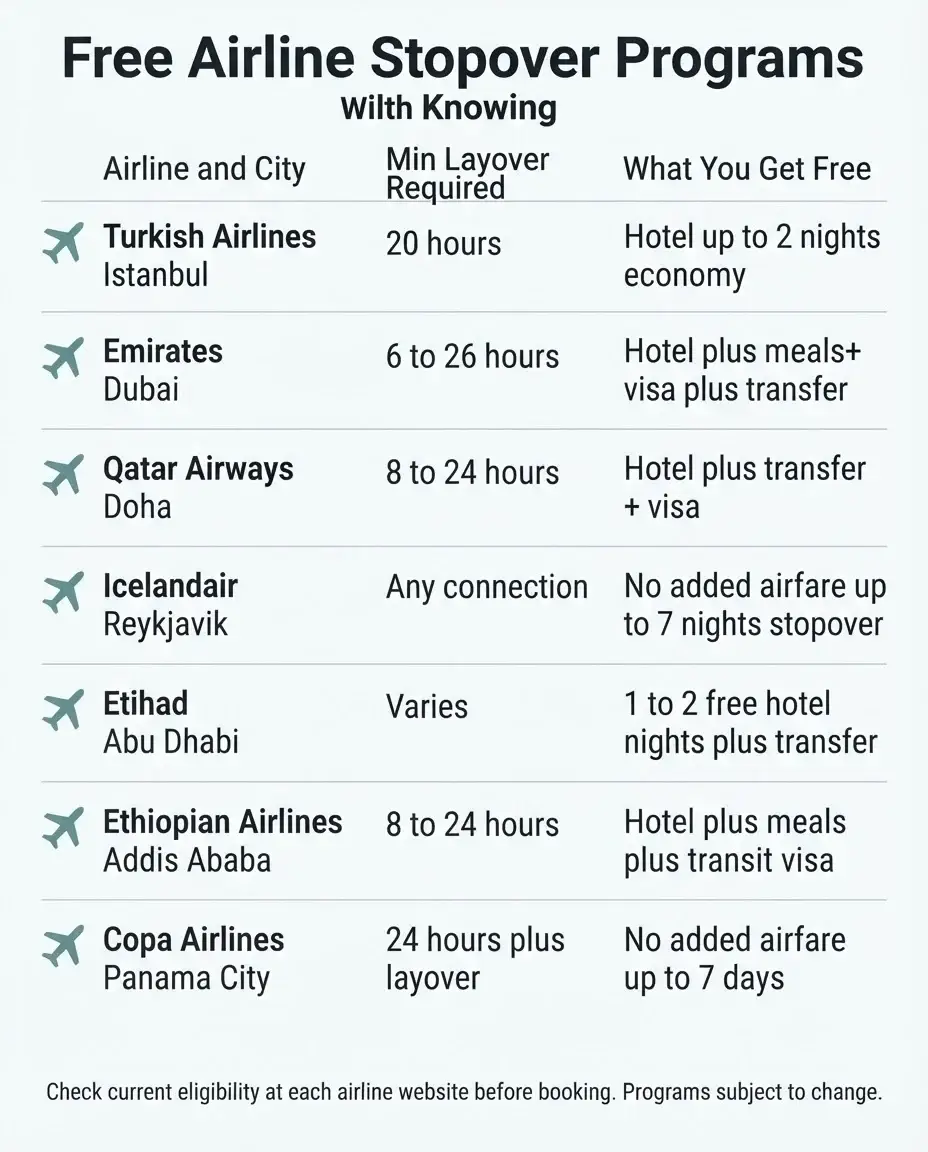
Beyond tools, it’s worth knowing that several major airlines now run formal stopover programs where the airline handles a free hotel stay for you. That changes the math entirely, because now your “inconvenient long connection” becomes a free extra night in a city you’d otherwise have paid to visit.
Let’s go city by city.
Istanbul, Turkey: The Hub That Rewards You with a Free Hotel
Istanbul is one of those cities that tends to pull people in the moment they step outside the airport. It sits at the crossroads of Europe and Asia, and Turkish Airlines has built one of the world’s most connected networks around it, which makes routing through Istanbul an option from almost everywhere.
Here’s the real draw for budget-conscious travelers: Turkish Airlines runs a free stopover program that gives eligible economy class passengers one free night in a 4-star partner hotel in Istanbul. Travelers departing from the US get two free nights in economy, or three nights if you’re in business. To qualify, your connection in Istanbul needs to be at least 20 hours. You apply at least 72 hours before your first flight by emailing the relevant address for your departure country.
That’s a free hotel, in Istanbul, just because you chose to route your ticket through the city.
Now, what do you actually do there if you get out? The historic neighborhoods of Sultanahmet and Beyoglu are walkable and rewarding. You’ll want to make time for the Hagia Sophia and the Grand Bazaar, but don’t stop there. From what solo travelers consistently report, the neighborhoods of Karakoy and Kadikoy offer a much more local, daily-life atmosphere. For food, try a simit from a street cart in the morning, then find a simple meyhane (a local tavern-style restaurant) in the evening for meze plates and fresh fish. Getting around is straightforward: the metro, trams, and ferries cover most of the ground you’ll want to cover.

One practical note: many nationalities can obtain an e-Visa for Turkey relatively simply, but confirm your passport’s requirements before booking. If you stay inside the international transit zone, most nationalities need no visa at all.
Dubai, UAE: Free Hotel, Free Meals, Free Visa
Dubai is polarizing in travel circles. Some people find it too sleek and commercial. But when an airline hands you a free hotel and free meals simply for routing through it, opinions tend to soften.
Emirates runs a program called Dubai Connect, and it’s one of the most comprehensive stopover perks in the industry. If your layover in Dubai is between 6 and 26 hours on an eligible Emirates ticket, you can get a complimentary hotel stay, all meals, airport transfers, and even a 48-hour complimentary visa for those nationalities that require one. The visa needs to be arranged at least 48 hours before arrival. There are minimum fare requirements, roughly $450 or more for one-way tickets, but on most long-haul routes, that’s easy to meet.
In terms of what to do: the Deira area and Dubai Creek offer a much more textured, older version of the city than the glittering Marina. The creek-side spice and gold souks are genuinely worth a walk. Getting around solo is easy thanks to the metro system, which runs clean and on time. For food, skip the hotel restaurants and find a simple Pakistani or Emirati canteen; the biryani and fresh-baked breads you’ll find in working neighborhoods are far more memorable than anything in a mall food court.
Doha, Qatar: Luxury Without the Luxury Price
Qatar’s capital isn’t the most obvious travel destination on its own, but Qatar Airways has made it one of the most accessible layover cities in the world. Their Qatar Stopover program offers 4-star and 5-star hotel nights starting from as little as $14 per person per night, for up to four nights. Separately, if you have a layover of 8 to 24 hours with no better connection available, Qatar Airways offers a complimentary hotel stay, transfers, and visa.
The Museum of Islamic Art is worth every minute of a short layover, and the Souq Waqif is the kind of market where you could spend two hours just eating and wandering. Solo travelers report feeling comfortable and safe throughout the city. Qatar requires a visa for many nationalities, but the visa-on-arrival or visa-free arrangement covers a large number of passport holders now, especially since the 2022 World Cup expansion of entry rules.
Reykjavik, Iceland: No Extra Airfare to Stop Here
This one genuinely surprises people. If you’re flying transatlantic between North America and Europe on Icelandair, you can add a stopover in Iceland for no additional airfare. On most standard fares, that’s up to 7 nights. On Flex fares, up to 21 nights. Icelandair’s stopover program doesn’t include accommodation, but when the flight itself costs no more than a direct ticket, you’re still coming out well ahead.
Iceland is one of the few places where the landscape itself is the attraction. Geysers, waterfalls, volcanic terrain, hot springs, the northern lights in winter, the midnight sun in summer. Reykjavik as a city is small and walkable with excellent coffee and great fish and lamb dishes. The famous Blue Lagoon is nearby and worth visiting, though booking ahead is essential. Car rental opens up the ring road and Golden Circle for those with a few days.

For travelers flying between, say, New York and Amsterdam, Paris, or Scandinavia, routing through Reykjavik is often no more expensive than a direct flight, sometimes cheaper, and you get Iceland in between. That’s hard to argue with.
Singapore: The Layover That Runs Itself
Singapore’s Changi Airport is consistently ranked among the world’s best airports, which means even a short stay in the terminal is comfortable. But the city itself is where things get interesting for a layover.
From what solo travelers consistently report, Changi’s official transit guide recommends at least 8 to 10 hours if you want to clear immigration, get into the city, and return without rushing. Most nationalities enter Singapore visa-free. The process is efficient. The MRT train connects the airport to the city center in about 30 minutes for very little cost.
Once there, the neighborhoods of Chinatown, Little India, and the Kampong Glam area around Arab Street offer the kind of cultural layering that rewards a few hours of wandering. Singapore is a genuine food city, and a hawker center is the ideal quick meal: clean, cheap, varied, and social. Chicken rice, char kway teow, and laksa are the things to eat. The city is also exceptionally safe and easy to navigate solo, which makes it a good first layover destination for anyone who’s nervous about stepping out of an airport alone.

The catch: Singapore is not a cheap city once you’re in it, so budget travelers may prefer to enjoy the airport’s own amenities (there’s a free rooftop pool and a butterfly garden inside the terminal) or simply keep time in the city short and efficient.
Abu Dhabi, UAE: The Understated Neighbor
While Dubai gets most of the attention, Abu Dhabi is worth knowing about as a layover hub, mostly because of Etihad Airways’ “Stopover on Us” program. Etihad offers eligible passengers one or two free nights in Abu Dhabi at a three-star hotel or above, with transfers included. The Louvre Abu Dhabi alone is worth a layover, an unexpected, remarkable museum that somehow works brilliantly in the Gulf context. The Sheikh Zayed Grand Mosque is similarly stunning and free to enter.
Abu Dhabi carries a more relaxed pace than Dubai, which solo travelers often appreciate. Entry requirements mirror the UAE generally: a growing number of nationalities enter visa-free, with others obtaining visas on arrival.
Addis Ababa, Ethiopia: The Africa Hub Most People Overlook
Ethiopian Airlines operates one of the most connected hub networks into and across Africa, making Addis Ababa a natural transit point for anyone traveling into or around the continent. What fewer people know is that Ethiopian Airlines offers one of the most generous free layover programs in the industry.
For layovers between 8 and 24 hours on Ethiopian Airlines, eligible passengers receive a free transit visa to Ethiopia, a free hotel room, airport transfers, and up to three meal vouchers. All at no cost.
Addis Ababa itself is a city of contradictions in the best way: a rapidly changing African capital with a deep food culture, warm people, and a history that includes both ancient traditions and the seat of the African Union. The National Museum, home to the fossil remains of “Lucy,” one of humanity’s oldest known ancestors, is genuinely worth a few hours. The Merkato is one of Africa’s largest open-air markets, vivid and chaotic and full of life. Ethiopian coffee, served in the traditional ceremony with popcorn, is something that should not be rushed through.
For anyone traveling from Europe or North America toward East Africa, Southern Africa, or anywhere along Ethiopian Airlines’ vast network, routing through Addis is not just practical, it’s a genuinely rewarding addition to the journey.
Panama City, Panama: The Overlooked Gateway to Latin America
Panama City is the hub for Copa Airlines and sits at the geographic center of the Americas, making it one of the most practical transit points for travel throughout Latin America and the Caribbean. Copa’s stopover program allows eligible passengers to stop in Panama City for no additional airfare, from 24 hours up to several days. Check the Copa Airlines booking options for current specifics when building your route, since terms vary by ticket.
What makes Panama City interesting beyond transit is how much it packs into a small footprint. Casco Viejo, the old quarter by the bay, is a UNESCO-recognized historic district full of colonial architecture, local restaurants, and rooftop bars with views of the city skyline. The Panama Canal is nearby and straightforwardly fascinating to watch. The Canal Museum in Casco Viejo is a solid two hours of context for what you’re seeing.
Entry is visa-free for most Western passport holders. The city is reasonably safe for solo travelers in the main tourist areas, and the food scene, especially seafood, is excellent and affordable.
A Few Things Worth Knowing Before You Book
Layover travel comes with some things to keep in mind. First, always give yourself enough buffer time. If something goes wrong with your first flight and you’ve planned to spend a day sightseeing, a missed connection is significantly more painful than if you were just changing planes. A rule I follow: any layover where I plan to leave the airport needs at least a five-hour buffer on return to allow for traffic, getting back through security, and the general unpredictability of cities.
Second, always check visa requirements before you leave the airport. Many countries allow transit without a visa if you’re staying airside, but the rules for entering the country can be entirely different. Research your specific passport and the specific country’s current rules before booking.
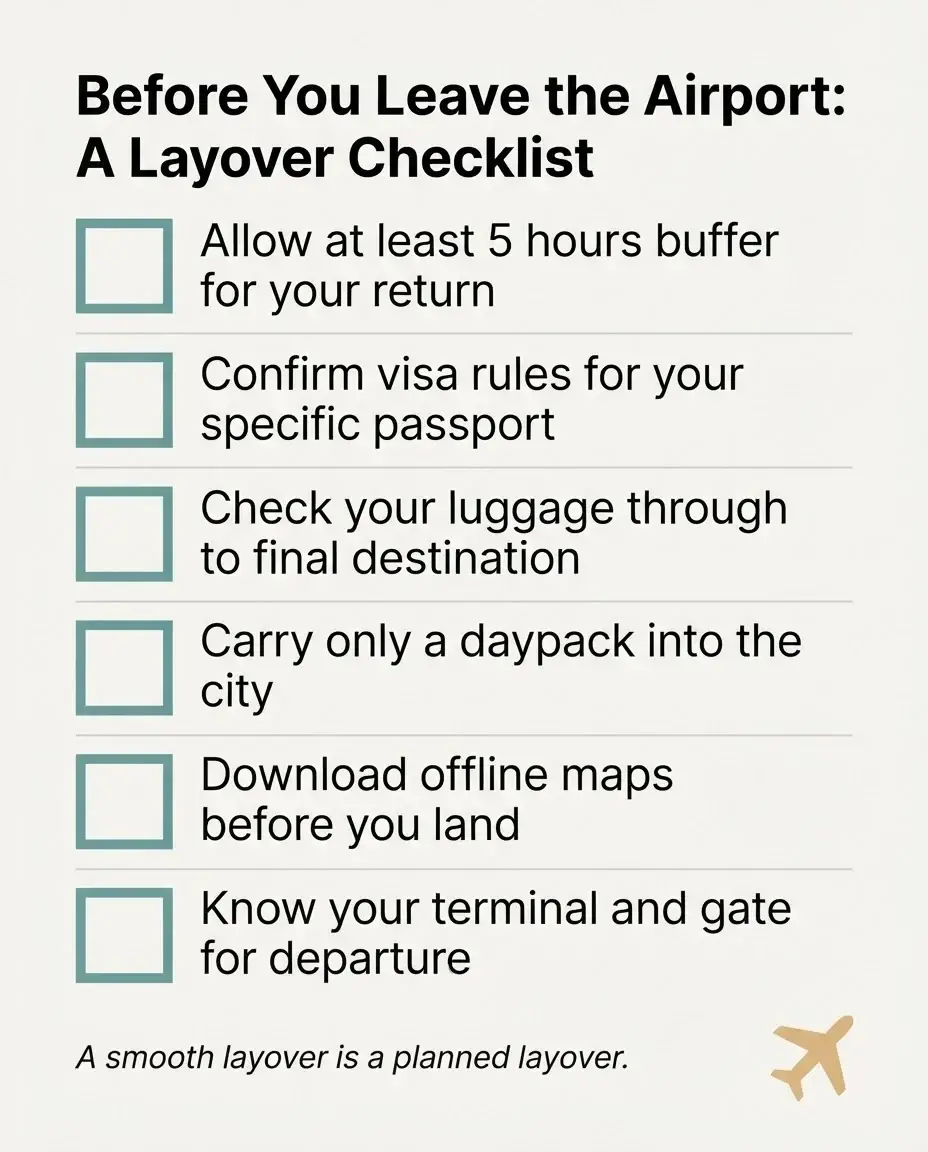
Third, carry only a daypack when you leave the airport on a layover, and check your main luggage through to your final destination if your airline allows it. Dragging a full suitcase around Istanbul or Singapore is a fast way to ruin what should be a light, enjoyable few hours.
There’s also a concept worth mentioning briefly: open-jaw flights. An open-jaw ticket is where you fly into one city and fly home from a different one, letting you travel overland in between. This is different from a layover strategy but complements it well. Booking an open-jaw through a hub city often costs less than a standard round-trip.
The Bigger Shift
Honestly, what this strategy gave me wasn’t just cheaper flights. It gave me the habit of seeing transit as an opportunity rather than a waiting room. When I was backpacking solo through Europe, the long rides and connections were some of my most formative hours: time to read, think, observe, and show up in places I hadn’t specifically planned for. Layovers can carry some of that same energy if you let them.
You don’t need to turn every connection into a two-day sightseeing sprint. Sometimes an eight-hour layover in Doha is just a meal and a museum and a quiet few hours in a city you’d never have chosen on your own, and that’s more than enough to make travel feel bigger than your original itinerary suggested.
Stop waiting for the perfect direct flight at the perfect price. The interesting route is often the cheaper one.