How to Get Error Fare Flights Without Losing Your Money

There’s a particular feeling that comes with seeing a $214 round trip to Tokyo pop up on your phone. Part disbelief, part adrenaline, part quiet panic that you have about eleven minutes to decide whether to change your year.
I get messages about this constantly. Someone saw the screenshot, they want in, and they want to know if it’s a scam. It isn’t. Error fares are real, they happen more often than most people think, and ordinary travelers book them every week. But the internet does a terrible job of explaining the part that actually matters, which is what happens after you click purchase.
So let’s do this properly. Not just where to find them, but how the pricing breaks in the first place, what airlines are and aren’t allowed to do, and how to protect your money and your sanity if the whole thing evaporates. I’ve built my life around cheap, slow, unglamorous travel since I left my office job, and the single biggest thing that separates people who fly on error fares from people who only read about them is not luck. It’s knowing the rules before the alert arrives.
What an Error Fare Actually Is
An error fare is a ticket priced far below what the airline meant to charge, published by mistake and available to the public until somebody catches it.
The word “error” is doing real work there. This is not a sale. It’s not a flash promo. It’s a genuine mistake that slipped into the systems airlines use to distribute prices to the whole world at once. Fares get filed centrally, pushed out to booking engines and travel agencies, and priced automatically. When something in that chain is wrong, it’s wrong everywhere simultaneously, and it stays wrong until a human notices.
For context on how dramatic the gap can be, the average US domestic itinerary fare was around $370 in the third quarter of 2025 according to the Bureau of Transportation Statistics fare data, and long-haul international economy usually runs several times that. An error fare might take a $1,400 New York to Johannesburg ticket down to $290. That’s the scale we’re talking about. Not fifteen percent off. Eighty percent off.
The four ways fares break
Missing fuel surcharges and taxes. On many international routes, the base fare is a small fraction of what you pay. The rest is surcharges. When those don’t attach correctly, you see the naked base fare, which can be absurdly low.
Currency conversion mistakes. An airline files a fare for its Danish market but the amount gets treated as dollars instead of kroner, or a decimal lands in the wrong place. These are the ones that produce the truly silly prices, business class for the cost of a checked bag.
Point of sale mismatches. Airlines price the same route differently depending on which country you’re buying from. Sometimes a fare intended for one small market escapes into all of them.
Plain human error. Somebody typed 189 instead of 1,890. It happens more than any airline would like to admit.
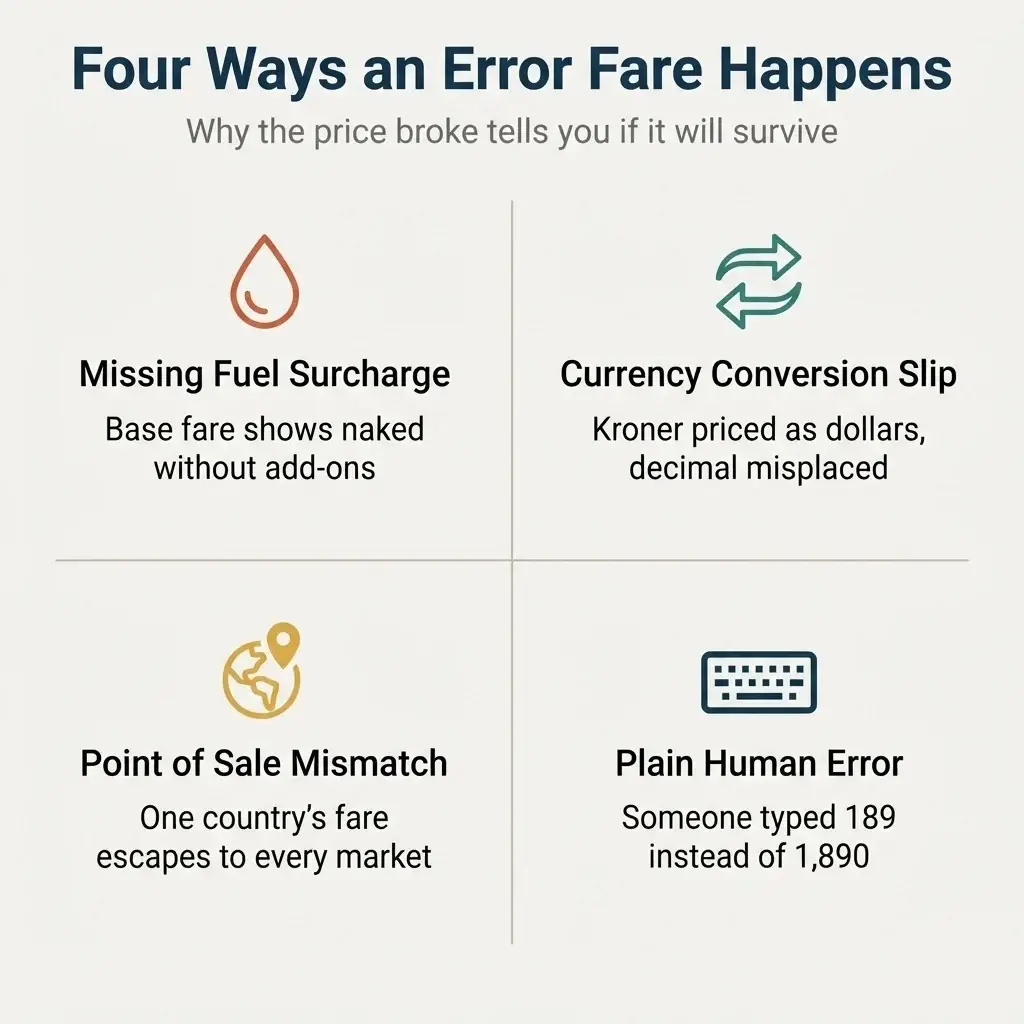
Knowing which type you’re looking at is genuinely useful, because it tells you how likely the airline is to fight it. A fare that’s cheap but plausible, say $340 to Europe in shoulder season, often gets honored quietly. A first class ticket to Auckland for $92 will almost certainly get killed within hours.
The Legal Reality Nobody Explains Properly
This is the part where most articles are years out of date, and it’s the part that determines whether you should book that hotel.
If you’re in the United States, there used to be a rule that effectively forced airlines to honor mistaken fares, because a separate regulation banned raising the price after purchase. Airlines hated it. In May 2015 the Department of Transportation changed course. Under the current DOT mistaken fare policy statement, the enforcement office will generally not take action against an airline or ticket agent that cancels a mistaken fare, as long as the seller can demonstrate the fare was a genuine error and reimburses consumers for reasonable out-of-pocket expenses they made in reliance on the ticket. Things like a non-refundable hotel, a visa fee, or a connecting ticket bought to reach the departure city.
Read that twice, because it contains both the bad news and the good news. The bad news: no, US airlines do not have to fly you. The good news: if they cancel, they are expected to make you whole on the money you actually spent because you believed you were flying.
If you’re booking from Europe, the picture is different again. EU consumer and contract law is generally friendlier to the buyer once a contract has formed, and national enforcement bodies exist to hear complaints. Just be clear about what applies to what. The famous compensation bands under the EU air passenger rights rules, which run €250, €400 or €600 depending on distance, cover cancelled and heavily delayed flights, not a booking the airline voids months out because it mispriced the seat. That’s a contract dispute, not a flight disruption claim. Different route, different paperwork.
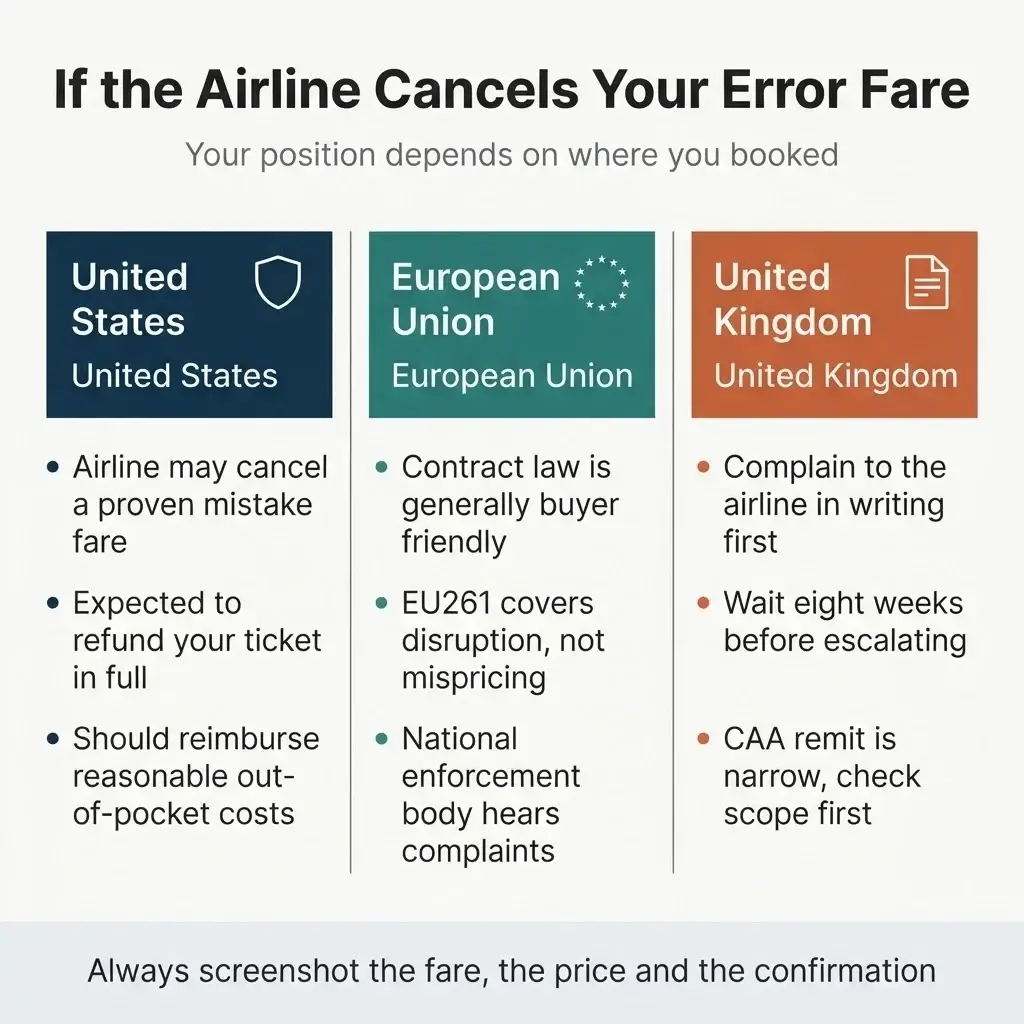
The practical takeaway: assume the ticket might vanish, and behave accordingly for the first few weeks. Every rule that follows flows from that one assumption.
Where Error Fares Actually Show Up
You will not find these by refreshing a search for one route on one date. Error fares are found by watching widely, not deeply.
Alert services. Going, Jack’s Flight Club, Secret Flying and Fly4Free all do the watching for you. Free tiers exist and are decent for domestic and mainstream routes. Paid tiers get you faster alerts and more departure airports, which matters enormously when a fare lives for two hours. If you fly from a smaller airport, a paid tier is usually the difference between hearing about deals you can use and deals you can’t.
Deal communities. FlyerTalk’s mileage run and premium fare deals forums, plus r/awardtravel and r/Flights on Reddit, often catch things before mailing lists do, because someone stumbles on it while doing their own search. The tone is technical. That’s a feature.
Doing your own hunting. Google Flights Explore lets you set a home airport, a flexible date window and no destination at all, then shows you a map of prices. When a number looks structurally wrong compared to its neighbors, dig in. ITA Matrix does the same job with far more control if you’re willing to learn its syntax, and it’s the tool the deal hunters actually use.

Watching from more than one country. Because fares vary by point of sale, the same flight can cost wildly different amounts on the airline’s Spanish site versus its American one. Plenty of travelers exploit this. I’d flag honestly that booking outside your home market can create problems: currency conversion fees, a foreign customer service line if something goes wrong, and in some cases airline terms that say the booking must match your market. It’s not illegal, but it is a place where tickets get cancelled for reasons unrelated to the error.
One thing I’ll steer you away from entirely is fuel dumping, which involves constructing itineraries specifically to strip surcharges out of a fare. It isn’t a mistake you found, it’s a manipulation you built, and it’s the fastest way to get tickets voided and frequent flyer accounts closed. Skip it.
The First Twenty Minutes: How to Move Fast Without Being Reckless
Here’s the sequence that separates people who fly from people who post “I hesitated” in the comments.
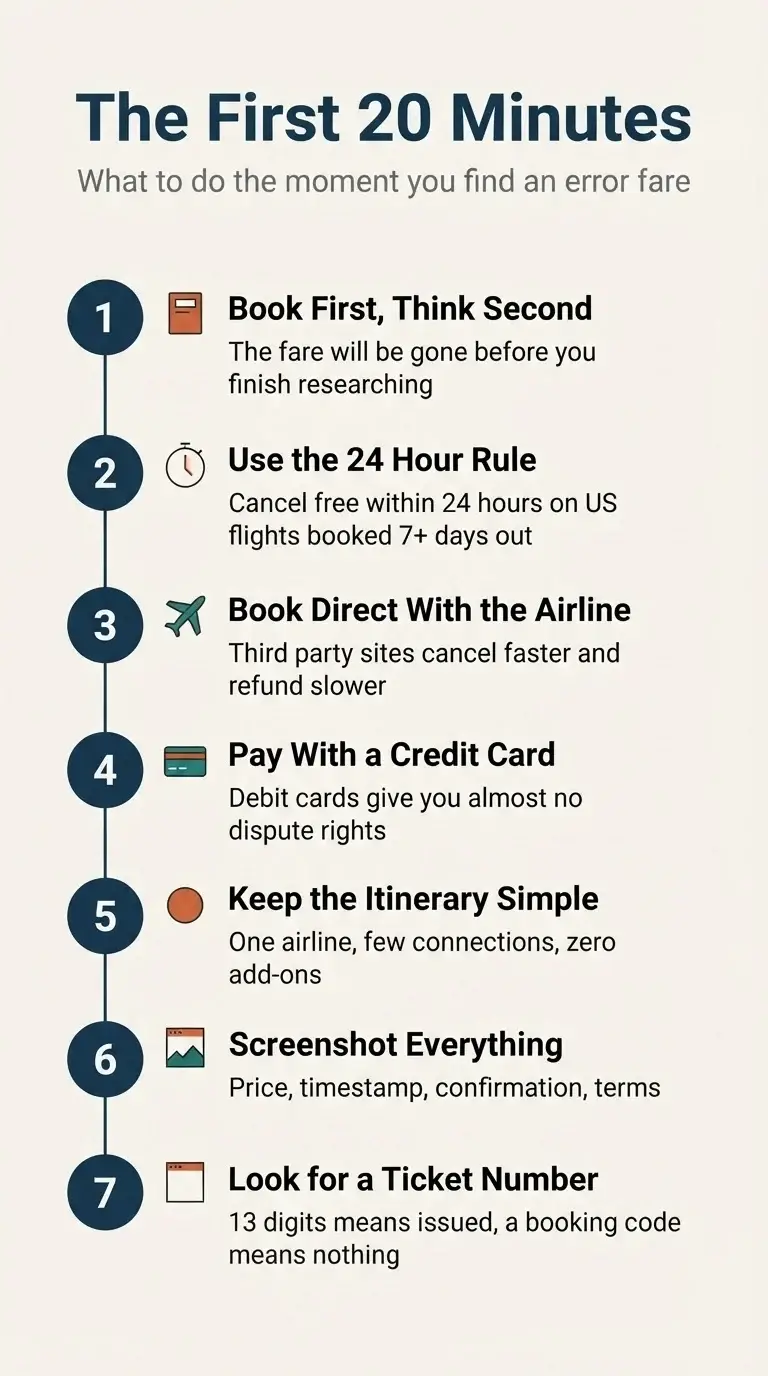
Book first, think second. This sounds like terrible advice and it’s the correct advice, for one specific reason explained in the next paragraph. Do not research the destination, do not text your friend, do not check whether your boss will approve the time off. Book. The fare will be gone.
Then use the 24-hour rule as your thinking time. For flights touching the US, the DOT’s 24-hour reservation requirement means airlines must either let you cancel for a full refund within 24 hours of booking, or hold the price without payment for 24 hours, as long as you booked at least seven days before departure. Refunds go back to a credit card within seven business days. This is your safety net, and it turns a panic decision into a paid overnight option to think. Two important limits: the rule applies to airlines directly, not to online travel agencies, and the OTA is under no obligation to match it. Which brings me to the next point.
Book direct with the airline whenever you can. Third party sites add a layer between you and the ticket, they frequently cancel error fares faster than airlines do, and their refund processes are slower and vaguer. Direct booking also means you’re the airline’s customer if things go sideways.
Use a real credit card, not a debit card. Credit gives you dispute rights that debit largely does not. More on that below.
Book the simplest possible itinerary. One airline, minimal connections, no add-ons. Complexity gives systems more chances to reject or flag your booking.
Screenshot everything. The fare page, the confirmation, the price, the timestamp, the terms. If you end up arguing about reimbursement in three weeks, this is your evidence.
Check for a ticket number. This is the detail most people miss. A confirmation code means the airline is holding seats. A 13-digit ticket number means the ticket has actually been issued. Only the second one means something. If there’s no ticket number after a few hours, the booking is fragile.
The Waiting Game and How Not to Blow It
You’ve booked. Now you do almost nothing for two to four weeks, and doing nothing well is a skill.
Do not call the airline. I cannot stress this enough. Calling to “confirm my booking is fine” is how a human being ends up looking at a reservation that automated systems would have ignored forever. The people who lose error fares disproportionately are the people who couldn’t resist checking.
Do not modify anything. No seat selection, no name corrections, no adding a frequent flyer number, no upgrades, no date changes. Any touch can retrigger repricing.
Do not book non-refundable anything. No hotels, no tours, no trains, no non-refundable positioning flight to reach the departure city. Wait until the ticket has been stable for two to three weeks and, ideally, until you see the reservation appear in the airline’s own manage-booking tool with a ticket number attached. Then start building the trip in refundable pieces first.
Do not post the fare publicly with your booking details. Sharing the deal is fine and generous. Tagging the airline is not.
Be quietly realistic about how much you tell people. I say this warmly, because I know the urge. Announcing “I’m going to Peru in March!” to everyone you know and then having the ticket voided is a specific and unnecessary flavor of disappointment. Sit with it privately for a couple of weeks. If it holds, tell the world.
When the Airline Cancels Anyway
Sometimes it dies. Here’s your actual playbook, in order.
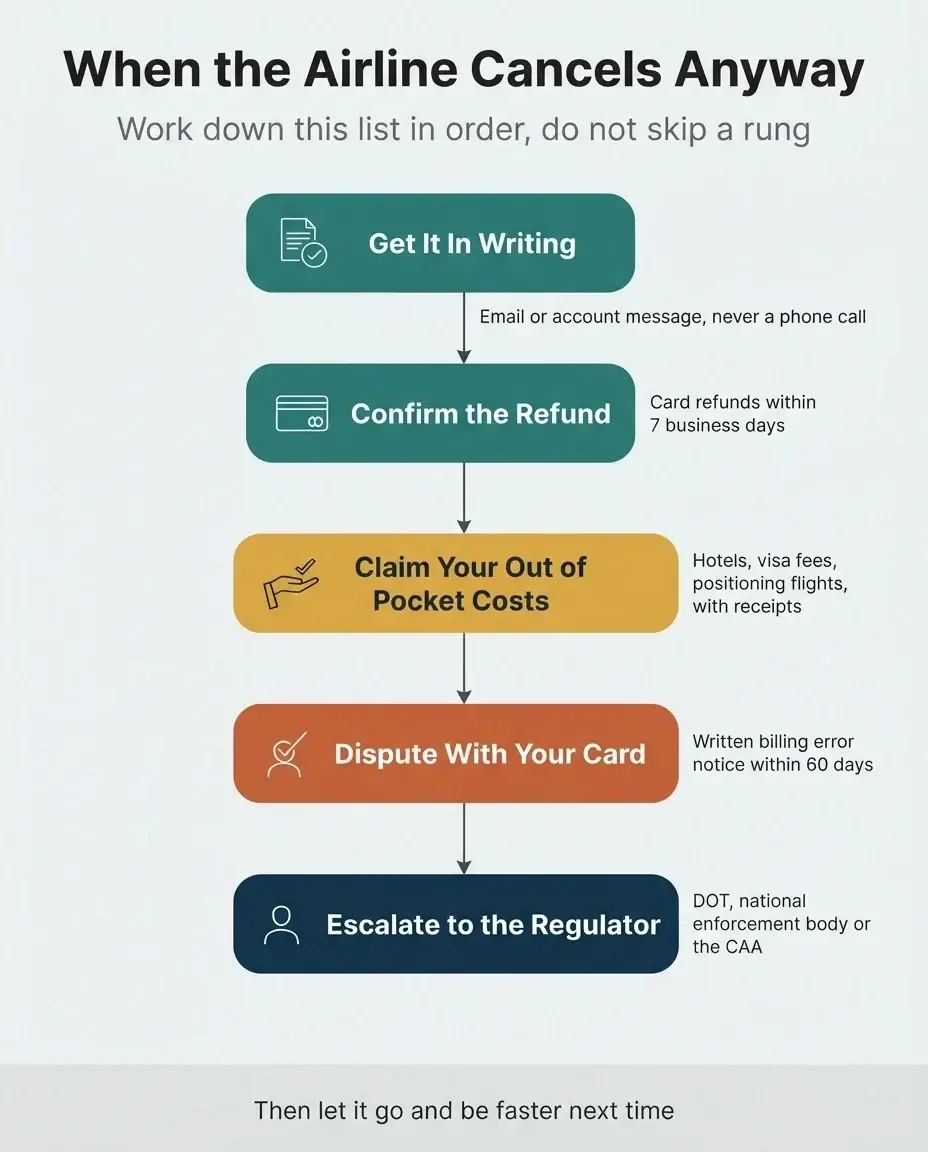
Get the cancellation in writing. Email or a message in your account, not a phone call. You want a record that says the airline cancelled, and ideally why.
Ask for the refund and confirm the timeline. A cancelled ticket means your money comes back. Airlines are required to process credit card refunds promptly, defined as within seven business days for US carriers. If it drags past that, escalate.
Claim your out-of-pocket costs. This is where most people leave money behind. If you spent anything in reliance on that ticket, a non-refundable hotel deposit, a visa application fee, a connecting flight, name it specifically, attach receipts, and ask for reimbursement. That expectation is baked into the DOT policy I mentioned earlier, and airlines outside the US often settle these quietly too because it’s cheaper than the argument.
If they stonewall, use the card. You have real statutory protection here. As the Consumer Financial Protection Bureau explains on disputing a credit card charge, you should notify the card company right away and send a written billing error notice within 60 days of the charge appearing on your statement, and the issuer must acknowledge it within 30 days. Keep copies of everything and note the dates of your calls.
Escalate to a regulator. US travelers can file an aviation consumer complaint with the DOT. UK travelers who have complained to the airline in writing and either waited eight weeks or been fobbed off can go to the CAA’s Passenger Advice and Complaints Team, though note their remit is focused on UK261, accessibility and baggage rather than pricing disputes, so read the scope before you invest the time. EU residents can go to their national enforcement body or a European Consumer Centre.
Then let it go. Genuinely. An error fare that dies costs you a refunded charge and a couple of evenings of daydreaming. That’s a cheap lesson in acting decisively, and you’ll be faster next time.
And to answer the question everyone asks nervously: no, booking a publicly available error fare will not get you banned. You clicked a price the airline published. That’s it. Bans and account closures come from repeat manipulation of fare construction or serial hidden city ticketing, not from taking a mispriced seat.
The Trip You Didn’t Plan: Paperwork, Timing and Real Life
Here’s the piece almost no error fare article covers, and it’s the one that actually determines whether you fly.
Passport validity. Many countries require your passport to be valid for at least six months beyond your arrival date, and much of Europe requires at least three months beyond your planned departure. If your passport expires within the next year, renew it now, before any deal appears. This is the single most common reason people watch a great fare go by.
Entry authorizations. Requirements shift, so check the destination’s official rules the same week you book, not the week you fly. If you’re a visa-exempt traveler heading to Europe, the EU’s official ETIAS information is the source to watch. It is not in operation yet, the EU has said it will announce a start date well in advance, and when it launches it will cost €20, be linked to your passport, and stay valid for up to three years. Bookmark it rather than trusting a third party site to tell you.
Time off. Error fares usually land three to eleven months out, which is enough runway to arrange leave. Have a rough sense of your blackout periods before you book so the yes is quick.
Positioning flights. Many error fares depart from a city you don’t live in. Budget realistically for getting there and always fly in the night before, on a separate refundable or cheap ticket, because a missed connection on a separate booking is entirely your problem.
The strange gift of the destination you didn’t choose. This is my favorite part of error fare travel and the reason I recommend it beyond the money. You do not pick the place. The place picks you. When I was backpacking around Europe, my best days were almost never the ones I planned, they were the cities I ended up in because a bus was cheap or a hostel had a bed. Landing somewhere you knew nothing about forces the kind of curiosity that a carefully researched trip can accidentally sand away.

When you do land somewhere unfamiliar, two habits carry you: eat where the queue is local and the menu is short, and take public transport in from the airport on day one. Both cost less, and both teach you the city faster than anything else. Living with a family in Ghana taught me more about a place in a month of shared meals than any itinerary could have, and hiking in China taught me that the days you can’t plan are the days you remember. Skipping the taxi and figuring out the train is a small version of the same lesson.
Is It Actually Worth It? The Honest Math
I want to be straight with you, because I’m not interested in selling anyone a fantasy.
An error fare is a fantastic deal on one component of a trip. It is not a free trip. A $250 ticket to Southeast Asia still leaves you with accommodation, food, local transport, insurance, visas and the opportunity cost of your vacation days. Budget the whole trip before you celebrate.
Error fares also reward a specific kind of flexibility. If you need exact dates, a particular week, a specific city and a direct flight, this strategy will frustrate you, and there’s no shame in that. Booking a normal advance fare on a route you actually want is often the smarter move.
Where error fares shine is for people with loose calendars and loose destination preferences. Students, remote workers, freelancers, anyone between jobs, anyone whose answer to “where do you want to go?” is “somewhere.” That was me in the years after I left the cubicle, working flexible jobs to fund the next trip. I said yes to places based on price more often than on desire, and it never once made the travel worse.
The reason I keep pushing readers toward this, though, isn’t the savings. It’s the muscle it builds. Error fare hunting trains you to decide quickly, to trust your own research, to accept that some plans fall through, and to stop treating travel as a thing that requires perfect conditions. Those are the exact habits that make someone a confident traveler. The cheap ticket is almost a side effect.
Your Ten Minute Setup
Do these now, before any deal appears, and you’ll be ready:
Check your passport expiry date and renew if it’s under a year out. Sign up for two or three alert services with every airport within reasonable reach of you set as a departure point. Follow one deal community. Make sure you have a credit card with a bit of headroom and no foreign transaction fees. Save your traveler details in the profiles of the two or three airlines you’d most likely fly, so checkout takes ninety seconds instead of five minutes. Decide, right now, what number you’d say yes to without a conversation. Mine used to be simple: if a long-haul ticket dropped under $300, the answer was yes and I’d figure out the rest later.
That last one is the real work. Not the searching. The deciding.
Because the fare isn’t the opportunity. The fare is just the nudge. The opportunity is that somewhere in the next few months, a price is going to appear on your screen that makes a trip you’ve been postponing suddenly, almost embarrassingly, possible. And the only question that will matter in that moment is whether you’re the person who already knows what to do.
Be that person. Get your passport sorted this week. The rest is just clicking.