How to Find Last-Minute Flight Deals Without the Panic Spiral

There is a very specific kind of stress that comes with booking a flight you need soon. The tab is open. The price has moved twice while you were making dinner. Some corner of your brain insists that if you just refresh one more time, a better fare will appear, and another corner insists you already missed it.
I know that feeling well. Back when I was working an office job in New York, my travel window was whatever scraps of vacation time I could scrape together, which meant almost every trip I took was a short-notice trip. I got good at last-minute searching out of pure necessity, long before I ever left that desk for good. What I learned is that finding a last-minute flight deal is not about luck or secret websites. It is about having a routine you trust so the panic never gets a vote.
Here is that routine, plus the honest version of what is and is not possible when you are booking inside of two weeks.
First, Let’s Bury the Myth That Waiting Always Wins
The old advice said airlines dump unsold seats cheap right before departure. That was true decades ago, when planes flew half empty and a warm body was better than nothing. It is mostly not true now. Load factors are high, revenue management software is ruthless, and the seats left in the final week are usually priced for business travelers who have no choice.
But “mostly not true” is not the same as “never.” The 2026 data actually complicates the old wisdom in an interesting way. According to a widely reported analysis of millions of flight bookings, travelers who booked 8 to 14 days before departure saved an average of $225 compared to other booking windows, while the sweet spot for most people sat at 31 to 45 days out. That same research found Friday has replaced Tuesday as the cheapest day to actually purchase a ticket, roughly 14% cheaper domestically than Sunday, and that Tuesday is the cheapest and least crowded day to fly.
So the realistic picture is this. Booking six months out is often a waste of money. Booking three days out is usually painful. The 8-to-14-day window is a genuine opportunity if you are flexible. Inside of a week, you are hunting for exceptions rather than expecting bargains.
That reframe matters, because it changes your goal from “find a miracle” to “find the best available option and stop.” Those are very different mental states.
What a Genuinely Good Last-Minute Fare Looks Like
You cannot know if you got a deal without a baseline. Most articles skip this entirely, which is why people either celebrate a mediocre price or agonize over a decent one.
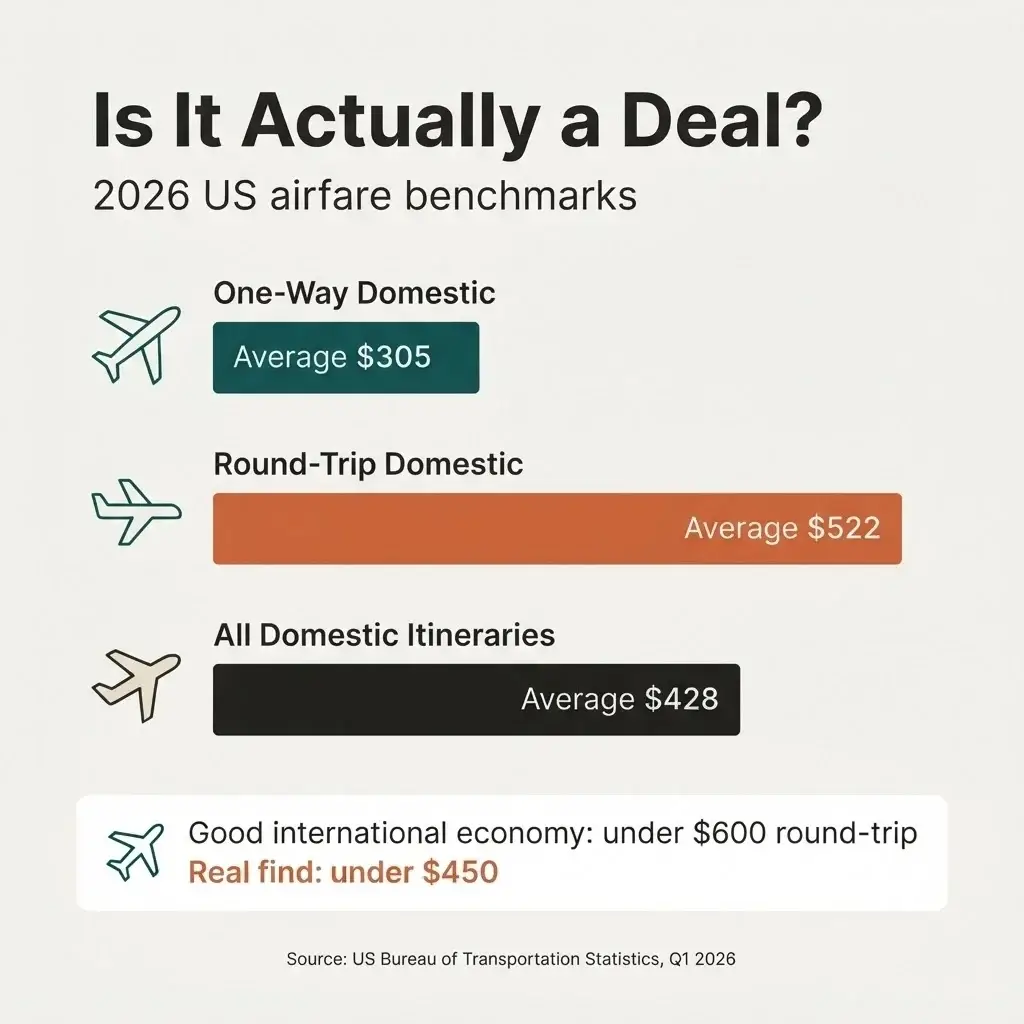
Use the national numbers as your anchor. The average US domestic itinerary fare was $428 in the first quarter of 2026, with one-way tickets averaging $305 and round-trips averaging $522. That is the middle of the market across all booking windows, all routes, all seasons.
So if you are looking at a $260 domestic round-trip nine days out, you are doing well. If you are looking at $700 for a two-hour hop, you are being quoted a business-traveler fare and should look harder. For international economy from the US, anything under $600 round-trip is generally solid, and under $450 is a real find.
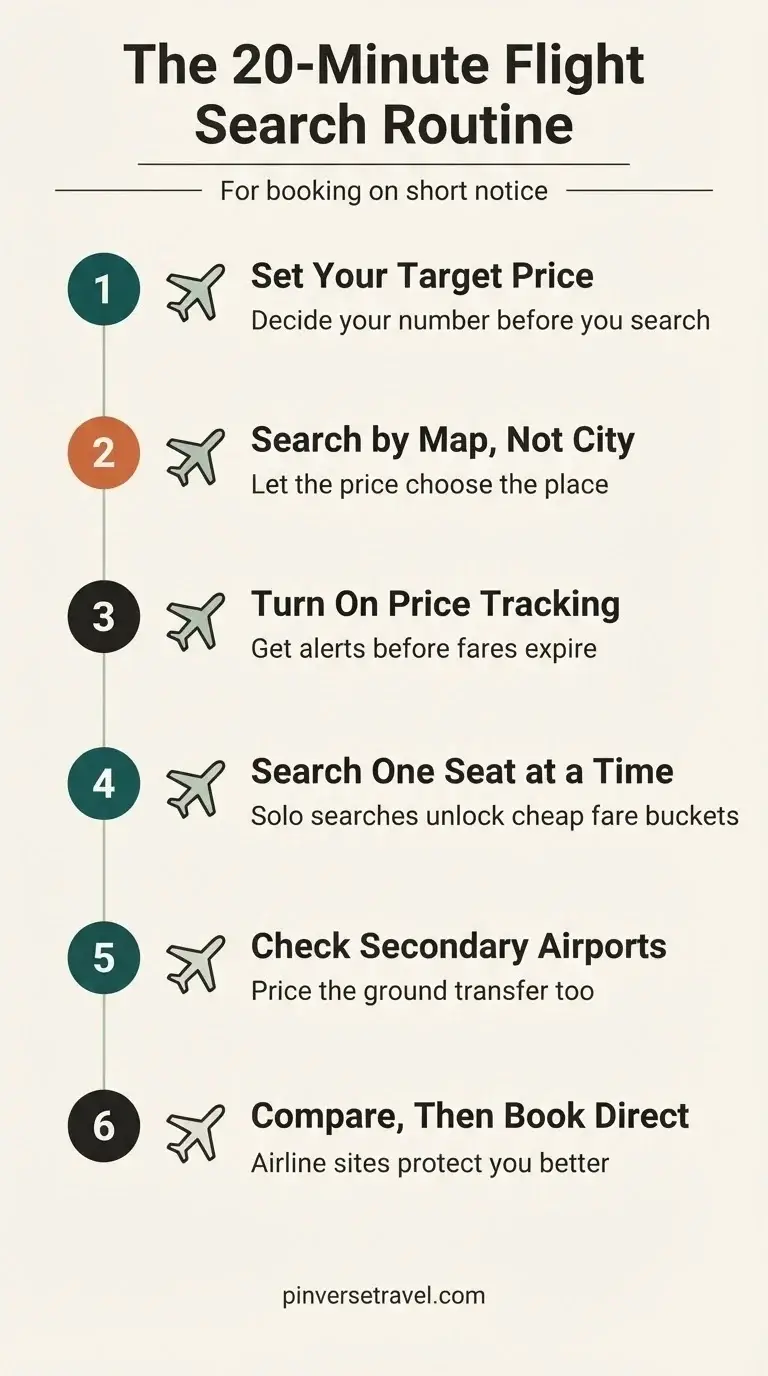
Write your number down before you search. Decide what you are willing to pay, and give yourself permission to book the moment you see it. The single most expensive habit in last-minute travel is refreshing past a good fare because you hoped for a better one.
The Search Routine I Use When the Clock Is Short
This takes about twenty focused minutes, not three days of anxious scrolling.
Start With a Map, Not a Date
If your destination is even slightly negotiable, search by region instead of city. Explore-style map searches show you the entire continent priced at once, and the difference between two airports 90 minutes apart can be $200. When I was backpacking Europe solo, this was how nearly every leg of my route got decided. I did not pick Porto because I had researched Porto. I picked it because it was cheap that week, and it turned out to be one of the best stops of the whole trip. Some of the best travel I have done came from letting the price choose the place.
Turn On Price Tracking Even Though You Are Booking Soon
This sounds backwards for a last-minute search, but it is not. Google Flights lets you track prices for a specific route or for “any dates” and will email you not only when a fare drops, but when its models predict the current fare is about to expire and rise. If you have four or five days before you must commit, that prediction is genuinely useful. It replaces your guessing with something closer to information.
Search One Seat at a Time
Airlines sell seats in fare buckets, and each bucket holds a limited number. If there is one seat left at $180 and the next four are $340, a search for two passengers will show you all of them at $340. Searching as a single traveler reveals the cheap seat. This is one of the quiet advantages of solo travel that nobody advertises, and last-minute booking is where it pays off most.
Compare, Then Book Direct
Use aggregators to find the fare, then check the airline’s own site before you buy. The price is usually identical, and booking direct gives you a real customer service relationship when something goes sideways at 6am in a terminal. It also matters for the refund rules I am about to explain.
And no, incognito mode does not lower prices. That myth refuses to die. Prices move because of demand and inventory, not because a cookie snitched on you.
Where Last-Minute Deals Actually Hide
Secondary airports. Almost every major city has a second or third airport that budget carriers use. Check them all, but price the ground transport before you get excited. A €25 flight into an airport that requires a €30 bus and 90 minutes each way is not the win it appears to be.
Ugly departure times. Red-eyes, 6am departures, and long layovers are cheap because most people will not take them. Solo travelers can. I have slept in more airport chairs than I care to count, and while I would not call it pleasant, it has funded entire extra weeks of travel.

Tuesday and Wednesday. Midweek departures are consistently cheaper and consistently less crowded. If your dates can slide by 48 hours, slide them.
Two one-ways instead of a round-trip. Mixing carriers often beats a single round-trip fare, especially on budget-heavy routes. Just build in a buffer, because two separate tickets means no protection if the first flight is late.
Points as a backstop. Last-minute is exactly when award seats earn their keep, because points pricing does not always spike the way cash pricing does. If you have a transferable points balance sitting idle, check it before you check your bank account.
Booking Fast Without Getting Burned
This is the part that turns a panicked purchase into a reversible decision, and almost nobody covers it.
US rules require airlines to let you either cancel for a full refund within 24 hours of booking, or hold the fare for 24 hours without payment, as long as you bought the ticket at least seven days before departure. That applies to non-refundable and basic economy tickets too. Read that again if you need to, because it fundamentally changes the emotional stakes. You can book the good fare now and still have a full day to double-check your dates, your ID, and your accommodation. Refunds on credit card purchases are due within seven business days.
One critical catch: that rule covers airlines, not third-party booking sites. Online travel agencies are not required to offer it, though many voluntarily do. This is the strongest practical argument for booking direct when you are moving fast.

If any part of your trip touches Europe, know your position there too. Under EU rules, a cancellation announced less than 14 days before departure can entitle you to 250, 400, or 600 euros depending on flight distance, and arriving three or more hours late can trigger compensation as well. Since last-minute travel by definition happens inside that 14-day window, this protection is unusually relevant to you.
Airport-Day Tactics Most Travelers Never Use
Your options do not end when you buy the ticket.
Same-day standby is free on many US carriers and is the most underused tool in air travel. American, for example, lets any passenger stand by for an earlier flight at no charge, with confirmed same-day changes starting around $60 domestically and $150 between JFK and Heathrow. You can request from 24 hours before departure, and you need to be listed at least 45 minutes before the flight you want. If you booked an awkward 9pm departure to save money and the 2pm has empty seats, you may be able to move for nothing.
If you are flying more than twice a year, expedited screening pays for itself in stress alone. TSA PreCheck costs $85 or less for five years, 99% of enrolled members wait under 10 minutes, and children can use the lane free with an enrolled parent. Global Entry runs $120 for five years and includes PreCheck. Neither helps you tomorrow, since your Known Traveler Number takes a few days to arrive, but book your next last-minute trip and you will wish you had done it already.
The Cheap Flight That Is Not Actually Cheap
Run this math before you commit. Baggage fees on budget carriers can exceed the fare. Seat selection is extra. Some low-cost airlines charge for a printed boarding pass. Airport transfers from secondary airports add up. And a 5am departure may require a taxi at 3am because public transit is not running.
I fly carry-on only for almost everything, a habit that started when I was living out of a backpack in Ghana and simply had nowhere to put more stuff. It is the single biggest cost saver in budget flying, and it makes standby and rebooking dramatically easier because you are never waiting on a bag.

On food, do not buy the airport sandwich. Bring an empty bottle to fill past security, pack something real, and save your money for the destination. When I was teaching in Thailand, the meals I remember were the ones from street carts near where I lived, not anything I ever ate in a terminal. The airport is transit. Eat properly when you arrive.
Mistake Fares and Deal Alerts, Realistically
Error fares exist. A pricing system drops a digit, a currency conversion glitches, and a $900 ticket briefly sells for $130. Deal alert services and dedicated communities do surface these, and people genuinely fly on them.
Here is the honest framing. They are rare, they vanish within hours, they rarely go where you specifically need to go, and airlines sometimes cancel them. Treat mistake fares as a lottery ticket for future trips, not a strategy for the trip you need to take next Thursday. If you find one, book direct, do not add a hotel or car to the reservation, and wait a week before booking anything non-refundable around it.
Similarly, skiplagging, where you book a longer itinerary and get off at the layover, is a real loophole with real consequences. Airlines have pursued it aggressively in court, you cannot check a bag, and frequent flyer accounts have been closed over it. I do not recommend building a travel life on a tactic that can get you banned by the companies you depend on.
Coming Home Smoothly
Returning to the US, Mobile Passport Control is free, requires no background check, and is now available at 63 sites including 37 US international airports plus 15 preclearance locations. You submit your passport details and declaration up to four hours before landing, and you can add up to 12 people to a single submission. It takes three minutes and regularly saves half an hour. There is no reason not to use it.
Your Short-Notice Checklist
Set your target price using the national averages as a baseline. Search by region, not city, if you have any flexibility. Search as one passenger. Check secondary airports and midweek dates. Compare on an aggregator, then book direct with the airline. Use the 24-hour cancellation window to double-check everything calmly. Pack carry-on only. Look into standby on the day. Then close the laptop.
The truth about last-minute travel is that the fare is rarely the hardest part. The hardest part is the voice that says you are being irresponsible, that you should have planned better, that the right moment is somewhere further down the calendar. I spent years listening to that voice from a cubicle in New York, waiting for a perfect window that was never going to open on its own.
It never opens. You open it. And sometimes the trip you book in a rush on a Tuesday night turns out to be the one you talk about for the next ten years.