
How to Find Last-Minute Flight & Hotel Deals Without Panic

There’s a specific kind of restlessness I know well. It usually hits on a Tuesday. You’re staring at a screen, the week stretches out gray and identical ahead of you, and a small voice says, “What if I just left?” For years, back when I was in my old office job in New York, I ignored that voice because I assumed spontaneous travel was expensive, reckless, and only for people with more money and nerve than me. I was wrong on all three counts.
Last-minute travel is a skill, not a gamble. And like most skills, it feels terrifying right up until you understand the moving parts. So let’s slow it down. I want you to finish this article feeling less like someone about to make a panicked purchase and more like someone quietly holding a good hand of cards.
First, the honest truth: is last minute actually cheaper?
I’m going to start here because almost nobody does, and it’s the question that’s really running your search.
Usually, no. Last-minute is not automatically cheaper. I wish it were, but the data doesn’t lie. For most domestic routes, fares tend to sit at their lowest somewhere around three weeks to two months before departure, and they generally creep upward as the plane fills. So if you’re picturing airlines slashing prices in a fire sale the night before, that’s mostly a myth for popular routes.
But here’s the part that makes last-minute travel worth doing anyway. “Last minute” and “cheap” aren’t the same goal, and once you separate them, everything gets easier. Sometimes you genuinely just want to go now and you’re willing to pay a fair price for the freedom. Other times a real deal appears, an airline dumps unsold seats, a hotel has empty rooms it would rather fill at a discount than leave dark, or a pricing error slips out. Your job isn’t to force a cheap flight into existence. It’s to be ready, flexible, and calm enough to grab a good one when it shows up.
That mindset shift, from “hunting for a bargain” to “staying ready for one,” is the whole game.

Set your safety net before you shop
This is the step that turns panic into confidence, and it’s the one I’d tattoo on every nervous first-timer if I could.
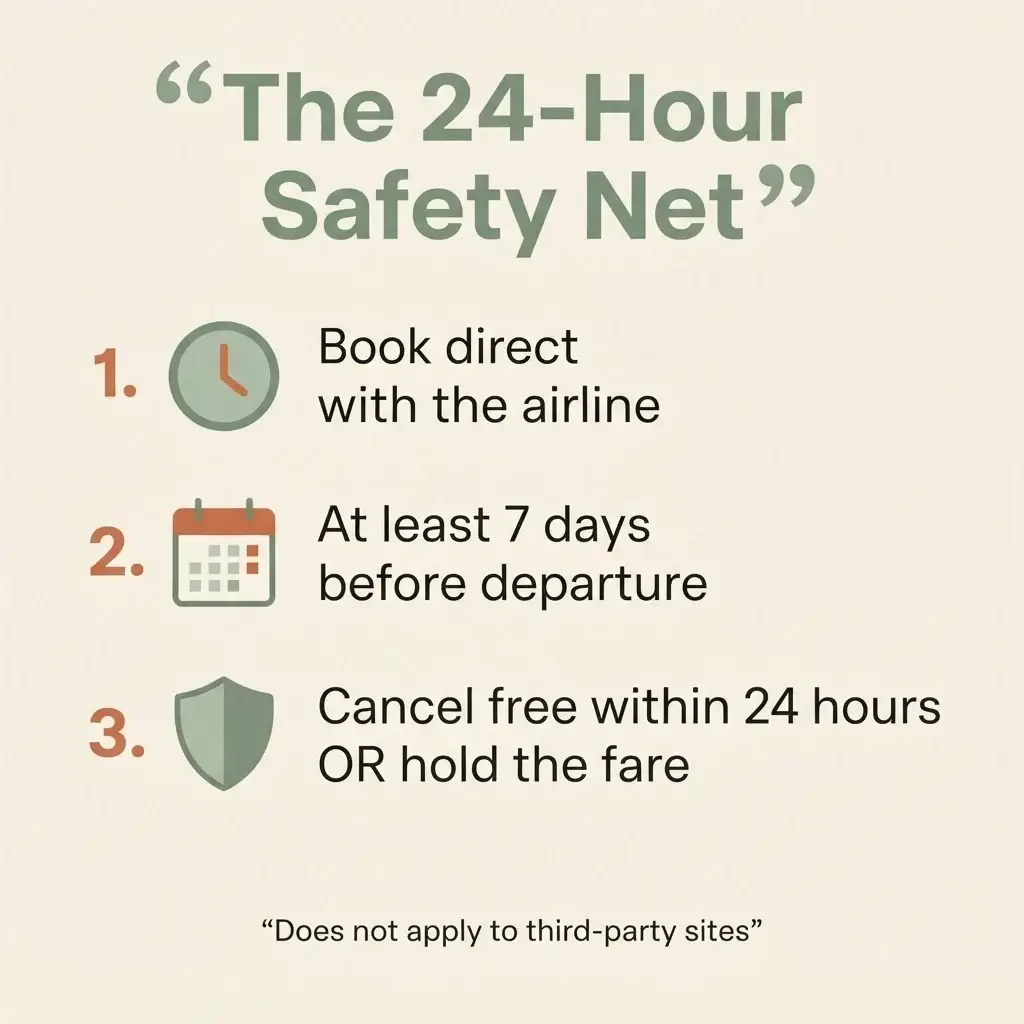
If you’re flying to, within, or from the United States and you book directly with the airline at least seven days before departure, you’re protected by a genuinely underrated rule. Under the US Department of Transportation, airlines must either let you cancel for a full refund within 24 hours of booking, or let you hold the fare without paying for 24 hours. You can read the specifics straight from the source on the Department of Transportation’s refunds page, and I really do recommend skimming it once so the words are yours, not mine.
Why does this matter so much for last-minute booking? Because it means you can lock in a flight the moment you find a good one, then spend the next 24 hours calmly sorting out your hotel, your time off, and your nerves, and still walk away clean if it all falls apart. That single rule removes most of the “what if I commit and it’s a mistake” fear.
One catch worth knowing: this protection applies when you book directly with the airline. If you book through a third-party site or online travel agency, they set their own cancellation policies, which may be stricter or looser. When I’m moving fast and want that safety net, I book flights directly with the carrier for exactly this reason.
Build your flight-finding toolkit
You don’t need ten apps. You need two or three that you actually understand.
My anchor is Google Flights, and the single most useful thing it does is track prices for you so you stop refreshing like a maniac. You pick a route or even “any dates,” turn on tracking, and it emails you when the price moves meaningfully, and it’ll even warn you when a fare is likely to rise soon. Google’s own step-by-step guide to price tracking walks you through it in about two minutes. For a spontaneous traveler, this is quietly powerful, because it means the deal comes to your inbox instead of you chaining yourself to a search bar.
The second tool I lean on is a flexible-destination search, the kind where you don’t tell it where, you tell it when and how much. Skyscanner’s “Everywhere” search and its last-minute deals page are built for exactly the mood you’re in when you just want out of town and don’t much care if it’s Lisbon or Ljubljana. I’ve planned entire trips backward from “what’s cheap and leaves Friday,” and honestly some of the best ones started that way.
If you want a broader, tested rundown of which search sites and AI tools are actually pulling accurate fares right now rather than just the famous names, Frommer’s keeps a genuinely useful annual roundup, and their comparison of the best airfare search sites is a solid reality check before you commit to any one platform.
The flexibility levers that actually move the price
When you’re booking close in, small flexibilities save the most money:
Fly the unglamorous times. Red-eyes, early mornings, and midweek departures are consistently cheaper because fewer people want them. As a solo traveler I’ve made peace with the 6 a.m. flight; a travel pillow and a paperback and I’m fine.

Check nearby airports. A second airport an hour away can be dramatically cheaper, especially last minute.
Stay open on the destination. This is the solo traveler’s superpower. When you’re not dragging a group’s opinions along, you can let the deal choose the country.
Watch the fine print on budget carriers. That headline fare can double once you add a bag, a seat, and a snack. I always add the real total, bag included, before I get excited.
Chasing error fares and flash deals (the fun, slightly wild part)
Every so often an airline or booking site publishes a price that’s simply wrong: a decimal in the wrong place, a currency mix-up, a fare filed without fuel surcharges. These are error fares, and they’re not illegal for you to book. They’re just glitches, and people have flown across oceans for the price of a nice dinner because of them.
The catch is they’re unpredictable and often disappear fast, so you can’t plan around them, you can only be subscribed and ready. Going (formerly Scott’s Cheap Flights) publishes a clear, honest explainer on how mistake fares work and how to book one safely, including the smart move of waiting a day before booking connected hotels, because error fares sometimes get cancelled by the airline. Treat these as a delightful bonus, never as your actual plan.
Now the hotel side: same-day rooms without the anxiety
Hotels behave differently from flights, and here the last-minute news is genuinely better. An empty room earns a hotel nothing, so many of them would rather sell it cheap the day of than let it sit. That’s the entire premise behind apps like HotelTonight, which specializes in unsold rooms at real discounts for tonight, tomorrow, and the next few days. For a spontaneous solo trip, this is one of my favorite tools, because it turns “I have nowhere to sleep” from a crisis into a fifteen-minute problem.
That said, a few habits keep last-minute hotel booking from going sideways:
Read the location, not just the price. A cheap room is not a deal if it’s 45 minutes from everything and you arrive after dark. As a solo traveler, I’ll happily pay a little more to be central and well-lit. I always drop the address into a map and look at the surrounding streets before I book.
Cross-check the same hotel on its own website. Sometimes the direct rate matches or beats the app, and booking direct can make it easier to fix problems at check-in.
Skim recent reviews, not the average. A 2019 review tells you nothing about the current owner. Sort by newest and read five.
Consider a mix. On a longer spontaneous trip I’ll sometimes book only the first night or two last minute, get the lay of the land in person, then decide where I actually want to be. Some of the best neighborhoods I’ve stayed in were places I only discovered by walking around on day one.

Doing flights and hotels together without double-committing
Here’s the sequence I actually use when the “let’s just go” urge strikes, and it keeps both pieces from colliding.
I find the flight first, because flights are the volatile, time-sensitive piece. If I book directly with the airline seven-plus days out, I’ve got that 24-hour window as a cushion. Then, inside that window, I sort the hotel, which is the more forgiving of the two. If the flight turns out to be a genuine error fare that might get yanked, I hold off on any non-refundable hotel until the flight is confirmed and ticketed. Only once both pieces feel solid do I let myself get excited and start looking up what to eat when I land.

That order, flight then hotel, safety net first, excitement last, is what keeps this whole thing feeling like an adventure instead of a scramble.
Protecting your money and your peace of mind
Two quick things I never skip on a spontaneous trip.
First, I pay with a credit card, not a debit card, for the fraud protection and the paper trail. If a deal is too tangled to book with a card, I take that as a warning sign.
Second, I think hard about travel insurance when I’m booking something non-refundable in a hurry. Spontaneity has a way of skipping the careful planning that normally catches problems, so a policy that covers cancellation and medical issues can be worth it, especially traveling solo with nobody else to lean on. Travel + Leisure keeps a practical overview of the tools that help you time and protect these purchases, including a clear guide to using flight price alerts effectively, which pairs well with deciding when a “deal” is actually worth locking in.
A realistic word on what “saving” really means
I don’t want to sell you a fantasy, because that’s not what Pinverse Travel is about. Last-minute travel occasionally hands you an incredible price. More often it hands you a fair price on a trip you’d otherwise have talked yourself out of entirely. And I’ve come to believe the second thing is worth far more than the first.
When I finally left my office job and started stitching together a life around flexible work and travel, I learned that the real cost of waiting for the perfect, perfectly cheap moment was all the trips I never took. A good last-minute deal isn’t really about the money you saved. It’s about the version of you that stopped waiting, packed a small bag, and went. That person, in my experience, comes home changed every single time.
So set your safety net. Turn on your price alerts. Keep your destination loose and your nerve loose too. The next time that Tuesday restlessness whispers “what if I just left,” you’ll actually know how to answer it.