How to Book Monastery Stays Around the World (Even If You’re Not Religious)

There is a moment every seasoned traveler has had where someone casually mentions they slept in a monastery in Florence for €45 a night, steps from the Uffizi, with a view of a walled garden and a breakfast made by actual nuns. And your brain just stops. Why don’t more people know about this?
The honest answer is that monastery stays sit in a strange blind spot. They don’t show up on the first page of hotel aggregators. Travel blogs rarely cover the booking mechanics in any real depth. And if you’ve never been religious, the whole idea can feel like it wasn’t meant for you, like you’d be sneaking into someone else’s sacred space.
You are not sneaking anywhere. Monasteries have offered hospitality to strangers for centuries. It is, for many religious orders, a formal vow. You do not need to pray, attend mass, or explain your beliefs to anyone. What you do need is a clear sense of how the world of monastery accommodation actually works, because it does work differently from booking a hotel, and the differences are worth knowing before you show up.
This guide walks you through everything: where to find monastery stays, how to book them by region, what the rules actually mean in practice, what to pack, and why this might be the most underrated travel experience you haven’t tried yet.
Why Monastery Stays Are Worth Your Attention
I have spent years chasing the kind of travel that slows you down and actually changes something in you. That is why I spent time living with a host family in Ghana and why teaching English in Thailand felt more meaningful than any rushed tour I could have taken. Monastery stays scratch a very similar itch.
These are not bare-bones hostels with a crucifix on the wall. Many monastery guest houses are housed in buildings that are several hundred years old, with stone cloisters, chapel bells, herb gardens, and the kind of silence that cities have spent centuries trying to generate through yoga studios and meditation apps. The rooms tend to be simple, clean, and quietly beautiful. The meals are often farm-to-table before that was a marketing term. And the price, especially in Europe, is frequently half of what you’d pay for a budget hotel in the same city.
For solo travelers in particular, these places have a safety record that is genuinely excellent. Doors are locked by curfew. The environment is calm. Other guests tend to be pilgrims, quiet travelers, and people seeking a brief break from the pace of regular life. It is one of the most underused accommodation strategies in solo travel, and once you understand how to navigate it, you will find yourself factoring it into trips you haven’t even planned yet.

The First Thing to Understand: You Don’t Have to Be Religious
This one point stops more people than any other, so let’s settle it right here.
The vast majority of monastery guest houses and convent accommodation around the world welcome guests of any faith or no faith at all. Monasteries.com, one of the most comprehensive booking platforms for monastery stays worldwide, is explicit: anyone can stay at most monasteries as long as you respect their community and traditions. Their top tips page for monastery guests confirms that there are no requirements to be of a religious background, and that properties are open to any guest who is respectful of the surroundings.
Religious activities, whether that is morning mass at a Catholic convent, gongyo at a Japanese Buddhist temple, or evening chanting at a Thai forest monastery, are almost always optional. You can participate if you want to. Many travelers who come in with no religious interest find themselves sitting in on a candlelit vespers service simply because it is beautiful and they happened to be there. Nobody is pressuring you, and nobody will be keeping score.
What monasteries do ask for is respect for the environment. You are not checking into a party hostel. Noise levels matter, communal spaces are shared quietly, and the rhythm of the place tends to set its own gentle pace. If you can genuinely agree to those terms, you are welcome.
How the Booking Process Works (And Why It’s Different)
This is where people get confused, and where a little preparation saves a lot of frustration.
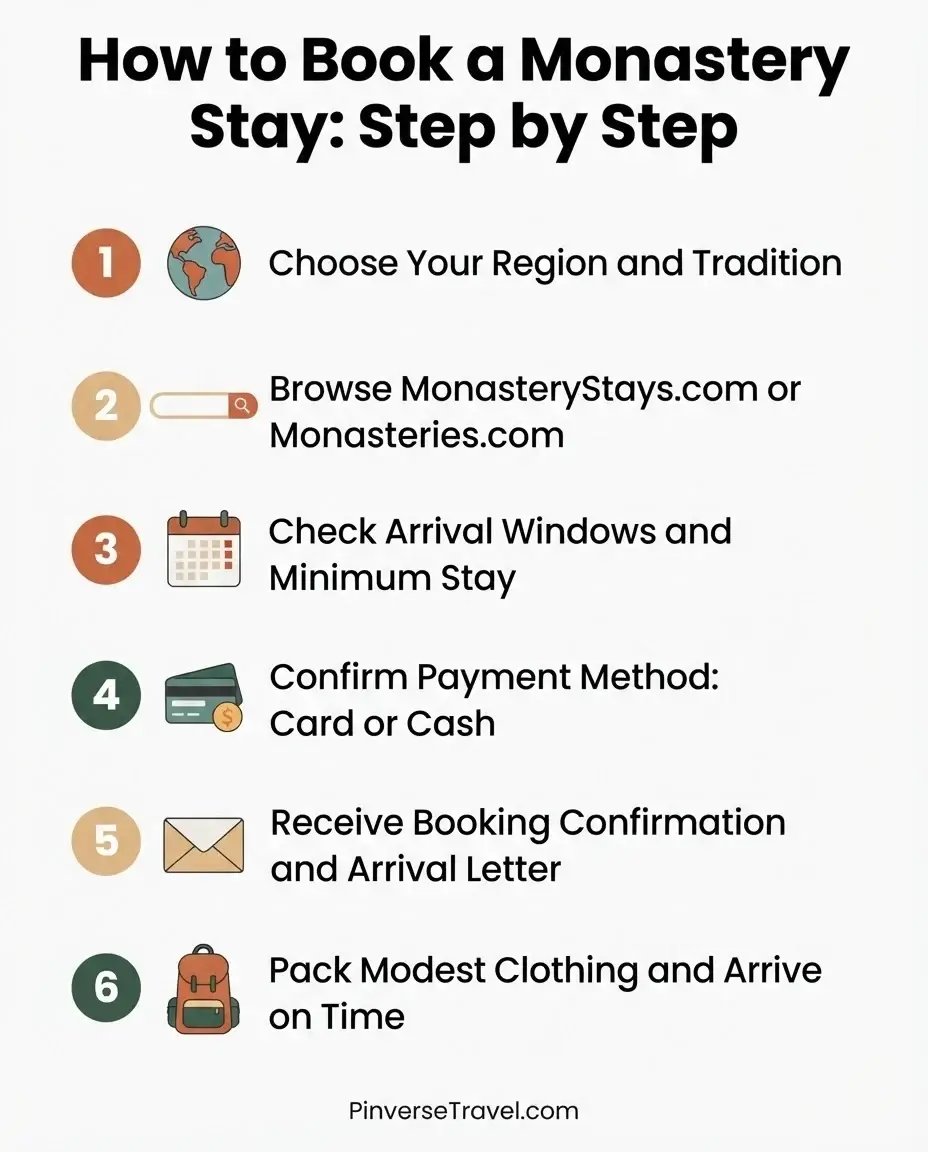
Monastery accommodation does not follow the same booking logic as a hotel. Some properties have live online availability you can book instantly. Others will confirm your reservation within 24 hours of your request. A number of places, particularly smaller or more traditional communities, still operate on a write-ahead-and-wait basis where you email or contact them directly and receive a letter of introduction with your arrival instructions.
The good news is that specialist booking platforms have made this significantly easier in the past decade. For Europe, the two most useful platforms are MonasteryStays.com, which focuses on Italy, Austria, and Slovenia with full online booking and private bathrooms in every listing, and Monasteries.com, which covers a broader geographic range including France, Spain, Portugal, the UK, Germany, Israel, South Africa, and beyond, with options ranging from traditional religious communities to more modern monastery-run hotels.
A few practical points about the booking process itself. Reservations are essential for all overnight stays. Many monasteries do not have a 24-hour front desk, so check-in windows are often restricted, typically between mid-morning and early evening. Read the arrival instructions carefully. Some places require a deposit on booking and the balance in cash upon arrival. You will also frequently see a city tax added at checkout, which is a local accommodation tax paid in cash at the property.
Cancellation policies vary significantly. Some communities are flexible. Others have non-refundable deposits once confirmed. Because these are small, often community-run operations, a late cancellation genuinely affects them in a way it wouldn’t affect a major hotel chain. Book only when you’re fairly confident about your plans, and read the terms before you confirm.
Monastery Stays in Europe: Where to Start
Italy is, by most travelers’ accounts, the easiest country to dive into monastery accommodation for the first time. Convent guest houses are widespread across major cities and rural areas alike, prices are genuinely competitive (typically €40 to €80 per person per night, often including breakfast), and the properties are well-accustomed to welcoming non-religious international visitors.
In Rome, several convents sit within walking distance of the Colosseum, Trevi Fountain, and Piazza Navona. In Florence, Cinque Terre, and the Umbrian countryside, you will find monastery accommodation that puts you inside the landscape rather than next to it. Venice has options too, including island monastery guest houses that put a water view outside your simple, clean window.
Spain is another strong option, particularly for anyone walking or planning the Camino de Santiago, where monastery accommodation has served pilgrims for over a thousand years. Pilgrim hostels connected to monasteries along the Camino routes are cheap, friendly, and full of the kind of fellow travelers you actually want to meet. Santiago de Compostela, Toledo, Granada, and Barcelona all have monastery properties listed on both platforms mentioned above.
France, Portugal, the UK, and Germany round out the European options well, with France in particular having a number of Benedictine and Cistercian communities that accept guests for stays that blend contemplative quiet with access to genuinely beautiful countryside.
For European stays, breakfast is usually included and often surprisingly good. Many monasteries produce their own bread, honey, jams, and preserves. In Spain, keep an eye out for nun-made sweets, particularly the yemas de Santa Teresa pastry that is a specialty of Carmelite convents in Avila. These small food moments are part of what makes a monastery stay memorable in a way a hotel breakfast buffet simply is not.
Japan: The Shukubo Experience
Japan has its own entirely distinct tradition of temple lodging called shukubo, and it is one of the most extraordinary overnight experiences available to any traveler regardless of spiritual interest.
Shukubo began as accommodation for monks traveling long distances between temples. Over time, they opened to pilgrims, and eventually to visitors from around the world. Today, staying in a shukubo means sleeping on a futon laid directly on traditional tatami mat flooring, eating shojin ryori (Buddhist vegetarian cuisine made without meat, fish, dairy, or eggs), and waking early to observe or participate in morning devotional practice.
The spiritual center of Japanese shukubo culture is Koyasan, a mountain temple complex in Wakayama Prefecture that is a UNESCO World Heritage Site. Around 52 temples on the mountain offer guest accommodation, and the experience of walking through the ancient cedar forest of Okunoin cemetery by lantern light at dusk is something solo travelers consistently describe as one of the most affecting moments of their time in Japan. The Japan National Tourism Organization’s official shukubo guide is the best place to understand the full experience before you plan, and the official Koyasan Shukubo Association booking site handles English-language reservations directly for the 51 UNESCO heritage temples on the mountain.
Prices at Koyasan typically run between 6,000 and 15,000 yen per person per night with two meals included. Some temples only accept cash, so confirm payment methods when you book. Morning devotionals are optional but deeply worth attending even if religious practice is not your usual frame of reference. The ritual, the incense, and the pre-dawn quiet have a way of cutting through regardless.
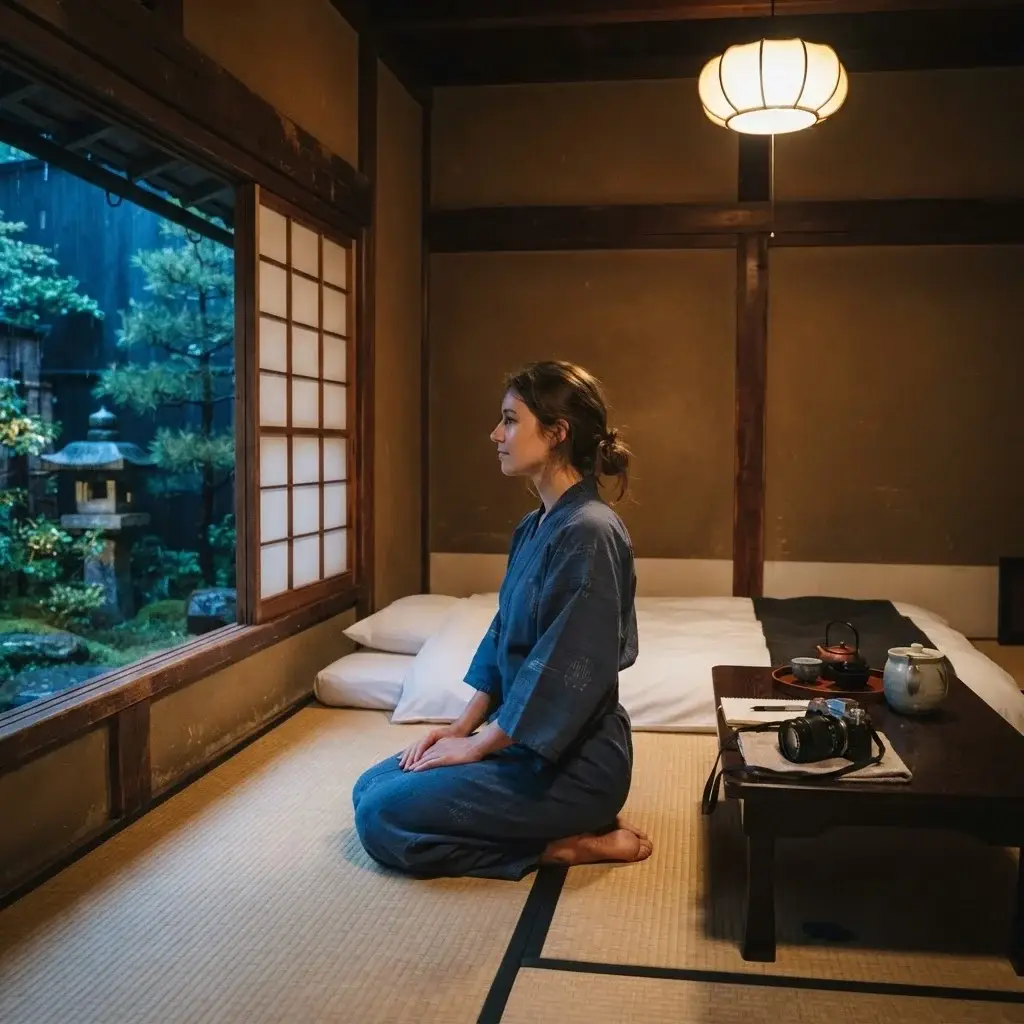
One important note: Japan’s shukubo vary considerably by Buddhist sect, and each has its own style of gongyo (morning prayer practice). Nichiren, Shingon, and Pure Land temples all do things differently. You don’t need to know any of this in advance, just be present and follow the gentle lead of your hosts. For detailed practical information on temple lodgings across Japan beyond Koyasan, Japan-guide.com’s temple lodgings page is an excellent, well-maintained reference.
Thailand: The Free Buddhist Forest Monastery
If you want to understand the purest end of the monastery-stay spectrum, look at Wat Pa Tam Wua in Mae Hong Son, Northern Thailand.
This is a Theravada Buddhist Forest Monastery where the stay is entirely free of charge. Accommodation, vegetarian meals, white practice clothes, and bedding are all provided without payment. Guests contribute through donations if and when they choose to. You can arrive any day of the year and check in between 6:00 AM and 4:00 PM. The recommended minimum stay is three days and the usual maximum is ten.
The official Wat Pa Tam Wua website is clear that this is a working monastery, not a wellness resort or hotel, and they ask that guests arrive prepared to genuinely participate in the daily schedule of meditation sessions, chanting, and communal meals. Electronics are not permitted in meditation areas. Silence is observed during certain periods. You follow the monastery’s timetable, not your own.
From what solo travelers and meditators consistently report, the experience is intense, humbling, and often unexpectedly transformative. People arrive skeptical and leave having understood something about stillness they couldn’t have found in a hotel room. Even if formal meditation practice is not what you’re seeking, the northern Thai landscape around Mae Hong Son is stunning, and the experience of living inside a working monastery for even three days recalibrates your sense of what travel can actually offer.

Thailand, having been the place where I spent a year teaching English, holds a particular warmth for me. The culture of generosity embedded in Theravada Buddhist practice is something you feel in daily life long before you ever visit a monastery. Wat Pa Tam Wua is simply one of its most concentrated expressions.
The Rules, Realistically Speaking
Here is what the rules actually mean for your daily experience, translated out of guidebook language.
Curfews are real and typically fall between 10:00 PM and midnight. In European monasteries, this is usually a locked gate situation rather than anyone waiting up for you. If you want to experience the nightlife of Rome, you can, but you need to be back by the gate time. Plan your evenings accordingly and treat it the way you would a very reasonable landlord’s expectation rather than a punishment.
Dress codes matter more than in a regular hotel. Covered shoulders and knees are the baseline expectation in most Catholic and Buddhist environments. In Japan, you may be provided with a simple yukata robe to wear within the temple. In Thailand, you will be given white clothing to wear. In European convents, your own modest clothing is fine. A light scarf or wrap that can cover your shoulders and double as a beach wrap is genuinely one of the most useful things to have in your day bag.
Noise is the real currency of a monastery stay. Not silence for its own sake, but a mutual respect for the fact that other people are there to rest or reflect. Communal areas are for quiet conversation. Phone calls in corridors are not welcome. This is honestly less restrictive than it sounds, and after the first few hours you usually find yourself not wanting to disrupt the atmosphere anyway.
Meals are communal in many properties and served at fixed times. Missing the breakfast window is a real possibility if you sleep late, so set an alarm. Vegetarian food is the norm in Buddhist settings and very common in Catholic ones too. If you have a serious dietary restriction, flag it when you book, not when you arrive.
Wi-Fi and phone access vary widely. Some European monastery guest houses have perfectly functional Wi-Fi in common areas. Others, particularly more traditional communities and Buddhist forest monasteries, have limited or no connectivity. Treat this as a feature, not a bug.
What to Pack for a Monastery Stay
Packing for a monastery stay is not complicated, but there are specific things that matter more here than in a regular hotel.
Modest clothing is the main one. You need at least two or three outfits where shoulders and knees are covered. Loose-fitting cotton works in every climate and every religious tradition. Avoid anything with large logos, slogans, or anything that reads as party-wear.
Comfortable flat shoes are important for wandering stone cloisters, temple grounds, and garden paths. In Japan, you will be removing shoes frequently, so slip-on styles are easier than anything with complex laces.
Bring cash for European monastery stays. Many properties cannot or prefer not to process card payments, and city tax is almost always cash on arrival. A small coin purse is more useful than you’d think.
Unscented toiletries are a kind choice in shared facilities and expected in some Buddhist communities. Bring a personal towel if you are heading to a more basic accommodation; most properties provide them but it’s worth confirming when you book.
A good book, a journal, or any form of analog entertainment serves you better than relying on your phone in these environments. The rhythm of a monastery stay tends to encourage the kind of slow attention that a screen actively disrupts.

A Few Things That Catch People Off Guard
Minimum stay requirements exist in some properties and are not always obvious upfront. Some monasteries, particularly rural ones offering retreat-style programs, require a two-night or three-night minimum. Check this before you book if you’re planning a one-night stop.
Check-in windows can be narrow. A monastery is not a hotel with a 24-hour desk. If the check-in window is 3:00 PM to 7:00 PM and your train arrives at 8:30 PM, that is a genuine problem. Email ahead and ask about late arrivals. Most communities are accommodating if you communicate in advance rather than surprising them.
Your room will be simple. This sounds obvious but it hits differently when you’ve been on the road and you’re tired. A single bed, a wooden desk, a small window, and quiet. No minibar. No entertainment system. No fluffy robe. If you can embrace that simplicity genuinely rather than tolerating it, the stay becomes something special. If you can’t, a budget hotel is not a lesser choice.
Monastery Stays as a Solo Travel Strategy
The practical advantages for solo travelers stack up quickly. You are paying single-occupancy rates without the punishing solo supplements that hotels frequently add. You are in a genuinely safe, quiet, supervised environment. You are often in a central location (Rome’s monastery guest houses near the Roman Forum are a prime example) at a fraction of what a nearby hotel costs.
But beyond the logistics, monastery stays do something more useful for solo travelers. They remove the default noise of travel, the busyness of tourist trails, the pressure to be somewhere doing something at all times, and replace it with a pace that makes you actually think. Many of the most interesting conversations I’ve had while traveling have happened not in hostels or hotel bars but in quieter places where people are moving more slowly and paying more attention to where they are.
You don’t need to be on a spiritual journey to benefit from that. You just need to be the kind of traveler who is interested in what travel actually teaches you, beyond the photos and the itinerary.
And if you are that kind of traveler, monastery stays are waiting for you.