The Budget Traveler’s Guide to Farm Stays Around the World

There is a particular kind of morning that only happens on a farm. You wake up before your alarm, and instead of traffic noise or the hum of a hotel air conditioner, you hear roosters, wind in the trees, and maybe the low shuffle of animals a few fields over. You pull on your boots, walk outside into cool air, and realize that today you have actual work to do, real work that feeds real people, in a real place, alongside a family who did not ask for a tourist and got something much better instead.
Farm stays are one of the most underused, underrated tools in the budget traveler’s toolkit. They are not glamping. They are not a trendy “experience add-on.” At their best, they are something much more useful: a way to cut your accommodation and food costs to almost nothing while trading in the passive tourist experience for something that actually changes how you see the world.
I have spent a lot of time thinking about what makes travel feel real versus what makes it feel like a very expensive performance. When I backpacked solo across Europe and later lived with a family in Ghana, the moments that stayed with me were not the famous sites. They were the kitchen tables, the evening conversations, the times I was useful to someone instead of just passing through. Farm stays give you that. And if you do it right, they will not drain your bank account either.
This guide covers everything you need to know, whether you are completely new to the idea or already have a tab open with Workaway listings you cannot stop scrolling through.
What a Farm Stay Actually Is (And the Two Very Different Types)
The phrase “farm stay” gets used for two completely different things, and understanding the difference before you start planning will save you a lot of confusion.
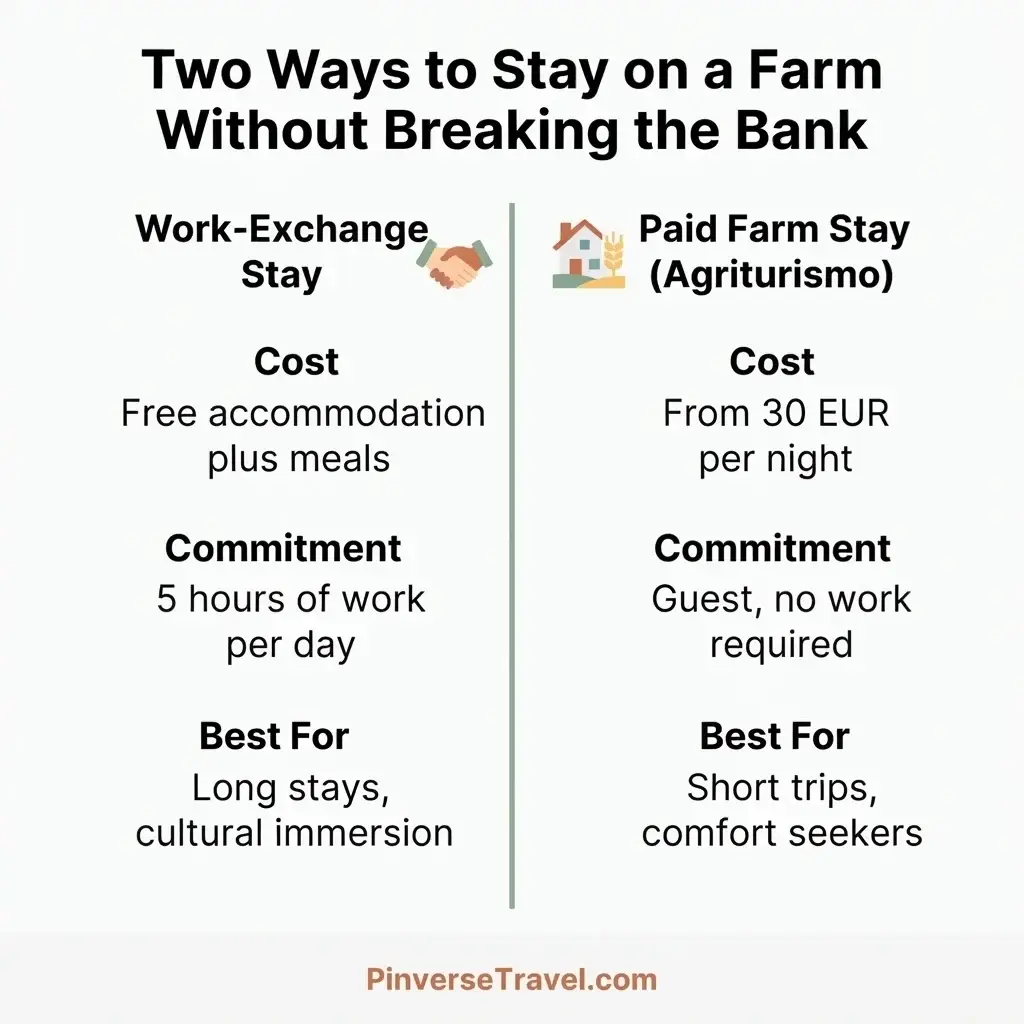
The first type is a paid farm stay: you book a room or cottage on a working farm and pay a nightly rate, but you get to experience farm life, eat fresh food, and enjoy the rural setting as a genuine guest. Italy’s agriturismo model is the most famous example of this, but it exists all over the world. In the United States, directories like FarmStay US connect travelers with working farms, ranches, orchards, and vineyards that offer real guest accommodations, not just a countryside B&B that happens to have a few chickens.
The second type is a work-exchange farm stay: you contribute a set number of hours of help each day (usually around five hours) in exchange for free or near-free accommodation and meals. No money changes hands for lodging. You gain experience, connection, and a home base. The host gains reliable, enthusiastic help. Platforms like WWOOF, Workaway, HelpX, and Worldpackers all operate on this model.
Both types are legitimate options for budget travelers. Paid farm stays are often surprisingly affordable compared to urban hotels, especially in rural regions where land is cheap and the hosts are farming families rather than hotel chains. Work-exchange stays take it a step further, dropping your accommodation cost to essentially zero. Which route you take depends on your flexibility, your schedule, and honestly how much you enjoy getting your hands dirty.
Work-Exchange Farm Stays: The Platforms You Need to Know
This is where most of the budget travel magic happens, so let me walk through the main platforms clearly.
WWOOF (World Wide Opportunities on Organic Farms)
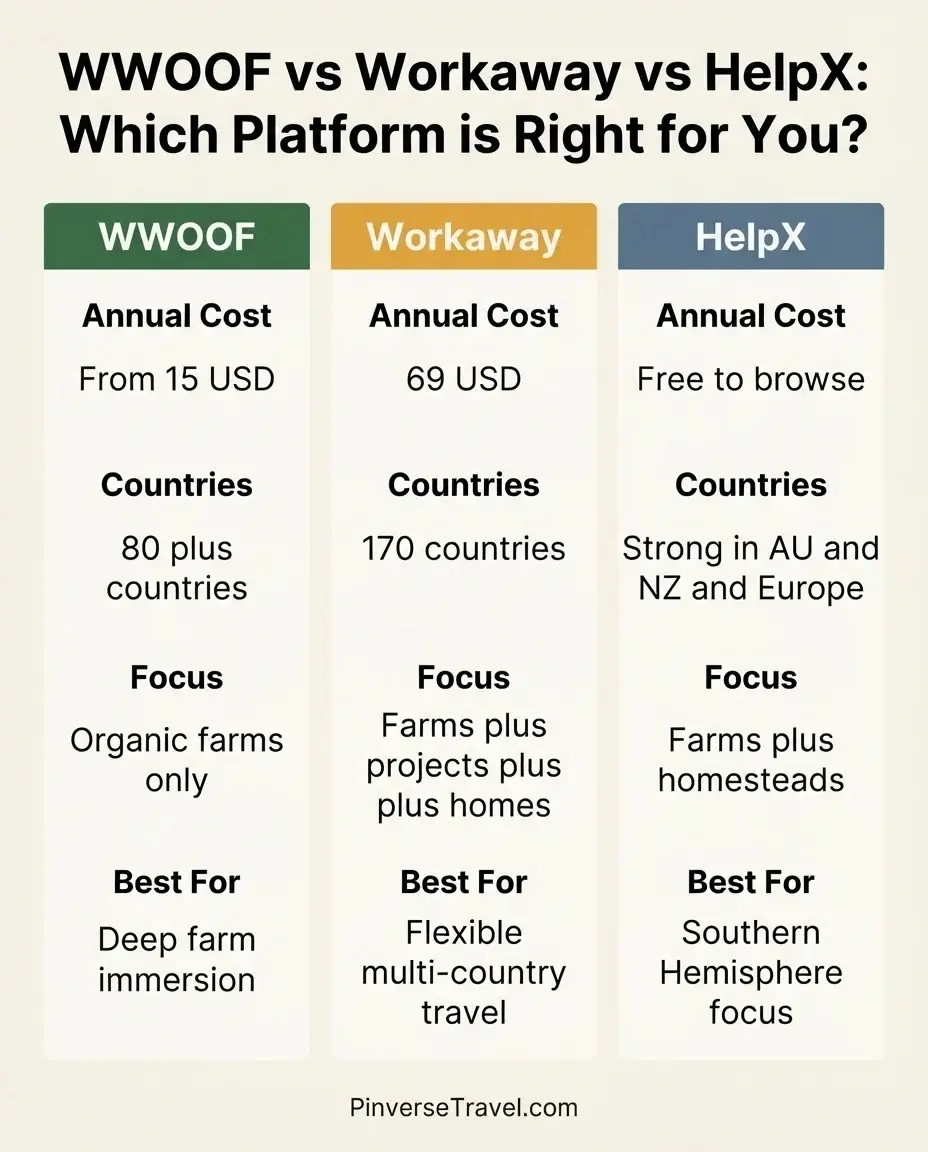
WWOOF is the original. It has been connecting travelers with organic farms since the 1970s, and it now operates in over 80 countries. The model is beautifully simple: as WWOOF explains on their own site, hosts offer accommodation and meals with no money exchanged. You share daily life with the farming family, learn about organic and sustainable agriculture through hands-on work, and get a real window into local life that no hotel could provide.
One important thing to know about WWOOF: it is organized on a national basis. You do not sign up for “WWOOF” globally. You sign up for the WWOOF organization in each country you want to visit. Membership costs vary by country. Looking at the official WWOOF membership pricing page, you will find that some countries like Belgium cost as little as 15 EUR per year, while others like the USA run around $40 per year. Italy is 40 EUR per year, and Korea is around $50 USD per year. These memberships give you access to each country’s host list, so you can browse farms and reach out directly. If you plan to WWOOF in three countries in one year, you will need to buy three separate memberships, but even then the total cost is usually well under $150 USD for a full year of free accommodation and food.
Workaway
Workaway is broader than WWOOF. It is not exclusively farms: it includes hostels, community projects, family homestays, language teaching, and much more. But farms make up a huge portion of the listings, and Workaway’s farm stay section is one of the richest resources available, with hosts across 170 countries looking for help with everything from olive harvesting in Spain to alpaca farming in Peru to rice paddies in Vietnam.
The membership is $69 per year for a solo traveler and $79 for a couple. In exchange, hosts typically ask for around five hours of help per day, five days a week, and in return provide accommodation and meals. What you get varies by host: sometimes it is a private room in the farmhouse, sometimes a shared bunkroom, sometimes a tent or a small cottage on the property. The listings are detailed and include photos, so you know what you are walking into.
HelpX
HelpX works on a similar principle. Hosts list their farms, homesteads, lodges, and ranches, and travelers apply to help in exchange for food and accommodation. HelpX tends to be popular in Australia, New Zealand, and Europe. You can browse listings for free, though a paid membership unlocks full contact details and messaging. It is particularly worth checking if your target destination is not heavily represented on Workaway.
The Honest Comparison
If you are doing one country, WWOOF is usually your best bet for genuine organic farm experience and deep cultural immersion. If you want flexibility across multiple countries and a wider range of host types, Workaway’s annual membership pays for itself fast. HelpX fills in the gaps. Many experienced farm stay travelers use all three, signing up for whichever platform has the best listings in their destination.
Paid Farm Stays That Are Actually Budget-Friendly
Work exchange is not for everyone, and that is completely fine. If you want the farm stay experience without the commitment of daily work, paid options can still be genuinely affordable, especially compared to city hotels.
Italy’s Agriturismo System
Italy has one of the most developed and beloved farm stay cultures in the world. An agriturismo is a working farm that is also licensed to host paying guests, usually serving meals made almost entirely from what the farm produces. The food alone is worth it: olive oil pressed on the property, wine from the vineyard next to your room, vegetables picked the same morning, pasta made by the farmer’s grandmother.
The cost varies widely, but budget options do exist. Italy’s rural portal Agriturismi.it, which has been listing these properties since 1999, shows prices starting at around 30-50 EUR per person per night for bed-and-breakfast style stays, with full-board options often available for not much more. Tuscany commands higher prices because of its fame, but Umbria, Le Marche, Basilicata, and Calabria often offer comparable quality at a fraction of the cost. If you stay during shoulder season (spring or fall rather than peak summer), you will find rates that feel almost impossibly good for what you are getting.
FarmStay US for North American Travelers
If you are based in the United States or want to experience farm life closer to home, the FarmStay US directory is one of the most useful tools available. Since launching in 2010, it has grown into a curated directory of working farms across the country that welcome guests. You will find cattle ranches in Colorado, organic vegetable farms in Vermont, apple orchards in the Pacific Northwest, and vineyard stays in California. Pricing varies by property, but many of these stays are priced comparably to or below what you would pay for a mid-range hotel in the same region, with the added benefit that your money goes directly to the farm family.
The Best Regions in the World for Budget Farm Stays
From what solo travelers and farm stay veterans consistently report, certain regions punch far above their weight for this style of travel.
Southern Europe is extraordinary for both WWOOF and paid farm stays. Greece, Portugal, Spain, and southern Italy all offer warm climates, stunning countryside, and farming families who genuinely love having visitors. An olive harvest in Greece or grape-picking season in Portugal gives you one of those travel weeks you will talk about for years. The cost of living in these countries also means your other expenses (transport, local food, occasional city breaks) stay manageable.
Southeast Asia, particularly Thailand, Vietnam, and Bali, has a growing community of Workaway farm hosts. Given my time teaching English in Thailand, I know how warm and genuinely curious about visitors Thai families can be, and that extends into farm and rural community stays. Rice paddies, herbal gardens, and small-scale permaculture farms dot the landscape, and the cultural exchange element here is particularly rich.
Latin America, especially Mexico, Peru, Colombia, and Costa Rica, has a thriving network of organic farms, cacao plantations, and community projects that welcome volunteers. Spanish is a huge bonus here, but many hosts work with beginners.
New Zealand has a long tradition of farm stays and is one of the most praised destinations for this style of travel in the Southern Hemisphere, particularly for solo travelers who value safety and infrastructure alongside the rural experience.
What Daily Life Actually Looks Like
Here is the part most articles skip over, and it matters.
A typical day on a Workaway or WWOOF farm starts early. Farming runs on nature’s schedule, and “sleeping in” usually means 7:00 a.m. You will eat breakfast with the family or fellow volunteers, then work a block of a few hours on whatever the farm needs that day: weeding vegetable beds, feeding animals, harvesting fruit, fixing fences, processing produce, helping prepare for a market. The work is physical, repetitive, often meditative, and occasionally harder than you expected.
By early afternoon, your working hours are usually done. The rest of the day is yours: reading, hiking the surrounding area, exploring the nearest village, cooking with other volunteers, or simply sitting in a field and doing nothing in particular. Evenings often involve shared meals, which are genuinely some of the best meals you will eat anywhere. Farm-fresh ingredients cooked by people who have been doing it for generations hit different from anything in a tourist-district restaurant.

The most common surprise first-timers report: they expected to feel like cheap labor, and instead they felt like part of a family.
How to Find and Vet a Good Host
Not every listing is a winner. Here is how to separate the great ones from the ones you will regret.
Read every review carefully. On Workaway, both hosts and travelers leave reviews, and the pattern of those reviews tells you everything. A host with consistent, specific, recent praise is almost always worth reaching out to. A host with vague reviews, very few reviews, or gaps in their review history deserves a harder look.
Ask direct questions before you commit. Ask exactly what accommodation looks like (private room, shared room, tent), what the daily schedule is, whether you will have days off, whether there is transportation access to the nearest town, and what the food situation covers. Good hosts welcome these questions and answer them clearly. Hesitation or vague answers are a signal.
Write a genuine application message. Copy-paste applications get ignored by the best hosts. Share something real about why you are drawn to that specific farm, what you hope to learn, and what you bring to the table. Even if your farming experience is zero, enthusiasm and reliability matter enormously to most hosts.
Solo travelers, especially women traveling alone, will be relieved to know that the reputable platforms take safety seriously. Workaway manually screens profiles before publishing them and offers 24-hour support. Checking whether a host has consistent reviews from other solo female travelers is also a reliable indicator of how comfortable the environment will be. The Solo Traveler World guide to WWOOFing is also an excellent resource if you want solo-specific perspective before committing.
What to Pack for a Farm Stay
A farm is not a city. Your usual travel wardrobe will need a few additions.
You need clothes you genuinely do not mind ruining: at least two pairs of work pants or tough leggings, a few long-sleeved shirts for sun and insect protection, and a worn-in pair of closed-toe shoes or light boots. Sandals are not a farm shoe. Bring a lightweight rain layer because outdoor work does not stop for light rain. A good sun hat, reef-safe sunscreen, and insect repellent round out the practical kit. If you are going somewhere cold, thermal base layers make early mornings much more comfortable.
Leave anything precious or dry-clean-only at home. Bring work gloves if you have them. Pack a reusable water bottle because you will drink more than you think. Everything else, keep light.

Common Mistakes First-Timers Make (And How to Sidestep Them)
Booking too short a stay. Most farm stays take a few days just to find your rhythm. If you book for three days and leave right as you are settling in, you miss the whole point. Most experienced farm travelers recommend a minimum of two weeks, and many say the third and fourth weeks are where the real magic happens.
Expecting a vacation. Farm stays are not a rest holiday. They are an active, physically engaged, often surprisingly tiring experience. If you go in expecting to lounge, you will frustrate your host and miss the experience entirely. Go in expecting to contribute, and the relaxation you find in the evenings will feel genuinely earned.
Choosing based on location alone. The farm’s location matters less than the host’s personality and communication style. A warm, communicative host on a small vegetable farm in rural Portugal will be a far better experience than an unresponsive host on a picturesque vineyard in France. Let the reviews and the quality of pre-arrival communication guide you more than the photos.
Forgetting travel insurance. Farm work involves physical activity, and accidents happen. Budget travel insurance is inexpensive and non-negotiable when you are doing hands-on work in a foreign country.
The Real Reason to Do This
I want to be honest with you about something.
The money savings are real. On a work-exchange stay, your accommodation and food costs can drop to nearly zero for weeks at a time. That is a genuine, practical advantage for budget travelers. But that is not actually why the people who have done this keep recommending it to everyone they meet.
They recommend it because of the farmer in Catalonia who spent an entire evening teaching them how to press olives and why it matters. Because of the other volunteers from six different countries who became friends around a shared dinner table. Because of what it feels like to fall asleep genuinely tired from useful physical work in open air, and wake up the next morning into a morning that feels like it belongs to you.
That is what travel has always meant to me: not just seeing a new place, but actually being in it. Farm stays are one of the best ways I have found to make that happen at any budget level. If you have been sitting on this idea, trying to figure out whether it is worth the leap, this is me telling you it is. Start with a short stay, pick a host with excellent reviews, and pack clothes you can get dirty. The rest takes care of itself.