
Hotel Loyalty Programs 101: How to Score Your Free Nights

There was a stretch of my travels when I paid full price for every single hotel room. Every night. No exceptions. I did not know any better, and honestly, I thought loyalty programs were something frequent business travelers used, not backpackers and solo explorers like me. Then a friend offhandedly mentioned she had just checked into a four-night stay and paid for only three of them. I asked how. She looked at me like I had been living under a rock.
She had not done anything exotic. She had signed up for a hotel rewards program, stayed at the same brand a handful of times, and redeemed her points. That was it.
I want to save you from the same slow realization I had. Hotel loyalty programs are genuinely one of the most accessible ways to reduce your travel costs, and they are nowhere near as complicated as they seem from the outside. This guide walks you through how they work, which ones are worth your time, and the practical steps to start earning free nights, even if you are relatively new to traveling.
What a Hotel Loyalty Program Actually Is
At the most basic level, a hotel loyalty program is a membership you join for free. When you stay at hotels within that brand’s portfolio, you earn points. When you accumulate enough points, you redeem them for free nights. That is the core loop, and everything else is a variation on it.
Every major hotel group runs one. Marriott has Marriott Bonvoy. Hilton has Hilton Honors. Hyatt has World of Hyatt. IHG (which owns Holiday Inn, Kimpton, and InterContinental, among others) has IHG One Rewards. Wyndham, one of the largest hotel groups in the world by property count, runs Wyndham Rewards. Choice Hotels runs Choice Privileges.
Most programs are free to join, require no minimum stay commitment, and have no annual fee unless you add a co-branded credit card. You can stay at a program’s hotels for years at the basic member tier and still earn free nights. Elite status, which unlocks perks like complimentary upgrades and late checkout, is a bonus, not a requirement.
Why Solo Travelers Have a Hidden Advantage
This is something I wish more people talked about. Solo travelers are actually well-positioned to benefit from loyalty programs for a few reasons.
First, flexibility. When you travel alone, you make decisions without needing to align schedules or preferences with a partner or group. You can choose hotels based on which brand will get you closest to a free night. You can be strategic in ways group travelers simply cannot.
Second, you book a room for one, which means you can choose budget-friendly properties within a program’s portfolio and earn points at a lower nightly rate. The points per dollar ratio is the same regardless of how expensive your room is, but cheaper rooms let you accumulate more nights more affordably.
Third, solo stays are often shorter, which means you might be mixing programs across a trip. This is fine, and it is actually a good reason to pick one or two programs as your focus and stay consistently loyal rather than scattering stays across five different brands with nothing to show for it.
The Big Programs, Briefly
Rather than an exhaustive feature-by-feature comparison, here is what genuinely matters as a beginner.
World of Hyatt consistently ranks as one of the best programs for point value. Free nights start at just 3,500 points at off-peak Category 1 properties, and the program is known for strong redemptions relative to what you earn. The World of Hyatt program overview shows that members earn up to 5 base points per dollar on qualifying stays and that there are four membership tiers: Member, Discoverist, Explorist, and Globalist. The tradeoff is that Hyatt has a smaller global footprint than Marriott or Hilton, which matters less if you are flexible about where you stay but can be limiting in some destinations.
Marriott Bonvoy is the largest hotel loyalty program in the world by portfolio size, covering over 30 brands and 10,000 properties across 141 countries. For travelers who want maximum flexibility in where they use their points, that breadth is a genuine advantage. Bonvoy also has a “Stay 5, Pay 4” benefit: when you redeem points for five consecutive nights, the lowest-value night is free. You can read exactly how that works on the official Marriott help page for Stay 5 Pay 4. Points values vary widely depending on the property, so this program rewards people who take time to research before booking.
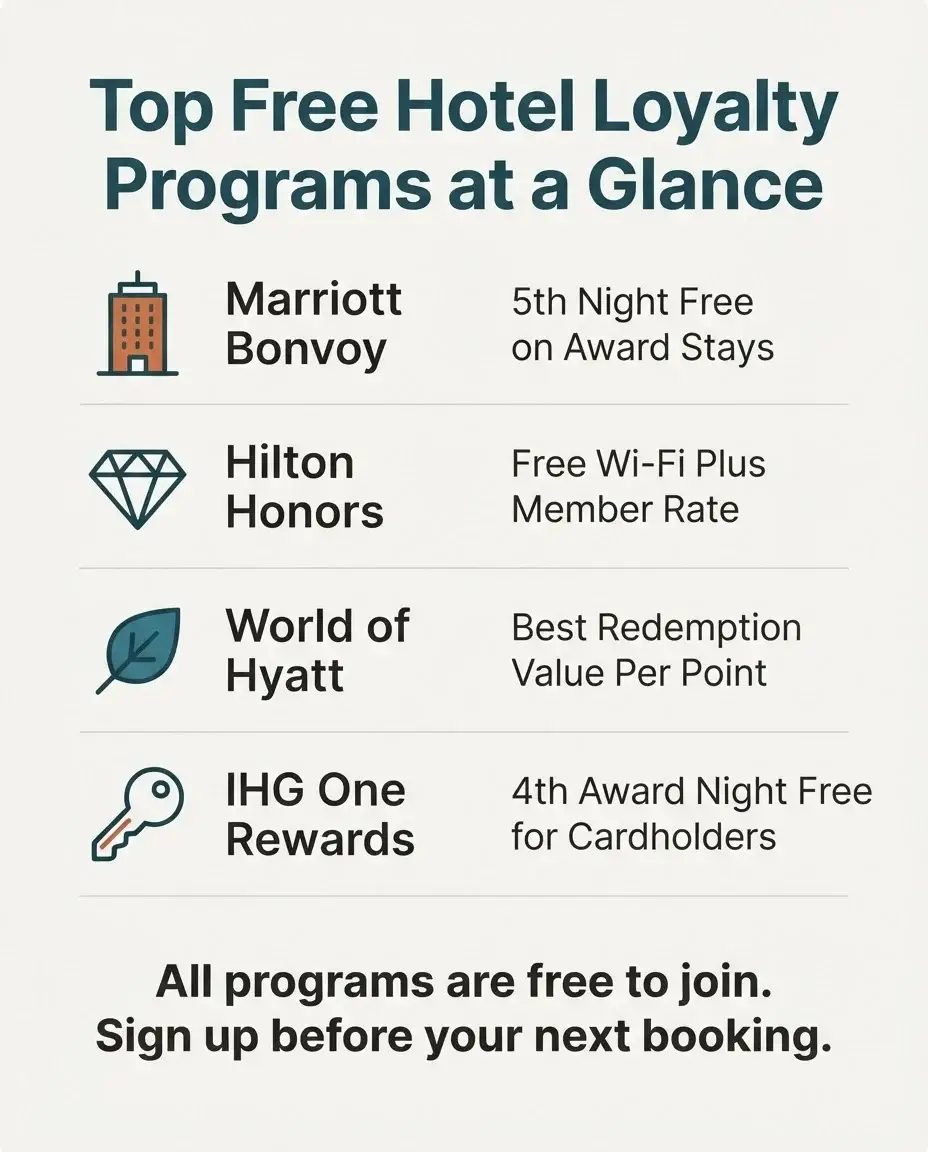
Hilton Honors is one of the easiest programs to join and use, largely because Hilton properties are everywhere. The program’s standout perk is the fifth night free benefit: when you book a standard room award stay for five or more consecutive nights using 100% of your points, every fifth night costs you nothing in points. According to the Hilton Honors member benefits page, this benefit is available to Silver status members and above. Silver status is easy to reach (just 10 nights or 4 stays) and the fifth night free can be used up to four times per award stay. The caveat is that after a round of devaluations in 2024 and 2025, luxury Hilton properties now cost significantly more points than before, so this program rewards careful property selection.
IHG One Rewards covers a huge range of properties, from budget Holiday Inn Express locations to luxury InterContinental and Six Senses resorts. Reward Nights start at 10,000 points, and IHG earns 10 points per dollar on qualifying stays. The IHG One Rewards redemption page also shows a Points + Cash option if you want to stretch your points further without waiting for a full award. IHG’s sweet spot is mid-range travel where you can get solid properties for reasonable point amounts.
Wyndham Rewards is often overlooked by the points community but is genuinely one of the most beginner-friendly programs available. Free nights start at just 7,500 points per night at thousands of properties worldwide. With Wyndham’s 2-free-nights summer offer structure, the program has run promotions offering 7,500 to 15,000 bonus points after qualifying stays, which is enough to cover a free night almost immediately. If you want your first free night as fast as possible, Wyndham is worth serious consideration.
The Fastest Way to Earn Free Nights Without Living in Hotels
Here is the piece beginners often miss: you do not have to stay at dozens of hotels to earn a free night. The fastest path for most people runs through a hotel co-branded credit card.
Every major program has at least one associated credit card. The typical structure works like this: you apply for the card, meet a minimum spending requirement in the first three months (usually somewhere between $1,000 and $4,000 USD depending on the card), and receive a welcome bonus that can be worth anywhere from 30,000 to 150,000+ points. That bonus alone is often enough for one or more free nights.
Beyond the welcome bonus, co-branded cards typically earn extra points on everyday purchases like dining, groceries, and gas, in addition to bonus points at the hotel brand itself. Some premium cards also include an annual free night certificate, meaning you receive one free night every year just for renewing the card. That single perk can easily be worth more than the card’s annual fee if you use it for a room that would otherwise cost $150 to $300.

You can compare how the major programs stack up for this kind of earning through a reference like NerdWallet’s travel loyalty program reviews, which ranks programs by point value and overall benefits.
A critical note if you are not a US resident or credit card eligible: you can still earn points meaningfully through hotel stays, hotel dining, program shopping portals, partner transfers (some programs allow points transfer from airline frequent flyer programs or credit card rewards currencies like American Express Membership Rewards), and occasional promotions that award bonus points for specific activities. It takes longer, but it works.
The Expiration Problem Nobody Warns You About
This is the mistake that costs people the most and gets the least attention in beginner guides.
Hotel points expire. The rules vary by program, and if you let an account go dormant long enough, you can lose everything you have earned. The general policies look like this: Hilton Honors points expire after 24 months of inactivity. Marriott Bonvoy points expire after 24 months of account inactivity (or up to four years from the stay checkout date for points from that stay). IHG One Rewards points expire after 12 months of inactivity, which is the shortest window of the major programs. Wyndham points expire after 18 months of inactivity. World of Hyatt points expire after 24 months of inactivity.
“Inactivity” typically means no points earned or redeemed during that period. The easiest way to reset the clock is to earn even a small number of points, whether through a hotel stay, a purchase through the program’s shopping portal, or any other qualifying activity. A detailed breakdown of each program’s expiration rules is available at One Mile at a Time’s hotel points expiration guide, which tracks policy changes as they happen.
The practical takeaway: pick one or two programs, stay active in them even during periods when you are not traveling much, and you will not lose a single point.

What “Redeeming” Actually Looks Like
Earning points is the part people understand. Actually using them for free nights is where beginners sometimes freeze up.
When you log into your program account, you will typically see a search interface just like a normal hotel booking tool. You enter your destination, dates, and number of guests, and you filter by award availability. Most programs show you both the cash price and the point price side by side. You pick the award night option, confirm your booking, and your points are deducted.
A few things to know before you book:
Not every room type is available on points, so standard rooms are nearly always available for award redemptions while suites may require more points or have limited availability. Book as early as possible for popular dates, since award inventory can disappear fast. Most programs allow free cancellation on award bookings up to a certain deadline, so booking early to lock in availability and canceling if plans change is a legitimate strategy. And if you are booking five or more nights, check whether your program’s “fifth night free” or “stay 5 pay 4” benefit applies, because that is a meaningful saving.
How to Choose Your First Program
If you are starting from zero, trying to sign up for every program at once is a fast way to earn too few points in too many places and end up with nothing redeemable. Pick one primary program and build there first.
Ask yourself three questions. Which hotel brand do you most often stay at or realistically will stay at based on where you travel? Which program has properties in the destinations on your near-term travel list? And which program offers a credit card welcome bonus good enough to give you a meaningful head start?
For most beginner travelers who want the fastest path to a free night, Wyndham Rewards or World of Hyatt tend to offer the clearest value. Wyndham wins on accessibility and low redemption thresholds. Hyatt wins on point value and redemption quality.
For travelers who want maximum global flexibility and do not mind a slightly more complex earning curve, Marriott Bonvoy’s enormous property portfolio is hard to beat.
Common Beginner Mistakes Worth Avoiding
Splitting stays across too many brands is the biggest one. Loyalty means concentration. If you stay two nights at Marriott, two at Hilton, and two at Hyatt on the same trip, you have earned points in three places and a free night in none of them.
Not reading the expiration policy before your points age out is the second most common and most painful mistake. Set a calendar reminder to check your account balances every six months.
Booking through third-party sites like Expedia or Booking.com is another trap. Most hotel loyalty programs do not award points on stays booked through third parties, only on stays booked directly through the hotel’s own website or app. Always book direct.
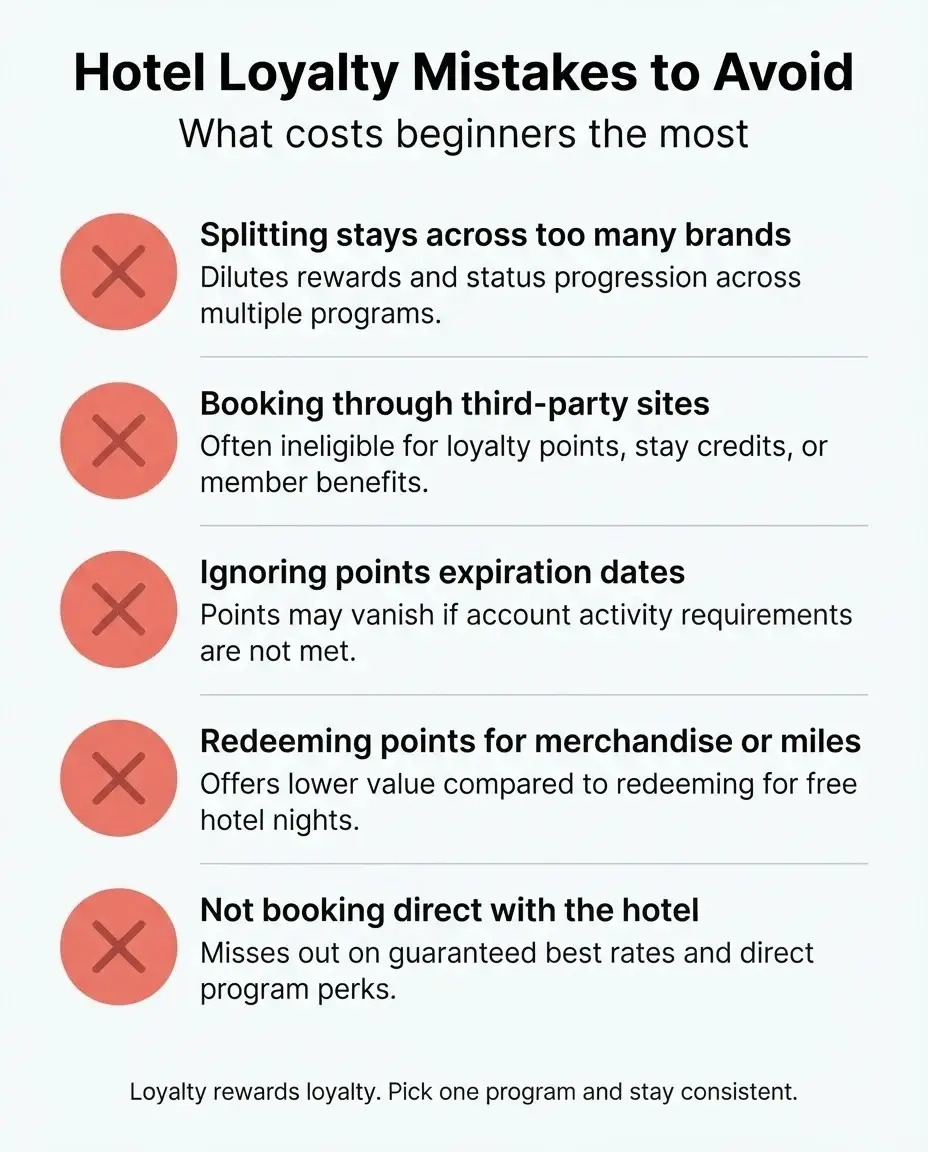
Redeeming points for low-value options like merchandise, gift cards, or airline miles at a poor transfer ratio is a waste. Points are almost always most valuable when used for hotel nights at properties with high cash rates. A $300 room night redeemed for 15,000 points is a much better value than transferring those same 15,000 points to an airline at a conversion rate that yields 6,000 miles.
A Simple First 30 Days Plan
If you want a clear starting point, here is what I would do. Week one: pick one program and create your free account. Week two: identify the next two or three hotel stays you realistically have coming up and make sure to book directly through the program. Week three: look at the program’s co-branded credit card to see if a welcome bonus makes sense for your spending habits and financial situation. Week four: explore the program’s dining and shopping portal, because you can earn points on purchases you were already making. That is it. No complexity required in the beginning.

Once you have your first free night in your sights, the whole system starts to feel less like a points hobby and more like a practical travel tool, which is exactly what it should be.
Free hotel nights are not a trick, a hack, or something reserved for people with complicated spreadsheets. They are the natural result of being consistent, loyal to one or two programs, and attentive to how your points are being earned and spent. If you can do those three things, the free nights follow.
Start today. Even if you have a single trip planned six months from now, signing up before that stay means you do not leave those points on the table.