Best Budget Airlines for International Travel: Real Talk

There is a specific feeling that comes with finding a $189 fare to a country you have been thinking about for two years. Your stomach drops a little. You open a new tab. You start doing math you have never done before, like whether you could skip eating out for six weeks.
I know that feeling well, because cheap flights are the reason my twenties looked the way they did. When I was backpacking solo through Europe, the low fare was often the only thing standing between “I’ll come back someday” and “I’m going Thursday.” Later, when I was teaching English in Thailand, I watched how completely normal it was for people around me to hop between countries on carriers that would have looked shockingly bare-bones to my New York self a few years earlier.
So this is not a piece where I tell you budget airlines are a trap. They are not. They are a tool. But they are a tool with sharp edges, and the travelers who get hurt are almost always the ones who thought they were buying a normal plane ticket. Let’s fix that.
First, understand what you are actually buying
A budget airline is not a discount version of a regular airline. It is a different product entirely.
Legacy carriers bundle. Your fare includes a seat assignment, a checked bag on most international routes, a meal, a customer service phone line, and, crucially, the ability to put you on another airline’s plane if yours breaks. Budget carriers unbundle all of that and sell you the metal tube and nothing else. Every additional thing has a price tag, and those price tags are where the airline actually makes its profit.
This is not sneaky once you see it clearly. It is the entire business model. The fare is low because you are buying less. Your job as the traveler is to add back only the things you genuinely need, and to walk away when the rebuilt total stops making sense.

The travelers I see get burned are the ones who book on price alone, arrive at the airport with a normal-sized suitcase, and get handed a bill that is triple what the flight cost. That is not bad luck. That is not reading the fare rules.
The budget airlines actually worth flying right now
Quality varies enormously in this category, and the gap between a well-run low-cost carrier and a chaotic one is huge. The most useful independent benchmark is the annual passenger survey behind the Skytrax World’s Best Low-Cost Airlines rankings, which named AirAsia the world’s best low-cost airline for the sixteenth year running in 2025, with Scoot taking best long-haul low-cost, Eurowings best in Europe, and Allegiant Air best in North America. The rest of that 2025 top seven ran IndiGo, Vueling, Volotea, and Transavia.
Here is how I would think about it by region.
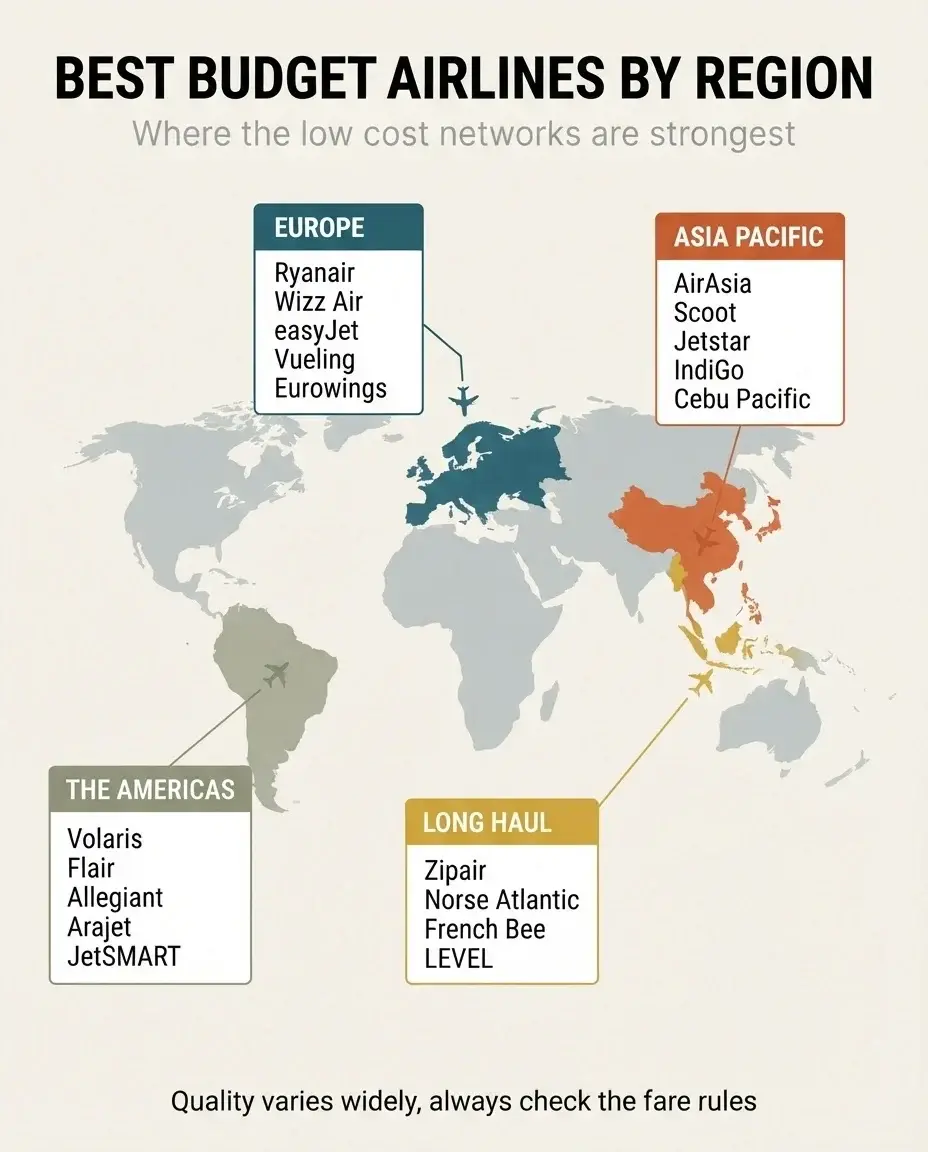
Europe: dense, cheap, and ruthless about bags
Ryanair, Wizz Air, easyJet, Vueling, Transavia, Volotea, and Eurowings blanket the continent, and the fares can be genuinely absurd in the best way. Ryanair is the strictest and the cheapest, and it now includes one free small personal bag of 40 x 30 x 20 cm that must fit under the seat. Anything bigger becomes a paid add-on. Wizz Air runs a similar model with an aggressive membership discount scheme. easyJet tends to be slightly gentler on the rules and slightly higher on the fare. Eurowings and Transavia sit closer to a mainline experience.
For a solo traveler stringing together a Europe trip, these airlines are transformative. They are also the ones most likely to fly you into an airport that is nowhere near the city on the ticket, which we will get to.
Asia-Pacific: the most mature budget market on earth
AirAsia, Scoot, Jetstar, IndiGo, Cebu Pacific, VietJet, and Peach have made regional flying in Asia feel like taking a bus. The service standard is generally warmer than the European equivalents, the fares are low even by low-cost standards, and the route networks reach small places that legacy carriers ignore. If your trip involves more than two countries in Southeast Asia, you are almost certainly flying one of these.
Scoot deserves particular attention because it is one of the few carriers doing genuinely long-haul low-cost well, and it is backed by Singapore Airlines.
Long-haul across oceans: better than it used to be
This is the category that has changed most. Zipair, Norse Atlantic, French Bee, LEVEL, AirAsia X, and Scoot now run real intercontinental routes at prices that were unthinkable a decade ago.
Zipair is my favorite example of how to read a long-haul budget fare properly. Its published rules let you bring two carry-on pieces free as long as the combined weight stays under 7 kg, which is not much once you add a laptop. Meanwhile the Zipair checked baggage charges run 11,000 yen for a single bag from Narita to Los Angeles, or 85 US dollars in the other direction. So a “cheap” transpacific fare with one suitcase each way is roughly 170 dollars more than the number that caught your eye. Still often a good deal. Just not the number on the ad.
Norse Atlantic runs a similar structure on the North Atlantic, with fare bundles where the cheapest tier includes a cabin bag but charges for everything else. The pattern repeats everywhere: the headline fare is real, and it is also incomplete.
The Americas
Flair and Lynx-style carriers in Canada, Volaris, Viva, and Arajet across Mexico and the Caribbean, Allegiant and Spirit and Frontier in the United States, and Sky and JetSMART down in South America. Reliability is the weak point in this region more than price, so build slack into your plans.
Do the real math before you click book
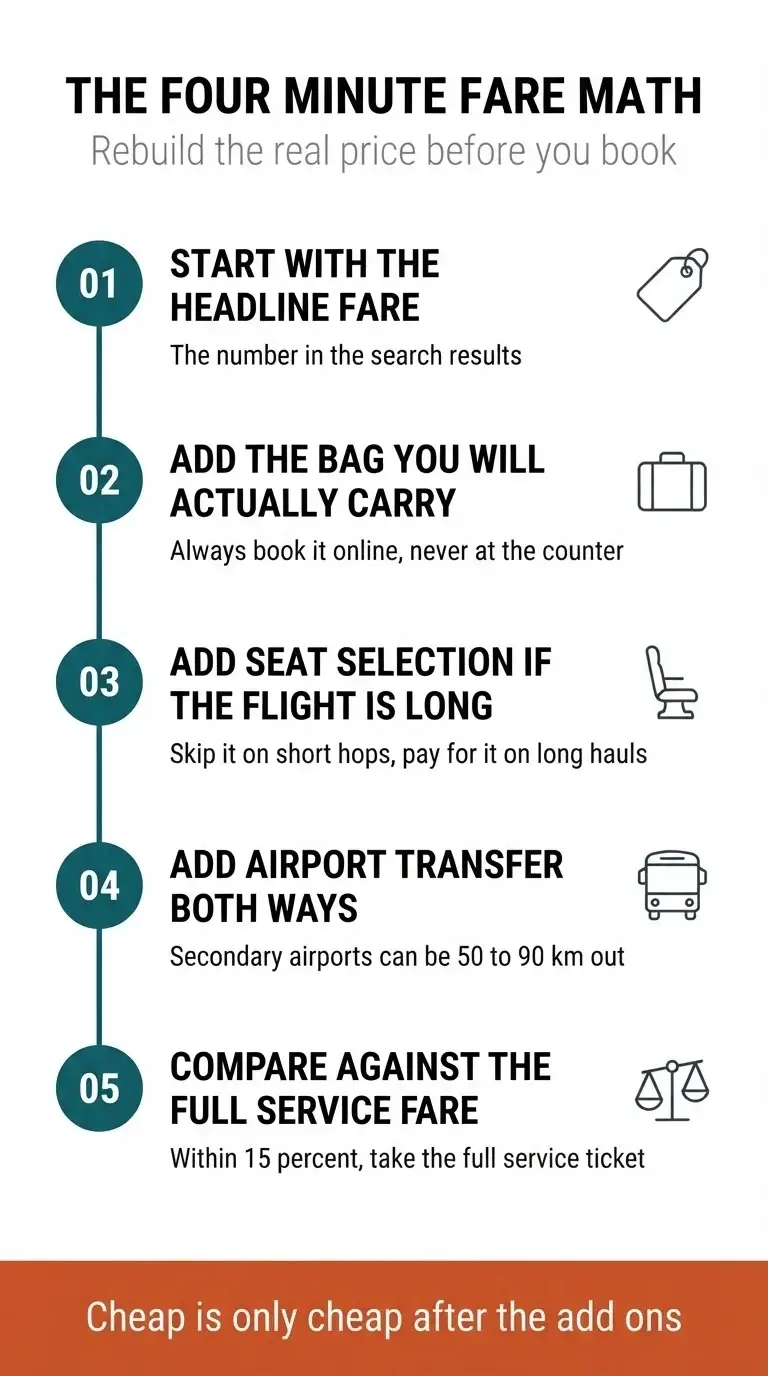
This is the single skill that separates people who love budget airlines from people who curse them. It takes four minutes.
Open the budget fare and the legacy fare side by side. On the budget one, add: the bag you will actually carry, seat selection if you cannot bear a middle seat on a long flight, and airport transfer at both ends. On the legacy one, add nothing, because it is usually already there.
Then compare. Sometimes the budget fare is still 300 dollars cheaper and you book it happily. Sometimes it comes within 40 dollars of a full-service ticket that includes a meal, a bag, and a real rebooking department, and the answer becomes obvious.
The airport transfer trap
Budget carriers save money by flying into airports with cheaper landing fees, and those airports are frequently a long way out. Paris Beauvais is the classic example. It is marketed as Paris and it is about 85 km north of it. The official Paris Beauvais airport shuttle to Porte Maillot or La Villette costs 17.90 euros one way or 29.90 euros return when booked online, takes around an hour and a half depending on traffic, and the airport itself recommends catching a bus at least three and a half hours before your flight when heading out. That is roughly 36 euros and half a day, both directions, on top of your fare.
Milan Bergamo is friendlier. The airport is about 50 km from central Milan and the official Milan Bergamo bus page lists four separate operators running to Milano Centrale, which keeps fares competitive at around 8 to 10 euros and departures frequent. Frankfurt Hahn, Stockholm Skavsta, and Tokyo Narita for some Zipair connections all deserve the same check.
Before you book, search the airport code, not the city name, and find out exactly how you get to your actual bed.

The 2 a.m. problem
Cheap fares cluster at unpleasant hours. A 6:10 a.m. departure from a secondary airport means either a 3 a.m. taxi or a night in the terminal. If you are going to spend 70 dollars on the taxi, that flight was not cheap. Solo travelers should weigh this twice, since arriving somewhere unfamiliar at 1 a.m. is the situation where I would happily pay more to arrive at 4 p.m. instead.
Are budget airlines safe?
Yes, and I want to be direct about it because this fear stops a lot of first-time international travelers.
Low-cost carriers operate under the same certification, maintenance, and crew training requirements as everyone else in their jurisdiction. Many of them fly newer, more fuel-efficient fleets than legacy airlines, because new aircraft burn less fuel and fuel is their biggest cost. A cheap ticket is not a cheap airplane.
What matters is not the fare model but the regulatory environment the airline operates in. The European Commission maintains an air safety blacklist, and its June 2025 update to the EU Air Safety List brought the total to 169 banned carriers, almost all of them from countries whose civil aviation authorities were found unable to provide adequate oversight. If you are ever flying a small domestic operator in an unfamiliar country, that list is a genuinely useful sanity check, and it has nothing to do with whether the airline is budget or not.
Booking smart, not just cheap
Use the 24-hour window. If you are flying to, from, or within the United States, the Department of Transportation requires airlines to let you either cancel for a full refund within 24 hours or hold the fare for 24 hours, on tickets bought at least seven days before departure. The DOT refunds guidance also confirms that when an airline cancels or significantly changes your flight and you choose not to travel, you are owed your money back, not a voucher, and that refunds must be processed within seven business days for card payments. Note that this window applies to airlines directly, not to third-party booking sites, which is one of several reasons I lean toward booking on the airline’s own website.
Book the bag in advance, always. Airport-counter bag prices are punitive by design, often double or triple the online rate. Zipair adds a 1,000 yen administration fee just for paying at the counter. Decide at booking.
Be careful with self-transfers. Two separate tickets on two separate airlines is often the cheapest way across a continent, and it is also the riskiest thing you can do. If the first flight is late and you miss the second, no one owes you anything. If you do it anyway, and sometimes it is worth it, leave an absurd cushion. Four hours minimum, overnight if the flights are long, and never check a bag through a connection that is not on one ticket.
Screenshot everything. Fare rules, bag dimensions, your boarding pass. Budget carriers run lean customer service and the burden of proof lands on you.
Know your rights, because they are better than you think
This is the part almost every budget-airline article skips, and it is the part that saves you hundreds.
If you are flying within Europe, or departing from Europe on any airline, or arriving in Europe on a European airline, you are protected by EU261. That means fixed compensation when you arrive more than three hours late for reasons within the airline’s control: 250 euros for flights up to 1,500 km, 400 euros for intra-EU flights over 1,500 km and other flights between 1,500 and 3,500 km, and 600 euros for longer journeys. It also means the airline must feed you and house you during long delays regardless of the cause. This applies to a 29 euro Ryanair ticket exactly as it applies to a business class seat.

The rules were just rewritten. In July 2026 the European Parliament confirmed a major overhaul of air passenger rights by 646 votes to 12. Compensation levels survive intact, the three-hour threshold survives, reimbursements become automatic when you choose a refund instead of rerouting, passengers get nine months to file a claim and airlines get 30 days to respond, and there is a new guaranteed right to bring one personal item on board at no cost, with fares required to display prices inclusive of carry-on luggage from the start of booking. Airlines also lose the ability to charge for correcting a misspelled name or printing a boarding pass after check-in.
One honest caveat: this is not live yet. The Council still has to confirm it, and member states and airlines then get a full year to implement. So plan your 2026 trips under the current rules and treat the new ones as good news arriving later.
The United Kingdom runs a mirrored version called UK261. The Civil Aviation Authority’s guidance on delays sets compensation at 220 pounds for flights under 1,500 km, 350 pounds for 1,500 to 3,500 km, and up to 520 pounds for long-haul arrivals more than four hours late, plus a right to food, communication, and overnight accommodation while you wait. Keep every receipt. If the airline will not help you at the airport, buy your own reasonable meal and claim it back.
In the United States there is no equivalent compensation regime for delays, which is worth factoring in when you compare a European budget carrier to a domestic one.
How to actually enjoy the flight
Pack to the airline, not to the trip. Measure your bag at home with a tape measure. Weigh it with a luggage scale. The 7 kg limits common in Asia and on long-haul budget carriers are real and enforced, and yes, they weigh your personal item with it. Wear your heaviest layer and boots onto the plane. Keep liquids to the standard 100 ml containers in a quart bag so you never risk a checked bag you did not pay for.
Eat before you board. No free meal means either buying overpriced onboard food or planning ahead, and planning ahead is more fun anyway. Airport food is one of the genuinely great low-effort cultural experiences: onigiri and a bento at Narita, focaccia and a panino at Bergamo, pastéis de nata at Lisbon, a bowl of noodles at Bangkok Don Mueang, jamón and tortilla at Spanish terminals. Buy something after security, bring an empty water bottle to fill at a fountain, and you have solved dinner for four euros instead of fourteen.

Decide honestly about seats. On a two-hour hop, take the random assignment. On a ten-hour crossing, paying 40 dollars for a window seat you can lean against is not a luxury, it is sleep. Budget carriers often have less recline and tighter pitch, so a neck pillow, an eye mask, and downloaded entertainment on your own device matter more than they would on a legacy carrier.
Buy travel insurance separately. Budget carriers will not rebook you on another airline when things collapse, because they have no interline agreements. Insurance covers the gap that the fare does not.
When a budget airline is the wrong call
I want to be balanced here, because “cheapest always wins” is bad advice.
Skip the budget option when you are flying to catch something unmissable the next day, like a cruise, a wedding, or a connecting long-haul on a separate ticket. Skip it when the total after bags lands within 15 percent of a full-service fare. Skip it when the schedule forces an arrival in the middle of the night in a place you do not know. And skip it when you are carrying gear you cannot afford to lose or replace.
The savings are only savings if they do not cost you the trip.
The part that actually matters
Somewhere in the middle of all these fee tables is the thing I do not want you to lose sight of. Budget airlines are the reason ordinary people with ordinary savings accounts get to stand in places that used to be reserved for the wealthy. They are the reason a semester abroad in Australia turned into a habit for me instead of a one-time story. They are democratizing in a way that is easy to sneer at and hard to overstate.
So learn the rules, do the four-minute math, measure your bag, and then book the thing. A slightly cramped seat that gets you somewhere new beats a comfortable one that stays on the ground. You will not remember the legroom. You will remember the morning you woke up in a country you had only ever seen in photographs.