How to Find Cheap Flights Every Time: A Beginner’s System

For a long stretch of my twenties, the flight was the reason I did not go anywhere.
I would sit at my desk in New York, open a search tab, see a number that made my stomach drop, and quietly close it again. Then I would tell myself I would look again next month, when things calmed down, when I had saved a bit more. That cycle went on for years, and it had nothing to do with money. It had everything to do with not knowing what I was doing.
What finally changed things was not a secret website. It was building a process I could run the same way every single time, so the price stopped feeling like luck and started feeling like something I had some control over. That process is what I want to hand you here.
First, let’s kill the myths that are wasting your time
There is no magic day of the week to book. There never was. The old advice about Tuesday at 1pm came from a time when airlines loaded fares manually on a weekly schedule. Pricing is algorithmic now and it moves constantly.
Incognito mode does not lower prices. Neither does a VPN, in most cases. Airlines price seats based on how many are left in each fare bucket, how far out you are, and demand on that route. Your browser history is not the lever people think it is. When prices appear to jump after you search, you are almost always watching a fare bucket sell out, not a website punishing you.
And “cheap” is not a fixed number. This is the one that trips people up most. If you do not know what normal costs, you cannot recognize a deal, and you will either overpay or refuse a genuinely good fare because it feels like a lot.
Know what “cheap” actually means before you start
Here is a useful anchor. According to the Bureau of Transportation Statistics fare data for the first quarter of 2026, the average U.S. domestic itinerary fare was $428, up 4.7% from the previous quarter. One-way tickets averaged $305 and round-trips averaged $522. Those figures do not include checked bags, seat selection, or anything else you add at checkout.
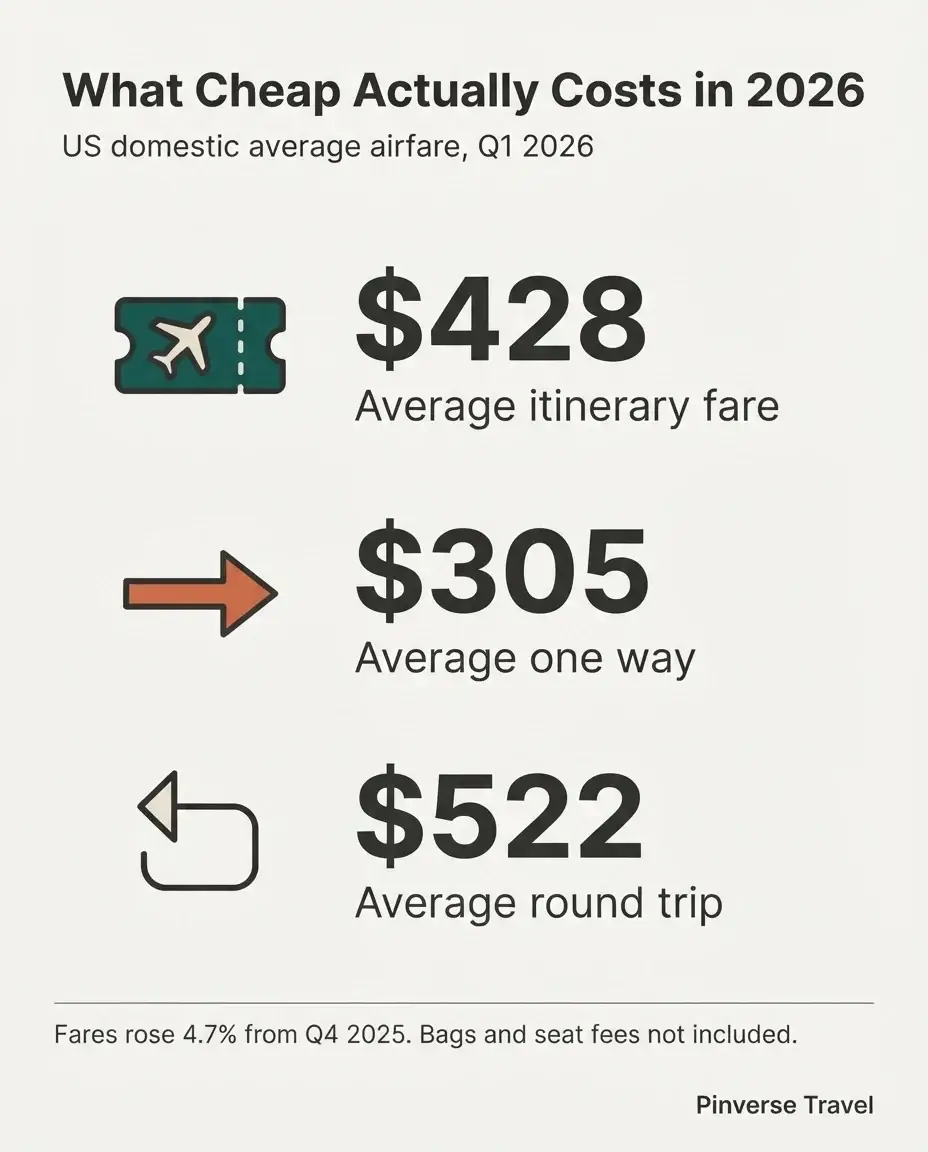
So if you are looking at a $310 domestic round-trip, you are already well under the national average. That is a real deal, and you can stop agonizing.
Industry forecasts for 2026 point to fares drifting upward as fuel and operating costs rise, which means the habit of waiting for prices to collapse is a losing strategy this year. Skill matters more than patience right now.
For international routes, build your own benchmark instead. Pick your route, search it three or four times over a few weeks, and write the numbers in a note on your phone. After a month you will have a personal baseline, and you will know a good fare when you see one because you will have watched the range with your own eyes.
Flexibility is the whole game, and it comes in three flavors
Everyone says “be flexible.” Almost nobody explains what to flex.
Flex your dates. This is the biggest single lever. Departing on a Tuesday or Wednesday instead of a Friday routinely changes the price of the same seat by a meaningful margin, because business and weekend leisure demand cluster around Thursday through Monday. Red-eyes and early morning departures price lower for the same reason: fewer people want them. Shoulder season, the few weeks on either side of peak, is where the real savings live. In much of Europe, that is May and late September rather than July.
Flex your airports. When I backpacked around Europe on almost nothing, the single habit that stretched my budget furthest was refusing to treat one airport as the only door into a city. Most large metro areas have two or three viable airports, and secondary ones are often served by low-cost carriers at dramatically lower fares. Just do the arithmetic on the ground transfer before you celebrate. A fare that saves you $60 but drops you two hours outside the city at 1am, with a $45 bus and a hostel check-in you will now miss, is not a saving.

Flex your destination. This is the one that changed how I travel. Instead of asking “how much to Lisbon,” ask “where can I go from here for under $400.” Both Google Flights and Skyscanner let you leave the destination blank and browse a whole map by price. Some of the most formative trips of my life happened because I let the price choose the country and then got curious about wherever it landed. That is not settling. That is how you end up somewhere you never would have thought to research.
The search routine I run before every booking
Same steps, same order, every time. It takes about fifteen minutes.
Step one: map the price landscape. I start on Google Flights with the destination and rough month, then open the price graph and the date grid. The official Google Flights guidance on finding the best fares explains something most people miss: the results split into a “Best” tab and a “Cheapest” tab, and the Cheapest tab pulls in extra itineraries from online travel agencies that may involve self-transferring your luggage between connections or flying out of one airport and back into a different one. Those are real trade-offs, not free money. Read what you are actually buying.
The tips panel is genuinely useful too. When it tells you prices are lower than usual for this route, or likely to rise, that is drawn from historical pricing on that specific route rather than a generic guess.
Step two: cross-check somewhere else. Google Flights does not show every carrier. Southwest sells only through its own site, and various regional and low-cost airlines are inconsistently included. Run the same search on Kayak or Skyscanner, then check the airline’s own website for anything promising. Booking direct with the airline is usually worth a small premium, because when something goes wrong, a third-party booking means two customer service queues instead of one.
Step three: try the split. Price the round-trip, then price two separate one-ways, potentially on different carriers. On international routes this occasionally beats the round-trip fare outright. The catch is that two one-ways are two independent contracts, so if the outbound is cancelled you have no protection on the return. Worth the check, worth the awareness.
Step four: set the alert and walk away. Turn on price tracking and let the algorithm do the watching. You can track a specific flight, a route on fixed dates, or a route with “any dates,” which emails you when the monthly minimum drops meaningfully. Then close the tab. Refreshing a fare eleven times a day does nothing except make you anxious and more likely to panic-book.
So when should you actually book?
The honest answer is that there is a window, not a day.
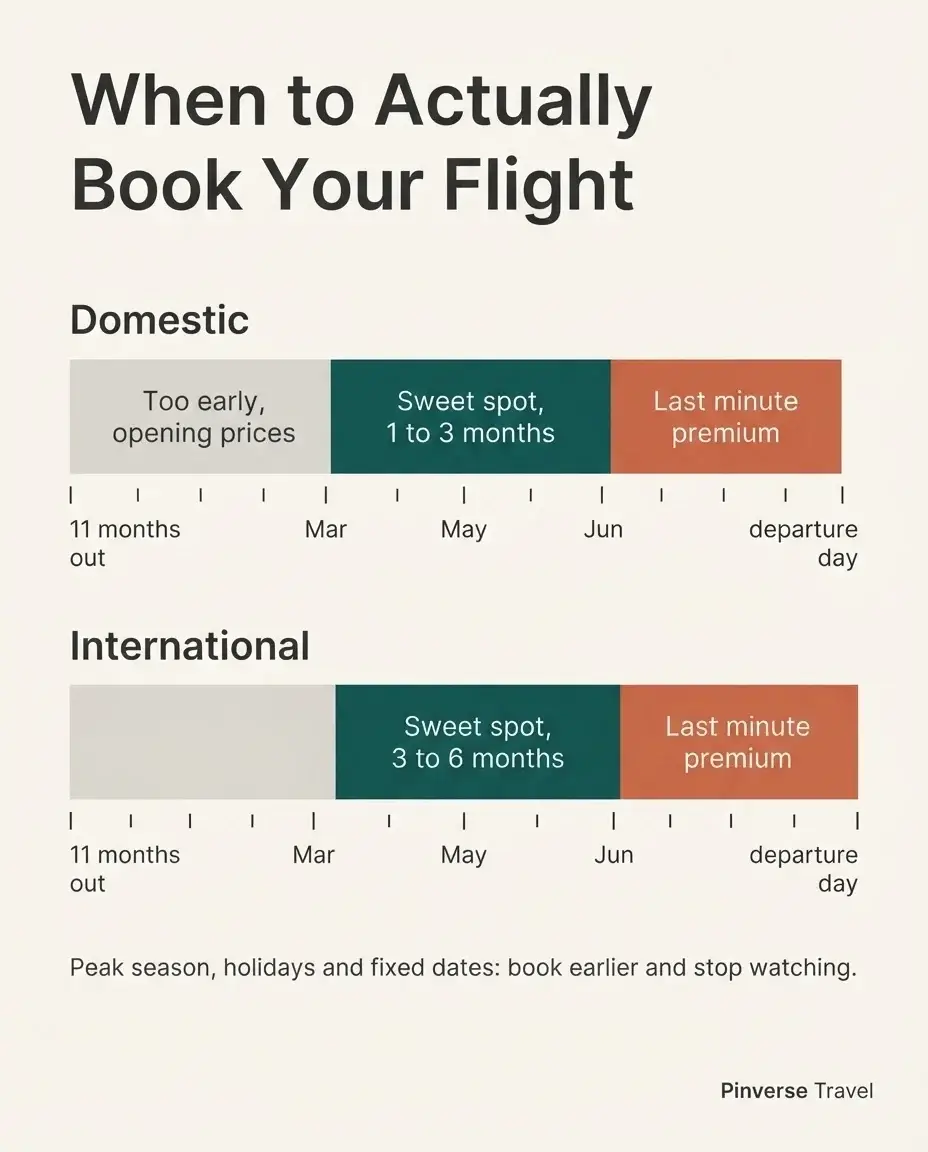
For domestic trips, the sweet spot generally falls somewhere between about one and three months out. Book inside two weeks and you are paying the last-minute premium. Book eleven months out and you are often buying the airline’s opening price before any competitive adjustment has happened. For international travel, push the window earlier, roughly three to six months, and earlier still for peak summer, Christmas, and any destination with a short high season.
Two things override all of that. If you need specific dates, especially around a holiday or a fixed event, book earlier and accept the price. Flexibility is what buys you the luxury of waiting, and if you do not have flexibility, waiting is just gambling. And if the fare you are looking at is clearly below your researched baseline, take it. Trying to squeeze out another forty dollars is how people lose three hundred.
Routing moves that genuinely work, and one that can get you banned
Positioning flights. Sometimes a cheap long-haul departs from a hub two hours away rather than your home airport. Booking a separate short flight or bus to reach it can still come out ahead. Give yourself a generous buffer, ideally an overnight, because a separate ticket means the long-haul carrier owes you nothing if the first leg is late.
Open-jaw and multi-city. Flying into one city and out of another often costs the same as a round-trip and saves you from doubling back. For overland travel it is almost always the smarter shape. When I hiked in China, the itineraries that made sense on the ground were rarely the ones that returned to where I started.
Layovers as free stopovers. Several airlines let you break a long journey in their hub city for a day or several days at no extra fare. It is essentially a second destination for the price of a hotel.
Skiplagging, and why I do not recommend it. Hidden city ticketing means booking a flight with a connection through the city you actually want, then walking away at the layover because that fare is cheaper than flying there directly. It is not illegal. It does violate the contract of carriage of most major airlines, which means they can cancel your return, strip your frequent flyer account, or ban you. You also cannot check a bag, and any schedule change can reroute you around the very city you were aiming for. For a solo traveler on a tight budget, a cancelled return in a foreign country is a catastrophic downside for a modest upside.
Mistake fares. They are real and they do get published. They also get cancelled. Since a 2015 Department of Transportation policy change, airlines can void a genuinely mistaken fare as long as they refund you and cover documented out-of-pocket costs. So enjoy the thrill, but do not book non-refundable hotels until the ticket is confirmed and issued.
The fare is not the price
This is where cheap flights stop being cheap.
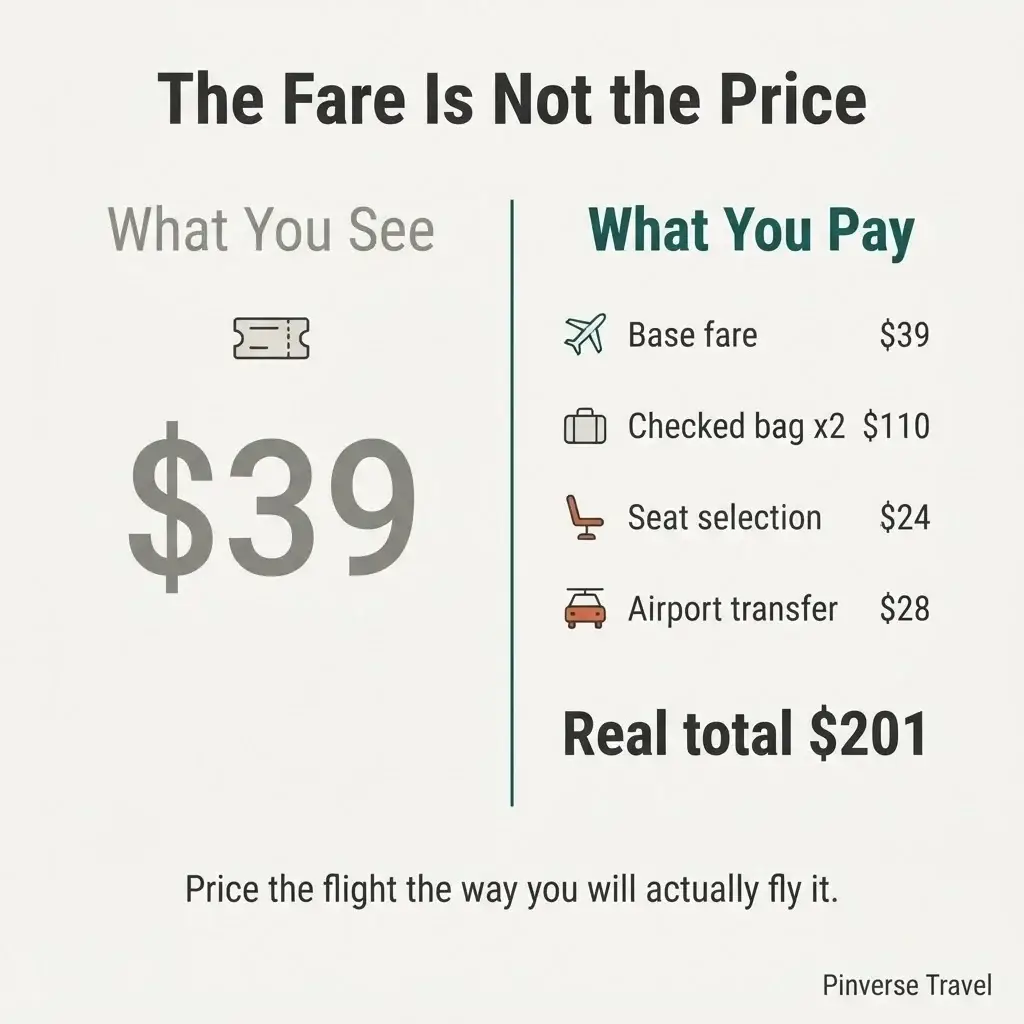
Basic economy fares typically exclude seat selection, often exclude a carry-on beyond a personal item, board last, and cannot be changed. Budget carriers price bags, seats, printed boarding passes, and sometimes even the airport check-in desk as separate items. A $39 fare with a $55 bag fee each way is a $149 flight.
Worth knowing: the 2024 U.S. rule that would have required airlines to display these ancillary fees upfront alongside the fare was struck down in court in early 2026, and the Department of Transportation has since restored the older, looser disclosure requirements. In practice that means the burden of finding the real total is back on you. Price the flight the way you will actually fly it: your bag, your seat, and the ground transport at both ends. Then compare.
I do this on a single line in my notes app. Fare, bags, seats, airport transfer in, airport transfer out. The winner changes more often than you would expect.
Points and miles, without turning it into a second job
Points can absolutely cut your costs, particularly on long-haul routes where cash fares are brutal. A single well-timed welcome bonus can be worth more than a year of careful searching.
Two cautions. First, only chase a sign-up bonus if you can hit the spending requirement on purchases you were going to make anyway. Interest charges will erase the value of any award ticket almost instantly. Second, understand that points are not money in the bank. The Consumer Financial Protection Bureau’s circular on credit card rewards programs documents how commonly programs devalue points that consumers have already earned, bury conditions in fine print, and make redemption harder than the marketing suggested. The practical lesson is simple: earn points for a trip you intend to take reasonably soon, and redeem them. Hoarding is how people watch their balance quietly lose a third of its value.
Protect yourself for the twenty-four hours after you book
This is the part almost no cheap-flights article covers, and it is the part that has saved travelers the most money.
For flights touching the United States, the Department of Transportation’s refund rules require airlines to either let you cancel for a full refund within 24 hours of booking, or hold your fare for 24 hours without payment, as long as you booked at least seven days before departure. That gives you a free option. Book the good fare, then spend the evening confirming your dates, your accommodation, and your time off. If it does not work, cancel clean.
One important limit: this rule applies to airlines, not to online travel agencies. If you booked through a third-party site, you are governed by that company’s own policy, which may be far less generous. That alone is a strong argument for booking direct.
You are also entitled to a refund, not just a voucher, if the airline cancels your flight or makes a significant schedule change and you choose not to travel. Refunds are due within seven business days for credit card purchases.
If you are flying within Europe, or departing from Europe on any airline, learn the EU air passenger rights rules before you go. Arriving at your final destination three or more hours late entitles you to compensation of €250 to €600 depending on distance, unless the cause was genuinely extraordinary, and weather or air traffic control decisions do count as extraordinary while most mechanical problems do not. Airlines also owe you meals, and a hotel if you are stuck overnight. When I was moving around Europe on the cheapest possible tickets, I had no idea any of this existed. Plenty of travelers are owed money they never claim.
Two airport-side habits that quietly pay for themselves
Skip the line. If you fly even three or four times a year, TSA PreCheck at $85 or less for five years is one of the highest-return purchases in travel, and Global Entry at $120 includes PreCheck plus expedited U.S. entry. The real value is not the time. It is that expedited screening lets you book tighter, cheaper connections with less anxiety, and it removes one of the more stressful moments of solo travel.
Eat before security, not after. Airport food is where a carefully saved $80 evaporates. My rule is a real meal before I leave, a refillable bottle in my bag, and something substantial packed for the flight. On long layovers, walk away from the central terminal food court toward the staff areas and gates at the far ends, where prices tend to drop. In many Asian airports, including the ones I passed through while teaching in Thailand, the staff canteens and the small local counters serve genuinely good food at a fraction of what the international chains near the main concourse charge. A bowl of noodles for a few dollars, eaten sitting on the floor by a window, is one of my favorite parts of a long transit day.

One honest note on flying less, better
Cheap fares make it tempting to take four weekend trips instead of one three-week journey. I would push back on that gently, and not only for environmental reasons.
The ICAO Carbon Emissions Calculator is the internationally recognized tool for estimating the emissions of a given flight, and running your itinerary through it once is a genuinely clarifying exercise. But the argument I find more persuasive is the travel one. Fewer, longer trips are cheaper per day, less exhausting, and vastly better for actually understanding a place. The months I spent living with a family in Ghana taught me more than any string of short trips ever could have. Slow travel is not just the ethical choice. It is the better deal.
The checklist, condensed
Set your baseline by searching the route several times over a few weeks. Search with flexible dates first and specific dates second. Check at least two search tools plus the airline’s own site. Compare the round-trip against two one-ways. Price the full cost including bags, seats, and ground transport. Set a price alert and stop refreshing. Book direct when the price is close. Use your 24-hour window to confirm everything else. Screenshot your confirmation and know your rights before you fly.
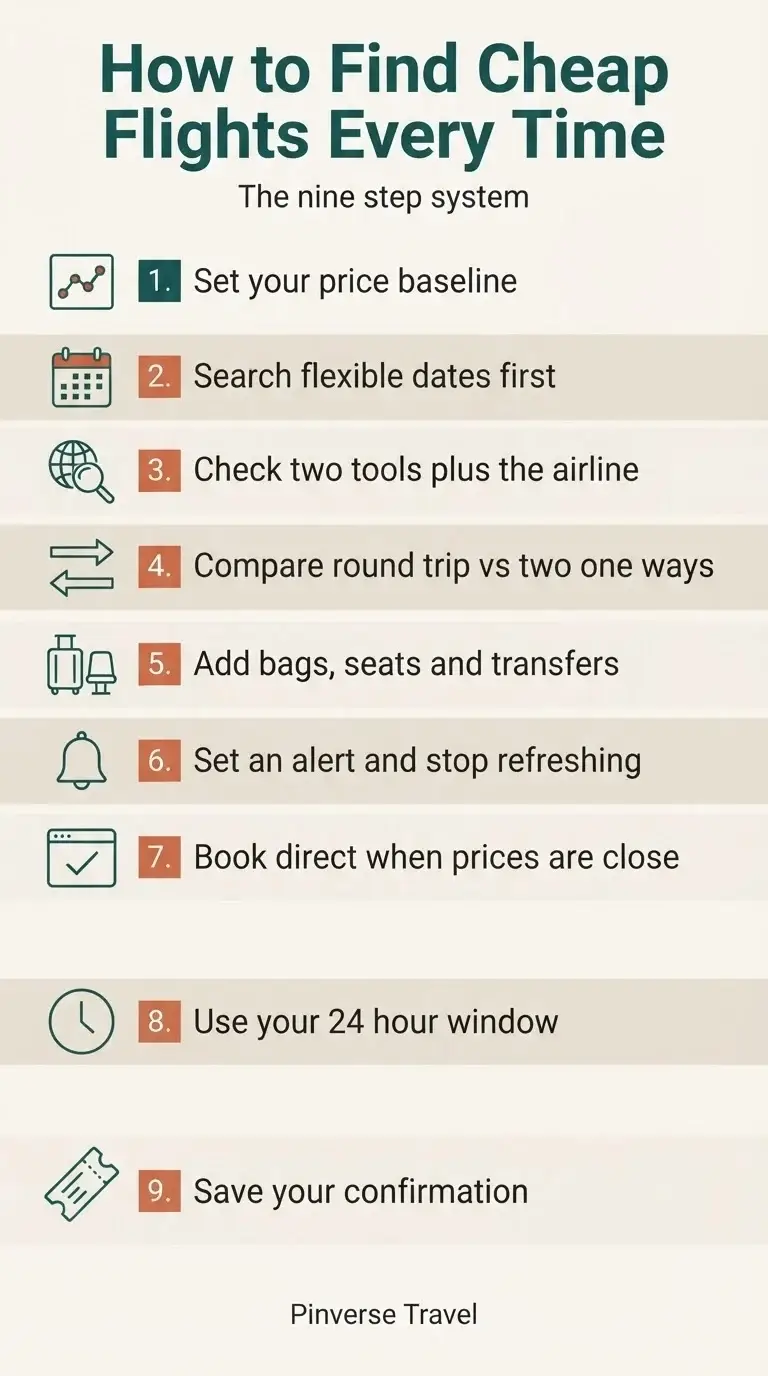
Run that sequence every time and you will not need luck. You will just have a system, and the system will keep working long after any individual trick stops.
The last thing I want to say is the thing I wish someone had said to me while I was closing all those tabs. A perfect fare is not a prerequisite for going. It is a nice bonus. The trip is the point, and the trip only starts when someone finally books it.