Best Websites to Find Flight Deals: A Beginner’s Walkthrough

For a long time, the flight was the thing that stopped me. Not fear of being alone in a new country, not the language barrier, not even the packing. It was that one number on a screen that made the whole dream feel unreasonable. Back when I was working an office job in New York and quietly saving for a backpacking trip through Europe, I understood the trip as a math problem. Every dollar I didn’t hand over to an airline was another two or three days I could stay on the road.
So I want to walk you through this the way I wish someone had walked me through it. Not a list of twenty sites you’ll never open again, but a small set of tools, a repeatable routine, and the honest limits of each one. Because the truth is that finding a good fare is less about a secret website and more about knowing where to look, when to look, and when to stop looking and just book the thing.
First, understand what you are actually up against
Airfare feels random because it mostly behaves that way from the outside. Airlines run pricing systems that adjust constantly based on how full a plane is, how far out you are, what your competitors are charging, and what day of the week people tend to fly that route. You are not being singled out. You are just watching a machine breathe.
Some context helps calm the panic. According to the Bureau of Transportation Statistics, the average U.S. domestic air fare hit $428 in the first quarter of 2026, up about 4.7 percent from the previous quarter, with round trips averaging $522 and one-way tickets averaging $305. That number does not include checked bags, seat selection, or any of the extras. Knowing the average matters, because it gives you a reference point. If you’re staring at a $310 domestic round trip, you’re doing fine. Stop torturing yourself over $18.
The second thing to understand is that there are three different kinds of websites in this game, and confusing them is where most beginners lose money.
Aggregators search everywhere and sell nothing. They scan airlines and online agencies, show you results, and then hand you off. Google Flights, Skyscanner, and Momondo work this way.
Online travel agencies, or OTAs, actually sell you the ticket. Expedia, Priceline, and dozens of smaller names sit here. Some are excellent. Some are cheap for a reason, and you find out why when you need to change something.
Airline websites are the source. Slightly less flexible for comparison shopping, considerably better when something goes wrong.
The pros use all three. Aggregators to find the fare, airline sites to book it whenever the price is the same or close.

The sites worth your time, and what each one is genuinely good for
Google Flights: your starting point, almost always
If you only learn one tool, learn this one. Google Flights is the fastest interface in the category, and its real advantage is context rather than raw price. It tells you whether today’s fare is low, typical, or high compared to the past year on that route. It shows a calendar grid with prices for days on either side of your dates. It lets you set a price alert and then go live your life while it watches the fare for you.
The feature that changed how I think about trip planning is the Explore map. Enter your home airport, leave the destination blank, pick a rough month, and watch the world load with prices on it. That single view turns “I can’t afford to travel” into “I can afford these eleven places, which one interests me most.” That reframe is worth more than any coupon code.
Where it falls short: Google Flights doesn’t include every budget carrier, and it does not fold baggage fees into the headline price by default. On a Ryanair or Frontier fare, bags can quietly double what you pay.
Skyscanner: the best tool for people who don’t know where they’re going
Skyscanner earns its place because of flexibility. You can type “Everywhere” as your destination, and you can search a whole month instead of fixed dates. Skyscanner’s own explanation of the Explore Everywhere search lays out the steps clearly: pick your departure airport, choose Everywhere or Anywhere, then select exact dates, a specific month, or “cheapest month,” and the results come back sorted cheapest first.
For a first solo trip, this is a genuinely useful way to plan. Instead of falling in love with one expensive city and then feeling defeated, you let the price help you shortlist, then you research which of those places suits a solo traveler right now.
Skyscanner also rates the third-party booking sites it sends you to, based on user reviews. That small star rating has saved a lot of travelers from a bad agency.

Momondo and Kayak: the deep search
Momondo and Kayak are owned by the same company and return very similar results, but Momondo does one thing almost nobody else does: it can fold checked baggage fees into the displayed price. There’s a fee assistant where you tell it how many bags you’re bringing, and it re-sorts the results accordingly. For anyone flying budget carriers, that’s the difference between a real comparison and a fantasy one.
Independent airfare testing has repeatedly put Momondo at or near the top for raw price performance, especially on advance-purchase international fares. It’s slower than Google Flights and the interface is busier, but if you’re booking something expensive, it deserves a second search.
ITA Matrix: the power tool almost nobody uses
Here’s the one that separates casual searchers from people who consistently find good fares. ITA Matrix is the airfare shopping engine built by ITA Software, now part of Google, and it’s the underlying technology that helped shape modern flight search. It does not sell tickets. It just searches, with an absurd level of control.
You can tell it how many extra stops you’ll tolerate, restrict or require specific airlines, search multiple airports at once, and run flexible date grids across a whole month. Then you take the exact itinerary it finds and book it on the airline’s site.
It looks like software from 2009 and there’s a small learning curve. Give it twenty minutes anyway. Once you can read a Matrix result, you will never again wonder whether a search engine is hiding something from you.
Kiwi.com and the self-transfer question
Kiwi built its reputation on virtual interlining, which means stitching together flights from airlines that have no partnership with each other. Sometimes that produces a genuinely clever route at a genuinely low price, especially around Europe and Southeast Asia.
Understand the tradeoff before you book. When you self-transfer, you collect your bag, exit, and check in again on a separate ticket. If the first flight is late, the second airline owes you nothing. Kiwi sells its own guarantee to cover that gap, which is exactly the point: the protection you’d get automatically on a single ticket becomes a product you have to buy.
My honest take is that self-transfer is a fine tool once you’ve traveled a bit and can handle a missed connection without spiraling. For a first trip, pay a little more for one ticket and one airline’s responsibility.
Deal alert services: for people who are flexible about where
Services like Going, Jack’s Flight Club, and Secret Flying work differently. They don’t search for your trip. They find unusually cheap fares and mistake fares, then tell you about them. Free tiers exist for all of them, with paid tiers offering faster alerts and more routes.
This only works if you’re genuinely flexible. If you need Denver to Lisbon on specific March dates, alerts will frustrate you. If your attitude is “I have a week off in the fall and $400,” they’re excellent. Set your home airports carefully, and be honest with yourself about whether you’ll actually act when something lands in your inbox.
The airline’s own website
Always check it. Southwest historically kept its fares off many search engines, though most major sites now show them. More importantly, when the aggregator price and the airline price are within a few dollars, book with the airline. Changes, cancellations, disruption rebooking, and refunds are all dramatically easier when the airline holds your reservation instead of a middleman.
A search routine you can actually repeat
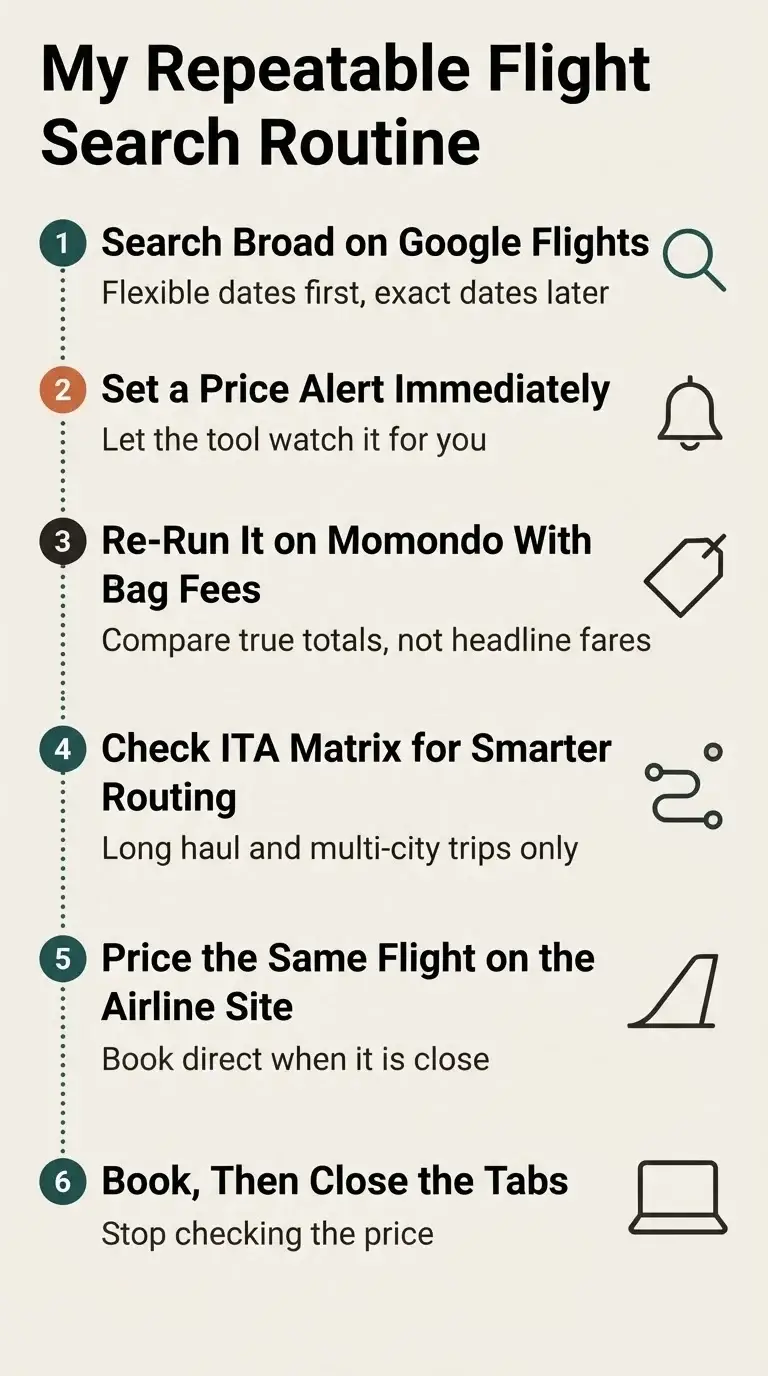
Here’s the process I’d give a friend who’s booking their first big trip.
Start broad on Google Flights with flexible dates and see what the price landscape looks like. Set a price alert immediately, even before you’re sure of your plan. Run the same route through Momondo with your real bag count so you’re comparing true totals. If the trip is international or complicated, run it through ITA Matrix to see whether a smarter routing exists. Check the airline’s own site for the exact itinerary you liked. Then book on the airline if the price is close, and on a reputable agency if the savings are meaningful.
Two extra habits: search both the main airport and the secondary ones in your metro area, and check one-way tickets separately on two different airlines. Mixed carriers often beat a single round trip, particularly within Europe and Asia.
When to book, based on data rather than folklore
The mythology around this topic is enormous, so let’s use actual numbers. Google analyzed five years of historical airfare data and published what the patterns actually show about booking windows, and a few findings are worth memorizing.
For U.S. domestic flights, prices have usually been lowest 21 to 60 days before departure, bottoming out around 44 days out. For trips from the U.S. to Europe, the best fares have typically appeared much earlier, around 129 days before departure, with the cheaper window running roughly 50 to 179 days out. Flights to Mexico and the Caribbean have been cheapest between 37 and 87 days ahead. Summer domestic trips run on a shorter clock, with prices lowest around 21 days out.
Two more findings that quietly save money. Departing on a Monday, Tuesday, or Wednesday has averaged about 12 percent cheaper than a weekend departure, and closer to 20 percent cheaper when you exclude international routes. And being willing to take a layover matters a lot: nonstop fares have averaged around 20 percent higher than flights with stops.
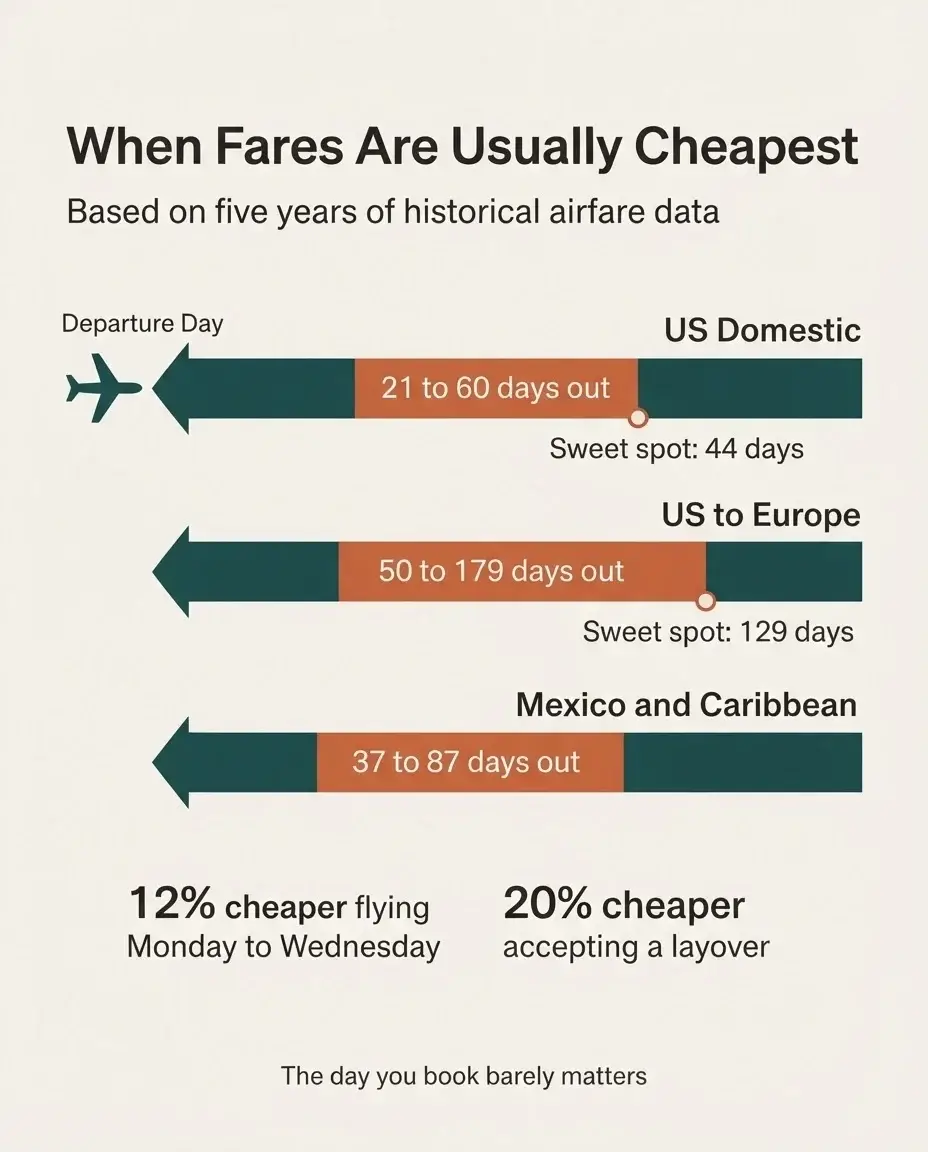
Now the myth-busting. The day of the week you book barely matters. Shopping Tuesday through Thursday instead of the weekend has produced savings of only about 1.9 percent on average. So if your trip is two weeks away, don’t wait for Tuesday. Book it.
Same goes for incognito mode. There’s no credible evidence that airlines jack up prices because you searched twice. Prices move because inventory and demand move. Clearing your cookies is harmless, but it’s a ritual, not a strategy.
Before you hit purchase, know these protections
This is the section beginners skip and then regret.
If you’re flying to, from, or within the United States, the U.S. Department of Transportation requires airlines to either hold a reservation at the quoted fare for 24 hours or allow you to cancel within 24 hours for a full refund, as long as you booked at least seven days before departure. This is the single most useful rule in air travel. It means you can lock in a fare you’re worried about losing, then spend the evening checking your dates and your visa situation with a clear head.
The catch, and it’s a big one: that 24-hour requirement applies to airlines, not to online travel agencies. Many agencies offer something similar voluntarily, but they are not obligated to. That alone is a strong argument for booking direct when the price is close.
A few practical things to check in that 24-hour window. Confirm your name matches your passport exactly. Confirm which airline actually operates each leg, since codeshares can be confusing. Confirm the layover is long enough, and if you’re changing airports or terminals, add buffer. And check what your fare class actually includes, because basic economy tickets on many carriers exclude carry-on bags, seat selection, and any changes at all.

What you’re owed when things fall apart
Cheap tickets feel a lot less cheap when a flight cancels and you’re stranded. Knowing your rights turns a crisis into an inconvenience.
In the U.S., the DOT’s automatic refund rule now requires airlines to refund you promptly and automatically when a flight is cancelled and you’re not rebooked, or when your flight is significantly changed and you decline the new itinerary. A significant change means a domestic flight departing three or more hours early or arriving three or more hours late, an international flight shifted by six or more hours, a changed origin or destination airport, added connections, or a downgrade in class. Refunds must come in your original form of payment within seven business days for credit cards, and airlines cannot push a voucher on you unless you actively choose it.
Europe works differently and is, in some ways, more generous. Under EU air passenger rights rules, compensation of 250 to 600 euros applies when you arrive at your final destination three or more hours late, depending on distance, unless the airline can prove extraordinary circumstances like severe weather or air traffic control decisions. The rules cover any flight departing an EU airport regardless of airline, and flights arriving into the EU on an EU airline. You’re also entitled to food, drink, and hotel accommodation while you wait. The UK maintains its own near-identical version, with compensation set between 220 and 520 pounds.

One important detail that connects back to the booking sites: these protections generally follow a single reservation. If you built your own self-transfer itinerary out of two separate tickets and the first one is late, you are, legally speaking, on your own.
The deals that are actually traps
Not every low number is a bargain. A few patterns to recognize.
Sketchy agencies. Some sites advertise a fare a few dollars below everyone else, then add fees at checkout or run an outright bait and switch. Before buying from a name you don’t recognize, search the company name alongside the word complaint and see what comes back. The Federal Trade Commission’s guidance on avoiding travel scams makes one point I’d underline for every new traveler: anyone who insists you pay by wire transfer, gift card, payment app, or cryptocurrency is running a scam, every single time. Pay by credit card. The chargeback protection alone is worth it.
Hidden city ticketing. This is the trick where you book a cheaper flight that connects through the city you actually want, then walk away at the layover. It sometimes works. It also violates airline contracts, and airlines have pursued it aggressively. In 2024, a jury ordered the site Skiplagged to pay American Airlines $9.4 million in a case connected to the practice. You can’t check a bag, your return leg can be cancelled, and frequent flyer accounts have been closed over it. I don’t recommend it, especially not to someone taking their first solo trip.
Fares that ignore the total cost. A $40 flight into an airport 90 minutes from the city, arriving at 1 a.m., with a $55 bag fee and a $60 taxi because the trains have stopped, is not a $40 flight. Always price the whole door-to-door journey. And bring food. Airport prices are the most reliable rip-off in travel, and a sandwich made at home plus an empty water bottle you fill after security will save you more on a travel day than an hour of fare hunting. In Thailand, I got completely used to eating well for a couple of dollars from a street stall, and the whiplash of paying twelve for an airport wrap never really faded.
The part nobody puts in a flight deals article
Somewhere in this process, you will find a fare that is good enough and you will hesitate anyway. That hesitation is rarely about money. It’s about the fact that booking makes the trip real.
I know that feeling well. Before I left my office job, I was very good at researching trips I didn’t take. Comparison shopping felt productive, and it let me stay in the part of the process where nothing could go wrong. What finally moved me was accepting that the perfect fare, like the perfect moment, mostly doesn’t arrive. What arrives is a reasonable fare on a Tuesday afternoon while you’re supposed to be doing something else.
So here’s my rule. Decide in advance what number you’d be happy with. Set your alerts. When a fare hits your number, book it inside the 24-hour window, review the details that evening, and then close the tabs. Do not check the price again after you’ve booked. It will change, sometimes down, and knowing that will only steal joy from a trip you were right to take.
The websites are just tools. What they really do is lower the wall between you and the version of yourself who has been on that trip already.