
OUTPUT ORDER

1. Prime Title Recommendation & SEO Metadata Block
2. The Full Deep-Dive Article
Smart Ways to Save Money on Hotels Every Time You Book
When I was working flexible jobs to fund my first solo adventures, accommodation was the one expense that kept me up at night. Flights you could hustle for, food you could manage with street eats and markets, but hotels felt like a fixed wall. You either paid the price on the screen, or you didn’t get a bed.
It took me a while to figure out that the price on the screen is almost never the real price. Once I understood that, everything changed.
Whether you’re planning a week in a new city or mapping out a longer trip on a budget, your hotel spend is one of the most controllable costs in your entire travel budget. You just need to know the levers. This guide walks you through every one of them, in order of impact, so you can stop overpaying and start putting that money toward the things that actually matter: experiences, food, and more time on the road.
Why Hotel Prices Are Not Fixed (and Why That’s Great News)
Here’s the thing most people don’t realize: hotel pricing is completely dynamic. The same room on the same dates can cost $80 one day and $180 three days later. Hotels use complex pricing algorithms that respond to demand, how full the property is, how close you are to the check-in date, what competitors are charging, and even what day of the week you’re searching.
That volatility is frustrating if you don’t understand it. But once you do, it becomes an opportunity. There are specific, repeatable strategies that take advantage of how this system works, and none of them require you to be a travel expert or spend hours researching.

Let’s go through them.
Join a Free Loyalty Program Before You Do Anything Else
This is the single highest-leverage move most travelers skip, and I can’t stress it enough: sign up for hotel loyalty programs before you book a single night. They are free to join, take five minutes to set up, and immediately unlock member-only rates that are simply not available to non-members.
Major chains including Marriott Bonvoy, Hilton Honors, World of Hyatt, IHG One Rewards, and Wyndham Rewards all offer member-exclusive pricing when you book directly through them. We’re talking 5% to 15% discounts just for being logged in. You also accumulate points with every stay, and those points turn into free nights down the road. IHG One Rewards is particularly strong for solo travelers who move around a lot: their cardholders get the 4th award night free, which beats Hilton and Marriott’s 5th-night-free policies if you’re doing shorter trips.
The Points Guy’s 2026 breakdown of best hotel loyalty programs is one of the best resources for comparing these programs side by side, including which ones align with your travel style and which credit card rewards currencies transfer into them. If you’ve been sitting on credit card points and not using them, this is a great place to start.
The key insight is that loyalty doesn’t have to mean brand loyalty in the rigid, old-school sense. You can hold memberships in multiple programs simultaneously. Sign up for all of them. Use whichever one gives you the best rate for your next specific trip.

Book Direct, But Not Blindly
The advice to “always book direct” is mostly true, but the nuance matters. Here is the accurate version: always check the hotel’s own website alongside comparison sites, then decide based on what you actually see.
Hotels pay commissions to third-party sites like Expedia, Booking.com, or Hotels.com. In return, some hotels offer lower rates or better terms when you book directly. Many chains also offer a best rate guarantee, which means if you find your exact room cheaper elsewhere within 24 hours of booking, they’ll match it and often add a bonus like extra points or a small percentage back. Marriott, Hyatt, Hilton, and IHG all have active best rate guarantee programs. NerdWallet’s guide to saving money on hotels explains clearly how these programs work and what to look for when comparing rates.
Here’s the honest flip side: sometimes the OTA has a better deal, especially for independent boutique hotels that don’t have strong direct booking incentives. For those properties, Booking.com, Expedia, or even last-minute apps can genuinely win. The rule is: never book the first price you see. Check both channels.
One thing I learned from my sightseeing guide days back in New York is that people rarely negotiate for hotel rates because it feels uncomfortable. But calling the hotel directly, telling them the price you found online, and simply asking “can you do better than this?” works more often than you’d think. Hotels prefer the direct booking because they keep the commission. That gives you leverage. Use it.
Time Your Search and Your Stay Strategically
Timing is one of the most underrated tools in the hotel savings toolkit, and it works on two different levels: when you book, and when you actually travel.
On the booking side, research consistently suggests that booking roughly two to three weeks in advance for most destinations hits a sweet spot between availability and price. Booking too far out means paying pre-demand prices. Booking too last-minute in a busy city means paying scarcity prices. The exception is last-minute apps like HotelTonight, which surfaces hotel inventory that properties need to offload urgently and often at steep discounts, but this only works if you have full flexibility and aren’t traveling during a major event or holiday.
On the travel timing side, this one can genuinely cut your costs by a significant amount. Shoulder season, the period just before or just after peak tourist season, consistently delivers lower hotel rates and thinner crowds without meaningfully worse weather. CNBC Travel’s 2024 deep-dive analysis crunched hotel rates across five major destinations and found dramatic price differences between peak and shoulder periods. In Kyoto, for example, the gap between cherry blossom season and off-peak months can be hundreds of dollars per night for the same entry-level room.
Even within a single city, day of the week matters. Business-oriented hotels in city centers often slash rates on weekends when their corporate clientele disappears. Resort-style properties do the opposite, charging more on weekends. Knowing the character of the hotel you’re looking at helps you time your search better.

Use Comparison Tools the Right Way
Most travelers use comparison sites like Kayak, Google Hotels, or Trivago as a final booking step. The smarter move is to use them as research tools only. Pull up the rates, make note of the best prices and properties, then go directly to the hotel’s site or call the front desk. Don’t click “book” on the comparison site unless the price there genuinely beats everything else.
A trick that gets talked about a lot is using incognito or private browsing mode when searching for hotels. The idea is that travel sites use cookies to track your searches and bump prices when they see repeat interest. The evidence on this is genuinely mixed: for flights, the price dynamic effect is more documented; for hotels, it’s less consistent. That said, it costs nothing to search in a private window, so it’s worth doing as a habit rather than a guarantee.
Also worth noting: Google Hotels is increasingly good for a fast side-by-side comparison, and it often surfaces the direct hotel website prominently alongside OTA listings, making it easier to compare apples to apples in one place.
Use Member Discounts You Might Already Qualify For
If you’re a student, active or veteran military member, government employee, or a member of AAA or AARP, you likely qualify for hotel discounts you’re probably not claiming. AARP members alone have access to discounts at over 7,000 hotel locations worldwide, including major chains like Wyndham, Choice Hotels, and Best Western, with deals that include both rate reductions and bonus rewards points.
AAA membership comes with discounts of up to 10% or more at partner hotels, and the discount more than pays for the membership cost if you travel even a few nights per year. These discounts stack onto loyalty program rates in some cases, so checking your eligibility before finalizing any booking is always worth an extra two minutes.
For anyone pursuing a location-independent lifestyle or long-term travel, looking into extended stay rates is also worth exploring. Many hotel brands have extended-stay properties, including Staybridge Suites and Residence Inn, where weekly and monthly rates can drop the nightly cost significantly compared to standard rates.
The Neighborhood Strategy Most People Ignore
One of the most consistent and reliable ways to cut hotel costs in any city is to stop defaulting to the most central, tourist-facing neighborhood. City centers and beachfront areas command a premium simply because of proximity. Move one or two neighborhoods out, stay near reliable public transit, and you often pay 30% to 50% less for a comparable room while still being 15 to 20 minutes from everything you actually want to see.
When I was backpacking solo across Europe, the difference between staying in the old town of a city versus one metro stop away was sometimes astonishing, and the extra transit time was always worth the savings. From what solo travelers consistently report across forums and communities, this strategy holds up in cities from Barcelona to Bangkok to Buenos Aires: the less “tourist-branded” the neighborhood, the more local the experience and the lower the price.
The key is to check transit access before booking. Look up the walk to the nearest metro or bus stop using Google Maps. If you’re within 10 to 15 minutes of reliable public transit, you’re in good shape.
Watch for Price Drops After You Book
This is the strategy most travelers don’t know exists, and it’s one of the most practical ones on this list. If you booked a refundable hotel rate, your work isn’t done. Hotel prices fluctuate constantly after you book, and if the price drops, you can often cancel and rebook at the lower rate.
The problem is manually checking this every few days is tedious. That’s where a service like Pruvo comes in. Pruvo is a free tool that monitors your hotel booking after you’ve made it and alerts you when the price drops. You share your booking confirmation, and Pruvo does the monitoring. If the rate falls, you rebook at the new price and pocket the difference. Travelers have reportedly saved anywhere from $50 to $200 or more on a single booking this way.
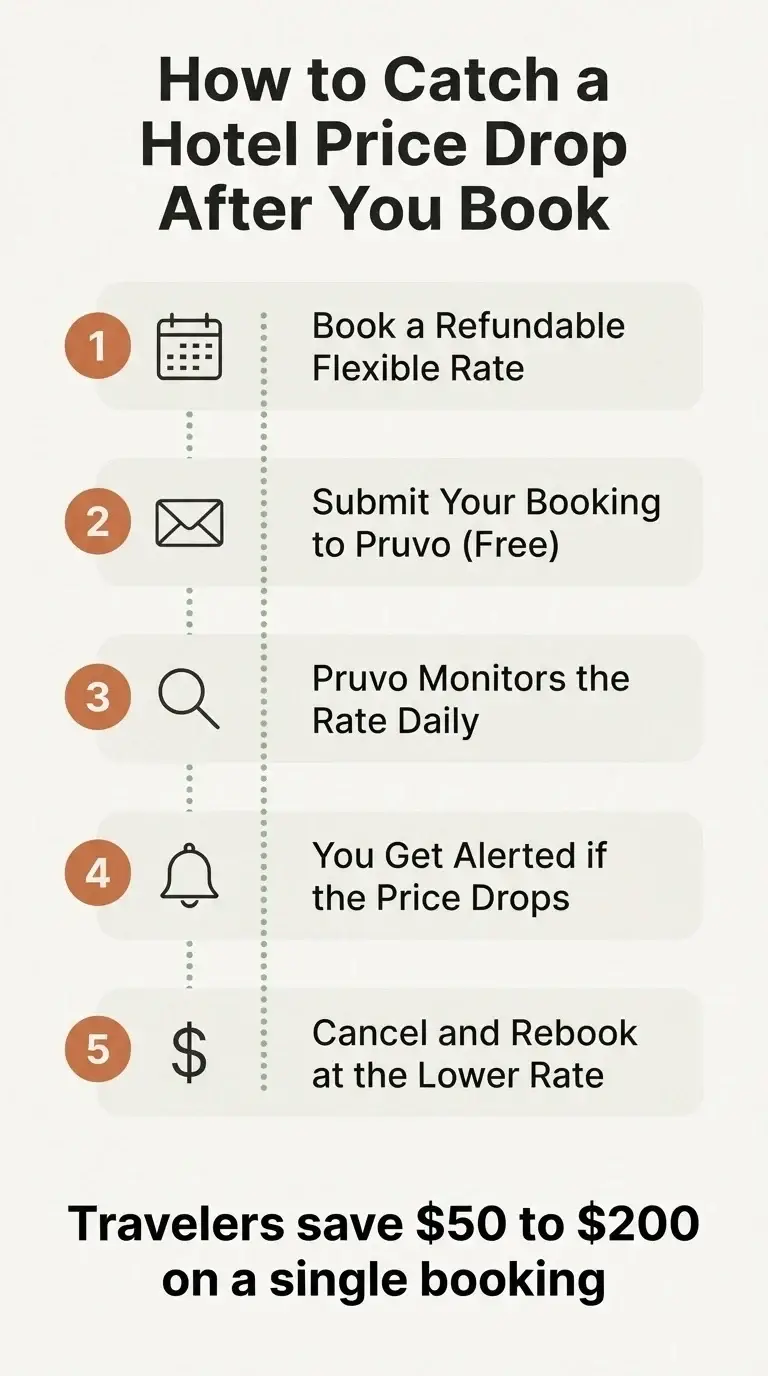
The catch is that this only works with refundable, cancellable bookings. If you booked a non-refundable prepaid rate, you can’t take advantage of a price drop. This is one of the reasons I generally recommend booking a flexible rate first and only switching to prepaid if you’re fully committed and the savings are significant enough to justify losing that cancellation window.
Read the Fine Print on Resort Fees
This one is less a savings tip and more a money-protection tip. Resort fees, also called destination fees or amenity fees, are mandatory daily charges tacked onto your hotel bill at check-out that are often not included in the rate you see when booking. In Las Vegas, Miami, New York, and many resort destinations, these fees can range from $25 to $50 or more per night.
A $159 room that looks like a great deal can become $209 per night once the resort fee is added. Always search for the total price, including taxes and fees, before comparing properties. Comparison sites increasingly show “total price” views, and Google Hotels is particularly good at surfacing these. If a hotel has a resort fee that covers amenities you’ll actually use, like a pool, gym, or breakfast, it can still represent good value. If you’re barely at the hotel and won’t use any of it, it’s just a cost to factor in.
Stack the Savings: Combining Strategies
The real power comes from layering multiple strategies together. Here’s an example of how this works in practice:
You identify a trip coming up in shoulder season. You search via Google Hotels using a private browsing window to get a clean view of rates. You compare the direct hotel site with OTA prices, logged into your loyalty program. The direct rate is slightly lower because of your membership discount. You book the flexible rate. You add the booking to Pruvo and let it monitor for price drops. Two weeks later, Pruvo alerts you that the rate dropped by $40 per night. You cancel and rebook. You arrive and check in using your loyalty member status, which includes free Wi-Fi and sometimes a small welcome perk.
None of these individual steps is complicated. Together, they can represent savings of 20% to 40% compared to just booking whatever the first result showed.

A Note on Alternative Accommodation
Hotels are not your only option, and for solo travelers especially, it’s worth knowing the full landscape. Hostels in Europe, Asia, and Latin America have evolved far beyond the dorm-room image many people still carry. Most offer private rooms with en suite bathrooms at rates well below comparable hotels, along with built-in social environments that can be genuinely valuable when you’re traveling alone.
For longer stays, vacation rental platforms, guesthouses, locally-run inns, and home-stays often deliver a more authentic, culturally rich experience at a lower nightly cost than chain hotels. When I lived with a family in Ghana, the level of cultural immersion I got was something no hotel stay could have provided at any price. That’s an extreme example, but the principle applies even on a shorter trip: sometimes the alternative accommodation isn’t just cheaper, it’s better.

The Real Bottom Line
Saving money on hotels isn’t about being cheap or compromising your experience. It’s about being intentional. Every dollar you reclaim on accommodation is a dollar you can spend on a meal at a local restaurant, a day trip you didn’t plan, a longer stay in a place that surprised you, or simply the confidence that you can stretch your trip a little further.
The perfect time to learn these strategies is now, before your next booking. Not because you need to spend hours researching every trip, but because once these habits are built, they become second nature. You stop seeing the first price you’re shown as the real price. You see it as the opening bid, and you know exactly how to do better.