
How to Get Hotel Discounts and Upgrades (No Elite Status Needed)

There is a particular kind of satisfaction that comes from checking into a hotel room, closing the door behind you, and realizing it is significantly better than what you paid for. Maybe the view is bigger than expected. Maybe the bathroom has a soaking tub you did not book. Maybe you paid $30 less than you thought you would, and that difference went toward dinner instead.
That feeling is not reserved for frequent flyers with platinum status and a company credit card. I know this because I have been that person booking budget rooms and stretching every dollar to make a trip happen. When I was working flexible jobs between travels, saving money on hotels was not a fun optimization exercise. It was necessary. And what I learned through that experience is that most travelers are leaving real savings and real perks on the table simply because they do not know the mechanics of how hotels work.
This guide is not about gaming the system or making unrealistic promises. It is about understanding a few straightforward things: when to book, how to book, what to say, and who to say it to. You do not need elite status, a luxury credit card, or years of travel experience to do any of it.
Why Hotels Have More Flexibility Than You Think
Before diving into tactics, it helps to understand what a hotel actually wants. A hotel earns nothing from an empty room. Every night a room sits unoccupied is revenue lost that can never be recovered. This basic reality shapes a lot of hotel behavior, from last-minute pricing to upgrade decisions at check-in.
Hotels also operate on tiered inventory, meaning they have a range of room categories, and moving a guest from a standard room to a junior suite costs them relatively little if that suite would otherwise sit empty. The upgrade is not a charitable act. It is a smart use of inventory. When you understand that, asking for an upgrade stops feeling presumptuous and starts feeling like a reasonable conversation.

That context matters as you read the rest of this guide.
When You Book Matters as Much as How You Ask
Most travelers instinctively book hotels as far in advance as possible, assuming earlier is always cheaper. The data tells a more nuanced story.
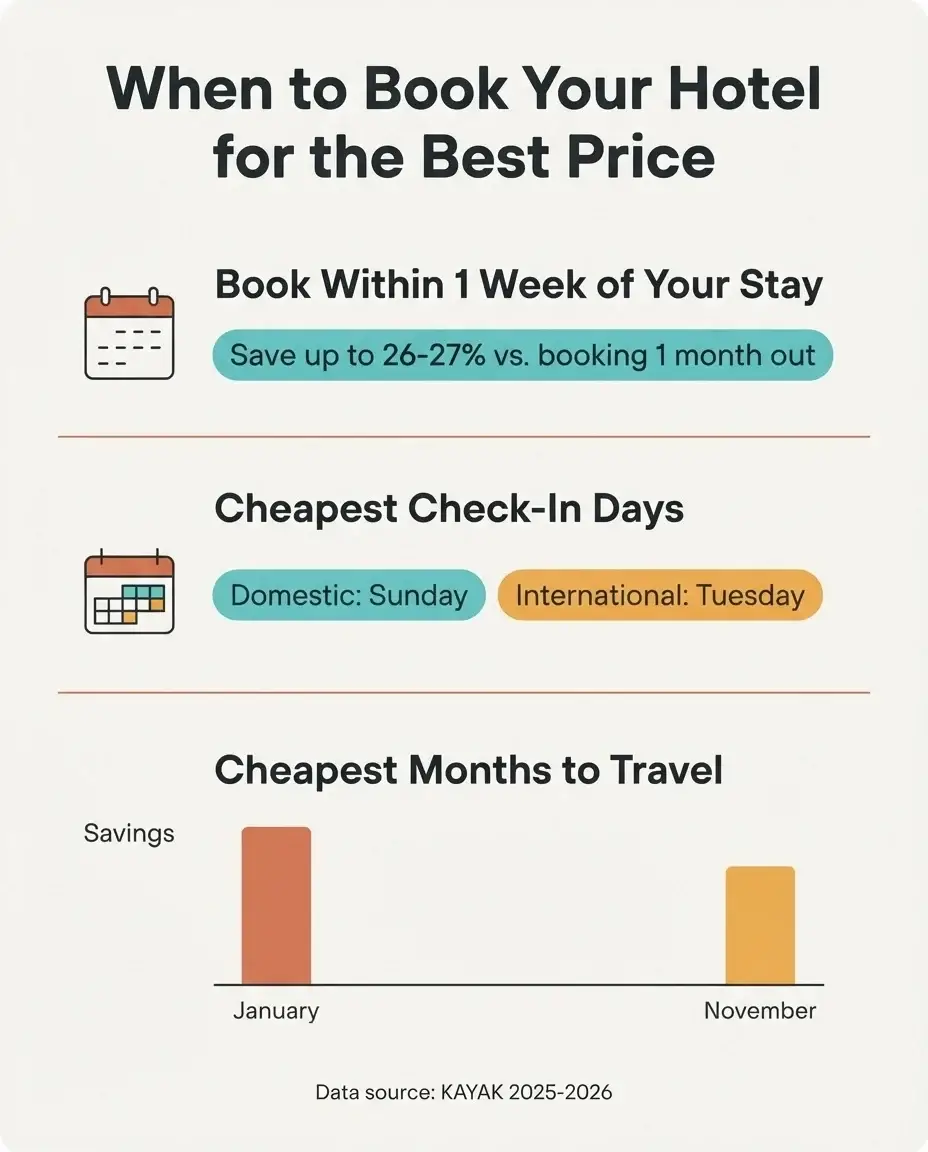
According to research from KAYAK using data from January 2025 through June 2026, booking within a week of your stay can save you up to 26% on domestic hotels and up to 27% on international hotels compared to booking a month out. The reason is straightforward: when guests cancel close to arrival, hotels often drop prices quickly to fill those rooms rather than let them sit empty.
This does not mean you should always wait until the last minute. If you have a specific hotel in mind, if your dates fall during a major event or festival, or if you are traveling to a popular destination during peak season, booking early still makes sense to secure the room at all. But if you are flexible and the destination is not wildly in demand, the savings from waiting can be significant.
The day you check in also matters. KAYAK’s data shows that Sunday check-ins are up to 24% cheaper than Friday for domestic U.S. hotels, averaging $165 versus $204 per night. For international travel, Tuesday is the cheapest check-in day. January is consistently the cheapest month overall, both domestically and internationally, followed closely by November.
As a solo traveler planning slower itineraries, I have found this timing flexibility to be one of the most underused tools in a traveler’s toolkit. When you are not locked into a fixed departure date tied to a work calendar, you can move things around by a day or two and save meaningfully.
The Single Most Overlooked Move: Book Direct
If there is one piece of advice I would give someone who has never thought about hotel strategy before, it is this: book directly with the hotel whenever possible.
Most travelers default to comparison sites like Expedia or Booking.com because they appear to surface the best deals. And sometimes they do. But here is the part the comparison sites do not advertise: when you book through a third party, you become an OTA guest, not a hotel guest. That distinction matters more than most people realize.
Hotels give their best treatment to guests who book directly. At many major chains, direct bookers get access to member rates (often 5-10% lower than OTA rates), they are prioritized for upgrades, and they are the ones who can actually use loyalty points and price match guarantees. Guests who booked through Expedia or a similar site are often ineligible for upgrades because the hotel does not have the flexibility to move them the same way.
NerdWallet’s guide to saving money on hotels makes this point clearly: hotel programs offer discounts to members who book directly specifically because the hotel wants to avoid paying OTA commission fees, which typically run 15-25% of the room rate. When you book direct, you are helping the hotel’s bottom line, and they have incentive to take care of you.
The workaround if you want to use comparison tools is to search on a third-party site to find the best available option, then go directly to that hotel’s website to book. Check whether the direct price is the same or lower. Most of the time it is at least equivalent, and often it comes with perks the OTA rate does not include.
Loyalty Programs: What They Actually Do (and What They Do Not)
There is a common misunderstanding about hotel loyalty programs. Many travelers assume they need to reach some high elite status tier before loyalty membership does anything useful. That is not accurate. Even free, entry-level membership in a hotel’s loyalty program delivers real benefits.
Here is what basic membership typically gives you: access to member-only rates when booking direct, eligibility for complimentary upgrades at check-in when availability exists, and the accumulation of points toward future free nights. You do not need to travel 50 nights a year to make this worth doing. Signing up takes five minutes and costs nothing.
That said, there is a real and meaningful difference between basic membership and elite status. Once you reach higher tiers, upgrades shift from “when available and staff feel like it” to structured program benefits. World of Hyatt is widely regarded as having the most generous upgrade program for top-tier members. Their Globalist tier members receive confirmed suite upgrade awards that can be locked in at the time of booking, which is a meaningful guarantee rather than a check-in gamble.
For travelers who stay primarily within the Marriott Bonvoy portfolio (which includes Sheraton, Westin, W Hotels, and many others), Nightly Upgrade Awards through Marriott Bonvoy work differently. Once you submit a request, the system begins checking for upgrade availability five days before your arrival date (three days for premium brands like The Ritz-Carlton and EDITION). You receive an email confirmation either way. Awards expire at the end of the year following the year they were earned. For someone who travels occasionally and has accumulated some status, understanding this timeline and submitting the upgrade request proactively is the difference between getting the upgrade and leaving it on the table.
For newer travelers without status at any chain, the practical advice is to pick one hotel family and concentrate your stays there. Even a handful of nights per year starts building toward the lower elite tiers, which deliver the most meaningful jump in upgrade eligibility.
The Price Match Guarantee Most People Never Use
Every major hotel chain offers some version of a best-rate guarantee, and most travelers have no idea it exists or how to use it.
The mechanics are simple. Book directly with the hotel. Then search the same room on OTA sites and comparison platforms. If you find a lower rate for the exact same room, dates, and conditions, submit a claim. The hotel matches the price, and in many cases adds something extra for the trouble.
IHG’s Best Price Guarantee goes one step further: if you find a lower rate elsewhere after booking direct, IHG will match it and give you five times your IHG One Rewards Points, up to a 40,000-point maximum. Hilton offers a similar program: find a lower qualifying rate and Hilton will match it and give you 25% off your stay.
There are conditions, of course. The rate must be for the exact same room type, the same dates, the same cancellation policy, and the comparison rate must be publicly available. You cannot use a special discount code or a closed user group rate as the comparison. But within those parameters, this is free money sitting on the table that most travelers walk past entirely.
The 48-Hour Pre-Arrival Email: A Small Effort That Pays Off
One of the most effective upgrade tactics is also the least dramatic. Two to three days before your arrival, send a brief, warm email to the hotel’s guest relations team. You are not asking for anything outright. You are introducing yourself, expressing genuine excitement about staying with them, and mentioning anything relevant: a special occasion, the fact that you are traveling solo, a flexibility in arrival time if that helps them with logistics.
Hotel staff read these emails during the period when they are finalizing room assignments. That is the window where upgrades actually get decided. An email that arrives at that moment, from a guest who sounds pleasant and excited, genuinely does influence room assignment decisions. You are not bribing anyone. You are simply making yourself visible as a real person rather than a booking number.
The email does not need to be elaborate. Something like: “I am so looking forward to my stay this weekend. I am a solo traveler arriving from New York and I am genuinely excited to explore the area. If there is anything you can do to make the stay special I would be so grateful, but I am just happy to be there.” That is it. No pressure, no demands, just warmth.
What to Actually Say at the Front Desk
Solo travelers sometimes feel at a disadvantage at check-in. There is no partner standing next to you signaling that this is a romantic trip or a celebration. But I would argue that being solo is actually a low-key advantage at the front desk, for one simple reason: it is much easier for a hotel to upgrade a single guest into a larger room or a premium floor than it is to accommodate a family or a couple with specific requests.

The key is timing and tone. Arrive at a quieter moment if possible, not during the morning rush when the lobby is full and the staff is managing ten things at once. Make genuine eye contact. Be warm. Ask something like: “I noticed when I booked that there might be some nicer rooms available. Is there any possibility of a complimentary upgrade, or a small upgrade I could add on?” You are not demanding. You are asking.
The Conde Nast Traveller piece on hotel upgrades, sourced directly from hospitality professionals, makes this point clearly: being genuinely kind and starting a real conversation with the front desk team is consistently one of the most effective approaches, particularly on days when flexibility exists. One hotel industry source quoted there recalled a guest at the Waldorf Astoria in New York who paid a $100 upgrade at check-in and moved from a standard entry-level room to a multi-room corner suite worth four times the original rate. That is the outcome of a polite conversation, not elite status.
Some front desk teams will say no. That is fine. You thank them, go to your room, and enjoy your trip. The ask costs nothing.
Traveling Off-Season: The Upgrade Multiplier
Almost everything in this guide becomes easier during the shoulder season or low season. When a hotel is running at 60% occupancy rather than 95%, the math changes entirely. There are simply more empty premium rooms available, and staff have more freedom to move guests around.
From what solo travelers consistently report, and from the hospitality professionals quoted in coverage of this topic, the combination of traveling in the off-season with a direct booking and a loyalty program membership is the closest thing to a reliable upgrade formula that exists for regular travelers. Each factor on its own shifts the odds modestly. All three together shifts them meaningfully.

Off-season travel also has obvious benefits beyond upgrades. Prices are lower, attractions are less crowded, restaurants are more relaxed, and you often get more genuine interaction with locals rather than navigating peak tourist traffic. I experienced something like this in my own travel across Europe, where the shoulder season months in cities like Prague and Lisbon had an entirely different energy than the peak summer weeks, quieter streets, easier reservations, and accommodation prices that were sometimes half what they would be in July.
Booking.com’s Genius Program: A Practical Note
If you do use booking platforms, it is worth understanding that some of them have their own loyalty structures that function independently from hotel loyalty programs. Booking.com’s Genius program is the most developed example of this.
At Genius Level 1 (which requires just one completed booking), you get 10% discounts at participating hotels. Level 2, reached after five completed bookings, adds free breakfast and the possibility of room upgrades at selected properties. Level 3, after fifteen bookings, increases discounts to 20% and makes upgrade eligibility more likely. Booking.com’s own coverage confirms that Level 3 members see significantly more upgrade activity than Level 2, even though the official benefit description begins at Level 2.
This is a useful option if you prefer using OTAs for flexibility or price comparison, but it is worth noting that Genius perks apply only at participating hotels and do not combine with hotel loyalty program benefits. You are essentially choosing one loyalty system or the other for a given stay.
A Few Things That Genuinely Do Not Work
No guide on this topic would be honest without addressing the myths.
Showing up and demanding an upgrade because you are “a loyal customer” without any actual record of stays almost never works, and it creates tension with front desk staff who remember the interaction. Loudly complaining about your room in the lobby in hopes of being moved is not a strategy, it is just unpleasant, and it tends to work against you.
Mentioning a birthday or anniversary when it is not true is also a bad idea. Hotels are in the business of hospitality and many have seen every variation of this approach. The staff are not naive. More practically, it is just uncomfortable to maintain a lie about why you are celebrating.
And booking through OTAs and then arriving and asking for an upgrade as though you booked direct puts the hotel in an awkward position. If you want the upgrade consideration, you need to be the kind of guest the hotel has direct information about: a direct booker, a loyalty member, or someone who reached out in advance.
Putting It All Together: A Simple Pre-Trip Checklist
You do not need to implement every single one of these things on your next trip. Even doing two or three of them changes the experience.

Join the loyalty program for the hotel family you are considering, even if you have never stayed with them before. Free membership takes minutes. Book directly on the hotel’s website and check whether the rate is lower than what you found on a comparison site. If not, use the price match process to close that gap. If you have flexibility in your travel dates, check Sunday check-ins for domestic travel and consider January or November travel windows for the best overall rates. Email the hotel’s guest relations team 48 to 72 hours before arrival. Keep it warm and brief. Ask about upgrades at check-in, plainly and pleasantly, and then let it go either way.
That is the whole system. It is not complicated. It is mostly just a matter of knowing what most travelers overlook.
Travel should not feel like you are always paying the premium rate for the least interesting room. There is a smarter, friendlier way to move through the world, and it starts with understanding how hotels actually operate, not just how they market themselves to you.