How to Book Boutique Hotels Cheap: A Practical, Honest Guide

I grew up in New York, which means I was surrounded by hotels my whole life without ever having a reason to think carefully about them. As a certified sightseeing guide leading tourists through the city, I watched people haul their luggage into massive chain hotels in Midtown, drop hundreds of dollars a night, and get virtually nothing back except a branded coffee cup and a loyalty point they’d never redeem. Meanwhile, two blocks away, there were independently owned hotels with incredible rooms, local art on the walls, staff who could actually tell you where the neighborhood’s best bakery was, and rates that were sometimes lower.
That observation stuck with me when I started traveling solo. When I backpacked through Europe, I stayed in a mix of hostels and small, independently run hotels. Those small hotels taught me something important: boutique doesn’t mean expensive. It means thoughtful. And thoughtful, when you know how to look for it, is often very affordable.
If you’ve been assuming boutique hotels are out of your budget, I want to challenge that assumption today. This guide walks you through every strategy I know for finding and booking boutique hotels at prices that won’t undo your travel budget.
What “Boutique Hotel” Actually Means (And Why It Matters for Your Budget)
Before we talk strategy, it’s worth being clear on what we’re talking about, because the word “boutique” gets thrown around a lot. A boutique hotel is typically small (usually under 100 rooms), independently owned or operated, and designed around a distinct aesthetic, personality, or local identity. It is not a product assembled in a boardroom. It is a place someone built with intention.
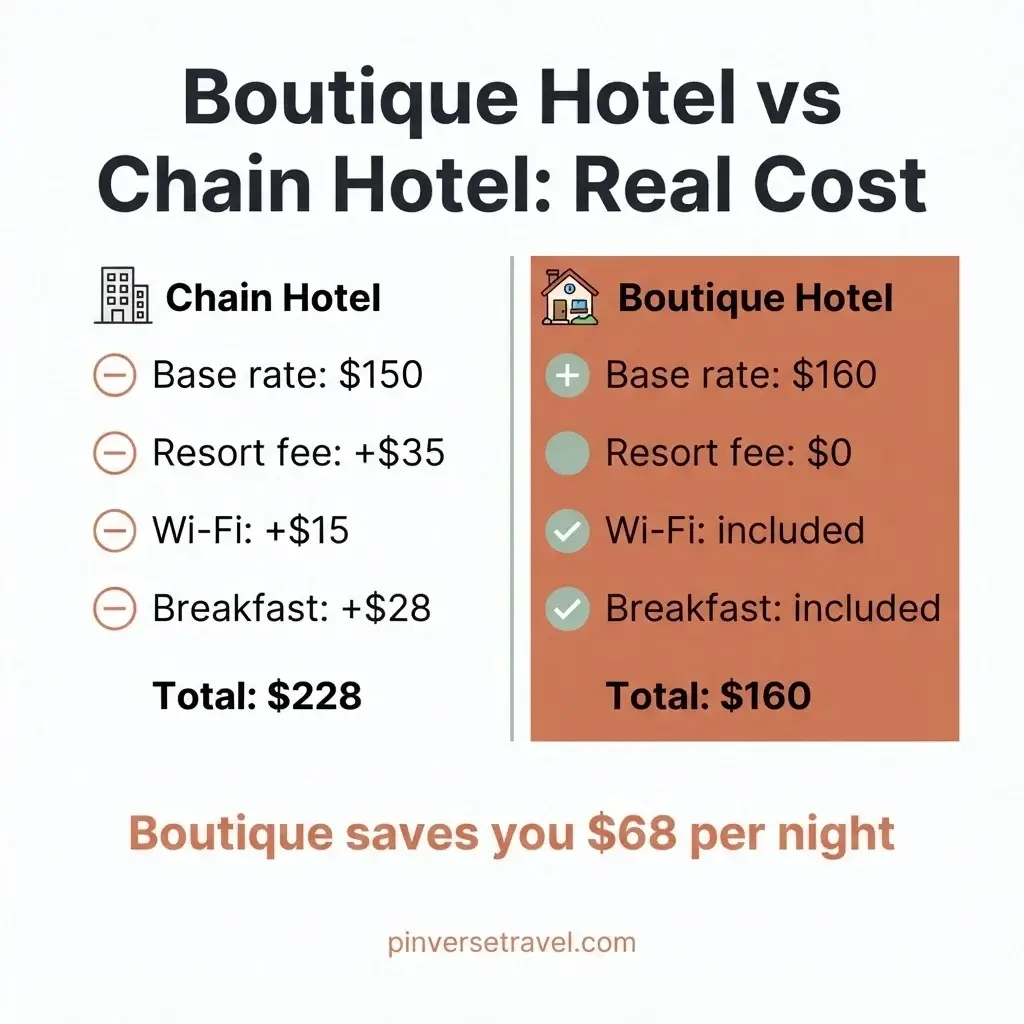
This distinction matters for your budget in a very practical way. Chain hotels often charge hidden fees that boutique properties don’t, including daily resort fees (sometimes $30-50 per night on top of your room rate), mandatory valet parking, and Wi-Fi charges. Many boutique hotels include breakfast, local transport tips, and use of bicycles or local maps as part of the experience, because the experience is the point. When you compare total cost of stay, not just the nightly rate, boutique hotels close the gap with chain hotels faster than most people expect.
Boutique hotels also tend to have smaller front desks and more flexibility. There is often a real human being with actual authority to offer you a better rate, throw in an extra night, or upgrade your room, because nobody has to file three forms with corporate headquarters to do so.
Where to Look: The Platforms That Actually Surface Real Boutique Hotels
The first mistake most people make is searching for boutique hotels on the same platforms they use for everything else. Booking.com and Expedia are fine, but “boutique” is just a filter tag on those platforms, and hotels of wildly varying quality self-select into it. You want to start your search on platforms that specifically curate independent properties.
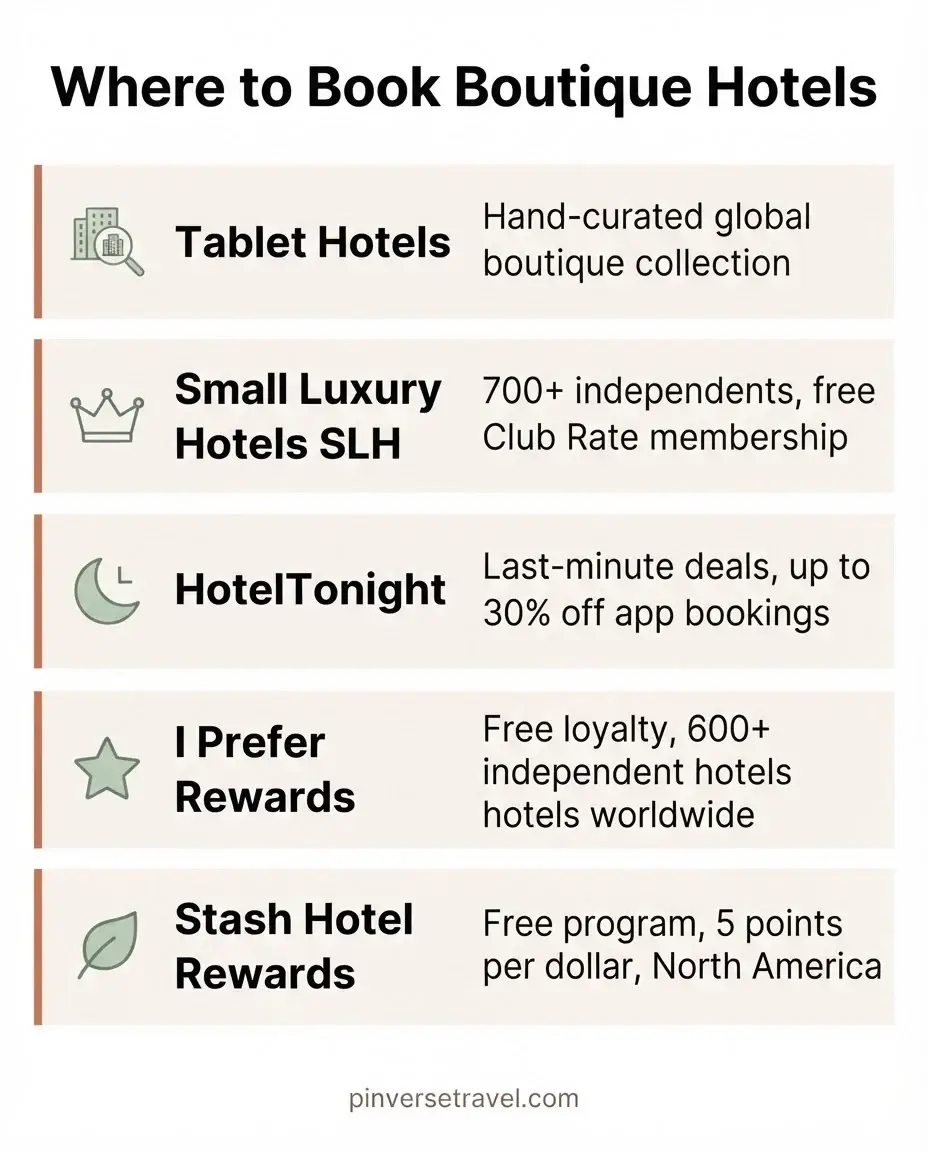
Tablet Hotels is one of the best places I know to start. Owned by the Michelin Guide, it hand-curates a global collection of boutique and independent hotels, and every property on the platform has been reviewed and vetted. The free browsing experience alone is valuable for research, and a Tablet Plus membership at $99 per year gets you best-rate guarantees and additional perks on stays worldwide. Even if you end up booking elsewhere, use Tablet to identify properties worth researching further.
Small Luxury Hotels of the World is another strong resource, covering more than 700 independently minded boutique and small luxury hotels across 100 countries. Their free SLH Club membership gives you access to a Club Rate (often lower than publicly listed rates), flexible check-in and check-out, and the ability to move up through reward tiers toward complimentary upgrades and daily breakfast. It’s one of the most underused tools for boutique hotel travelers.
For last-minute situations, HotelTonight is worth having on your phone. It specializes in same-day and short-notice bookings, and a significant portion of its inventory is independent boutique hotels that have unsold rooms they’d rather fill at a discount than leave empty. The app’s Daily Drop deal goes up to 30% off, and booking through the app (rather than the website) saves you an extra 5%.
For North America-focused travel, Google Hotel Search is genuinely underused. If you go to Google’s hotel search help page, you’ll see how to use filters like property type, amenities, and guest rating to surface independent hotels. Many boutique properties appear in Google Hotel Search with their direct booking rates shown alongside OTA rates, which makes it easy to see when booking direct is cheaper.
The “Book Direct” Strategy: Why It Works Especially Well with Boutique Hotels
If you take nothing else from this guide, take this: for boutique and independent hotels, booking direct is almost always worth at least a quick attempt before you commit to an OTA.
Here’s the dynamic at work. When a boutique hotel sells a room through Booking.com or Expedia, they pay that platform a commission of roughly 15-25% of the room rate. That’s a significant cut for a small property operating on thin margins. When you book directly through the hotel’s own website or by calling them, they keep the full revenue. That gives them real financial incentive to offer you something extra: a free breakfast, a room upgrade, flexible cancellation, or occasionally a slightly lower rate. Chain hotels have rigid policies that prevent this. Independent boutique hotels have flexibility.
The practical approach is simple. Find a hotel you like on a comparison platform to get the lay of the land on pricing. Then go directly to that hotel’s website and see what they show. If the direct rate is the same or lower, book it there. If it looks the same, call or email and ask: “I’m interested in booking for these dates. Is there anything you can offer if I book directly rather than through a third party?” You won’t always get a yes, but you’ll get a yes far more often than you’d expect, and even when the rate stays the same, you often get a better room or a small added perk.
Travel + Leisure notes that Hotels.com data shows travelers who book within one week of their stay can save around 35% on domestic and 25% on international travel compared to early bookers in summer months. That’s a meaningful number. The tradeoff is that you have fewer room options, but for flexible solo travelers, that is often a perfectly reasonable trade.

Timing Your Booking: When to Book and When to Wait
Timing is one of the most underrated levers you have on hotel pricing, and boutique hotels respond to demand even more dramatically than chains because they have fewer rooms to fill.
The general principle is this: book early if you need a specific type of room or have no flexibility. Book later, even at the last minute, if you are flexible and traveling in shoulder season or to a destination where demand is not extreme. Prepaid non-refundable rates at most hotels save you 20-30% off the retail rate, and for boutique hotels, that’s often the best published deal you’ll find.
The cheapest time of year to book a boutique hotel varies by destination, but the pattern is consistent everywhere: shoulder season is your friend. If a city’s high season is June through August, the rates in May and September will often be dramatically lower, the hotels will be less crowded, and the staff will have more time for you. Solo travelers are particularly well-positioned to take advantage of this, since you’re not coordinating multiple people’s schedules or school holidays.
For true last-minute flexibility, Skyscanner’s research found that Friday bookings tend to be slightly cheapest for US domestic hotels, while Thursday is marginally better for international bookings. The savings are modest (2-6%), but when you’re already working to stretch a budget, these small edges add up.
One more timing strategy that gets overlooked: longer stays. Many boutique hotels offer weekly rates or will negotiate a better nightly rate for stays of 5-7 nights, because every hotel prefers to minimize room turnover. If your itinerary allows you to slow down and stay in one place longer, it often pays both financially and experientially.
Boutique Hotel Loyalty Programs Most Travelers Have Never Heard Of
Here’s something that surprises most travelers: you don’t have to abandon loyalty perks just because you prefer staying at independent boutique hotels. There are several excellent programs specifically designed for independent hotel lovers, and most of them are completely free to join.
I Prefer Hotel Rewards, the loyalty program of Preferred Hotels and Resorts, is one of the best-kept secrets in travel. It’s free to join and covers more than 600 independent luxury and boutique hotels in over 80 countries. You earn points on every eligible stay, those points never expire, there are no blackout dates for reward nights, and you can redeem starting at 15,000 points for a free night at participating properties. Elite tiers unlock room upgrades and late checkout. For a solo traveler staying at independent hotels a few times a year, the points accumulate faster than you’d think.
Stash Hotel Rewards is another free program, focused on independent hotels across North America and the Caribbean. You earn 5 points per dollar spent, with no blackout dates, and you can earn a free night in as few as five stays. If you travel domestically with any regularity and prefer independent properties over Marriotts and Hiltons, Stash is one of the most practical loyalty programs available.
For travelers who lean toward trendier, design-forward boutique properties, AFAR’s breakdown of lesser-known boutique hotel loyalty programs is worth a read. It covers programs like Dis-loyalty (which gives 20% off first stays and 10% off returns at properties like The Hoxton and Mama Shelter for $18/month) and FoundersCard, as well as how some boutique brands that have merged into larger loyalty ecosystems still retain their independent character.
The key insight is that loyalty doesn’t have to mean settling for a brand-stamped room. You can earn meaningful rewards while staying in places that feel genuine.
How to Read Reviews Like Someone Who Knows What They’re Looking For
One of the biggest mistakes I see travelers make when booking boutique hotels is trusting aggregate star ratings without reading the actual text. A boutique hotel with a 4.2 average might have that score because it has incredible character, genuine service, and an amazing location, but the bathrooms are small and one reviewer was annoyed the gym was just a single treadmill. That is not the same kind of 4.2 as a chain hotel with 4.2 stars for being reliably inoffensive.
When reading reviews for a boutique property, filter for the things that matter to you specifically. Ignore the reviews that complain about noise if you already know you sleep with earplugs. Pay close attention to comments about staff and service, because at a boutique property, the quality of the people working there makes or breaks the experience. Look for reviewers who mention the neighborhood, the recommendations they received from staff, and the small details, because that’s where boutique hotels either deliver or fall short of their marketing.
Also look for reviews that mention what was included in the rate. Free breakfast, complimentary local transit passes, bottled water in the room, use of bikes, wine at check-in, these are things boutique hotels quietly offer that don’t always appear in the standard amenity list. When a property includes breakfast, you’re not paying a premium, you’re often saving money compared to a chain hotel with resort fees and a paid breakfast buffet.
Red Flags to Avoid: When “Boutique” Is Just a Marketing Word
Not everything calling itself a boutique hotel deserves the label. Here are the signs that a property is using boutique branding without delivering boutique value.
A hotel that has more than 150 rooms but calls itself boutique is almost certainly stretching the term. The intimacy of a boutique property depends on its scale. Once a hotel grows past a certain size, the personalized experience becomes difficult to sustain regardless of the decor.
Generic interiors assembled from a mood board (exposed brick, Edison bulbs, industrial pipes) without any connection to the actual city or culture you’re in are a warning sign. A genuinely boutique hotel reflects something real about its location: local art from actual local artists, staff from the neighborhood, a design that references the city’s architectural or cultural history.
Resort fees are another red flag. Independent boutique hotels generally do not charge mandatory daily resort fees because they don’t have the corporate infrastructure that invented that practice. If you see a property marketing itself as boutique but charging a $35 daily resort fee on top of your room rate, look carefully at who owns it. Many large hotel groups have launched boutique sub-brands (often called “lifestyle hotels”) that retain chain ownership and pricing structures behind a more aesthetic facade.
Practical Booking Checklist Before You Confirm
Before you click confirm on any boutique hotel booking, run through this quickly. Check the total price including all taxes and fees, not just the nightly rate. Confirm the cancellation policy, because boutique hotels vary widely here and some require full payment much earlier than chains do. Verify what is included in the rate, particularly breakfast, parking if relevant, and Wi-Fi. Check whether the hotel has a specific page or contact for direct bookings, and if so, spend two minutes comparing that rate to what the OTA shows. And read at least 10-15 recent text reviews, not just the summary score.
For solo travelers specifically, it’s worth checking whether the property has single occupancy rates. Many boutique hotels quote double occupancy pricing as their default, and a quick email asking about solo traveler rates can sometimes surface a meaningfully lower price that never appears publicly.
Boutique hotels are, at their best, one of the most rewarding ways to experience a place. They are run by people who care about the craft of hospitality. They are embedded in neighborhoods rather than hovering above them. They are the kind of place where a staff member might sketch you a map on a napkin, point you toward a restaurant that isn’t in any guidebook, and remember your name the next morning at breakfast. That experience is available at almost every price point if you know where to look and how to book it.
The tools are all here. The platforms, the loyalty programs, the timing strategies, the direct booking approach. None of them are complicated. They just require a little more intention than clicking the first result on a hotel search. And for a solo traveler who already decided to do something most people only talk about, a little extra intention is nothing new.