
Earn Hotel Loyalty Points Faster: What Actually Works in 2026

I spent years treating hotel loyalty programs like a background rumble — something happening quietly in the distance while I focused on actually getting to the destination. I’d check in, toss my keycard on the nightstand, and mostly forget I’d even signed up for whatever program the property was running.
Then I started paying attention. And what I discovered was not complicated, not just for business travelers who clock 100 nights a year, and not limited to people who want to open six credit cards at once. There are real, practical strategies that work for travelers like me — people who take a handful of meaningful trips a year, care about where their money goes, and would genuinely love a free night here and there without turning points into a part-time job.
This is what actually moves the needle.
The Single Most Important Decision You’ll Make: Pick One Program
Before you can earn points fast, you have to stop splitting them everywhere. This is the mistake I see most often among travelers who feel stuck — they stay at a Marriott one trip, earn a few Hilton points on the next, scatter a handful of IHG points somewhere in between, and end up with balances in four programs that never add up to anything redeemable.
Hotel points are not like frequent flyer miles where diversification sometimes makes sense. Hotel points expire faster and carry less flexibility across programs. Concentration is your friend.
So how do you choose? Ask yourself three questions: Which hotel chain shows up most often in the destinations you actually visit? Which program has properties that match your travel style and budget? And which program is currently offering the most generous earn rates or welcome bonuses?
Here’s a quick honest snapshot of the major programs as they stand in 2026. NerdWallet’s IHG One Rewards guide is a useful reference point if you’re weighing IHG against other chains — it’s particularly good for budget-conscious and occasional travelers because IHG has one of the broadest property footprints in the world at 6,600+ hotels. Hilton Honors earns you 10 base points per dollar at most full-service properties (dropping to 3-5 at budget sub-brands). Marriott Bonvoy earns 10 points per dollar. World of Hyatt earns 5 base points per dollar, which sounds lower but Hyatt points are generally worth more per point. IHG earns 10 points per dollar at most properties and 5 at Candlewood Suites. Pick one. Get to know it. Stick with it long enough to actually see the rewards.
Always Book Direct. Always.
This sounds simple because it is, but a surprising number of travelers still book through Expedia or Booking.com out of habit — and then wonder why their balance barely moves. When you book through a third-party site, you typically earn zero loyalty points. The hotel and the OTA split the room rate, and your loyalty number is either not attached at all or earns at a dramatically reduced rate.
Booking direct through the hotel’s own app or website means you earn full base points on your stay. The Hilton Honors points program page lays this out clearly — you only earn the full rate of base points when you book an eligible rate directly through Hilton channels. Beyond points, most major chains also reserve their best rates for members who book direct, and some throw in perks like free Wi-Fi, room upgrades, or complimentary breakfast that OTAs simply do not offer.

The practical habit here is to delete your OTA apps from your phone’s home screen. Not delete entirely — just move them out of reach. Then go straight to the hotel brand’s own app as your first stop when searching for a stay.
Charge Everything to Your Room
This one feels almost too easy, but it is wildly underused. If your hotel’s loyalty program earns points on all eligible charges — and most major ones do — then every meal at the hotel restaurant, every drink at the bar, every spa service, and every room service order can add points to your balance.
Marriott Bonvoy members, for example, earn base points on incidentals charged to the room, including dining and spa spend. If you’re at a Marriott property for three nights and you eat breakfast in the hotel restaurant each morning, that’s additional eligible spend earning you points at the same base rate as your room. Marriott’s official Platinum Elite benefits page shows how this stacks up at higher tiers — Platinum Elite members earn a 50% bonus on every eligible hotel purchase, which turns that breakfast habit into a meaningfully faster accumulation.
Before you check in to any stay, quickly look up whether your incidental spend earns points. If it does, use the hotel restaurant at least once. Put the minibar charges on your room account. This is not about spending money you wouldn’t otherwise spend — it’s about getting credit for spending you’re already doing.
Register for Bonus Promotions Before Every Trip
This is the single strategy that most people skip because they simply do not know it exists. Every major hotel chain runs limited-time bonus point promotions throughout the year — and most of them require you to register before the qualifying stay. You can earn the promotion and not get a single extra point if you stayed without registering first.

Right now in 2026, the promotions landscape is genuinely generous. Hilton Honors is currently offering up to 4,000 bonus points per eligible stay for stays between June 1 and August 15, 2026 — 2,000 bonus points for stays up to 3 nights and 4,000 for 4+ nights. IHG One Rewards is running a promotion offering 2,000 bonus points every two nights or 8,000 every four nights through August 31, 2026. Best Western is giving 1,000 bonus points per night in the U.S., Canada, and the Caribbean through September 7, 2026. Accor ALL is offering 4X points at select new properties worldwide through November 2026 (registration required). These are real stacks of points sitting on the table, unclaimed, for anyone who doesn’t know to look for them.
The easiest way to stay on top of all of these without becoming a spreadsheet person is to bookmark AwardWallet’s current hotel promotions page. They track all the major chains in one place and update it regularly. I check it before any trip I’m planning. Take five minutes, find your program’s current promotion, click register, and those bonus points show up after your qualifying stay. That simple.
Earn Points When You’re Not Even Staying in a Hotel
This is where a lot of occasional travelers are leaving real points on the table. You do not need to be checking in to a hotel to earn hotel loyalty points. Every major program has a network of earning partners — restaurants, online shopping, rideshare, car rental, and more — that let you quietly accumulate points in between trips.
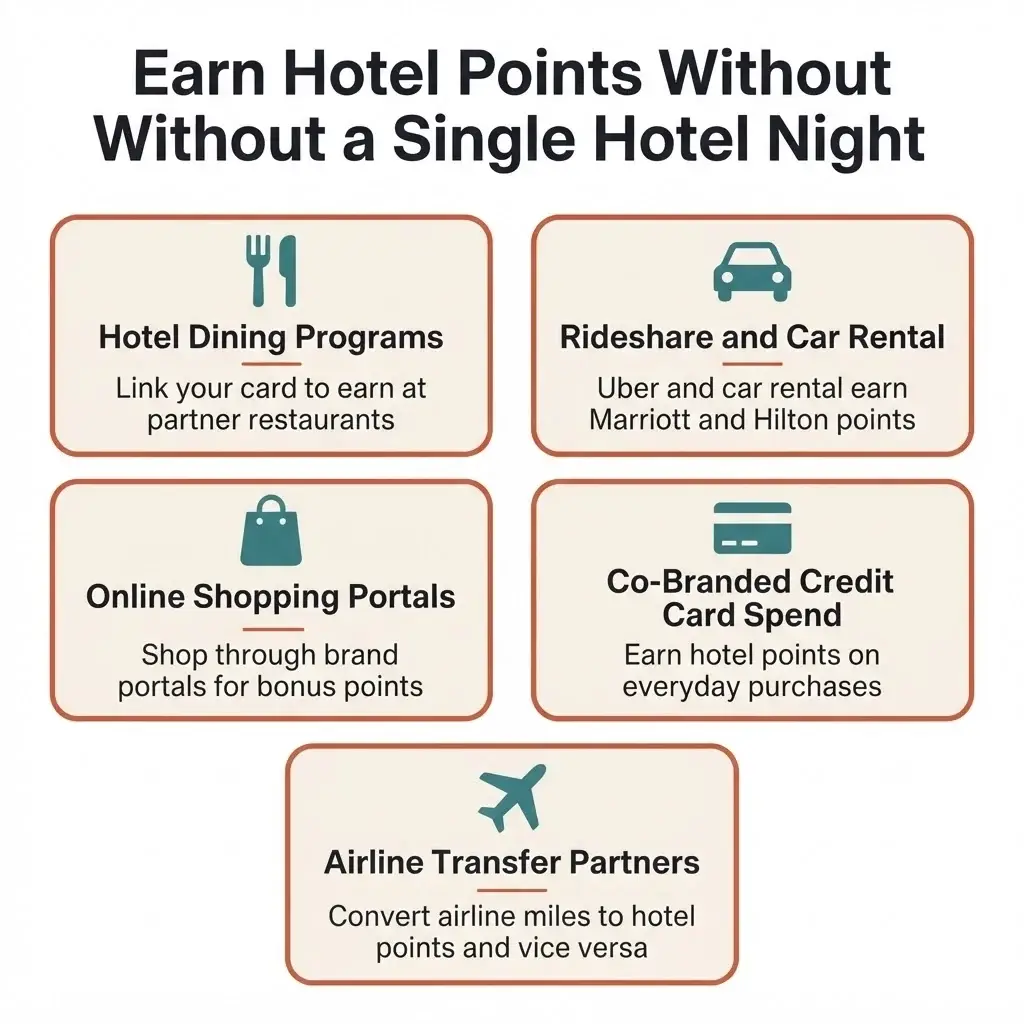
Marriott Bonvoy’s partner earning ecosystem includes Uber rides and Uber Eats orders, dining at participating restaurants, car rentals, and shopping through their online portal. The Marriott Bonvoy official partner earning page shows the full current list — it’s broader than most people realize. IHG One Rewards similarly has a range of earning partners beyond hotel stays, including dining, rideshare, and shopping. Their official partner offers page lists current options. If you eat at participating restaurants a few times a month and link your loyalty account, those points add up quietly without any extra effort from you.
Hilton Honors takes this even further — you can use points at Amazon.com and their online shopping mall, redeem for Lyft rides, and earn through dining at participating restaurants. World of Hyatt has a dining program where members earn points at hundreds of participating restaurants globally, and Hyatt points are among the more valuable hotel currencies, which makes this particularly worth pursuing.
The setup takes about fifteen minutes: log into each of your programs, find the dining or shopping section, and register your credit card to earn automatically. After that, points come in without you having to think about it.
Use the New Member Welcome Bonus
If you haven’t joined a program yet — or you’re considering adding a second one for a specific destination — the welcome bonus for new members can jumpstart your balance faster than almost anything else.
IHG One Rewards is currently offering new members 3,000 bonus points just for joining and completing at least one night within 21 days of enrollment (offer valid through December 31, 2026). Marriott Bonvoy is offering 500 bonus points for joining, 2,000 bonus points after your first stay, and another 5,000 after your second — so a simple two-stay commitment early on nets you 7,500 bonus points on top of your regular earnings. These are not trivial numbers if you’re just starting out.
This is worth mentioning specifically to anyone who has been on the fence about joining a program at all. There is no cost to join. The welcome bonus alone can cover a significant chunk of what you’d need for a free night at a mid-tier property.
Understand Your Elite Status Tier and What It’s Worth
One of the fastest ways to earn more points per stay is to reach a basic elite status tier, because every major program gives elite members a points multiplier on qualifying spend. And the thresholds for the first tier are not as far out of reach as most people assume.

With World of Hyatt, for instance, Discoverist status — Hyatt’s entry-level elite tier — requires just 10 qualifying nights or 25,000 base points in a calendar year. That’s about 3-4 short trips, depending on how long your stays are. Once you hit Discoverist, you unlock a tier bonus on your base points, complimentary upgrades where available, late checkout, and bonus points towards your next stay. The jump in points acceleration at even the first tier is real, and it compounds quickly once you’re earning at the higher rate.
Marriott Bonvoy Gold Elite (25% more points on every eligible hotel purchase) kicks in at 25 elite nights per year. For many solo travelers who take two or three longer trips, that’s achievable with some intentionality around which properties you choose. If you’re planning a week-long stay somewhere, choosing a Marriott Bonvoy property instead of an independent hotel might push you meaningfully closer to a tier that pays you back for the rest of the year.
A note on status match and challenge programs: if you already have elite status with one chain, it’s worth checking whether a competing chain will match or at least offer you an accelerated challenge to earn equivalent status. The status match landscape shifts constantly and some chains run these programs quietly, so it’s worth a quick search before any long trip where you’ll be concentrated in one brand’s properties.
The Fastest Acceleration: A Co-Branded Hotel Credit Card (Honestly Explained)
I want to be upfront here because I think a lot of travel content treats credit cards like a magic trick rather than a financial tool. A co-branded hotel credit card is, without question, the single fastest way to accumulate a large hotel points balance quickly — but it only makes sense if you pay your balance in full every month. If you carry a balance, the interest eliminates any points value. Full stop.
With that said: if you’re the kind of person who already pays their card off monthly, a co-branded hotel credit card can do something remarkable. The welcome bonuses on these cards — typically awarded after meeting a minimum spend requirement in the first few months — often represent more points than you could earn from a year or more of regular hotel stays. These bonuses shift regularly, so checking a reputable comparison source like NerdWallet or the card issuer’s official site before applying gives you the current offer. Beyond the welcome bonus, co-branded cards also give you a points multiplier on hotel spend (often 10-14 points per dollar at the brand’s own properties), bonus points on everyday purchases like dining and groceries, and sometimes automatic elite status just for holding the card.
If a credit card doesn’t fit your situation right now, that’s completely fine. The strategies above — direct booking, promotions registration, dining/shopping partners, and stay concentration — can build a meaningful balance without one. It just takes a bit longer.
Stack Everything on a Single Stay
Here’s what separates travelers who accumulate points efficiently from those who don’t: they understand that a single stay can earn points from multiple sources simultaneously, and they set it up before arrival.
On any qualifying stay, you can stack: base points from the room rate, tier bonus points if you have elite status, bonus points from a current promotion (registered in advance), and additional points from incidentals charged to the room. If you’re using a co-branded credit card, you’re also earning card bonus points on top of all of the above. A well-stacked three-night stay at a Hilton property right now, for someone with Gold status who registered for the current Hilton bonus promo, could realistically earn three to four times the base point value of what an unprepared traveler would earn for the identical stay.

This isn’t gaming the system. It’s just using the system the way it was designed. The programs want you to do this. They built it this way. The only travelers who miss it are the ones who never look.
A Few Things Worth Knowing Before You Go All In
Points expire. Most programs will expire your points if your account goes inactive for a certain period — typically 12 to 24 months without earning or redeeming. Mark your calendar or set a recurring reminder if you’re not a frequent traveler.
Points devalue. Hotel programs reserve the right to change how many points a free night costs, and they do exercise this right. This is not a reason to avoid earning — it’s a reason to not hoard obsessively. Earn steadily and redeem at a pace that feels satisfying.
More programs is not better. Solo travelers sometimes sign up for every loyalty program in existence because it feels like smart coverage. In practice, this produces thin balances everywhere and free nights nowhere. Choose your primary program, learn it well, and let a secondary program only if a specific trip justifies it.
Free nights are closer than they look. From what travelers consistently report across all the major programs, a determined but casual traveler can accumulate enough points for a 2-4 night free stay within 12-18 months using a combination of direct booking, promotions, and partner earning — no credit card required. Add a card with a solid welcome bonus and you can potentially get there in a single quarter.
Final Thought
Hotel loyalty points are not a system designed exclusively for business travelers who live out of a suitcase. They work for people who travel intentionally, a few times a year, and pay attention to how they book and spend during those trips. The gap between travelers who regularly earn free nights and those who never seem to get there isn’t luck or frequency. It’s information and habit.
You now have the information. The habits just take a few bookings to click into place. Pick your program, register for the next promotion, and book your next stay direct. That’s where it starts.