
Skip the Hidden Fees: Best Budget Vacation Rental Websites

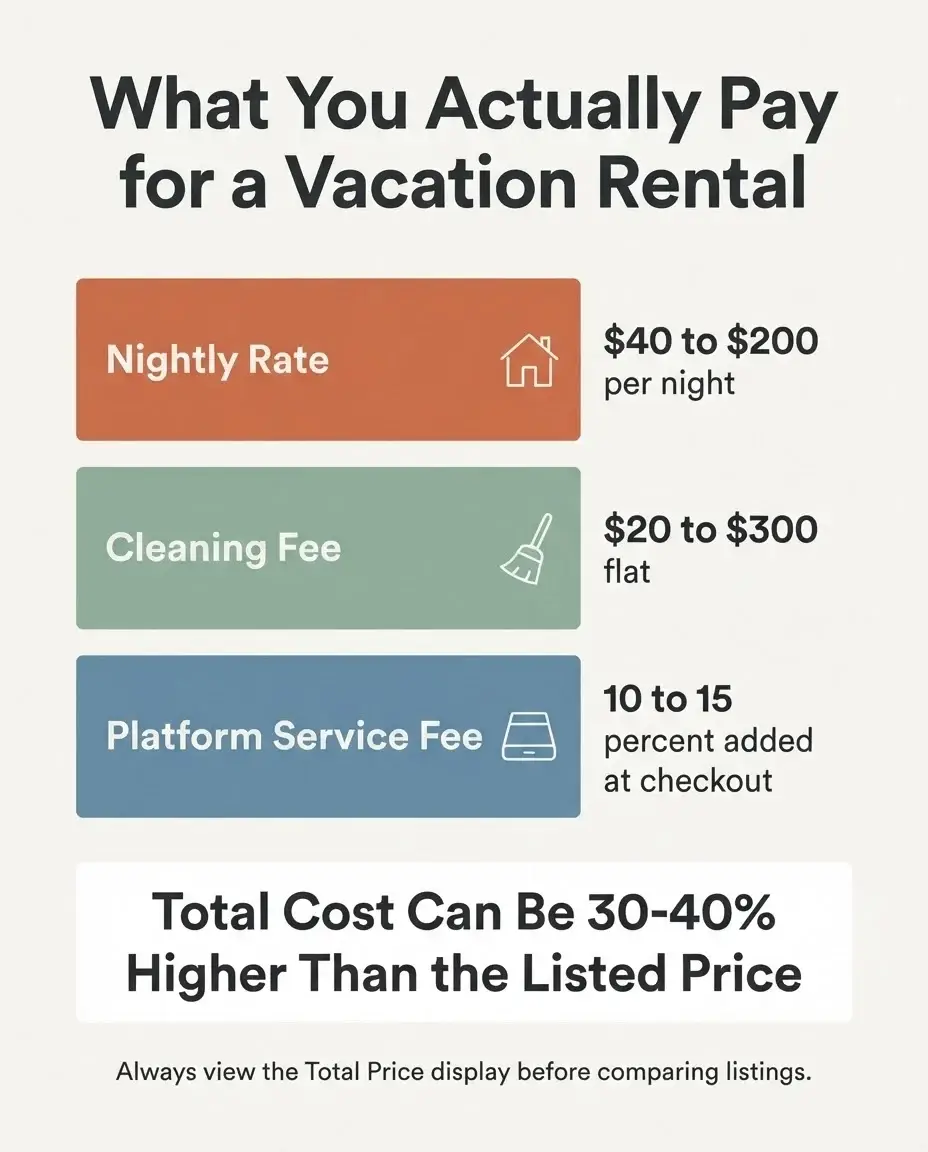
There is a very specific kind of frustration that every traveler knows. You find a rental that lists for $65 a night, do the math, feel genuinely excited, and then get to the checkout screen. Suddenly there is a $120 cleaning fee, a $45 service fee, and a $22 “platform fee.” Your affordable getaway just became a not-so-affordable one.
I have been there. When I left my office job in New York and started building a life around travel, my budget was real and my margin for error was small. Learning how to actually find cheap accommodation, not just accommodation that looks cheap, was one of the most practical skills I developed early on. And over the years, the vacation rental landscape has changed a lot. New platforms have appeared, fee structures have shifted, and there are now smarter ways to search than just opening Airbnb and hoping for the best.
This guide is for anyone who wants to use vacation rentals to travel more affordably, whether you’re planning your first solo trip, trying to stretch a tight travel budget further, or just sick of paying more in fees than you expected. I’ll walk you through the best websites to use, the strategies that actually work, and the things competitors rarely tell you about how these platforms handle pricing.
Let’s start with the uncomfortable truth about vacation rental fees.
Why “Cheap” Listings Are Often Not What They Seem
Before we get into the platforms, it helps to understand why vacation rental pricing feels so confusing. Most of the major platforms operate on a fee model where the price you see on the search results page is NOT what you will pay. Fees are added at checkout.
Airbnb overhauled its fee structure and now charges hosts a flat 15.5% service fee, which hosts factor into their pricing. Guests may also see a separate service fee added on top at checkout, and the amount varies by listing. According to Airbnb’s official help page, service fees for accommodations are typically built into the total price displayed, but the percentage you actually absorb depends heavily on how the host has configured their pricing. On top of that, cleaning fees are set entirely by the host and can range from $20 to several hundred dollars for a single stay.
Vrbo’s structure is slightly different. The platform charges hosts around 8% combined (a 5% commission plus a 3% payment processing fee), but those costs get passed to guests in the form of higher nightly rates or separate fees depending on the host’s setup.
The reason this matters is simple: the same property can cost meaningfully different amounts depending on which platform you book it through, and which night you choose. That is not a glitch, it is how these platforms are designed. Knowing that sets you up to use them far more strategically.
The Big Players: Airbnb, Vrbo, and Booking.com
Airbnb remains the largest and most recognizable vacation rental platform in the world, with over 8 million listings across 220 countries. For budget travelers, its biggest strength is variety. You can find a private room in someone’s apartment, a studio flat, a tiny house, or a full villa. For solo travelers especially, the private room category is often the most budget-friendly option, since you only pay for one bed rather than renting an entire property by yourself.

The key to using Airbnb affordably is filtering ruthlessly. Use the “Total price” display setting so fees show up in search results before you fall for a misleading nightly rate. Look for listings with no or low cleaning fees if you’re only staying two or three nights. And pay attention to the “monthly stay” discount badge, which signals the host is open to negotiating longer stays at lower rates.
Vrbo (Vacation Rental By Owner) tends to skew toward families and whole-home rentals, but it is a genuinely strong option for solo travelers planning longer trips or anyone wanting more space. Vrbo openly advertises weekly and monthly discounts, and the savings are real. Their monthly vacation rentals page documents average savings of $1,500 on select homes for stays of 28 nights or more. If you are planning a slow travel stretch, spending a month in one city or region, Vrbo is one of the first places worth checking.
Booking.com is arguably the most underrated of the three for budget travelers. Most people think of it as a hotel site, but Booking.com has a massive inventory of apartments, guesthouses, and private rentals. It also has something the other two lack: a strong free-cancellation culture. A huge percentage of Booking.com properties allow you to cancel for free up to 24-48 hours before arrival, which is enormously useful when you’re traveling on a flexible or uncertain itinerary. For extended stays, Booking.com’s monthly rentals section lists nearly one million long-stay properties with dedicated monthly rates and flexible cancellation options. For solo travelers doing slow travel in Europe or Southeast Asia, this makes Booking.com an incredibly practical tool.
The Smarter Play: Use a Price Comparison Tool
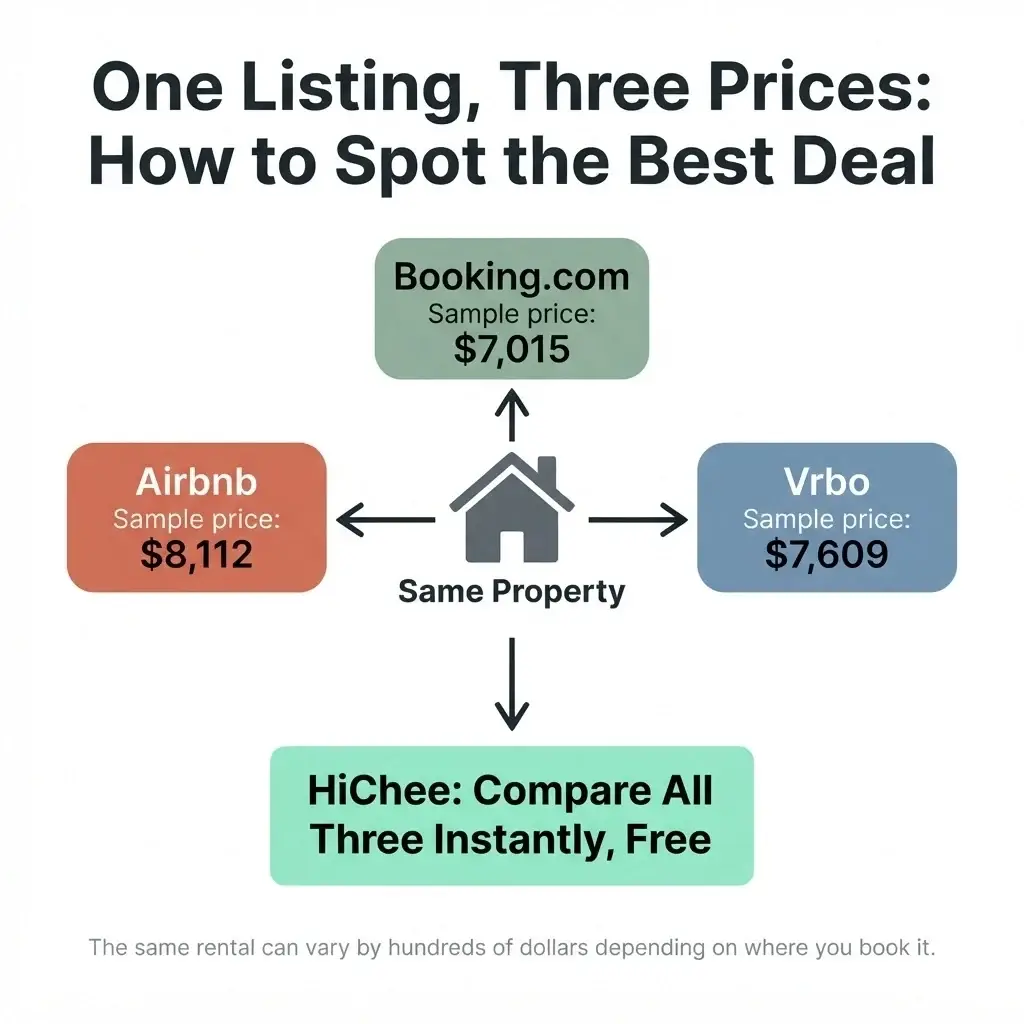
Here is something most “best vacation rental sites” articles skip entirely: the same property is often listed on two or three platforms at different prices for the exact same dates. The difference can be $50, $150, or more on a single stay. That means blindly searching one platform and booking is leaving real money on the table.
This is where a tool like HiChee becomes genuinely useful. HiChee is a vacation rental price comparison platform that monitors more than 18 million properties across Airbnb, Booking.com, and Vrbo. You paste the URL of a listing you’ve found on any one of those platforms, and HiChee instantly shows you what that exact same property costs on the other two platforms, as well as whether the host has a direct booking option available. It is free to use, and the price differences it surfaces are real. In their own example on the homepage, the same Hawaiian villa costs $8,112 on Airbnb, $7,609 on Vrbo, and $7,015 on Booking.com for the same dates. That is not a small gap.
The practical workflow is this: find a property you like on Airbnb or Vrbo, copy the listing URL, paste it into HiChee, and see where it’s cheapest. That one step can save you more than a nice dinner out.
The Fee-Free Alternative: Direct Booking Platforms
One of the most significant shifts in the vacation rental world over the last few years is the growth of the “book direct” movement. The idea is straightforward. When you book through Airbnb or Vrbo, both the host and the guest pay platform fees. Those fees pay for Airbnb’s marketing, customer service, and profit margin. But when a host and guest connect directly, those fees disappear entirely.
Houfy is the largest platform built specifically around this model. It lists over 98,000 vacation rentals across more than 100 countries, and guests pay zero service fees. The host pays a one-time $5.99 verification fee, and that’s it. Houfy verifies every property owner before listing, which provides a basic layer of trust and safety. The inventory is smaller than Airbnb, but for popular domestic destinations and international hotspots, you’ll often find the same properties or very comparable ones at genuinely lower total costs.
The tradeoff is worth knowing: direct booking platforms like Houfy offer less buyer protection than Airbnb in a dispute. If something goes seriously wrong with your rental, Airbnb has a customer support layer; Houfy puts you in more direct contact with the host, which can be great or require more effort depending on the situation. For travelers comfortable doing a bit of vetting, Houfy is a legitimate money-saver. For first-time solo travelers who want more of a safety net, use Houfy to price-shop and then book through whichever major platform offers the best protection.

For Nature Lovers and Outdoor Adventurers: Hipcamp
If your version of budget travel leans toward the outdoors, there is an entire category of vacation rental that most comparison articles ignore. Hipcamp is the largest outdoor camping and stay platform in the United States, covering tent campsites, RV parks, cabins, treehouses, and glamping setups on private land. Cabin prices average between $45 and $150 per night depending on the region and level of amenity, making them genuinely affordable compared to hotel rooms in the same area.
What makes Hipcamp interesting for the solo traveler crowd is the sense of connection and privacy it offers simultaneously. You are often on someone’s private land, but with your own space. Many hosts include amenities like fire pits, outdoor showers, and access to trails. The experience can feel far more authentic than a standard city rental, and the cost is often dramatically lower.

If you loved camping or hiking as a kid, or if you’re drawn to the idea of slow travel in nature rather than always centering your trip around cities, Hipcamp is worth adding to your accommodation toolkit.
HomeToGo: When You Want One Search to Cover Everything
HomeToGo is a meta-search aggregator that pulls vacation rental listings from dozens of sources and surfaces them in one place. It can be useful for getting a broad overview of what’s available in a destination across multiple platforms without having to search each one manually. That said, HomeToGo has moved to an onsite booking model, meaning fees can vary depending on the underlying booking source, and the savings are not always as dramatic as the “save up to 40%” headline suggests. Use it as a first-pass discovery tool, not as your final price-check step.
How to Actually Find the Lowest Price: A Practical Approach
Knowing which platforms exist is only half the equation. The other half is knowing how to search strategically. Here is what consistently works based on what solo travelers and experienced budget travelers report:
Search with flexible dates whenever possible. Vacation rental prices on weekends are dramatically higher than midweek in many popular destinations. Shifting a trip that runs Friday to Sunday into a Sunday to Thursday trip can cut your total accommodation cost significantly, sometimes by 30% or more.
Calculate the full cost before comparing. Always look at the total checkout price, not the advertised nightly rate. A listing at $55/night with a $180 cleaning fee for a three-night stay costs you $345 in fees alone before the nightly rate. A listing at $80/night with no cleaning fee costs $240. The “more expensive” nightly rate is actually cheaper.
The New York Times ran a piece in 2024 noting that the most reliable way to reduce vacation rental costs is to either book stays of seven nights or more (which unlocks weekly discounts on most platforms), or to seek out direct-booking options to eliminate platform service fees entirely. Both of those strategies hold up. Their guide to avoiding rental fees is worth reading if you want a deeper look at the mechanics.

Longer stays are rewarded on almost every major platform. If you can commit to a week instead of a long weekend, or a month instead of two weeks, you will almost always pay less per night and often less in total. This aligns naturally with the slow travel mindset I come back to again and again: spending more time in fewer places is not just more meaningful, it’s also frequently cheaper.
Read the reviews, but read them strategically. Filter for solo traveler or couple reviews if those exist, since a five-star review from a family of six praising the large backyard is less useful for your solo stay. Look for anything that mentions “cleanliness on arrival,” “accurate photos,” or “the neighborhood.” These patterns tell you more than the star rating.
A Note for Solo Travelers Specifically
When I was building my early travel life around flexible work and real budget constraints, I quickly realized that vacation rentals are not automatically the best choice for a solo traveler. The math only works in your favor under certain conditions: when the nightly rate is low, the fees are minimal, you stay long enough to spread the cleaning fee across multiple nights, and the location genuinely saves you money on transport or food by giving you kitchen access.
For short two or three night trips as a solo traveler, a well-reviewed budget hotel or hostel private room is often cheaper and simpler. Vacation rentals start to shine when you’re staying five or more nights, when you want to cook some of your own meals to stretch your food budget, or when you’re in a destination where standard accommodation is expensive and a shared apartment rental gives you far more value.
The point is not to default to any single platform or accommodation type. The point is to run the actual numbers, including all the fees, before you commit.
Quick Reference: Which Platform for Which Situation
For sheer variety and private room options for solo travelers, Airbnb is still the starting point, but always display total pricing and filter on fees. For whole-home stays of a week or longer, Vrbo’s discount structure makes it worth checking directly. For flexible bookings with easy cancellation or for European and Southeast Asian destinations, Booking.com’s apartment inventory is underrated. For cross-platform price comparison on the same listing, HiChee is the free tool that most travelers don’t know about yet. For fee-free direct bookings where you’ve already identified a property you trust, Houfy gives you the most transparent pricing. For outdoor, cabin, or glamping stays on a budget, Hipcamp fills a gap that no other major platform covers well.
No single website “wins.” The travelers who save the most are the ones who understand which tool serves which purpose and use them in combination.
The Bottom Line
The vacation rental market has more options and more pricing complexity than ever before. But that complexity works in your favor once you understand it. The biggest mistake most travelers make is searching one platform, falling in love with a listing’s photos, and booking without doing the 15 minutes of extra checking that could save them a hundred dollars or more.
Check the total price, not the nightly rate. Compare the same property across platforms. Look at direct booking options. Consider a longer stay if your plans are flexible. And remember that the goal isn’t to find the cheapest possible place to sleep, it’s to find the best value so your money goes toward the experiences that actually make a trip memorable.
That philosophy has served me well from the moment I left my desk in New York to the road and back again, and it is the one I’d put in your hands before you open any booking app.