
Secret Tricks to Booking Cheap Airline Tickets That Work

There was a stretch of my life where I opened flight search pages the way some people open bank statements. Slightly clenched. Half expecting bad news. Back then I was still in an office in New York, rationing vacation days like they were currency, and every fare I looked at felt like proof that the life I wanted belonged to someone with a bigger paycheck.
What actually changed was not my income. I left the office job and pieced together flexible work, which meant less money, not more. What changed was that I stopped treating airfare like a fixed price tag and started treating it like a puzzle with rules. Once you learn the rules, the “secrets” stop feeling like secrets. They feel like basic literacy.
So let’s go through them properly. Not the recycled tips, the real ones.
First, Let’s Bury Three Myths That Are Costing You Money
Half of what circulates about cheap flights is folklore. Clearing it out makes room for the tricks that actually work.
Incognito mode is not saving you anything
The story goes that airlines watch your cookies, notice you searching Lisbon four times, and quietly raise the price to panic you. It is a satisfying story. It has also never held up well under testing, and the price changes people notice are almost always ordinary fare bucket movement, which happens whether you are watching or not.
Use incognito if it makes you feel calmer. Just do not build your strategy on it, and please do not pay for a VPN expecting magic.
There is no magic booking day or hour
The “buy on Tuesday at 1am” advice is a fossil from an era when airlines loaded fare sales manually on a weekly cycle. Pricing is algorithmic now and updates constantly. There are mild statistical patterns favouring midweek purchases, but the effect is small enough that it should never be the reason you delay a booking. Your flexibility on travel dates matters roughly ten times more than the day you happen to click buy.
Booking eleven months out is not clever
Airlines release seats far in advance at unremarkable prices, then adjust as demand becomes visible. Booking the moment a schedule opens usually means paying a placeholder fare. Booking three days out means paying the business traveler tax. The useful zone sits in between, and I will get specific about it shortly.
What “Cheap” Actually Looks Like Right Now
You cannot recognise a deal without a benchmark, and most articles skip this entirely.
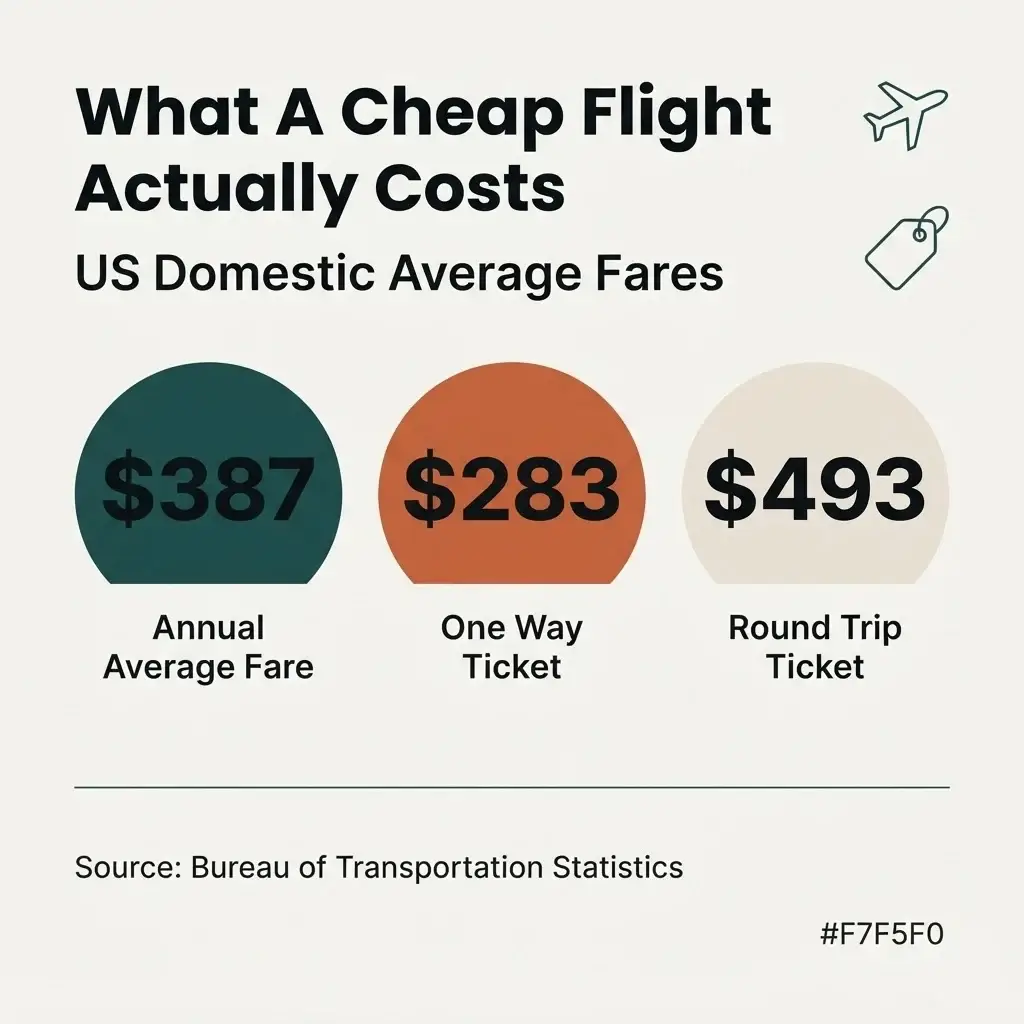
For a sense of scale, the Bureau of Transportation Statistics reported that the 2025 annual average domestic itinerary fare in the United States was $387, which was actually down 1.8% from the inflation adjusted 2024 figure. That average covers one-way tickets around $283 and round-trips around $493. If you are staring at a $340 round-trip and wondering whether to grab it, that context alone answers the question.
The direction of travel matters too. The U.S. Travel Association’s Travel Price Index showed airline fares up 26.7% year over year in May 2026, driven largely by fuel costs, with travel prices overall rising nearly ten percent. Practically speaking, that means waiting for prices to fall back to some remembered 2021 number is a losing game. Book against today’s market, not against nostalgia.
Write your personal number down before you search. “I will book anything under $420 round-trip.” A pre-committed threshold protects you from the two most expensive emotions in travel planning, which are greed and hesitation.
The Real Trick Is Flexibility, and Here Is How to Convert It Into Cash
Everyone says be flexible. Almost nobody explains the mechanics. Flexibility is only valuable if you have a way to see what it is worth in dollars.
Search the whole month, never a single date
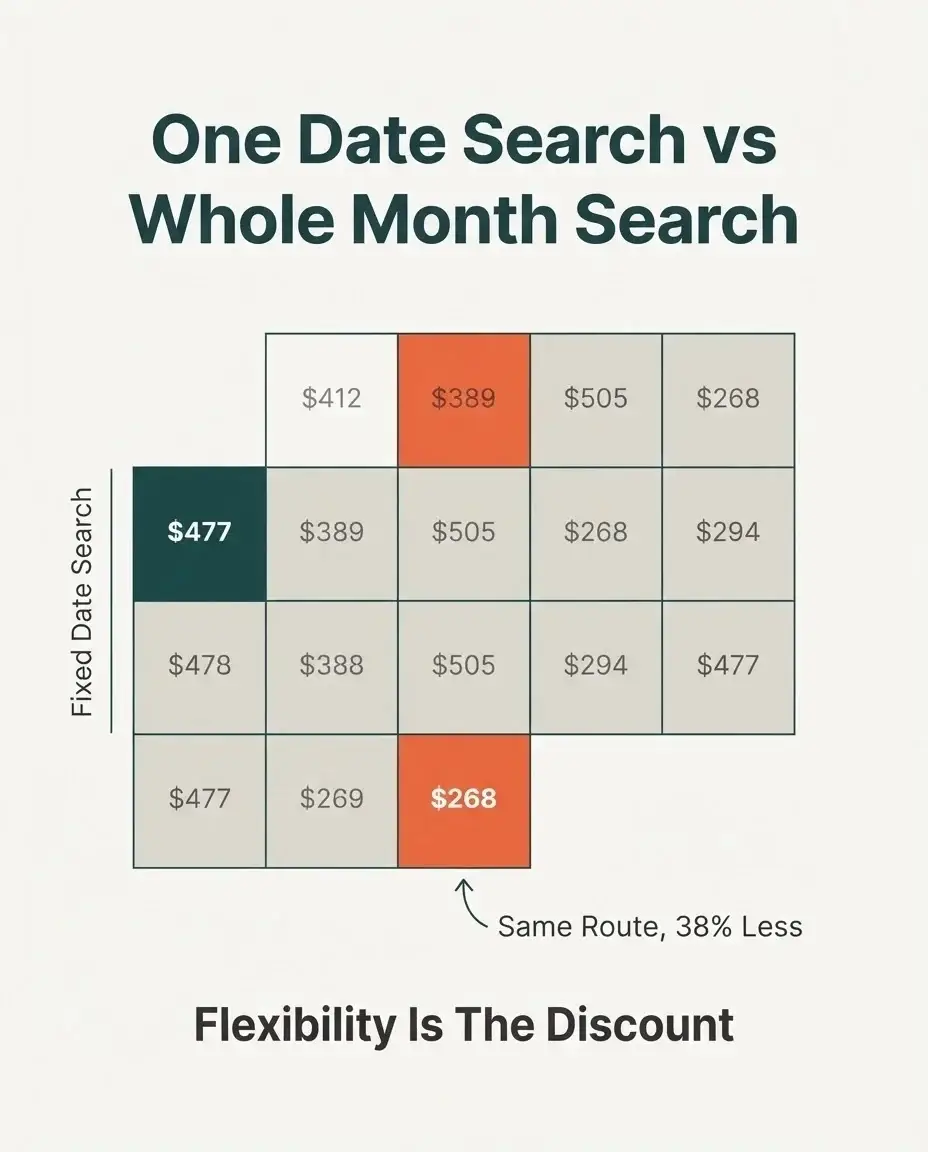
The single highest-return habit you can build is refusing to search one specific day. Open the date grid and the price graph and look at an entire month at once. On a lot of routes, shifting your departure by two or three days moves the fare by thirty to fifty percent, and you would never see that shift if you only ever typed in one Friday.
Google’s own documentation on how their date grid, price graph and fare tips work is genuinely worth ten minutes of your time, particularly the difference between the Best and Cheapest tabs. Cheapest is not a free lunch. It pulls in itineraries that may require you to collect and recheck your own luggage between flights, or to fly out of one airport and back into a different one in the same city. Those are fine trades if you know you are making them, and miserable surprises if you do not.
Search a region, not a city
If your real goal is “somewhere in Southeast Asia in February” rather than “Hanoi on the 14th,” search it that way. The map and explore views let you enter a whole country, a region, or even leave the destination blank and browse outward from your home airport by price.
This is where solo travel becomes a genuine financial advantage, not just an emotional one. When I backpacked Europe alone, I never had to negotiate a route with anybody. If the fare into Budapest was half the fare into Vienna, I went to Budapest. No group chat, no compromise, no waiting for three friends to check their calendars. Travelling alone means you can chase price the way a single seat can slip into an almost-full flight.
Fly on the days nobody wants
Tuesdays, Wednesdays and Saturdays are usually the cheapest departure days. Early morning departures, red eyes and flights over major holidays themselves rather than around them are consistently softer. Shoulder season, meaning the weeks just before or after peak, is the largest single lever of all, and it tends to produce better trips anyway because you are not queuing behind everyone else.
Set the Trap and Let It Work While You Sleep
Manually refreshing fares is a hobby, not a strategy. Automate it.
The feature most people underuse is tracking a route with flexible dates rather than one exact itinerary. Google’s guidance on tracking flights and prices explains that when you track “any dates” you get notified when the route’s minimum price drops meaningfully across a whole month, and you also get warnings when a fare you are watching is likely to rise. That second alert is the underrated one, because it tells you when to stop waiting.
Set alerts for three or four destinations you would genuinely be happy with, then get on with your life. Deals find people who left the door open.
The Booking Window That Actually Matters
Here is the honest answer, based on the pricing patterns airlines consistently follow.
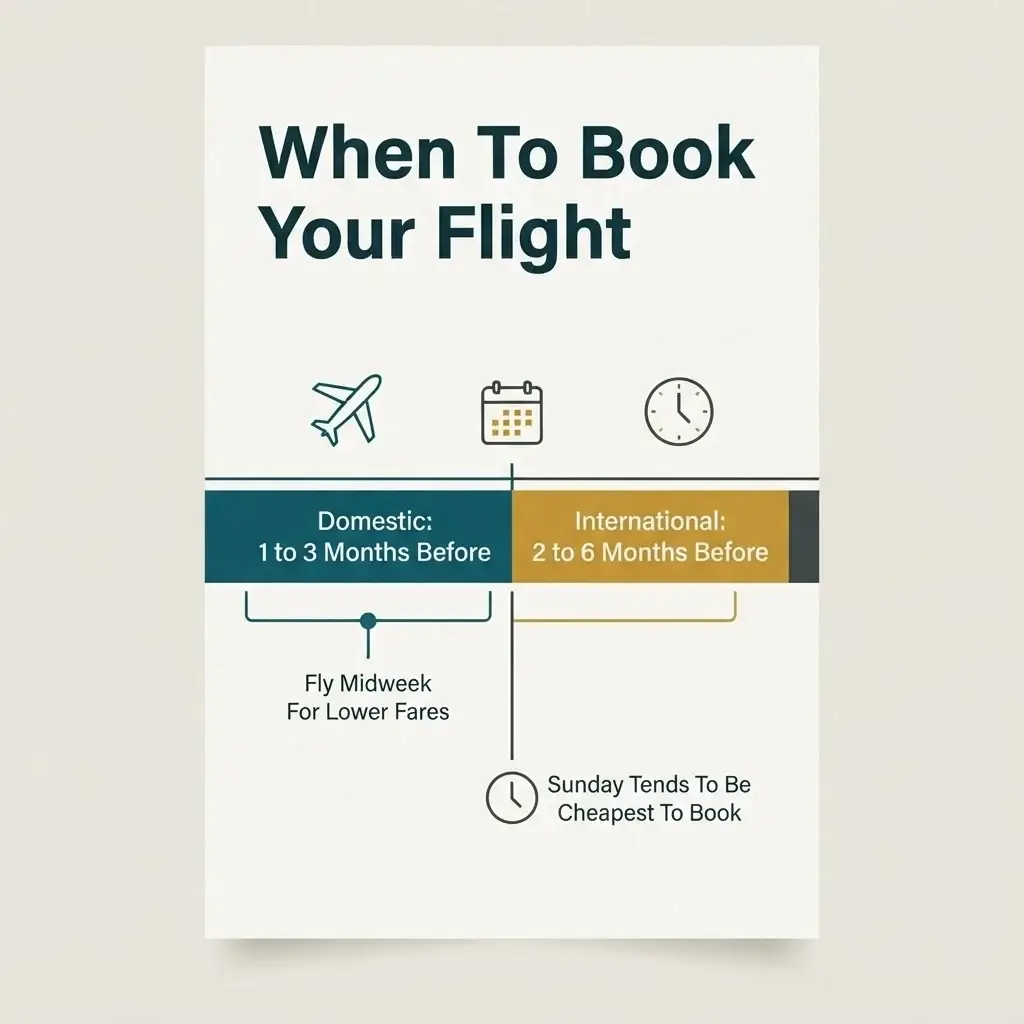
For domestic flights, the productive window is roughly one to three months ahead, with the sweet spot often around six to ten weeks. For international flights, think two to eight months ahead, stretching toward the far end for peak summer travel or major holidays.
Two important exceptions. Popular routes to genuinely capacity-constrained places, meaning small islands, remote regions and peak festival dates, break this rule and reward early booking. And a fare that is already clearly below the benchmark you set is not a fare to negotiate with. Take it.
Route Tricks Most Travelers Never Try
This is where you start operating like someone who has done this a while.
Split tickets and self transfer
Instead of buying one ticket from New York to Chiang Mai, price out New York to Bangkok on one ticket, then Bangkok to Chiang Mai separately on a regional carrier. Savings can be substantial because you are escaping the pricing logic of a single through-fare.
The risk is real and you must respect it. Separate tickets mean no protection if the first flight is late. Missing your second flight is entirely your problem. My rule when I do this is a minimum six hour buffer on international connections, and I never plan a self-transfer where I have to clear immigration, collect a bag, and recheck it in under four hours.
Positioning flights
Sometimes the cheap long-haul fare departs from a city that is not yours. If a Lisbon flight out of Boston is $400 less than the same flight out of your home airport, a cheap regional hop or a bus to Boston the day before can put that difference straight in your pocket. Always fly in the night before. Never same day.
Check the airline’s other country sites
Airlines sometimes publish different fares on their national versions of the same website, priced in local currency. Comparing the same itinerary on two or three regional versions of a carrier’s site is a legitimate, boring, occasionally lucrative habit. Just use a card with no foreign transaction fee, or the currency conversion will quietly eat the win.
Hidden city ticketing, and why I do not recommend it
You will see this promoted as the ultimate secret. You book a flight with a layover in the city you actually want, then simply walk out at the layover. It works mechanically and it violates the contract of carriage of essentially every major airline. Consequences range from a voided return leg to a closed frequent flyer account. You also cannot check a bag, and you cannot do it on the outbound of a round-trip without killing the rest of the booking.
I mention it because you deserve the full picture, not because I think you should build your trip on it.
The 24 Hour Rule That Turns Booking Into a Free Test Drive
This is the single most useful thing in this article and almost nobody talks about it.
Under U.S. Department of Transportation rules, for tickets purchased at least seven days before departure, airlines must either allow you to cancel within 24 hours for a full refund, or hold the fare for 24 hours without payment. Airlines are not required to offer both, so check which one your carrier does. Refunds must be processed within seven business days for credit cards and twenty days for cash or check.
What this means in practice is that hesitation has no financial upside. Book the good fare, then spend the next day checking your work calendar, your accommodation options and your visa requirements. If something does not fit, cancel and lose nothing.

One critical catch. That protection applies to airlines, not to third party booking sites. Online travel agencies may voluntarily offer something similar, but they are not obliged to. This is the main reason I book directly with airlines unless the saving through an agency is genuinely large. Direct booking also means one phone number, not two, when a schedule changes.
Budget Carriers: Cheap Until They Are Not
A $39 fare that becomes $180 after a bag, a seat and a check-in fee was never a $39 fare. The trick with low-cost carriers is not avoiding them. It is calculating the honest total before you compare.
Price out the whole thing: base fare, carry-on if it is not included, checked bag if you need one, seat selection if you care where you sit, and the cost of getting to and from the secondary airport they often use. Compare that number to the legacy carrier. Sometimes the budget airline still wins by a mile. Sometimes it loses.

The way to make budget carriers genuinely cheap is to travel carry-on only, which is a skill rather than a sacrifice. When I taught English in Thailand I learned that I wore the same six things regardless of how much I had packed, and that laundry exists everywhere in the world. Everything liquid goes into containers of 3.4 ounces or less in one quart-sized bag, and the TSA’s searchable list of what you can bring settles arguments about the odd items fast. Heaviest shoes and jacket go on your body, not in the bag.
Also watch basic economy on the major carriers, which is essentially a budget product in disguise. Read what it excludes before you compare it to anything.
Long Layovers, Cheap Fares, and Eating Well Anyway
Cheap tickets usually cost you time rather than money, and that time shows up as layovers. Handled badly, a seven hour connection is misery. Handled well, it is a free extra city.
If the layover is long enough and the airport has decent rail access, leave. Many major hubs sit thirty minutes from a city centre by train. Check visa rules for transit first, since some countries require one even to step outside the terminal.

If you are staying inside, eat like a local rather than like a tourist. Airport food courts are almost always cheaper in the domestic terminals and in the staff-facing areas near the far end of concourses, and airports in Asia in particular tend to have proper noodle and rice counters rather than only sandwich chains. Carry an empty water bottle and fill it after security, since that single habit saves a few dollars every single flight. Bring a piece of real food with you, ideally something with protein, because being hungry is what makes people spend fourteen dollars on a sad wrap.
Build your buffer around reality, not optimism. If you are connecting through a hub that struggles operationally, a glance at the FAA’s live national airspace status page will tell you how often ground delays hit that airport, and that should influence how tight a connection you are willing to book.
A Cheap Ticket Still Comes With Rights
People assume a bargain fare means bargain treatment. Legally, that is often untrue, and knowing this makes you far more willing to book aggressively.
If your flight touches Europe, the protections are strong. Under EU rules, passengers can be entitled to compensation of 250, 400 or 600 euros depending on flight distance when they arrive three or more hours late, plus meals, refreshments and hotel accommodation while they wait. It applies to any airline departing from the EU and to EU airlines flying in. Compensation is not owed for genuinely extraordinary circumstances like severe weather, and not owed if you were told of a cancellation more than fourteen days in advance, but most technical faults do not count as extraordinary.
In the United States, you are entitled to a refund whenever an airline cancels or significantly changes your flight and you choose not to travel, regardless of the reason and regardless of whether your ticket was non-refundable.
Two practical habits follow from this. Screenshot everything when a disruption starts, and always put your refund or compensation request in writing.
My Actual Booking System, Start to Finish
Tips are easy to forget. A sequence is not.
Start eight to twelve weeks out for domestic, four to six months for long-haul. Set your maximum price and write it down. Set flexible-date alerts on three or four candidate destinations rather than fixating on one. Search a full month at a time, always. Check the fare on the airline’s own site once you find it, since the difference is often small and the direct booking is worth more when things go wrong. Calculate the honest total including bags and airport transport. Then book on a credit card that carries travel protections, and use the 24 hour window to verify everything calmly.
Then stop looking. Genuinely. Watching your fare after purchase is a tax on your own peace of mind, and you cannot spend the imaginary money you might have saved.
Questions I Get Asked Most Often
Is there really no cheapest day to book? Midweek purchases show a slight statistical edge, but the effect is minor. Your travel dates matter far more than your purchase date.
Should I book one-way tickets separately? Sometimes, particularly with budget carriers and on international routes where two one-ways beat a round-trip. Always price both. Just be aware that some countries require proof of onward travel at immigration.
What about error fares? They are real and occasionally spectacular. Book them directly with the airline, do not add hotels or extras for a few days, and accept that the airline may cancel them. Treat any error fare as a lottery ticket, not a plan.
Are points worth learning? Yes, but start small. One solid transferable-points card used for ordinary spending, held long enough to earn a welcome bonus, will do more than a complicated system you abandon after two months.
Do I need travel insurance on a cheap ticket? The cheaper the ticket, the less the flight itself is worth insuring. The medical coverage is the part that matters, and that has nothing to do with what you paid for your seat.
Every trick here comes down to the same idea, which is that price rewards flexibility, and flexibility rewards the person who is willing to be a little curious and a little decisive. You do not need a secret website. You need a benchmark, a set of alerts, and the willingness to say yes when a fair price appears.
The trip you keep postponing is usually not waiting on a cheaper fare. It is waiting on you deciding it counts.