
How to Find Cheap Flights to Africa as a Solo Traveler

I still remember the feeling of booking my ticket to Ghana before I went to live with a family there. I had never spent that much on a flight in my life, and I sat staring at the checkout page for what felt like twenty minutes before I finally clicked confirm. Africa felt big. The cost felt bigger.
Here is what nobody told me at the time: I probably paid more than I needed to. Not because cheap flights to Africa don’t exist, but because I didn’t know the system. I booked too late, used the wrong tools, and had no strategy beyond searching once on a major booking site and assuming that was the price.
If you are in that position right now, searching and feeling your stomach drop at the numbers you are seeing, this guide is for you. Africa is not out of reach. You just need to know how the pricing actually works, which tools to use, and when to move.
Why Africa Flights Are Expensive (and Why That Can Work in Your Favor)
Before we get into strategy, it helps to understand why flights to Africa tend to cost more than flights to, say, Europe or Southeast Asia. The short answer is competition, or the lack of it. Fewer airlines serve direct routes between the US and sub-Saharan Africa compared to other long-haul markets, which means airlines have less pressure to drop prices. Long flight distances also push base costs up, since a flight from New York to Nairobi covers roughly 7,400 miles.
The good news is that this same limited competition creates dramatic pricing windows. When airlines do compete for seats, prices can swing significantly. February round-trip fares from the US to Africa average around $551, according to Kayak data, while peak July prices can run $800 to $1,800 for the same routes. That is not a small gap. It means timing and strategy can save you hundreds of real dollars on a single booking.

The other good news: once you know which airlines run efficient hub connections through Africa’s major connecting cities, you open up a much wider range of affordable options than just searching “flights to [destination]” will ever show you.
Know Your Hub Airports: This Changes Everything
One of the single biggest things you can do to cut costs on Africa flights is stop thinking about your destination airport and start thinking about connecting hub airports. Most of the best deals into Africa are not direct flights. They route through a handful of key cities, and understanding which hubs work best can unlock fares that never appear in a basic search.
Addis Ababa (ADD), Ethiopia is arguably the most important hub for affordable Africa travel from the US. Ethiopian Airlines, Africa’s largest airline by network size, operates from Addis Ababa Bole International Airport and connects to over 84 African destinations across the continent. From the US, Ethiopian Airlines flies direct to Addis from New York JFK, Newark, and Washington Dulles. Once you are in Addis, you can connect to almost anywhere in Africa, often for a fraction of what a separate routing would cost.
Casablanca (CMN), Morocco is the other hub worth knowing. Royal Air Maroc connects New York, Washington, Miami, and Atlanta to Casablanca, and from there offers flights to destinations across Africa including West African cities like Dakar, Abidjan, and Accra that are notoriously hard to reach cheaply. If your destination is in West or North Africa, Casablanca is often your best friend.
Middle Eastern hubs also deserve mention: Emirates via Dubai, Qatar Airways via Doha, and Turkish Airlines via Istanbul consistently offer competitive Africa fares, especially to East and Southern Africa. These are worth comparing side by side with Ethiopian and Royal Air Maroc.
Cairo (CAI) via EgyptAir works particularly well for North and East Africa connections.
Knowing these hubs means you can search smarter. Instead of searching “New York to Accra” and accepting whatever comes up, you can search “New York to Casablanca” and then a separate “Casablanca to Accra” leg. Sometimes this saves money, sometimes the combined routing on Royal Air Maroc is better. Knowing to check both is the skill.
The Tools That Actually Work
Most people pick one booking site, search once, and assume that is the price. That is not a strategy. Here is the actual toolkit.
Google Flights is your starting point, always. The real power of Google Flights is not just searching a specific route. Go to Google Flights’ Africa region explorer and use the date grid view, which shows you a calendar of prices across a full month. You can immediately see that a Tuesday flight two weeks from now costs $400 more than the same route three weeks later. The “Explore” map function is even more useful if your destination is flexible: it shows you which African cities are cheapest from your home airport right now. Many of my best Africa trip ideas have come from flipping to that map and realizing somewhere I had not considered was surprisingly affordable at that moment.
Set up price tracking alerts on Google. Once you have a route in mind, toggle the “Track prices” button on any search result. Google will email you when prices on that route go up or down. The official how-to for setting this up is straightforward and takes under two minutes. This is passive deal hunting at its best. You are not checking every day. The price change comes to you.
Going.com (formerly Scott’s Cheap Flights) is worth subscribing to. The service finds and alerts you to significant price drops and mistake fares. Their data shows the cheapest deal found to Africa was $361, versus the normal average of around $1,128. The Going Africa flights page shows you real-time deal counts too. In a recent month they found 312 deals and 110 mistake fares to Africa alone. A paid subscription costs around $49 to $99 per year and focuses their alerts based on your home airports. For frequent travelers or anyone planning a major trip, that often pays for itself in a single booking.
Skyscanner’s price alerts work similarly and are free. You can set a route alert and Skyscanner will notify you of price changes. Their price alert guide walks through exactly how to set it up. I recommend running Skyscanner alerts alongside Google Flights tracking. They don’t always surface the same deals.
Hopper is useful for a second opinion on whether to book now or wait. The app uses price prediction algorithms and will tell you whether current fares are likely to rise or fall. Its accuracy is not perfect, but it is a reasonable gut-check if you are sitting on a deal and are not sure whether to pull the trigger.
The Pricing Calendar: When to Fly and When to Book
Timing is the single biggest lever you have on price. Here is what the data consistently shows.
Cheapest months to fly: February and October. February is the cheapest month across most Africa routes from the US, with fares averaging around $551 round-trip. October is the second best window. West African cities like Lagos and Accra can see prices drop by as much as 40% in February and March compared to peak months.
Most expensive months: July, August, and December. July is consistently the worst month for deals, driven by Northern Hemisphere summer travel demand. December follows close behind because of holiday travel and Southern Hemisphere summer coinciding. Prices during these windows can spike 30-40% above average.
Shoulder season sweet spots: May through June and September through October offer a genuine middle ground. Prices are lower than peak, the weather is reasonable across much of the continent, and you get the added benefit of thinner crowds.
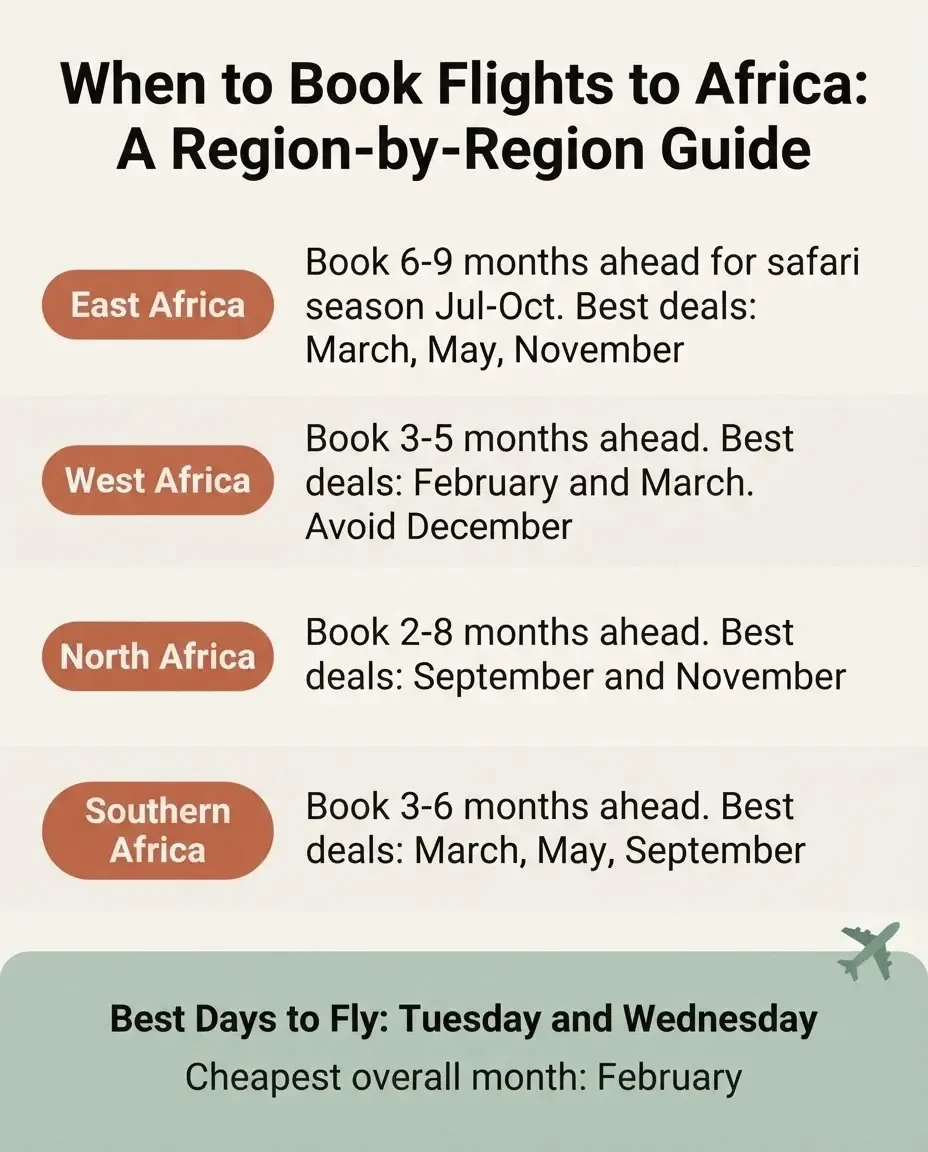
Regional nuance matters: East Africa during safari season (roughly July through October, when the Great Migration peaks) requires booking 6 to 9 months in advance because demand is genuinely high and seats fill. If you want to be in Kenya or Tanzania during that window, early booking is not optional. For North Africa (Morocco, Egypt), September and November are particularly affordable and the shoulder weather is excellent. For Southern Africa, March and May outside the peak wildlife season offer good value. According to the research at Dollar Flight Club’s Africa booking guide, the advance booking sweet spot for most Africa routes is 3 to 6 months, with East Africa safari season requiring 6 to 9 months.
Best days to book and fly: Tuesdays and Wednesdays consistently show lower fares across Africa routes. If you can be flexible by even two or three days around your preferred travel window, check midweek departures. The difference can be $75 to $150 per ticket.
Mistake Fares: What They Are and How to Handle Them
Mistake fares are exactly what they sound like: pricing errors where an airline accidentally lists a fare far below its actual price. These are real, they happen regularly on Africa routes, and they can be extraordinary deals. Going.com found 110 mistake fares to Africa in a single recent month.
Here is how to handle one when you find it.
Act immediately. Mistake fares are often corrected within hours, sometimes faster. Do not email your travel partner to discuss it. Book first, then discuss. Under US Department of Transportation rules, airlines are generally required to honor mistake fares once ticketed, though this has some nuance around obvious errors. More practically, you have 24 hours from the time of booking to cancel any flight purchased directly from a US airline or from any carrier on a flight departing from the US, as long as the flight is at least seven days away. This means you can book a mistake fare confidently, confirm the deal is real, and cancel penalty-free if something is wrong.
Set up multiple deal alerts (Google Flights, Going.com, Skyscanner) on your target routes, and check your email consistently when you are in active planning mode. That is how you catch these.

A Note on Visas Before You Book
Here is something I wish someone had told me before I booked my first Africa trip: check visa requirements before you pay for anything, not after. Some African countries offer US citizens visa-free entry or easy e-visa access on arrival. Others require advance applications that take weeks. Getting this wrong does not just inconvenience you, it can mean losing a non-refundable ticket.
For current entry requirements, the US State Department maintains updated travel advisories for every country. Check the South Africa travel advisory as an example of the kind of practical entry detail they provide, including passport validity requirements (South Africa requires at least 30 days of validity past your exit date and two consecutive blank visa pages). For any destination you are considering, the State Department’s travel site is your first stop. Then cross-reference with the specific country’s embassy website.
This is not meant to add fear. Most African countries are very accessible for US passport holders. It is just the kind of practical step that saves you from an expensive and avoidable mistake.
How to Actually Pull the Trigger When You Find a Deal
This is where a lot of people fall apart. They find a good price, spend three days thinking about it, and it is gone. I have done this myself. Here is a cleaner process.
Know your destination range before you start searching. If you are open to East Africa, Southern Africa, or West Africa, that flexibility is your biggest asset. If you have already narrowed it to one country and one specific date range, you have limited your options significantly, and your deal-finding will reflect that.
Set your alerts across at least two tools, Google Flights and either Going.com or Skyscanner. Check them every few days, not obsessively, but consistently.
When a deal appears that is 30% or more below what you have been seeing, that is worth acting on. Use the DOT 24-hour rule as your safety net. Book it, take a breath, and spend the next 24 hours confirming the details, the visa situation, the connection times. If anything is wrong, cancel within the window and you are out nothing.
Avoid rebuilding your search from scratch every time. Stick with the routes you have been tracking so you know what “normal” looks like. That context is what tells you a deal is actually a deal.

A Few Things Worth Skipping
Incognito mode and VPNs as price-reduction tricks are largely myths for airline bookings. While there are occasional stories of price differences being found this way, airlines use server-side pricing models that are not reliably manipulated by browser mode. The time you spend on this is better spent on the real strategies above.
Booking the absolute cheapest ticket without reading the details is also a trap. Ultra-low fares to Africa sometimes come with 20-plus hour layovers, no carry-on included, or routing through three cities. Always check total travel time, layover details, and baggage policy before confirming.
And do not wait for the “perfect” fare. If you find something in the good range and your dates are set, book it. I have watched friends spend weeks hunting for $50 more in savings and lose the seat entirely. A good deal taken is better than a perfect deal missed.
What Flexibility Actually Means in Practice
I know “be flexible” sounds like the most generic advice in travel. But for Africa specifically, flexibility has an outsized return. Here is what it actually looks like in practice.
Flexible by destination means comparing East, West, and Southern Africa options simultaneously. Ghana is often cheaper from the US than Kenya. Morocco is often the cheapest entry point on the continent. Cairo can be surprisingly affordable. If the experience of Africa is the goal and a specific country is not locked in, use the Google Flights explore map to let price help shape the itinerary.
Flexible by departure city means checking multiple US airports. JFK, Newark, IAD, and Atlanta typically have the strongest Africa route competition and the most frequent deals. If you are within driving distance of any of these, run comparisons from each.
Flexible by a few days means checking three or four date combinations on any route you are tracking, not just your first-choice dates. A Wednesday departure versus a Sunday departure on the same route can differ by $150 or more.
None of this requires a completely open schedule. It just means giving yourself enough margin to land on the best version of a trip you already want to take.
The Mindset That Actually Makes This Work
When I was planning my Ghana trip, the price felt overwhelming partly because I was treating it as a one-time, all-or-nothing decision. But flight hunting is more like a process than a single moment. You build knowledge over a few weeks of tracking. You develop a sense of what normal prices look like. And then when something below normal appears, you recognize it.
This is the same muscle I use for every big trip now. It is not about luck. It is about being ready. Set your alerts, know your tools, understand the seasonal calendar, and have your passport valid and your visa homework done before you need it. When the deal appears, you just need to click confirm.
Africa is one of the most extraordinary places I have ever traveled. The continent is vast, wildly diverse, and full of cultural experiences that change how you see yourself and the world. The flight is just the beginning. Do not let the price stop you from getting there.