
How to Survive a Long-Haul Flight and Land Ready to Explore

The first time I boarded a flight longer than a few hours, I had no real plan. I had snacks, a book, and the vague hope that it would somehow be fine. By hour seven I was stiff, dehydrated, mildly miserable, and watching the flight tracker with the specific despair of a person who realizes they still have nine hours left. I landed in a foreign country feeling like I’d been wrung out and left to dry.
I’ve since figured out what actually works. And I want to give you the honest version of that, not a glamorized checklist written by someone who flies business class and somehow forgot to mention it.
Here’s how to survive a long-haul flight and actually land feeling like a person.
Before You Even Get to the Airport: The Decisions That Matter Most
The smartest thing you can do for a long-haul flight happens before you touch the airport. Two choices made in advance will shape your entire experience: your seat and your pre-flight sleep.
Choose Your Seat Like It Actually Matters (Because It Does)
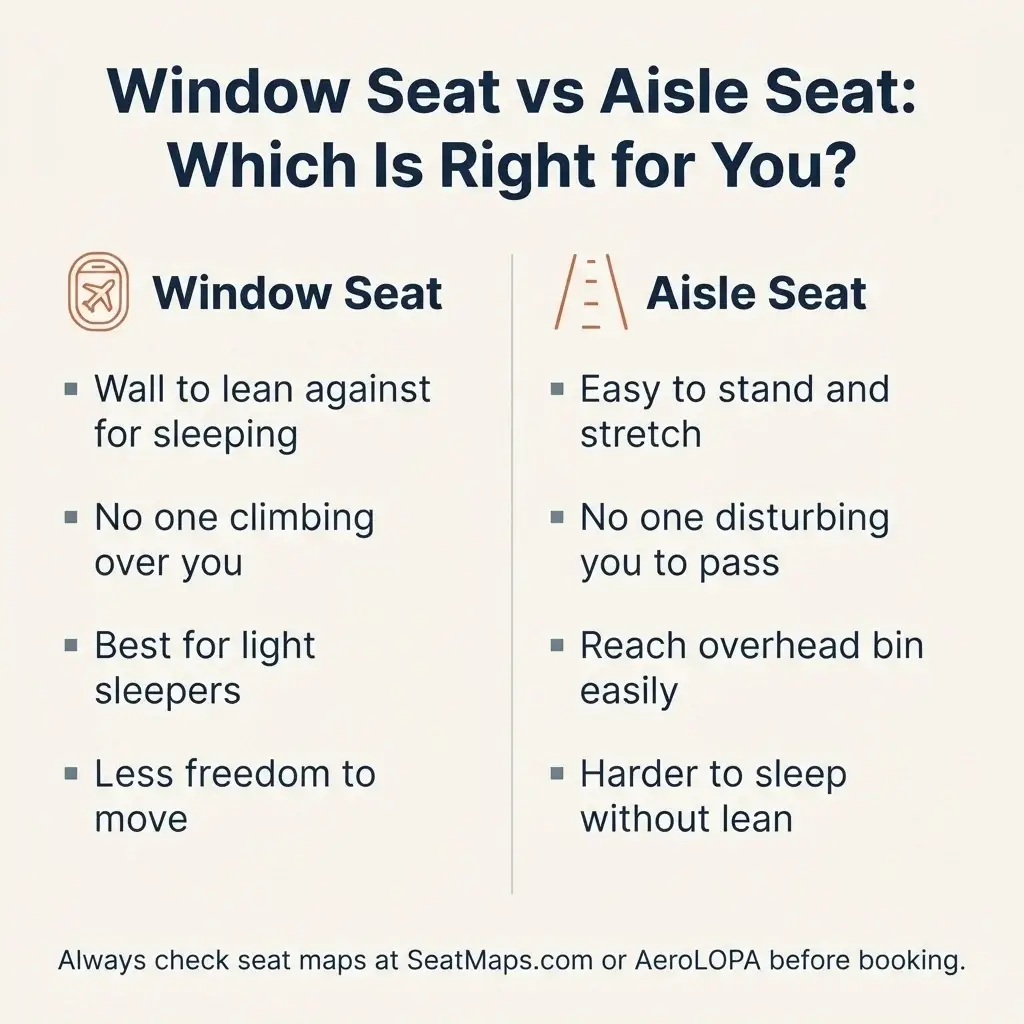
Seat selection is not a perk upgrade. On a 12 to 16 hour flight, the difference between a good seat and a bad one is the difference between arriving rested and arriving defeated. The general rule is simple: if you plan to sleep, book a window seat so you have a wall to lean against and nobody climbing over you at 3 a.m. If you need to move around frequently, book an aisle. Middle seats on long-haul flights should be avoided whenever humanly possible.
Beyond the window/aisle question, the real skill is knowing which specific seats to pick and which to avoid. Exit row seats offer extra legroom but often have immovable armrests and no recline. Seats in the last row of a section frequently don’t recline. Seats directly in front of a galley or bathroom can be noisy and bright throughout the night.
The go-to tool for this used to be SeatGuru, which shut down permanently in November 2025. The two best replacements right now are SeatMaps, which covers more than 700 airlines with weekly-updated maps and actual passenger reviews, and AeroLOPA, which offers scale-accurate LOPA diagrams with legroom measurements and seat ratings. Before any long-haul booking, I’d spend 10 minutes on one of those sites. It’s one of the highest-value uses of your pre-trip time.
Fix Your Sleep Before You Fly
There is a small but effective trick that frequent long-haul travelers swear by: don’t sleep a full night before a daytime flight you want to sleep through. If you’re getting on a night flight to Europe or Asia, stay up a bit later than usual the night before. Tire yourself out. Your body will cooperate on the plane in a way it simply won’t if you boarded fully rested.
This isn’t about sleep deprivation. It’s about giving yourself a gentle biological nudge in the direction you need.
What to Pack in Your Carry-On (and What to Leave Behind)
The carry-on is your survival kit. Checked luggage disappears into the plane’s belly. Everything that will make or break your comfort lives in the bag under the seat in front of you. Here’s what actually earns its place.

The Non-Negotiables
A good neck pillow is one of those things that seems fussy until you’re on hour eight and the person next to you is somehow sleeping beautifully while you’re staring at the ceiling. Memory foam U-shaped pillows are worth the space. Pair it with an eye mask and earplugs or noise-canceling headphones, and you’ve built a reasonable sleep environment out of nothing.
Compression socks also belong in your bag, and not just as a precaution. Here’s why it matters: sitting for extended periods in a cramped position with your legs at a fixed angle slows blood flow. A 2024 analysis from the American Heart Association found that long-haul flights make venous thromboembolism 1.5 to 4 times more likely compared to not flying. While the absolute risk is still low for healthy travelers, the expert recommendation is consistent: get up and walk, and if you want extra support, compression socks do no harm and may reduce leg swelling and discomfort. Put them on before you board, not after you’ve been sitting for six hours.
Pack a small toiletry pouch in your personal item with a toothbrush, face wipes, lip balm, and a travel moisturizer. These are not luxury items. They are the difference between feeling like a functioning human being at hour 10 and feeling like someone who has been sealed inside a tin can. More on why in the next section.
Other things worth having in your carry-on: a portable charger, a reusable water bottle (empty through security, fill it at the gate), snacks that are not salty and processed, headphones, and any medication you take regularly. Never check your daily medication. If your bag gets delayed or lost, that’s a problem you don’t want to solve in a foreign airport at midnight.
The Cabin Environment: What’s Actually Happening to Your Body at 35,000 Feet
This section exists because understanding what a long flight does to you is what motivates you to actually do something about it. Most people know they should “stay hydrated.” Very few understand why it matters this much.
The Humidity Problem
Airplane cabin air has a relative humidity of roughly 6 to 10%, according to published research in the NIH’s PMC journal on aircraft cabin environments. To put that in context, the air in a typical home or office sits somewhere between 30 and 65% humidity. The air at a desert location like the Sahara still runs around 25%. The inside of an airplane is significantly drier than a desert.

What that means practically: your mucous membranes dry out, your skin loses moisture at an accelerated rate, your throat gets scratchy, your eyes get irritated, and you arrive feeling more exhausted than the hours lost to the time zone would explain. Cabin pressure is also maintained at roughly the equivalent of 8,000 feet altitude, which means your blood is carrying slightly less oxygen than usual. That’s part of why you feel foggy and tired even if you slept.
What to Do About It
Drink water consistently throughout the flight. Not just when you feel thirsty. Aim for around 8 ounces per hour of flight time. Skip the alcohol, or at minimum treat it as a deliberate indulgence rather than a way to relax yourself to sleep, because alcohol accelerates dehydration at the exact moment your body needs moisture most. Caffeine does the same.
Apply moisturizer to your face after the first few hours. Reapply on long flights. Use lip balm. If you wear contact lenses, switch to glasses if you can, or at least bring rewetting drops. None of this is vanity. It’s maintenance. Your skin is literally drying out in real time.
Sleep Strategy: How to Actually Rest on a Long Flight
Sleep is where most first-time long-haul travelers struggle. You’re not in a bed. The seat reclines by about four inches. Someone’s elbow is in your space. The lights flicker on for a meal service you didn’t ask for. Here’s how to work with the situation rather than against it.
Build Your Sleep Environment
Put on your eye mask, neck pillow, and headphones before you try to sleep, not after you’ve spent 45 minutes failing to get comfortable. Set up your sleep environment early. Change into comfortable, loose-fitting clothes or at minimum loosen anything with a waistband. Take your shoes off. Many long-haul flights have a lights-out period after the first meal service, and that window is your best chance.

If you have trouble sleeping on planes without help, the CDC advises that for flights crossing more than three time zones, low-dose melatonin can assist with shifting your body clock. According to the CDC’s Travelers’ Health guidelines on jet lag, avoiding alcohol and managing light exposure are also key factors. The CDC Yellow Book recommends starting low, around 0.5 to 1 mg of melatonin, and the guidance is clear that doses above 5 mg are not recommended for jet lag purposes. Check with your doctor if you have any concerns before you try it.
Time Your Meals and Movement
Try to align your sleeping attempt with nighttime at your destination, not nighttime at your departure city. If you’re flying from New York to Tokyo, try to sleep during the portion of the flight that corresponds to night in Japan. It’s not always perfectly possible, but even a rough attempt pays dividends on arrival.
Also, get up and walk. Not because it’s pleasant to shuffle down a narrow aisle in your socks, but because movement is genuinely important. Aim to stand up and take a short walk every 90 minutes to two hours. While seated between walks, flex your calves, roll your ankles in big circles, and wiggle your toes. These small movements keep blood circulating in your legs. It is not a coincidence that the advice for DVT prevention and the advice for arriving less stiff are exactly the same.
What to Eat and Drink (and What to Skip)
Airline food has improved significantly on many carriers, but there are still smart choices and less-smart ones when it comes to surviving a long flight well.
Avoid heavily salted snacks before and during the flight. Salt accelerates the dehydration the cabin air is already causing and contributes to swelling in your legs and feet. Avoid carbonated drinks, which can cause bloating and discomfort at altitude where cabin pressure causes gas to expand. Skip the airline alcohol unless you’ve decided you’re not trying to sleep.
Eat light portions. Your digestion slows at altitude, and a heavy meal at hour two means you feel uncomfortable for the next five hours. If you brought your own food, something like nuts, fresh fruit, or a light sandwich beats salty chips and processed airport sandwiches every time.
Eat according to your destination’s time zone where you can. If it’s midnight in your destination city, treat it as midnight. Don’t eat a full meal just because the airline is serving one.
Entertainment: Making the Hours Move
Here’s the part of the flight most guides skip: the mental game. You are going to run out of things to do if you don’t plan in advance. The in-flight entertainment system will have movies, but Wi-Fi on long-haul flights is inconsistent and often expensive. Download content before you board.
Build what I think of as a “flight stack”: two or three movies downloaded to your device, a podcast series you’ve been meaning to start, a playlist you love, an e-book or two, and one thing that requires light active focus (a language learning app, a journaling prompt, a crossword). The flight stack means you’re never staring at a blank screen wondering what to do next.
For solo travelers especially, a long-haul flight can actually be a genuinely useful stretch of time. I’ve used long flights to plan itineraries, write in my journal, read books I never make time for at home, and just think. You’re not on your phone for social media. Nobody needs anything from you for 12 hours. There’s something quietly valuable about that once you stop fighting it.
Jet Lag: Starting the Battle Before You Land
Jet lag is a biological fact, not a weakness. When you cross multiple time zones rapidly, your internal clock doesn’t update automatically. The sun and your body disagree about what time it is, and that disagreement shows up as fatigue, brain fog, poor sleep, and digestive upset for anywhere from one to several days depending on how many time zones you’ve crossed and which direction you went.

The CDC recommends that if your destination is more than three time zones away, you should begin adjusting your sleep and wake patterns to match your destination as early as possible, both before you leave and on the flight itself. Get daylight in your destination city when you land. Resist the urge to nap for more than 15 to 20 minutes during the day. Stay awake until a reasonable local bedtime if you can manage it, even when every cell in your body disagrees.
The general travel wisdom on direction holds true: eastward travel is harder than westward travel because you’re shortening your day, and the human body adjusts more easily to a longer day than a shorter one.
The Final 30 Minutes: Land Like a Human Being
Most people spend the final approach doing nothing. Use that window. Go to the bathroom and freshen up with face wipes or a quick wash. Change back into your shoes. Moisturize. Get yourself mentally prepared to step off that plane and be present in a new place. Put your destination’s local time as your phone’s active clock and stop converting it back to home time.
When that door opens, you’re stepping into a new country, a new culture, a new adventure. You spent the last 12 or 14 hours getting yourself here. A few minutes of intentional transition makes the arrival feel less like a disembarkation and more like a beginning.
That is ultimately what all of this is about. The flight is not the destination. It’s the price of admission. And with a bit of strategy, it’s a price you pay with a lot more comfort than you think is possible.
Have a long-haul flight coming up? Share your biggest worry in the comments. I read them all.


