
Best Flight Booking Hacks for 2026: What Actually Works

The first time I booked a long-haul ticket with my own money, I refreshed the same search for eleven days straight. I was still working my office job in New York, saving every spare dollar, and that fare felt like the only thing standing between the life I had and the life I wanted. I finally booked it at 1 a.m. on a Wednesday because someone on a forum swore Wednesdays were magic.
They were not. I just got lucky.
Since then I have booked flights to backpack across Europe, to teach English in Thailand, to hike in China, and to reach a family in Ghana who took me in like one of their own. I have learned that almost everything people call a flight hack is either a myth, a trick that saves four dollars, or a genuinely useful habit dressed up in mysterious language. This guide is my attempt to sort those three piles for you, using current 2026 data instead of advice that was already stale in 2019.
Fair warning: a few of these are not glamorous. But the boring ones are the ones that put money back in your pocket.
First, know what you are up against in 2026
You are not imagining it. Flights are expensive right now, and pretending otherwise would be useless to you.
The federal government tracks this, and the numbers are blunt. According to the Bureau of Transportation Statistics, the average U.S. domestic itinerary fare climbed to $428 in the first quarter of 2026, up 4.7% from the previous quarter after adjusting for inflation. Round-trip itineraries averaged $522. The U.S. Travel Association’s Travel Price Index told a similar story in July, with airfares roughly 26.5% higher than a year earlier even though prices had gone nearly flat month to month.
Why does this matter before we talk hacks? Because it resets your expectations in a healthy way. The goal in 2026 is not to find a $300 flight to Europe. The goal is to pay meaningfully less than the person who booked the same seat carelessly, and to protect that money once you have spent it. Those are two different skills, and almost every article on this topic only teaches the first one.
Here is the mindset I want you to carry into this: you are not hunting for a miracle. You are removing the ways people overpay.
The booking window that actually holds up
The old rule was “book domestic six weeks out, international six months out.” The current data says something more interesting, and honestly more forgiving for people who plan late.
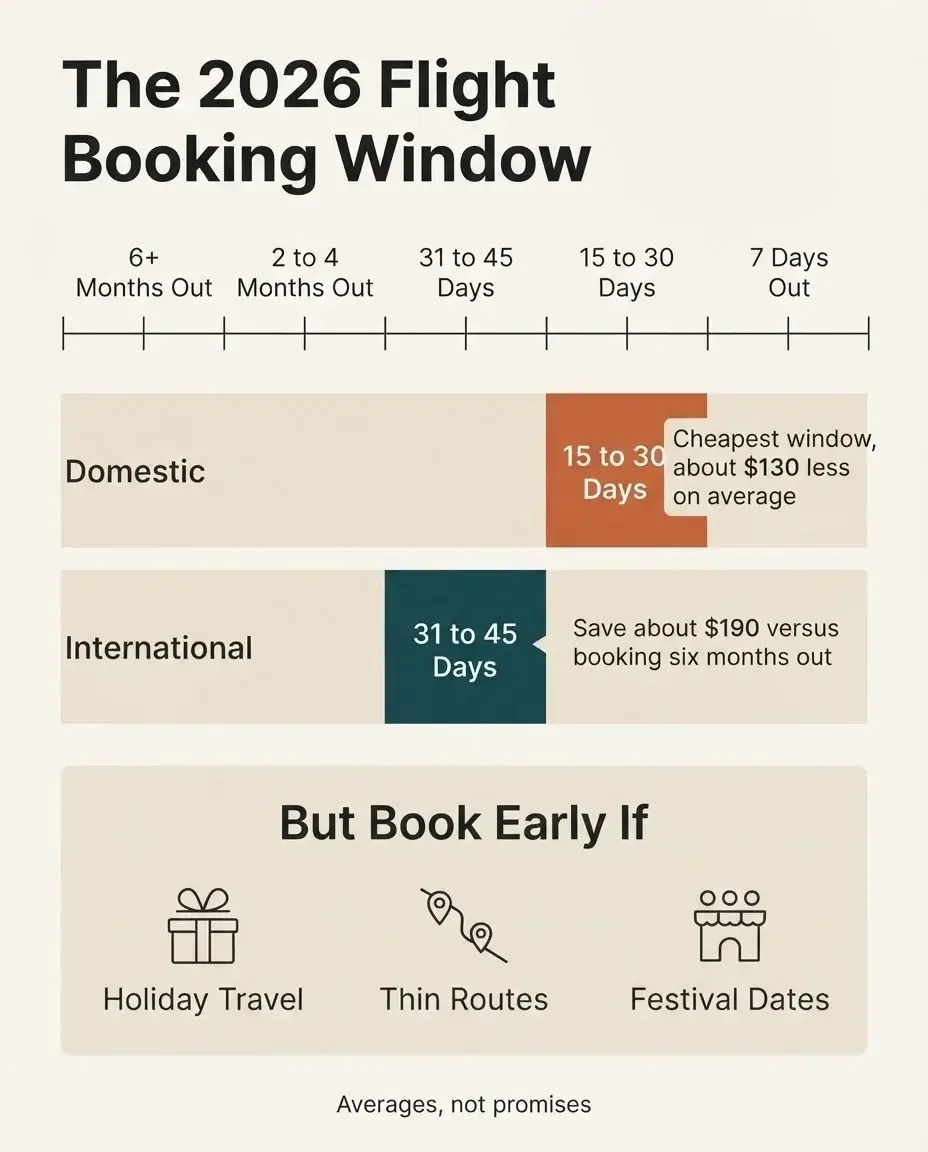
Expedia’s 2026 Air Hacks report, built on millions of their own bookings, found that domestic economy fares are lowest in the 15 to 30 day window before departure, averaging about $130 less than bookings made much further ahead. For international trips, 31 to 45 days out beat booking six months ahead by roughly $190 on average. That same report also crowned Friday as the cheapest day to book, and found Tuesday the cheapest domestic day to fly, up to 14% below Sunday, with Friday about 8% cheaper than Sunday for international departures.
Now let me add the part a data report will not tell you.
Averages are not promises. That 15 to 30 day window is an average across every route and season, including thousands of ordinary business routes with plenty of inventory. If you are flying somewhere with two flights a week, or during a festival, or over a major holiday, waiting until three weeks out is not a hack. It is a gamble with your entire trip.
So here is how I actually apply it:
For flexible domestic trips with lots of daily flights, start watching two to three months out, expect to buy somewhere in that one to two month range, and do not panic if you have not booked yet at six weeks.
For international trips, start watching four to five months out and aim to buy in the two to four month range. The data says you can often do better closer in, but I would rather you sleep well.
For anything holiday-adjacent, event-driven, or on a thin route, book early and stop reading fare articles. Peace of mind is worth more than the $80 you might have saved.
If you are a first-time solo traveler, I want to say something directly to you. Book earlier than the optimizers tell you to. The confidence you get from having the ticket in hand, from the trip becoming real and non-negotiable, is worth more than the theoretical savings. I have watched too many people optimize themselves right out of going.
Search like a data person, not a hopeful person
Refreshing the same route on the same dates twenty times is not searching. It is worrying with extra steps. Replace it with three habits.
Search flexibly before you search specifically. Use a date grid and a price graph to see a whole month at once rather than one date at a time. Shifting a departure by two days or flying into a different airport in the same region routinely moves a fare more than any clever trick will.
Let the software watch for you. This is the single highest-value habit in this entire article. Google lets you track prices for a specific flight, a whole route, or even “any dates” if you are flexible, and it will email you when a fare moves significantly or when it predicts prices are about to rise. Set your alerts, then close the tab and go live your life. You will make a better decision from an email notification than from an anxious 11 p.m. refresh.

Price the trip three ways. Check the round-trip, then price two one-ways, then price an open-jaw where you fly into one city and out of another. On my Europe backpacking trip, flying into one country and out of another was the thing that made the route make sense at all, and it often costs the same or less than doubling back.
Two related notes. Booking two one-ways on different airlines is genuinely useful for flexibility, but if the airlines are unrelated, you own the risk of a missed connection. That is a real trade, not a free win. And self-transfer itineraries where you collect your bag and re-check it need far more buffer than the two hours a search engine suggests.
The 24-hour rule is the hack almost nobody uses correctly
This one is free, legally guaranteed in the United States, and constantly misunderstood.
For tickets bought at least seven days before departure, airlines must either let you cancel within 24 hours for a full refund or hold the fare for 24 hours without payment. The U.S. Department of Transportation lays out exactly when you are entitled to a refund and how fast it must be paid, including the rule that refunds go back within seven business days on a credit card. Airlines are also required to refund you automatically when they cancel or significantly change a flight and you choose not to travel.
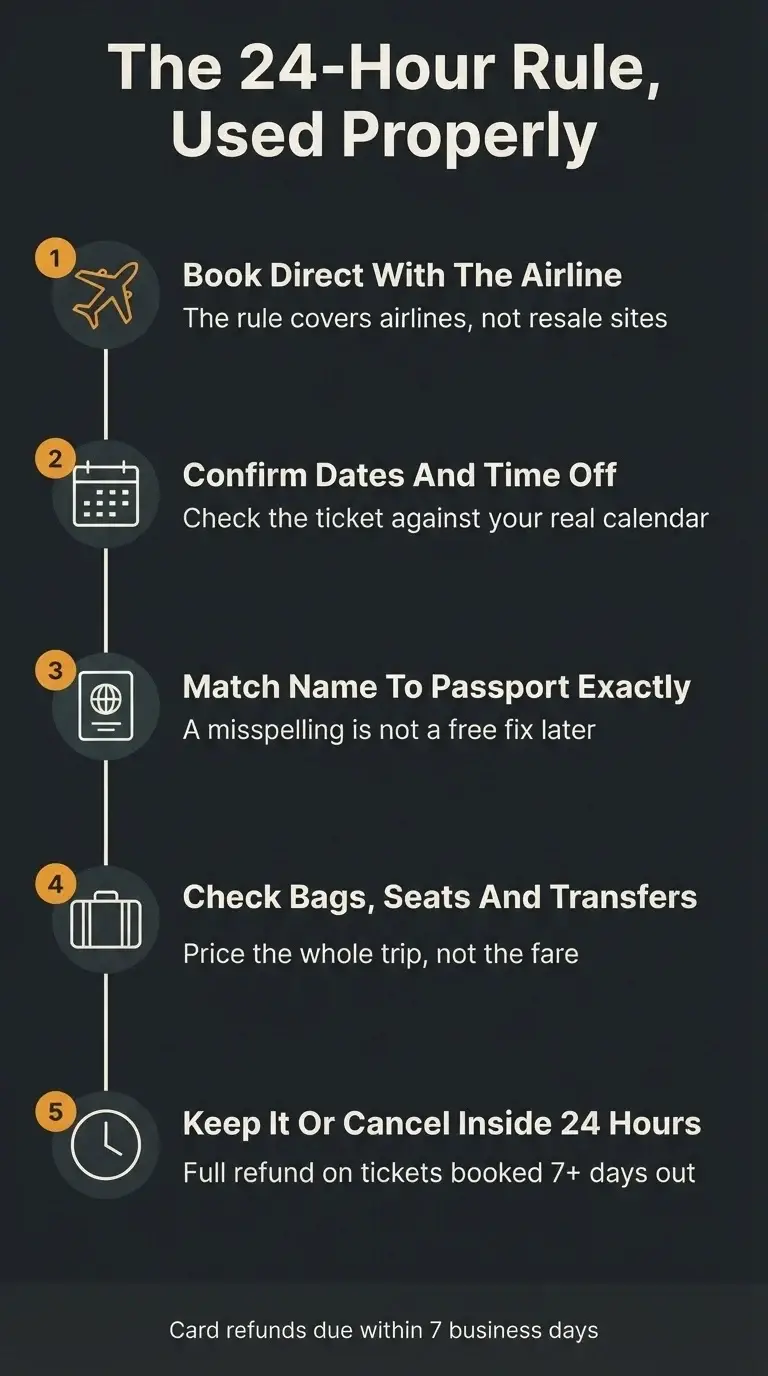
Here is the part that catches people. That 24-hour requirement applies to airlines, not to online travel agencies. If you book through a third-party site, you are relying on that company’s own policy, which may be less generous and much slower to reach a human. That is my main reason for booking directly with the airline whenever the price difference is small. When a schedule change or a cancellation hits, the airline can fix it. A reseller has to ask the airline first, and you are the one waiting.
How to actually use the rule: when you find a fare you are happy with, book it. Then spend the next few hours confirming your dates against your time off, your accommodation, and your onward transport. If something does not line up, cancel inside the window. It turns a nerve-wracking decision into a reversible one, and for a first-time booker that is enormous.
Hacks I would skip, and one I would think very hard about
Not every popular trick deserves your trust.
Incognito mode and VPNs. The idea that a site raises your price because you looked twice is the most persistent myth in travel. Fares move because of inventory, demand, and fare rules. Clearing cookies costs you nothing, so do it if it soothes you, but do not build a strategy on it.
Hidden city ticketing, also called skiplagging. You book a flight with a connection in the city you actually want and simply do not board the final leg. It can be dramatically cheaper. It also violates most airlines’ terms of carriage. Realistic consequences include having your remaining legs cancelled, losing frequent flyer miles or account status, and being refused travel in the future. It only works one way, only with carry-on luggage, and never on a return you still need. Courts have generally not treated the practice itself as illegal for passengers, but “not illegal” and “safe” are very different things. I do not use it, and I would especially not use it on a solo trip where a stranded night has bigger consequences.
Mystery “secret” booking sites. If a site is unfamiliar, undercuts everyone by a suspicious margin, and asks you to pay by bank transfer, walk away. The savings will never cover the loss.
Fare-drop refunds and price guarantees. These are real and worth knowing about, but read the conditions. They typically only apply when you book through a specific channel, and only for certain fares. Treat them as a small bonus, never as the reason to book somewhere you otherwise would not.
Cheap fare, expensive trip: do the total-cost math
This is where budget carriers separate the careful traveler from the frustrated one.
Basic economy and ultra-low-cost fares are advertised stripped down to almost nothing. Once you add a carry-on, a checked bag, a seat assignment, and sometimes a fee just to print a boarding pass, that $89 fare can quietly land above the main cabin ticket you dismissed. A federal rule requiring upfront disclosure of these fees was struck down in court in 2025, so you cannot count on seeing the full picture at the moment you search. You have to go looking for it.
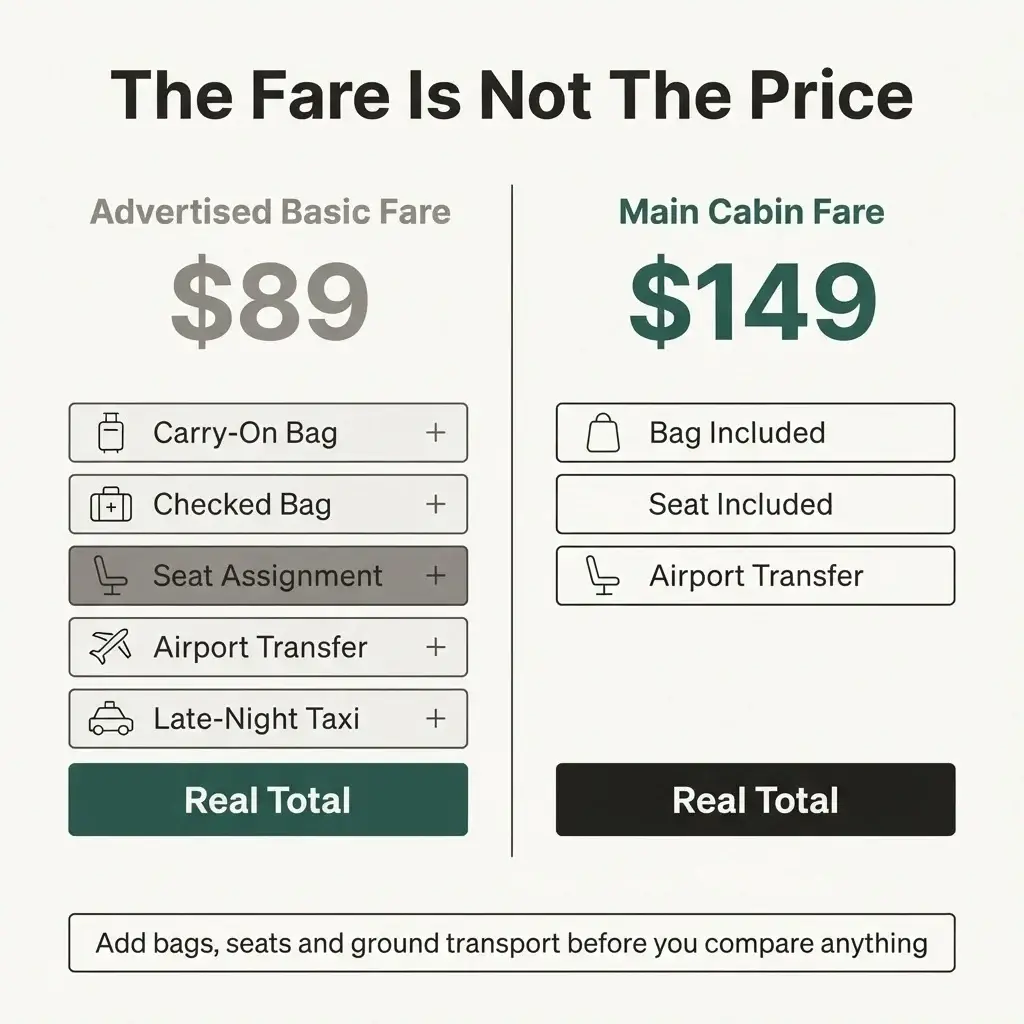
Before you compare two fares, add up: bags you will actually bring, a seat if sitting apart genuinely bothers you, and the cost of getting to and from the airport. That last one is the sneakiest. A secondary airport an hour outside the city can erase its own savings the moment you factor in a $40 transfer each way, or a $60 taxi because your 11:50 p.m. arrival missed the last train.
I also want you to price your own energy honestly. A red-eye or a 5:40 a.m. departure can save real money, and sometimes I would take it. But if arriving exhausted means you lose your first day, or take a cab you did not budget for because you cannot face public transport, it was not a saving. It was a transfer of money from one line of your budget to another.
One small, genuinely useful habit: eat before you fly. Airport food pricing is its own economy, and a $19 sandwich at the gate is not a rounding error on a budget trip. Pack something from the neighborhood you are staying in. Empty bottle through security, fill it after. When I was guiding sightseeing tours in New York, this was the advice I gave visitors constantly, and it applies double at 6 a.m. in a terminal.
When your flight breaks: the money most travelers leave behind
Booking well is half the job. Knowing what you are owed is the other half, and it is where the real money hides.
In the United States, the DOT publishes an airline cancellation and delay dashboard showing exactly what each carrier has committed to when a disruption is within its control. It is worth two minutes of your time before you choose a carrier. As of now, all ten major U.S. airlines commit to rebooking you on their own flights and to providing a meal or voucher when a controllable disruption leaves you waiting three or more hours. But rebooking you on a partner airline, which is often the difference between getting home tonight and getting home tomorrow, is only committed to by Alaska, American, Delta, Hawaiian, JetBlue and United. Allegiant, Frontier, Southwest and Spirit do not commit to it. Frontier also does not commit to hotels or ground transport for overnight controllable disruptions. And not one U.S. airline commits to cash compensation for delay.
Read that last sentence again, because it explains why a $40 fare difference sometimes is not a saving at all. In the U.S., you are buying the recovery plan as much as the seat.
Flying to or from Europe or Canada? You may be owed real money
This is the part I wish someone had told me before my first backpacking trip.
Under EU rules, if you arrive at your final destination three or more hours late, or your flight is cancelled with less than 14 days’ notice, you may be entitled to cash compensation. The official EU portal explains that compensation runs from €250 to €600 depending on distance, alongside rights to meals, accommodation and re-routing. These rules cover any flight departing an EU airport regardless of the airline, and flights arriving in the EU when operated by an EU carrier. Airlines are not required to pay for genuinely extraordinary circumstances like severe weather or air traffic control decisions, but most technical faults do not qualify as extraordinary. Checked baggage liability runs to roughly €1,300, with claims for damage due within seven days and delayed baggage within 21.
Canada has its own version. The Canadian Transportation Agency’s Air Passenger Protection Regulations set compensation for delays within an airline’s control at CAD $400, $700 or $1,000 for arrival delays of 3-6, 6-9 and 9 or more hours with large airlines, and $125, $250 or $500 with small ones. Denied boarding pays considerably more, from $900 up to $2,400. You have a full year to file, and the airline has 30 days to respond.
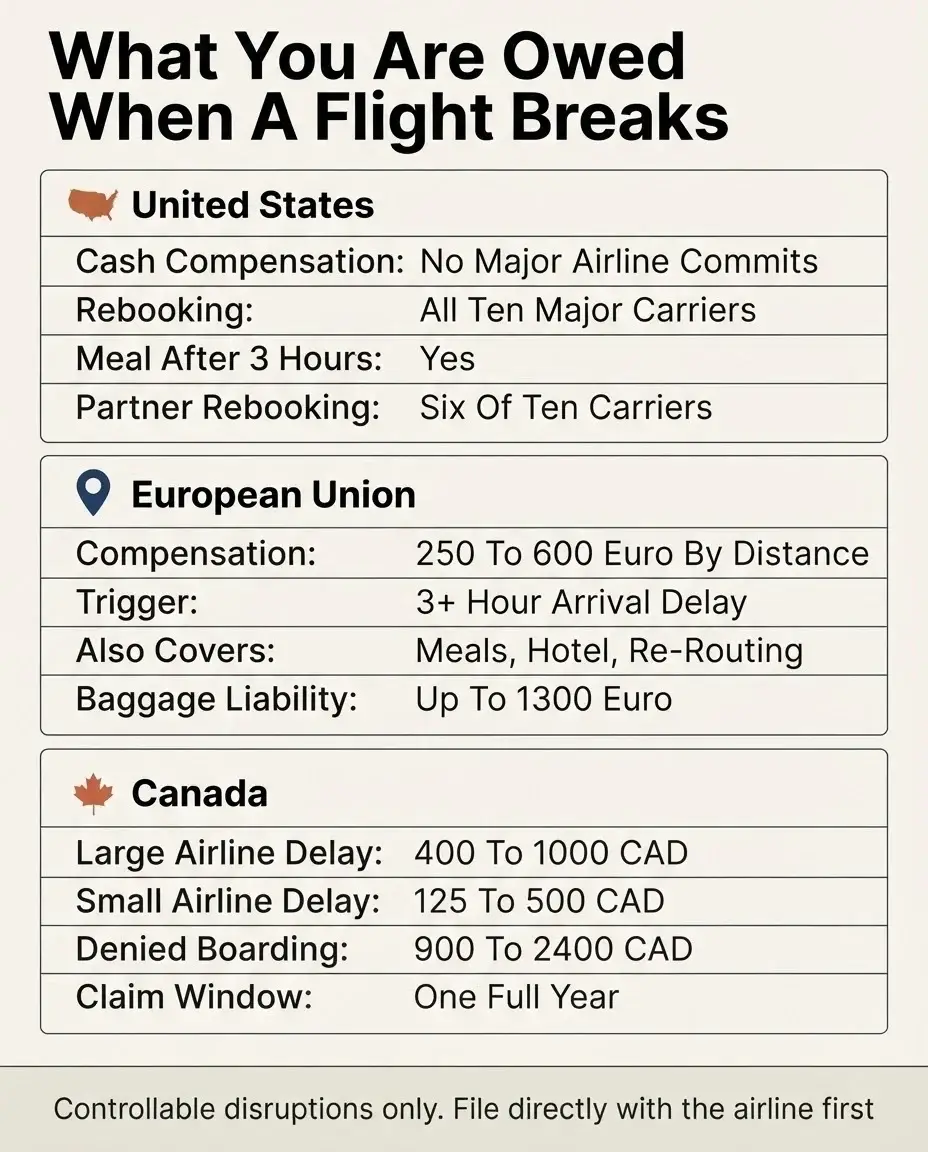
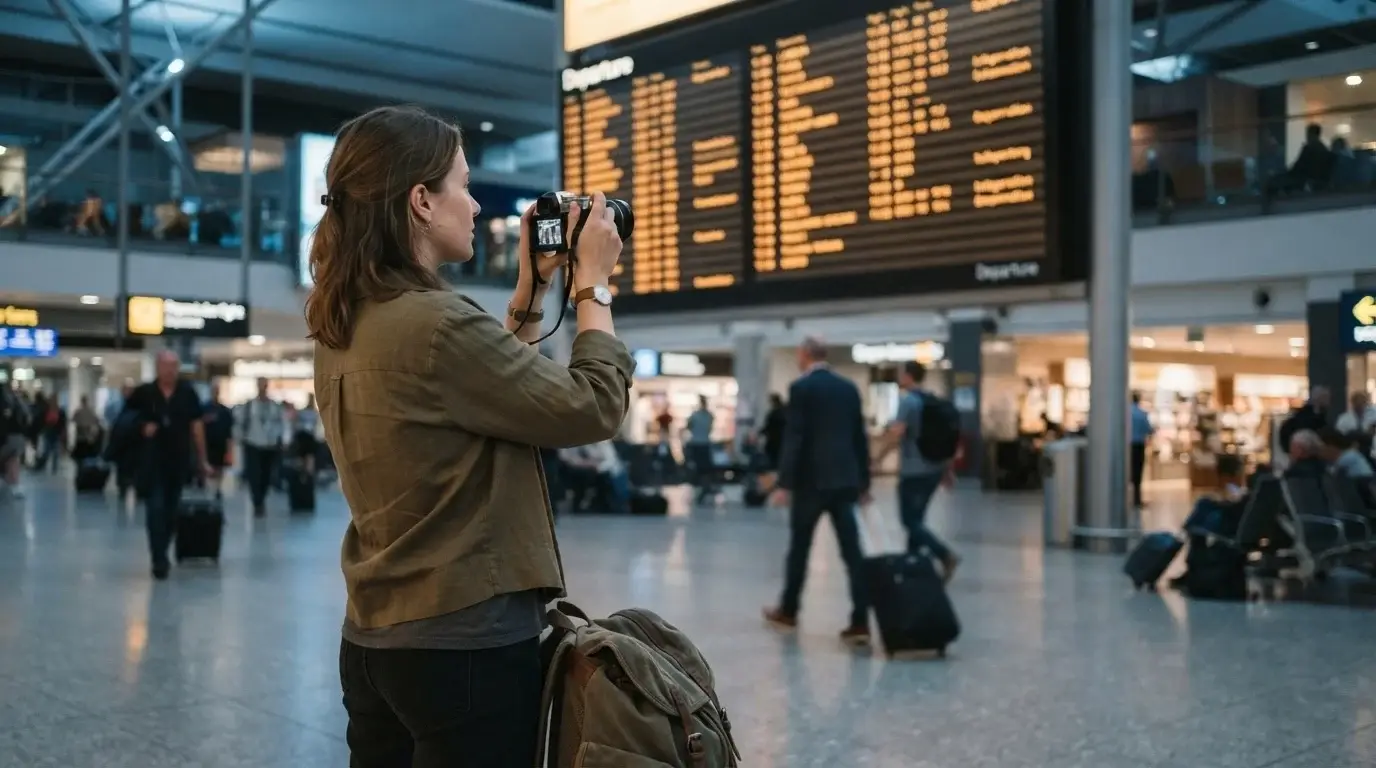
Practical steps if it happens to you: photograph the departure board, keep every receipt, ask a gate agent in writing for the reason for the delay, and file the claim directly with the airline first. Claim agencies will take a large cut for a form you can submit yourself. This is genuinely worth more than most booking tricks, and hardly anyone bothers.
Paperwork that can quietly cancel your cheap flight
A brilliant fare is worthless if you are denied boarding, and 2026 is a year of new entry requirements.
If your trip touches the United Kingdom, including a landside airport transit where you pass through border control, you almost certainly need an Electronic Travel Authorisation. The UK government’s official page confirms an ETA costs £20 and covers visits of up to six months, and every traveler needs their own, babies included. Apply on the government site only. Copycat sites charge more for the same thing.
For Europe, ETIAS is coming and is worth understanding now. The official EU site confirms that ETIAS will cost €20, be linked to your passport, and cover 30 European countries for stays of up to 90 days in any 180-day period. It is not yet in operation, and no applications are being taken at the moment, with the launch expected around the end of 2026. When it does go live, apply before you buy tickets. Most applications are processed within minutes, but the system allows up to four days, and longer if additional documents or an interview are requested.
Two more checks that cost nothing. Confirm your passport has enough remaining validity for your destination’s rules, which is often three or six months beyond your departure date. And confirm the name on your ticket matches your passport exactly. A misspelled name is not covered by the 24-hour cancellation rule as a free fix, and correcting it can cost real money.
Small upgrades worth their price
Not everything cheap is smart, and not everything paid is a splurge.
Global Entry costs $120 for five years and includes TSA PreCheck, which makes it better value than the $85-or-less standalone PreCheck if you cross a U.S. border even occasionally. Divided over five years, that is $24 a year. If you fly three or four times annually and have ever sprinted through a security line with your shoes in your hand, it pays for itself in reduced stress alone. A number of travel credit cards reimburse the fee outright, so check yours before you pay.
Points are the other lever. If you are building toward a big trip, transferable credit card points remain more resilient than points locked into a single airline, because award charts get devalued regularly and transferable balances let you move where the value is. But I want to be honest about the timeline: points are a long game. Do not delay your first trip waiting to accumulate them.
And travel insurance deserves a sober look rather than an automatic yes or no. Some credit cards already include trip delay and baggage coverage when you pay with that card, which can duplicate what you are about to buy. Read what you already have first, then decide what gap you are actually filling. I am not a financial adviser, and the right answer here depends on your health, your destination, and how much of the trip cost you could absorb losing.
The five-step routine I would give a friend
If you remember nothing else, remember this sequence.
Set your rough dates and pick two or three possible airports at each end. Set price alerts on all of them and then step away. When an alert fires or you reach your booking window, price the round-trip, two one-ways, and an open-jaw. Add bags, seats, and airport transport to each before comparing. Book directly with the airline, then use your 24 hours to verify everything against the rest of your plan. Finally, screenshot your confirmation, note your rights for that route, and stop looking at the price.
That last instruction matters more than it sounds. Once you have booked, checking the fare again can only make you feel worse. Let it go, and put that energy into planning the part of the trip that actually changes you.
Because that is the whole point of this. Nobody looks back on a journey and remembers the fare. I remember the family in Ghana who fed me until I could not move. I remember my legs shaking on a trail in China. I remember standing in a European train station at midnight with no plan, terrified and completely alive. The ticket was only ever the door.
Get a fair price, protect it properly, and then go walk through it.