
Best Budget Airlines for Cheap European Travel (Real Talk)

The first time I flew across Europe on a budget airline, I stood at the gate absolutely certain I was about to get caught doing something wrong. I had this tiny fare, a backpack I’d wrestled into the metal sizer three times, and a low hum of panic that someone in a hi-vis vest was going to charge me a small fortune in front of a queue of strangers. Nobody did. My bag fit, my boarding pass scanned, and an hour later I was in a different country for less than the price of a nice dinner back home.
That’s the magic of budget flying in Europe, and also the reason it scares people. The fares are genuinely cheap. The rules are genuinely fiddly. And the gap between “I saved so much money” and “how did this cost me double” comes down to a handful of things nobody explains clearly.
So let’s fix that. This is the honest version. Which budget airlines are actually worth flying, who each one suits, and exactly how to keep your cheap flight cheap. No hype, no perfect-highlight-reel nonsense. Just the stuff I wish someone had told me before I white-knuckled my way through that first gate.
Why budget airlines changed European travel for regular people
Here’s the thing that took me a while to appreciate. Budget airlines are the reason ordinary people can build a trip around curiosity instead of a corporate travel budget. When I left my old office job and started stitching together income from flexible work, cheap flights were what made a big European trip possible on a small savings pile. A weekend in one country, a week somewhere else, all for fares that used to feel impossible.
Short hops between major European cities regularly land somewhere in the fifty to two-hundred-dollar range, and if you time it well, far less. That single fact is what turns “someday” into “I booked it.” You don’t need to be rich. You need to understand the game.
The catch is that the low headline price is the beginning of the story, not the end. Budget carriers make their money on the extras: bags, seats, priority, check-in slip-ups. None of that is a scam. It’s just a different model. You’re paying for a seat and nothing else, and everything else is a menu. Once you see it that way, it stops being stressful and starts being something you can control.
The main budget airlines, and who each one is really for
There are dozens of low-cost carriers crisscrossing Europe, but a handful will cover most trips you plan.
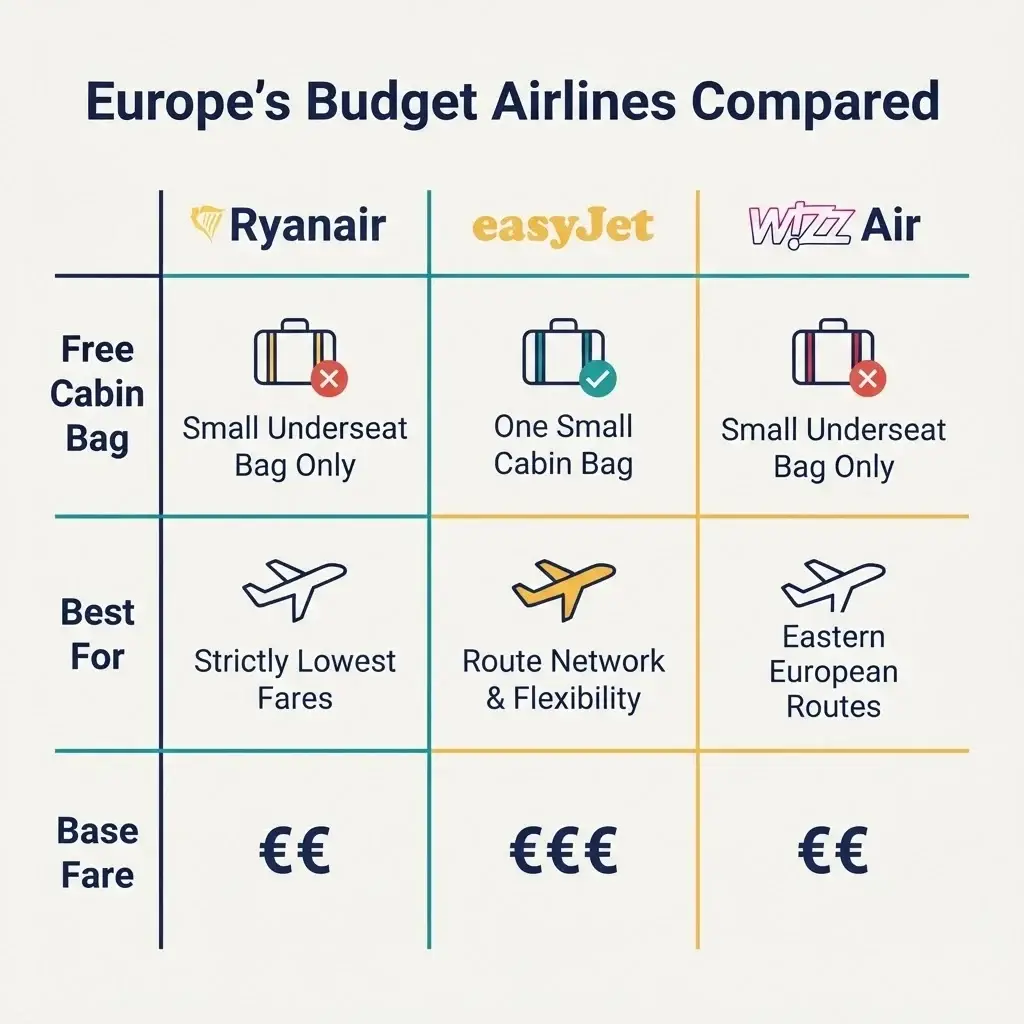
Let me walk you through the ones that matter and, more usefully, who each one actually suits.
Ryanair: the cheapest fares, if you play strictly by the rules
Ryanair is the giant. It flies more routes to more places than anyone, and its base fares are often the lowest you’ll find anywhere. That’s the whole appeal, and it’s a real one.
The trade-off is discipline. Ryanair’s Basic fare includes only one free small personal bag that must fit under the seat in front of you, sized up to 40 x 30 x 20 cm, and if you want a proper cabin bag you’ll need to add Priority. I always check the current details straight from Ryanair’s own bag policy page before I book, because the numbers do shift and the gate staff enforce them to the centimeter. Ryanair rewards travelers who pack light, check in online on time, and read the fine print. It punishes the improvisers. If you’re the kind of person who likes a clear system, you’ll do great. A 20kg checked bag typically runs somewhere between about €15 and €52 depending on the route and how early you add it.
Best for: solo travelers and light packers chasing the absolute lowest fare who don’t mind following instructions exactly.
easyJet: a gentler middle ground
easyJet tends to cost a little more than Ryanair, but it buys you breathing room, and for a lot of first-timers that’s worth it. The big difference is the free cabin bag. Everyone gets one small cabin bag on board at no charge, and it can be a bit larger than Ryanair’s freebie. That single detail removes the most common source of budget-flight anxiety.
Best for: nervous first-timers, and anyone who wants the low-cost price without feeling like they’re walking a tightrope over bag rules.
Wizz Air: unbeatable in central and eastern Europe
Wizz Air is the one people forget about until they’re planning a trip through central or eastern Europe, and then it’s suddenly the obvious choice. It dominates routes into places like Budapest, Warsaw, Bucharest, and beyond, often at fares that make you double-check the screen. Its Basic fare, like Ryanair, includes one free carry-on up to 40 x 30 x 20 cm and 10kg, with the bigger trolley bag reserved for its Priority-style fares. Checked-bag prices swing widely, so buy them at booking, never at the airport.
Best for: anyone exploring central or eastern Europe, where Wizz often simply has the routes others don’t.
The quality players: Vueling, Eurowings, Volotea, Transavia, Jet2
Don’t sleep on the smaller and mid-sized carriers. In the Skytrax World Airline Awards, Europe’s best low-cost airlines for 2025 were led by Eurowings, followed by Vueling, Volotea, Transavia, Iberia Express, then easyJet, Ryanair, and Jet2. Vueling is a strong pick for Spain and the Mediterranean, Eurowings shines out of Germany, and Volotea quietly connects smaller cities that the big two skip entirely. When two airlines fly the same route at a similar price, the higher-rated one is usually worth the couple of extra euros for a calmer experience.
The real cost of a cheap flight (do this math before you book)
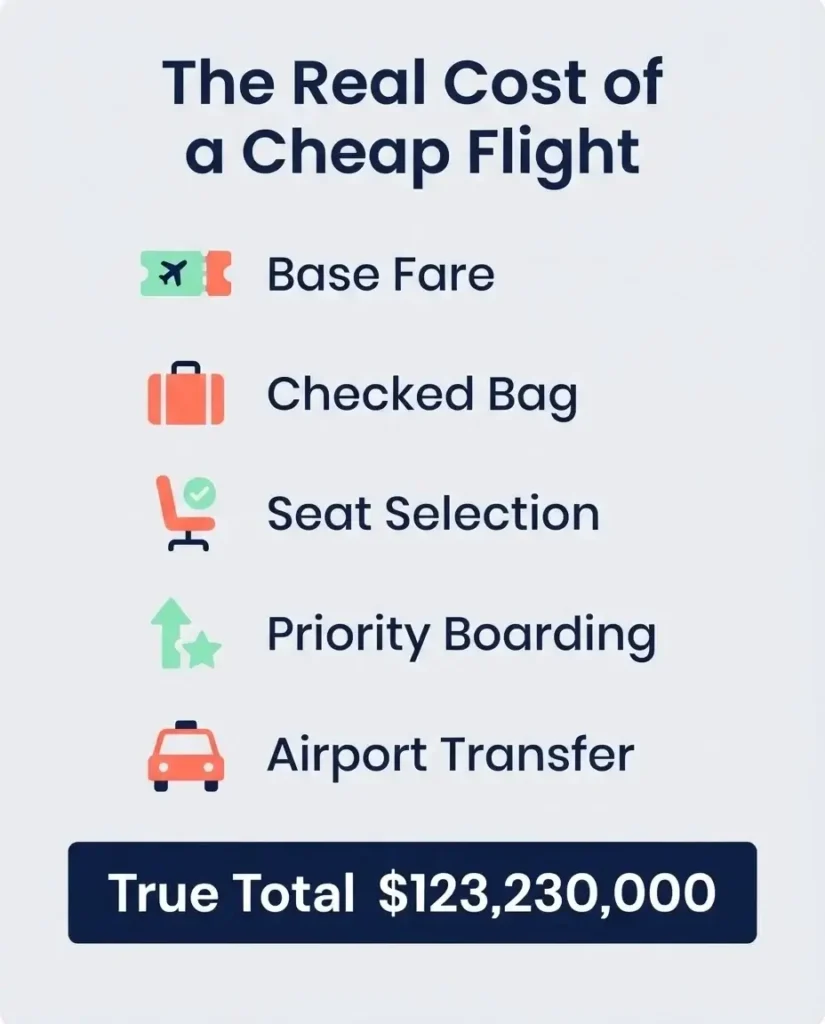
This is the single most important habit I can give you, and it’s the one competitors almost never spell out. The fare you see is not the price you pay. Before you book anything, add up the true total.
Start with the base fare. Then add: any bag beyond the free personal item, seat selection if you care where you sit (I usually don’t on a short hop), priority boarding if you need the bigger bag, and, quietly, the cost of getting from the airport into the actual city. When you total all of that, a “cheap” Ryanair fare and a slightly higher easyJet fare sometimes come out nearly even, at which point comfort wins.
I do this quick sum in my notes app every single time. It takes ninety seconds and it’s saved me from more than one flight that looked like a bargain and wasn’t. The winner isn’t the lowest fare. It’s the lowest total.
The hidden fees, and exactly how to dodge every one
None of these fees are secret, technically. But they catch people constantly, so here’s how I sidestep them.
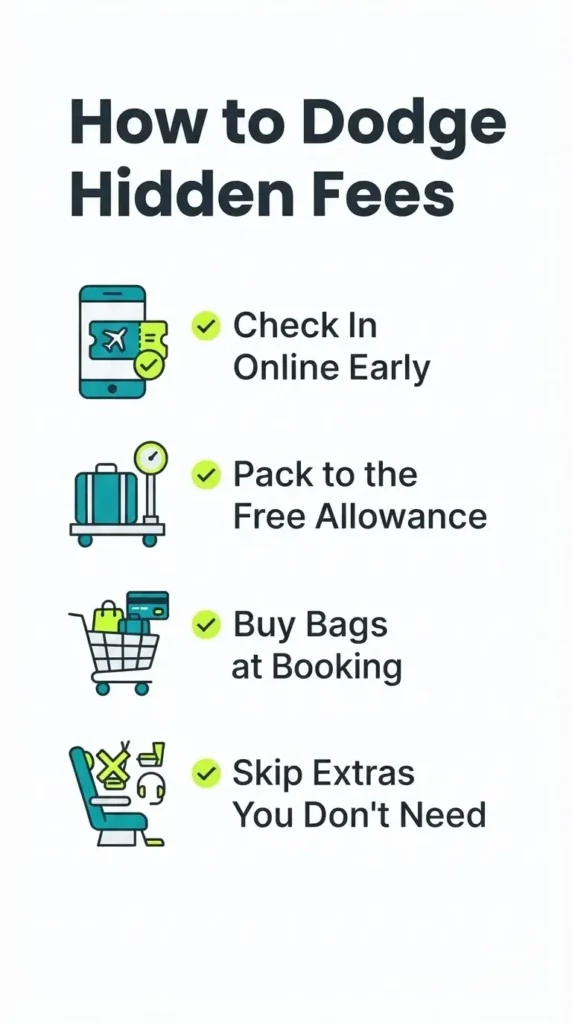
Check in online, always, and do it early. The gate desk check-in fee at some budget carriers is brutal, and it’s completely avoidable. Set a phone reminder for the moment check-in opens so you never forget.
Pack to the free allowance. If you can live out of a single personal item that fits under the seat, you skip bag fees entirely. This is the one habit that saves the most money over a multi-city trip, and it’s why I’ve become a devout one-bag traveler. Measure your bag at home against the exact dimensions on the airline’s site, not a guess.
Buy bags at booking, never at the airport. Adding a checked bag during booking is a fraction of the airport price. The gate is where the expensive mistakes live.
Skip the extras you don’t need. Seat selection, priority boarding, insurance upsells at checkout. On a ninety-minute flight, a random assigned seat is genuinely fine. Only pay for what actually improves your trip.
The secondary airport trap nobody warns you about
Here’s the one that ambushed me in my early backpacking days. Budget airlines love flying into secondary airports, the smaller ones parked well outside the city they claim to serve. The fare looks incredible until you realize the airport is an hour and a bus ride away from where you actually want to be.
Before you book, look up which airport you’re flying into and how far it sits from the city center. Then price the transfer, a shuttle, train, or bus, and add it to your total-cost math. Sometimes the secondary airport is still a great deal. Sometimes the “expensive” flight into the main airport is actually cheaper once you count the taxi you’d otherwise need at midnight. Know before you go, not after.
Fly or take the train? An honest comparison
Budget flying isn’t always the answer, and I’d be doing you a disservice to pretend otherwise. On shorter routes, trains often win once you count the time you’d spend getting to a far-off airport two hours early, clearing security, and traveling in from the secondary airport on the other end. City-center to city-center, a train can be faster and far more pleasant.
There’s also the footprint to be honest about. Rail is dramatically cleaner than flying. According to data compiled by Our World in Data on travel’s carbon footprint, a train like the Eurostar produces roughly 4 grams of CO2 per passenger kilometer, compared with around 154 grams for a short-haul flight. That’s a genuinely enormous difference. I fly budget airlines often and I’m not going to pretend I don’t, but on shorter routes I’ll take the train when I reasonably can, and I sleep a little better for it.
My rough rule: for trips under three or four hours by rail, seriously price the train first. For longer distances, the plane usually wins on both time and money.
When to book for the cheapest fares
Timing matters more than people think, and less than the internet claims. For short-haul European flights, the reliable sweet spot is roughly a few weeks to about four months before departure. Book too early and you may overpay; wait until the final days and prices usually spike.
Midweek flying, Tuesday through Thursday, is often cheaper than weekend departures, since everyone else wants Friday and Sunday. Be flexible with your dates if you can, use the whole-month view on flight search tools, and let the cheap day tell you when to travel rather than forcing a date. Some of my favorite trips happened simply because a random Wednesday was half the price of the Saturday.
Are budget airlines safe? Yes, and here’s the reassurance
I get this question a lot from nervous first-timers, so let me be direct. European budget airlines operate under the same strict aviation safety regulations as the full-service carriers. A cheaper ticket does not mean a less safe plane. What you’re giving up is legroom, free bags, and frills, not safety standards. The Skytrax rankings I mentioned earlier are about service quality and experience, not safety, because on safety the bar is set the same for everyone.
Know your rights when things go wrong
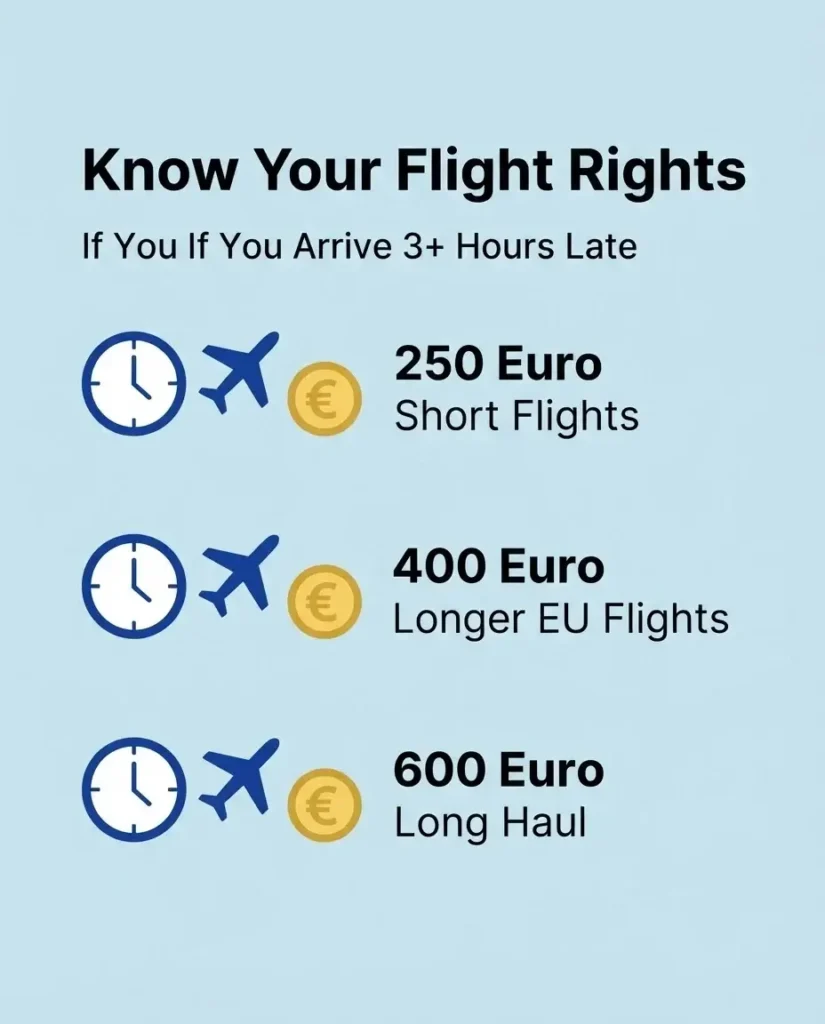
Cheap doesn’t mean you have no protection, and this is the part that turns a stressful delay into a manageable one. If you’re flying within the EU, departing the EU, or arriving into the EU on an EU airline, you’re covered by strong passenger-rights rules, and they also extend to Iceland, Norway, and Switzerland.
The short version: if you arrive at your final destination three or more hours late, you may be owed compensation, ranging from €250 on shorter flights to €400 on longer intra-EU routes, unless the airline can prove genuinely extraordinary circumstances like severe weather. A cancellation with short notice can also trigger a payout, plus your choice of a refund or rerouting, and the airline owes you meals and, if needed, a hotel while you wait. I keep the official EU air passenger rights page bookmarked on my phone so I can quote the actual rule at the desk if I ever need to. Screenshot your boarding pass, keep every receipt, and complain to the airline in writing first. Budget carriers are legally bound by the same rules as everyone else.
A quick word for solo and first-time travelers
If you’re doing this alone for the first time, budget flying is honestly one of the best confidence-builders out there. You’ll figure out the check-in, wrangle your one bag, find your gate, and land somewhere new entirely under your own steam. That small victory stacks up fast. The first flight is the nervous one. By the third, you’re the person calmly measuring their bag at home and breezing through the gate.

Two practical notes before you go. Keep your travel documents sorted early, and if you’re crossing between countries with different entry rules, check the official EU guidance on documents you need for travel in Europe so nothing surprises you at the airport. And embrace the single-bag life. Nothing makes solo budget travel smoother than never waiting at a carousel and never paying a bag fee.
You don’t need the perfect airline or the perfect fare. You need a rough plan, a light bag, and the willingness to press “book.” The rest, like almost everything in travel, you’ll figure out as you go. And you’ll be so glad you did.