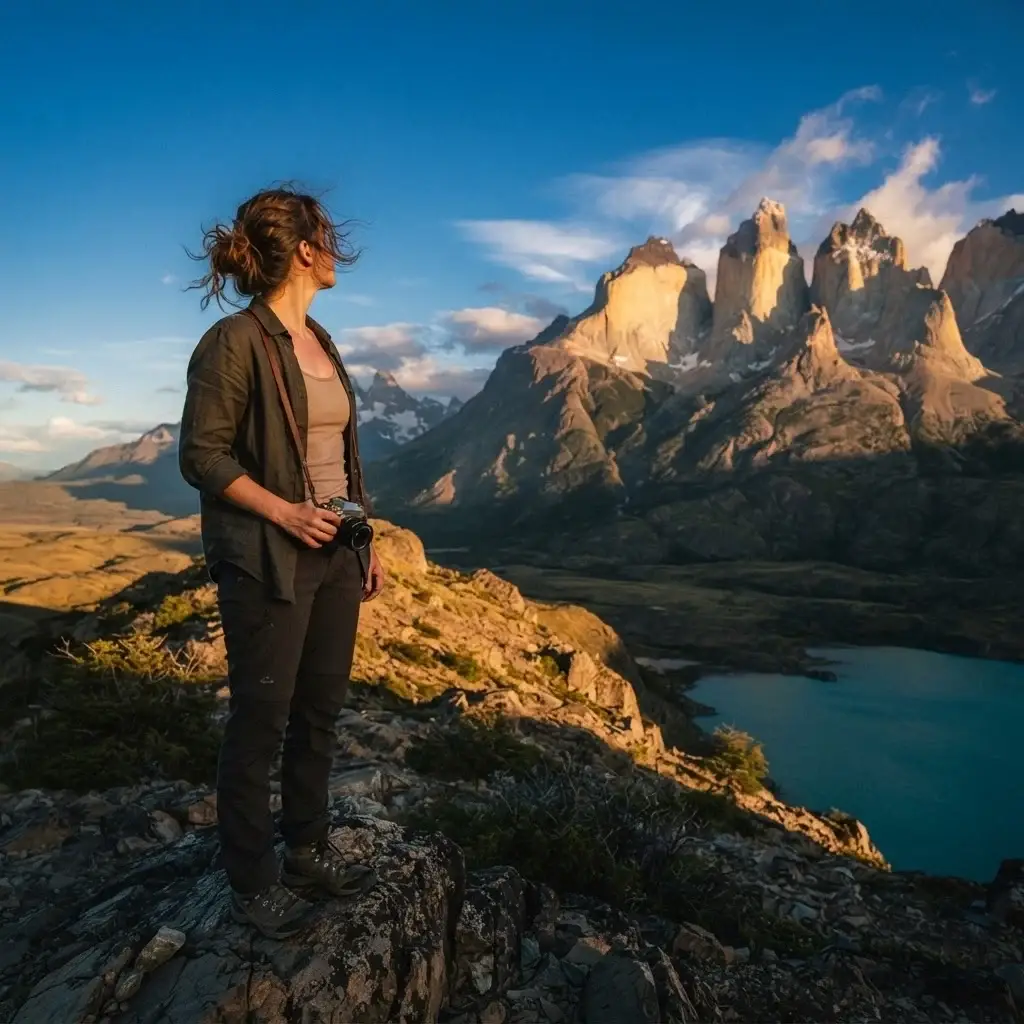
There is a specific kind of overwhelm that hits when you start researching national parks in the Americas. You open one tab and Yellowstone is staring back at you. You open another and there are granite towers in Chilean Patagonia that look almost too dramatic to be real. Then someone mentions Banff, and another person says you absolutely cannot skip Iguazu Falls, and before long you have seventeen tabs open and zero decisions made.
I know that feeling well. It is the same one I had before my first big solo trip through Europe, when every city felt equally important and choosing between them felt impossible. What I eventually learned is that the right starting point is not the “best” park by some universal ranking. It is the park that fits where you are right now, physically, logistically, and emotionally.
The Americas hold some of the most extraordinary protected landscapes on Earth. Across the United States, Canada, and South America, you will find thermal basins, ancient glaciers, cloud forests, volcanic islands, and waterfalls wider than most city blocks. This guide walks through the parks worth building a trip around, with honest notes on what to expect, how to get in, when to go, and what makes each one worth the effort of going alone.
How to Think About the Americas Before You Book Anything
One mistake I see a lot of first-time visitors make is treating a national parks trip like a highlights reel where every park gets one afternoon. National parks in the Americas almost universally reward slowing down. The traveler who spends three full days in Yellowstone sees things the one-afternoon visitor completely misses:
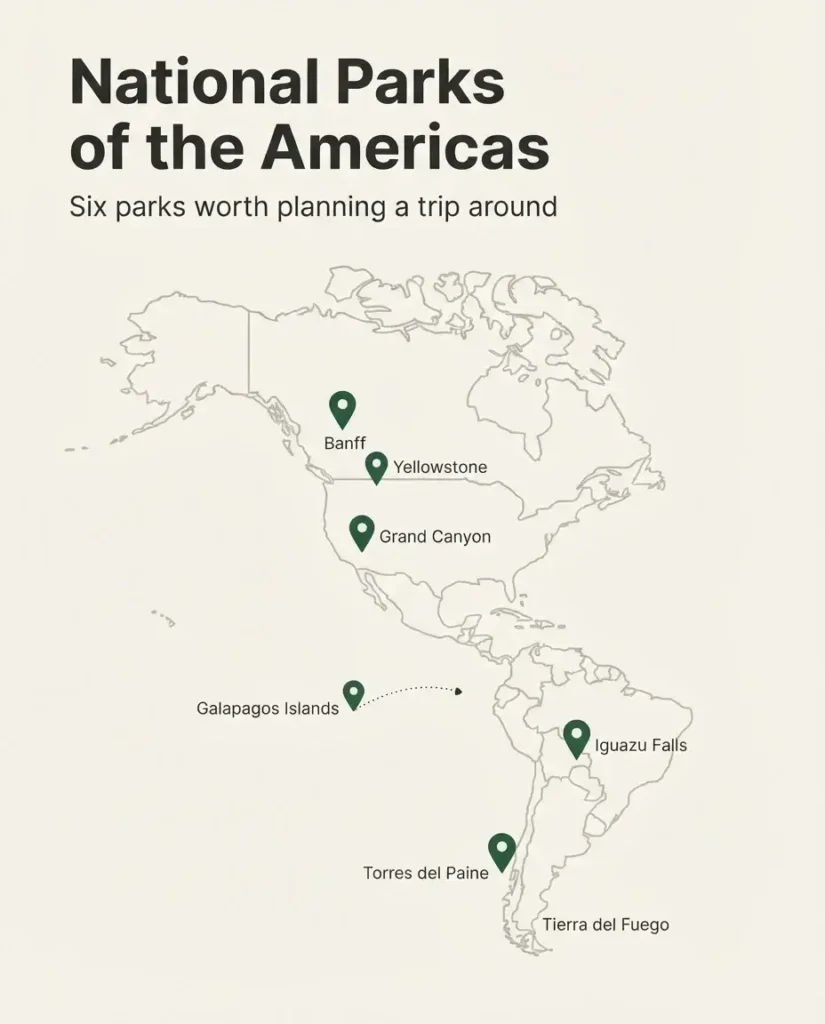
the way the light shifts over the Grand Prismatic Spring at different hours, the bison moving through the Lamar Valley at dusk, the quieter thermal basins off the main boardwalk loop.
Before you do anything else, decide what kind of trip you want. A road trip through the American West connects several parks in one journey and is deeply doable solo. A dedicated trek to Torres del Paine is a commitment of at least five to seven days just inside the park. The Galapagos requires a week at minimum to do justice to multiple islands. These are not places to rush, and the good news is you do not have to choose between them forever. You just have to choose where to start.
One practical thing worth knowing early: if you are planning to visit multiple U.S. national parks in one trip, the America the Beautiful Pass available through the National Park Service gives you unlimited entry to all federal recreation sites for $80 per year (U.S. residents) or $250 (non-residents). If you are visiting more than two parks in one trip, it pays for itself quickly.
Yellowstone National Park, Wyoming / Montana / Idaho
Yellowstone is, without question, one of the most genuinely astonishing places in North America. I grew up hearing about it as a New Yorker, the way you hear about places that feel mythological. The idea of a supervolcano sitting underneath a landscape of geysers, hot springs, and wildlife corridors did not fully register until I started reading about it in depth. From what solo travelers consistently report, nothing quite prepares you for the scale and strangeness of this place in person.
The park sits across nearly 3,500 square miles, making it larger than Rhode Island and Delaware combined. The star attraction for most visitors is Old Faithful, the geyser that erupts roughly every 90 minutes, but focusing only on Old Faithful misses the point. The Grand Prismatic Spring near Midway Geyser Basin is one of the most visually striking natural features in the world:
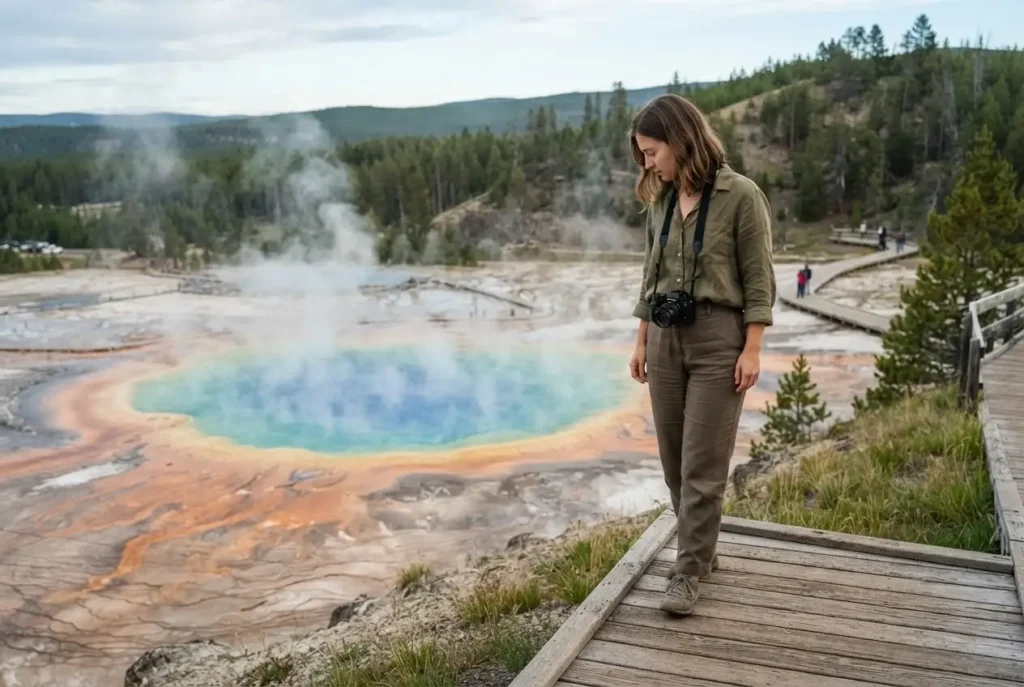
a massive hot spring ringed in bands of orange, yellow, and deep blue produced by heat-loving microorganisms. The best view of it is not from the boardwalk at ground level but from the short overlook trail above the basin, which most visitors skip entirely.
For wildlife, the Lamar Valley in the park’s northeastern corner is where serious wildlife watchers go. Early morning and late afternoon are the most productive windows for spotting wolves, grizzly bears, bison, and pronghorn. Solo travelers do well here because you can move at your own pace, stop whenever something catches your eye, and spend as much time as you want in one spot without worrying about a group schedule.
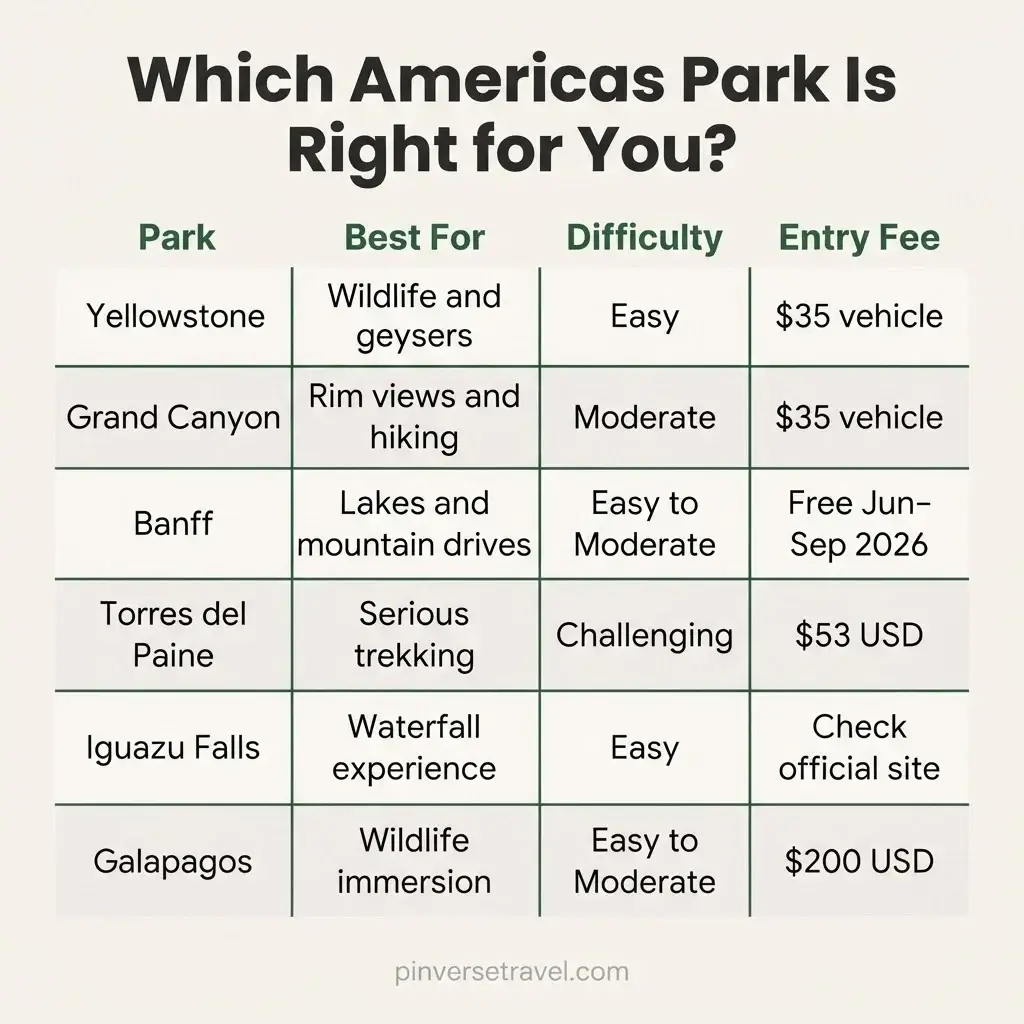
Entry to Yellowstone currently runs $35 for a private vehicle (valid for 7 consecutive days). If you are a non-U.S. resident aged 16 or older, there is an additional $100 per person surcharge added on top of the standard fee. You can read the full breakdown and pass options directly on the Yellowstone fees page at the National Park Service. As of 2025, no timed-entry reservation is required, though arriving early in summer significantly reduces crowds at major sites.
For food near the park, the town of Gardiner, Montana (at the north entrance) has several good local spots. Inside the park, the Lake Hotel dining room offers a surprisingly lovely sit-down meal with views of Yellowstone Lake. For something quick between stops, the Canyon Village area has a cafeteria that works when you are mid-loop and hungry.
Grand Canyon National Park, Arizona
There is a version of the Grand Canyon experience that almost every first-timer has: you walk up to the South Rim, look out, and feel briefly unable to process what you are seeing. It is one of those rare landscapes that genuinely does not translate to photographs. The canyon is a mile deep, 277 miles long, and up to 18 miles wide. Your brain keeps trying to scale it using familiar references and keeps failing.
Solo travel here is excellent for a specific reason: you are free to linger at the rim without feeling like you are slowing anyone down, and lingering is exactly what the Grand Canyon rewards. Sunrise at Mather Point and sunset at Hopi Point are two completely different experiences in light, color, and atmosphere. Going alone means you can catch both without negotiating timing with travel partners.
If you want to hike down into the canyon, the Bright Angel Trail is the most accessible route from the South Rim. It is a serious hike, though, and the inner gorge gets brutally hot in summer. Solo hikers should carry far more water than they think they need, ideally a liter per hour in warm conditions, and the NPS strongly advises against attempting to hike to the Colorado River and back in a single day. The canyon claims lives every year from heat and dehydration, and it does not care how fit you are. Respect the rim-to-river distance.
Entry fees at the Grand Canyon follow the same structure as Yellowstone: $35 per vehicle or $20 per individual on foot or bicycle for a 7-day pass, plus the $100 per person non-resident surcharge for international visitors aged 16 and over. Full fee details are on the Grand Canyon’s official fees page at the NPS. The America the Beautiful Pass covers entry here as well.
For food, Bright Angel Lodge inside the park has a casual restaurant with reliable burgers and Southwestern dishes. The town of Williams, about an hour south, is a classic Route 66 stop with real diner culture and locally owned restaurants worth a sit-down meal after a long day on the rim.
Banff National Park, Alberta, Canada
Canada’s oldest national park opened in 1885, and it still earns the superlatives people throw at it. The combination of turquoise glacial lakes, jagged Rocky Mountain peaks, and accessible trail infrastructure makes Banff one of the most well-rounded national park experiences in the Americas for solo travelers at any experience level.
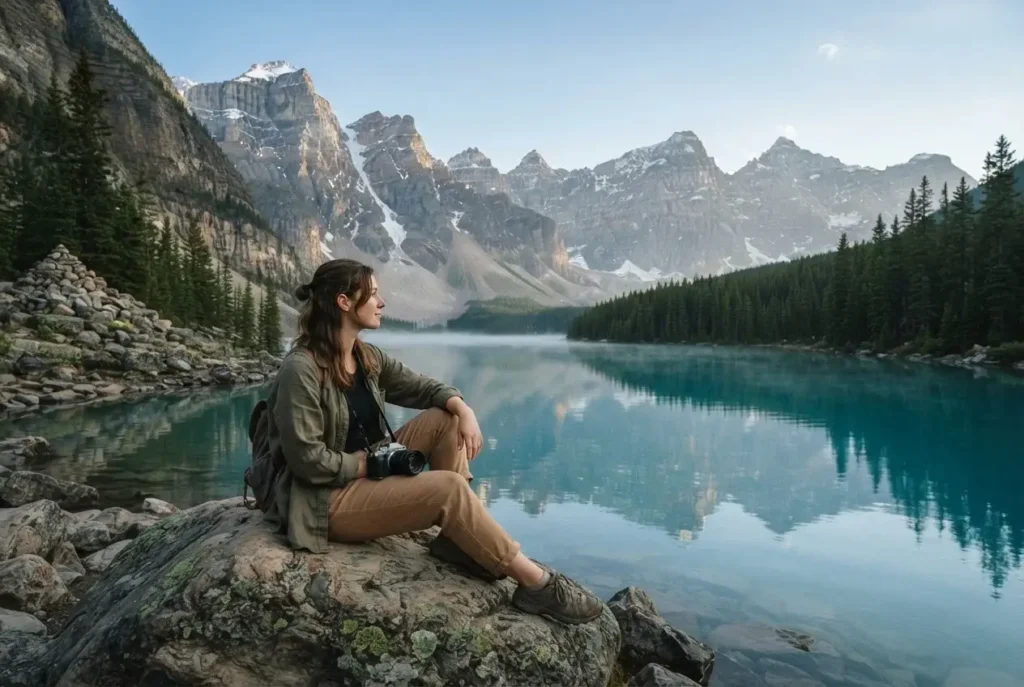
Lake Louise and Moraine Lake are the two most photographed spots in the park, and for good reason: the water color is unlike anything produced by a filter or camera trick. It comes from glacial rock flour suspended in meltwater, which reflects sunlight in the blue-green spectrum. Moraine Lake in particular, set against the Valley of the Ten Peaks, is the kind of view that stays with you. Note that both require early arrival in peak summer season, often before 6 a.m., to secure parking before the lots fill and shuttles become mandatory.
Beyond the lake photos, Banff rewards hikers willing to go just slightly off the main circuit. The Plain of Six Glaciers trail above Lake Louise gives you a completely different perspective of the park and leads to a teahouse at the end. The Icefields Parkway, the highway connecting Banff to Jasper National Park to the north, is consistently rated one of the most beautiful drives in the world and is completely manageable as a solo road trip.
For entry logistics, Parks Canada recently introduced the Canada Strong Pass, which makes admission to Banff free from June 19 through September 7, 2026. Outside that window, daily adult passes run approximately C$11. Full details and pass options are on the official Parks Canada Banff page. The town of Banff inside the park boundary has excellent food options ranging from casual to sit-down, with Bear Street Tavern and Earls being consistent local favorites.
Torres del Paine National Park, Chilean Patagonia
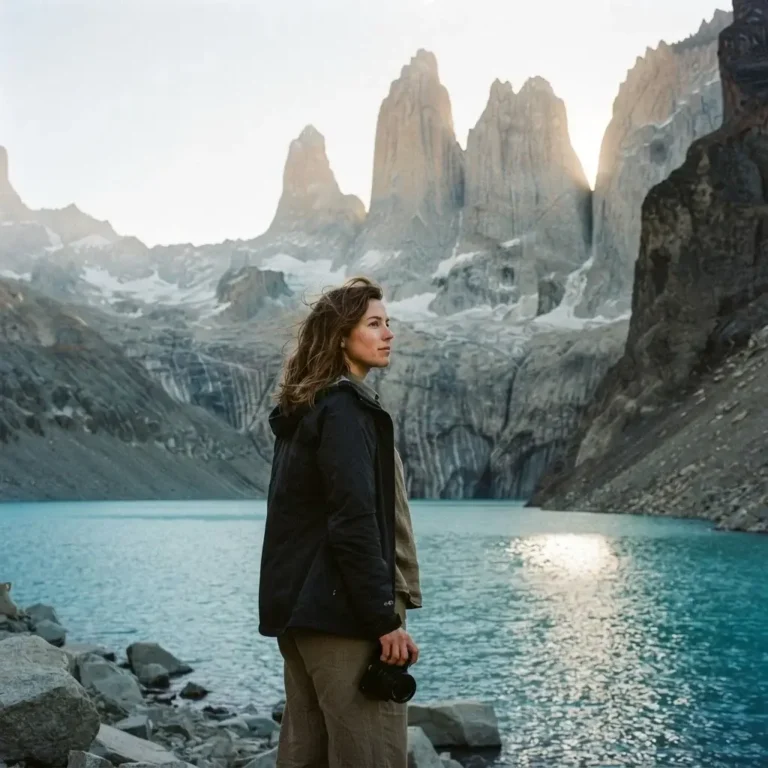
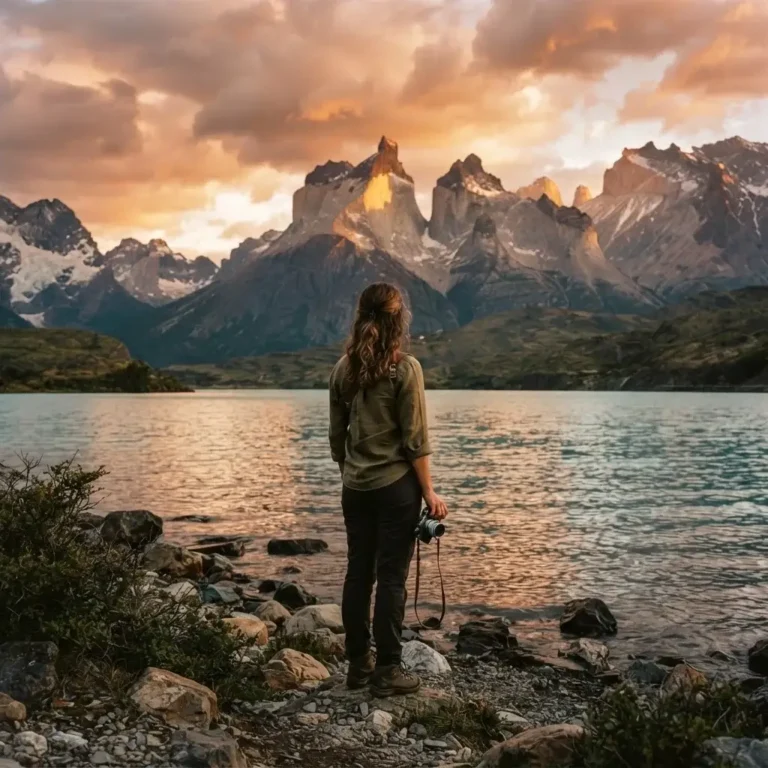
If there is one park in South America that solo travelers consistently describe as a turning point, Torres del Paine is it. Located in the far south of Chilean Patagonia, the park is a UNESCO Biosphere Reserve and one of the most visually dramatic landscapes in the world, a wild arrangement of granite towers, turquoise lakes, hanging glaciers, and Patagonian steppe that shifts dramatically in the wind. The UNESCO Man and the Biosphere Programme profile for Torres del Paine documents its ecological significance across more than 770,000 hectares.
The most famous route through the park is the W Trek, a 4 to 5-day trail that takes in the base of the towers, the French Valley, and the Grey Glacier. It is rated moderate to challenging, with some exposed and windy sections, but it does not require technical mountaineering skills. Solo hikers complete it regularly. The key is booking campsites and refugios well in advance, as the most popular spots (particularly at Mirador Las Torres and Paine Grande) fill months ahead for the peak season of November through March.
Weather in Patagonia is famously unpredictable. You can experience sun, rain, hail, and strong wind all within the same afternoon. Layering is not optional here. Experienced travelers pack waterproof gear even when the morning looks clear, because a Patagonian morning forecast is genuinely unreliable.
Entry for international visitors runs approximately $53 USD per adult for a multi-day pass. The park is only accessible via Puerto Natales, a small town about 70 miles north of the park entrance. Puerto Natales is also where you will sort out gear, food, and logistics, and it has a warm, friendly traveler community with several good parrilla restaurants where you can eat excellent lamb stew (cordero al palo is the local specialty, and it is exceptional) before heading in.
Iguazu Falls National Park, Argentina / Brazil
Few natural features in the world create a genuine physical sensation just from proximity. Iguazu Falls does. The waterfall system stretches nearly 2.7 kilometers wide and drops roughly 80 meters, producing a continuous roar and mist that soaks everything within a significant radius. Standing at the edge of the Devil’s Throat, the most powerful section of the falls, is one of those rare moments where the natural world completely overwhelms rational thought.
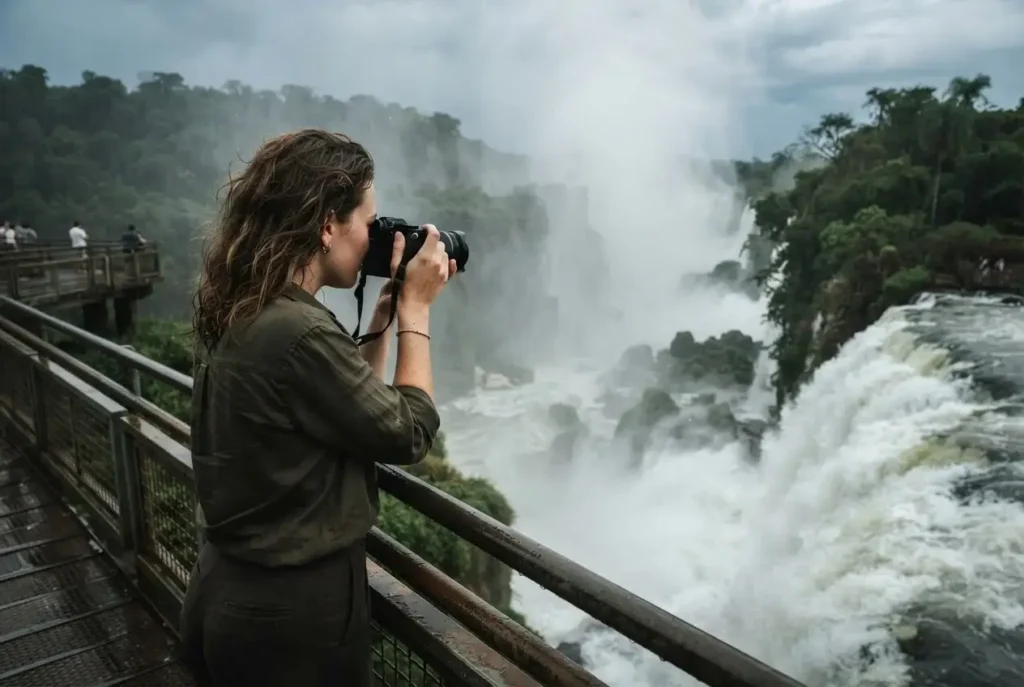
The falls straddle the border between Argentina and Brazil, and both sides offer legitimate and distinct experiences. The Argentine side gives you a much more immersive, up-close perspective, with walkways that put you directly above and beside the cascades. The Brazilian side offers a panoramic view of the full width of the falls from across the canyon, which is where most of the iconic wide-angle photographs are taken. If you have time, both sides are worth a day each.
The Argentine side of Iguazu Falls is a UNESCO World Heritage Site, inscribed in 1984. You can read the full ecological and cultural significance of the site at the UNESCO World Heritage Centre’s official listing for Iguazu National Park. The Brazilian sister park was inscribed separately in 1986.
Tickets for the Argentine side must now be purchased in advance online. Pricing is volatile due to the Argentine peso situation, so check the official park website close to your travel dates rather than relying on figures from older articles. The nearest city is Puerto Iguazu on the Argentine side, and Foz do Iguacu on the Brazilian side. Both have good food options: on the Argentine side, El Quincho del Tio Querido is consistently praised for its regional parrilla. Try the pacú, a local Parana River fish, if it is on the menu.
Galapagos Islands National Park, Ecuador
The Galapagos demands a level of commitment that not every traveler is ready for, and that is completely fine. But if you are ready, there is genuinely nothing else like it on Earth. The islands sit about 600 miles off the coast of Ecuador in the Pacific Ocean, and the wildlife here evolved with almost no natural predators, which means the animals have no fear of humans. You can sit down next to a marine iguana. Blue-footed boobies will walk past you on the trail. A sea lion may fall asleep a meter from where you are standing.
The Galapagos National Park covers about 97 percent of the archipelago’s land area. Accessing the islands requires flying from Quito or Guayaquil to either Baltra or San Cristobal island. The national park entrance fee is $200 USD per adult (non-Ecuadorian, age 12 and over), paid in cash on arrival, so make sure you have it ready before you land. Children pay $100. You can review what to expect in terms of conservation rules and planning directly through the Charles Darwin Foundation’s trip planning resource, which is the most authoritative non-government planning resource for first-time visitors.
Solo travel in the Galapagos is a bit different from other parks on this list. You cannot explore freely across all areas independently; many sites are only accessible through licensed guides and naturalist-led day tours. This is not a barrier so much as a different kind of experience: the guides are deeply knowledgeable and the structure means you are genuinely learning rather than just wandering. Many solo travelers connect with small group day trips out of Puerto Ayora on Santa Cruz Island, which is the main hub.
The best time to visit is between June and December for penguins, sharks, and cooler water temperatures, or January through May for lush green landscapes and warmer snorkeling conditions. Neither window is wrong; they just offer different experiences.
A Few Things Nobody Tells You Before Your First Park Trip
Planning a national park trip anywhere in the Americas tends to surface the same few surprises. Here are the ones worth knowing before you arrive anywhere.
Reservations fill up far earlier than most people expect. Campsites in Banff during July, for example, book out weeks in advance. The W Trek in Torres del Paine requires reservations months ahead for peak season. Even some U.S. parks now use timed-entry systems during peak periods. Building your bookings before you build your itinerary is not an overreaction; it is just good logistics.
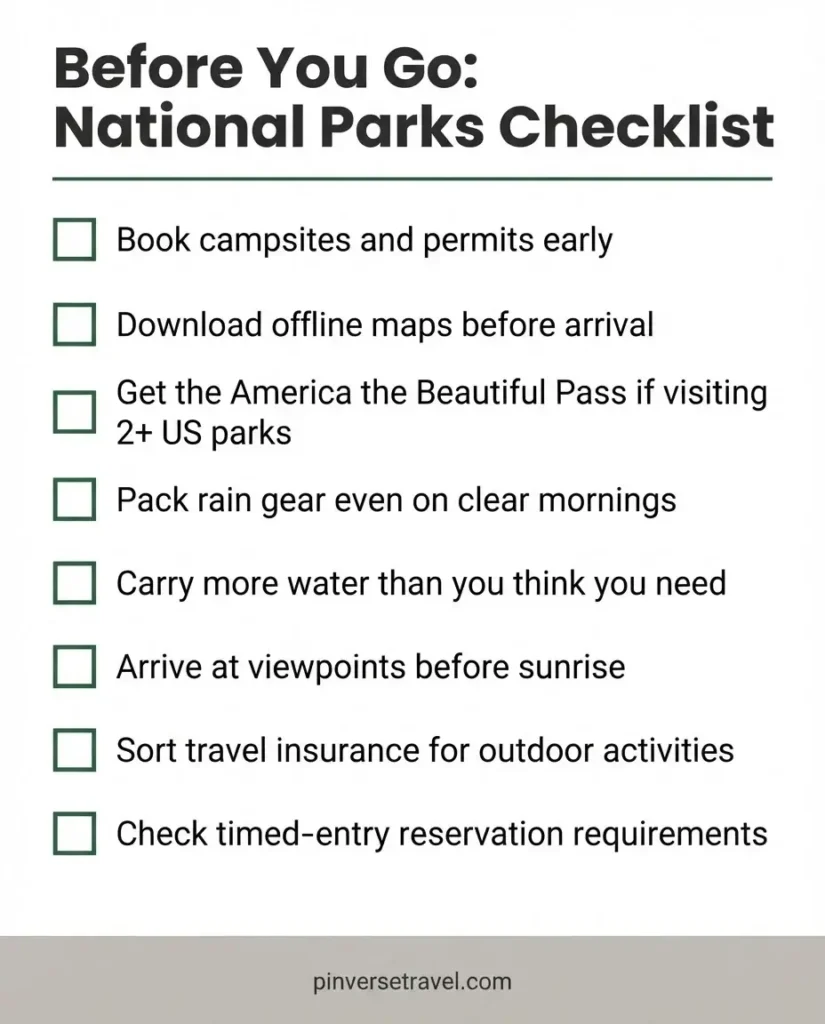
Cell service is unreliable or absent inside most national parks in the Americas. Download offline maps (Maps.me or Gaia GPS are both reliable) before you arrive. For the Galapagos specifically, having a local SIM or eSIM sorted before you leave the mainland makes communication on the islands much easier.
The America the Beautiful Pass is one of the genuinely good deals in North American travel. At $80 for U.S. residents, it covers unlimited entry to all NPS sites, Bureau of Land Management land, and several other federal recreation areas for a full year. If you are doing any kind of multi-park road trip in the American West, it is a no-brainer.
Finally, go early. Almost every national park in the Americas is more crowded, more expensive to park in, and more photographically difficult in the middle of the day. Getting to a trailhead or viewpoint an hour before sunrise is rarely the wrong call, and it consistently delivers experiences that the midday crowd never gets.
Which Park Should You Start With?
If you are based in North America and have not visited any of these parks, Yellowstone or Banff are genuinely excellent starting points. Both are accessible by road, have strong infrastructure, and offer enough variety across a few days to feel deeply rewarding. The American West as a road trip circuit (Yellowstone, Grand Teton, Zion, Grand Canyon) is a classic for a reason and works beautifully as a solo journey.
If you are ready for South America, Torres del Paine is worth planning a larger trip around. Combine it with Buenos Aires and the Argentine lake district and you have one of the most satisfying multi-week itineraries in the Southern Hemisphere.
And if you want something that feels genuinely different from anywhere else you have ever been, the Galapagos will give you exactly that. It requires more investment in time and money, but solo travelers who go there consistently describe it as one of the most clarifying travel experiences of their lives.
The perfect moment to book will not arrive on its own.
Pick the park that is pulling at you right now, and start there.