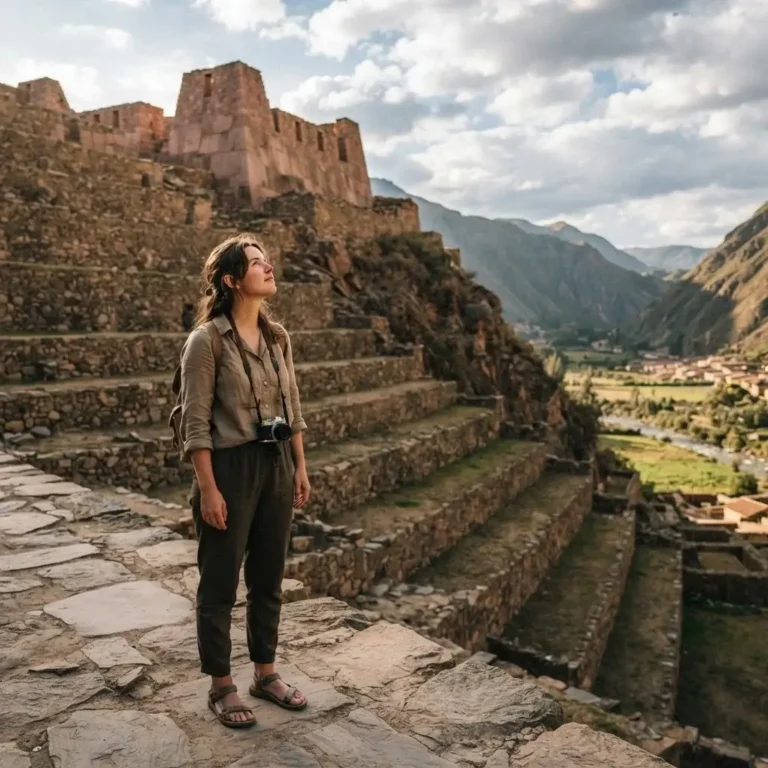
I have stood at the edge of a crater in my imagination more times than I can count. There is something about a volcano that pulls at you in a way that a mountain or a beach simply does not. It is not just the scale or the drama. It is the fact that the earth beneath your boots is still alive. It breathes. It erupts. It reminds you that you are very small, and somehow that is exactly what you needed to feel.
The Americas stretch from the glaciated peaks of Washington State down through the cloud forests of Guatemala and into the high Andean plateau of Ecuador and Chile. Along that spine, there are dozens of hike-able volcanoes, some accessible to first-timers, some requiring technical skill and cold-weather gear, and a handful that are simply off-limits right now because the mountain is in an especially feisty mood. This guide is going to walk you through the best, be honest about the hard ones, and help you figure out where to start.
No fabricated summit stories from me. For the ones I have not personally stood on, I am going to tell you what consistent firsthand reports from solo travelers and official park sources actually say. That is more useful to you than a borrowed anecdote anyway.
Why the Americas Are the World’s Best Volcano-Hiking Continent
It is not a small claim, but it holds up. The Americas sit along the Pacific Ring of Fire, which means volcanic activity from Alaska to Patagonia. What makes this continent stand out for hikers specifically is the range. You can do a genuinely beginner-friendly, half-day active volcano hike in Guatemala for under $20. You can do a technical two-day glacier climb in Ecuador that requires crampons and an acclimatization protocol. You can walk the wildflower-covered trails of a massive stratovolcano in Washington State with your family. That spread of difficulty, budget, and terrain does not exist anywhere else in the world in the same concentrated form.
The cultural texture matters too. Volcano hikes here are not isolated wilderness experiences. They come wrapped in Mayan history, Andean indigenous traditions, thriving colonial gateway towns, and remarkable food. If you have ever spent time backpacking through Europe, as I did, learning to look beyond the obvious and lean into local rhythm, you will recognize that same quality in the communities around these volcanoes. Antigua, Guatemala. Pucon, Chile. Latacunga, Ecuador. These are not just transit points. They are part of the experience.
Before You Choose: The Three Things That Should Guide Your Decision
Too many travel articles hand you a list of volcanoes without helping you figure out which one actually fits where you are in life right now. Here are the three real questions to ask yourself before you commit.
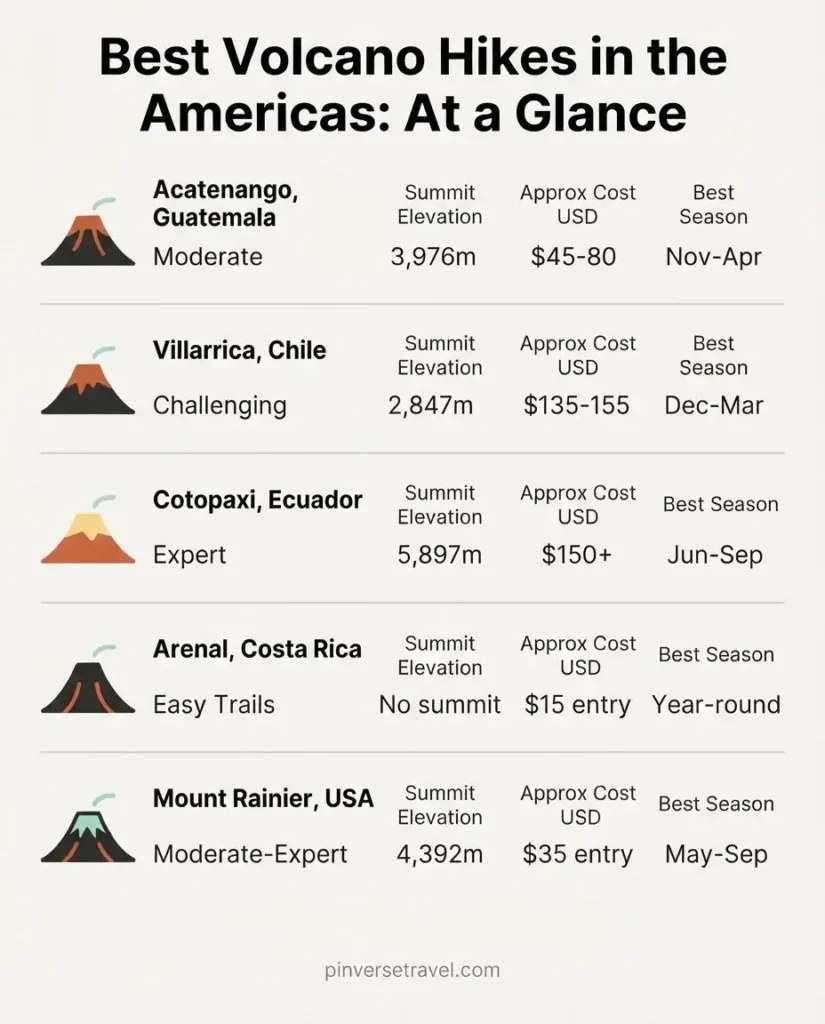
How does your body handle altitude? This is not about fitness. It is about physiology. Some people acclimatize to high elevation quickly. Others feel genuinely unwell at anything above 3,000 meters, no matter how fit they are. Cotopaxi in Ecuador sits at nearly 5,900 meters at the summit. Acatenango in Guatemala peaks at about 3,976 meters. Mount Rainier’s popular day hikes sit mostly below 2,400 meters, well within comfortable range for most people. If you have never been at altitude before, start lower and work up.
Are you comfortable solo hiking with a guide you just met that morning? For most of these volcanoes, a certified local guide is either mandatory or strongly recommended. That is a good thing, not a limitation. A local guide at Acatenango or Villarrica knows where the trail turns treacherous, monitors volcanic alert levels, and carries the gear you cannot bring yourself. But it does mean you will often be pairing up with a small group of strangers or a private guide on short notice. If you are a seasoned solo traveler, you already know how comfortable this kind of spontaneous collaboration can feel. If you are newer to solo travel, it is worth sitting with this before you go.
What is your honest fitness baseline? Not gym fitness. Trail fitness. There is a difference. Long, steep elevation gains on loose volcanic scree demand leg endurance, not just cardio. Most of the hikes below list their elevation gain and estimated duration. Read those numbers honestly, not optimistically.
Acatenango, Guatemala: The One That Converts People Into Hikers
If there is one volcano hike in the Americas that consistently shows up in the stories of people who then go on to hike every volcano they can find, it is Acatenango. It sits at 3,976 meters (13,045 feet) above the colonial town of Antigua in Guatemala’s Western Highlands, and its neighbor, the active Fuego, erupts several times a day directly in front of your campsite.
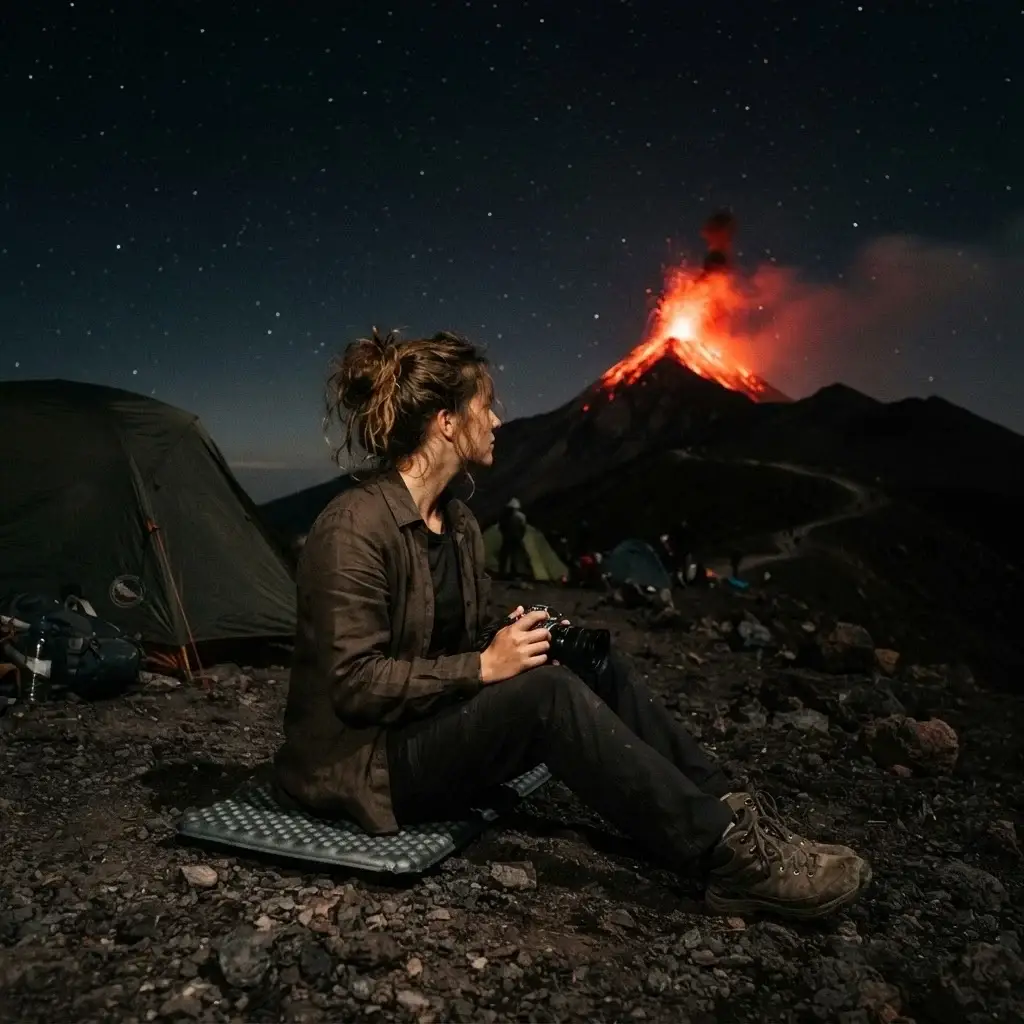
That last detail matters. Acatenango itself is dormant. But you camp overnight on its flanks specifically to watch Fuego erupt throughout the night, glowing red against a dark sky. Solo travelers and small groups consistently describe this as one of the most viscerally powerful nights of their lives. The sound, the light, the sheer improbability of it.
The hike starts from the village of La Soledad, passing through coffee and corn farmland before climbing through cloud forest and eventually into the barren, otherworldly terrain near the summit. The ascent takes five to six hours at a steady pace. The terrain is steep, especially the final section, and the thin air makes it harder than it looks on paper. But it is not technical. You do not need crampons or ice axes. You need broken-in hiking boots, layers, and the willingness to move slowly and breathe deliberately.
A mandatory guide is required, and a park entrance fee of around 100 quetzales (roughly $13 USD) applies. Guided overnight tours out of Antigua run approximately $45 to $80 USD per person and typically include transport, tents, meals, and a bilingual guide. As National Geographic documented in their March 2025 coverage, the strenuous hike rewards those who pace themselves, passing through ecosystems from farmland to conifer forest to volcanic cloud, and the overnight option is genuinely worth the extra night.
The dry season runs from November through April, and these months give you the clearest views of Fuego. During the rainy season, cloud cover can obscure the eruptions entirely. If you want to see the lava glow, plan accordingly.
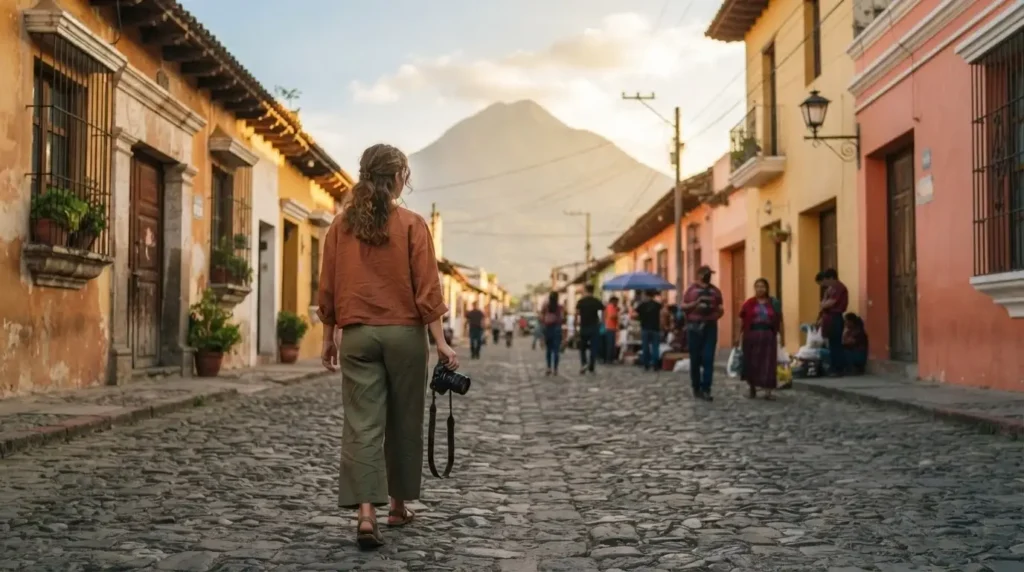
Where to base yourself: Antigua Guatemala. It is a gorgeous colonial UNESCO-listed town about an hour from Guatemala City, full of excellent food, Spanish school options, and a very walkable center. Spend at least two nights before and one night after the hike. Your legs will thank you.
What to eat: Try pepián, Guatemala’s thick, earthy seed-based stew, at any sit-down spot in Antigua’s market area. Fresh fruit and black bean dishes make for good pre-hike carbohydrate loading.
Villarrica, Chile: The Volcano That Requires You to Earn the View
Chile’s Villarrica sits at 2,847 meters above the lake town of Pucon in the Chilean Lake District. It is an active stratovolcano with an open lava lake in its crater. You can see the glow on a clear night from town. On a good summit day, you stand at the rim of a 200-meter-wide crater and peer down at churning lava.
This hike is harder than Acatenango. The summit ascent requires crampons, ice axes, and around seven to nine hours of hiking. The standard route climbs 1,400 meters of elevation gain across snow, ice, and loose volcanic rock. A certified mountain guide is mandatory for all non-professional climbers, and the required CONAF (Chile’s national forestry and parks authority) permit is obtained through your guide. According to the official Villarrica Volcano site, foreign adult park entry costs 11,000 CLP, while guided summit tours including all gear and transport run 130,000 to 150,000 CLP per person, which works out to roughly $135 to $155 USD.
The park is open Tuesday through Sunday, 08:30 to 17:30, and is closed on Mondays. Operations can halt without warning if SERNAGEOMIN raises the volcanic alert level, so check the alert status the night before your hike. The best climbing season is December through March, when weather is most stable. June through August brings heavy snow and frequent route closures.
There is an optional chairlift at the base (17,000 to 20,000 CLP) that skips the first 1.5 hours of trudging through loose volcanic ash and saves your legs for the actual glacier climb. It is worth every peso.
One thing solo travelers consistently mention about Villarrica: the descent. You slide down the snowy slope on a plastic sled, braking with an ice axe. It sounds terrifying. People report it is one of the most absurdly fun ten minutes of their lives.
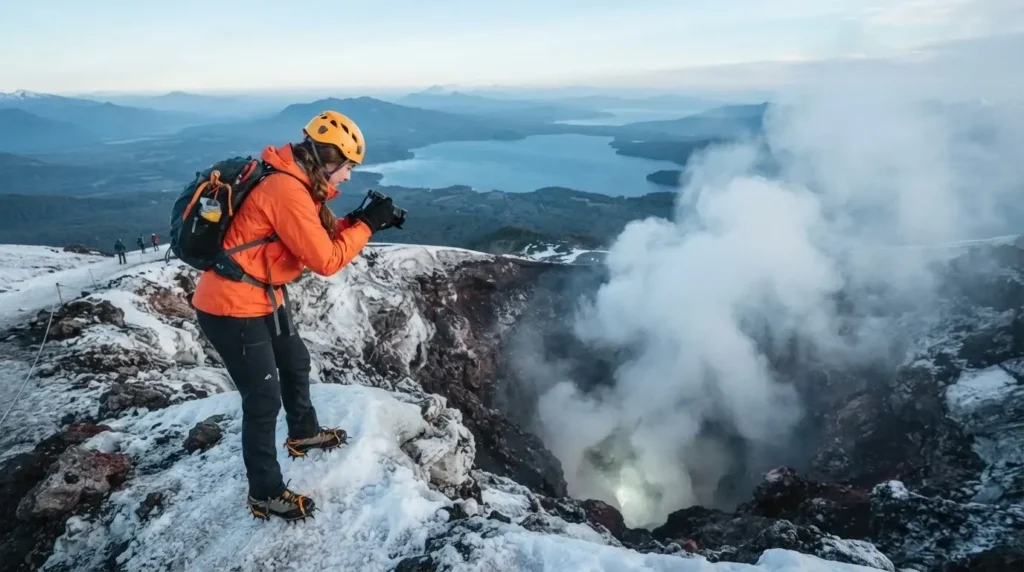
Where to base yourself: Pucon. It is a perfectly set-up adventure town on the shores of Lake Villarrica. Book your guided tour in person at one of the local agencies rather than online. Local operators know the current weather and alert status and will not take your money for a day they know will be cancelled.
What to eat: Try a cazuela, the Chilean slow-cooked broth with potato, corn, and meat, at any local restaurant in Pucon. After a nine-hour volcanic hike, it hits differently.
Cotopaxi, Ecuador: A Volcano That Asks Something Serious of You
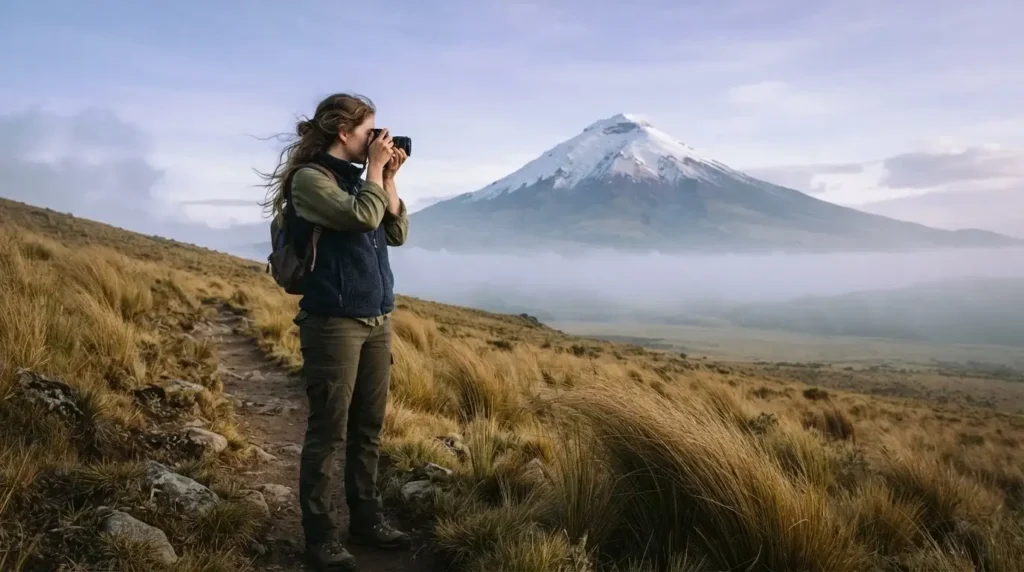
Cotopaxi is one of the highest active volcanoes in the world, sitting at 5,897 meters in the Ecuadorian Andes. It is a near-perfect symmetrical cone dusted with a permanent glacier, and photographs of it look almost too dramatic to be real. Summit climbs here are not for beginners. They require prior high-altitude experience, a guide, technical gear including crampons and ice axes, and ideally at least a few days in Quito or the surrounding highlands to acclimatize before attempting anything above 4,000 meters.
That said, Cotopaxi National Park itself, which sits at around 3,400 meters at its main access point, is genuinely worth visiting for non-summit hikers. The páramo landscape, a high-altitude grassland ecosystem found almost nowhere else on earth, is extraordinary. Wild horses roam the plain near the volcano’s base. A refuge hut at around 4,800 meters is accessible with a day hike guide and offers some of the most dramatic views on the continent without requiring glacier experience.
The Ecuador Ministry of Tourism lists Cotopaxi National Park as one of the country’s flagship natural sites, covering 32,255 hectares just south of Quito. Entry fees for foreign tourists run approximately $10 to $20 USD depending on activity level. Guided summit climbs from Latacunga typically cost around $150 per person for a two-day expedition.
Altitude sickness is a real and non-negotiable concern here. Take it seriously. Spend at least two to three days in Quito (2,850m) before heading to the park. Do not push through symptoms like headache, nausea, or fatigue. Ascend slowly. Drink water constantly. If you have never been above 4,000 meters, Cotopaxi’s summit is not the right first attempt. Do Acatenango or Villarrica first, build your confidence and your altitude awareness, then come back for this one.
Where to base yourself: Quito or Latacunga. Quito gives you acclimatization time and is one of the most beautiful high-altitude cities in Latin America. Latacunga is the practical jumping-off point for guided climbs.
What to eat: Locro de papa, a thick Andean potato and cheese soup, is the classic comfort food of this region. You will find it in every local market and family restaurant. After an altitude day, it is exactly what your body wants.
Arenal, Costa Rica: The Gateway Volcano for First-Timers
Here is an honest note about Arenal that many travel articles gloss over. You cannot hike Arenal’s volcanic cone. The national park authority, SINAC, strictly prohibits summit climbing for safety reasons, and that rule is enforced. This is an important fact to know before you book flights to Costa Rica specifically for a summit hike.
What you can do at Arenal is genuinely wonderful for a different kind of experience. The national park has well-maintained trails through former lava fields and rainforest, including the 1.7-kilometer Coladas Trail with views of the volcanic cone and Lake Arenal, and the 610-meter Heliconia Trail through dense jungle. According to SINAC, Costa Rica’s official national park authority, the park is open daily from 8 AM to 4 PM, with adult non-resident entry priced at $15 USD.
Arenal is better understood as a volcano-adjacent adventure hub rather than a volcano summit destination. The surrounding area offers incredible hiking through the wider Arenal Conservation Area, world-class hot springs fed by geothermal activity, wildlife watching in some of the most biodiverse terrain in Central America, and white-water rafting on the Rio Toro. For a first visit to Costa Rica or a first foray into Central American adventure travel, it is a brilliant choice. Just go with clear expectations.
Where to base yourself: La Fortuna, the small town at the base of the volcano. It is built for travelers, with a good range of accommodation, restaurants, and tour operators.
What to eat: Gallo pinto (rice and black beans with Lizano sauce) is the local staple and one of the most satisfying breakfasts you can have before a full day on the trails.
Mount Rainier, Washington, USA: The Volcano in Your Backyard
For North American travelers, particularly those based on the West Coast, Mount Rainier is the most accessible volcano hike on this list. It is a massive, ice-capped stratovolcano in Washington State, standing at 4,392 meters (14,411 feet), and it anchors one of the country’s most stunning national parks. You do not need to go to South America to walk on volcanic terrain.
The key distinction at Rainier is the range of experience on offer. Casual hikers can walk the Paradise area’s Skyline Trail through subalpine meadow and wildflower fields, a loop of about 5 miles with manageable elevation gain and spectacular views of the glaciated summit above. The National Park Service’s official hiking page for Mount Rainier lists over 260 miles of maintained trails across the park, from 20-minute family walks to full wilderness routes.
For those who want to attempt the summit, that is a different category entirely. A summit climb requires technical mountaineering skills, glacier travel experience, and specific permits. Climbing above 10,000 feet or on the glaciers requires a permit obtained in person at a wilderness information center, with backcountry overnight fees of $12 per person per night as of 2025. Summit attempts are generally handled through registered guide services rather than independent climbers, and the season runs roughly from May through September.
For solo travelers on a road trip through the Pacific Northwest, a day at Rainier, walking the high meadow trails with the glaciated summit above and wildflowers at your feet, is one of the best free (park entry aside) experiences in the country.
Where to base yourself: Ashford, for park access, or tie it into a broader Pacific Northwest road trip through Seattle, Olympic National Park, and the Columbia River Gorge.
What to eat: Stop at a diner in Eatonville or Ashford for a classic American breakfast before heading into the park. Simple, hearty, and right.
A Note on Volcanoes You Cannot Hike (and Why That Is Important to Know)
Not every famous volcano is open for hiking, and pretending otherwise gets people into trouble. Popocatepetl in Mexico, the dramatically smoking cone visible from Mexico City, is currently permanently closed to all summit hiking. As of 2025 and into 2026, it remains in an active eruptive state and climbing is forbidden. If you see older blog posts telling you how to hike Popocatepetl, that information is outdated and potentially dangerous. The neighboring Iztaccihuatl is still hike-able and impressive in its own right, but Popo’s summit is off the table.
This is a good general rule for volcano hiking anywhere in the Americas: always check current volcanic alert levels before committing to a hike. In Chile, the SERNAGEOMIN alert system is the authoritative source. In Ecuador, the Instituto Geofisico monitors activity. In Guatemala, INSIVUMEH publishes daily bulletins. Guides in each region will have current information, which is one more reason why hiring a local certified guide is more than just a regulatory hoop. It is a genuine safety mechanism.
What to Pack: The Honest Gear List
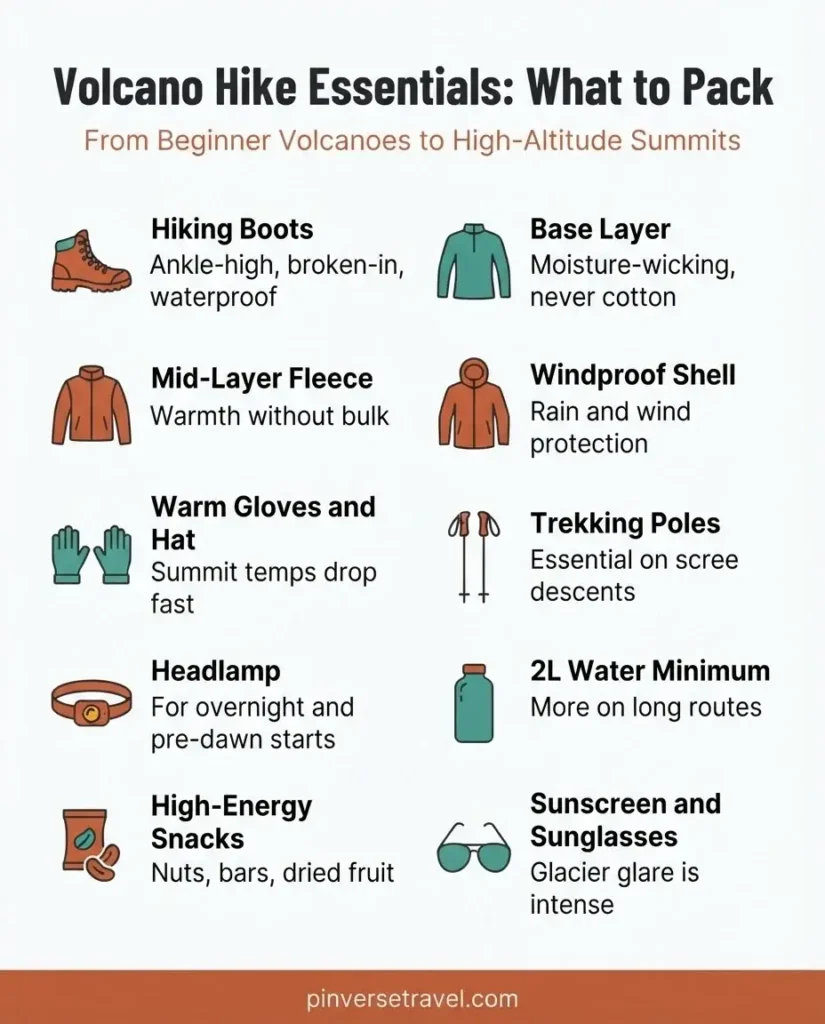
The specific gear you need varies significantly by volcano, but here is the core kit that covers most of the hikes on this list.
Layers are everything. The temperature swings on a high-elevation volcanic hike are extreme. You can start a Guatemala hike in 75-degree heat at the trailhead and be shivering in freezing wind at the summit four hours later. A moisture-wicking base layer, a mid-layer fleece, a windproof outer shell, warm gloves, and a hat cover you on all of these hikes. Do not substitute a cotton hoodie for any part of this. Cotton retains moisture and drops your core temperature fast.
Boots matter more than people expect. You want ankle-high, broken-in hiking boots with grip. New boots on a volcano hike are a blister guarantee. Break them in on regular trails for at least a few weeks first.
Other essentials: a daypack that fits 20 to 30 liters, at least two liters of water (more on Rainier where you cover greater distance), high-energy snacks, sunscreen and sunglasses (glacier glare is intense), a headlamp for overnight hikes, and trekking poles, which are a genuine game-changer on steep volcanic scree descents.
For Villarrica and Cotopaxi specifically, technical gear (crampons, ice axe, helmet, harness) is provided by your certified guide service. Do not try to source this independently for your first attempt.
The Honest First-Timer Recommendation
If you are reading this guide and wondering where to start, here is my honest answer: start with Acatenango.
It is hard enough to feel like a real accomplishment. The overnight camp with Fuego erupting in front of you is an experience unlike anything else on the continent. It is accessible without technical training. It costs under $80 with a guide. And Antigua, the base town, is one of the most enjoyable places in Central America to spend a few extra days. It will not ruin other hikes for you. It will make you want to do all of them.
Then come back for Villarrica. Then Rainier. Then, when you are ready for altitude, go to Ecuador and earn Cotopaxi.
The perfect time to plan this is now. The perfect moment to feel ready? It is probably not coming. Book the flight. Lace the boots.