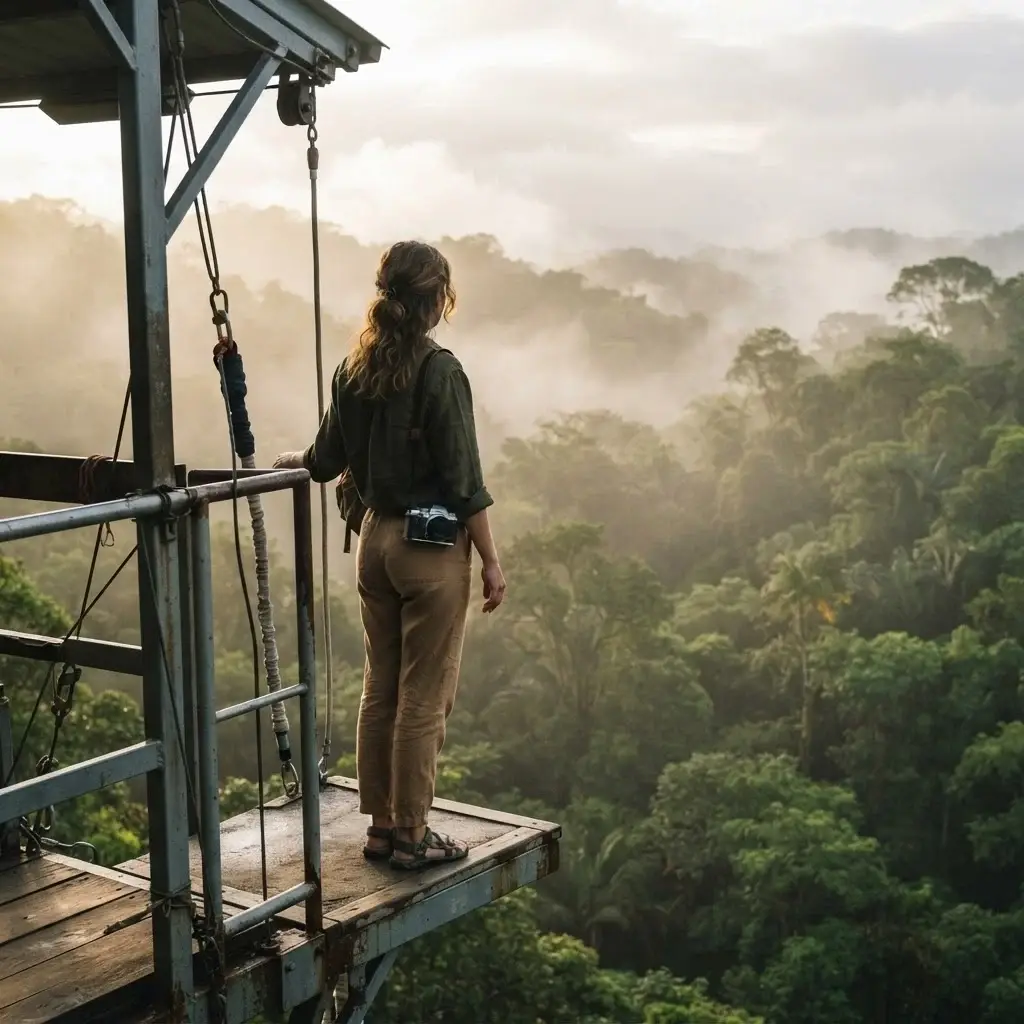
There is a very specific kind of nervous energy that builds in the hours before you do something you have always told yourself you would do “someday.” I know that feeling well. I felt it standing at the door of an overnight train in Europe before my first solo overnight journey with nobody waiting for me at the other end. I felt it landing in Ghana without a plan beyond the address of the family I would be living with. That electric, slightly sick, absolutely alive feeling is the whole point.
Bungee jumping is one of the clearest ways to manufacture that feeling on purpose. You pick a spot, you walk to the edge, and you jump. It is that simple, and it is that hard. If you have been circling the idea for a while, this guide is here to stop the circling and help you actually pick a spot and go.
The Americas are genuinely one of the best regions on earth for this. You have dramatic jungle platforms in Costa Rica, glacier-fed river bridges in British Columbia, a legendary hiking-access bridge in the California mountains, a brand-new purpose-built tower on the US East Coast, cloud-high platforms in the Peruvian Andes, and a raw, walkup bridge jump in a volcanic valley in Ecuador. Every one of those is real and reachable. Let me walk you through them all.
What Kind of Jump Do You Actually Want?
Before you decide where, it helps to understand that not all bungee jumps feel the same. The structure you jump from changes the experience more than you might expect.
A bridge jump, which you find in places like Whistler in Canada and Baños in Ecuador, puts you over open moving water. You jump horizontally outward from the edge of a structure that was built for a completely different purpose. There is something wonderfully raw about that. A tower jump, like the new setup at Harpers Ferry in West Virginia, places you on a purpose-built cantilevered platform that juts out over a dramatic landscape. Everything about it is designed for the jump, which means maximum efficiency and a vertigo-inducing view straight down. A cable-car or gondola platform jump, like the one at Monteverde in Costa Rica, elevates you above the forest canopy by mechanical lift before you freefall. That type tends to deliver the most breathtaking scenery per jump.
Think about which version excites you most. That instinct will help narrow down your destination before logistics even enter the picture.
Whistler, British Columbia, Canada: Scenic and Seriously Legit
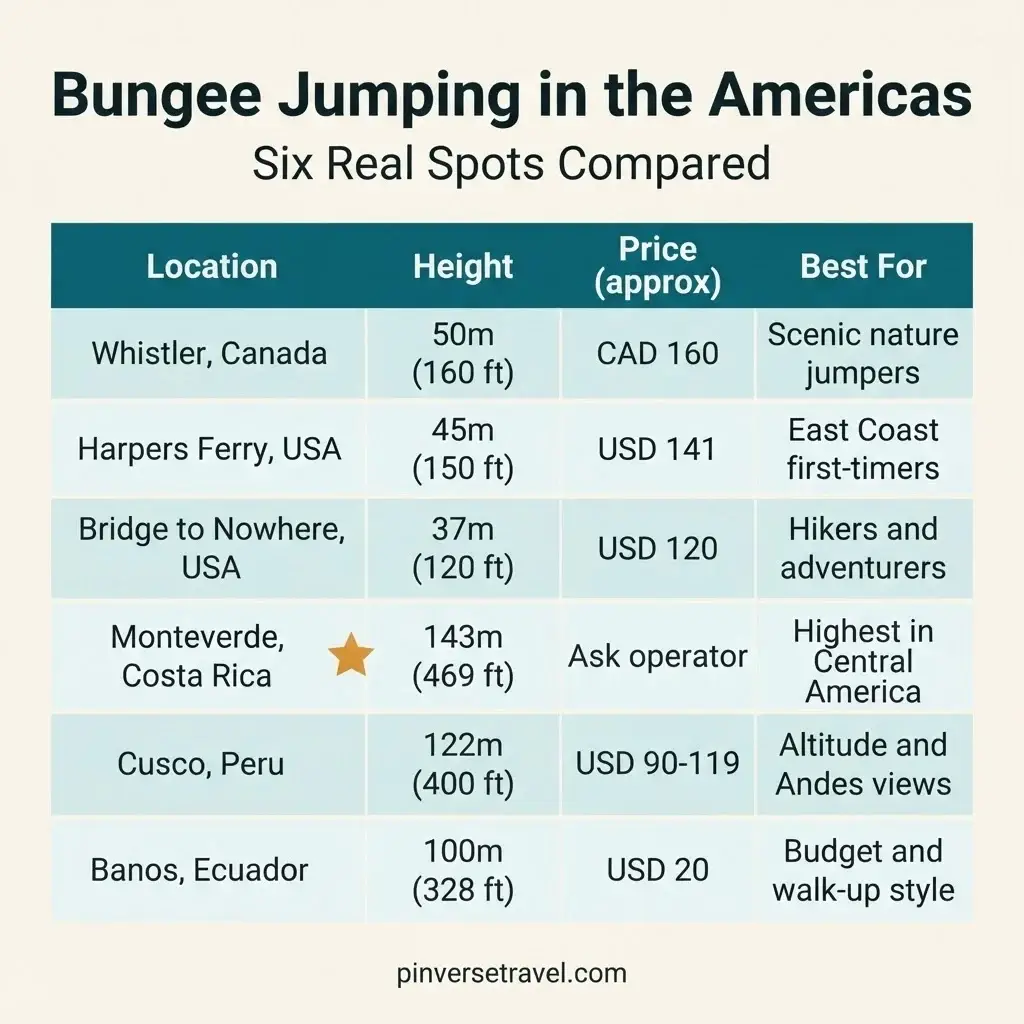
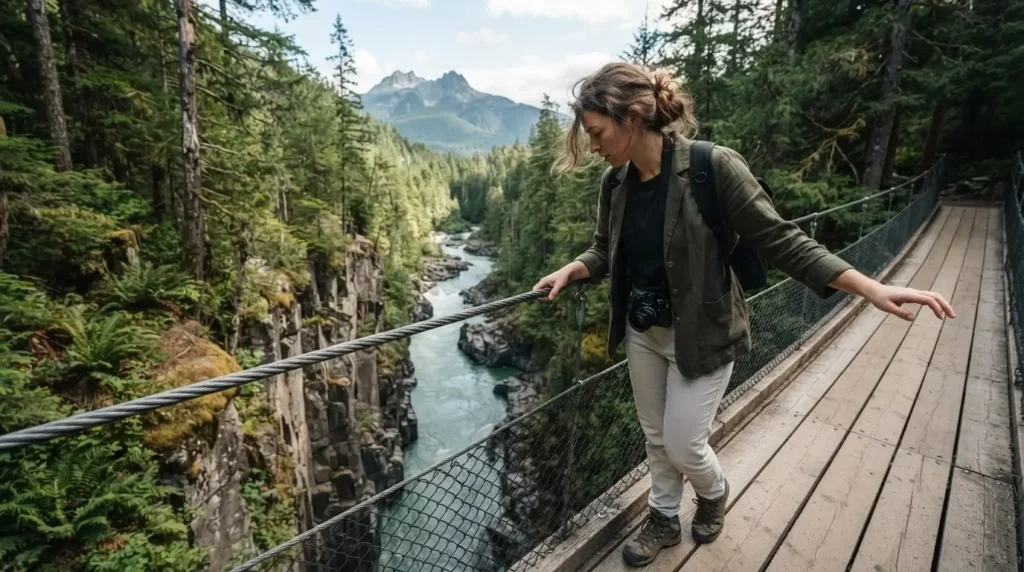
If you want a bungee jump that combines professional infrastructure with jaw-dropping natural beauty and is easy to work into a broader trip, Whistler is the answer. Whistler Bungee operates a 160-foot (50-meter) bridge jump over the glacial Cheakamus River, surrounded by old-growth forest and basalt column cliffs with the Black Tusk peak in the background. Locals consistently rate it as the most extreme activity in Whistler, which is saying a great deal for a town where people ski off vertical cliffs for fun.
Pricing sits at around CAD $160 per person, and you need to book online at least four days ahead of your planned jump date. The site is open year-round, which makes it viable whether you are visiting Whistler for winter skiing or a summer hiking trip. For solo travelers, this is one of the most accessible options in the Americas because it is easy to reach from Vancouver (about two hours by car or the Greyhound bus route), the town itself has a strong solo travel infrastructure with hostels and affordable meal options, and there is always a crowd at the site which means you will not feel lonely on your jump day.
For food while you are in Whistler, Function Junction, just south of the village, has a cluster of casual spots that local workers eat at daily.
Skip the overpriced village restaurants for a pre-jump meal and grab something there instead.
Harpers Ferry, West Virginia, USA: The New East Coast Option
For years, people on the US East Coast who wanted to bungee jump had to either fly west or commit to a multi-day road trip. That changed when The Great Bungee Company opened its dedicated bungee site at the Old Standard Quarry in Harpers Ferry, West Virginia. It is the first purpose-built dedicated bungee site on the US East Coast, and it is operated by an international team with over 30 years of experience and more than 200,000 jumps behind them.
The setup is a 150-foot cantilevered jump tower positioned directly across from the Harpers Ferry National Historical Park, where the Shenandoah and Potomac rivers meet. The scenery is genuinely dramatic, with Civil War battlefield views and two rivers framing the drop below you. First jump pricing is $141.51 plus tax, with discounted additional jumps available for the same person on the same day. It is reachable from Washington D.C., Baltimore, Philadelphia, and New York City in under two hours, which makes it a realistic weekend trip without the need to fly.
The town of Harpers Ferry itself is worth exploring before or after your jump. The lower town near the river is a National Historical Park, and you can walk through preserved 19th-century streets that feel genuinely removed from the modern world. For food, the Canteen Grille on High Street is a reliable local option with sandwiches and burgers at reasonable prices.
Bungee America, California, USA: The Adventure Starts Before You Jump
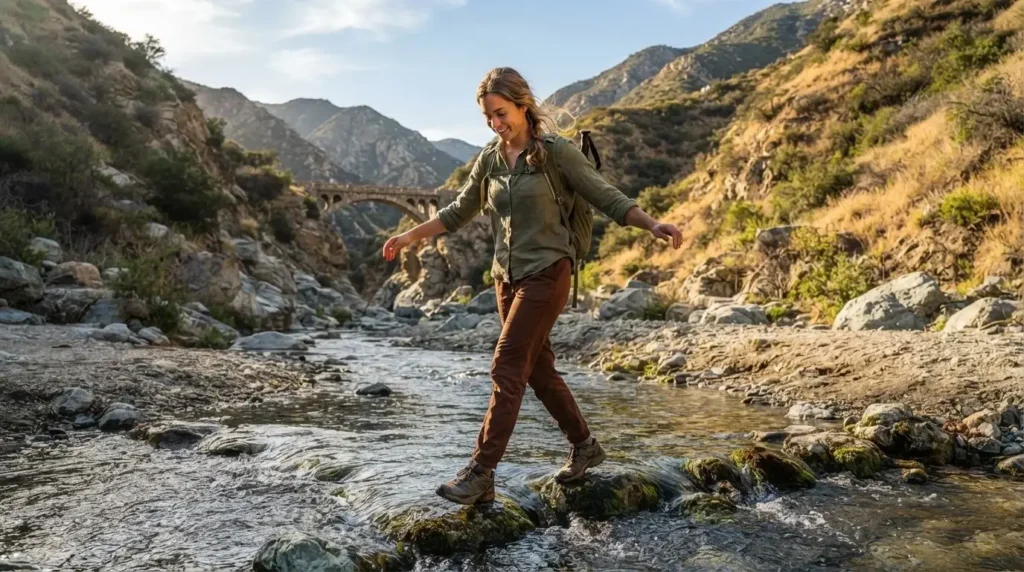
Here is the thing about the Bridge to Nowhere jump in Azusa Canyon: the jump is not actually the hardest part. Getting there is. Bungee America operates from a historic 1930s stone bridge deep in the San Gabriel Mountains, about 20 miles north of Azusa. To reach it, you hike roughly 2.5 miles each way through canyon terrain, river crossings included. By the time you reach the bridge, you have already earned the view.
The jump itself sends you off a 120-foot arched bridge over the East Fork of the San Gabriel River. Pricing starts at around $120 per person when booked online. From what solo travelers consistently report, the hike-in creates a natural camaraderie with whoever else shows up that day. You end up talking to the other jumpers on the trail, which makes this one of the more social bungee experiences in North America even if you arrived completely alone.
If you are based in Los Angeles, this is genuinely a day trip. Take the 210 freeway east to Azusa, wear real hiking shoes, bring more water than you think you need, and pack a light snack for the trail. The jump site itself has a small platform area where staff brief you before you go.
For food after, the town of Azusa has plenty of casual taco spots along Foothill Boulevard that are exactly what your legs will want after a 5-mile round-trip hike in the mountains.
Monteverde Extremo Park, Costa Rica: Highest in Central America
Costa Rica has built its entire tourism identity around adventure, and Monteverde delivers on that promise more thoroughly than almost anywhere else in the country. Monteverde Extremo Park operates the highest bungee jump in Central America at 143 meters (469 feet) above the cloud forest canopy. You reach the jump platform via a cable car, which means the ascent itself is an experience worth noting. You sit in the cable car as the forest falls away beneath you, and then you step out onto the platform and look down at the canopy you just floated above.
Jumper weight restrictions apply: minimum 50 kilograms and maximum 113 kilograms. Transportation to the park is available from Monteverde town. The park sits in the cloud forest, which means you should expect cool temperatures and the possibility of mist or light rain. Layers and waterproof outer wear are useful. The surrounding Monteverde Cloud Forest Reserve is one of the most biodiverse places on earth, and combining your jump day with a morning nature walk through the reserve makes for one of the most memorable 24 hours of any trip to Costa Rica.
For food in Monteverde, the Trio restaurant near the main park entrance is a solid local option with good casados (the traditional Costa Rican rice and beans plate) at fair prices. The town itself is small, easy to navigate on foot, and genuinely welcoming to solo travelers.
Action Valley, Cusco, Peru: Jumping at Altitude in the Andes
Cusco sits at over 3,400 meters above sea level, and Action Valley takes full advantage of that elevation to give you a jump with a backdrop that few places in the Americas can match. The park offers a bungee platform that lifts jumpers via hydraulic winch to approximately 122-128 meters before the freefall. According to Action Valley’s TripAdvisor page, this is widely considered the highest bungee jump in South America. Jump pricing runs around $90-119 USD per person.
One thing solo travelers consistently flag about Cusco: give yourself at least two full days in the city before attempting the jump to properly acclimatize to the altitude. The altitude affects your body’s recovery, your heart rate, and your adrenaline response more than you might anticipate. Most solo travelers who have done both agree that the freefall hits differently at that elevation. For logistics, Machu Travel Peru has a detailed bungee jumping breakdown that covers the specifics of Action Valley along with other adventure options in the Sacred Valley area.
Cusco itself is one of South America’s most walkable, solo-traveler-friendly cities. The San Pedro Market is a short walk from the Plaza de Armas and is one of the best places to eat in the entire city. Caldo de gallina (a hearty chicken and noodle broth) from the market stalls is the classic local post-activity meal, warming and filling at an altitude where your appetite can be unpredictable.
Baños, Ecuador: The Raw, Accessible One
If you want bungee jumping with almost zero barrier to entry, Baños in Ecuador is unlike any other spot on this list. The town sits in a valley surrounded by active volcanoes, with the Pastaza River running directly through it. There is a bridge over the river right near the bus station where local operators offer a bridge bungee jump of approximately 100 meters for around $20 USD. Walk-up style, minimal paperwork, and a view of the Andes that no photograph fully captures.
I want to be clear that this type of informal setup is very different from the regulated, professionally run operations at Whistler or Harpers Ferry. The operators in Baños are experienced locals who have been running these jumps for years, and the activity has a strong reputation among backpackers and solo travelers who have been through the Ecuadorian adventure circuit. That said, doing your own informal equipment check, watching a jump or two before your own, and choosing the operator with the most visible rigging attention is the right approach. Trust your instincts.
What makes Baños special beyond the jump itself is the surrounding town and culture. Baños is famous for its taffy (called melcocha), and the candy shops along Ambato street where workers pull hot taffy on large hooks in the storefront windows are genuinely worth seeing. The thermal baths the town is named for are ideal for the evening after your jump, when your body has processed the adrenaline and you just want hot water and quiet mountains. A soak in the baths costs only a few dollars.
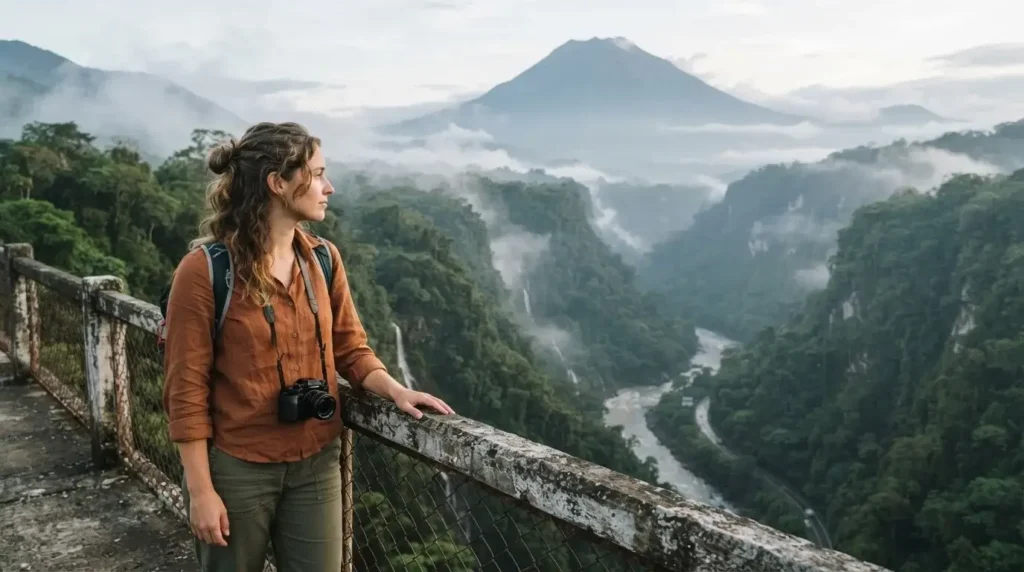
Practical Things to Know Before You Go
What to wear and what to leave behind. Wear fitted, comfortable clothing. Nothing loose, nothing that will fly up or get caught. Secure your glasses with a strap or leave them with your bag. Remove earrings, necklaces, and anything in your pockets. Most operators provide a small bag or locker for your belongings.
Weight and age restrictions are real. Most professional operators require jumpers to be at least 18 years old and will have both minimum and maximum weight limits. Monteverde Extremo, for example, requires a minimum of 50kg and a maximum of 113kg. Check the specific operator’s requirements before booking.
Your heart and your medication. If you have a heart condition, high blood pressure, back or neck issues, or are pregnant, bungee jumping is not recommended. This is not excessive caution. The harness and cord put real strain on those systems. Talk to your doctor if you have any uncertainty.
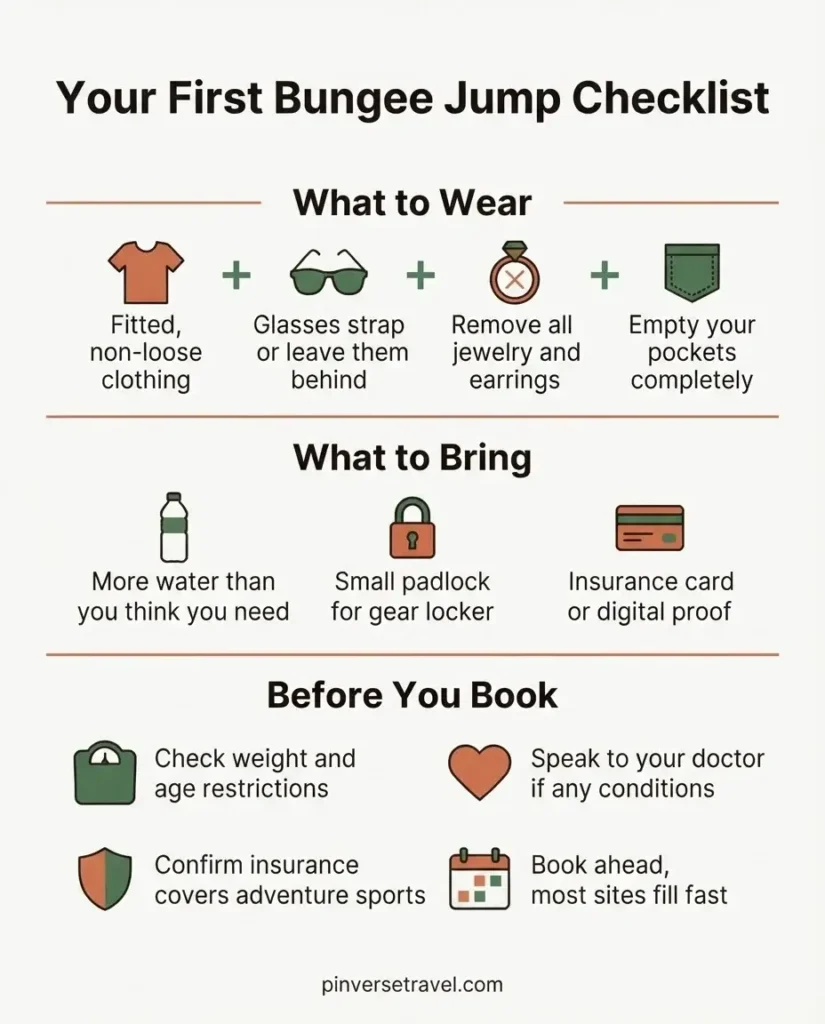
Travel insurance matters here. Standard travel insurance policies often exclude extreme sports activities. Before you book any jump, confirm that your policy covers adventure activities or purchase a rider that does. World Nomads is one of the insurers that includes adventure sports coverage in their plans, and it is worth comparing options before your trip.
Booking alone is completely normal. From everything solo travelers report across these sites, showing up alone is the norm, not the exception. Operators are used to it. You will be briefed, harnessed, and cheered on by staff regardless of whether you arrived with a group or a backpack and a train ticket.
The Part Nobody Really Talks About
Here is what I have learned from years of traveling and from talking to people who have stepped off every kind of edge: the three seconds before you jump are always the worst. You stand there, you look down, and your brain, which is excellent at keeping you alive, starts generating very convincing reasons to step back. The trick is not to wait for the fear to pass. It will not pass. You jump while it is still there.
That is true whether you are standing at a bungee platform, a departure gate for a country where you do not speak the language, or a fork in the road where one direction leads somewhere you have never been. The jump is a metaphor, but it is also just a really fun thing to do. Both things can be true.
Pick one spot from this list that genuinely excites you. Put a date on it. Tell someone. The rest tends to take care of itself.