There’s a particular kind of travel experience that stays with you differently from everything else. Not the Instagram photo, not the famous landmark, not the restaurant reservation you waited three weeks for. I’m talking about the kind of encounter where you sit with someone in their community, watch the way they move through their own world, and quietly realize how much you’ve been missing by moving too fast through yours.
Indigenous cultural tourism across the Americas offers that kind of depth in abundance. The problem is that “indigenous experience” has become a marketing phrase slapped on everything from a single dusty display case at a highway rest stop to a deeply legitimate, community-run weaving cooperative in the Peruvian Andes. Knowing the difference matters, and not just for your own experience. It matters because genuine indigenous tourism can funnel real economic power back into communities that have historically had it taken away. Performative tourism does the opposite.
I’ve spent enough time learning about responsible cultural travel, and listening to solo travelers who’ve done this well and badly, to know that the first question you should ask isn’t “where do I go?” It’s “how do I make sure what I’m doing is actually worth doing?”
Let’s start there.
What “Real” Indigenous Cultural Tourism Actually Means
The phrase gets used loosely, so here’s a working definition worth holding onto. Genuine indigenous cultural tourism is tourism that is either led by indigenous community members themselves or directly benefits those communities in a meaningful, ongoing way. It centers indigenous voices, not outside interpreters. It invites participation or respectful observation on the community’s terms, not on the terms of a tour broker trying to fill seats.
Community-led experiences are the gold standard. These are tours where the guide is a tribal or community member, where the money flows back to the village or cooperative, and where the encounter is structured around what the community wants to share, rather than what a travel company thinks tourists want to see.
The American Indian and Alaska Native Tourism Association (AIANTA) is the most reliable starting point for finding these in the United States. They maintain a planning portal, publish annual top experience guides, and verify indigenous tourism operators by region. If you’re planning anything in North America, bookmark their site before you do anything else.
North America: Where to Go and What to Expect
New Mexico: The Pueblo World, Done Right
If you want one region in North America that offers the most layered, accessible, and genuinely community-led indigenous cultural experiences, it is New Mexico. The state is home to 23 federally recognized tribes and pueblos, and several of them actively welcome respectful visitors.
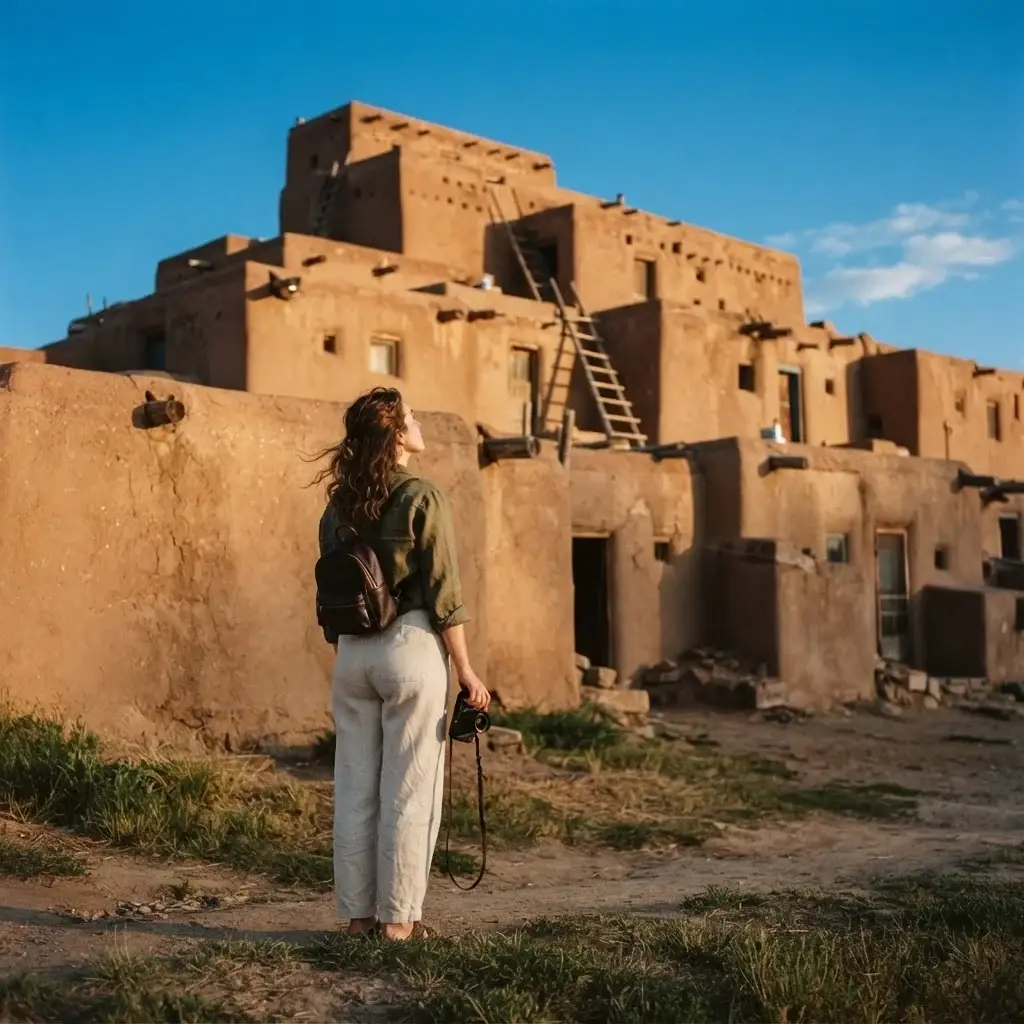
The most well-known entry point is Taos Pueblo, a UNESCO World Heritage Site that has been continuously inhabited for over a thousand years. Admission runs $25 for adults, $22 for seniors and students, and children under 10 enter free. Guided tours run daily starting at 9:00 AM, Monday through Saturday from 9:00 AM to 4:00 PM and Sunday from 8:30 AM. Here’s what makes this different from most heritage sites: Taos Pueblo is still a living community. Real families live inside those adobe walls. The Taos Pueblo people have made a deliberate choice to open their home to visitors, and they are clear about the rules when you arrive: respect restricted area signs, do not enter homes not marked as businesses, ask permission before photographing anyone, and absolutely no photography inside the San Geronimo Chapel.
Those rules are not bureaucratic inconvenience. They are the community drawing the line between what they are willing to share and what remains sacred. Honoring those boundaries is the entire point.
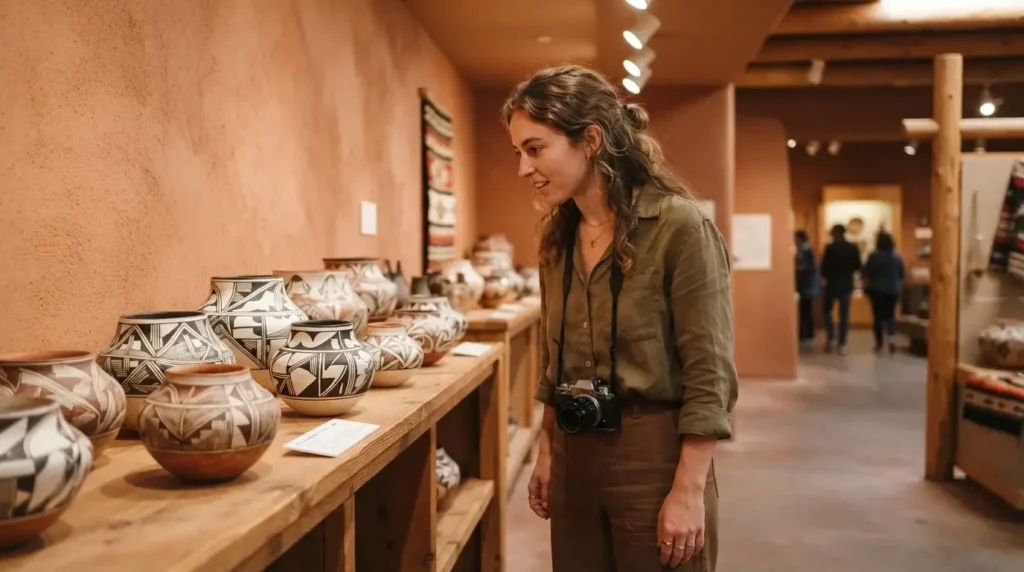
Before visiting any of the 19 pueblos in New Mexico, I’d recommend starting at the Indian Pueblo Cultural Center in Albuquerque. It’s open seven days a week from 9 AM to 5 PM, with admission running $12 on weekdays and $15 on weekends for adults, and $10 for New Mexico residents and military. The museum spans the full cultural arc of Pueblo life, from ancient history through contemporary art and tradition. It also has a restaurant serving traditional Pueblo-inspired food, including green chile stew and blue corn dishes. Going here first gives you cultural context that makes every subsequent pueblo visit far richer.
A few practical notes for New Mexico: unexpected closures do occur when communities hold religious ceremonies, and this is completely appropriate. Build flexibility into your itinerary and take it as a sign of a community that hasn’t commercialized its sacred practices.
Canyon de Chelly and Navajo Nation, Arizona
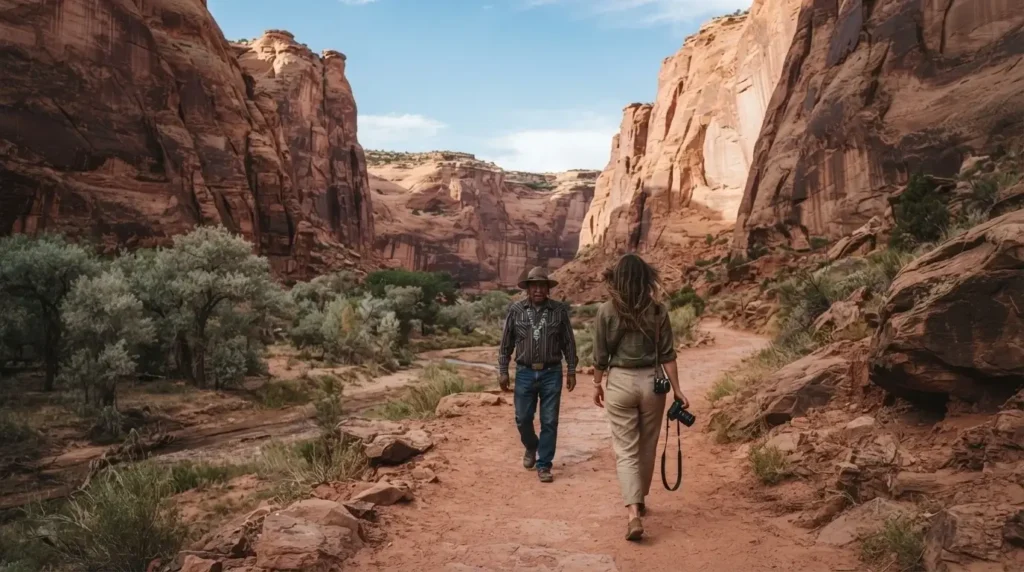
Solo travelers who want something more physically adventurous have a compelling option in Canyon de Chelly National Monument, located within the Navajo Nation in Chinle, Arizona. This 83,000-acre canyon has been inhabited for roughly 5,000 years and holds deep historical weight for the Diné people, including being the starting point of the Long Walk, the forced march of nearly 10,000 Diné between 1863 and 1866.
Canyon de Chelly is one of the few national monuments where you cannot enter independently. You must be accompanied by a Diné guide, which is exactly as it should be. Lupita McClanahan, a Diné elder and operator of Footpath Adventures, runs small-group four-day cultural immersion trips through the canyon during spring and fall that include hiking ancient sandstone trails, exploring petroglyphs and cliff dwellings, grinding corn, and learning traditional song. National Geographic has covered several indigenous-led experiences like these across the US, and the operators they highlight are worth your attention when planning.
South Dakota: Lakota Culture on the Northern Plains
The Black Hills and Badlands region of South Dakota is one of the most underrated destinations for indigenous cultural travel in the United States. The South Dakota Native Tourism Alliance coordinates experiences across multiple tribal nations, including the Oglala Lakota at Pine Ridge Reservation, the Cheyenne River Sioux Tribe, and others.
Visitors can attend powwows, visit the Akta Lakota Museum at St. Joseph’s Indian School in Chamberlain, explore the Wounded Knee Massacre Site, and connect with Lakota-led guides who offer land tours through the terrain that shaped Lakota cosmology and history. These aren’t museum experiences dressed up as adventures. They are encounters with a living culture that is actively reclaiming the narrative around its own homeland.
What solo travelers consistently report from this region is that the emotional weight of the landscape itself does something to you. The wide-open sky over the Badlands, the quiet gravity of Wounded Knee, and conversations with people whose relationship to that land goes back thousands of years have a way of reorganizing your priorities.
Mexico: Beyond the Mayan Coast
Most travelers who think about indigenous cultural experiences in Mexico think of the Yucatan Peninsula: Chichen Itza, Tulum, cenotes. And yes, the living Maya culture of the Yucatan has real depth worth exploring. But Mexico is a country with 68 recognized indigenous language groups, and the Yucatan is only one piece of a much larger story.
Oaxaca and the Zapotec World
Oaxaca is the state with the greatest indigenous cultural and linguistic diversity in Mexico, home to 16 main indigenous groups including the Zapotec, Mixtec, and Mazatec peoples. The Zapotec civilization built Monte Alban, a sprawling hilltop city that served as the political and ceremonial center of their world for over a thousand years. You can visit the archaeological site independently by shuttle from Oaxaca City for around M$210 in entrance fees, and a few hours among those flattened pyramids and deep stone tombs gives you a sense of scale that the city center alone can’t.
But the ruins are only the beginning. The real texture of Zapotec culture lives in the villages of the central valleys: the black clay pottery of San Bartolo Coyotepec, the weavings of Teotitlan del Valle, the mezcal traditions of Santiago Matatlan. In these communities, artisans are not performing for tourists. They are doing work they have always done, and they welcome people who come to understand it rather than just photograph it.
Zapotec Travel is an indigenous-led tour company in Oaxaca that specifically structures its experiences around Zapotec communities and their own telling of their story. Seek out operators like this over generic city tour agencies.
Chiapas: Tzeltal and Tzotzil Maya
San Cristobal de las Casas in Chiapas is the gateway to highland Maya communities that have maintained distinctive textile traditions, language, and spiritual practices through centuries of colonial pressure. The village of San Juan Chamula is just 10 km away and is home to the Tzotzil Maya. Its church, where Catholic iconography and traditional Mayan ceremony have been syncretized into something entirely unique, is one of the most extraordinary interior spaces I’ve read about from other travelers. Candles on the floor, pine needles, copal smoke, Pepsi used as a ritual offering because the belching is thought to release bad spirits. You can visit as a respectful observer, but photography is strictly prohibited inside the church, and that prohibition exists for good reason.
South America: Peru and the Sacred Valley
If there is one destination in the Western Hemisphere where indigenous cultural tourism has been most thoughtfully developed at the community level, it is Peru’s Sacred Valley.
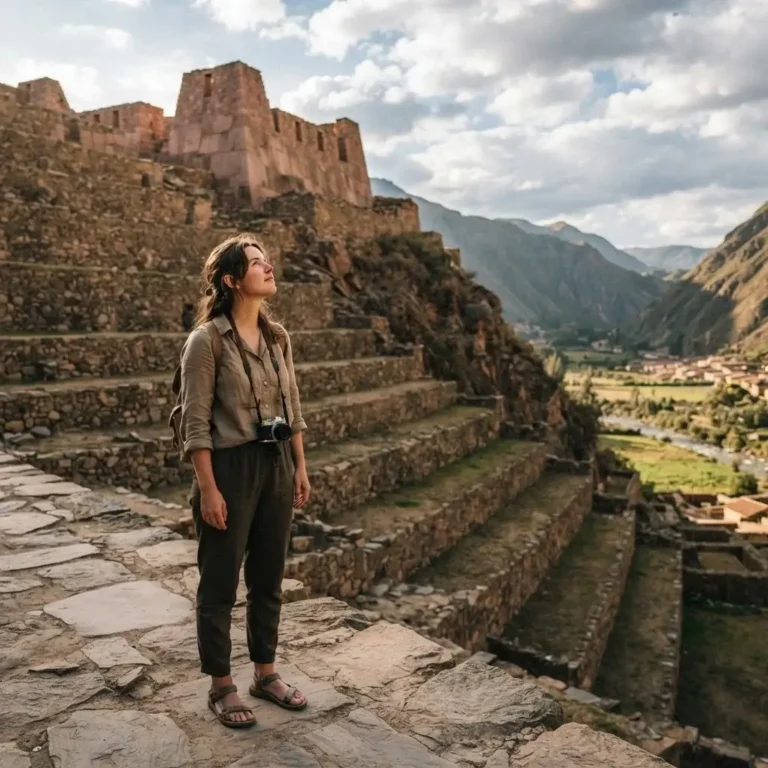
The Quechua-speaking communities of the Andean highlands have been here far longer than the Inca empire that most tourists come to see. And while Machu Picchu will always be extraordinary, the communities that live in the mountains above Ollantaytambo offer something that no ancient ruin can: a living, breathing relationship with Andean tradition.
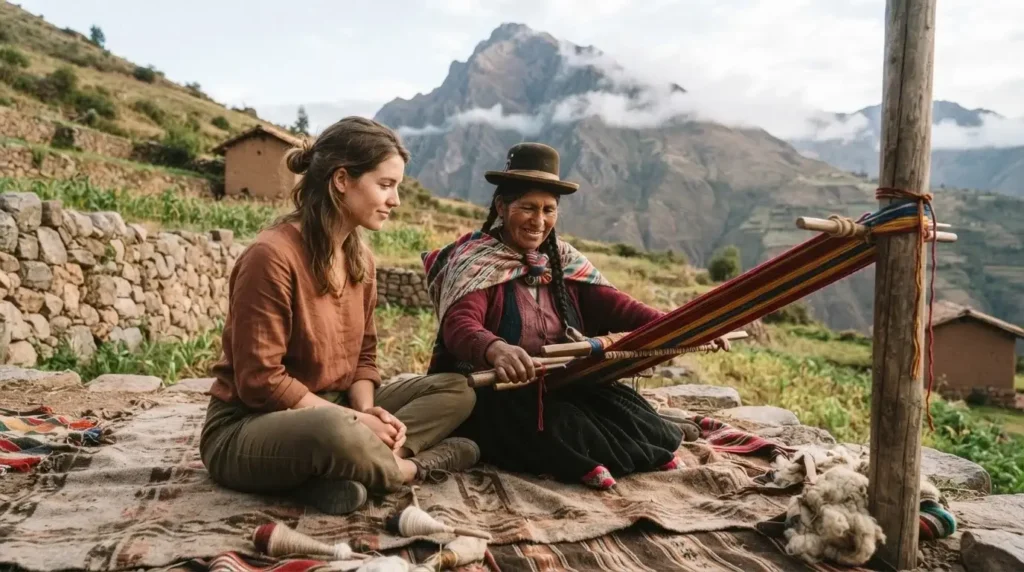
Awamaki, based in Ollantaytambo, is one of the best examples of what community-based cultural tourism can look like. It works directly with women-led Quechua artisan cooperatives in the high communities above the valley, and it structures its experiences around participation rather than performance. You can spend a day in a rural weaving community learning the process of natural dyeing and backstrap-loom weaving from the women who have practiced it since childhood. You can share a traditional Pachamanca meal, where food is cooked in an earth oven using heated stones, a method older than the Inca. You can take Quechua language classes, do a cooking class using local ingredients, or arrange an overnight stay in a partner community.
Awamaki’s tours begin in or near Ollantaytambo and can be built around a Machu Picchu itinerary, which means you don’t have to choose between the two. What solo travelers consistently say about this experience is that the day with the weavers outranks Machu Picchu in terms of what stayed with them. That’s the difference between going to a place and actually meeting it.
The Ethics Layer: How to Show Up Well
This section matters as much as the destination information above, so don’t skim it.
AFAR’s guide on how to respectfully visit indigenous communities covers this thoughtfully from an indigenous writer’s perspective, and I recommend reading it in full before any of these trips. Here’s the practical core of what it and other reliable sources consistently emphasize:
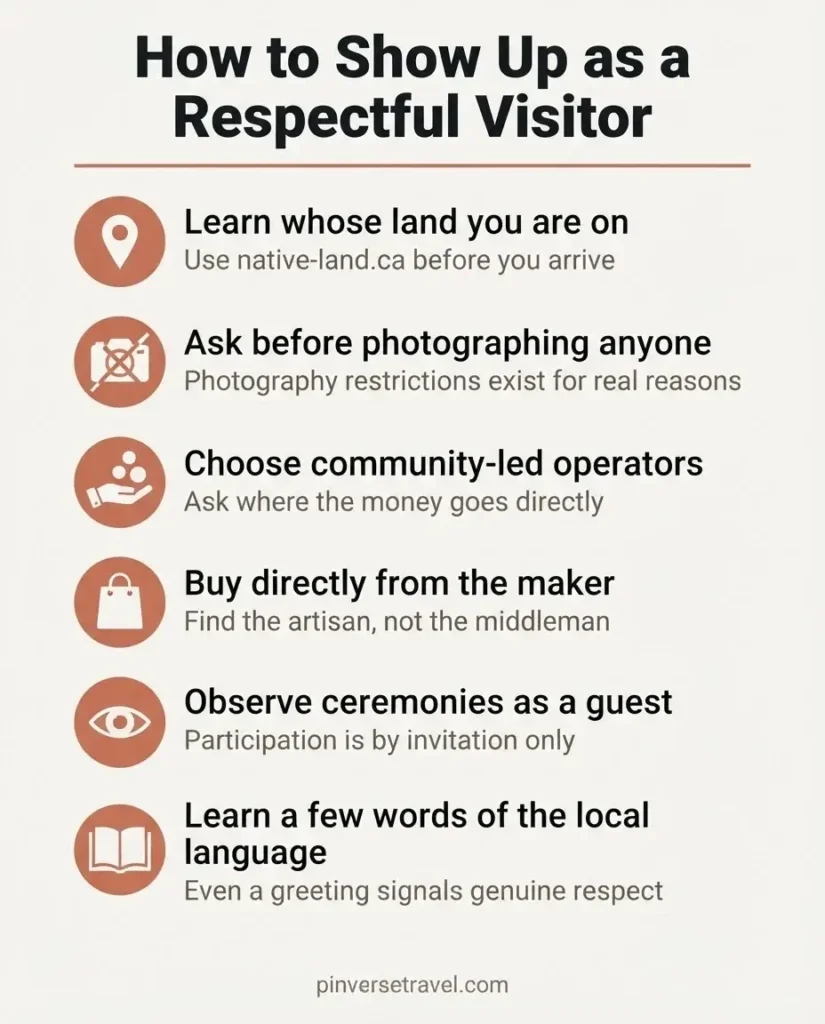
Be aware of whose land you’re on, not just in an abstract sense, but concretely. Before you visit a site or a community, take ten minutes to learn whose ancestral territory it sits on and what that history looks like. The app and website Native Land Digital (native-land.ca) is a useful tool for this.
Ask permission before photographing anyone or anything. At Taos Pueblo, at San Juan Chamula, in the Sacred Valley, the rules will be communicated clearly. Follow them exactly, not approximately. Photography restrictions exist because these communities have experienced decades of exploitation and voyeurism, and the line between curious visitor and intrusive one is real.
Choose community-led or community-benefiting operators. Ask directly: does this tour employ indigenous guides? Where does the money go? A good operator will answer these questions without hesitation. A bad one will change the subject.
Buy directly from artisans where possible. In every indigenous market from Oaxaca to Cusco, there is a temptation to buy from whoever is closest. Take a few extra minutes to find out whether you’re buying from the maker. The economic difference this makes is significant.
Do not try to participate in ceremonies unless you are explicitly invited. Watch. Be quiet. Be grateful.
A Note on Why This Kind of Travel Matters Right Now
According to data from AIANTA cited by National Geographic, the three years between 2017 and 2020 alone saw a 230% increase in American Indian, Alaska Native, and Native Hawaiian-owned tourism firms. That is not a trend, it is a reclamation. Indigenous communities across the Americas are taking control of how their cultures are presented, shared, and monetized, and they are doing it on their own terms.
When you choose an indigenous-led experience over a generic tour, you are participating in that reclamation in a small but real way. Your $25 admission at Taos Pueblo stays in the Taos Pueblo community. Your day with Awamaki’s weavers directly funds the cooperative that supports those women’s families. That’s not incidental. That’s the point.
I’ve always believed that the best travel changes you and does something good for the place you visited. Indigenous cultural tourism, done right, does both.
Before You Go: Practical Planning Notes
Plan for flexibility in your itinerary for any community-based experience. Closures happen, ceremonies take priority, weather matters in mountain communities. Build buffer days.
The best single planning resource for indigenous tourism in the United States is AIANTA’s portal at americanindigenoustourism.org, which organizes verified indigenous experiences by region and publishes annual top-experience guides.
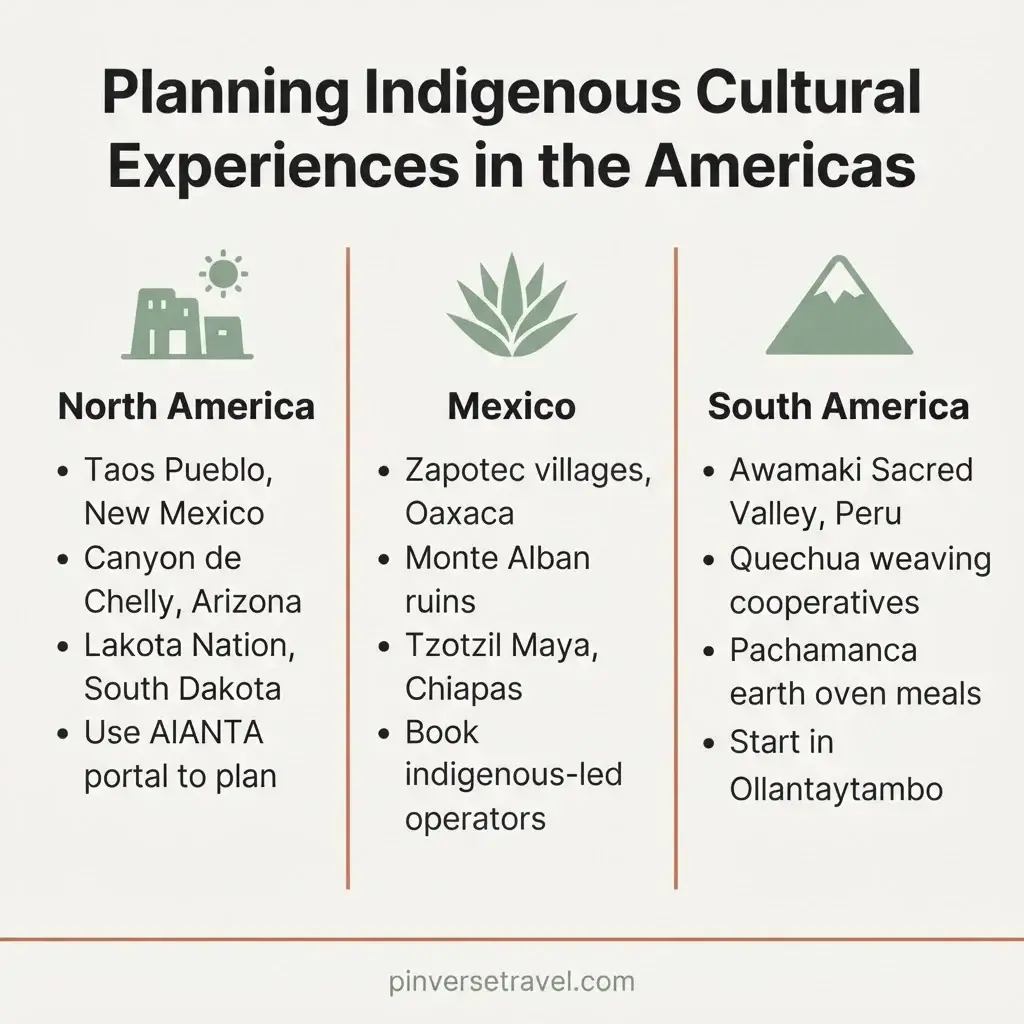
For Peru, Awamaki’s website allows you to book cultural tours directly, with full transparency about where your money goes.
For Mexico, seek out indigenous-led operators specifically (Zapotec Travel in Oaxaca is one example), and use Oaxaca-based cultural organizations to vet experiences in the villages.
Pack layers, especially in the Andes and the American Southwest. Bring small bills for markets. Learn a handful of words in the local language before you arrive. Quechua, Zapotec, Diné: even a greeting shows respect.
And go slowly. These are not places to rush through. Give them the time they deserve.