Six Secret Historical Towns in Europe Worth the Detour

There is a version of Europe most travelers never see.
It is not the version with two-hour queues outside the Colosseum, or the one where every other person on the street is holding a selfie stick in front of the same fountain. It is quieter, older, and honestly more interesting. It is the version where you can walk through a cobblestone alley that has been there for seven centuries and not have to dodge a tourist group doing it at the same time.
I know what it is like to arrive in a new country and realize the famous city you came for feels like a theme park version of itself. When I was backpacking solo through Europe, some of my most vivid memories were not of the big landmark moments. They were of getting off a train in a town I could barely pronounce, finding a cafe run by someone who spoke approximately four words of English, and sitting there for two hours trying the local food and watching ordinary life happen around me. That is the feeling these towns can give you.
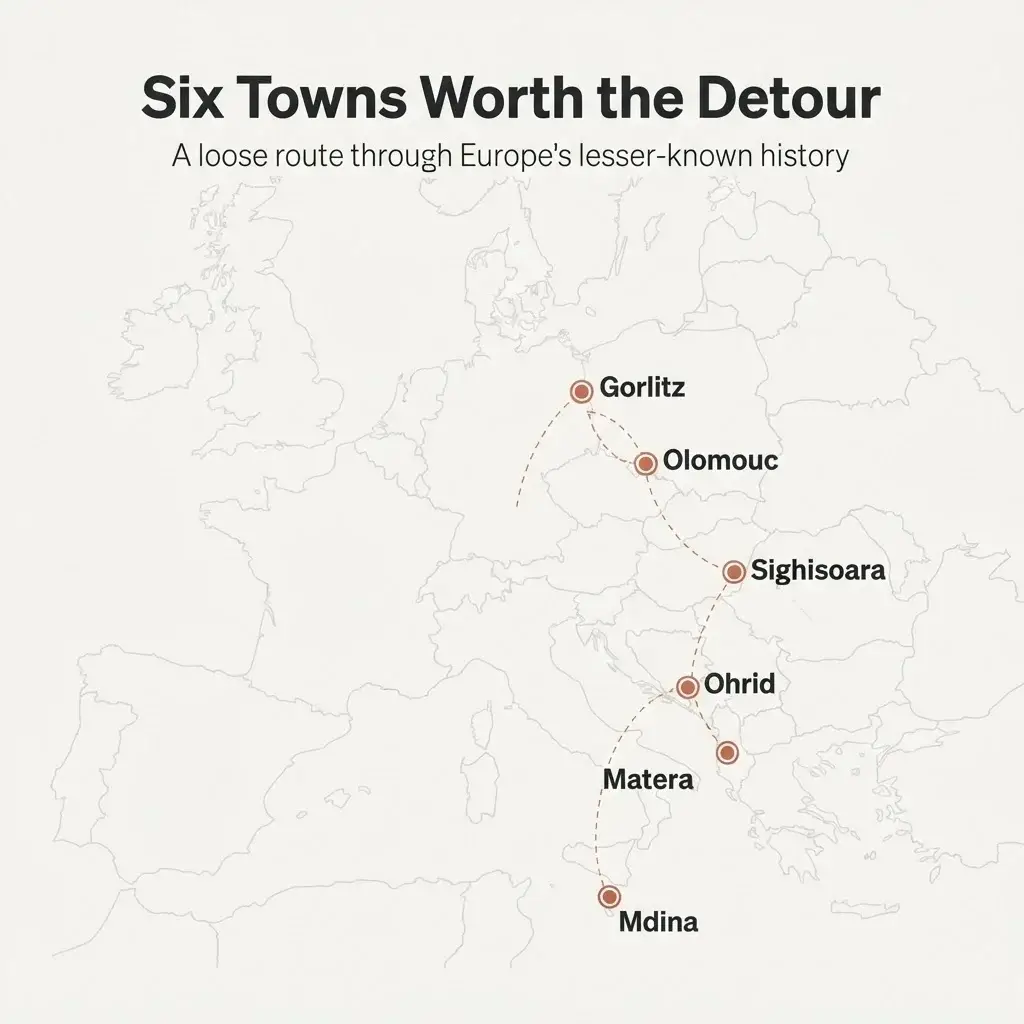
This is not a list of places that are secretly terrible or impossibly remote. These are six historically significant, genuinely beautiful towns that exist on the edges of the European tourist circuit. They reward the traveler who is willing to add a train journey, swap the obvious choice for the curious one, and slow down enough to actually absorb a place. A few of them carry UNESCO World Heritage status. All of them have a story most travelers never hear.
Here is where to go, how to get there, what to eat, and what to know before you arrive.
Görlitz, Germany: The Town That Time Forgot to Gentrify
Görlitz sits on the eastern edge of Germany, right on the Neisse River, which forms the border with Poland. Cross a bridge and you step into Zgorzelec, the Polish twin town on the other side. That border location is part of what makes Görlitz so unusual. The town was spared the bombing of World War II almost entirely, which means it still has its original Gothic, Renaissance, and Baroque architecture standing side by side in a way that no other German city can claim. Film directors have noticed this. Görlitz has served as a stand-in for pre-war Berlin and other fictional European cities in dozens of productions, earning it the affectionate nickname “Görliwood.”
What solo travelers consistently report is that this town feels almost eerily preserved. You walk through the Untermarkt, the lower market square, and the buildings around you date from the 15th and 16th centuries. The Peterskirche, a late Gothic hall church, is one of the largest in the region. The old town is compact and entirely walkable. The official Görlitz tourism board offers guided walking tours in English, which are worth booking if you want the historical context rather than just the architecture.
The practical details: Görlitz is roughly two and a half hours by train from Berlin or Dresden. Accommodation is affordable compared to western Germany. A main meal in a local restaurant runs around 10 to 14 euros. The town’s relatively small tourist footprint means you can find a hotel or guesthouse on shorter notice than in the major cities. Spring and autumn are ideal, when the light through the old stonework is dramatic and the streets are quiet. The cross-border element adds a natural solo-traveler adventure: walk across the bridge, wander Zgorzelec for an hour, and come back having technically visited two countries in a morning.

Sighisoara, Romania: A Medieval Town That Is Still Lived In
Most people have heard the name Transylvania and immediately picture castles and fictional vampires. The real Transylvania is something much better: a region of rolling green hills, medieval Saxon towns, and some of the most intact fortified architecture in all of Europe. Sighisoara is the crown of it. It is a living medieval town, meaning people actually live inside the fortified citadel on the hill, which is rare. Most medieval “old towns” in Europe are preserved as museums. Sighisoara still has residents going about their daily lives among towers that date back to the 14th century.
The UNESCO World Heritage designation, which Sighisoara has held since 1999, recognizes it as an outstanding example of a small, fortified medieval town that played a strategic commercial role on the edges of Central Europe for centuries. The Transylvanian Saxons, German craftsmen and merchants who settled here, built the citadel and its defensive towers. Nine of the original fourteen towers still stand. The Clock Tower, the largest and most iconic, was built in the 14th century and now houses a history museum. Climb it for views over the terracotta rooftops and the valley below.
Getting to Sighisoara by train is genuinely part of the experience. Trains run from Bucharest (roughly five hours) and from Cluj-Napoca (roughly three hours). The station sits about 15 minutes on foot from the lower town, and from there you climb up into the citadel. Food matters here: look for traditional Romanian dishes like sarmale (cabbage rolls stuffed with minced meat and rice), mici (grilled minced meat rolls), and palinca, the local fruit brandy that appears whether or not you asked for it. Accommodation inside the citadel itself exists and is worth the small splurge. Staying inside the walls after the day tourists leave is a completely different experience.
The biggest mistake I see travelers make with Sighisoara is treating it as a day trip from Brasov. It deserves two nights minimum.
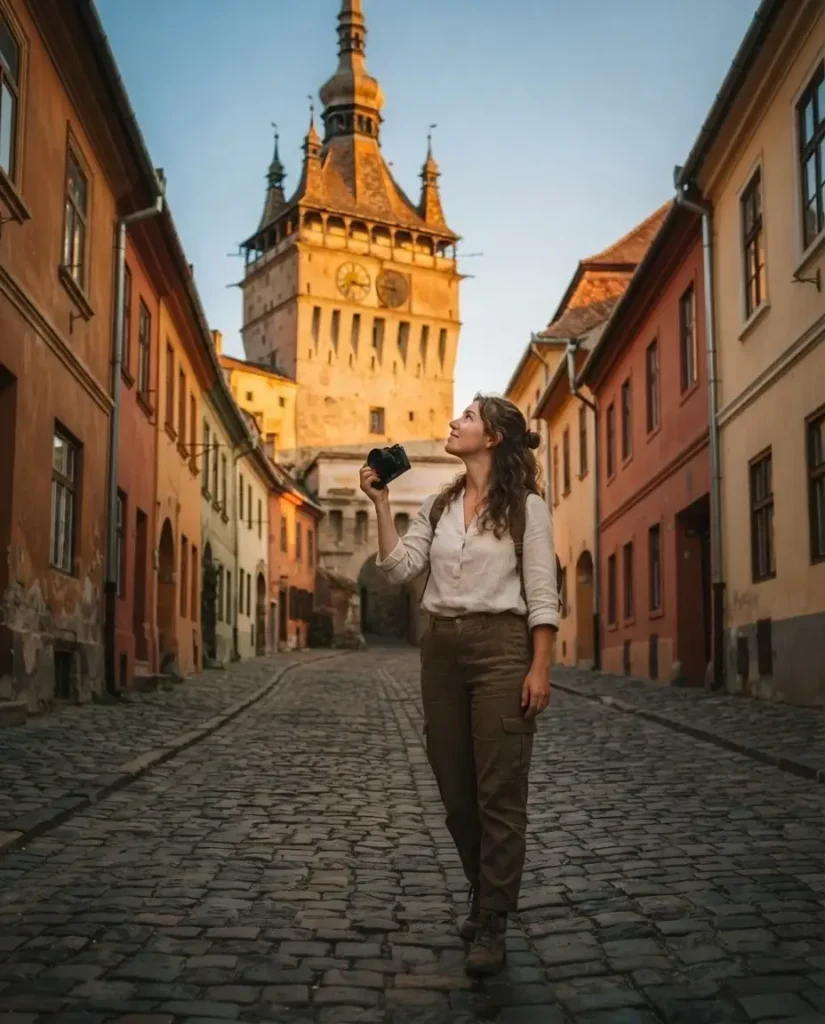
Give yourself the evening when the light goes golden and the streets empty out, and you will understand why.
Ohrid, North Macedonia: Byzantine History on a Lake That Pre-Dates the Ice Age
North Macedonia is still one of the most underestimated countries in Europe for travelers, and Ohrid is its greatest argument for a visit. The town sits on the shore of Lake Ohrid, and both the lake and the town together form a UNESCO mixed World Heritage site, meaning they carry recognition for both cultural heritage and natural conservation simultaneously. That is rare. Only 39 sites worldwide hold this mixed designation.
The UNESCO listing for the Ohrid region describes the town as one of the oldest human settlements in Europe, home to the oldest Slavic monastery and more than 800 Byzantine-style icons dating from the 11th through 14th centuries. The lake itself is two to three million years old, predating the last Ice Age, and contains over 200 endemic species of plants and animals found nowhere else on Earth. Walking through Ohrid’s old town means passing churches that are older than most countries, on cobblestone streets that drop down to a lake that feels impossibly blue and impossibly ancient at the same time.
For American travelers, North Macedonia is visa-free for up to 90 days for tourism purposes. The US State Department travel page for North Macedonia has the current entry requirements. The easiest way to get to Ohrid is to fly into Skopje, the capital, and take a roughly three-hour bus from the main bus station. The journey itself passes through dramatic mountain scenery. Budget travelers will find Ohrid extremely affordable. A meal at a lakeside restaurant, fresh trout being the local specialty, typically runs 6 to 12 euros. Accommodation in the old town starts at around 25 to 40 euros per night for a private room.
The old town is very walkable and feels safe as a solo traveler. The Church of Saint John at Kaneo, perched on a cliff above the lake, is the photograph most people associate with Ohrid and it earns every pixel. Arrive early morning before the day visitors to have it nearly to yourself.
Matera, Italy: A City Carved Out of Stone
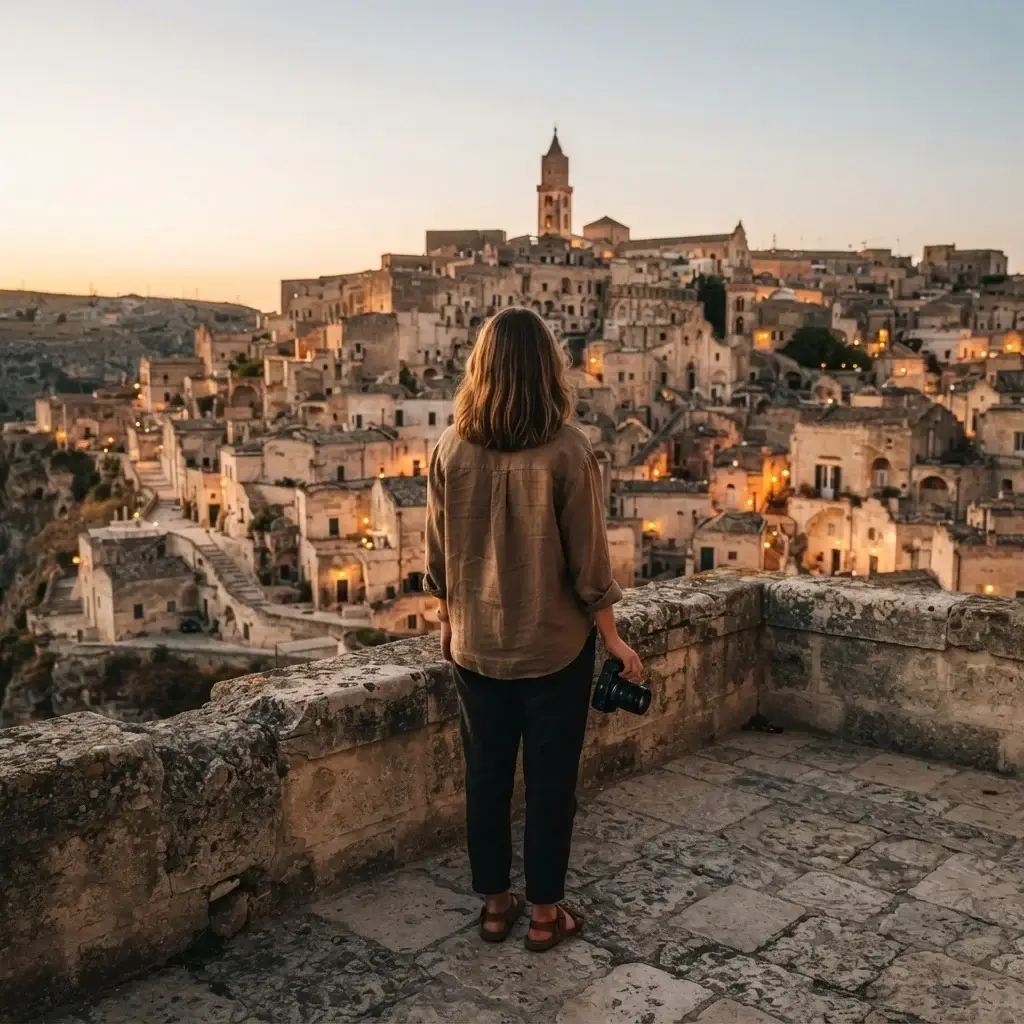
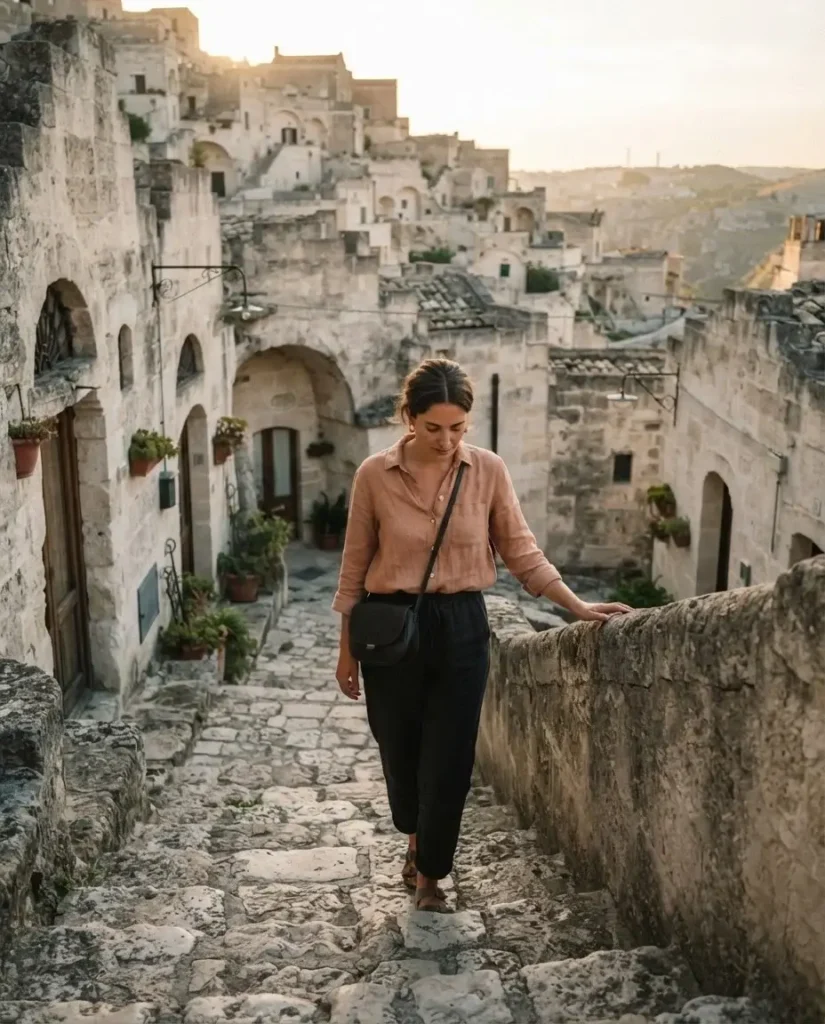
Matera, in the southern Italian region of Basilicata, is one of the oldest continuously inhabited cities in the world. People have been living in its caves, called the Sassi, since the Palaeolithic period, which means humans occupied these rock-hewn dwellings for longer than most modern civilizations have existed. For most of the 20th century, the Italian government considered the Sassi a national embarrassment, a symbol of poverty, and forcibly relocated the entire population in the 1950s. The residents came back from the 1980s onward, and today those same caves are boutique hotels, restaurants, and family homes.
The UNESCO World Heritage listing for Matera’s Sassi and Rupestrian Churches recognizes the site as an outstanding example of a rock-cut settlement that exhibits continuous human occupation across more than two millennia. The official Italian tourism board’s Matera page describes the best approach: begin with the two main Sassi districts, Sasso Caveoso and Sasso Barisano, and work your way through the network of paths and staircases that connect them. The walking is free. Individual cave-house museums charge entry of around 5 euros per person and are worth it for the context they give you about how people actually lived in these spaces.
Getting to Matera requires a little effort, which is part of why the crowds are thinner than you would expect for a UNESCO site of this significance. The nearest major hub is Bari, about 65 kilometers away. From Bari you can take the FAL (Ferrovie Appulo Lucane) train to Matera, a journey of about an hour and a half. Once you are there, Matera is walkable. What to eat: Matera is known for its bread, Pane di Matera, which has a thick crust, saffron-yellow interior, and an IGP protected status. Eat it with local cheeses. Also try crapiata, a traditional bean and grain soup that locals have made for centuries. The food here is deeply regional and very far from the tourist-adapted Italian menus of the north.
Olomouc, Czech Republic: Prague’s Quieter, More Academic Sibling
If you have been to Prague and loved it but wished it were less crowded and more local-feeling, Olomouc is the answer. It is the second largest historical monument reserve in the Czech Republic after Prague, with a beautifully preserved old town, a lively university atmosphere, an impressive collection of Baroque fountains, and a UNESCO World Heritage monument that most travelers have never heard of.
The Holy Trinity Column in Olomouc’s Upper Square is the centerpiece. Standing 32 metres high, it is the largest grouping of Baroque statues within a single sculpture in Central Europe. It was inscribed on the UNESCO World Heritage List in 2000. The Olomouc official city tourism site notes that a significant restoration of the column is ongoing through the end of 2026, so scaffolding may be present during your visit, but the town and its six other Baroque fountains are entirely unaffected. The Archbishop’s Palace, several well-preserved churches, and a remarkable central European café culture make the rest of the old town genuinely engaging for a full day or two of exploration.
Olomouc is about two hours by train from Prague and ninety minutes from Brno. The journey is straightforward and affordable. The student population keeps prices low and the atmosphere relaxed. A good meal in a local restaurant costs around 8 to 12 euros, noticeably cheaper than Prague. The beer, served in local pubs called hospodas, is exceptional. Olomouc is an ideal addition to any Czech Republic trip that extends beyond Prague, and solo travelers consistently describe it as one of the friendliest towns they have visited in Central Europe.
Mdina, Malta: A Medieval Walled City With No Cars
Malta is a small island nation in the Mediterranean that most travelers pass over in favor of Italy or Greece, and within Malta, most tourists who do visit spend their time in Valletta, the capital. Mdina, roughly 13 kilometers inland, is a different world entirely. Called the Silent City, Mdina is a medieval walled town where private motor vehicles are banned, the population is around 300 people, and the streets are so narrow and so quiet that the sound of your own footsteps feels surprisingly loud.
The official Mdina heritage site describes a city with roots going back 4,000 years. The Romans had a city here. The Arabs renamed it Mdina during their rule in the 9th century. The Knights of St. John, who ruled Malta for 268 years, left their mark throughout the architecture. The current walled city dates largely from the medieval Norman and later Baroque periods. Walking through it, especially in the early morning before the afternoon crowds from Valletta arrive, genuinely feels like stepping into a place that exists outside normal time. St. Paul’s Cathedral sits at the center and is open from 9 AM to 5 PM most days. The views from the city’s bastions over the Maltese countryside stretch for miles.
Getting to Mdina from Valletta is simple and cheap. A public bus (route 51 or 52) makes the journey in about 30 to 40 minutes and costs around 1.50 euros. From the bus stop at Rabat, the town directly adjacent to Mdina, you walk five minutes into the walled city. The timing trick: arrive before 9 AM or after 4 PM. The tour groups that arrive from Valletta between 10 AM and 3 PM transform the narrow streets. Outside those hours, Mdina is as quiet as its name suggests.

Stay for dinner if you can. The handful of restaurants inside the walls are not cheap by Maltese standards, but eating inside those ancient walls after dark, with almost no one else around, is one of those rare travel experiences you do not plan and cannot quite explain to people who were not there.
A Note on How to Actually Use This List
One of the most common mistakes I have seen travelers make with a list like this is trying to visit all six. That is not a trip. That is a sprint across three time zones and five countries, and you will come home exhausted having experienced nothing properly.
Pick two or three that genuinely call to you. Give each one at least two nights, ideally three.
Walk without a strict itinerary on your second day. Eat in a place that does not have a menu in English. Talk to the person running your guesthouse, because they will tell you something no travel article will.
The towns on this list do not reward rushing. They reward the kind of traveler who is willing to sit with a place for a while and let it reveal itself. That kind of travel is slower, yes. It is also far more interesting.
If you are planning your first solo trip to Europe, these towns are genuinely approachable. They are safe, they have accommodation options at various budgets, and most have enough infrastructure that you will not feel stranded. The reward for choosing them over the obvious options is that you come home with stories nobody else has told yet.
That is worth the detour.