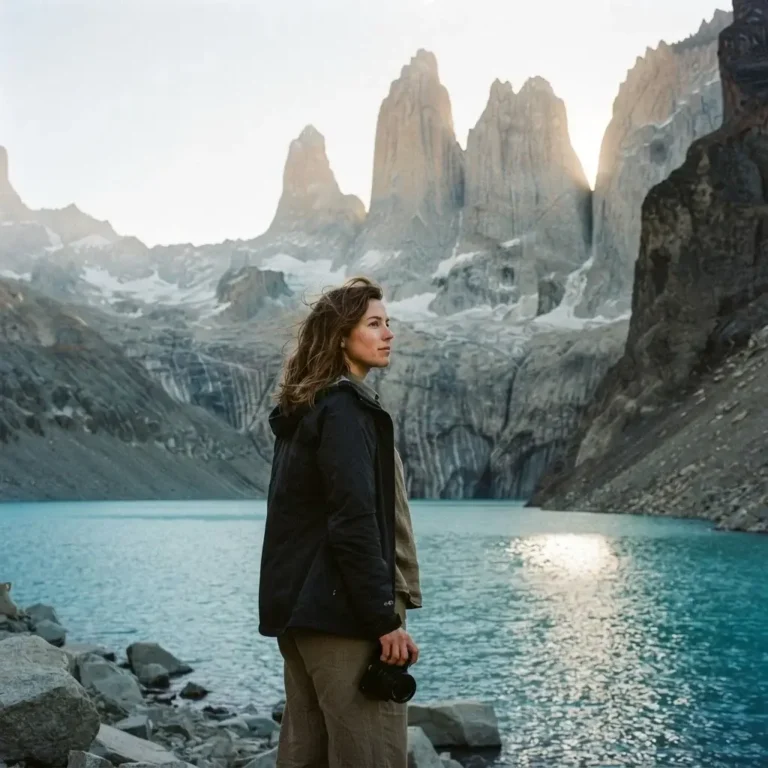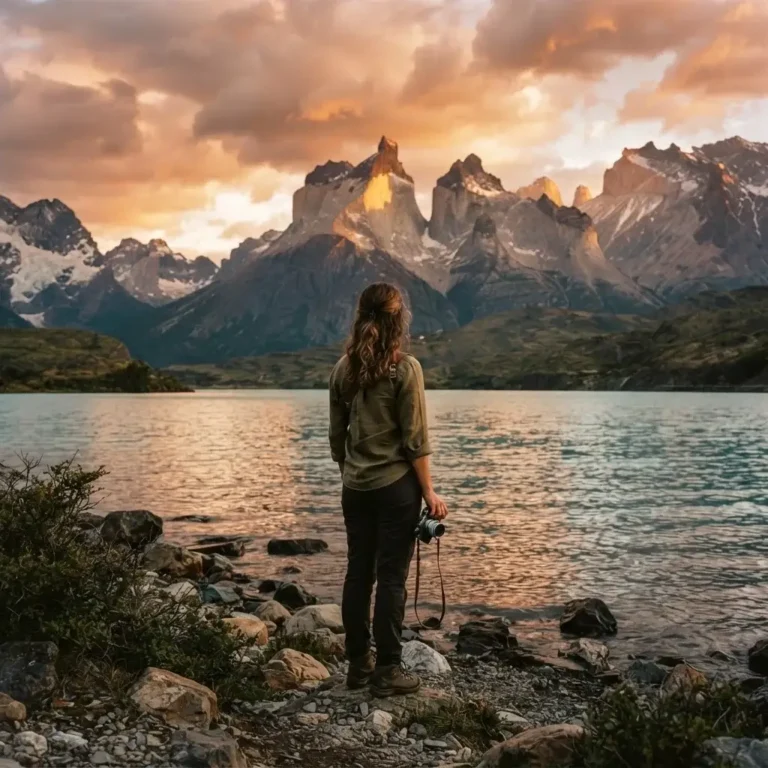
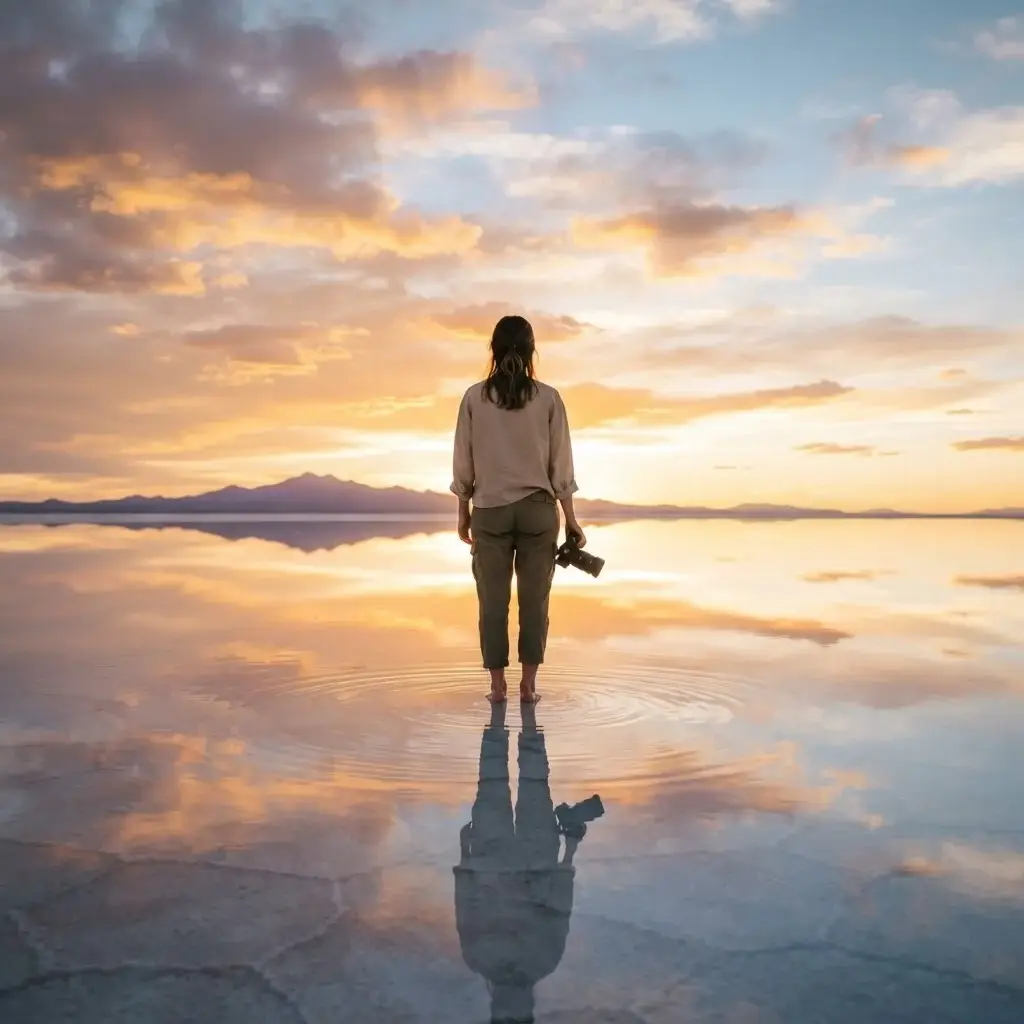
There’s a specific kind of silence that only exists in the desert. Not the silence of an empty room or a quiet street at 3 a.m. Something far bigger. The kind of silence that makes you suddenly, sharply aware of how small and loud and complicated your regular life actually is.
I’ve chased that feeling across continents. I’ve hiked through remote landscapes in China where the terrain shifted from green mountains to bone-dry plateaus in a single afternoon. I’ve driven roads in Europe where the countryside turned to arid scrubland before I even noticed it happening. And every time, something in me settled. Something clarified.
That’s what desert travel does. It strips things back.
The Americas have some of the most extraordinary desert landscapes on Earth, and most travelers only scratch the surface. They hear “Atacama” and think it’s out of reach. They hear “Joshua Tree” and assume it’s just a weekend Instagram trip for Californians. They’ve never even heard of the Tatacoa Desert in Colombia.
This guide is for the person who wants to go beyond the thumbnail. Whether you’re planning your first real desert trip or you’ve been dreaming about the Uyuni Salt Flats for two years and haven’t pulled the trigger yet, here’s what nobody actually tells you.
Why Deserts Demand a Different Kind of Preparation
Before we get into specific destinations, I want to be honest about something most travel guides skip entirely.
Deserts are not inherently dangerous. But they are genuinely unforgiving of poor preparation in a way that cities and beaches are not. Heat, altitude, remoteness, and the sheer lack of water and shade create conditions where small mistakes become big problems, especially when you’re traveling solo. The good news: none of this should stop you. It should just make you thoughtful.
There are two types of desert challenges in the Americas. In North America, the primary concern is heat. The Mojave, Sonoran, and Chihuahuan deserts can reach 40°C (104°F) or higher in summer. Hiking midday in July is genuinely dangerous, not dramatic. In South America, specifically in the Andes-adjacent deserts of Chile and Bolivia, the challenge is altitude. San Pedro de Atacama sits at around 2,400 meters above sea level, which is high enough that many travelers feel short of breath and headachy when they arrive. The geysers and salt flats you’ll want to visit are often at 4,000 meters or more.
The practical rule for North American deserts: hike early, rest mid-afternoon, hike again in the evening. Carry more water than you think you need, every single time.
The practical rule for South American high-altitude deserts: give yourself 24 to 48 hours to acclimatize before doing anything strenuous. Drink water constantly. Avoid alcohol for the first couple of days. Move slowly. Your ego is not worth a day curled up in your hostel feeling like you have the world’s worst hangover.
Keep both of these in mind as we go through the destinations below.
Joshua Tree and the Mojave: The Solo Desert Starter
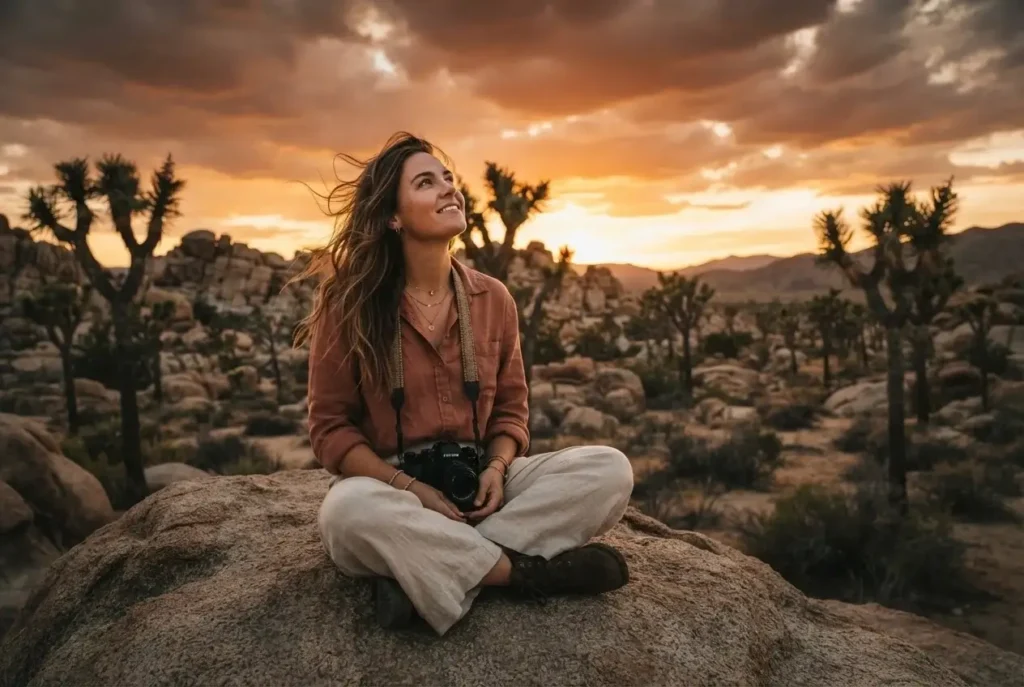
If you’ve never done serious desert travel before and you live in North America, Joshua Tree National Park in California is where I’d send you first. Not because it’s easy, but because it’s accessible enough to build your confidence without overwhelming you, and it’s genuinely spectacular.
The Mojave and Colorado deserts collide inside Joshua Tree, which gives you two distinct landscapes within a single park. The northern half is classic high Mojave terrain: the famous Joshua trees (which look like something Dr. Seuss invented), granite boulder formations stacked on top of each other like giants left them there, and a kind of otherworldly quiet. The southern portion shifts into lower Colorado Desert ecosystem with cholla cacti and ocotillo plants dominating the landscape.
For a first-timer, I’d suggest arriving in fall or spring. October, November, March, and April are ideal. The light is extraordinary, temperatures are comfortable for hiking (usually 15-25°C), and you can actually be in the sun for more than 20 minutes without feeling like you’re being slow-cooked.
The most rewarding short hike in the park is the Barker Dam loop, a 2.7 km trail through boulder fields to a small reservoir that sometimes reflects the surrounding rocks like a mirror. Hidden Valley is another favorite: a 1.6 km trail through a ring of boulders with excellent bird spotting. If you want something more challenging, the Ryan Mountain summit (about 5 km round trip) puts you above everything with a 360-degree view of the entire park.
One practical note: Joshua Tree National Park charges $30 per vehicle for a 7-day pass, or $15 if you’re arriving on foot or by bike. If you plan to visit multiple national parks in a year, the America the Beautiful Annual Pass at $80 is an excellent investment. Download your pass before you arrive. Cell service inside the park is essentially nonexistent, and if you’re relying on a digital pass, you need it already saved to your phone.
Stargazing at Joshua Tree is world-class. The park is one of the few International Dark Sky Parks in Southern California. Bring a blanket, lie on your back in the dirt, and look up. It will readjust your sense of perspective in ways that nothing in a city ever will.
What to eat: The park itself has no food vendors. Stock up in the town of Joshua Tree or Twentynine Palms before you enter. Crossroads Cafe in Joshua Tree town is a solid, unpretentious option for breakfast before a day in the park.
White Sands, New Mexico: The Most Otherworldly Place in North America
If Joshua Tree is the confident first chapter, White Sands National Park is the plot twist that changes everything.
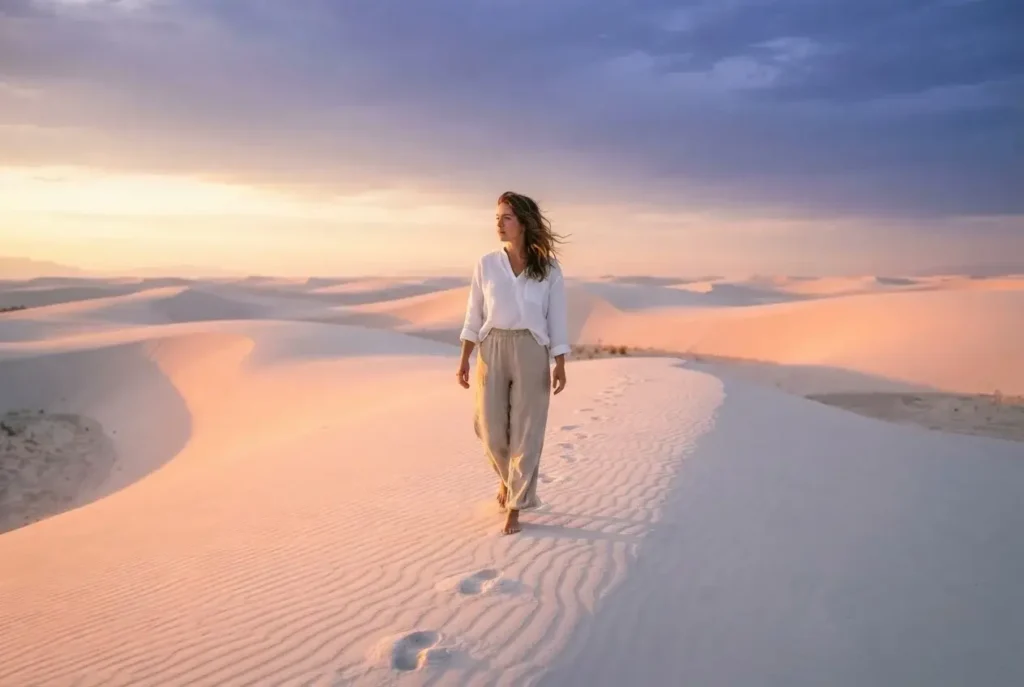
White Sands is a place that doesn’t seem real. The dunes here are made not of sand but of gypsum crystal, which means they stay blindingly white even in direct sunlight, and they never heat up the way sand does. You can walk on them barefoot in the middle of summer. They feel cool and powdery underfoot.
From what solo travelers consistently report, nothing prepares you for the actual scale of this place. The dunes reach up to 18 meters high and extend across 710 square kilometers of southern New Mexico. Standing inside the dune field, you lose all sense of direction. Everything is white in every direction. It is, without exaggeration, unlike anything else on the North American continent.
The most popular activity here is also the most joyful: sledding. The park sells plastic sleds at the visitor center for about $20, and you can sled down the gypsum dunes all day. It sounds like something for children, but I promise you, adults have just as much fun. Equally popular is the Dune Life Nature Trail, a 1.6 km loop through the dunes with signs explaining the bizarre ecosystem that has adapted to survive here.
Timing matters at White Sands. Sunset turns the dunes a soft rose-gold and then deep coral. This is, by multiple accounts from travelers I’ve spoken with, one of the most beautiful natural light shows in the country. Plan to be inside the park at least two hours before sunset and stay as long as the park allows.
White Sands National Park charges $25 per vehicle for a 7-day pass, or $15 per person on foot. The park is located about 25 km northeast of Las Cruces, New Mexico. Note that the park does occasionally close due to nearby White Sands Missile Range operations, so check current conditions before you drive out.
What to eat: Drive into Mesilla, a historic village just outside Las Cruces, where you’ll find La Posta de Mesilla, one of New Mexico’s most atmospheric old adobe restaurants serving traditional New Mexican food including excellent red and green chile.
The Sonoran Desert and Arizona: Culture, Wildlife, and a City That Understands the Desert
Most people fly into Phoenix, spend one day in Sedona for the red rocks, and then fly home thinking they’ve done Arizona. They’ve missed the real thing almost entirely.
The Sonoran Desert is the most biologically rich desert in North America. It’s the only place on Earth where the iconic saguaro cactus grows, and that matters because these cacti are not just beautiful landmarks. They are living ecosystems. A mature saguaro can live 150 to 200 years, reach 12 meters in height, and provide nesting cavities for dozens of species of birds and mammals.
For desert immersion in Arizona, Tucson is the base I’d recommend over Phoenix. It’s smaller, more authentic, and oriented around the desert in a way that Phoenix has largely paved over. From Tucson, you have access to Saguaro National Park (split into an east and west district, both free to enter), the Santa Catalina Mountains for hiking, and one of my favorite institutions in the American Southwest.
The Arizona-Sonora Desert Museum sits just west of Tucson and is genuinely one of the best places to understand the Sonoran Desert before you venture into it. It’s part zoo, part botanical garden, part natural history museum, spread across 40 hectares of actual desert with trails threading between enclosures that house mountain lions, javelinas, river otters, and over 300 plant species. Admission is $29.95 for adults, and summer hours run from 7:30 a.m. to 4:00 p.m. Monday through Saturday. I’d budget at least three hours here.
For solo travelers, Arizona is genuinely comfortable and navigable. Tucson has a relaxed, creative energy, good hostels and budget accommodation, and an incredibly vibrant Mexican and indigenous food culture. Don’t leave without eating at one of the many family-run taquerias along South 4th Avenue, where the carne asada burritos are made with flour tortillas the size of a small blanket.
The Atacama Desert, Chile: Where the Sky Actually Changes You
Now we cross into South America, and the scale of everything shifts.
The Atacama Desert in northern Chile is often cited as the driest non-polar desert on Earth. Some weather stations in the Atacama have never recorded rainfall. The landscape is ancient beyond comprehension: salt flats that crack into perfect geometric tiles, volcanic peaks above 6,000 meters, valleys carved by wind into shapes that look more lunar than terrestrial.
The gateway to all of it is San Pedro de Atacama, a small adobe town in the desert that functions as the hub for every excursion. Flying into El Loa Airport in Calama (airport code CJC) with a direct flight from Santiago is the most practical way in. From Calama, it’s about 100 km and 90 minutes by bus or transfer to San Pedro. Chile’s official tourism board provides detailed travel information and route guidance for the region, which is worth reading before you book anything.
San Pedro sits at about 2,400 meters elevation, which is manageable for most people with a day or two of rest. The problems start when you take tours to higher-altitude sites. El Tatio Geysers, arguably the most dramatic sight in the Atacama, sit at over 4,300 meters. Most tours depart at 4:00 a.m. to reach the geysers at sunrise when the steam columns are most active. This is spectacular. It is also bitterly cold. Pack layers you’d associate with a mountain trip, not a desert one.
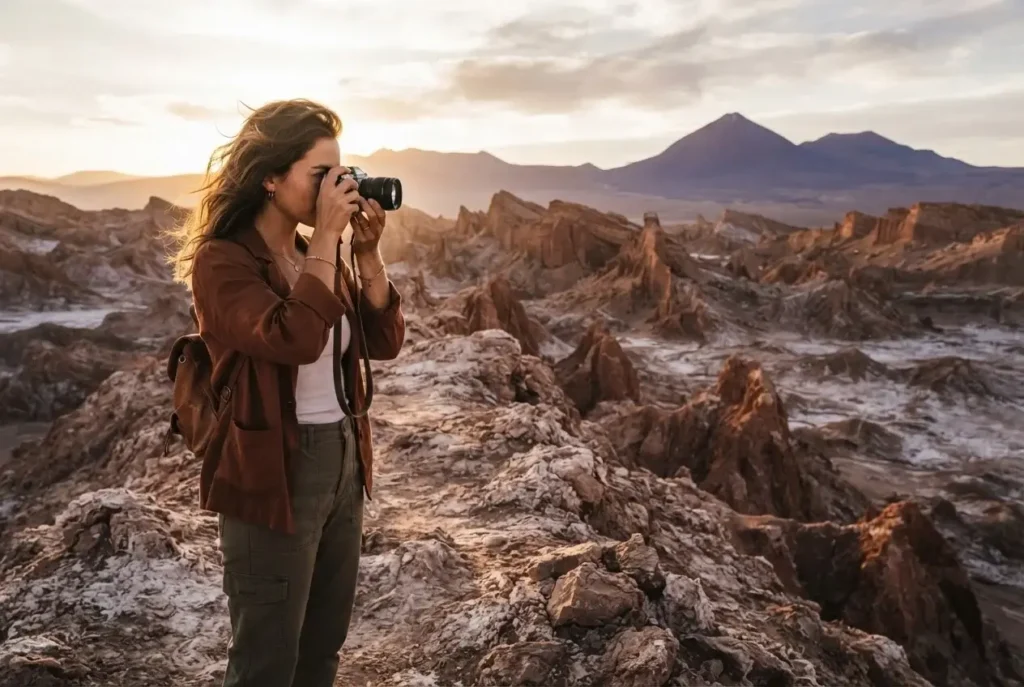
Valle de la Luna (Moon Valley) is the essential Atacama experience for first-timers. The landscape of salt formations, sand dunes, and strange rock structures creates a setting that feels completely extraterrestrial. Entrance is around 10,000 Chilean pesos (approximately $11 USD). The walk through the valley takes about two to three hours and should be done in the late afternoon when the light turns the formations amber, pink, and eventually a deep blood orange as the sun drops.
The stargazing in the Atacama is among the finest on Earth, which is precisely why astronomers have built some of the world’s most advanced telescopes in this region. The clearest skies, per consistent reports from researchers and astronomers working in the area, occur between June and August during the dry, cold winter months. The San Pedro de Atacama entry on the UNESCO World Heritage tentative list reflects its significance not just geologically but culturally, with evidence of Atacameño indigenous communities and pre-Columbian settlements in the surrounding valleys.
What to eat: In San Pedro, look for quinoa stew (cazuela de quinoa) and grilled llama (llama a la plancha) at the local restaurants along Caracoles Street, the main strip. It’s tourist-oriented but the food is genuinely good and often locally sourced. Budget around $12-18 USD per main meal at sit-down restaurants.
Salar de Uyuni, Bolivia: The Mirror at the Edge of the World
If the Atacama humbles you, the Salar de Uyuni will make you question the rules of reality.
The Uyuni Salt Flats in southwestern Bolivia are the largest salt desert in the world at roughly 10,582 square kilometers. During the rainy season between November and March, a thin layer of water covers the flats and creates a perfect mirror effect, reflecting the sky in a way that makes the horizon disappear entirely. You’ve seen the photos. In person, it’s more disorienting and more beautiful than any photo has ever conveyed.
The base town of Uyuni is functional but not particularly charming. Most travelers treat it as a one-night stopover before or after their tour. The main event is a multi-day 4×4 tour into the salt flats and beyond into the Andean highlands, past bright-colored mineral lagoons, flamingos feeding in shallow salt lakes, and geothermal fields puffing sulfurous steam.
One-day tours of the Salar de Uyuni typically cost between $65 and $90 USD per person, while three-day tours run roughly $189 to $239 USD per person. These prices usually exclude entrance fees and sometimes exclude meals, so read the fine print before you book. The three-day tour is widely considered the better experience because it takes you well beyond the salt flats into the far more remote and visually jaw-dropping Eduardo Avaroa National Andean Fauna Reserve.
For solo travelers, joining a group tour at Uyuni is the norm and genuinely works in your favor. You share a 4×4 jeep with four or five other travelers, which cuts costs and makes the whole thing more enjoyable. The friendships formed over three days rattling across salt flats at altitude in a jeep tend to be the kind that stick around.
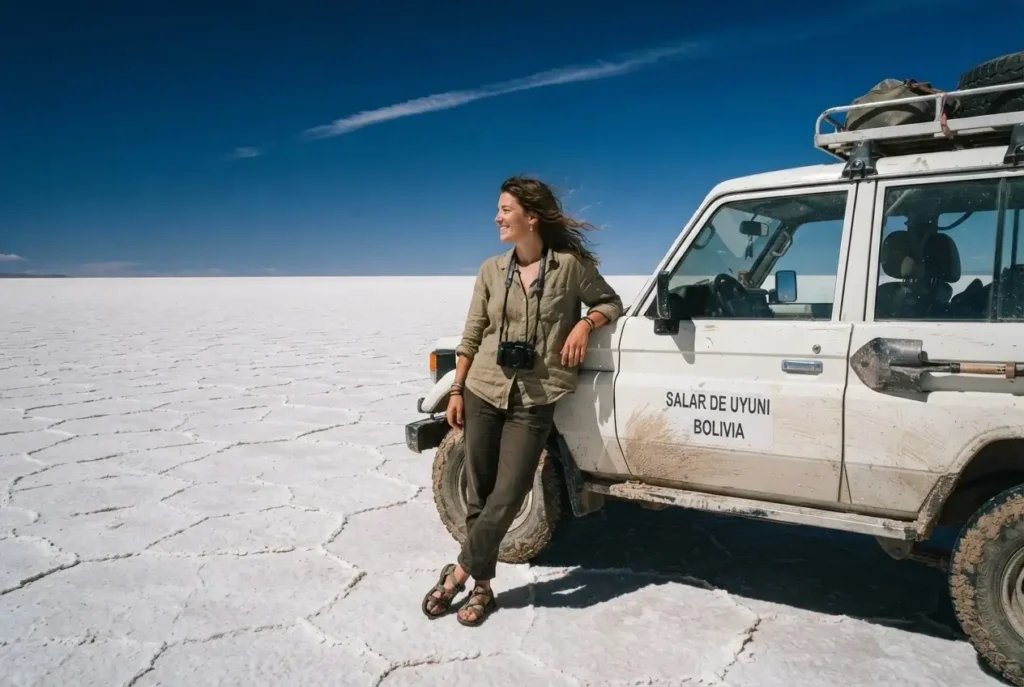
Altitude here is no joke. Uyuni town sits at 3,656 meters. The highlands you pass through on the three-day tour hit 5,000 meters at some points. Take acclimatization seriously. If you’re coming from low altitude, spend at least two nights in Uyuni or nearby before the tour departs. Drink water constantly, skip the celebratory beer until you’re back at lower elevation, and don’t push through symptoms like headache and nausea. Your body needs time, and this is not a situation where willpower is useful.
What to eat: In Uyuni town, Minuteman Pizza is something of a traveler institution, open since the 1990s and serving reliably good food in a no-nonsense setting. For Bolivian food, try saltenas (meat-filled pastries, baked in the morning) as a breakfast before your tour departs.
The Tatacoa Desert, Colombia: The One You Probably Haven’t Heard Of
Here is where I’d send the curious traveler who has already done one of the destinations above and is hungry for something less traveled.
The Tatacoa Desert in the Huila department of Colombia is not technically a desert in the strictest climatic sense. It’s a dry tropical forest, one of only two arid zones in Colombia. But calling it a desert feels right because the landscape is openly, unapologetically alien. Red ochre rock formations in one section, pale grey formations in another, divided by dry riverbeds and populated by scorpions, iguanas, and a surprisingly charming collection of local astronomical observatories.
From what solo travelers consistently report, the Tatacoa rewards the person who slows down. This is not a park you race through in three hours. The closest town is Villavieja, reachable by bus from the city of Neiva, which is itself connected to Bogota by both bus (about four hours) and domestic flights. The desert itself is small enough to walk in a day but rich enough to spend two nights near, especially if you book a night at one of the simple observation decks to stargaze. The skies here are remarkably clear for a destination this accessible.
The Tatacoa is a strong option for solo travelers who want South American desert adventure without the altitude and logistical weight of Bolivia or even the Atacama. Cost of living in the region is very low. Accommodation options near the desert include basic hostels and family guesthouses where meals are often included. The whole trip from Bogota costs a fraction of what you’d spend in Chile or Bolivia.
Five Things Every First-Timer Gets Wrong About Desert Travel
After years of hearing from solo travelers who’ve been to these places, and drawing from my own experiences in remote landscapes in China and elsewhere, these are the mistakes that keep coming up.
Underestimating temperature swings. Desert days are scorching. Desert nights are cold, sometimes genuinely freezing.
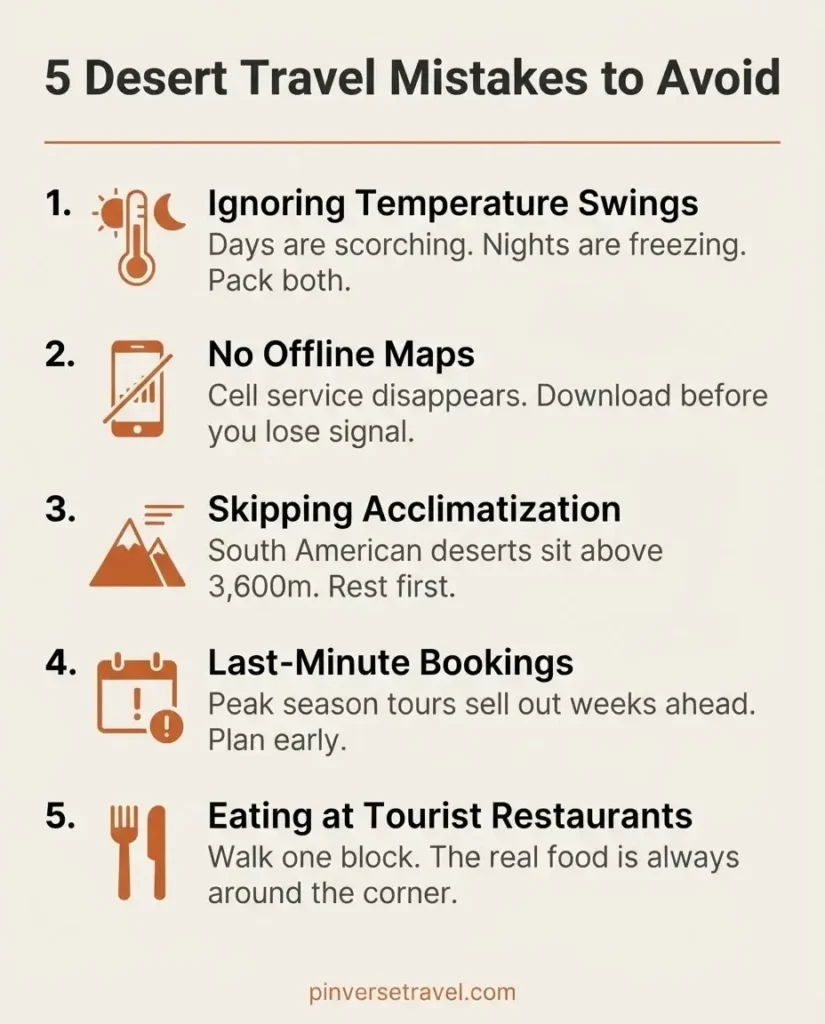
Travelers consistently pack for one or the other but not both. Bring layers. Wear them in the mornings and evenings. Stuff them in your pack for the afternoon.
Going without downloaded maps. Cell service in desert parks and remote desert towns is unreliable at best, nonexistent at worst. Download offline maps on Google Maps or Maps.me for every region you’re visiting before you lose service. This is not optional.
Rushing the acclimatization in South America. I mentioned this in the Bolivia section, but it deserves its own emphasis here. Every experienced traveler who has visited the Bolivian highlands has a story about someone in their tour group who tried to push through altitude sickness and made the entire group miserable. Don’t be that person. Give yourself time.
Booking tours last-minute in peak season. The Atacama in particular fills up fast from December through February (South American summer) and in July and August when the skies are clearest. Book geysers tours and stargazing experiences at least a week ahead during these months.
Skipping the food. Desert regions in the Americas have genuinely extraordinary local food cultures. The Andean highlands influence Bolivian and Chilean desert cuisine in fascinating ways. Southern New Mexico’s green chile culture is one of the most distinctive regional food identities in the entire country. Arizona’s Sonoran Mexican food is different from Tex-Mex in every way that matters. Don’t eat at the tourist restaurant. Walk one block further and eat where the locals eat.
Which Desert Is Right for You?
If you’ve made it this far, you might be feeling either excited and overwhelmed, or narrowing in on a specific destination. Here’s a quick framework for deciding.
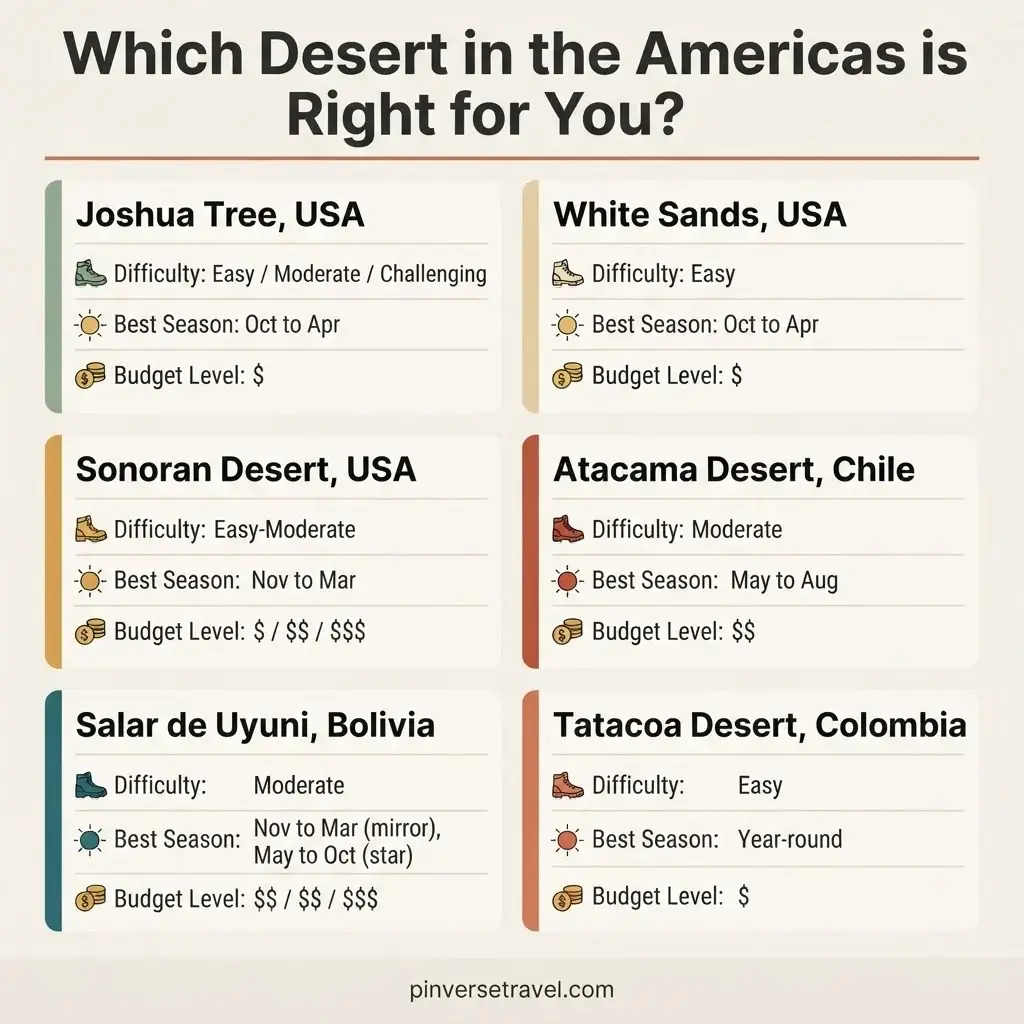
First desert trip ever, never traveled solo before: Joshua Tree, California. Low barrier to entry, stunning scenery, safe and well-managed, accessible from Los Angeles. A perfect proving ground for your own confidence.
Want something genuinely otherworldly without leaving the US: White Sands, New Mexico. No other destination on this list will create that same sense of complete disorientation. Plan around a sunset.
Want cultural depth plus dramatic desert landscape: Sonoran Desert, Arizona, with Tucson as your base. The combination of indigenous history, Sonoran-Mexican food culture, wildlife, and manageable logistics makes this a deeply satisfying desert experience.
Ready for South America and want the classic big experience: Atacama Desert, Chile. This is where the scale and the sky both become something you feel in your chest. Fly into Calama, spend five to seven days in San Pedro, and let the landscape recalibrate you.
Want maximum wonder and are comfortable with rough logistics: Salar de Uyuni, Bolivia. The most visually surreal place on this entire list. Commit to the three-day tour. Prepare for altitude.
Want something off the radar on a budget: Tatacoa Desert, Colombia. Genuinely underrated, cheap, easy to reach from Bogota, and the kind of discovery that makes you feel like you’ve found something real.
One Last Thing Before You Go
The thing I come back to, every time I’m standing in a landscape that makes me feel small and alive at the same time, is that the hardest part of any of these trips is the decision to go.
I spent years in New York knowing I was meant to be somewhere else. I watched travelers plan and postpone and plan again. The perfect moment never arrived for any of them. It doesn’t arrive. You create it by moving.
Pick one desert from this list. Not the most impressive one or the one that will photograph best. The one that genuinely calls to you right now with what you have, what you know, and where you are in your life. Then start planning that one. The rest will follow.
The silence is waiting for you out there. It’s worth every bit of effort it takes to find it.