I remember the feeling of standing at the edge of something that has existed for centuries longer than you can truly comprehend. The size of it, the silence, the weight of human history pressing in around you. That feeling is exactly what the best UNESCO World Heritage Sites in the Americas are capable of giving you, and it is completely different from anything you get scrolling through photos online.
The Americas contain some of the most varied and moving UNESCO-designated places on the planet. From ancient Maya cities buried in jungle to volcanic island chains that rewrote our understanding of evolution, from Caribbean colonial fortresses to one of the deepest gorges on Earth. Two continents, thousands of miles, and more history and natural wonder than most people realize is accessible to an independent traveler with a genuine sense of curiosity.
This guide is for the person who has heard the names Machu Picchu and the Galapagos a hundred times but still is not sure where to start, what things actually cost, or whether they can pull it off without a pre-packaged tour group telling them where to stand. You can. And this is where I help you figure out which of these places is calling your name.
What “UNESCO World Heritage Site” Actually Means For a Traveler
Before we get into specific destinations, it is worth taking a moment to understand what the designation actually signals, because it changes how you approach a place.
UNESCO, the United Nations Educational, Scientific and Cultural Organization, designates World Heritage Sites as places of “outstanding universal value” to all of humanity, not just to the country that contains them. There are currently over 1,100 sites across the globe, and the Americas hold a significant share of them, spread across natural landscapes, pre-Columbian civilizations, and colonial-era cities.
What the label means for you in practice is this: these are places where preservation is taken seriously, where visitor management often exists specifically to protect what makes the site special, and where the experience tends to be more layered and meaningful than a typical tourist attraction. It also often means advance booking, entry limits, and specific rules you need to know before you arrive. Showing up unprepared is one of the most common mistakes travelers make, and it is completely avoidable.
The Americas’ UNESCO sites broadly split into two categories: natural sites (like the Galapagos and Iguazu Falls) and cultural sites (like Machu Picchu, Chichen Itza, and Cartagena’s walled city). A few, like Tikal in Guatemala, are mixed designations covering both. Knowing which type draws you more is actually a useful first step in choosing where to go.
Machu Picchu, Peru: The One That Earns Its Reputation
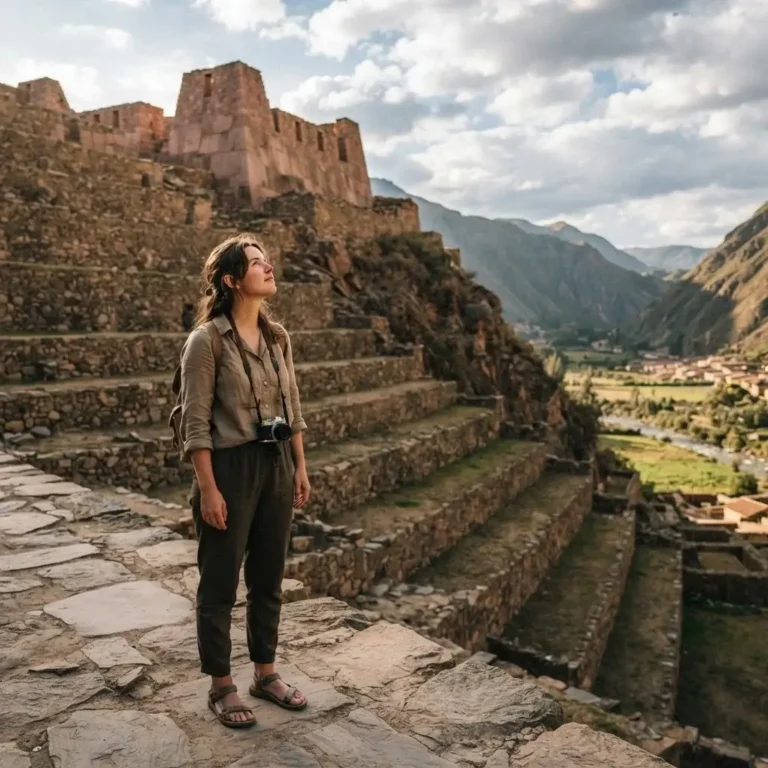
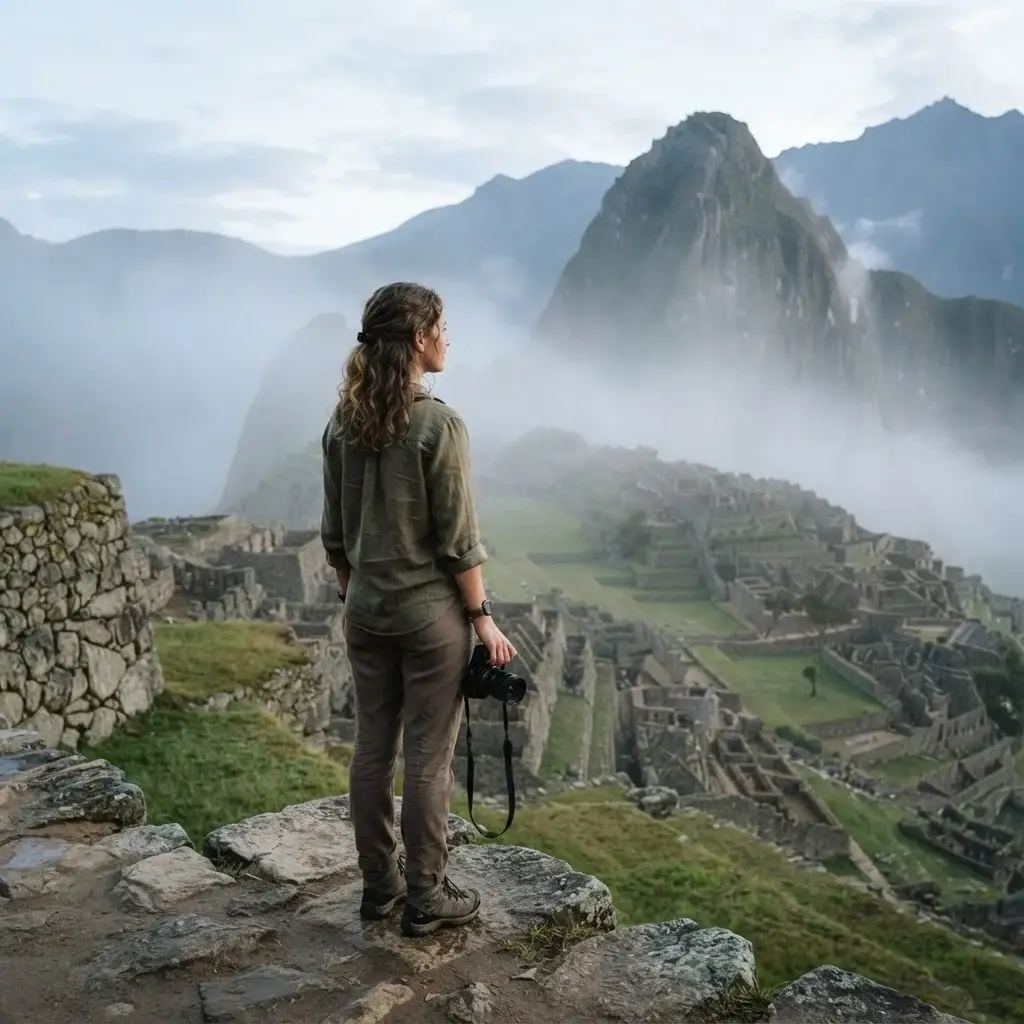
Machu Picchu is probably the first name that comes to mind when someone says “UNESCO site in the Americas,” and for genuinely good reasons. Perched at roughly 2,430 meters above sea level in the Andes, this 15th-century Inca citadel produces the kind of reaction that is difficult to describe until you are standing on that terrace with clouds moving through the ruins below you.
Here is what most travel content fails to mention clearly: you cannot just show up. Peru’s government has implemented strict ticketing controls to manage the enormous pressure that mass tourism was putting on the site. Tickets are timed and capacity-limited per entry session. As of 2026, an international adult ticket costs 152 soles, which works out to roughly $40 USD. You must book in advance through the official Peruvian government ticket portal, and during peak season (June through August), tickets can sell out weeks or months ahead. Do not learn this lesson the hard way after flying to Cusco.
There are now multiple visit circuits within the site, each with different access points and durations. If you want to climb Huayna Picchu mountain or Machu Picchu Mountain, those require separate permits purchased at the same portal, and they sell out even faster.
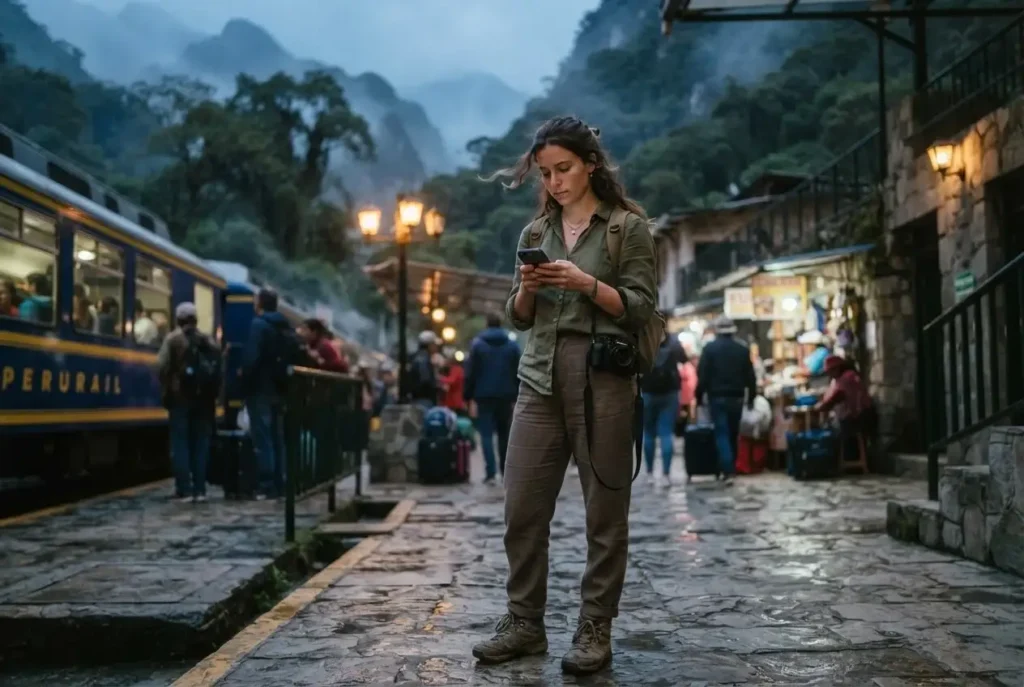
Getting there is part of the adventure. Most travelers base themselves in Cusco, acclimatize for a day or two (this is genuinely important at altitude), then take a train to Aguas Calientes (the town at the base) and a shuttle bus up the switchbacks to the entrance. If you want to arrive on the famous Inca Trail instead, that four-day trek requires its own permit and a licensed guide, and those sell out by January for the peak season.
For solo travelers, Machu Picchu is extremely manageable on your own. The site is well-marked, guides are available at the entrance if you want context, and Aguas Calientes has good accommodation at a range of price points. Arrive at opening (6am) to get ahead of the tour groups. The morning light is extraordinary, and the terraces feel more intimate before the midday crowds move through.
Chichen Itza, Mexico: Go Early, Go Knowing
Chichen Itza is one of the New Seven Wonders of the World and a UNESCO World Heritage Site, and it is also one of the most visited archaeological sites in Mexico, pulling in somewhere between three and eight thousand visitors per day according to the UNESCO World Heritage listing. That number matters because your experience will be very different at 8am versus 11am.
The site sits in the Yucatan Peninsula, roughly 200 kilometers from Cancun and 120 kilometers from Merida. General admission as of 2026 runs approximately 697 Mexican pesos (around $43.50 USD) for adult international visitors. The site opens daily at 8am and closes at 5pm, with the last entry at 4pm. Tickets can be purchased on-site without advance booking, though arriving early is still the single most effective strategy for a meaningful visit.
El Castillo, the stepped pyramid also known as the Temple of Kukulcan, is the centerpiece, and what surrounds it is equally worth your attention. The Great Ball Court is one of the largest in all of Mesoamerica. The Sacred Cenote, a natural sinkhole used for offerings and ceremonies, sits at the end of a wide causeway. The Temple of the Warriors is flanked by hundreds of columns, each one carved. This is not a place to rush.
A useful strategy for solo travelers is to base yourself in Valladolid rather than Cancun. It is a small, beautiful colonial city about a 30-minute drive from Chichen Itza, considerably cheaper than the resort coast, and it has genuine character. From Valladolid, you can arrive at the site right at opening and avoid the early tour bus traffic from Cancun entirely.
One thing that catches people off guard: vendors operate throughout the site grounds. They are persistent but not aggressive, and a polite, firm “no gracias” is all you need. It is part of the Chichen Itza experience, and there is something to be said for understanding that these stalls represent real livelihoods tied to the site.
The Galapagos Islands, Ecuador: Plan for It, Save for It, Go
The Galapagos Islands are the kind of place that shifts something in how you see the world. This archipelago of 127 islands sitting roughly 1,000 kilometers off the coast of Ecuador is where Charles Darwin developed the observations that led to his theory of evolution by natural selection. Being there and watching a marine iguana drag itself out of the ocean, or a blue-footed booby conduct its courtship dance without paying you the slightest attention, is profoundly disorienting in the best possible way. Wild animals here were never given a reason to fear humans, so they did not develop one.
The Galapagos is a UNESCO World Heritage Site, and its management reflects how seriously Ecuador takes the protection of what is arguably the most ecologically significant island chain in the world. What that means practically is that entry comes at a real cost. As of August 2024, the Galapagos National Park entrance fee doubled to $200 USD per adult international visitor and $100 for children. The Galapagos Conservation Trust has noted that this increase was implemented specifically to fund conservation and limit the environmental pressure caused by growing tourism numbers. It is paid upon arrival in cash.
Solo travelers have two main ways to visit. The first is a liveaboard cruise, where you sleep on a boat and access different islands each day with a licensed naturalist guide, which the rules of the national park require for most visitor zones. These range from budget to luxury in price, but even the most affordable multi-day cruises represent a significant investment. The second is to base yourself on one of the inhabited islands, Santa Cruz or San Cristobal, and take day trips. This is considerably cheaper and still gives you extraordinary wildlife encounters, though you will cover fewer islands overall.
The Galapagos is not a budget destination, but it is a worthy one. If you are serious about going, start planning six to twelve months out. The experience of watching a sea turtle surface three feet from you while snorkeling, surrounded by Galapagos sea lions, is genuinely not replicable anywhere else on the planet.
Tikal National Park, Guatemala: Ruins Inside a Living Jungle
If Chichen Itza is the Maya site everyone knows, Tikal is the one that actually feels like a discovery, even though it has been excavated and studied for decades. Located in northern Guatemala’s Peten region, Tikal was one of the most powerful cities in the ancient Maya world, inhabited from roughly the 6th century BC through the 10th century AD. Today it sits inside a national park that is also a UNESCO World Heritage Site for both its cultural and natural significance, and that dual designation gives you a clue about what makes it special.
The pyramids are extraordinary, but it is the jungle around them that transforms the experience. Howler monkeys fill the air with sounds that would genuinely alarm you the first time you hear them at dawn. Toucans move through the canopy. Spider monkeys watch you from the trees. Temple IV, the tallest structure in the complex at 65 meters, rises above the jungle canopy, and from its summit in the early morning you look out over an unbroken sea of green with pyramid tops emerging like islands.
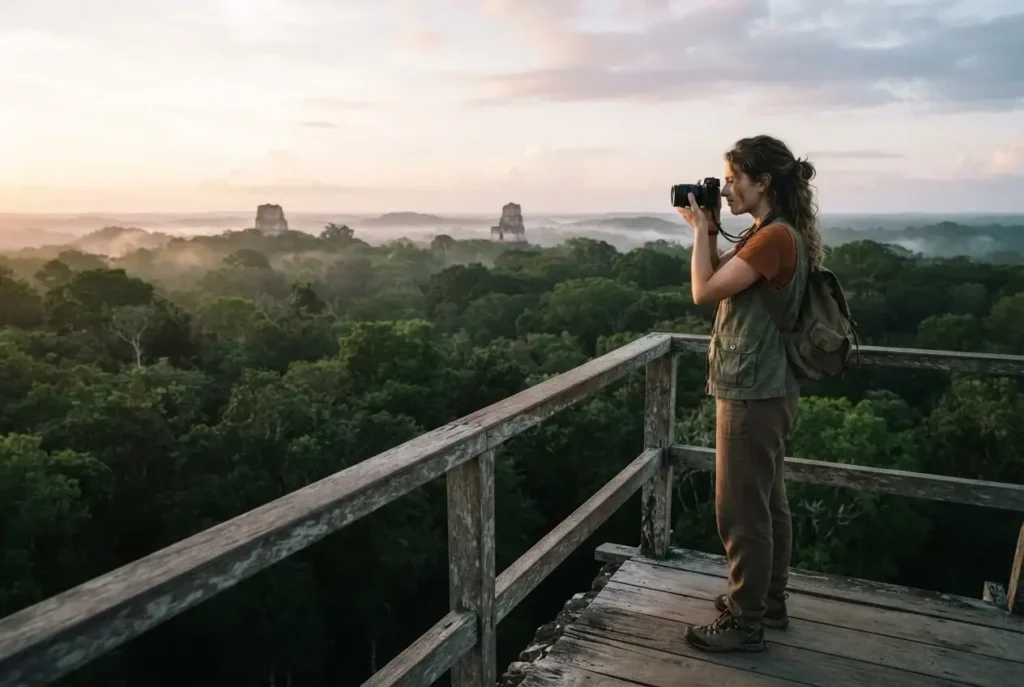
It is one of the most photographically stunning and emotionally quieting views anywhere in the Americas.
Foreign visitors pay 150 GTQ (approximately $20 USD) for entry, and the park is open daily from 6am to 6pm. Getting there from Guatemala City involves either flying to Flores (the nearest town) or taking an overnight bus, followed by a short drive to the park entrance. Most travelers base themselves in Flores or at the eco-lodges directly inside the park, which allows for an early morning start before day-trippers arrive.
One practical note: the jungle humidity is real and relentless. Bring significantly more water than you think you need, apply sun protection, and wear light, breathable clothing. The trails are well maintained but uneven in places. Take your time. The pace of the site rewards slowness.
Iguazu Falls, Argentina and Brazil: Two Countries, One Waterfall System
Few natural places in the world create the sense of being physically overwhelmed that Iguazu Falls does. This system of roughly 275 individual falls spanning 2.7 kilometers along the Argentina-Brazil border is wider than Niagara and produces a roar you can hear from a kilometer away. From what solo travelers who have visited both sides consistently report, the experience is genuinely different depending on which country you stand in.
The Argentine side of Iguazu National Park covers significantly more ground and puts you inside the falls system itself, with walkways that take you directly over and beside the water. The trail to Garganta del Diablo, or Devil’s Throat, is the centerpiece: a horseshoe-shaped chasm where the majority of the water falls, and the spray and sound are overwhelming in a way that feels almost confrontational. The Argentine entrance fee runs approximately $26 to $32 USD for foreign visitors, and the park is open from 8am with last entry at 4:30pm.
The Brazilian side offers the panoramic perspective: a wide, curved viewing platform that puts the entire width of the falls in front of you in a single frame. Most visitors say the Argentine side offers more to do over a full day, while the Brazilian side delivers the single most dramatic viewpoint.
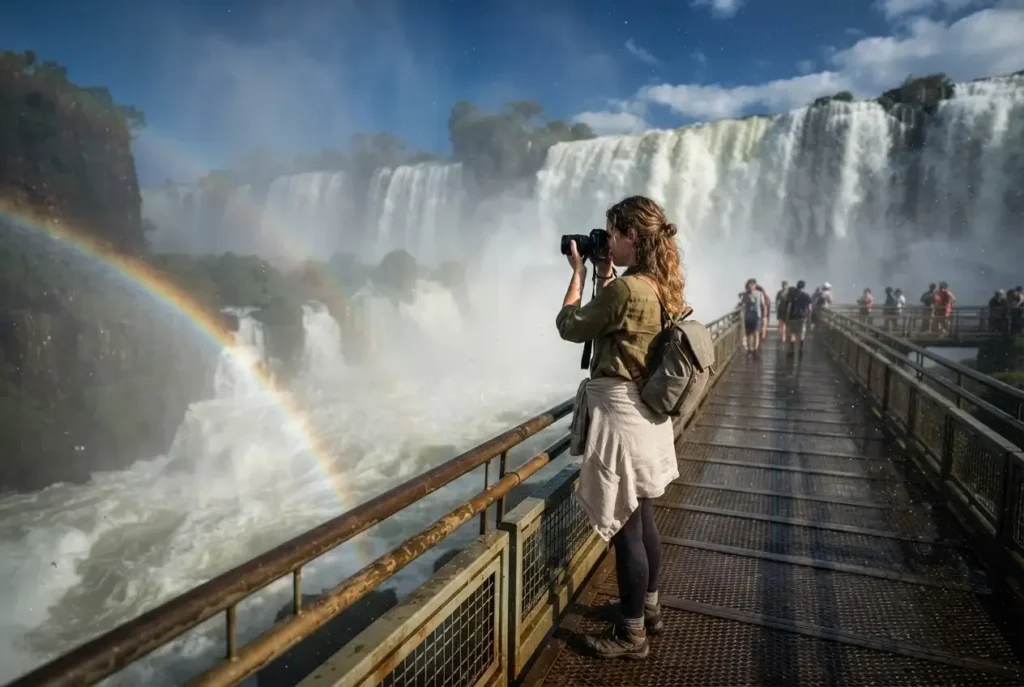
If you have two days in the region, crossing both borders is well worth the effort of sorting out the logistics.
Foz do Iguacu on the Brazilian side and Puerto Iguazu on the Argentine side are both small cities that exist largely to serve visitors to the falls. Puerto Iguazu is quieter, cheaper, and plenty of solo travelers find it a perfectly comfortable base. Both sides are manageable without a tour group.
Cartagena’s Walled City, Colombia: A UNESCO Site You Actually Live Inside
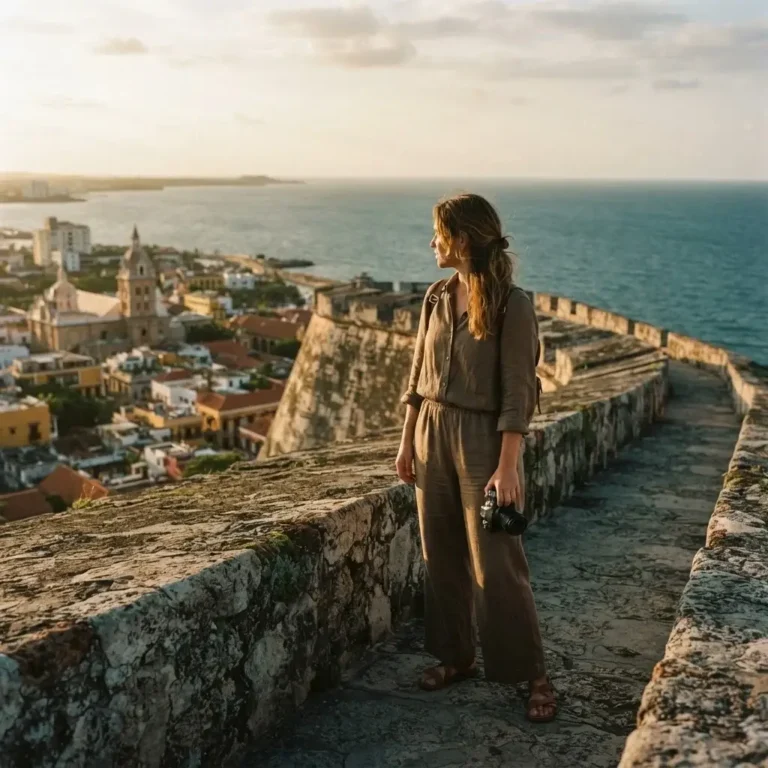
Most UNESCO sites are places you visit and then leave. Cartagena is different, because the UNESCO-designated historic center of the city is not a ruin or a remote park. It is a living, inhabited neighborhood of ochre and mustard-colored colonial buildings, flower-draped balconies, cobblestone streets, and plazas where locals and travelers share the same space in the early evening.
The Port, Fortresses and Group of Monuments in Cartagena, designated as a UNESCO World Heritage Site in 1984, represents one of the most complete examples of Spanish colonial fortification in the Americas. The walls themselves, which you can walk along for free, stretch for kilometers around the historic center and give you views out over the Caribbean. Castillo San Felipe de Barajas, the enormous fortress outside the walled city, is the most impressive military structure the Spanish ever built in the Americas. Entry costs a few US dollars and the views from the top are extraordinary.
For solo travelers, Cartagena’s walled city is genuinely one of the safest and most enjoyable urban UNESCO experiences in the Americas. It is walkable, visually stunning at almost every turn, and the food alone justifies the visit. Look for arepa de huevo vendors near the main plazas, eat seafood at the Mercado de Bazurto if you are feeling adventurous, and spend at least one morning sitting in the shaded courtyard of a colonial cafe watching the neighborhood come to life.
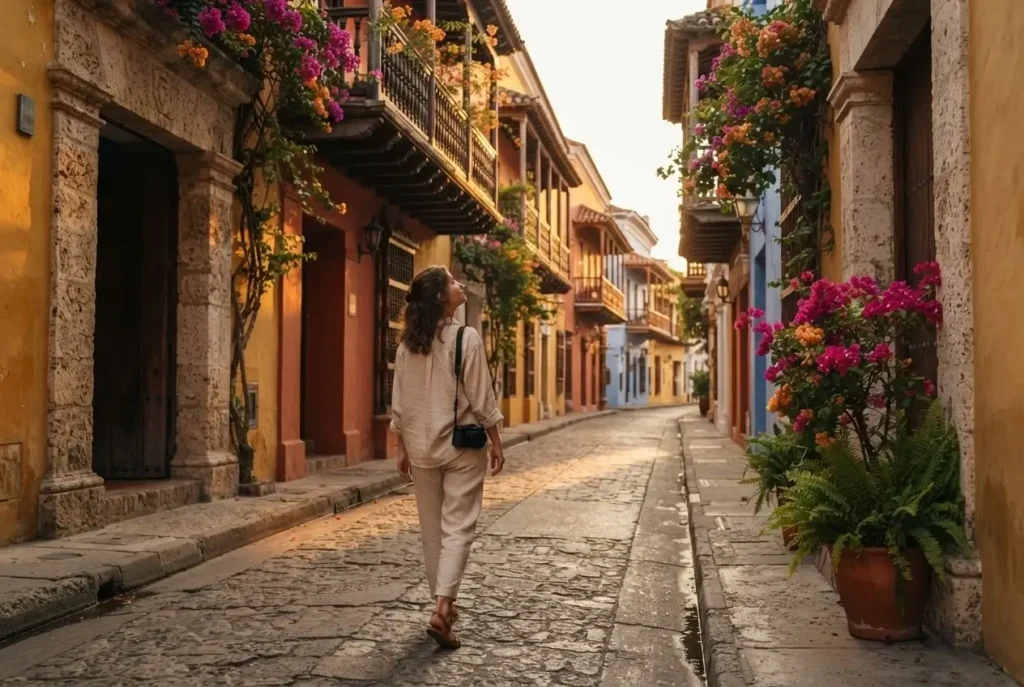
Stay inside the walled city or in the Getsemani neighborhood just outside the walls if budget is a consideration. Getsemani has transformed over the past decade into one of the most interesting neighborhoods in South America, full of street art, small restaurants, and a creative local energy that the more expensive walled city interior sometimes lacks.
Grand Canyon National Park, USA: The One Closer Than You Think
For anyone reading this from North America, it is easy to mentally file the Grand Canyon under “I’ll do that someday” without urgency because it feels so accessible. That is worth reconsidering. The Grand Canyon is a UNESCO World Heritage Site, and standing on the South Rim for the first time produces a cognitive disruption that is difficult to prepare for. The scale of the place is simply beyond what your eyes are calibrated to process.
The National Park Service fee page sets the current standard vehicle entrance at $35 for a seven-day pass. As of 2026, international visitors aged 16 and older pay an additional $100 nonresident fee unless they hold an America the Beautiful annual pass (which runs $250 for non-US residents). The park accepts no cash at entrance stations, so plan for card payment. No timed entry reservation is currently required, which makes the Grand Canyon one of the most logistically straightforward major UNESCO sites in the Americas to visit independently.
For solo hikers, the South Rim’s Rim Trail covers 21 kilometers along the canyon edge and is largely flat and paved, making it accessible regardless of fitness level. Descending into the canyon via Bright Angel Trail or South Kaibab Trail is a different commitment entirely: the National Park Service strongly warns against attempting to hike to the Colorado River and back in a single day, and every year people underestimate the heat and distance and require rescue. Take that warning seriously. Day hikes to the first or second rest house on Bright Angel are spectacular and manageable.
Sunrise at Mather Point, a ten-minute walk from the main visitor center, is one of those travel moments that earns its reputation. The light shifts from orange to pale gold to white as it moves across the canyon walls, and on a clear morning the depth of the layers is almost geological poetry.
How to Choose Your First UNESCO Site in the Americas
If you are standing at the start of this list feeling uncertain about where to begin, here is the framework I would suggest.
Your budget is the first honest filter. The Galapagos requires the most financial commitment and advance planning by a significant margin.
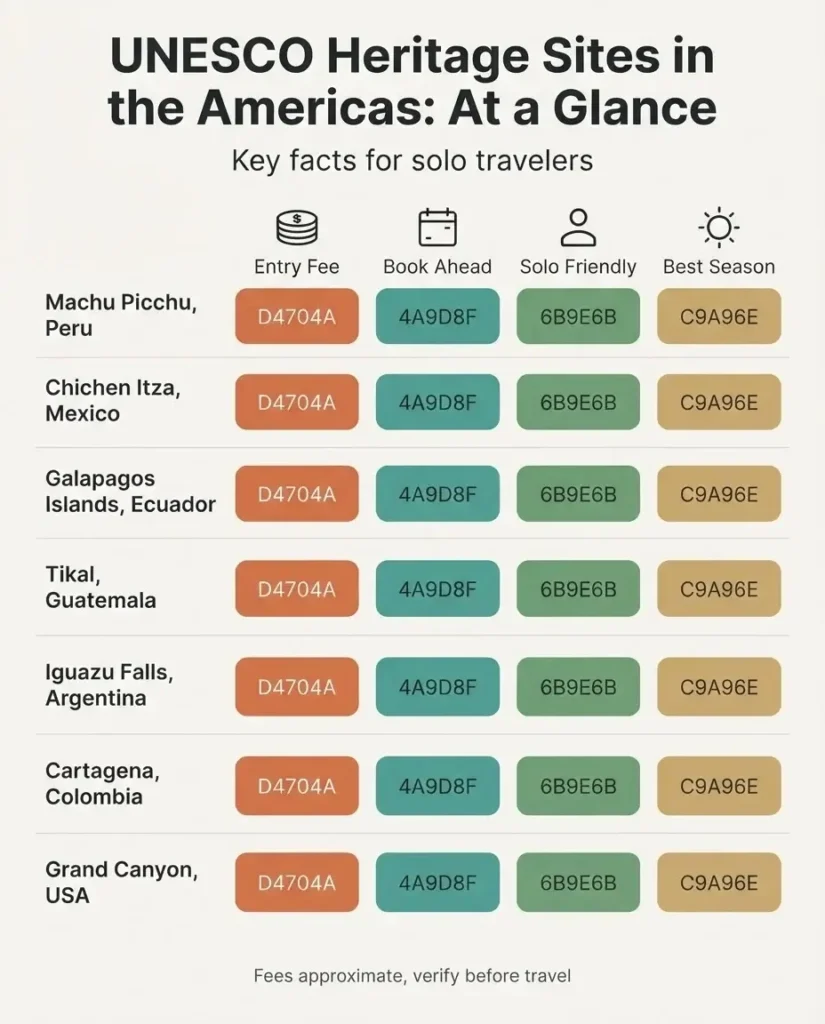
Machu Picchu is a moderate investment, especially once you factor in Cusco accommodation and the train. Tikal, Cartagena, and Chichen Itza are all relatively affordable and do not require expensive tour packages to experience fully.
Your travel style is the second filter. Do you want to be physically inside a landscape or walking through history? Do you want a place where the surrounding city is itself worth exploring, or a remote site where the destination is the whole point? Cartagena and Chichen Itza sit inside a broader cultural context that extends beyond the UNESCO boundary. Tikal and Iguazu are the destination.
And then there is the question of what kind of traveler you are trying to become. For me, the places that have changed me most were not always the most famous ones. They were the places where I had to navigate something uncomfortable, show up without knowing exactly what to expect, and let the experience be what it was rather than what I had imagined. Every site on this list has that potential. You just have to start.
A Few Practical Rules That Apply Everywhere
Book tickets in advance for any site that requires them. Machu Picchu’s ticket shortage is the most acute, but Chichen Itza can also sell out for specific time windows during holiday periods.
Arrive early, without exception. The first hour after opening at nearly every major site in the Americas is categorically better than midday: lighter crowds, better light for photographs, cooler temperatures.
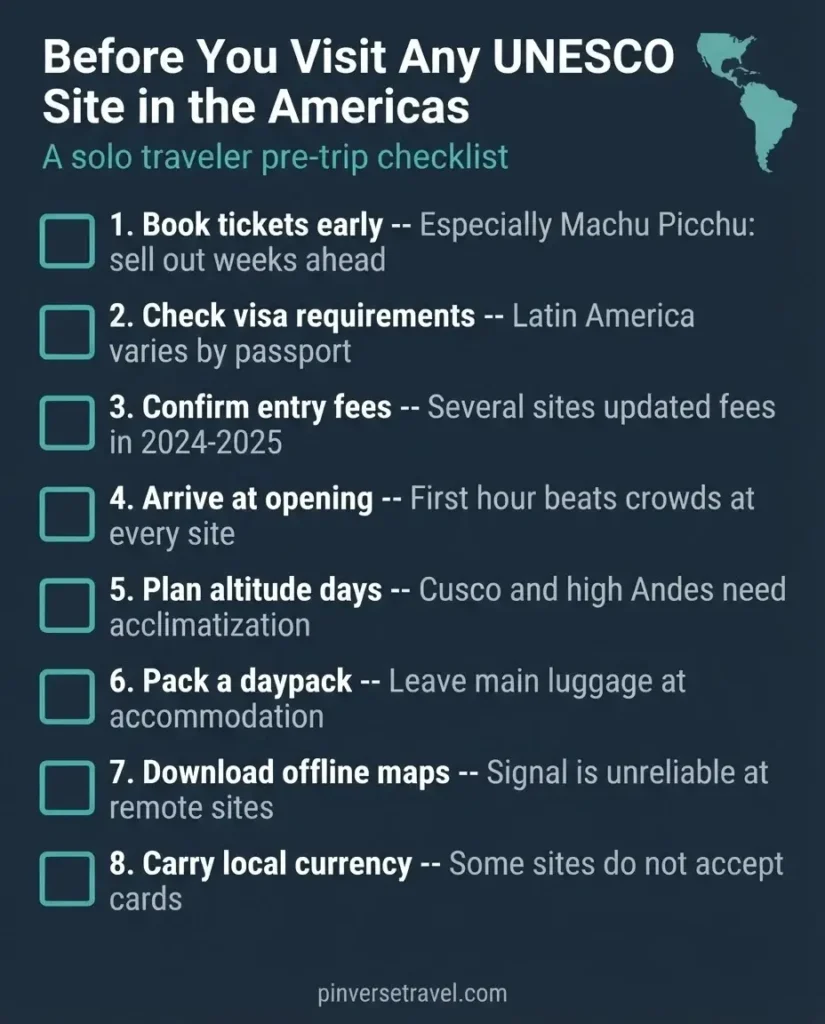
Research the shoulder season. June through August is peak season for almost everything in the Americas. May and September tend to offer better weather balance, fewer crowds, and lower accommodation prices across the board.
Learn a few basic words in the local language. Even stumbling through a greeting in Spanish, or attempting a phrase in Quechua near Cusco, creates a different kind of interaction with local people than arriving as a purely English-speaking visitor.
Finally, resist the pull to treat UNESCO sites as checkboxes. The value of these places is not in having visited them. It is in what you bring back with you.