Here is something nobody tells you when you start planning a trip to the Mayan world: the Maya are not an ancient people.
They are here. Right now. Around 7 million Maya people live across Mexico, Guatemala, Belize, Honduras, and El Salvador. They speak dozens of distinct Mayan languages, grow the same crops their ancestors cultivated for thousands of years, and observe ceremonies rooted in a calendar system that predates most modern nations. The pyramids are spectacular, yes. But the real depth of this culture is not found in the stones. It is found in the people who still carry it.
I think about this a lot when I see travel content that frames “Mayan culture” as something you visit inside a fenced archaeological site, take a photo of, and leave. That approach misses almost everything. If you are someone who wants to go beyond the surface, to understand how a civilization this old still breathes today, this guide is for you.
What follows is not a list of ruins. It is a practical, honest look at the places across Mexico, Guatemala, and Belize where traditional Mayan culture is still genuinely alive, what you will actually experience there, and how to approach it with the curiosity and respect it deserves.
A Note on Approach Before You Go
Before I get into specific destinations, I want to say something that matters more than any opening hour or entry fee. Living Mayan communities are not performances. They are people’s homes, places of worship, and daily lives. When you show up with that understanding, something shifts. You stop being a tourist collecting experiences and you start being a guest learning from people.
Ask before photographing anyone. Follow the rules of every community you enter, even if they feel unfamiliar. Hire local guides. Eat at local restaurants. Buy crafts directly from the artisans who made them. These small choices determine whether your visit contributes to a community or simply extracts from it. Keep that in mind throughout everything that follows.
The Yucatan Peninsula, Mexico: Where the Layers Run Deep
If you are flying into this part of the world for the first time, the Yucatan Peninsula in Mexico is where most people begin, and it is a genuinely rich place to start. The challenge is knowing which experiences to prioritize.
Chichen Itza: Go Early and Go Beyond the Pyramid
Yes, you should go to Chichen Itza. It is crowded, particularly between 10am and 2pm when the tour buses arrive, but it is crowded for a reason. This site is genuinely extraordinary. The Temple of Kukulkan, El Caracol (a circular astronomical observatory), the Great Ball Court, and the Temple of the Warriors represent some of the most sophisticated architecture ever built in the ancient world. As a UNESCO World Heritage Site since 1988, Chichen Itza illustrates the remarkable fusion of Maya and Toltec civilization at its peak.
The site opens daily at 8am and closes at 5pm, with the last entry at 4pm. International visitors pay approximately 697 MXN (around $40 USD). If you arrive at 8am on a weekday, you will have a genuinely different experience than the midday rush, quieter, cooler, and far more atmospheric.
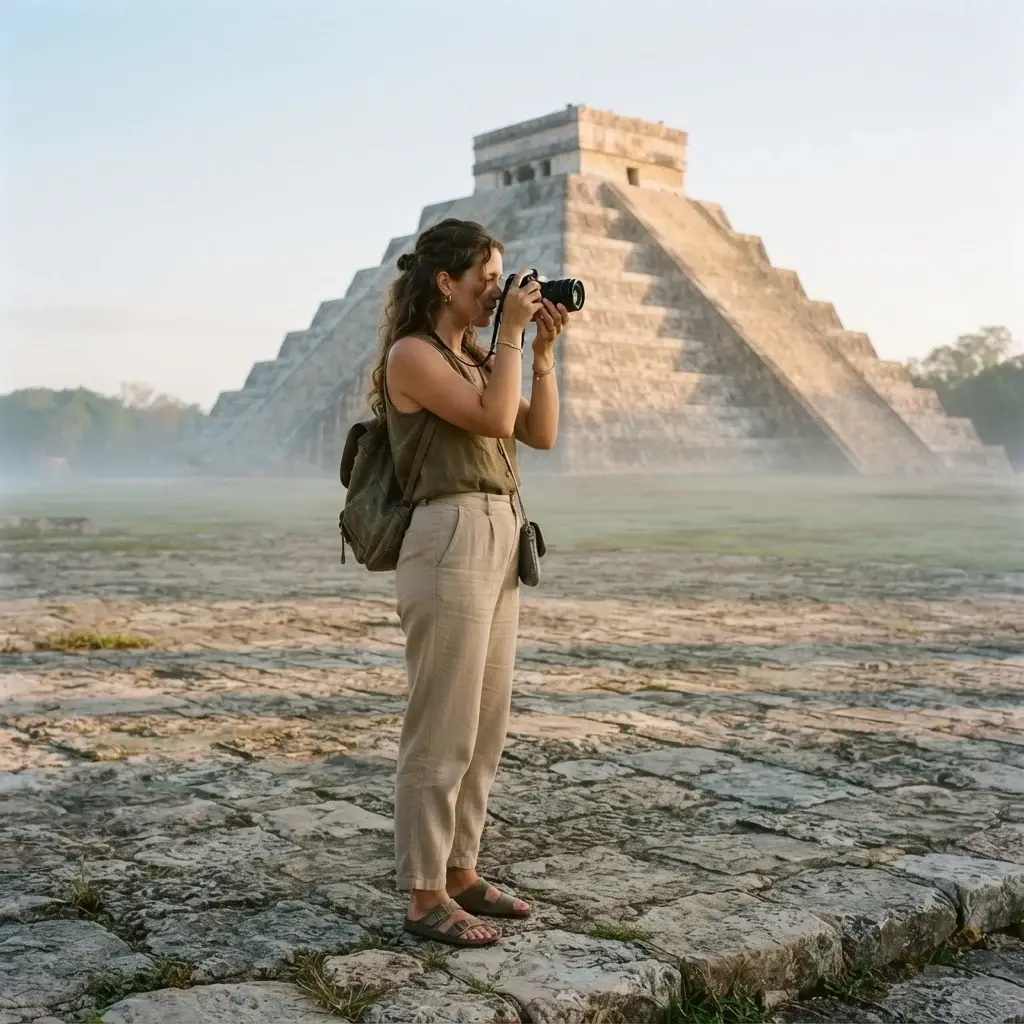
What most visitors miss is the conversation available with local Yucatec Maya vendors and guides just outside the site entrance. These are not just people selling souvenirs. Many of them are descendants of the very people who built what you are looking at. A good local guide will explain the astronomical precision of the spring equinox light show on El Castillo, the spiritual role of cenotes as portals to the underworld, and what Kukulkan means to Maya cosmology today. That context transforms the site from impressive to profound.
From Chichen Itza, head to Visit Mexico’s Yucatan page before your trip to get a broader picture of the state’s indigenous heritage sites, many of which sit well off the main tourist routes.
Merida: The Cultural Capital You Need More Than a Day In
Merida is often treated as a base for day trips to ruins, which is a mistake. This city is one of the most culturally layered places in all of Mexico, and if you slow down here, you will find living Mayan culture woven into everything.
The Gran Museo del Mundo Maya is the place to start. This is one of the best archaeology and anthropology museums in all of Latin America, with around 1,200 Mayan artifacts and a narrative that takes you from ancient cosmology to contemporary Maya life. It is open daily except Tuesdays from 9am to 5pm. International visitors pay 150 MXN (about $8 USD). Check the official museum site for current hours and visitor information before you go.
In the streets and markets around Merida’s centro historico, you will find Yucatec Maya women selling handmade huipiles (traditional embroidered tunics) and men speaking Maya to each other in the market stalls. Order a bowl of sopa de lima or try poc chuc (a grilled pork dish marinated in sour orange) at any of the family-run restaurants around the central plaza. The food in Merida is extraordinary and almost every dish has roots in pre-Columbian Mayan cooking.
Ek Balam: The Mayan Site Worth Going Out of Your Way For
About two hours from Merida and just 30 minutes from Valladolid sits Ek Balam, one of the most undervisited and genuinely atmospheric Mayan sites in all of Mexico. Unlike Chichen Itza, you can actually climb the main pyramid here, the Acropolis, which rises about 32 meters and offers views over the entire jungle canopy. The stucco carvings near the entrance to the tomb at the top are among the finest preserved examples of Classic Maya sculpture anywhere.
Solo travelers consistently love Ek Balam because it is quiet enough to actually sit and take in the surroundings. You can hire a bicycle in the nearby village and ride to the site yourself, explore without a guide if you prefer, or hire a local guide on-site for a very reasonable fee. From Valladolid, a colectivo (shared van) gets you close for almost nothing.
Chiapas, Mexico: Living Mayan Culture at Its Most Striking
If the Yucatan is where you learn about Mayan history, Chiapas is where you feel it still breathing.
The state of Chiapas in southern Mexico is home to some of the largest and most culturally intact indigenous Maya communities in the entire region. The primary languages spoken here are Tzotzil and Tzeltal, not Spanish, and the traditions of weaving, ceremonial life, and community governance remain deeply rooted.
San Cristobal de las Casas: Your Base for Chiapas
San Cristobal de las Casas is a small, walkable colonial city at about 2,200 meters elevation in the Chiapas Highlands. It is cool, beautiful, and culturally alive in a way that few cities anywhere can match. The markets here are filled with textile cooperatives run by indigenous Maya women, and it is entirely possible to sit down with a weaver, watch her work, and learn about the meaning of the patterns she chooses.
From San Cristobal, two nearby communities are essential visits.
San Juan Chamula: An Experience Unlike Anything Else
About 10 kilometers from San Cristobal sits San Juan Chamula, a Tzotzil Maya community that has maintained a remarkable degree of cultural independence. The church of San Juan Chamula is one of the most extraordinary spaces I have read and heard described by travelers, and from everything they report consistently, nothing quite prepares you for it.
Inside, there are no pews. The floor is covered with pine needles. Candles burn in rows, grouped by color according to their spiritual purpose. Families kneel among incense smoke and conduct their own healing ceremonies led by traditional spiritual practitioners. The combination of Catholic iconography and ancient Maya ritual is not syncretism in a watered-down sense. It is something entirely its own.
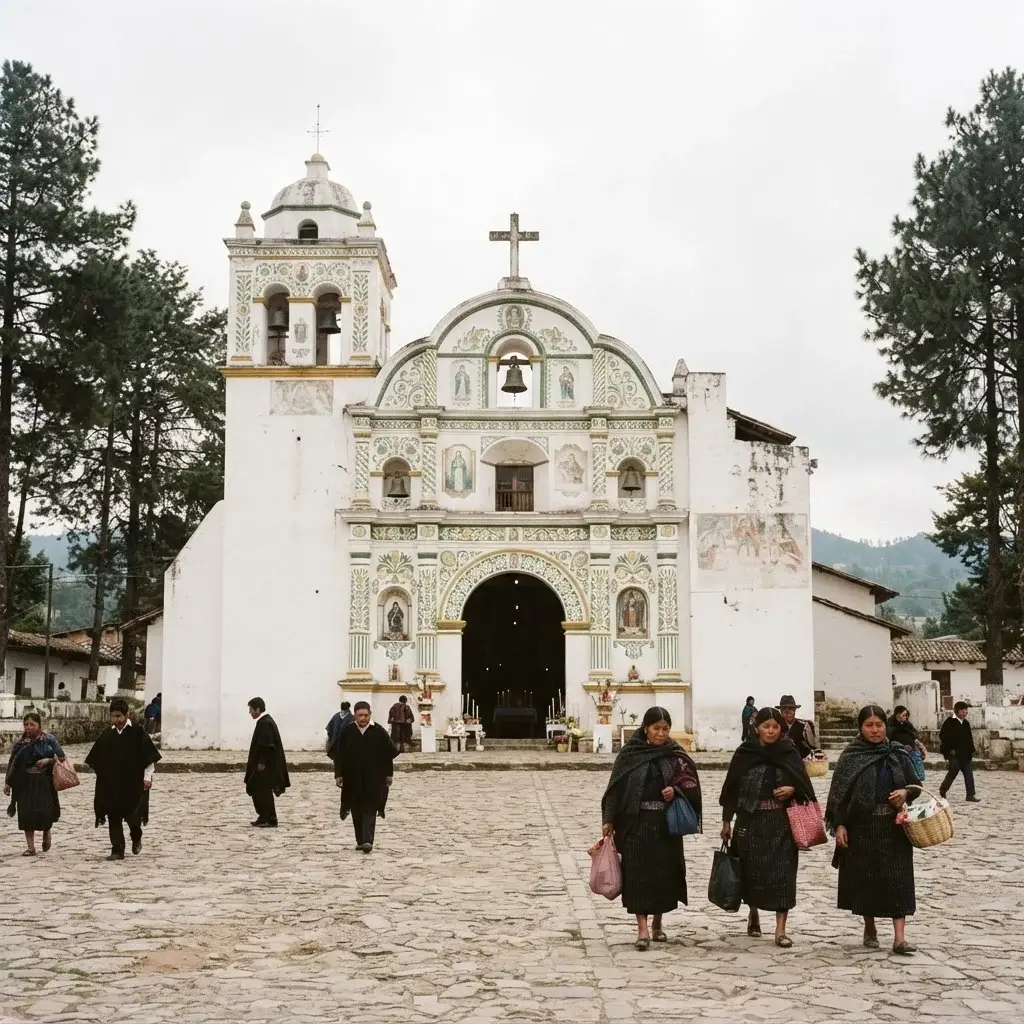
Absolutely no photography is allowed inside the church. This is a hard rule that the community actively enforces. Cameras and phones have been confiscated from visitors who ignored it. Treat this rule as non-negotiable. You can hire a local guide in San Cristobal who can take you respectfully, explain what you are witnessing, and make introductions if appropriate.
Zinacantán: Weaving, Flowers, and an Open Door
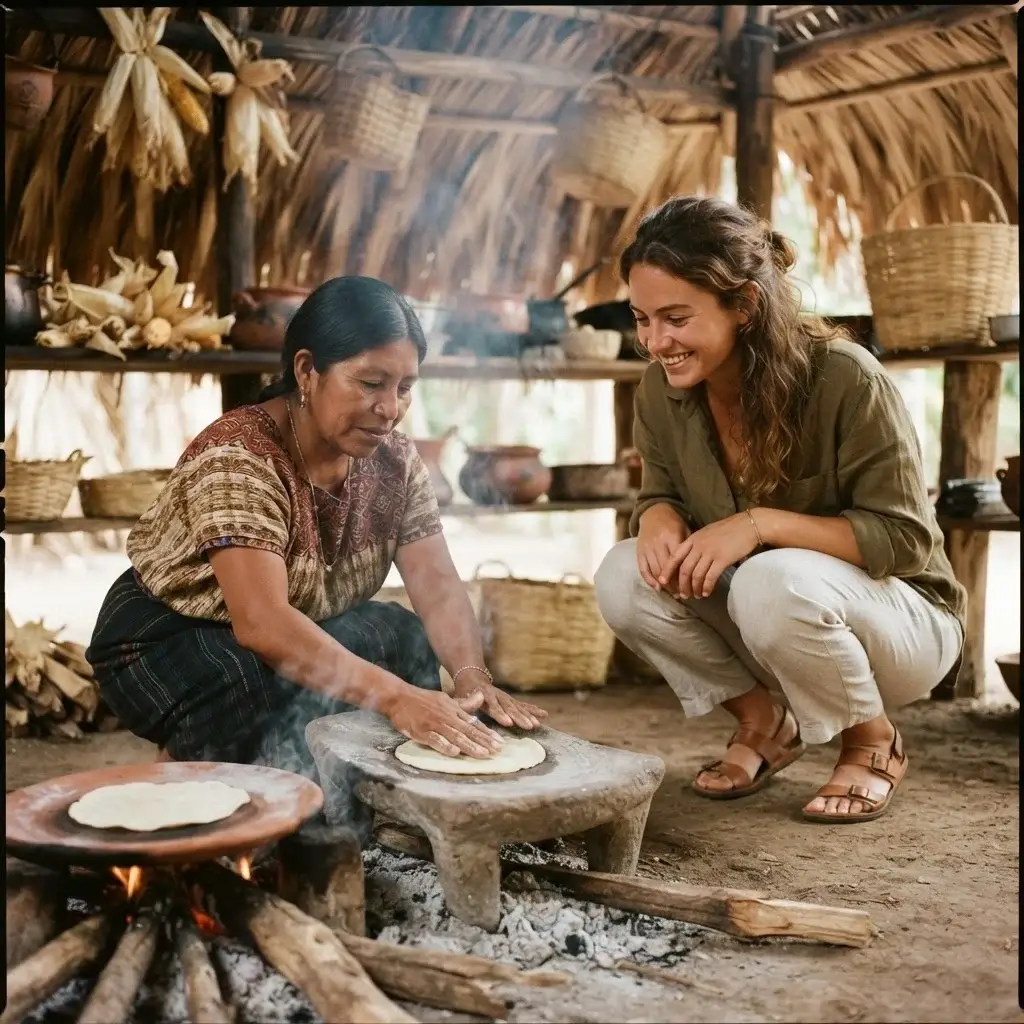
The neighboring community of Zinacantán tends to be slightly more welcoming of visitors. The weaving cooperatives here are famous, and you can sit with local women, watch the loom work, and buy directly from the artisans without going through an intermediary. The community is known for its use of bright pink and purple florals in traditional dress, which is distinct from any other Mayan weaving tradition in the region. Try the local food while you are there. A bowl of black bean soup with fresh tortillas made on a wood-fire comal is as close to the daily food of a Chiapas Highland Maya community as you can get.
Palenque: Where the Jungle Meets the Stone
Further east in Chiapas sits Palenque, a UNESCO-listed site that consistently earns its reputation as one of the most beautiful Mayan ruins in the world. The Pre-Hispanic City and National Park of Palenque is recognized for its exceptional Classic period architecture, its remarkably preserved stucco carvings, and the famous tomb of Lord Pakal, discovered inside the Temple of the Inscriptions and now considered one of the most significant archaeological finds in the Western Hemisphere.
The site is surrounded by thick jungle, and howler monkeys call overhead while you walk between the temples. Arrive early, around 8am when it opens, because the mist still sits over the trees and the atmosphere is unlike anything you will experience at a more exposed site.
The site museum on-site, the Alberto Ruz L’huillier, contains Mayan jade jewelry, ceramic burial offerings, and funerary objects that put the architecture in deep human context. Do not skip it.
Guatemala: Where Mayan Culture is the Majority, Not the Minority
Guatemala is where something shifts in your understanding of the Maya. In Mexico’s Yucatan, Mayan culture often exists around the edges of Spanish colonial history. In Guatemala, the Maya are the majority. More than 40% of the country’s population is indigenous Maya, and around 22 distinct Mayan languages are spoken here.
Tikal: Jungle Ruins That Earn Every Superlative
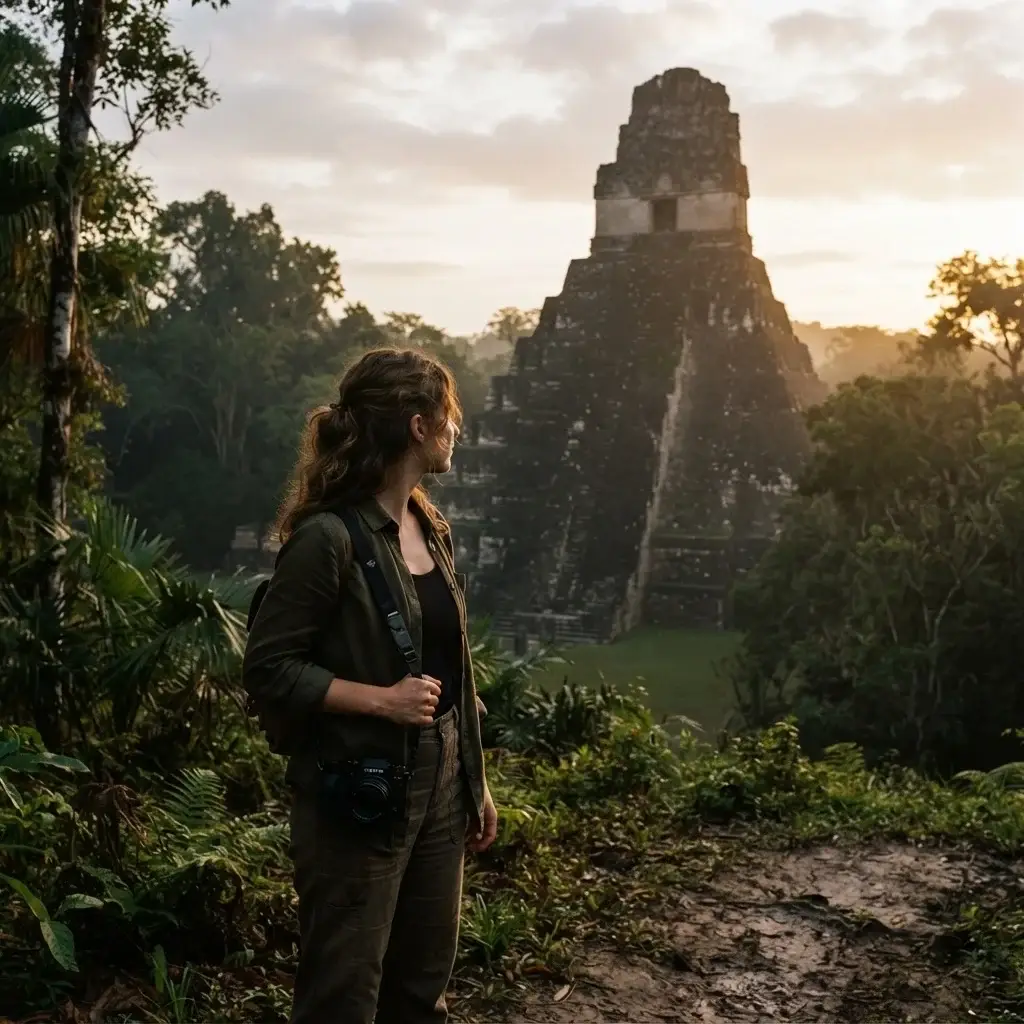
You will hear Tikal compared to many things, and most of those comparisons fall short. This UNESCO World Heritage Site deep in the Petén rainforest is one of the great ancient urban centers of the entire Maya world, and walking through it, with Temple I rising 47 meters above the Great Plaza and the jungle canopy stretching in every direction, feels genuinely overwhelming in the best way.
Solo travelers consistently report that the experience of climbing Temple IV at dawn, before the tour groups arrive, and watching the sunrise above the forest with toucans calling and spider monkeys moving through the branches, is among the most powerful travel experiences of their lives. According to the UNESCO World Heritage entry for Tikal National Park, the site spans 57,600 hectares and contains thousands of architectural and artistic remains spanning more than a millennium of Maya civilization, from roughly 800 BC to 900 AD.
Entry for international visitors runs approximately 150 Guatemalan Quetzales (around $20 USD) for daytime access. The nearby town of El Remate on Lake Peten Itza is the budget base of choice for solo travelers, with guesthouses that can arrange early morning entry to the park before the tour buses from Flores arrive.
Lake Atitlan: Living Mayan Culture in the Highlands
Lake Atitlan in Guatemala’s Western Highlands is, by nearly every measure, one of the most beautiful places on earth, a vast volcanic caldera lake ringed by three volcanoes and dotted with small Maya villages, each with its own distinct identity, language variant, and traditional dress.
The villages accessible by the local boat taxis (lanchas) that cross the lake are where you find the most genuine daily-life cultural immersion available anywhere in the Mayan world. San Juan La Laguna is particularly respected for its commitment to traditional Maya textile traditions, natural dye cooperatives, and community-run cultural experiences.
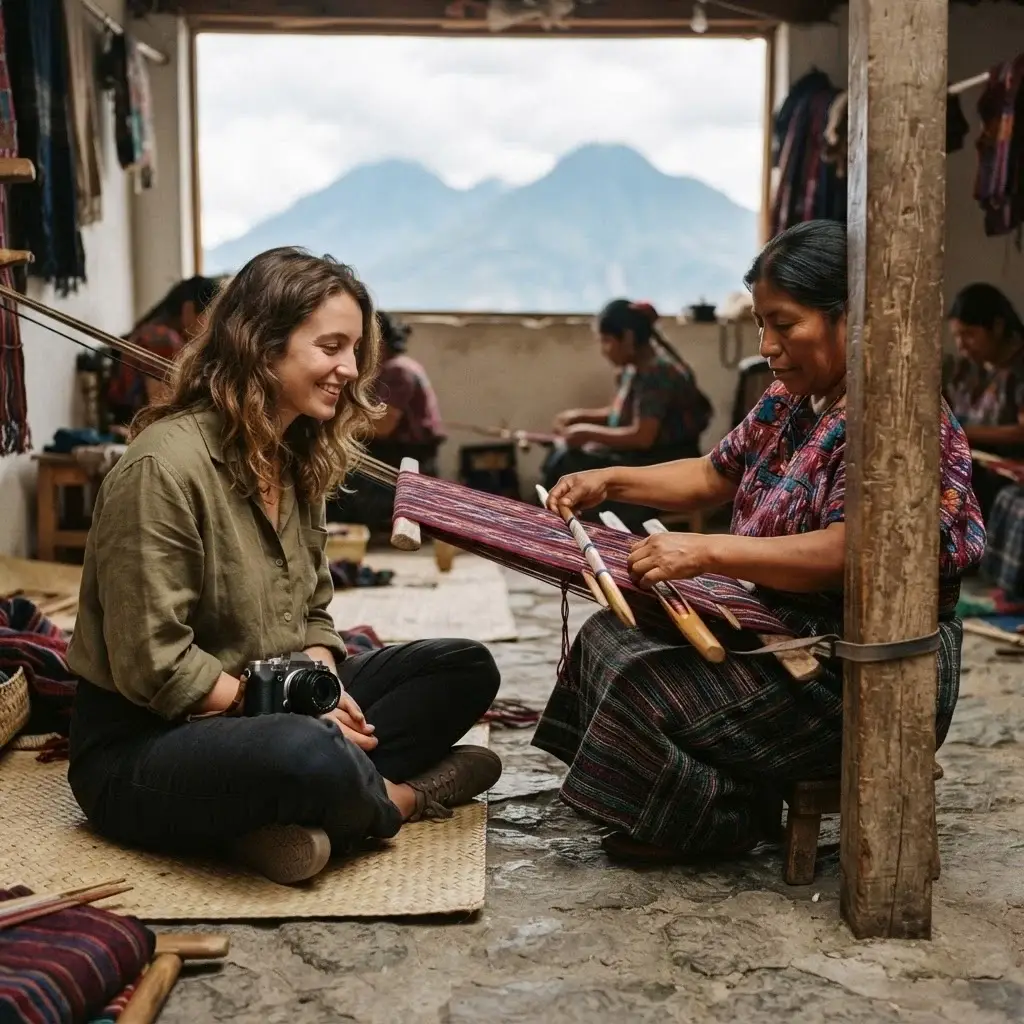
San Antonio Palopo is known for its traditional weaving and ceramics. Santiago Atitlan has one of the most significant weekly markets in the region, where Tz’utujil Maya women still wear the traditional huipiles distinctive to their village.
This is slow travel territory. Spend at least three or four days here. Stay in a small guesthouse run by a local family, eat at the family comedores (basic local restaurants), and ask about taking a traditional temazcal (sweat lodge) ceremony if the opportunity presents itself respectfully.
If you want to understand the spiritual and cosmological dimensions of contemporary Maya culture in this region, seek out community-run cultural tours rather than the more commercial spiritual retreat market that has grown up around the lake in recent years. The difference between the two is easy to feel once you are there.
Belize: Small Country, Deep Mayan Roots
Belize is easy to overlook because it is small and English-speaking, which makes it feel less “exotic” than its neighbors to some travelers. That would be a mistake. Belize sits at the heart of the ancient Maya world geographically, and it has 12 significant archaeological sites and two distinct living Mayan communities, the Mopan and Q’eqchi’ Maya, particularly concentrated in the Toledo District in the country’s south.
San Ignacio and the Western Highlands
San Ignacio in the Cayo District is the main hub for Mayan cultural and archaeological tourism in Belize. From here, MayaWalk Tours runs cultural tours that include the Actun Tunichil Muknal (ATM) cave, a sacred Mayan ceremonial site deep inside a cave system where ceramic offerings and skeletal remains of ritual sacrifice were found, along with hands-on Mayan cooking experiences and traditional cacao preparation.
The ATM cave is one of those places that solo travelers consistently describe as changing something in them. You swim, wade, and climb through an active cave with a local guide, arriving in underground chambers where the ancient Maya performed rituals, and where the calcified crystal skull of a teenage girl known as the Crystal Maiden sits in exactly the position she was placed in over a thousand years ago. There is nothing commercial about the experience inside.
Toledo District: The Most Authentic Living Maya Experience in Belize
The Toledo District in southern Belize is the beating heart of living Mayan culture in the country. The Belize Tourism Board has recognized Toledo as a priority area for authentic cultural tourism, and the investment in community-led experiences here shows. This is where you can do a genuine Maya family homestay, learn to make corn tortillas from masa ground on a stone metate, participate in a traditional cacao preparation ceremony (the Maya revered cacao as a sacred food long before it became chocolate), and visit Mayan archaeological sites like Lubaantun and Nim Li Punit that few international visitors ever see.
The town of Punta Gorda is your base for the Toledo District. It is small and simple, with basic guesthouses and a market where Q’eqchi’ Maya women sell hand-made baskets, pottery, and traditional foods. From Punta Gorda, community-run tours take you into the villages and let you spend time with families who are happy to share their culture, on their own terms and at their own pace.
What to Eat Across the Mayan World
Food is one of the most direct ways to connect with any living culture, and Mayan food is extraordinary. Here is what to look for specifically.
In the Yucatan, cochinita pibil (slow-roasted pork marinated in achiote and sour orange, traditionally cooked in a pit oven) is the flagship dish with direct pre-Columbian roots. Sopa de lima is a Yucatec chicken broth with fried tortilla strips and a squeeze of the local lime that bears no resemblance to what you may know as lime elsewhere. Papadzules are tortillas dipped in a pumpkin seed sauce, one of the oldest documented Mayan dishes.
In Chiapas and Guatemala, black beans cooked with hierba santa (a native anise-flavored herb), handmade corn tortillas, and tamales wrapped in banana leaves and steamed over wood fire are the backbone of daily life. In Guatemala’s western highlands, pepián (a thick stew of ground seeds, chili, and tomatoes) has roots that go back centuries.
And wherever you are in the Mayan world, look for cacao in its traditional form.
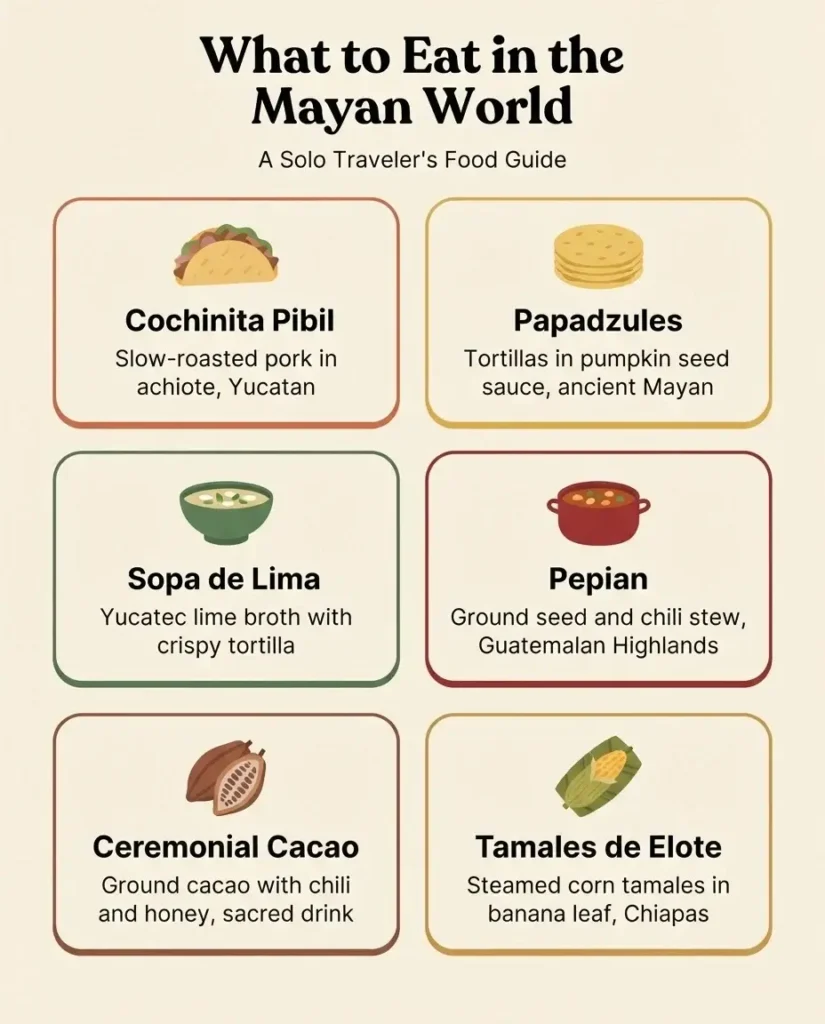
A cup of hot chocolate made from ground cacao paste with water and chili and a little honey, the way the ancient Maya drank it, is a humbling and delicious thing.
Practical Tips for Solo Travelers
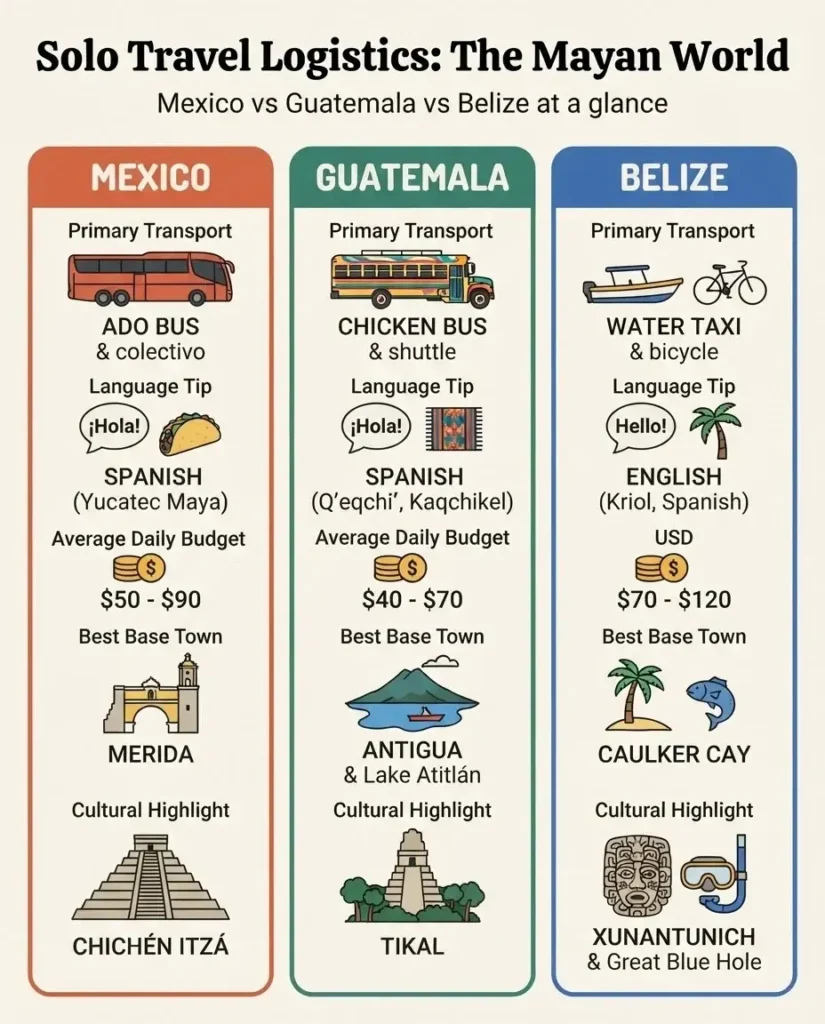
Getting around this region as a solo traveler is more manageable than many people expect. In Mexico’s Yucatan, colectivos (shared minivans) connect most towns and sites cheaply and run frequently. ADO buses link the major cities and are comfortable and reliable. In Guatemala, chicken buses (repurposed American school buses) are the budget way to move between towns in the Highlands, and lanchas cross Lake Atitlan constantly throughout the day. In Belize, shared taxis and local buses connect most of the country.
Spanish will carry you through Mexico and Guatemala. In Belize, English is the official language. In deeply indigenous areas of Chiapas and the Guatemalan Highlands, knowing even a few words in the local Maya language earns extraordinary goodwill, though Spanish works fine for practical communication everywhere.
Budget travelers can do all of the above, including the Toledo District homestay, Tikal, Chiapas communities, and Merida, for a very reasonable daily cost, particularly outside Mexico City, Cancun, or the Riviera Maya hotel zone.
The single biggest practical advice I can offer from everything solo travelers consistently report from this region: build in more time than you think you need.
The Maya world rewards slowness. The best moments, a conversation with a weaver in Zinacantán, a dawn walk through Tikal with the jungle waking up around you, sitting in a Toledo kitchen while someone teaches you to make tortillas, happen when you are not rushing to the next thing.
Final Thought: The Culture is Alive, and the Door is Open
One of the things that stays with me after exploring the history of Mayan civilization in depth is how deeply it refuses the past tense. People write about the “fall” of the Maya, but no such thing happened. The cities were abandoned, yes. The reasons remain debated. But the people, the languages, the ceremonies, the food, the cosmology, and the extraordinary craft traditions are very much present. They are in Zinacantán on a Tuesday morning when a weaver sits at her loom. They are in Tikal at 6am when the jungle is still and the mist moves between the pyramids. They are in a Toledo kitchen where cacao beans are being roasted over a wood fire.
The door to all of this is open. You just have to walk through it with curiosity, humility, and enough patience to stop and actually listen.