The Best Train Journeys for Eco-Friendly Travel in Europe

The first time I crossed Europe by train, I was broke, a little scared, and completely hooked. I had left my office job behind, saved up tip money from flexible work, and bought myself a rail pass and a backpack. What I remember most is not a single monument. It is the window. Hour after hour of Europe unspooling past the glass, farms turning into forests turning into mountains, all while I did absolutely nothing but watch and think and sip bad coffee. That was the trip that taught me something I still believe: how you move through a place changes what the trip means.
If you have been dreaming about seeing Europe without the guilt of another short-haul flight, this is your guide. I am going to walk you through the most rewarding train journeys for eco-friendly travel, why the train is genuinely so much better for the planet, and exactly how to plan and book it so you feel confident, especially if you are going solo. No fluff, no perfect-postcard nonsense. Just real talk from someone who has done it with a pack on her back.
Why the Train Beats the Plane (And It Is Not Even Close)
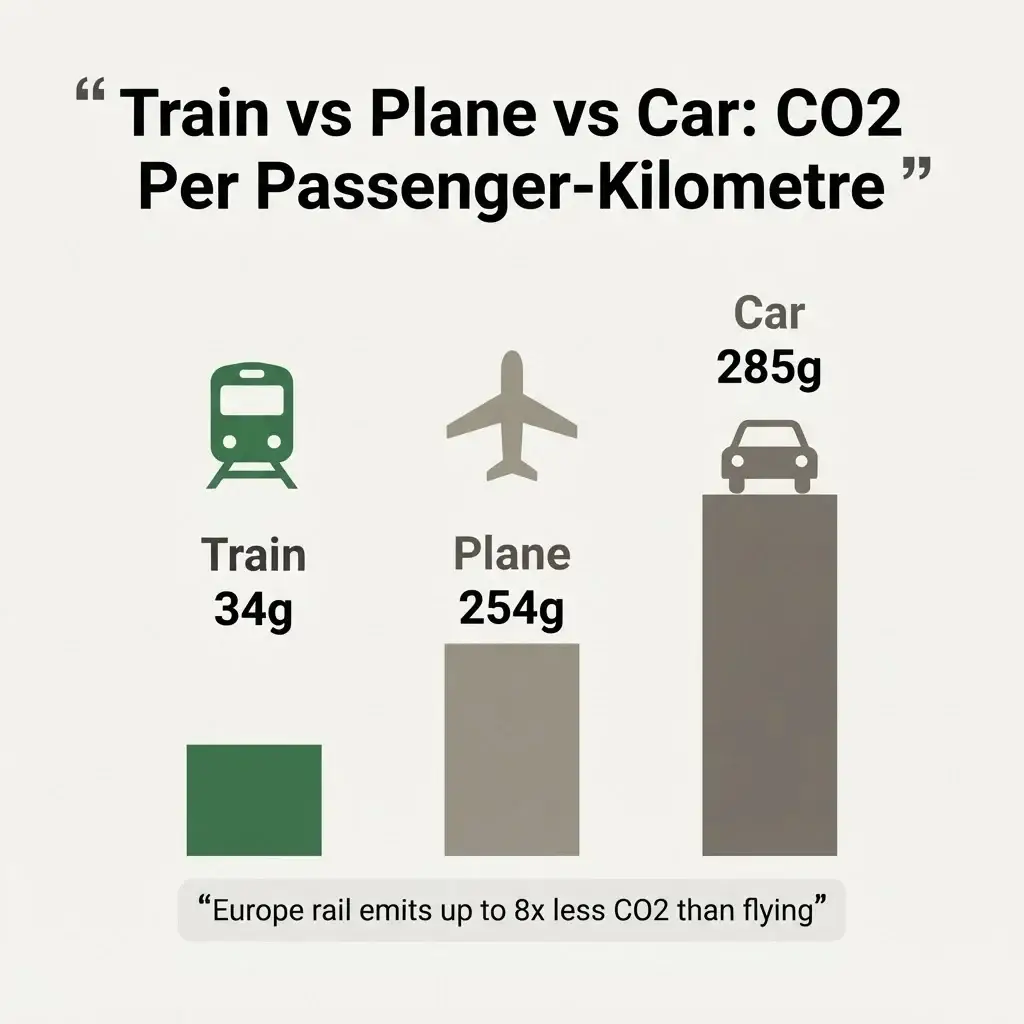
Let me get the numbers out of the way, because they matter and they are honestly kind of stunning. According to figures from the International Energy Agency shared by France’s official tourism board, rail travel in Europe emits around 34 grams of CO2 per passenger-kilometre. A plane over the same distance? Roughly 254 grams. A car? About 285 grams. So the train is not a little better. It is close to seven or eight times cleaner than flying for the same trip.
There is a reason for this. Most of Europe’s rail network runs on electricity, and more and more of that electricity comes from renewable sources. Trains also carry far more people per journey than a plane, and they do not burn a huge amount of fuel just to climb into the sky. Some services push the math even further. Eurostar, the train that runs under the Channel between London and mainland Europe, comes in at around 10 grams of CO2 per passenger-kilometre.
Governments are catching on too. France banned short domestic flights on routes where you can take a train in under two and a half hours, and Spain has moved in a similar direction. That tells you where this is all heading. The train is not the sacrifice option anymore. On many routes it is simply the better one.
Here is the part people forget, though. The eco benefit is not just an abstraction you feel good about later. It changes the actual experience. You skip the airport lines, the security theatre, the cramped seat. You step onto a train in a city centre and step off in another city centre. You keep your bottle of water. You watch the world instead of the back of a headrest. Good for the planet, good for your soul.
The Bernina Express: Alps to Palm Trees in One Ride
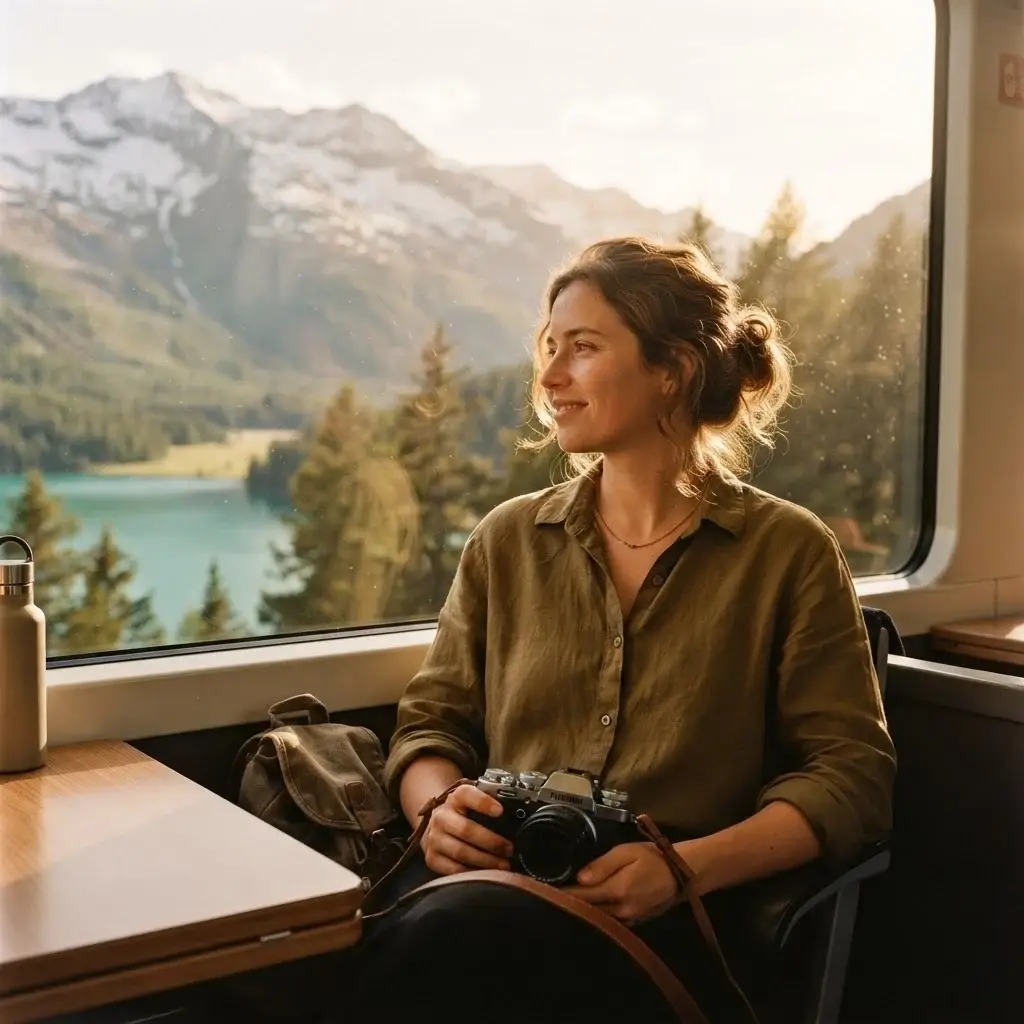
If you take only one scenic train in Europe, I would point you toward the Bernina Express in Switzerland. This is the route that shows up on every list for good reason, and unlike a lot of hyped experiences, it earns it.
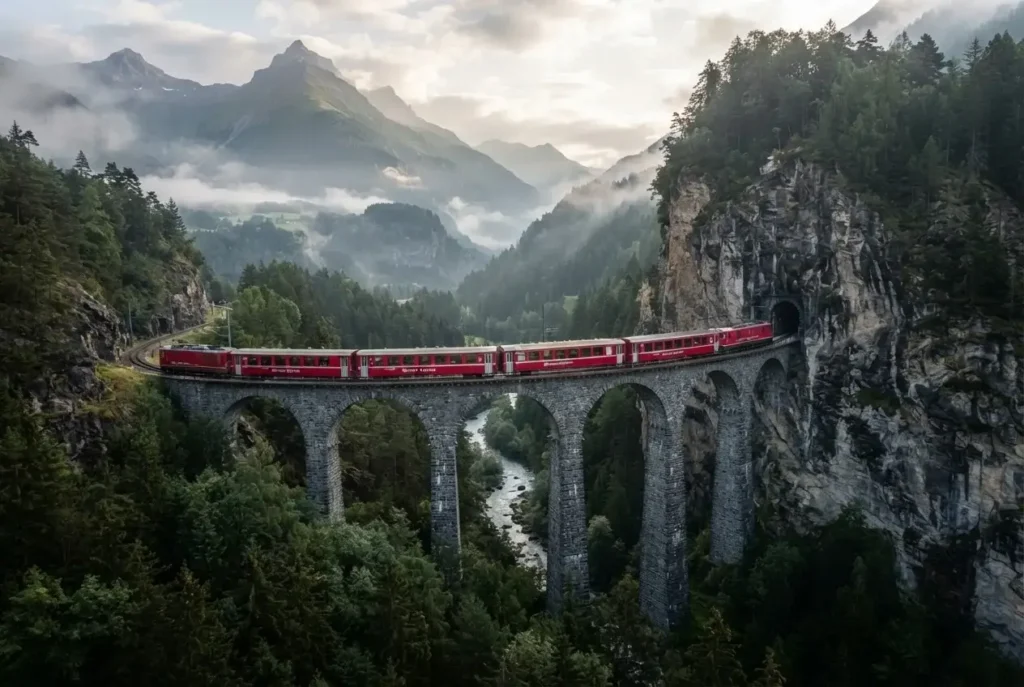
The train runs from Chur, the oldest town in Switzerland, down to Tirano just over the Italian border. Along the way it crosses 196 bridges and threads through 55 tunnels, climbing up to the Bernina Pass past glaciers and turquoise Alpine lakes, then dropping down toward palm trees on the Italian side. You genuinely watch the climate change outside your window. The whole line is a UNESCO World Heritage Site, which you can read about on the UNESCO World Heritage listing for the Rhaetian Railway, and once you see the Landwasser Viaduct curving into a cliff face, you understand why.
A few practical things I want you to know before you go. This is a reservation-required train, not a hop-on service. You book a seat separately from your ticket or pass, and seats open up to 93 days before travel through the official Rhaetian Railway Bernina Express page. In summer the panoramic cars sell out, so book early. Sit on the right-hand side heading from Chur to Tirano for the best of the drops and viaducts, then switch your gaze often because the good stuff comes from both windows.
For food, do not overthink it. There is at-seat catering with snacks and drinks, but my move on scenic trains is always to buy a proper picnic beforehand. In Switzerland that means grabbing bread, local cheese, and some Bündnerfleisch, the air-dried beef from the Graubünden region, from a shop before you board. Eating regional food while the region rolls past you is one of travel’s simplest pleasures.
Night Trains: The Real Eco Game-Changer
Here is where things get exciting for anyone serious about low-carbon travel. Night trains are having a genuine comeback, and they solve the biggest complaint people have about the train, which is time. You board in the evening, sleep, and wake up in a new country. Your journey and your accommodation become the same thing. You save a hotel night and you skip a flight. That is the eco equation working in your favour twice.
The research backs this up. A 2025 study published on ScienceDirect assessing overnight trains found that a large share of European aviation trips could realistically be served by night trains, and that for many long-distance routes they are the most viable low-carbon option we have. This is not a nostalgia trip. It is a serious piece of the future.
The main operator to know is Nightjet, run by the Austrian railways, and they have been expanding fast. You can see the full network on the official Nightjet destinations page. Newer connections include Amsterdam to Vienna and Amsterdam to Munich and Innsbruck, both running since spring 2025, plus a Hamburg to Zurich sleeper added at the end of 2025. There is also the European Sleeper service running Brussels and Amsterdam to Berlin and Prague, which has built a devoted following.
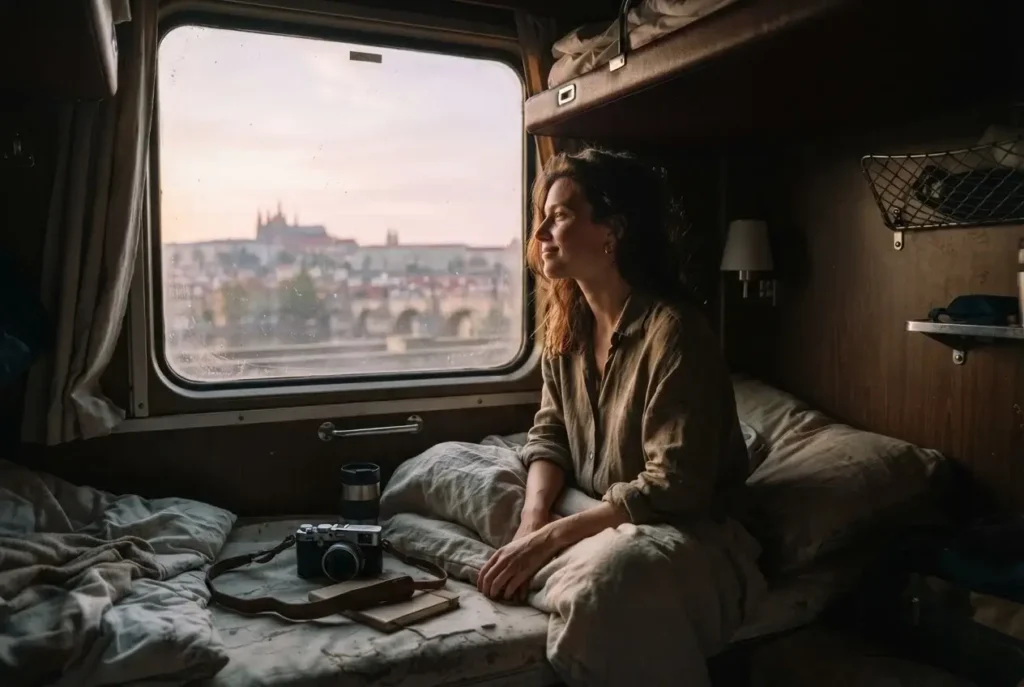
Now, solo travellers, I want to speak to you directly because I know the question you are thinking. Yes, night trains are a good choice on your own. You can book a private single sleeper cabin if your budget allows, which gives you a lockable door and your own space. If you are watching money, a couchette is the shared bunk option, usually four or six beds, and there are often women-only couchettes you can request when booking. I always keep my valuables in a small bag I sleep with or clip to myself, the same habit I use in hostels. Bring earplugs, an eye mask, and something to snack on, and you will sleep better than you expect. Waking up as the train pulls into a new city, watching a foreign morning arrive through the window, is the kind of moment that reminds you why you left the ordinary life behind.
More Routes Worth Building a Trip Around
Beyond the headliners, Europe is stitched together with scenic lines that make the getting-there feel like the point. The Flåm Railway in Norway is a short but jaw-dropping descent through waterfalls and mountain villages, often paired with a fjord cruise. Scotland’s West Highland Line, running out toward Mallaig, crosses the viaduct that film fans will recognise and rolls through some of Britain’s wildest scenery. The Centovalli Express, which crosses between Switzerland and Italy through a valley of a hundred waterfalls, is a lesser-known gem that costs a fraction of the famous panoramic trains.
The magic of eco-friendly travel here is that you do not have to pick just one. Because the network connects, you can chain these together into a single low-carbon trip. From what solo travellers consistently report, the biggest surprise is how much they end up enjoying the “in-between” legs, the ordinary regional trains between the famous ones, where you share a carriage with commuters and school kids and get a truer feel for a place than any tour would give you.
If you want to go deep on any specific route’s timetables and quirks, the reference I trust most and have leaned on for years is the practical rundown at Seat61’s guide to European train travel. It is run by a former rail insider and is the closest thing the train world has to a bible.
Passes vs Point-to-Point Tickets: How to Actually Save Money
This is where most first-timers freeze up, so let me make it simple. You have two ways to pay for a European rail trip. You buy individual tickets for each journey, or you buy a rail pass that covers many journeys across many countries.
If you are a European resident, the pass you want is Interrail. If you live outside Europe, the identical product is called Eurail. Same trains, same countries, different name based on where you live. The flexible Global Pass lets you travel a set number of days within a window, which is perfect if you want freedom to change plans on a whim. You can compare the options on the official Interrail Global Pass page.
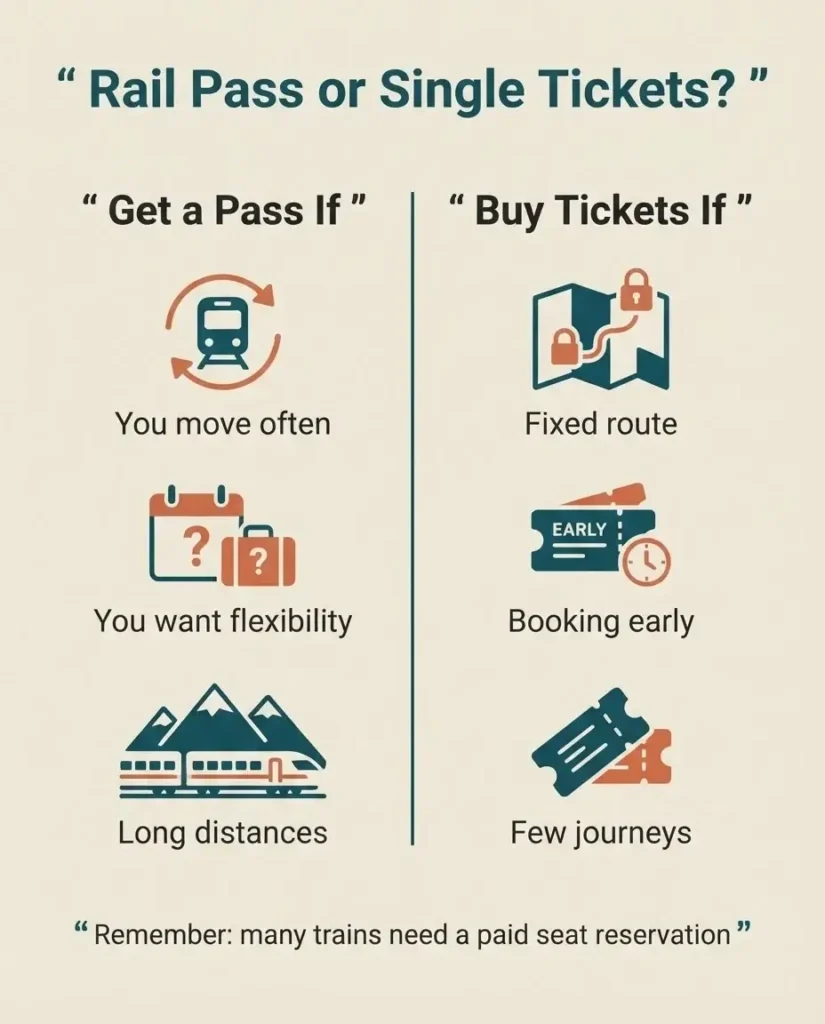
So which is cheaper? Honestly, it depends on how you travel. A pass shines if you are moving frequently, covering long distances, and value flexibility, which describes most first-time Europe trips. Point-to-point tickets can be cheaper if you book far in advance and stick to a fixed route, because advance fares can be very low. The trap to avoid is assuming a pass means everything is free. Many high-speed and night trains require a paid seat reservation on top of your pass, usually a modest fee, and those reservations can sell out. Budget for them and book the popular ones early.
My honest advice, the same thing I tell friends who are nervous, is to sketch your rough route first, add up what point-to-point tickets would cost, and compare it against a pass. Spend twenty minutes on the math and you will save real money.
When I was living out of a backpack and stretching every dollar from my waitressing shifts, that twenty minutes of planning was the difference between a two-week trip and a three-week one.
Slow Travel Is the Feature, Not the Bug
I want to gently challenge something before you plan, because it is the mindset shift that makes all of this click. Somewhere along the way we started treating travel time as wasted time, something to minimise. The train invites you to think differently.
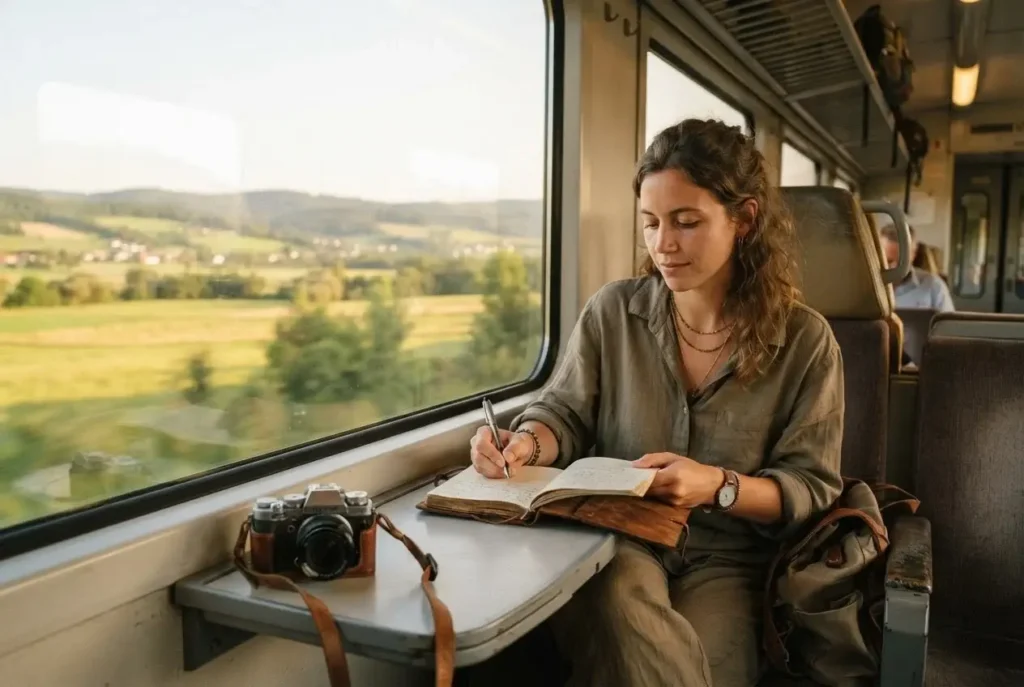
When you take the train, the journey stops being dead space between two “real” destinations and becomes part of the trip itself. I have done my best thinking on trains. I have written pages of journal, met people I still remember, watched countries change character through a window in a way you simply cannot from 35,000 feet. This is the heart of what I believe about travel. It is not about collecting places like stamps. It is about being present enough to let a place, or a journey, actually change you.
There is a freeing honesty in it too. You will have delays. You will get on the wrong platform at least once. I certainly have, more than once, standing confused with my pack while a train I needed pulled away. Those moments felt like disasters and became my favourite stories. The train teaches patience, and patience is one of the best things travel ever gave me.
Practical Tips for Your First Eco Rail Trip
A few things I wish someone had told me before my first big rail journey. Pack light, genuinely light, because you will be carrying your bag up station stairs and lifting it onto luggage racks yourself. A backpack you can carry beats a wheeled case on cobblestones every time. Bring a refillable water bottle, since most stations have taps and you will save money and plastic. Download offline maps and your tickets before you board, because signal drops in tunnels and rural stretches.
Arrive at the station earlier than you think for your first few journeys, until you learn how the boards and platforms work in each country. Trust me, the anxiety of finding your platform fades fast once you have done it a couple of times. Keep snacks on you, especially for regional trains without a cafe car. And say yes to the small talk. Some of my warmest travel memories started with a stranger in the next seat asking where I was headed.
For safety as a solo traveller, the train is one of the easier environments out there. You are around other people, staff are present, and you can move carriages if a seat feels off. Keep your bag within sight or touch, trust your gut, and you will be fine. The confidence you build doing this, figuring out a foreign rail system on your own and succeeding, spills over into the rest of your life. That is not a small thing. It is honestly one of the biggest reasons I keep encouraging people to try solo travel in the first place.
Your Next Step
You do not need to be rich, fearless, or an expert to see Europe by train. I certainly was none of those things when I started. You need a rough plan, a light bag, and enough courage to book the first ticket. The perfect moment is not coming. The good news is you do not need it. You need a window seat and the willingness to watch the world go by.
So pick a route that makes your heart beat a little faster, whether it is glaciers on the Bernina Express or falling asleep in one country and waking in another. Do the twenty minutes of planning. Then go. The Europe you have been daydreaming about is out there, and the greenest, most beautiful way to reach it is already waiting at the platform