Top Spots for Responsible Wildlife Tourism in the Americas

There is a moment that changes how you see wildlife travel. For a lot of people, it happens the first time they realize the “sanctuary” they just paid to visit isn’t really a sanctuary at all. The animals are trained. The photo op is staged. And somewhere behind the scenes, a wild creature is living a life it was never meant to live, all because tourists wanted a memory.
I think about this a lot when I’m planning trips that involve animals. Growing up in New York and working as a sightseeing guide, I spent years directing people’s attention toward the living, breathing things that make a place feel real. And what I’ve learned from years of travel and research is this: seeing wildlife well, seeing it in a way that actually matters, is one of the most powerful experiences travel can give you. But doing it responsibly means making deliberate choices before you ever board the plane.
The Americas, from the wetlands of Brazil to the volcanic islands of Ecuador to the frozen coasts of Patagonia, hold some of the most extraordinary wildlife on the planet. This guide is about helping you find the experiences worth having, and giving you the tools to tell the good from the bad. Let’s start with that.
Why Responsible Wildlife Tourism Matters More Than You Think:
Here’s a number that stopped me in my tracks when I first read it. World Animal Protection found that more than 40% of wildlife selfie photos on social media show someone hugging, holding, or inappropriately interacting with a wild animal. That’s not a fringe problem. That’s nearly half of all wildlife travel photos, representing a massive, largely invisible industry built on animal suffering.
The demand for up-close animal encounters has created a whole economy of facilities that present themselves as ethical while being anything but. Animals are taken from the wild, separated from mothers at birth, kept in inadequate conditions, and trained through fear to sit still for tourists. And the tourists almost never know.
This is not meant to make you feel bad about loving animals or wanting to see them. It’s meant to give you the information to make choices that actually benefit wildlife rather than harm it. Because when responsible tourism works the way it should, your money funds conservation, supports local communities, and gives governments an economic reason to protect wild habitats. The difference between a harmful and a helpful wildlife trip often comes down to about five minutes of research before you book.
How to Spot a Responsible Operator Before You Go:
National Geographic’s wildlife tourism ethics guidelines put it simply: look for experiences where animals are engaging in natural behaviors in natural environments. That is your starting benchmark.
Beyond that, here are the practical things worth checking:
The operator should maintain clear distance rules between visitors and animals, and enforce them. If a guide is letting tourists crowd a nesting bird or approach a jaguar resting on a riverbank, that’s a problem. If the marketing material shows anyone riding, hugging, or posing with a wild animal, move on. If the tour is small-group (ideally six people or fewer), that’s a good sign. If the boat or vehicle is one of dozens swarming a single animal, that’s not.
Ask directly: does any of this revenue go to local conservation or community projects? A good operator will answer that question without hesitation. A bad one will pivot to talking about the quality of the accommodation.
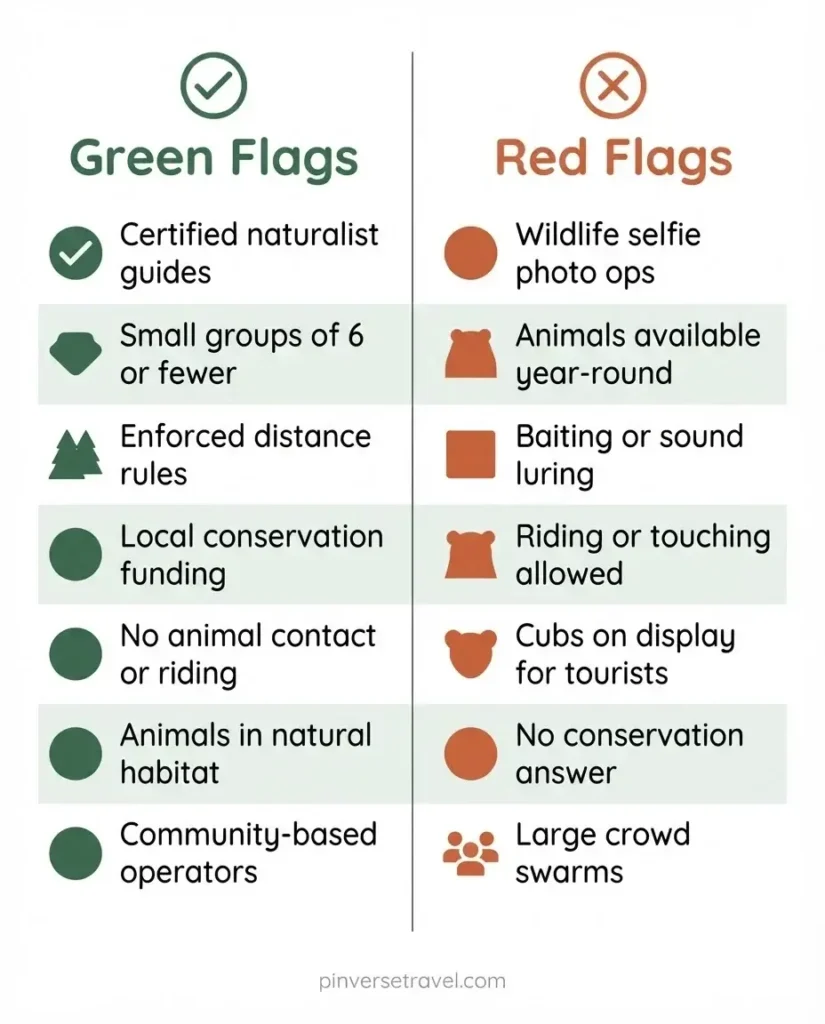
The red flags are consistent across destinations. Avoid any experience that lets you touch, ride, or hand-feed wild animals. Avoid any “sanctuary” that has cubs or babies available for selfies year-round. Avoid any guide who uses bait or sound recordings to force animal encounters. These things feel exciting in the moment, but they are not what real wildlife travel looks like.
The Galapagos Islands, Ecuador:
If there is one place in the Americas that gets responsible wildlife tourism almost completely right, it is the Galapagos. That’s not by accident. It’s the result of decades of strict regulation and active conservation management.
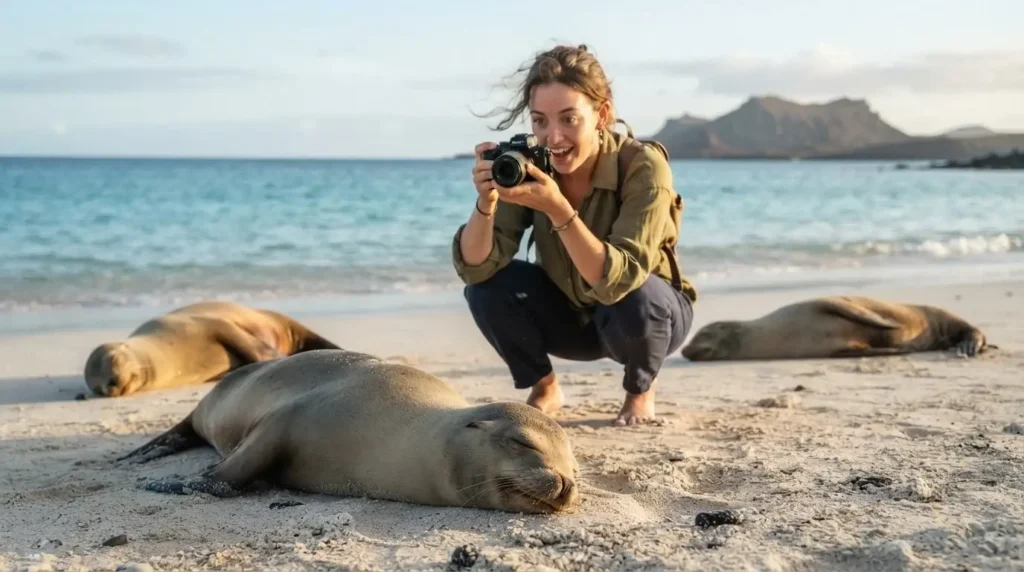
From what solo travelers and naturalists consistently report, the experience of standing on a Galapagos beach surrounded by sea lions and blue-footed boobies that have no fear of humans is genuinely unlike anything else. Because there are no natural predators on the islands, the animals simply don’t register you as a threat. They waddle past your feet. They sleep on the path you’re trying to walk. Marine iguanas pile on top of each other and blink at you slowly while you photograph them from two feet away. You don’t need to chase anything. You just need to show up and be still.
The rules that make this possible are enforced by the Galapagos National Park Directorate. The official park regulations require all visitors to protected areas to be accompanied by a certified naturalist guide, stay at least 6 feet (2 meters) from all wildlife even when the animals approach you, never feed any wildlife, use no flash photography on animals, and leave absolutely nothing behind. Camping is only allowed in authorized areas and requires a permit request at least 48 hours in advance. You are also not permitted to bring food, plants, or animals into the archipelago, and biosecurity inspections take this seriously when you arrive.
These rules feel strict on paper and barely noticeable in practice, because the guides make them seamless. Choosing a guide who is actually GNPD-certified is one of the most important decisions you’ll make for this trip. The certification matters because it ensures your guide understands both the ecology and the regulations, not just the highlights reel.
Best time to visit: the Galapagos is a year-round destination. December through May brings calmer, warmer seas and is ideal for snorkeling. June through November brings cooler water, higher sea activity, and better wildlife density in some areas.
What to eat while you’re there: in Puerto Ayora on Santa Cruz, look for the local fish market at the main dock, where brown pelicans and sea lions gather every morning hoping for scraps. Order fresh ceviche from a nearby stall and eat it standing up while watching the whole scene unfold. It’s one of those chaotic, loud, joyful moments that travel writers usually forget to mention.
Tortuguero, Costa Rica:
Costa Rica accounts for just 0.03% of the Earth’s surface, yet it holds around 6% of the world’s biodiversity. That number tells you something important about what this country has chosen to protect. And nowhere illustrates that choice more vividly than Tortuguero.
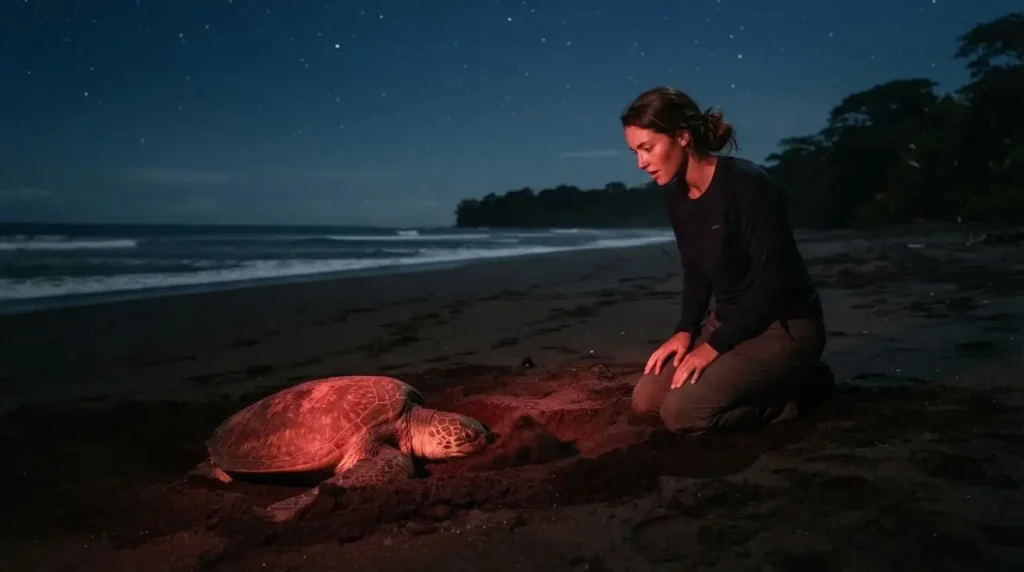
Tortuguero National Park sits on the Caribbean coast and is accessible only by boat or small plane, which keeps the crowds manageable and the atmosphere genuinely wild. The beach here is the most important nesting site for the endangered green turtle in the entire Western Hemisphere. Between July and October, leatherback, hawksbill, and loggerhead turtles also come ashore to nest. The Sea Turtle Conservancy has been running continuous sea turtle research and monitoring here since 1959, making it the longest uninterrupted sea turtle study in the world.
What this means for you as a visitor is that the experience here is grounded in real science and real conservation outcomes. Nighttime turtle tours in Tortuguero are regulated by the park. You go with a licensed guide in a small group, lights are kept red or completely off on the beach to avoid disorienting the turtles, no flash photography is permitted, and you observe from a distance that the guide will enforce. It’s quiet and slow and a little tense in the best way, because you genuinely don’t know if a turtle will emerge right next to you or fifty meters down the beach.
If you want to go deeper, the Sea Turtle Conservancy offers eco-volunteer opportunities where you join the research team, help count and tag nests, and contribute directly to the data that drives conservation policy. Solo travelers in particular tend to love this kind of experience because you’re immediately part of a team with a shared purpose, and the camaraderie that builds over a week of night shifts on a dark beach is something genuinely hard to replicate.
Beyond turtles, the canals around Tortuguero are excellent for early morning boat tours. Monkeys, sloths, caimans, river otters, and an extraordinary variety of birds move through the vegetation along the water. The pace is slow and the encounters feel genuine because nobody is staging them.
What to eat: stop in the small village of Tortuguero and look for a local soda (a Costa Rican family-run eatery) serving gallo pinto, the traditional rice and beans dish, with fried plantains and fresh juice. It’s simple, cheap, and the right fuel for a morning on the water.
The Pantanal, Brazil:
The Pantanal is the world’s largest tropical wetland, roughly ten times the size of the Florida Everglades, and it is widely considered the single best place in the world to see jaguars in the wild. Not glimpse, not guess. Actually see, up close, in full daylight, along the river banks.
From what wildlife travelers and conservation researchers consistently report, a well-run Pantanal trip from a responsible lodge involves slow boat rides along the Cuiaba River at dawn and dusk, when jaguars come down to drink and rest. Guides with local ecological knowledge can read the riverbank and position the boat quietly at a respectful distance before a jaguar appears. No baiting. No calls. No chasing. The cat does what it wants, and you watch.
The Pantanal suffered devastating wildfires in 2020 that burned roughly 22% of the wetland, driven by expanding agricultural activity and drought. Responsible tourism directly supports the communities and lodges working against that pressure. Choosing a locally owned, research-affiliated ecolodge here puts money into the hands of people who depend on the ecosystem staying intact. Ask any lodge about their relationship with local conservation organizations and whether their guides are from the surrounding communities. The best ones will have strong, specific answers.
The Pantanal is also home to giant anteaters, yacare caiman in staggering numbers, hyacinth macaws (the world’s largest parrot species), giant otters, and tapirs. Even a four to five day visit to a responsible lodge will leave you with more wildlife sightings than most dedicated safari trips to other continents.
Planning note: the dry season, roughly July through October, concentrates wildlife around water sources and is widely considered the best time for sightings. Flooding season (November through March) transforms the landscape and has its own beauty but makes some areas inaccessible.
San Ignacio Lagoon, Baja California, Mexico:
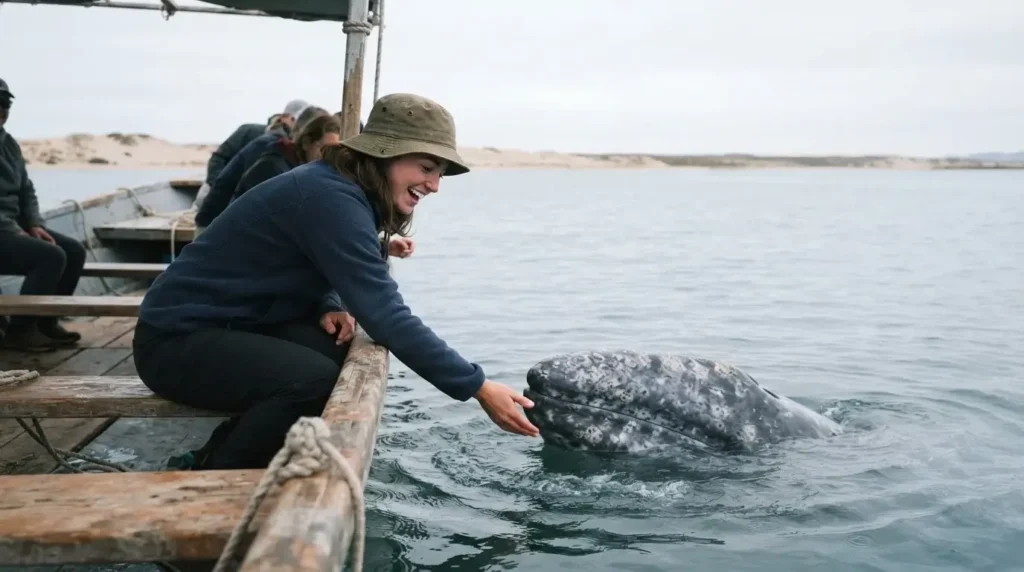
This one stops people in their tracks the first time they hear about it, because it sounds almost impossible. Every winter, gray whales migrate from the Arctic to the warm lagoons of Baja California to breed and give birth. And in San Ignacio Lagoon specifically, these whales come to the boats.
Not the other way around. The whales come to you.
The Oceanic Society, which runs research expeditions to the area, explains that gray whales in Baja’s lagoons have been voluntarily approaching human visitors for decades. Mothers bring their calves alongside small panga boats, and the whales linger, sometimes letting visitors gently touch them. This is considered one of the rare ethically defensible cases of close human-animal contact in wildlife tourism, for a specific reason: the whales initiate it. Boats hold position and wait. If the whale isn’t interested, it doesn’t come over. There is no chasing, no luring, and no forcing.
The interactions are governed by Mexico’s SEMARNAT and CONANP agencies, with strict limits on the number of licensed boats allowed in the lagoon at any time, designated no-go zones where whales can rest undisturbed, and required time limits on any single encounter. San Ignacio Lagoon sits within the El Vizcano Biosphere Reserve, a UNESCO World Heritage Site. Decades of scientific monitoring have found no evidence of negative population-level impacts from these regulated encounters.
The season runs from roughly January through April. Local fishing communities, who historically depended on the same waters for livelihood, now largely run or support the whale watching operations, which gives them a direct financial reason to protect the lagoon. That’s exactly how responsible tourism is supposed to work.
Getting there takes some effort. The lagoon is remote, accessible by a long dirt road or small aircraft. That effort is worth it. Travelers consistently describe the gray whale encounters in San Ignacio as one of the most profoundly moving wildlife experiences of their lives.
Yellowstone National Park, Wyoming, USA:
Responsible wildlife tourism doesn’t require a passport. Yellowstone, which covers about 3,500 square miles across Wyoming, Montana, and Idaho, is one of the most wildlife-dense national parks in the United States and one of the most misused.
Every year, people get gored by bison and charged by elk because they walked up for a photo. This isn’t a small problem. The National Park Service’s official safety guidelines for Yellowstone require visitors to stay at least 25 yards from all wildlife including bison, elk, and deer, and at least 100 yards from bears, wolves, and cougars. Bison, which look slow and pastoral, can run three times faster than a human and have injured more visitors in Yellowstone than any other animal.
The good news is that Yellowstone done right is extraordinary. Wolf packs are regularly spotted in the Lamar Valley in early morning hours, which wildlife photographers and naturalists call the Serengeti of North America. Grizzlies with cubs are spotted from the road in Hayden Valley. Bison herds move through meadows in the kind of numbers that make you understand what this continent looked like before European settlement. All of this can be seen from a safe distance with binoculars or a camera with a decent zoom lens. You don’t need to be close. Being close isn’t the point.
Arriving early matters here. Most serious wildlife activity happens within the first two hours after sunrise and the last two hours before sunset. Bring layers regardless of what month you’re visiting, because Yellowstone weather changes fast. And if you’re a solo traveler, consider hiring a ranger-led wildlife watching program through the park’s education office, which keeps groups small and provides genuine ecological context for what you’re seeing.

The Thread That Runs Through All of These:
Whether you’re watching a jaguar pace the riverbank in the Pantanal or staying completely still while a sea lion sniffs your shoes in the Galapagos, the most memorable wildlife experiences share something in common. They are moments where the animal is in control and you are simply allowed to be present.
That’s what responsible wildlife tourism protects. Not just the animals, though it does that. It protects the quality of the experience itself. The moment a wildlife encounter becomes about what you want from the animal rather than what the animal naturally does, you’ve lost the thing that made it worth traveling for.
The Americas offer some of the most breathtaking wildlife on earth, and the communities and conservancies working to protect it deserve the support of thoughtful travelers. Your choice of where to go and who to book with is a meaningful one. The World Animal Protection organization’s Real Responsible Traveller campaign tracks how the travel industry handles animal welfare, which is a useful reference when researching tour companies for any of the destinations in this guide.
You don’t have to wait until you’ve figured out every detail to start moving in this direction. Pick one destination. Research one operator. Ask one question about where the conservation revenue actually goes.

That’s enough to start.
The animals don’t care about your Instagram. But they will absolutely notice whether you kept your distance.