
There is a particular kind of frustration that hits when you book a flight, feel pretty good about the price, and then someone mentions they flew the same route for half what you paid. I know that feeling. Back when I was working as a sightseeing guide in New York, every dollar mattered, and figuring out how to stretch my travel budget without missing real experiences became something of an obsession. Eventually it became a skill.
The Americas is a massive and wildly varied travel region. We are talking about a landmass that stretches from the icy tips of Patagonia all the way to the northern forests of Canada, with everything in between: Caribbean islands, Central American rainforests, Andean cities, and the sprawling urban buzz of places like New York, Mexico City, and Buenos Aires. The sheer size of the region means flights can be breathtakingly cheap or surprisingly expensive depending on what you know and when you move.
This guide is not about gimmicks. It is not about clearing your cookies (that does not work, and I will explain why). It is about the real, proven strategies that travelers consistently use to pay significantly less for flights across North, Central, and South America. Let’s get into it.
Why “Flight Hacking” Is Really Just Knowing the Rules
The phrase “flight hacking” sounds more complicated than it is. At its core, it just means understanding how airline pricing works and using that knowledge to your advantage. Airlines do not price seats based on what is fair. They price seats based on demand, timing, and a constantly shifting set of algorithms that respond to how many seats are left and who is buying them.
Once you understand that, the whole game changes.

You stop looking for some magic trick and start building a simple system. That system has a few layers: knowing when to search, knowing which tools to use, knowing how to be flexible, and knowing which myths to ignore. All of that is covered below.
Myth-Busting First: Stop Doing These Things
Before I tell you what works, let me save you some time by clearing up a few things that do not.
The incognito mode thing is a myth. This one has been circulating for years, and I completely understand why it sounds logical. The idea is that airlines track your searches and raise prices when they see you coming back to the same route. The reality, confirmed by data from the flight intelligence firm OAG, is that airline pricing is driven by dynamic algorithms responding to demand and seat availability across the whole market, not your individual browser history. Clearing your cookies or searching in a private window will not change the price you see. Going.com, which employs a team dedicated to fare analysis, has written extensively debunking this. Save your mental energy for the things that actually move the needle.
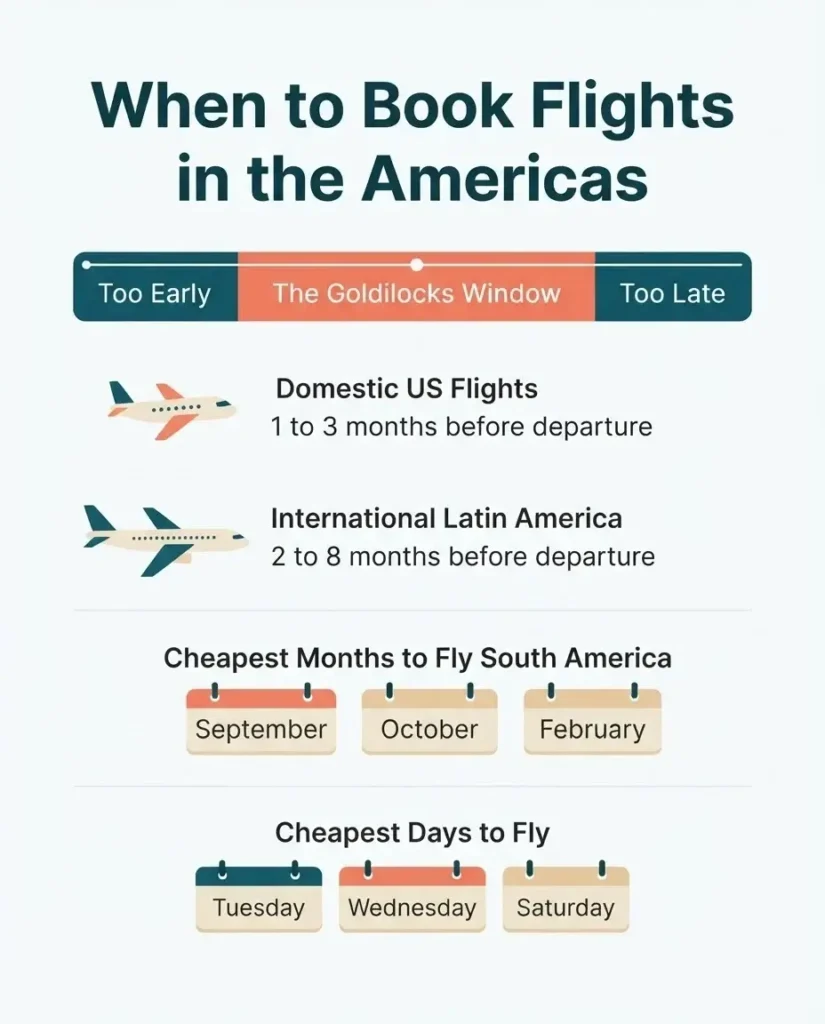
The “book on Tuesday” myth is mostly dead. Yes, Tuesday, Wednesday, and Saturday tend to produce the cheapest fares because those are low-demand travel days. But the day you book? That does not reliably change the price anymore. Dynamic pricing means fares fluctuate many times a day based on how many seats are left, not what day of the week you happened to open your laptop. What matters is the day you fly and how far in advance you book.
Last-minute deals are rare now. Twenty years ago, airlines would slash prices to fill empty seats at the last minute. Today, the opposite is often true. Airlines have learned that business travelers book late and are less price-sensitive, so unsold seats near departure frequently go up in price rather than down. Waiting to score a last-minute deal is a risky strategy that rarely pays off for the Americas.
The Single Most Powerful Thing You Can Do: Be Flexible
Every genuinely experienced budget traveler will tell you the same thing. Flexibility is the currency of cheap flights. You do not need to be completely untethered (you can still have preferences), but the more rigid you are about exact dates and routes, the more you pay.
Even shifting your travel dates by two or three days can save you a substantial amount. Midweek departures on Tuesdays and Wednesdays are consistently among the cheapest days to fly across the Americas. Flying home on a Saturday instead of a Sunday can save you noticeably on domestic US routes. If you are heading somewhere in South America, research shows that September, October, and February tend to offer lower airfares and fewer crowds than the high season months.
If you are not locked into specific destinations, that flexibility becomes even more powerful. More on that in the tools section below.
The Booking Window That Most Travelers Get Wrong
Timing is one of the biggest levers you have, and most people either book too early or too late.
For domestic US flights, Dollar Flight Club’s research on booking windows for South America and domestic routes consistently points to a sweet spot of about one to three months before departure for domestic trips and two to eight months before departure for international routes within or into the Americas. For peak season travel (summer, major US holidays, Carnival in Brazil), move the earlier edge of that window out by another month or two.
Going.com, which analyzes millions of fare data points, describes this as the “Goldilocks Window.” Book too far out and you catch the airline’s initial high prices before competition and demand signals have settled the fare down. Book too close and you catch the late-demand spike. The middle zone tends to produce the most consistently good prices.
For South America specifically, Going defines a “good deal” as $600 or below roundtrip from the US. For Central America and the Caribbean, that number is around $300 or below roundtrip. If you see prices in those ranges for your preferred dates, that is a genuine deal worth booking.
Build Your Flight-Searching Stack
You do not need one perfect tool. You need a small, complementary stack of tools that together cover different angles.
Google Flights as your foundation. Google Flights is the starting point for most of my route research, and for good reason. It is fast, clean, and packed with genuinely useful features that most travelers never use. The official Google Flights tips guide from Google itself walks through features like the price graph, the date grid, and the fare tracking toggle, all of which let you visualize how prices move across different travel windows for the same route.
The Explore map is particularly useful when you are open to destination. You go to Google Flights, set your home airport, type “Americas” or leave the destination blank, and the map populates with price bubbles across the region. If you are deciding between Colombia, Costa Rica, and Peru, the map shows you real-time prices for all three simultaneously. This is one of the fastest ways to let price partially inform your destination choice, which is honestly one of the smartest moves a flexible traveler can make.

Flight deal alert services. Rather than manually checking fares every day (which nobody has time for), the smarter move is to let a service watch the market for you and alert you when prices drop significantly on routes from your home airports. Going (formerly known as Scott’s Cheap Flights) and Dollar Flight Club are the two leading services for English-language travelers. Going has a free Limited membership tier that sends domestic deal alerts, and paid Premium membership (around $49 per year) covers international routes including South America and Central America. Both services specialize in finding fares that are genuinely below the historical average for the route, not just slightly discounted.
For the full picture of what makes a cheap flight strategy work using these tools together, Going’s own comprehensive guide is worth reading before your next international booking session.
Set a fare alert for specific routes. Once you know where you are going and roughly when, go into Google Flights, run your search, and toggle “Track prices.” You will receive email alerts when that fare changes significantly. This lets you do your research once and then let the system notify you rather than obsessively refreshing the search.
Hub Airports and Americas Routing: What Travelers Miss
One of the most underused flight hacking concepts for the Americas specifically is understanding the hub structure that connects the US to Central and South America. The major gateway hubs are Miami (MIA), Houston Intercontinental (IAH), New York JFK and Newark (EWR), and Los Angeles (LAX). Airlines funnel a large share of their Latin American routes through these cities, which means that flying into one of these hubs first, even if it adds a connection, can dramatically reduce your fare compared to trying to fly direct from a smaller regional airport.
If you live in, say, Phoenix or Atlanta or Boston, the price to fly direct to Bogota or Lima or San Jose is often significantly higher than flying first to Miami or Houston and then connecting onward. The savings can be large enough to more than offset the extra time and the positioning flight cost. Solo travelers who are comfortable with longer travel days can use this routing logic to shave real money off long-haul Americas trips.
This is also where the open-jaw ticket strategy becomes very practical. An open-jaw ticket lets you fly into one city and out of a different city on your return, which suits the Americas extremely well given how far apart major destinations can be. Flying into Cartagena, Colombia and out of Lima, Peru, for example, allows you to travel overland through Ecuador without backtracking, and often costs the same or less than a roundtrip to a single city.
The Budget Airline Landscape Inside Latin America
Once you land in the Americas, the internal flight market has its own ecosystem that is completely separate from what you are used to in North America. Knowing these carriers saves both money and stress.
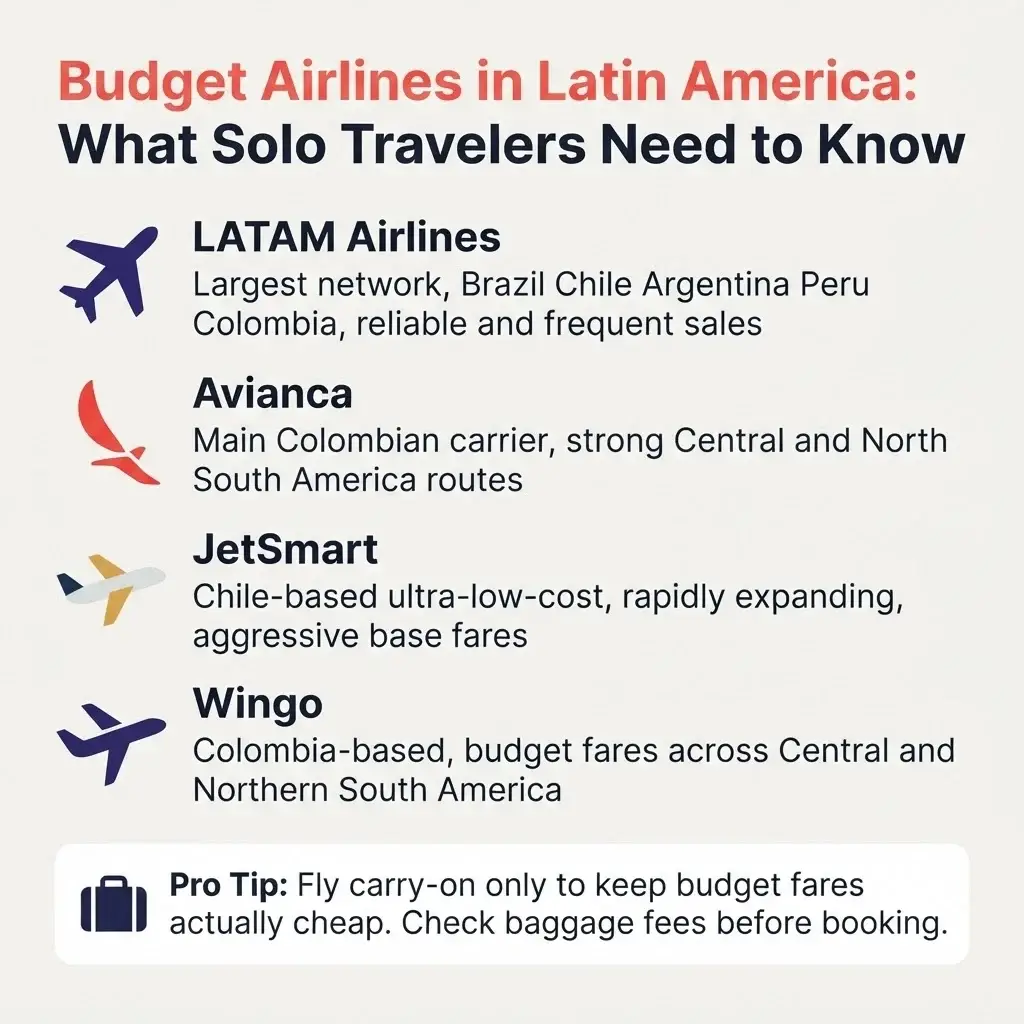
LATAM Airlines is the largest carrier in South America by a significant margin and tends to have the widest route network, connecting major cities across Brazil, Chile, Argentina, Peru, and Colombia. They frequently run sales and are generally reliable. Avianca is the main Colombian carrier with strong regional coverage throughout Central and northern South America.
The newer budget players are where prices get aggressive. Going.com’s complete guide to budget airlines in South America covers JetSmart and Wingo in detail. JetSmart is a Chile-based ultra-low-cost carrier that has been expanding rapidly and often offers fares between South American cities that are extraordinarily cheap by any standard. Wingo is Colombia-based and covers a lot of the same Central and northern South American ground as Avianca but at a significantly lower base price.
The key thing to understand about these carriers is the same rule that applies to Spirit or Ryanair: the base fare is the starting point, not the final price. Baggage, seat selection, and even carry-on fees can add up fast. Before you celebrate a $40 fare between Lima and Santiago, factor in what you actually need to bring and what it costs to bring it. Traveling with a single carry-on bag is the best way to keep budget airline tickets genuinely cheap, and it is a habit worth building for the Americas in general.
The 24-Hour Rule: Your Free Insurance Policy
This one belongs in every traveler’s toolkit, and it is completely official. Under US law, the US Department of Transportation requires airlines to allow passengers to cancel a flight within 24 hours of booking without penalty, provided the flight was booked directly with the airline and departs at least seven days from the time of booking.
This is more powerful than most travelers realize. Here is how to use it strategically: when you find a fare you like, book it immediately to lock in the price. Then spend the next 24 hours doing two things. First, check whether any better versions of the same route exist (different times, fewer stops, lower price). Second, confirm your travel plans are firm. If you find something better or decide not to go, cancel for free before the 24-hour window closes. If the price drops on the same itinerary within those 24 hours, you can book the new lower price and then cancel the original.

This removes a lot of the anxiety around “what if I book too early and the price drops?” You have a window to reconsider. Use it.
Points, Miles, and Loyalty Programs: The Long Game That Pays Off
I want to be honest here: the full world of award travel and credit card points is a deep rabbit hole, and it takes time to understand. But you do not need to be an expert to start benefiting. Even basic participation in a loyalty program, meaning you consistently earn miles on the flights you would be taking anyway, adds up meaningfully over time.
For travelers focused on the Americas, a few programs are particularly strong. NerdWallet’s most recent analysis of the most valuable airline rewards programs places Alaska Airlines Atmos Rewards at the top for US-based travelers, citing its generous earning rate and flexible redemption options, including strong partnerships with carriers that serve the Americas. United MileagePlus is one of the most useful programs for Latin America specifically, given United’s extensive presence at Houston IAH and the volume of routes it operates to Central and South America. American Airlines AAdvantage and Delta SkyMiles round out the major options, each with different partner carrier strengths.
The easiest entry point is this: pick one or two programs that match the airports closest to you and the carriers you tend to fly most often, and start routing your bookings through those. Even if you do not have a travel credit card yet, earning miles just from flying takes nothing extra from you.
If you do have or are considering a travel credit card, the key principle is to use points to book travel, not to redeem them for cash back. The redemption value for flights is almost always significantly higher than the cash value, meaning you extract more from every point when it goes toward an airline ticket rather than a statement credit.
Three Strategies Worth Knowing (One of Which Has Real Risk)
Split ticketing (hacker fares). This means booking two separate one-way flights rather than a single roundtrip. Sometimes, mixing airlines produces a total fare that is lower than any roundtrip ticket either airline offers alone. For example, flying to Bogota on Avianca and returning on American might cost less combined than booking a roundtrip on either carrier. Google Flights does show some of these combinations automatically, labeled as different-airline options. Worth checking before you assume the roundtrip is always the best deal.
Positioning flights. If you live in a mid-size US city without great Latin America connections, flying to a hub city first can unlock dramatically cheaper fares to your actual destination. A short, cheap domestic hop to Miami, Houston, or New York before your international flight can save more than the positioning flight costs. This works especially well for South America routes where the hub coverage is strongest through those cities.
Hidden city ticketing. This strategy involves booking a ticket with a layover at your actual destination, then simply getting off at the layover city and skipping the final leg. It can produce significant savings in specific cases. However, it comes with real consequences if airlines catch it: frequent flyer accounts can be flagged or cancelled, and some airlines have banned passengers for repeated use. You can only use it for one-way trips (you cannot check bags, and the remaining trip gets cancelled if you use it), and it is not something to rely on regularly. Skiplagged is the most well-known tool for finding these fares and clearly outlines the risks on their own blog. Go in with open eyes if you try it.
Mistake Fares: Real, Rare, and Requires Speed
Occasionally, airlines accidentally publish fares far below their intended price, either through currency conversion errors, data entry mistakes, or glitches in pricing systems. These are called mistake fares or error fares, and they can be extraordinary. Round-trips to South America for $200. Business class to Europe for $400. They are real, but they disappear within hours, sometimes within minutes.
The only reliable way to catch them is to have a service watching the market for you around the clock. This is where Going’s Premium tier earns its keep. Their team monitors global fare data specifically looking for prices that fall well below the historical average for a route, which is also how they catch mistake fares before most individual travelers notice them.
If you do spot one through any source, the rule is simple: book immediately. You can cancel within 24 hours if you change your mind. Spending ten minutes debating whether it is real is the fastest way to miss it.
One More Practical Tip: Book Group Tickets One at a Time
This one surprises people. If you are traveling with friends and searching for, say, three tickets on the same flight, most search engines will show you the price for three seats in the same fare class. If only one seat is left in the cheapest bucket, the algorithm will bump everyone up to the next price tier. The result is you pay the higher price for all three tickets.
The workaround is to search for one passenger at a time, identify the cheapest remaining seat, book it, then repeat the search for the next seat. This is more effort, but on popular routes with limited cheap seats, it can save you real money per person.
Building Your System Before You Book
If you have gotten this far, you probably have a few new tabs open and a slightly clearer picture of how all this fits together. Here is a simple framework to carry forward.
Start with your home airports and your rough travel window. Use Google Flights’ Explore map to see what is genuinely cheap from your city to the Americas region during that period. Set a fare alert on the specific routes you like. Sign up for Going or Dollar Flight Club so deal alerts come to your inbox passively. Know the booking window for your destination type (1-3 months for domestic, 2-8 months for international). Use the 24-hour cancellation rule as your buffer when you find something that looks right. Start building at least one loyalty program account and route your flights through it.
That is the system. It is not complicated. It just requires putting a few consistent habits in place before you get to the booking page.
Closing Thoughts
One of the biggest reasons people put off travel to places like Colombia, Peru, Costa Rica, Chile, or even Canada and Mexico is that they assume flights will be too expensive, so they never even look. The truth is that with even a basic understanding of how airline pricing works, the Americas becomes one of the most accessible travel regions in the world from the US.
I left a rigid, limited-vacation corporate job because I wanted more time to actually be in the world. And one of the earliest lessons I had to learn was that cheaper travel was not about luck. It was about knowing where to look and when to move. These tools and strategies have been around long enough that they are not secrets, they are just skills. And skills, unlike luck, are things you can actually build.
Start with one flight. Pick a destination, work through the system above, and see what price you land on. You might surprise yourself.