The Honest Guide to Travel Gadgets for Comfortable Flights

There is a version of a long flight that I think about every time I start packing my carry-on. It’s the version where I arrive stiff, dehydrated, overstimulated from seven hours of ambient engine noise, and completely useless for the first day of wherever I’ve landed. I’ve had that flight. More than once.
Then there is the other version. The one where I step off the plane feeling like a functional human being, already excited about where I am. That version, I’ve learned, comes down less to luck and more to a small collection of the right gadgets packed in the right bag.
This is not a list of every travel product that exists. It is an honest breakdown of what actually makes a difference in the air, what is genuinely worth packing for solo travelers who are carrying everything themselves, and what you can safely leave on the shelf. I’ve also included a few things competitors never mention, like battery rules and what you can actually bring past TSA for your skin.
Let’s start at the beginning of the flight and work our way through.
Before You Even Board: The Gadgets That Start Working at the Gate
Your neck pillow is either the best or worst thing in your bag
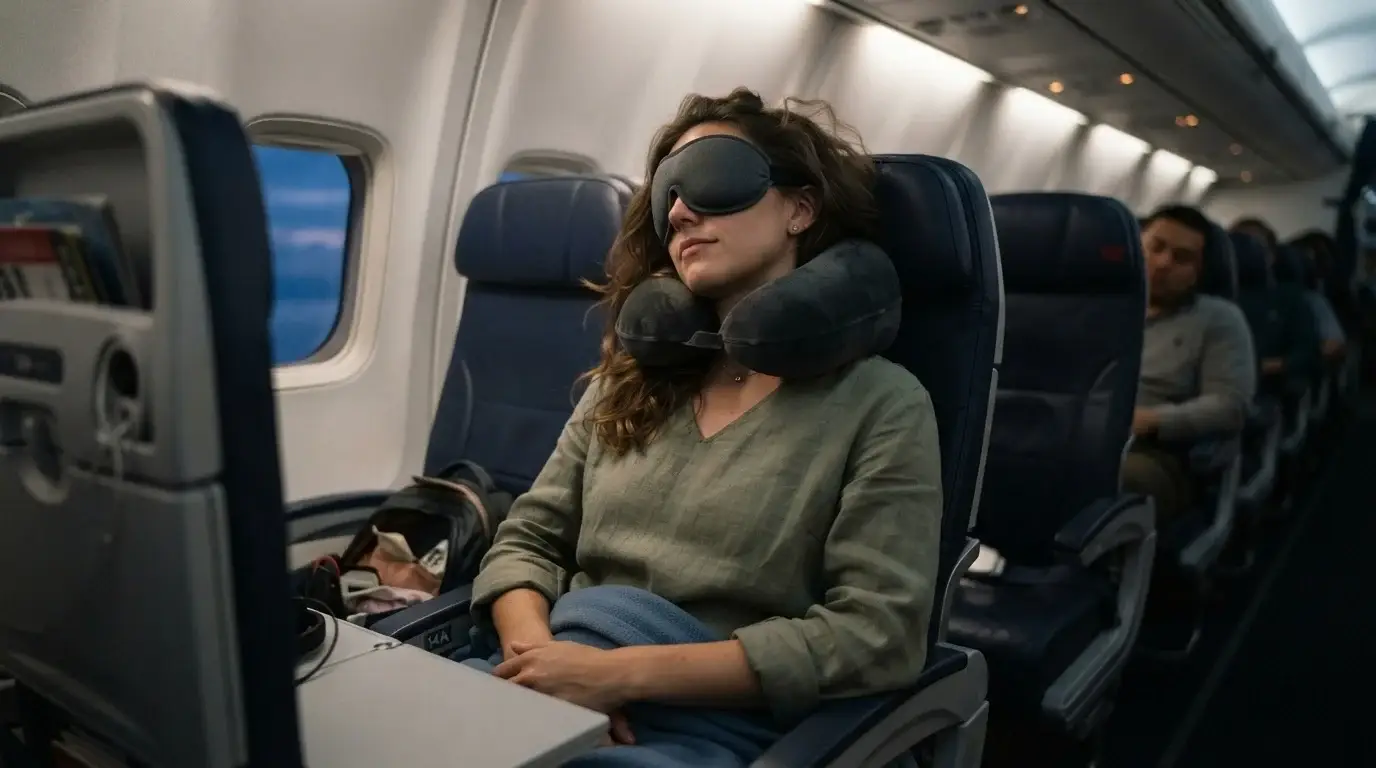
I want to address neck pillows first because they are probably the most purchased and most disappointing category in travel gear. Most of the classic U-shaped foam pillows look right in the product photo and fail completely in the aisle seat. Your head tips forward, the pillow slides, and you wake up forty minutes later with your chin on your chest and a crick in your neck.
The two pillows that actually work, based on what experienced solo travelers consistently report and independent reviewers have tested repeatedly, are the Trtl Travel Pillow and the Cabeau Evolution S3. The Trtl is a wrap-style pillow with an internal support frame. It holds your head to one side rather than floating it in a foam ring, which makes a real difference for side sleepers. It is also incredibly compact, which matters a lot when you are a solo traveler and every cubic inch of your carry-on is precious. The Cabeau Evolution S3 is better for taller travelers who need more coverage at the back of the neck. Neither is cheap. Both are worth it if long-haul flights are part of your regular life.
Noise-cancelling headphones: the single biggest upgrade you can make
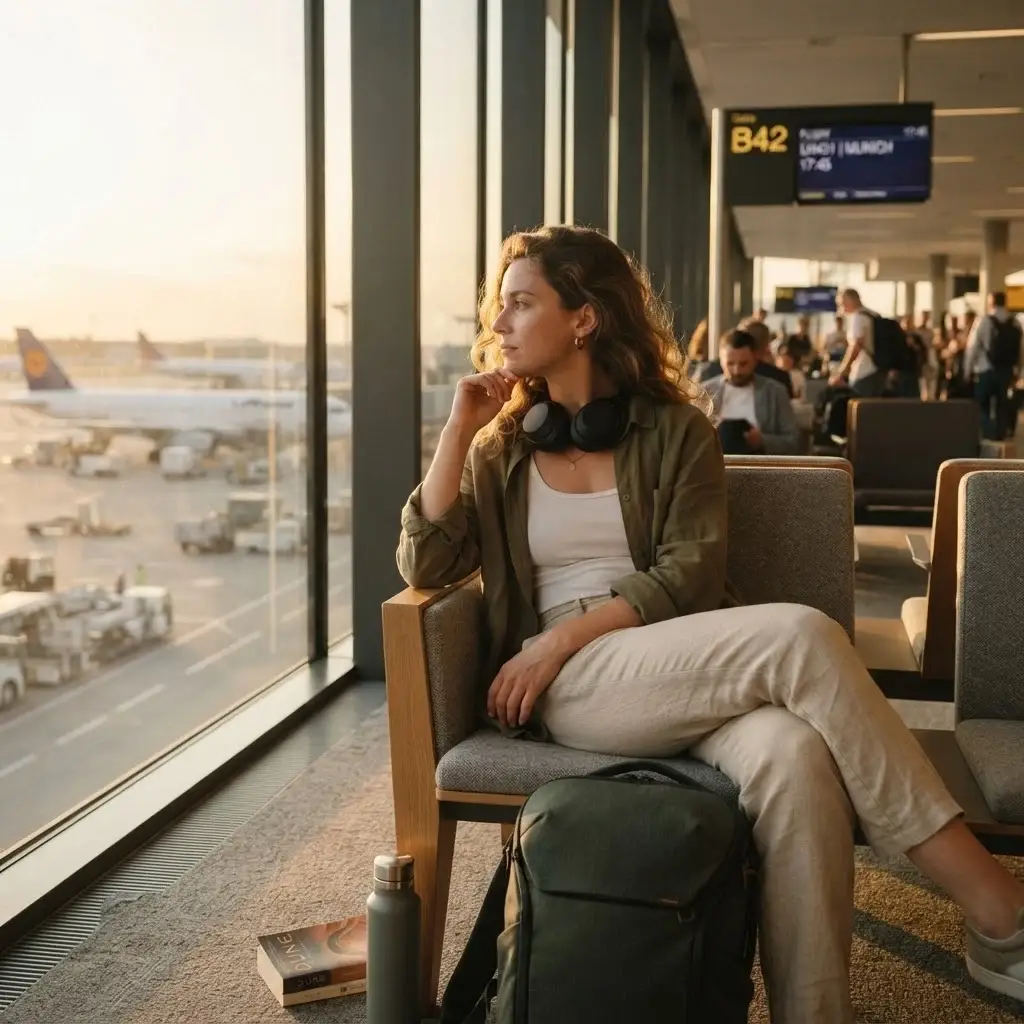
If there is one gadget on this entire list that I would call non-negotiable for anyone doing flights longer than four hours, it is a good pair of noise-cancelling headphones. The constant low-frequency drone of a plane engine is exhausting in a way you don’t fully notice until it stops. After eight hours of that noise, your brain is just tired in a way that has nothing to do with sleep.
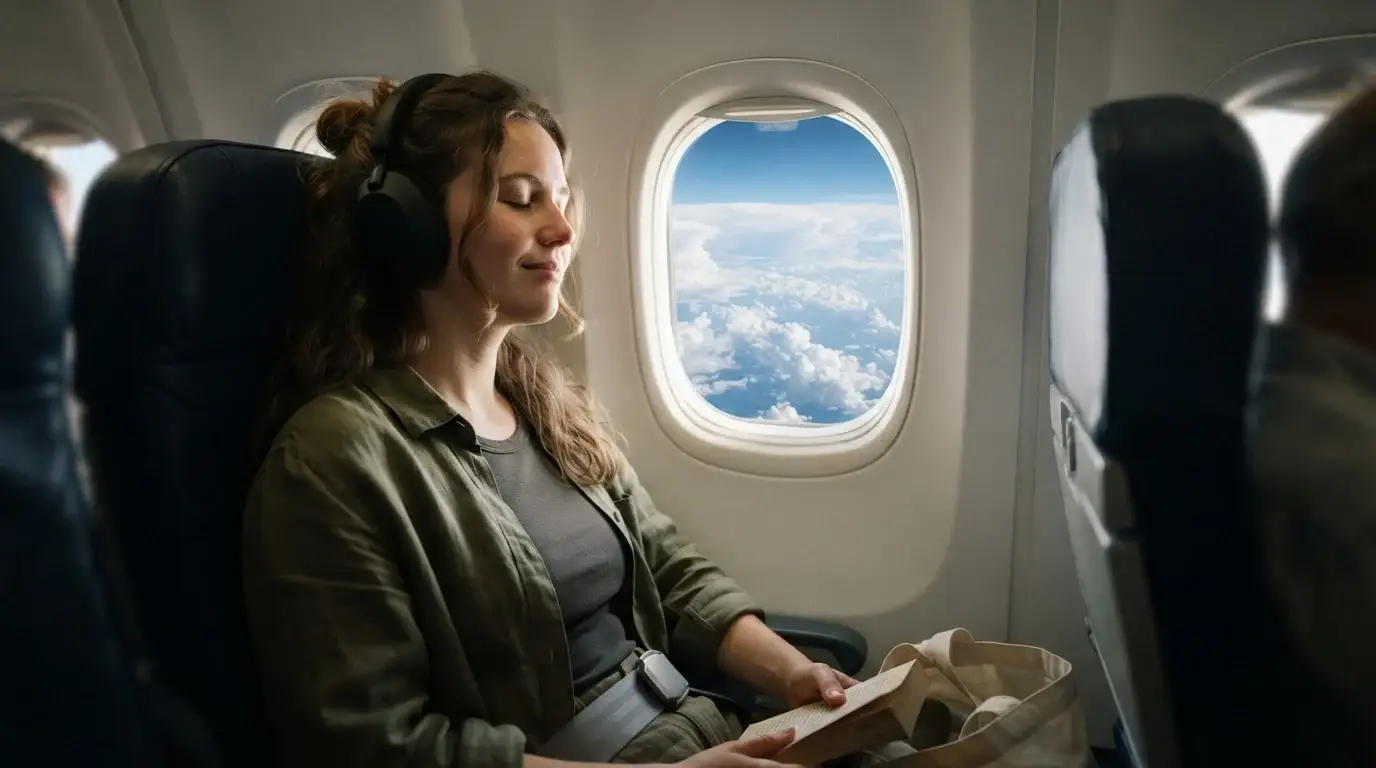
Right now, the Sony WH-1000XM6 is the top-rated travel headphone across nearly every independent review platform. RTINGS, one of the most rigorous headphone testing labs online, currently ranks them as the best travel headphone you can buy, specifically calling out their noise cancellation as exceptional for aircraft engine noise. They fold flat, come with a hard carry case, and include a cable for planes that still use the old two-pin audio jack. The Bose QuietComfort Ultra Headphones (2nd Gen) are also excellent and tend to edge out Sony on pure comfort for long wear, though they are slightly more expensive.
If you want the budget route, quality noise-isolating earbuds paired with foam earplugs can get you surprisingly close. But the over-ear headphones make a genuine qualitative difference for long-haul, and most solo travelers who make the investment say they can’t imagine flying without them afterward.
A sleep mask that actually blocks light
Economy cabins are lit on other passengers’ schedules, not yours. The person next to you wants to watch a movie. The overhead light near your row stays on for the entire meal service. A sleep mask is one of those things that sounds minor until you fly without one, and you realize how much ambient light was keeping you from real rest.
Contoured eye masks with molded cups are worth the extra few dollars over flat fabric masks because they don’t press against your eyelids. The Trtl Glimpse and several options from Alaska Bear are consistently rated highly for fit and blackout quality. Look for an adjustable velcro or elastic strap. Anything that digs into the back of your head will come off by hour three.
In the Air: The Gadgets That Actually Earn Their Pack Space
Your power bank rules (and yes, there are rules)
This is the section almost no travel blog tells you about, and it trips people up at security more often than it should.
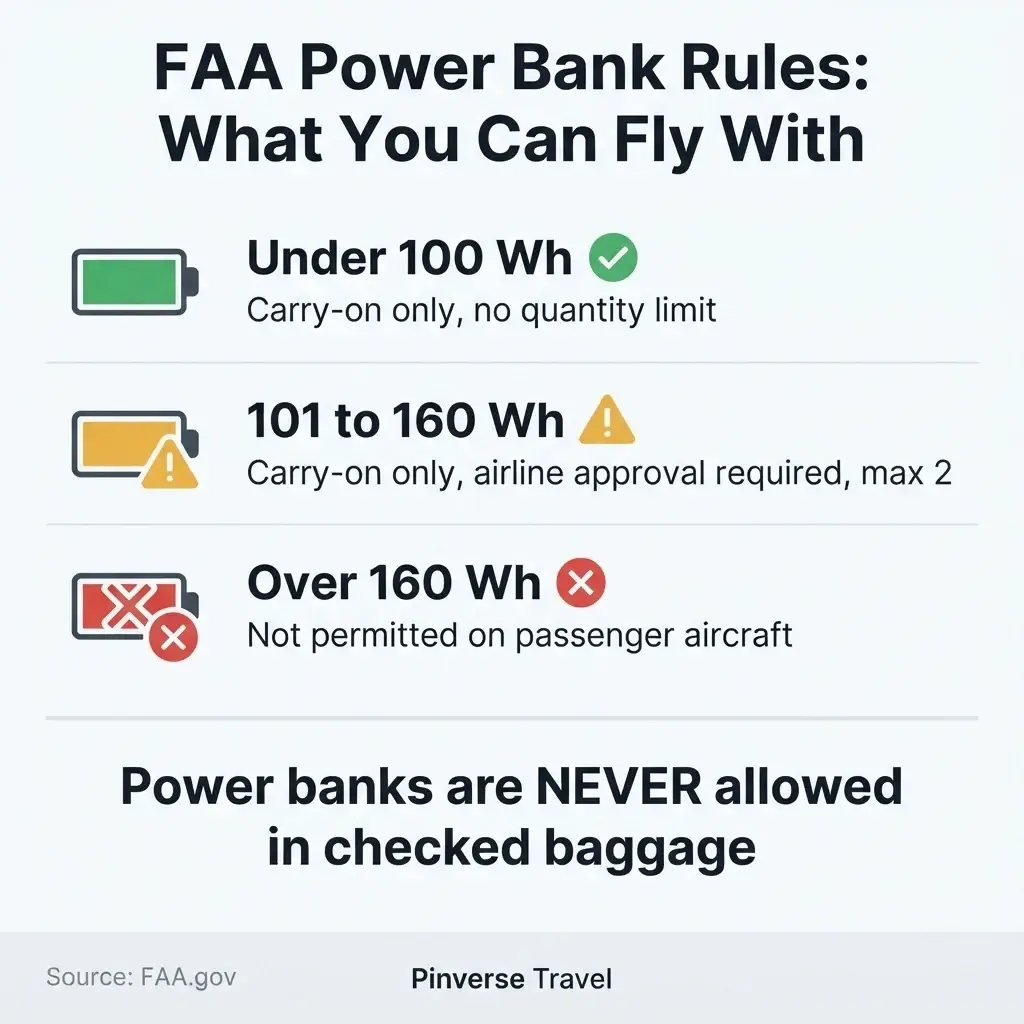
Per the Federal Aviation Administration, portable chargers and power banks must be in your carry-on bag only. They are never allowed in checked luggage. The standard rule is that power banks under 100 watt-hours (Wh) are fine with no quantity restriction. If you’re carrying one in the 101-160 Wh range, you need explicit airline approval, and you’re capped at two. Anything above 160 Wh is not allowed on a passenger flight at all.
Most everyday travel power banks (the ones that charge your phone two or three times) fall well under 100 Wh, so you’re usually fine. But check the watt-hour rating printed on the side of your charger before you pack. If it only shows milliamp-hours (mAh), you can calculate Wh by multiplying the mAh by the voltage and dividing by 1,000. A 10,000 mAh bank at 3.7V is about 37 Wh, which is well within limits.
For charging itself, a compact multi-port USB-C charging brick is one of the most useful things I always have in my bag. Having one cable solution instead of four separate chargers is one of those small things that genuinely reduces travel friction. It also frees up outlet space, which matters in shared terminal waiting areas.
Compression socks: this one is about health, not just comfort
I know compression socks don’t sound exciting. I also know they make a real difference, and the science backs them up.
The CDC’s Traveler Health page on DVT is clear that anyone on a flight of four hours or more is at elevated risk for blood clots due to prolonged immobility. Sitting still at altitude reduces circulation in your lower legs, and on a really long flight, that can become a genuine health concern. Compression socks work by applying graduated pressure to your calves and feet, which helps blood move back up toward the heart rather than pooling.
Harvard Health Publishing reviewed the evidence and found that compression stockings do reduce the risk of deep vein thrombosis on long flights, noting high-certainty evidence from multiple travel studies. You don’t need to be elderly or in poor health for this to be relevant. You just need to be a person sitting still for many hours.
They also, as a bonus, help with the foot swelling that makes your shoes feel two sizes too small when you land. Most people notice that their feet are noticeably less puffy after a long flight when they wore compression socks versus when they didn’t.
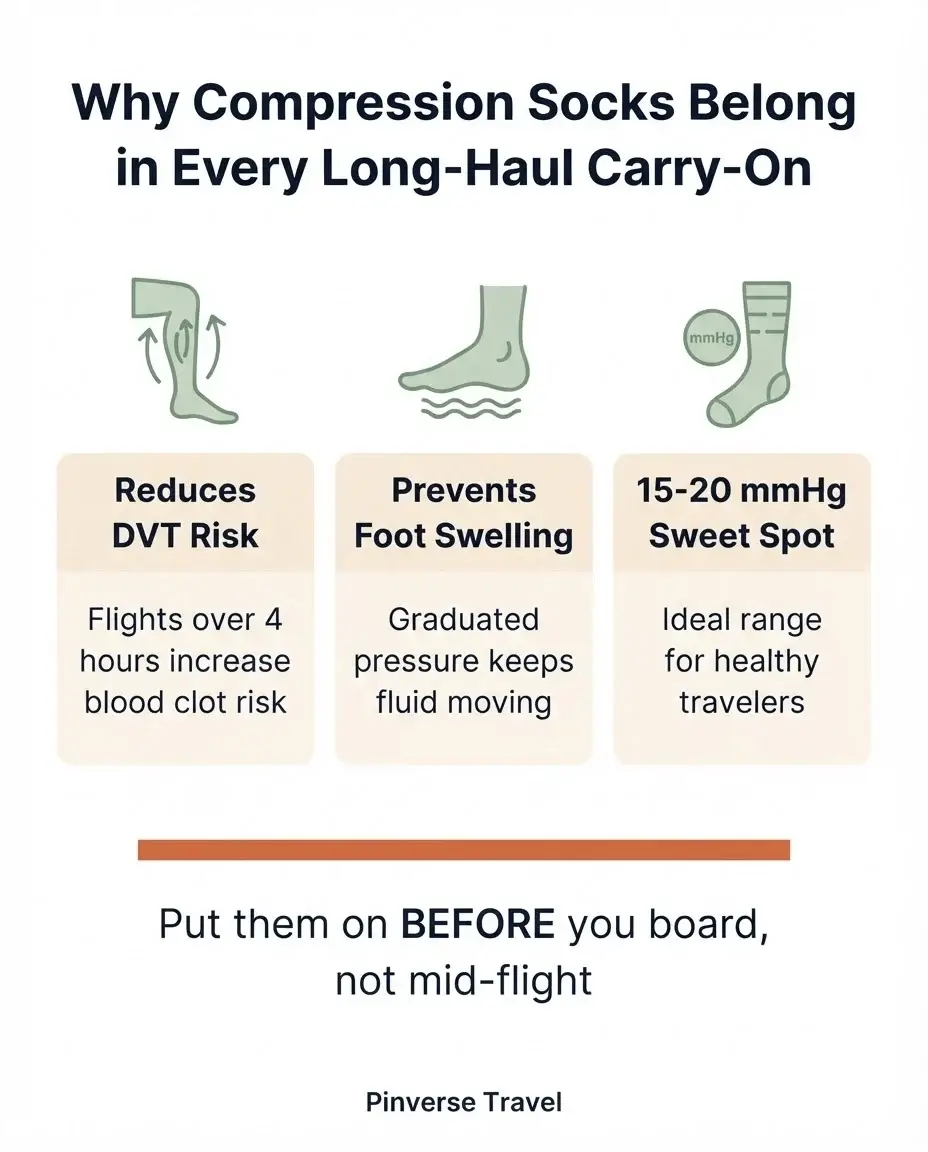
Compression socks in the 15-20 mmHg range are the sweet spot for healthy travelers on flights. They are available from brands like Sockwell, CEP, and Bombas, and cost anywhere from $15 to $40. Put them on before you board, not after you’ve already been sitting for two hours.
Foot rest or foot hammock for economy seats
This sounds indulgent. It is not. When your feet are hanging without support for eight hours, your lower back takes the pressure. A compact inflatable foot rest or a clip-on foot hammock (the kind that hooks onto the tray table mount in front of you) costs about $20 and folds into almost nothing. Solo travelers who do regular long-hauls consistently name this as one of the most underrated items they own.
The foot hammock style fits most standard economy tray tables and raises your feet to a more natural angle. It is one of those things that does not look impressive but genuinely changes how your back and hips feel at the end of a ten-hour flight.
A reusable water bottle (filled after security)
Cabin air at altitude is dramatically drier than the air you breathe on the ground. Humidity in a commercial aircraft cabin typically sits around 10 to 20 percent, which is drier than most deserts. This dryness is responsible for headaches, dry sinuses, dry skin, and a level of fatigue that often gets misattributed to jet lag when it is actually dehydration.
The easiest fix is to drink more water than you think you need. A collapsible or lightweight stainless steel bottle that you empty before security and fill at a terminal water fountain or cafe after is one of the most practical habits you can build. Aim for about one glass of water per hour of flight time as a baseline, and limit alcohol and coffee, which both accelerate dehydration.
Taking care of your skin in the air
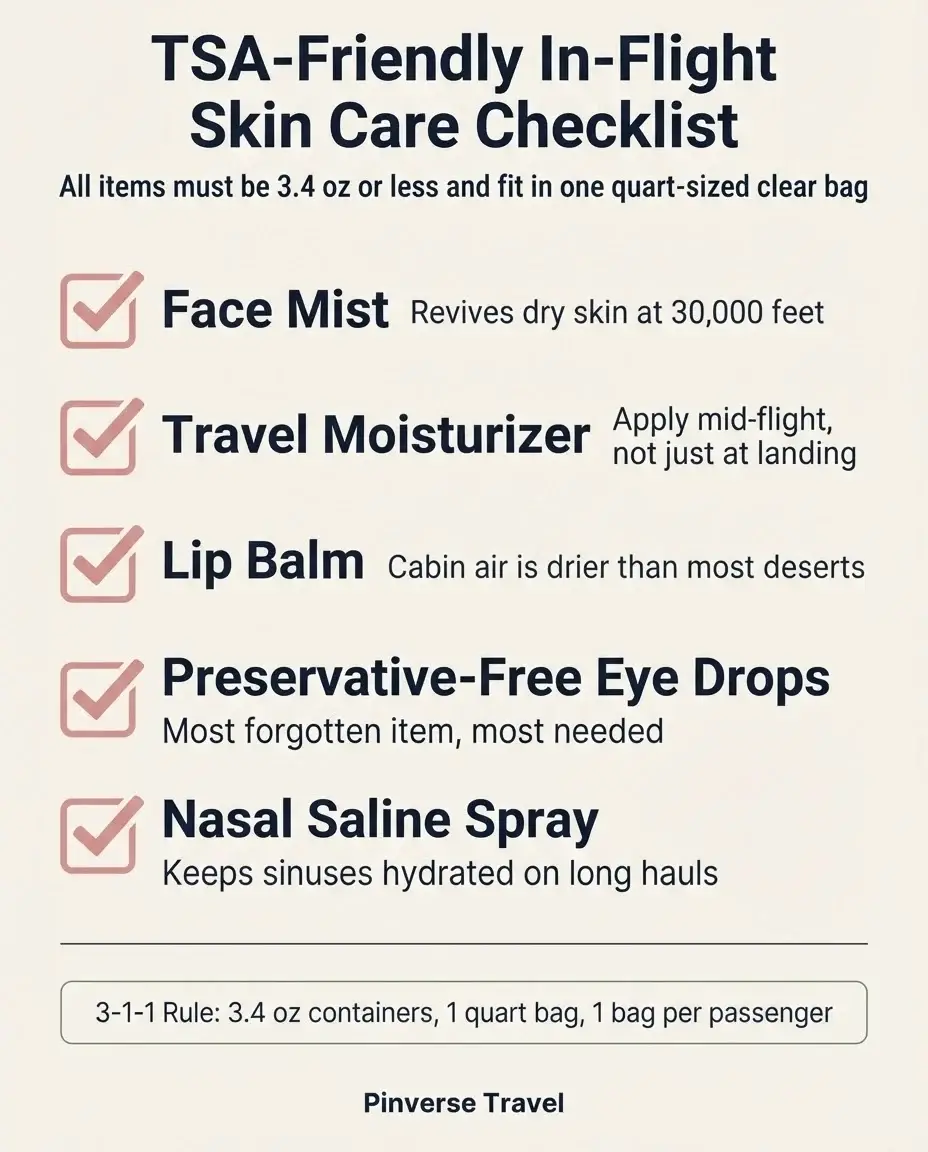
Dry cabin air also hits your skin, especially on overnight or long-haul flights. A small face mist and a simple moisturizer can make a big difference in how you feel and look when you land. A hydrating serum in a travel size works well under a moisturizer.
Here is the part that trips people up: anything that counts as a liquid, gel, or aerosol is subject to the TSA’s 3-1-1 liquids rule, which means containers of 3.4 oz (100ml) or less, all fitting in a single quart-sized clear bag. Face mists, moisturizers, lip balm (if it counts as a paste), and nasal saline sprays all need to be in travel-size containers. The good news is that most pharmacy chains sell travel-size versions of popular products, and most drugstore brands work just as well as premium options in a pinch.
A separate tip: eye drops are one of the most forgotten skincare items for flying, and dry eyes from recycled cabin air are extremely common. A small bottle of preservative-free artificial tears does not take up meaningful space and can make the last three hours of a flight far more comfortable.
The Tech That Reduces Stress Before You Land
An eSIM or international SIM: set it up before you board
One of the most stressful moments in international travel is landing in a new country, not being able to connect to anything, and standing in a foreign terminal trying to figure out where to go. This used to be a given. It does not have to be anymore.
An eSIM lets you activate a local or regional data plan on your phone before you even leave home. You download the eSIM profile, activate it, and when your plane lands, you switch over and have data instantly. No hunting for a SIM card kiosk. No waiting in line. No getting a physical SIM forced on you at the airport with a confusing setup process.
Airalo is one of the most widely used eSIM providers for international travel, offering regional and country-specific plans for most destinations. Holafly is another solid option, particularly for travelers who want unlimited data without tracking usage. Most plans are activated directly through the provider’s app and take about five minutes to set up. Doing this the night before you fly is one of those small preparation habits that removes a whole category of stress from the arrival experience.
A luggage tracker for your carry-on
Even when I’m flying with only a carry-on, which is most of the time, I like having a small luggage tracker inside my bag. Apple AirTags are the most widely used option in the Apple ecosystem, and there are similar Bluetooth trackers for Android users. The peace of mind of being able to see where your bag is in real time is worth the $30 price tag, particularly for solo travelers who don’t have a travel partner to watch their bag while they navigate an unfamiliar airport.
Per FAA rules, AirTags and Tile trackers are allowed in both carry-on and checked baggage as long as the battery doesn’t exceed 2.7 Wh, which the standard CR2032 battery in an AirTag does not. So they are fully compliant for any bag.
A Few Things Worth Leaving Behind
Not everything sold as a “travel comfort gadget” earns its place in your bag. A neck pillow that doesn’t fit your sleep style. Oversized noise-cancelling headphones if you are a light packer. A portable humidifier (yes, these exist for planes, and no, they are mostly impractical in an actual cabin setting). A full-size blanket when most long-haul carriers provide one.
The best travel kit is a lean one. Every item you pack for a flight has to justify its weight and volume, especially when you’re a solo traveler who carries everything yourself. Pick the things that solve your specific comfort problems. If you sleep fine in the noise but your back always aches, prioritize the foot hammock over the headphones. If you get cold easily but sleep anywhere, the blanket matters more than the eye mask.
The honest truth is that you will not know exactly what your kit needs to look like until you’ve done a few long flights and noticed what costs you the most comfort. Start with the fundamentals: headphones, a real pillow, compression socks, and something to keep you hydrated. Build from there.
The flight is the price of admission. But it doesn’t have to be the worst part of your trip.