How to Stay in a Hostel and Actually Save Money (A Real Guide)

The first night I booked a hostel bed, I sat at my desk in New York refreshing the confirmation email like it might disappear. I was about to sleep in a room with strangers on the other side of the world. I had absolutely no idea what I was doing.
That was before I backpacked solo across Europe. Before I taught English in Thailand. Before hostels stopped feeling like a gamble and started feeling like one of the best decisions I make on any trip.
Here is the honest truth: hostels are not for everyone, but they are for far more people than think they are. And if you learn how to use them well, they will transform your budget without sacrificing your experience. They might actually improve it.
This is the guide I wish I had before my first dorm check-in. No fluff, no vague “just be open-minded” advice. Real tactics, real numbers, and everything you need to walk in on day one and feel completely at ease.
What a Hostel Actually Is (and What It Isn’t)
A hostel is shared accommodation where you pay per bed rather than per room. You might be sleeping in a room with 4, 6, 8, or 12 other people. Sometimes more. Most hostels also offer private rooms, which are cheaper than hotels but give you your own space. Beyond the beds, a good hostel has a common room, a shared kitchen, lockers, and often a bar, a rooftop, or a program of social events.
What a hostel is not: a dirty, unsafe place where your things will disappear and you will never sleep. That is the outdated image that still keeps people away. Modern hostels, particularly the top-rated ones, are clean, social, and genuinely comfortable. Some look like boutique hotels inside.
The biggest shift in the hostel world right now is the rise of hybrid hostel-hotels, places that blend the communal energy of a classic hostel with proper amenities, ensuite private rooms, co-working spaces, and rooftop bars. Hostels have grown up. The only thing keeping you from them is your own assumption about what they look like.
The Real Cost of Staying in a Hostel
Before you do anything else, understand the numbers, because this is where hostels change everything.
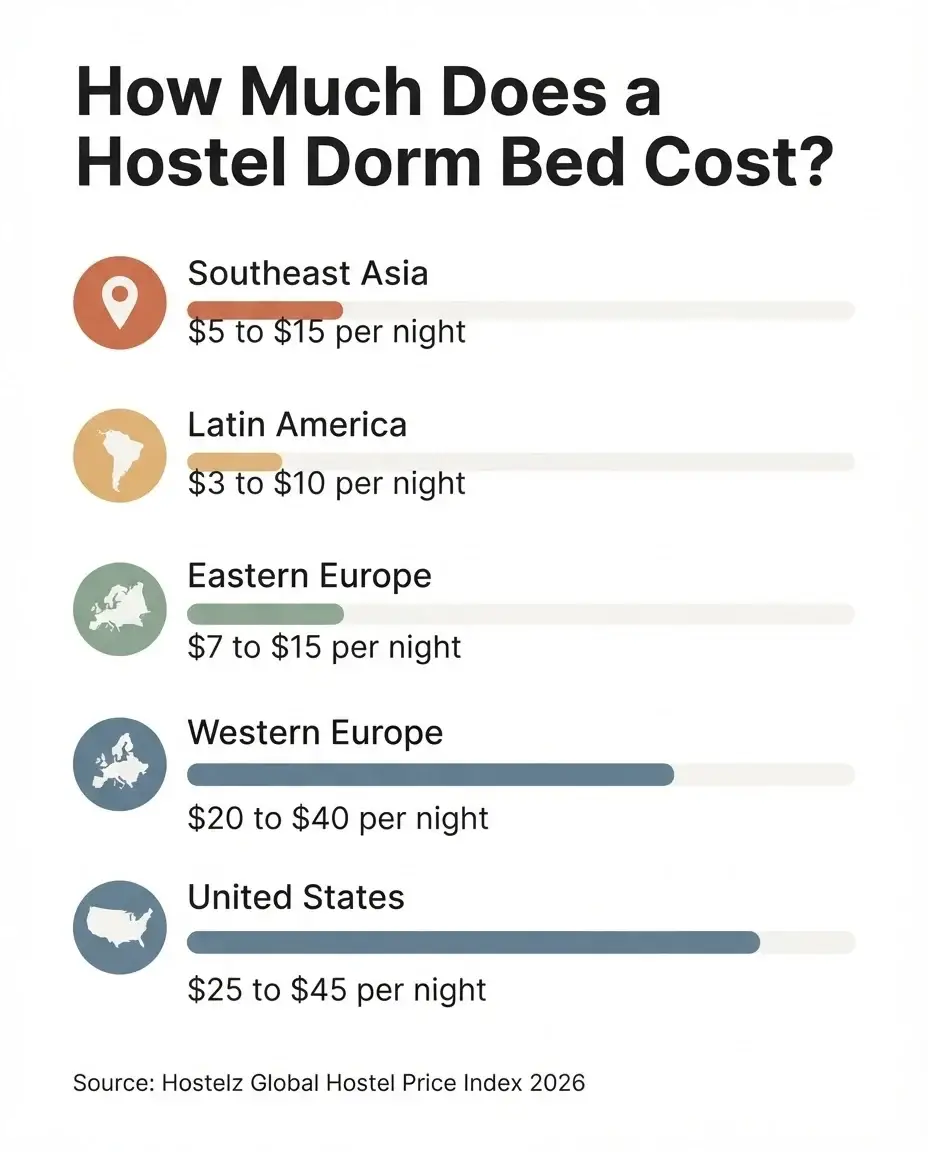
According to Hostelz’s Global Hostel Price Index, dorm beds in Southeast Asia run as low as $5 to $15 per night, with destinations like Yogyakarta in Indonesia coming in around $1 to $3 and Bangkok averaging $8 to $12. In Latin America, Colombia and Ecuador routinely offer dorm beds for $3 to $10 per night. Eastern Europe is the bargain of the continent: Prague from $9, Budapest from $8, Tallinn from $7 per night. Western European cities like Paris and Rome average $20 to $40 for a dorm bed, which still beats nearly any hotel option in the same city. US hostels in major cities like New York or San Francisco typically run $25 to $45 per night.
Compare that to even a budget hotel. In most of those same cities, you are looking at $80 to $200 per night minimum for a private hotel room. For a two-week trip, the difference can be the equivalent of an extra flight, a week of food, or three more days of exploring.
The savings compound when you factor in what good hostels include for free: breakfast at many properties, use of a full kitchen, free walking tours, free social events, and access to a common space that replaces the need for a separate coffee shop or co-working space.
How to Find and Book the Right Hostel
This is where most first-timers go wrong. They search for the cheapest option and pick whatever appears first. That is not how it works.
Read ratings the right way. The standard I use is simple: a hostel with a rating above 8.5 and more than 200 reviews is a reliable choice. Above 9.0 with 500 or more reviews is genuinely exceptional. The review count matters as much as the score. A 9.8 rating from 14 reviews tells you almost nothing. A solid 8.7 from 1,200 reviews tells you a lot. Hostelworld’s guide to picking a good hostel breaks down exactly what each rating category means, and it is worth a read before you start comparing properties.
Use a price comparison tool. Hostelz.com aggregates prices from Hostelworld and Booking.com simultaneously, which means you can see the exact same bed listed across platforms and sometimes find it 10 to 20 percent cheaper without any extra work. Once you find the best price, check if the hostel offers a lower rate for booking direct, which many do because they avoid platform fees.
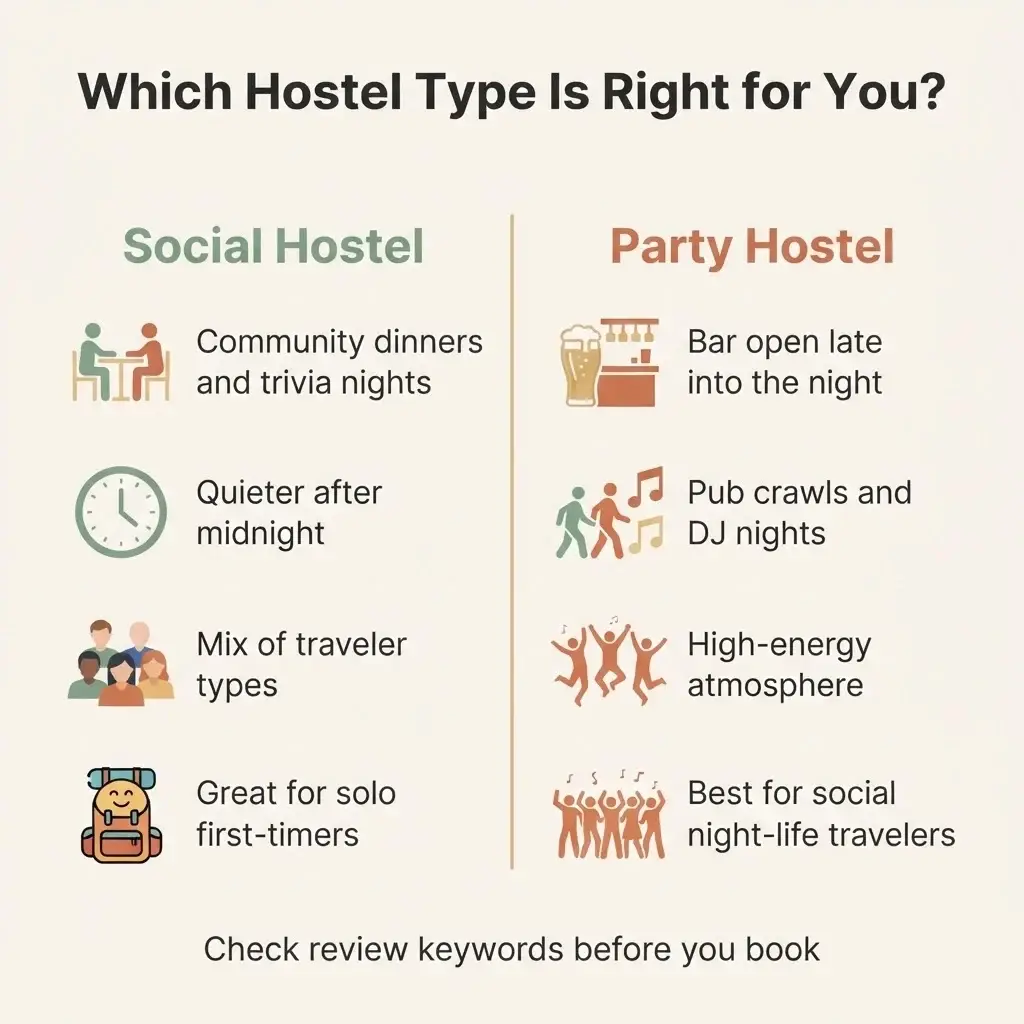
Know the difference between hostel types. A party hostel and a social hostel are not the same thing. A party hostel is loud, runs late, and centers around its bar. A social hostel is community-oriented, runs organized events like family dinners, walking tours, and trivia nights, and tends to attract travelers who want genuine connection rather than a nightclub atmosphere. Both are valid depending on what you want, but choosing the wrong type is how you end up sleep-deprived and annoyed on night one. Reviews that mention “met so many people” and “great vibe even for quiet nights” signal a social hostel. Reviews that say “great for partying” and “bar open until 4am” signal a party hostel. Hostelworld’s social hostel guide is a useful primer for understanding how to read these signals before you commit.
Book in advance for popular destinations, flex for off-peak ones. During peak tourist season in cities like Amsterdam, Lisbon, or Barcelona, the best-rated hostels fill weeks out. If you are traveling at a quieter time, booking last-minute can sometimes land you a lower rate or even an upgrade from a dorm to a private room because the hostel is trying to fill beds.
The HI Membership Trick Most Travelers Miss
If you plan to stay in hostels regularly, a Hostelling International membership is one of the most underused money-saving tools out there. HI USA membership gives you 10% off every stay at HI USA properties and access to discounted rates at over 2,300 hostels across the global HI network in nearly 80 countries. You also get discounts with partner travel companies, early access to hostel promotions, and free virtual workshops and cultural programming. Annual membership for US adults is around $28. If you are planning a trip where you will stay in hostels for even a handful of nights, the membership pays for itself quickly and often covers several times its cost over the course of a longer trip.
For travelers outside the US, Hostelling International has national organizations in most countries. You can find your closest affiliate and purchase membership through hihostels.com to access the same global network of discounts.
What to Pack for a Hostel Stay
You do not need much, but the things you do need really matter. Getting this wrong makes your stay noticeably worse. Getting it right means you arrive comfortable and prepared.
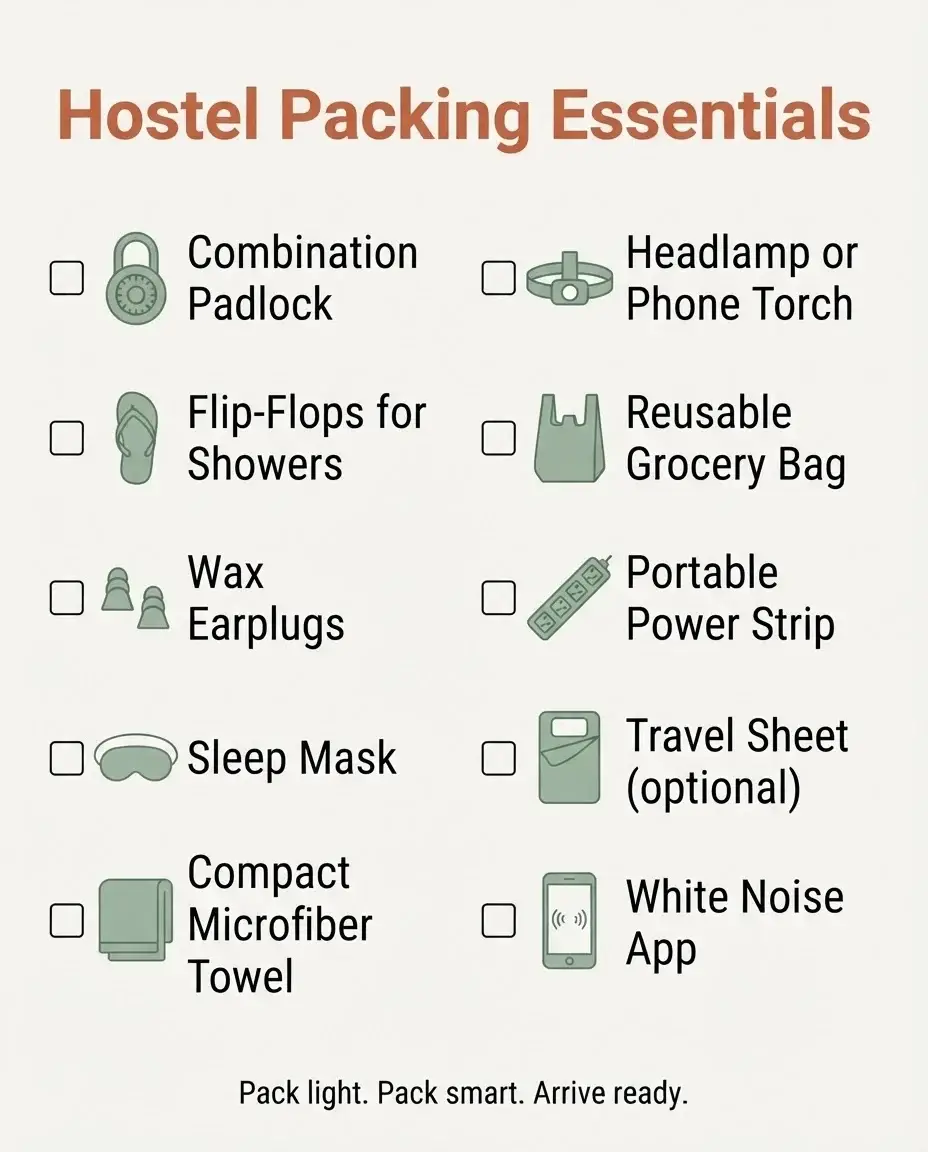
The non-negotiables are a combination or keyed padlock (more on lockers in a moment), flip-flops for shared showers, a compact travel towel because most hostels either charge for towels or do not provide them at all, earplugs and a sleep mask for dorm sleeping, and a small portable power strip if you are staying somewhere with limited outlets near your bunk.
On earplugs specifically: wax earplugs outperform foam ones in a hostel dorm. They mold to your ear canal and block more ambient noise. If you are a light sleeper, this single item can be the difference between a miserable night and a genuinely restful one. A white noise app on your phone set to low volume works well as a backup layer.
For lockers: most hostels have them, but not all provide the lock. A good padlock needs the right shackle size to fit the locker opening. If you check Hostelz’s guide to the best locks for hostel lockers before you travel, you will know exactly what dimensions work across most hostel locker types. A combination lock means no key to lose; a keyed lock from a solid brand like ABUS is slightly more secure but requires you to manage the key.
Keep your valuables, passport, and any cash you are not actively using in the locker every time you leave the room. Not because hostels are dangerous, but because this is simply the smart habit in any shared space.
Saving Money Beyond the Bed Price
The bed rate is only the beginning. Here is where experienced hostel travelers quietly save hundreds of dollars on a single trip.
Use the kitchen. Almost every hostel with a kitchen has one that is massively underused. Buying groceries at a local market and cooking simple meals, even just breakfast and one meal a day, can save $10 to $20 daily compared to eating every meal at restaurants. Over a two-week trip, that is a potential $140 to $280 in savings just from cooking occasionally. The kitchen is also one of the best places to meet other travelers organically. Someone is always making pasta at 7pm and happy to share a table.

Claim the free breakfast. When comparing hostel options at similar price points, always check whether breakfast is included. A hostel charging $18 with breakfast included often beats one charging $14 without it, once you price out even a basic cafe breakfast in that city. Use Hostelworld or Hostelz to filter for hostels with breakfast included. It is a detail most people skip over during booking.
Take advantage of free hostel events. This is one of the most underrated budget strategies I know. Hostelworld’s research on hostel activities shows that top-rated social hostels run multiple free or nearly free events per week, including walking tours, family dinners, pub crawls with discounted drinks, trivia nights, cooking classes, and yoga sessions. A free hostel walking tour of a city replaces a $30 to $50 guided tour. A group dinner at the hostel is cheaper and often more memorable than a restaurant meal alone. Before you book paid tours or activities in any destination, check your hostel’s events calendar first. You might already have access to the experience you were about to pay for.
Avoid checking in with tourist tunnel vision. The hostel staff and the people at the front desk often know things no guide or blog post does: which neighborhood market has the best cheap food, which bus route is free or nearly free, which local activity is worth it versus overpriced. When I arrived at hostels during my time backpacking through Europe, talking to the staff at check-in consistently led me to experiences that saved money and felt more authentic than anything I had pre-planned.
Hostel Etiquette: How to Be the Roommate Everyone Likes
Knowing the unwritten rules matters. Breaking them does not get you in trouble, but it makes the experience worse for everyone, including you.
Quiet hours are real. Most hostels maintain quiet hours from around 10pm or 11pm to 7am or 8am in dorm rooms. Coming in late and turning on overhead lights, rustling plastic bags, or having a full conversation at volume is the fastest way to make enemies of your roommates. Pack your things the night before if you have an early departure. Use your phone torch rather than the room light. This sounds small but it matters enormously in a shared space.
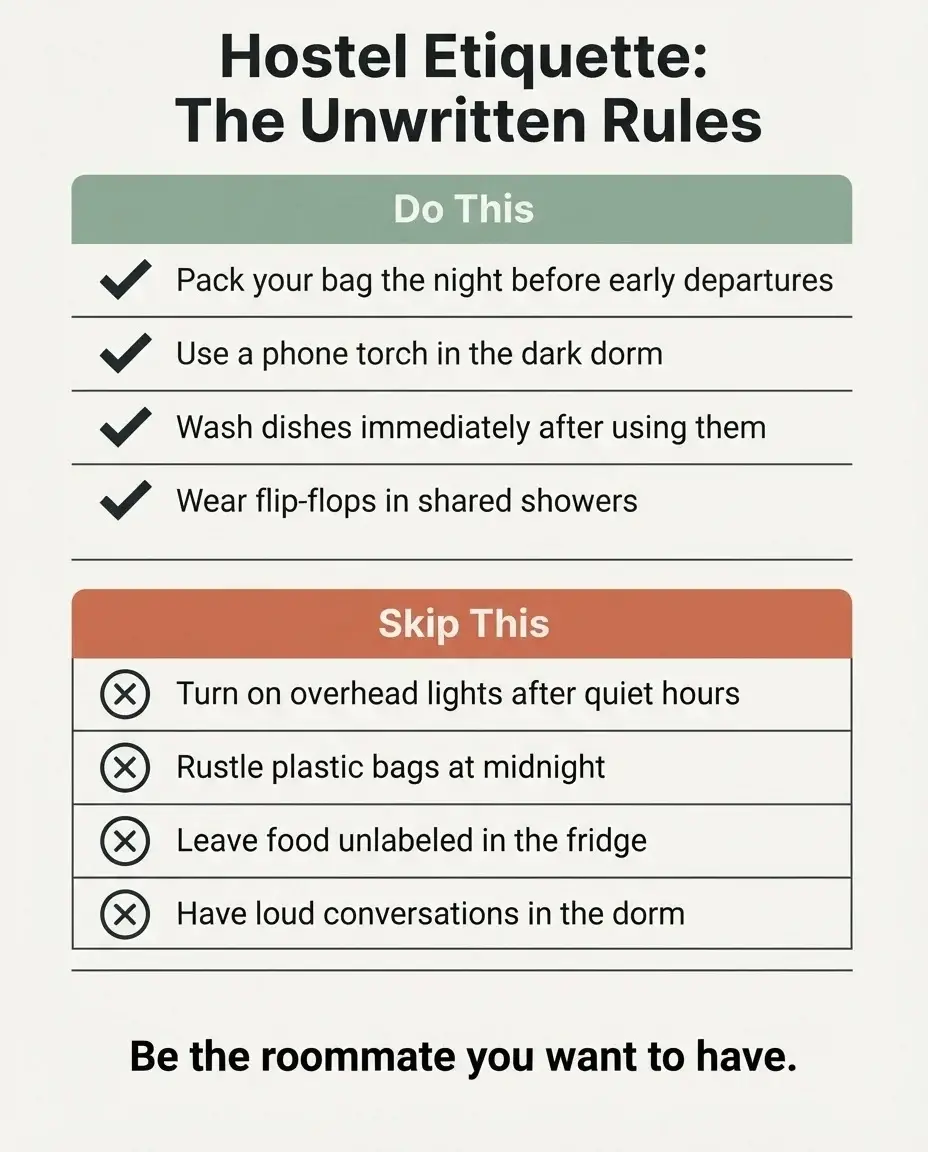
Showers are shared infrastructure. Keep it brief during peak times, clean up after yourself, and wear your flip-flops. On the flip-flop point specifically: shared shower floors in a hostel carry a higher risk of athlete’s foot and fungal infections than a private bathroom, a basic hygiene consideration backed by standard CDC travel health guidance on shared facilities. Flip-flops eliminate this risk entirely and take up almost no space in your bag.
The kitchen has social norms. Wash your dishes immediately after using them. Do not leave food out or take food that is not yours (unless it is labeled as free or communal). Label anything you want to keep in the fridge. A shared kitchen that works is one where everyone treats it like a shared kitchen and not a personal pantry.
Be social but read the room. A hostel common area is one of the easiest places in the world to start a conversation: everyone there is a traveler, most are alone, and the environment practically invites interaction. But it is also okay to be in the mood for quiet. Some people are recovering from long travel days or just want to read. The golden rule is simple: match the energy of the room rather than forcing a dynamic.
A Note on Safety, Especially for Solo Women
Hostels are, for the vast majority of travelers, very safe environments. The fears around them tend to be far larger than the actual risk. That said, smart habits make a genuine difference.
Read safety-specific reviews. Search the word “safety” or “solo female” in the reviews of any hostel you are considering. Patterns in the feedback, both positive and negative, tell you more than the aggregate score alone.
Consider female-only dorms. Many hostels offer female-only dorm options alongside mixed-gender rooms. These tend to be quieter at night and often have a strong communal dynamic. Hostelz.com specifically has a filter for female-only hostels and female-only dorms, which makes finding them significantly easier during the planning stage.
Trust your instincts at check-in. If the vibe of a hostel feels off when you arrive, if the reception is chaotic, the lockers look broken, or something just does not feel right, you are allowed to leave. Booking is not a contract that traps you somewhere uncomfortable. Most hostels with reasonable cancellation policies will work with you. The perfect hostel exists for every budget and every destination. If the one you arrive at is not it, the next one probably is.
The Part About Why Hostels Are Worth It Beyond the Money
I want to say something that the purely practical guides tend to leave out.
Hostels changed the way I travel. Not because they saved me money, though they absolutely did, but because they put me in the same room as people I would never have met otherwise. During my solo backpacking trip across Europe, some of the most memorable conversations of my travel life happened in hostel kitchens and common rooms: a woman from Brazil who had been teaching herself languages for a decade, a retired teacher from Scotland doing his first solo trip at 62, a group of Australians who convinced me to take a day trip I had not planned and that turned out to be one of the best days of the trip.
You cannot replicate that in a private hotel room. You can absolutely enjoy a private hotel room, but the serendipity that comes from shared space is something else entirely. Hostels are not just cheaper accommodation. They are a different way of experiencing a place.

If you are on the fence, I would encourage you to try it once. Book a well-rated social hostel for two or three nights in a city you already feel comfortable in. Go in with the knowledge from this guide. See how it feels. Most people who try it once keep going back, not because of the price, but because of what happens there.
Before You Check In: A Quick Practical Checklist
These are the things worth confirming before arrival rather than figuring out at the front desk.
Check the check-in time and whether there is 24-hour reception, especially if you are arriving on a late flight. Pack your padlock in an accessible part of your bag so you can set up your locker immediately. Know whether your hostel provides linen or whether you need a sleep sheet (most include linen now, but some budget properties charge extra). Download the Hostelworld app before you go and check the hostel’s events calendar for the dates of your stay. Bring a small headlamp or use your phone flashlight so you can move around a dark dorm without waking anyone. And bring a small reusable bag for groceries if you plan to use the kitchen, because you will inevitably want to.
Getting the practical details right before you arrive means your first night goes smoothly. That first night matters. A smooth arrival in a well-chosen hostel sets the tone for everything that follows.
The goal is simple: to arrive, get settled, and then go live the trip you planned. Hostels, done right, are how you afford to stay longer, go further, and come home with stories that actually meant something.