How to Book Safe Cheap Airbnbs Without Getting Burned

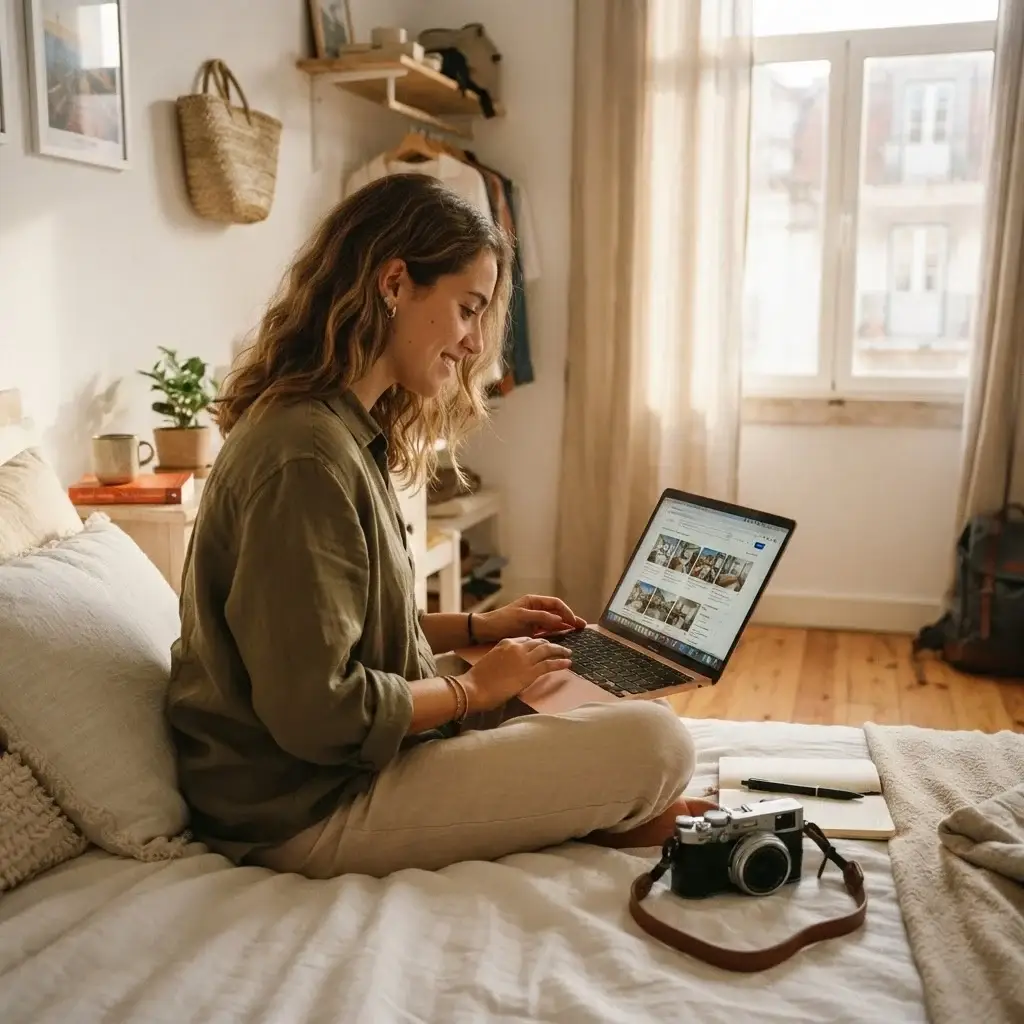
There is a particular feeling that comes with opening Airbnb for the first time with a trip on the horizon. Part excitement, part overwhelm, and underneath it all, a small nagging voice asking: “But what if it’s nothing like the photos?”
I know that voice well. Before I left my office job and started traveling full-time, I booked some truly questionable accommodations. Not because I was careless, but because I didn’t yet know what to look for. I learned through trial and error, through a musty hostel in Amsterdam that claimed to be “cozy” and a room in Barcelona where the door didn’t actually lock from the inside. Those experiences didn’t stop me from traveling. They made me a smarter traveler.
Airbnb is genuinely one of the best tools a solo traveler has, especially for slow travel and longer stays. But it rewards people who know how to use it. This guide is everything I wish I’d had before I started booking. We’re going to go through the full process, from understanding the real cost of a listing to knowing what to do if something goes wrong after check-in.
Why “Safe” and “Cheap” Are Not Opposites
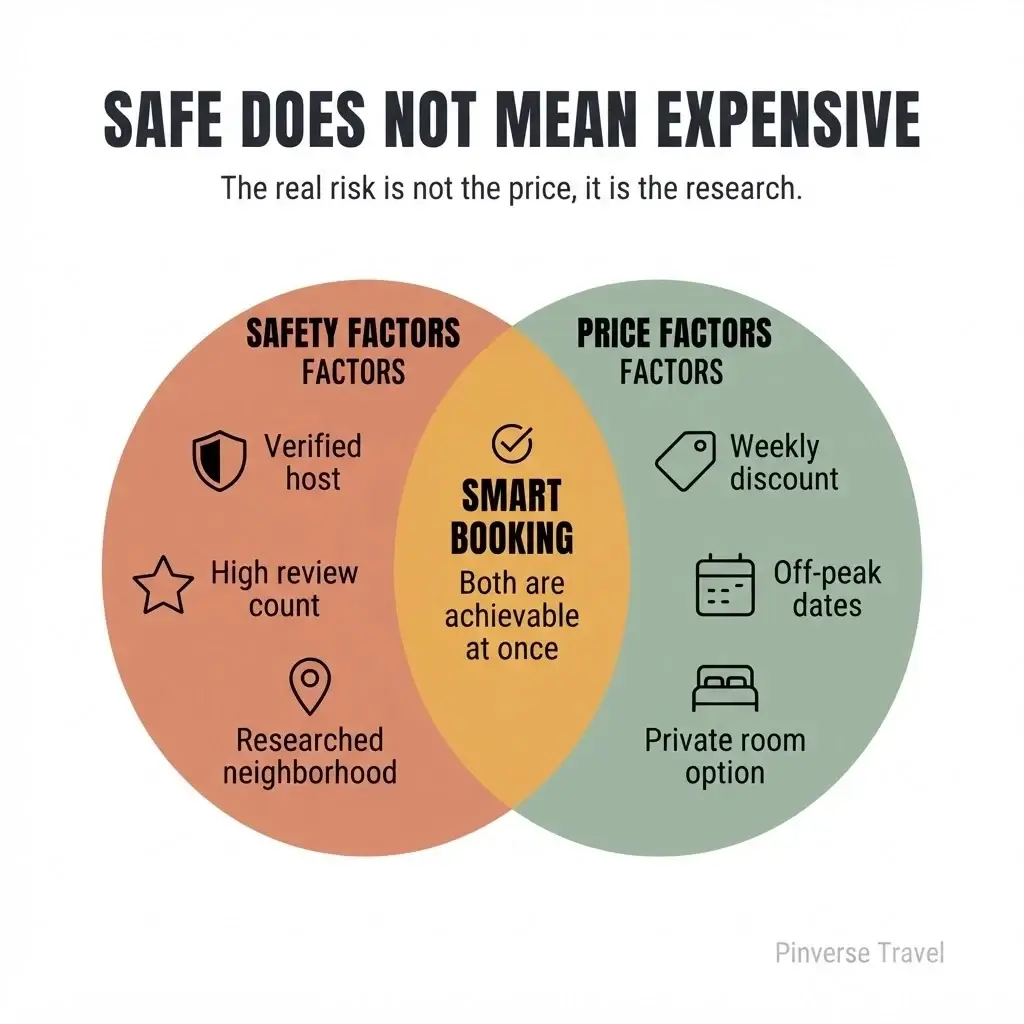
A lot of people treat safety and affordability as competing priorities, like you have to sacrifice one to get the other. That’s not true, and I want to clear that up before we go any further.
The most expensive Airbnb in a neighborhood is not automatically the safest. And a budget-friendly listing with 200 glowing reviews from solo travelers is not a red flag. The real risks with Airbnb have almost nothing to do with price. They have to do with how well you vet the listing, the host, and the location before you hand over your money. A careful search process protects you regardless of your budget, and that’s exactly what this guide is built around.
Start With the Real Price, Not the Nightly Rate
Before we even talk about safety, let’s talk about the number one way people get surprised by Airbnb: the fees.
The nightly rate you see in search results is almost never what you’ll actually pay. Airbnb adds a service fee, which typically ranges from around 14% to 16.5% of your booking subtotal. Then there’s often a cleaning fee set by the host, which can range from a few dollars to an amount that completely wipes out any savings compared to a hotel. For a one-night stay, a $50 cleaning fee makes that $60 “cheap” listing cost $110 before the service fee even hits.
Here’s how to handle it. Always click through to the full price breakdown before you get attached to any listing. Switch the Airbnb search display to show the total price per night, which is an option in the filters. This shows you the all-in nightly cost including fees, spread across your stay length, which makes it much easier to compare listings honestly.
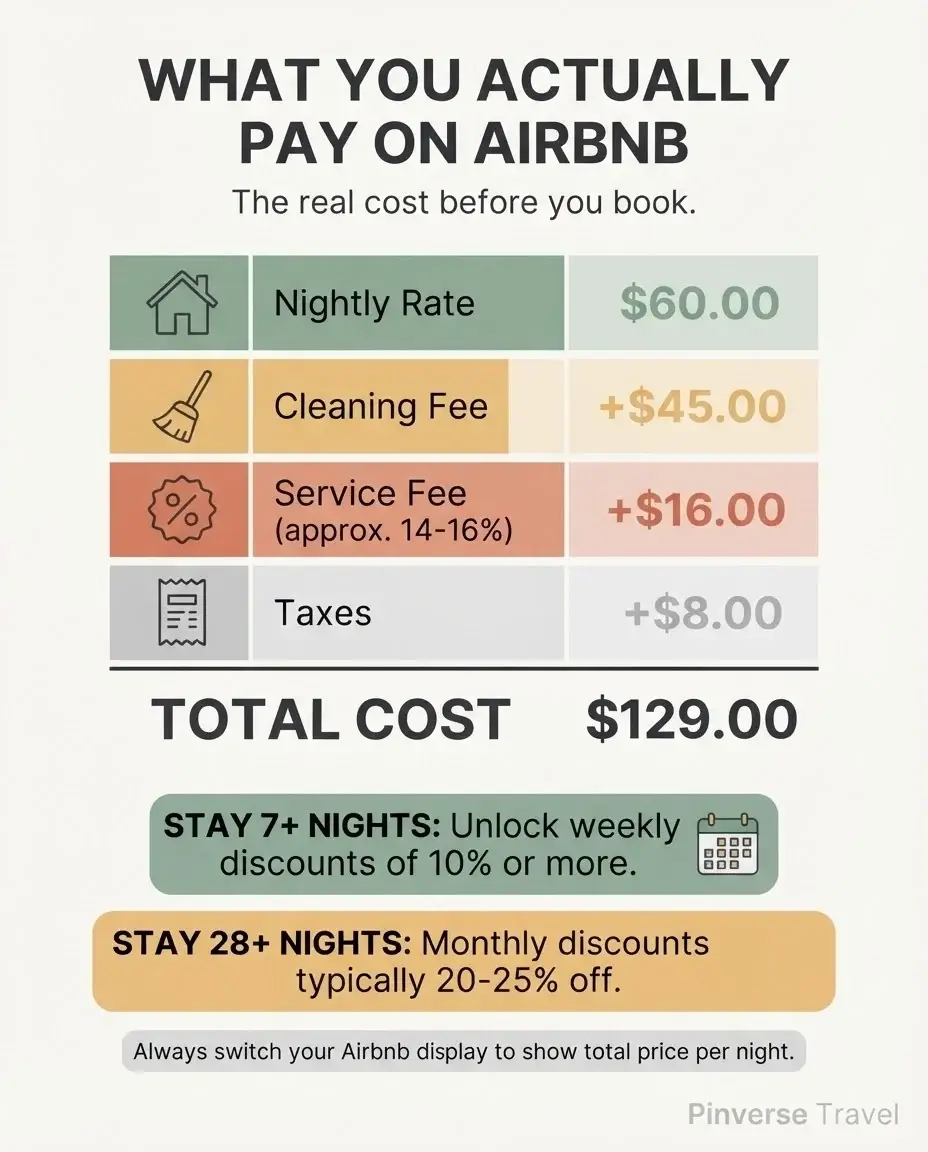
If you’re planning a longer stay, this is where Airbnb gets genuinely great for budget travelers. Hosts can offer automatic weekly discounts for stays of 7 or more nights, and monthly discounts for stays of 28 nights or more. According to Airbnb’s own guidance on weekly and monthly discounts, discounts of 10% or more are highlighted in search results, and monthly discounts commonly range between 20% and 25% off the base rate. If you’re doing a slow trip and spending two or three weeks in one city, booking a monthly Airbnb instead of hopping between hotels can save you a serious amount of money and give you a much more comfortable base.
How to Find Listings Worth Your Attention
With millions of listings on Airbnb, the search itself can feel paralyzing. Here’s how to cut through the noise efficiently.
Use the filters strategically, not aggressively. The more filters you stack, the fewer results you see, and you may miss great listings that don’t technically tick every box. Start with your non-negotiables only. For solo travelers, that usually means the property type (entire place or private room), a minimum rating, and your price ceiling. Add other filters one at a time.
Filter by “Guest Favorite” or look for the Superhost badge. Superhost is a status Airbnb awards to hosts who consistently deliver excellent experiences. According to Airbnb’s Superhost requirements, a host must maintain a 4.8 or higher overall rating, respond to 90% of messages within 24 hours, have a cancellation rate below 1%, and have hosted at least 10 reservations. This status is reviewed every quarter. It doesn’t guarantee a perfect stay, but it does tell you the host has a long track record of happy guests, which is meaningful. As a solo traveler, I always give Superhost listings a closer look.
Look at how many reviews a listing has, not just the star rating. A brand new listing with zero reviews and a 5.0 rating means nothing yet. A listing with 150 reviews and a 4.7 rating tells you a lot. New listings aren’t automatically bad, but they require more scrutiny.
How to Actually Read Airbnb Reviews
This is where most people stop too early. They glance at the star rating and scroll through a couple of five-star comments. But reviews are the richest source of real information you have access to, and most travelers don’t use them properly.
First, sort reviews by most recent. Listings change. A host who was wonderful two years ago may have gotten lazy, changed the space, or handed management to someone else. Recent reviews tell you what the current experience actually looks like.
Second, scan for patterns, not just complaints. One guest mentioning “the wifi was slow” is not a red flag. Five guests across different time periods mentioning “the wifi was slow” is a real problem. Any issue that appears more than once is the real experience, not an outlier.
Third, pay attention to what reviewers don’t say. When every single review gushes about the decor and the location but nobody mentions the host’s communication, that’s a gap worth noticing. The best listings generate comments like “the host responded immediately,” “they left great local recommendations,” and “I felt completely comfortable staying here alone.” Those details matter especially if you’re traveling solo.
Fourth, look at the host’s responses to any negative reviews. A host who handles criticism graciously, takes responsibility, and explains what they’ve done to fix the issue is someone you can trust. A host who argues with guests in public responses is someone you want to avoid.
Vetting the Neighborhood Before You Commit
No matter how perfect a listing looks, if it’s in a neighborhood that makes you uncomfortable, none of the rest matters. Airbnb shows you a rough map location before booking, and the exact address after. That means you need to do some independent research.
One tool I find genuinely useful is Numbeo’s city safety index, which is a crowdsourced database that tracks perceived safety levels across hundreds of cities worldwide. It won’t tell you about a specific street, but it gives you a solid baseline for understanding how safe a city or neighborhood generally feels to travelers and residents. It’s free, regularly updated, and much more granular than any generic travel advice.
Beyond that, open Google Maps and spend five minutes doing a Street View walk of the block. Look at the actual buildings, street lighting, what businesses are nearby. Does the street feel lively and accessible? Is public transit close? Are there cafes and convenience stores within easy walking distance? These small things matter enormously to your daily comfort and sense of security, especially when you’re alone.
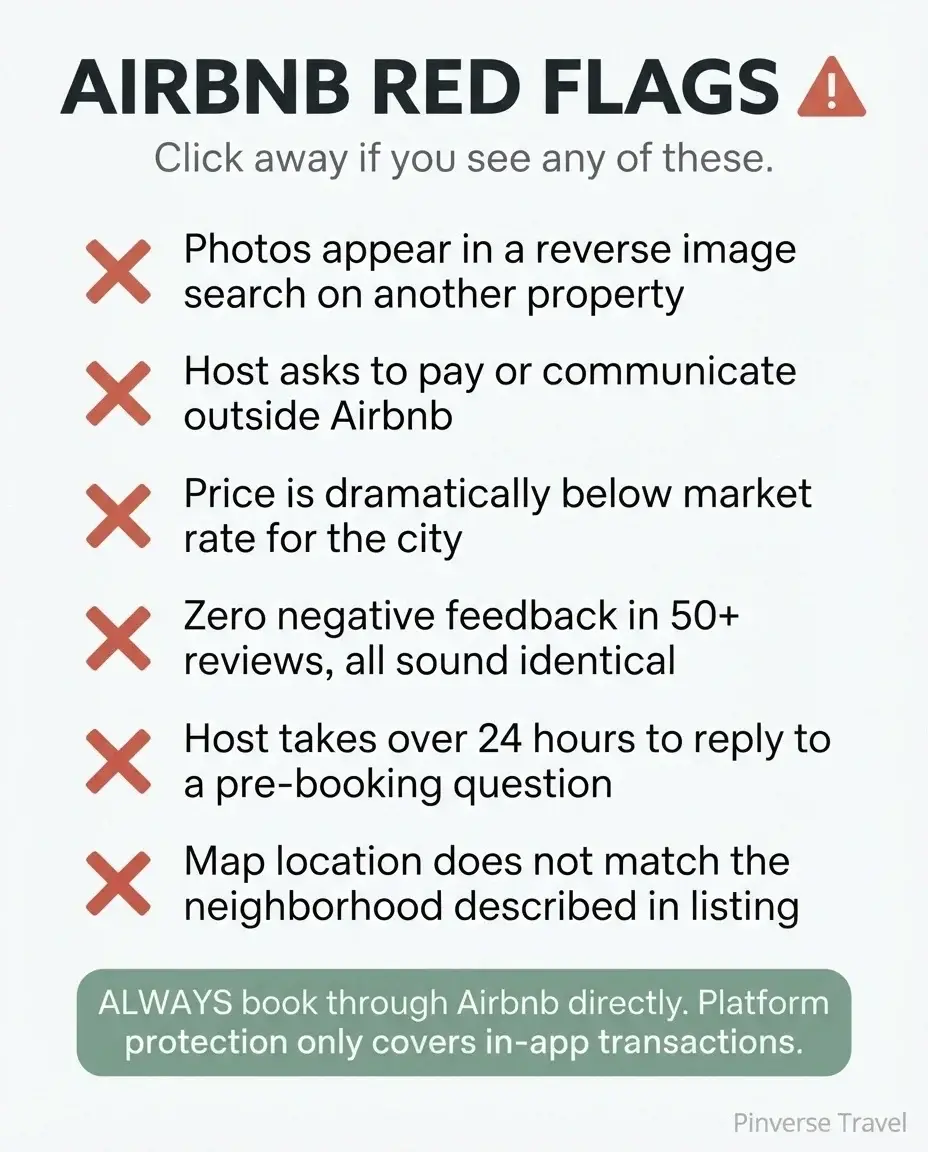
Don’t be afraid to message the host directly before booking and ask about the neighborhood. Something simple like: “I’m traveling solo and wondering what the neighborhood is like at night, and which areas to avoid nearby?” A good host will answer promptly and give you real, honest information. A host who gives a vague non-answer, or takes more than 24 hours to reply to a pre-booking question, is showing you exactly how they’ll communicate if you have a problem during your stay.
Red Flags That Should Make You Click Away
Solo travel has taught me that my gut reaction when something feels off is almost always worth listening to. Here are the concrete signals that mean “keep looking.”
Listings where the photos look too professional and the price is dramatically below market for that city. This is a common pattern in fake listings. A great guide from Norton Security on Airbnb scams outlines how fraudulent listings often use stolen photos from other properties, and the simplest way to verify photos is a quick Google reverse image search on the main listing image. If the same photo shows up on a different property, walk away immediately and report it.
Any host who asks you to communicate or pay outside of the Airbnb platform is a scammer. Full stop. Always book through Airbnb directly. The platform’s protection only covers you for transactions that happen inside it.
Listings described as “private room” that show photos of an entire apartment. Listings where the location pin on the map doesn’t match the neighborhood described. Listings with reviews that all sound oddly generic and were posted within the same week. All of these are worth treating as warnings.
An unusually high concentration of five-star reviews without a single piece of constructive feedback is also worth noting. Real reviews contain a mix of thoughts. When every single review reads like a copy of the same template, that’s a flag.
Understanding What Airbnb’s Protection Actually Covers
This part matters a lot for solo travelers and first-time Airbnb users, because a lot of people don’t realize they have more recourse than they think when something goes wrong.
Every Airbnb booking comes with something called AirCover for guests. According to Airbnb’s official AirCover page, this covers you in specific serious situations: if your host cancels before check-in, if you can’t get into the property, or if the listing is significantly different from what was advertised. In any of those cases, Airbnb will help you find comparable accommodation or issue a refund including service fees. There is also a 24-hour safety line that connects you to trained safety agents or local emergency services if you ever feel unsafe during a stay.
The key thing to know is the 72-hour rule. If something is wrong with your listing, you must report it to Airbnb within 72 hours of discovering the issue to be eligible for help. Document everything with photos or video the moment you notice a problem, message your host through the app, and if they can’t or won’t resolve it, contact Airbnb directly. Don’t wait. Don’t hope it gets better on its own.
AirCover does not cover minor inconveniences. A broken toaster or a slow shower drain won’t qualify. But if the listing has fewer bedrooms than advertised, a major amenity like AC or a washing machine doesn’t work, or the entire property type is different from what you booked, that absolutely falls under their protection.
For disputes and reimbursement requests after the fact, Airbnb’s Resolution Center is where you manage those conversations. It’s accessed through your account and works as a formal record of the issue and the resolution.
A Quick Word on Privacy and Cameras
This comes up a lot in solo travel circles and it deserves a direct answer. Airbnb’s policy is clear: hosts are strictly prohibited from placing cameras inside a rental in any private space, including bedrooms, bathrooms, and sleeping areas. Disclosed outdoor cameras are permitted under the rules. If you find an undisclosed camera indoors, document it, leave the property if you feel unsafe, contact Airbnb immediately, and contact local police.
For peace of mind, Airbnb’s camera policy for hosts is detailed and the platform takes violations seriously. When you check in to any new place solo, do a quick visual scan of the space. Pay attention to smoke detectors pointed at beds, decorative objects facing unusual angles, or anything with a small hole or lens. Most stays will have nothing of concern, but it takes two minutes and it’s worth the habit.
Smart Strategies for Genuinely Lower Prices
Beyond the long-stay discounts already mentioned, there are a few more reliable ways to find better prices without compromising on quality.
Book slightly off-peak. Prices on Airbnb are dynamic, just like flights. The same listing will often cost 30% less on a Tuesday check-in than a Friday check-in, or in the shoulder season of a popular destination compared to peak summer.
Look at listings that have been sitting without bookings for a while. If a listing’s calendar shows open dates near your travel window with no bookings, the host may be more willing to lower their price. You can send a polite message asking if they have any flexibility for your dates. Many hosts would rather fill the calendar at a slight discount than have it sit empty.
Consider private rooms in addition to entire places. A private room in a shared apartment or house is often dramatically cheaper, and for solo travelers in cities they’re exploring actively, it can actually feel safer. You’re sharing the space with someone who knows the neighborhood and has as much interest as you do in keeping the place comfortable. Some of my most interesting travel conversations have happened over a kitchen table with a host whose apartment I shared.
Finally, be flexible on check-in dates when you can. Some platforms connected to Airbnb, and Airbnb’s own flexible date search, will show you which dates nearby are cheapest. Shifting a trip by even two or three days can change the total cost significantly.
Before You Finalize Any Booking: A Simple Pre-Booking Checklist
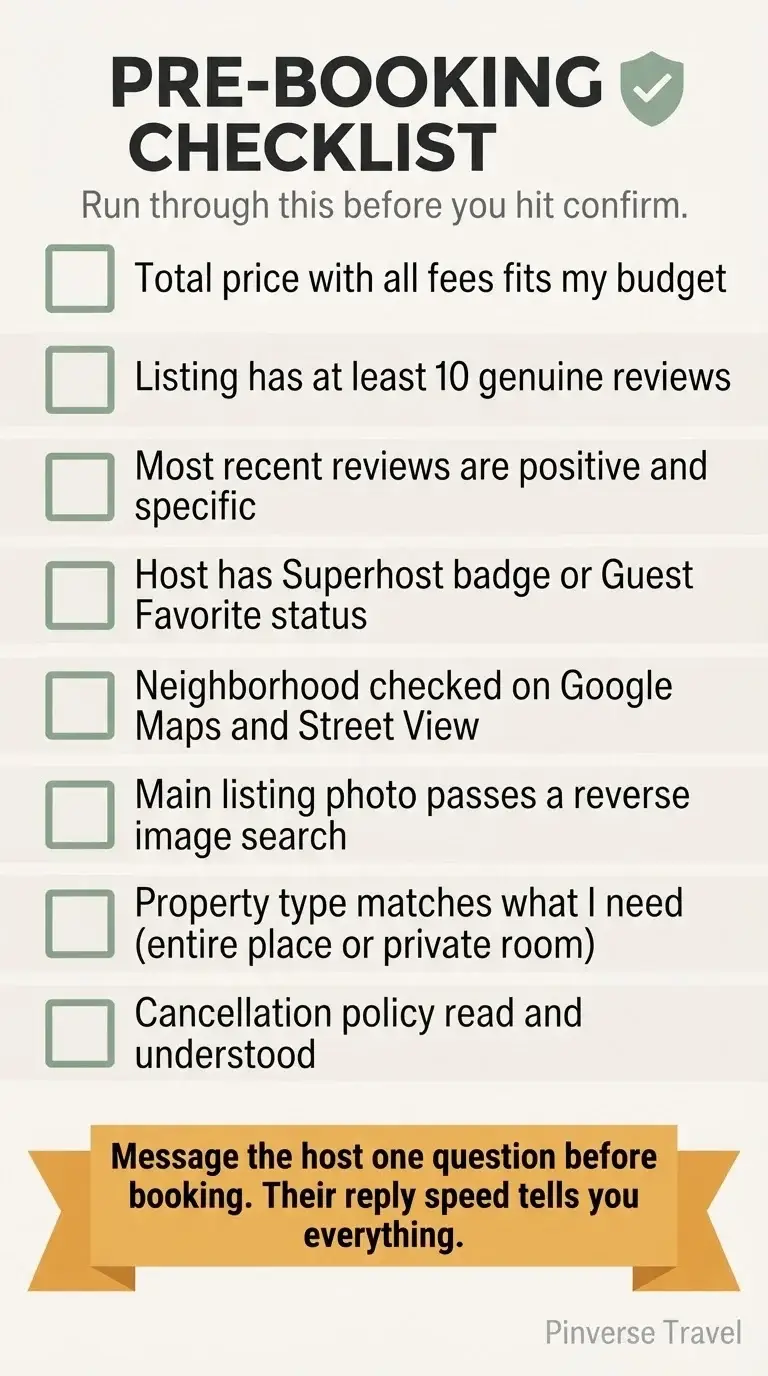
Run through this before you hit confirm on any listing:
- Is the total price (with all fees) still within your budget?
- Does this listing have at least 10 reviews, ideally more?
- Are the most recent reviews positive and specific?
- Is the host a Superhost or does the listing have “Guest Favorite” status?
- Have you looked at the neighborhood on Google Maps and Street View?
- Have you cross-checked the listing photos with a reverse image search?
- Have you confirmed the property type matches what you want (entire place vs. private room)?
- Have you read the cancellation policy so you know your options if plans change?
If you can answer yes to all of these, you’re in solid shape. You won’t eliminate every possible surprise in travel, and honestly, some of those surprises turn into the best stories. But you’ll eliminate the ones that stem from not looking closely enough.
What to Do When You Arrive
The first five minutes in any Airbnb tell you a lot. Take them seriously.
Walk through the whole space before you unpack. Check that windows and door locks work properly. Look at the condition of things that reviews mentioned, good or bad. Take a few quick photos of any existing damage, scuffs, or issues before you settle in. This protects you if the host tries to claim damages after checkout that were there before you arrived.
If something significant is not as described, start the clock on that 72-hour window immediately. Message the host through the app, explain what you found, and give them a chance to fix it. If they can’t, contact Airbnb. Keep everything documented in writing inside the platform.
Most stays will be straightforward and lovely. But knowing what to do if they aren’t makes the whole experience more comfortable, because you’re not traveling in a state of hoping nothing goes wrong. You’re traveling knowing you can handle it if something does.
A Final Thought
The people who are afraid of Airbnb usually haven’t used it much. The people who have had bad experiences on Airbnb usually didn’t know what to look for. And the people who use it confidently and consistently, and find brilliant, affordable places all over the world, have usually just done a version of what this article covers.
Solo travel is one of the most clarifying things I’ve ever done. It taught me to trust my own judgment, to ask questions I wouldn’t have thought to ask before, and to get comfortable in situations that would have felt overwhelming from the outside. Booking an Airbnb is a small version of that same process. It rewards the traveler who pays attention, does a little homework, and doesn’t just accept the first thing that looks okay.
You’re capable of this. Go find the place that makes your next trip feel like home.