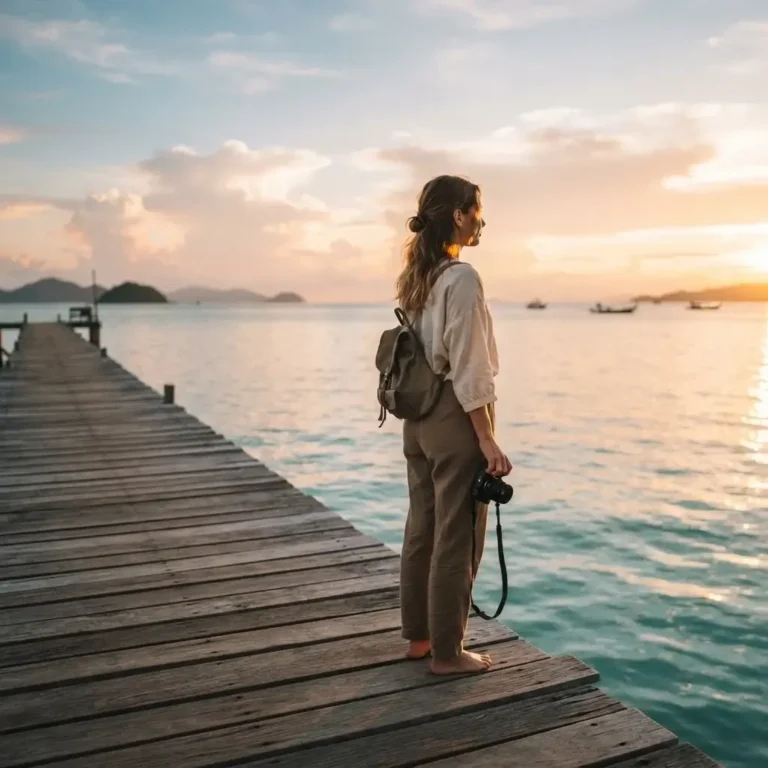
The Best Warm Places to Travel Solo for the First Time

I remember the exact moment I finally stopped waiting for the right time to travel alone. I was sitting in my New York apartment in February, staring at a grey sky that looked like it had no intention of ever changing, and I thought: I could be somewhere warm right now. Not just warm outside. Warm in every sense of the word. Open, alive, full of color and food and people who weren’t rushing past me to catch the subway.
If you’re searching for the best warm destinations for solo travelers, I want to bet that you’re somewhere similar right now. Maybe you’ve been saying “someday” for a little too long. Maybe you’re nervous about going alone, but the fantasy of beaches, spice markets, golden-hour streets, and actual sunshine keeps pulling at you.
Here’s what I want you to know before we dive in: choosing a warm destination for your first solo trip doesn’t have to be complicated or scary. The right place for you depends less on some objective ranking and more on what kind of experience you actually want. And there are some genuinely incredible warm places in the world that are welcoming, navigable, and deeply rewarding for solo travelers at almost any confidence level.
Let’s go through them honestly.
How to Actually Think About Warm Destinations as a Solo Traveler
Before any list, I want to give you a framework that most articles skip entirely. “Warm” covers an enormous range of experiences. Lisbon in October is warm and easy and feels a little like Europe with sunlight. Northern Vietnam in winter is warm and complex and will challenge you in beautiful ways. The Guanacaste coast of Costa Rica is warm and lush and surrounded by wildlife that will genuinely stop you in your tracks.
Knowing which kind of warm appeals to you matters far more than picking a destination from a ranking. Ask yourself: do I want warm and gentle, where I ease into solo travel in a familiar-ish setting? Or warm and immersive, where I push myself deeper into a culture that operates on completely different rhythms than my own?
Both are valid. Both will grow you. But they are different trips.
With that in mind, here are the warm destinations that solo travelers consistently rate highest, along with what you need to actually know to plan one.
Thailand: The One That Converts Nervous Travelers Into Confident Ones
I spent time teaching English in Thailand, and I want to be honest with you: I arrived with zero idea what I was doing. What I found was a country that somehow manages to be both wildly different from anything in my Western experience and also incredibly accessible to first-time solo travelers. Thailand is warm year-round, with the coolest and driest months running from November through February, which is when you’ll find the most ideal conditions in the north and along the Gulf of Thailand coast.
For a first solo trip, Bangkok and Chiang Mai are the two anchors that make the most sense. Bangkok teaches you how to read a city that operates on its own logic. The BTS Skytrain is clean, cheap, and reliable. Street food is extraordinary and costs almost nothing. You can eat pad krapow (basil pork or chicken over rice) at a street stall for about 60 baht, which is less than two dollars. Khao san Road is lively and fun, but it’s worth wandering a few blocks off the tourist trail to find the Bangkok that locals actually love.
Chiang Mai is where a lot of solo travelers fall properly in love with Thailand. The old city is surrounded by a moat, the temples are staggering, and the Saturday Night Walking Market on Wualai Road is one of the better evening experiences in Southeast Asia. Chiang Mai is also significantly cooler than Bangkok in the winter months, making it ideal for walking, cycling through the old city, or taking a day trip to elephant sanctuaries in the hills.
Practically speaking, the Tourism Authority of Thailand is a genuinely useful planning resource for mapping out regions, festivals, and regional climate variations before you go. For entry: as of May 2025, all travelers entering Thailand must complete the Thailand Digital Arrival Card online before arrival. U.S. citizens don’t need a visa for stays under 60 days. Full entry details are available directly from the U.S. Embassy in Thailand. The TDAC takes only a few minutes to fill out, but you should do it before you board your flight.
Cultural notes: remove your shoes before entering temples, always, without exception. Dress modestly when visiting religious sites (shoulders and knees covered). Don’t touch monks or pass items directly to them. The Thai people are remarkably warm toward visitors who make even basic efforts at respectful behavior. A simple “sawadee kha” (if you identify as female) or “sawadee khrap” (if male) with a slight bow goes further than you’d expect.
Safety-wise, Thailand is considered very safe for solo travelers, including solo women. Violent crime against tourists is genuinely rare. The things to watch for are the standard things: tuk-tuk scams in tourist areas, gem store scams, and the “temple is closed today” distraction that’s been running in Bangkok for decades. Use your common sense, trust your instincts, and you’ll be absolutely fine.
Portugal: The Warm European Entry Point That Changes Everything
If the idea of Southeast Asia feels like too big a leap for your first solo trip, Portugal is where I’d send you first. It sits in Western Europe, runs on familiar infrastructure, and yet it doesn’t feel at all like the manicured, tourist-heavy experience you might expect from a popular European destination. Portugal is genuinely its own thing.
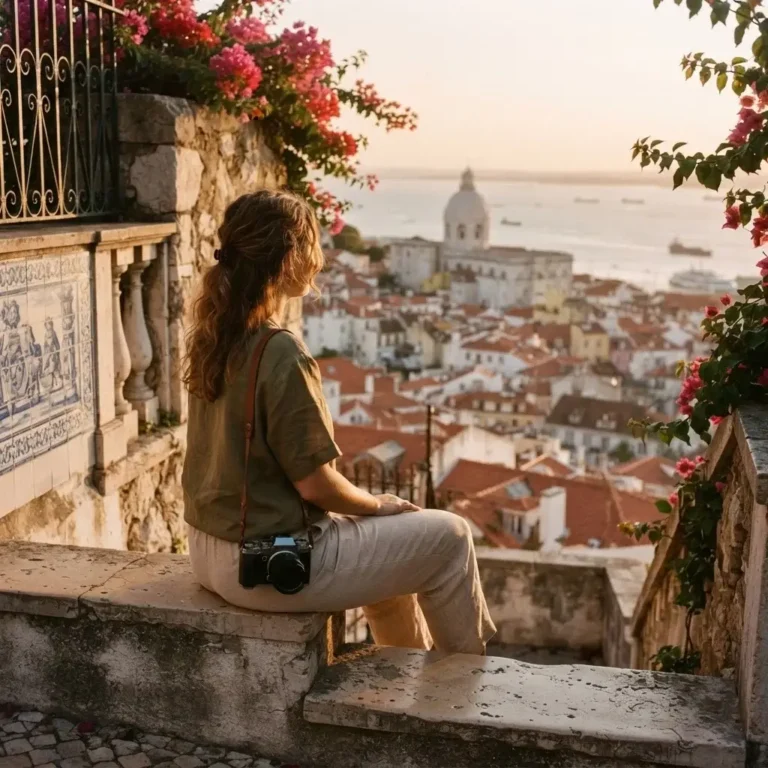
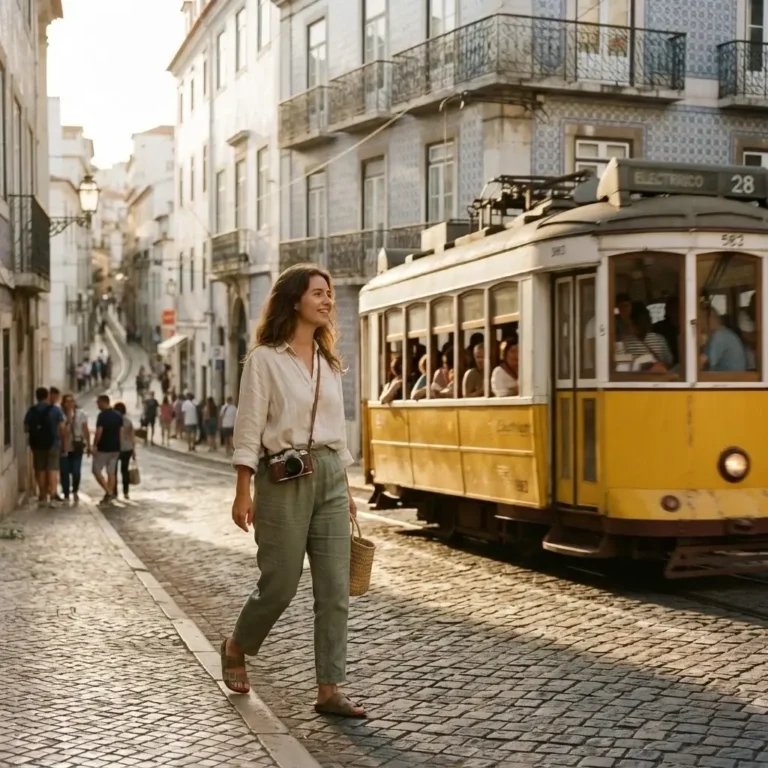
Lisbon is the obvious starting point, and it earns every bit of its reputation. The city climbs up and down seven hills, which means every walk somewhere becomes an accidental scenic route. The best food discovery I can point you toward without having lived it myself comes from what solo travelers consistently report: don’t skip the neighborhood tascas, the small family-run restaurants that aren’t on any tourism board poster. Order grilled fish, a glass of vinho verde, and watch the room. You’ll understand something about Portuguese pace and pleasure in about twenty minutes. Pastel de nata (custard tarts, ideally still warm from the oven) are mandatory.
The city is warm from late spring through October, with July and August hitting their hottest. September and October are widely considered the sweet spot: warm enough for beaches, uncrowded enough that you can actually move through the city without feeling like a sardine. The U.S. State Department Travel Advisory for Portugal is Level 1, the lowest possible rating, meaning “Exercise Normal Precautions.” For U.S. citizens, no visa is required for stays up to 90 days within the Schengen area, and your passport just needs to be valid for at least 3 months beyond your planned departure date.
Beyond Lisbon, Porto is a two-hour train ride north and feels almost like a completely different country. The Douro River, the iron bridge, the blue-tiled churches, the port wine caves of Vila Nova de Gaia, all of it is astonishing. The Algarve in the south gives you dramatic cliffs, warm golden beaches, and some of the best seafood you’ll find anywhere.
What makes Portugal particularly good for solo travel, and this is something every solo traveler I’ve spoken to confirms, is the genuine warmth of the people. The Portuguese have a concept called saudade, a bittersweet longing that sits at the heart of their culture, their music (Fado), and their relationship with the sea. You don’t need to understand it intellectually to feel it in the atmosphere of the city. That emotional depth is what gives Portugal its texture.
Vietnam: Where Slow Travel Makes Complete Sense
Vietnam is one of those destinations that I hear about from solo travelers with a kind of reverence. Not because it’s easy, but because it’s rich. The country stretches over 1,600 kilometers from north to south, which means you can move through genuinely distinct climates, cultures, and cuisines in a single trip. The best time to visit depends on which part you’re heading to: the south (Ho Chi Minh City, the Mekong Delta) is warm and dry from December through April. Central Vietnam (Hoi An, Da Nang) is at its best from February through August. The north (Hanoi, Sapa) is milder and can be cooler.
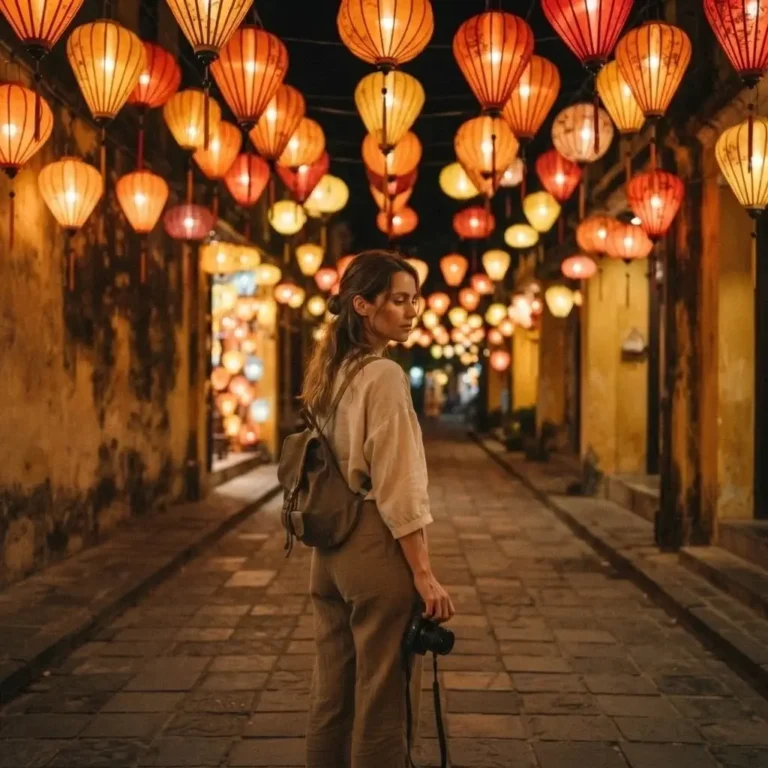
For solo travelers, the region of central Vietnam offers something that feels almost perfectly designed for the kind of slow, immersive travel I believe in. Hoi An is the centerpiece. The old town is a UNESCO World Heritage Site, a remarkably preserved 15th-to-19th-century trading port with narrow lantern-lit streets, Japanese-influenced architecture, and a community that still lives and works inside the heritage area. Solo travelers consistently describe it as one of the most welcoming, walkable, and genuinely beautiful places they’ve experienced anywhere in Asia.
Practical things to know: grab a bicycle in Hoi An. The town and its surroundings are flat enough that cycling is genuinely the ideal way to explore. The beach at An Bang is about 4 kilometers from the old town and takes about 15 minutes by bike. For food, do not leave without eating cao lau, a noodle dish made with pork, greens, and rice crackers that exists almost nowhere else in Vietnam because it depends on water from a specific local well. It’s not just a meal, it’s the kind of food that stops you mid-bite and makes you pay attention.
For entry: U.S. citizens need a visa. The simplest option is the Vietnam e-visa, available through the official Vietnam National Electronic Visa system, valid for up to 90 days. A single-entry e-visa costs $25, multiple-entry is $50. Apply at least a week before departure to be safe.
Getting between cities in Vietnam is easy and affordable. The Reunification Express train that runs from Hanoi to Ho Chi Minh City is one of the great rail journeys in Southeast Asia. Book through the Vietnamese Railways website or a trusted local agent. Grab (the Southeast Asian equivalent of Uber) works in all major cities and makes getting around affordable and easy to track.
Costa Rica: Where Solo Travel and Nature Become the Same Thing
There is a specific kind of traveler who hears “warm destination” and immediately thinks: I want to be outside. I want to be in the ocean, in the jungle, on a volcano, somewhere that doesn’t feel like a city. If that’s you, Costa Rica is one of the most obvious and most rewarding answers.
The country reserves more than 25 percent of its land for conservation, which means the wildlife and ecosystems you come to see are genuinely protected. Sloths in the trees, sea turtles on the beach at night, toucans in the canopy, scarlet macaws overhead. Solo travelers consistently report that Costa Rica feels almost improbably generous with its natural beauty.
The phrase you’ll hear everywhere is “pura vida.” Roughly translated, it means pure life, and it functions as a greeting, a farewell, a philosophy, and a way of measuring what actually matters. After a few days in the country, you’ll find yourself using it without thinking.
For solo travel logistics, the Northern Plains region is one of the most popular starting points. La Fortuna sits at the base of Arenal Volcano and gives easy access to the national park, hot springs, white-water rafting, and zip-lining. Manuel Antonio on the central Pacific coast combines beach access with a national park where you’ll almost certainly see monkeys. The Visit Costa Rica official tourism site is thorough and genuinely useful for planning, especially for understanding the range of sustainable tourism options and regions. U.S. citizens don’t need a visa, just a valid passport and proof of onward travel.
One practical note: the rainy season runs from May through November, with the heaviest rain typically from September to October. That said, the rain usually comes in afternoon bursts rather than all-day downpours, and the country is significantly less crowded and cheaper during the green season. December through April is the dry season and corresponds to the peak tourist period, so book accommodation earlier if you’re going during those months.
Solo travel safety in Costa Rica follows common-sense rules. Petty theft is the main concern, particularly in San Jose and on crowded beaches. Use hotel safes, don’t carry more than you need, and take registered taxis or Uber rather than accepting rides from strangers.
Mexico (Oaxaca): For the Traveler Who Wants Culture to Be the Whole Point
Every time the conversation around Mexico and solo travel comes up, people immediately jump to the beach resorts. And yes, Puerto Vallarta and Tulum have their appeal. But the destination that solo travelers who go deep into Mexico talk about with the most genuine emotion is almost always Oaxaca.
Oaxaca City, in the southern highlands, sits at about 1,500 meters above sea level, which keeps it warm rather than hot, with highs typically around 25-28°C (77-82°F) most of the year. It is a city of extraordinary food, extraordinary art, and an Indigenous Zapotec and Mixtec culture that feels present and alive rather than preserved behind museum glass. The historic center and the nearby archaeological site of Monte Alban are collectively a UNESCO World Heritage Site, recognized since 1987. Monte Alban itself was inhabited for over 1,500 years by successive civilizations, and standing on its central plaza at dawn, before the tour groups arrive, is genuinely one of those travel moments that rearranges something in you.
For food, Oaxaca is widely regarded as one of Mexico’s gastronomic capitals. The seven moles are the obvious entry point, but don’t overlook tlayudas (large, crunchy tortillas loaded with beans, meat, and Oaxacan cheese), chapulines (toasted grasshoppers with lime and chili, better than they sound), and the chocolate mole negro that exists in a different category from anything you’ve likely tasted before. Mezcal, produced in the surrounding valleys from agave plants that take years to mature, is Oaxaca’s defining drink. Visit a palenque, a traditional mezcal distillery, if you want to understand what you’re drinking before you drink it.
From a safety perspective, solo travelers, including solo women, consistently describe the Centro Historico neighborhood as safe, walkable, and welcoming. The streets are compact enough to navigate comfortably on foot. Stick to well-lit areas at night, use registered taxis or apps for longer trips, and you’ll find Oaxaca genuinely rewards slow, curious exploration.
A Few Things That Apply to All of These Destinations
No matter which warm destination you choose for your solo trip, a few things remain consistent across all of them.
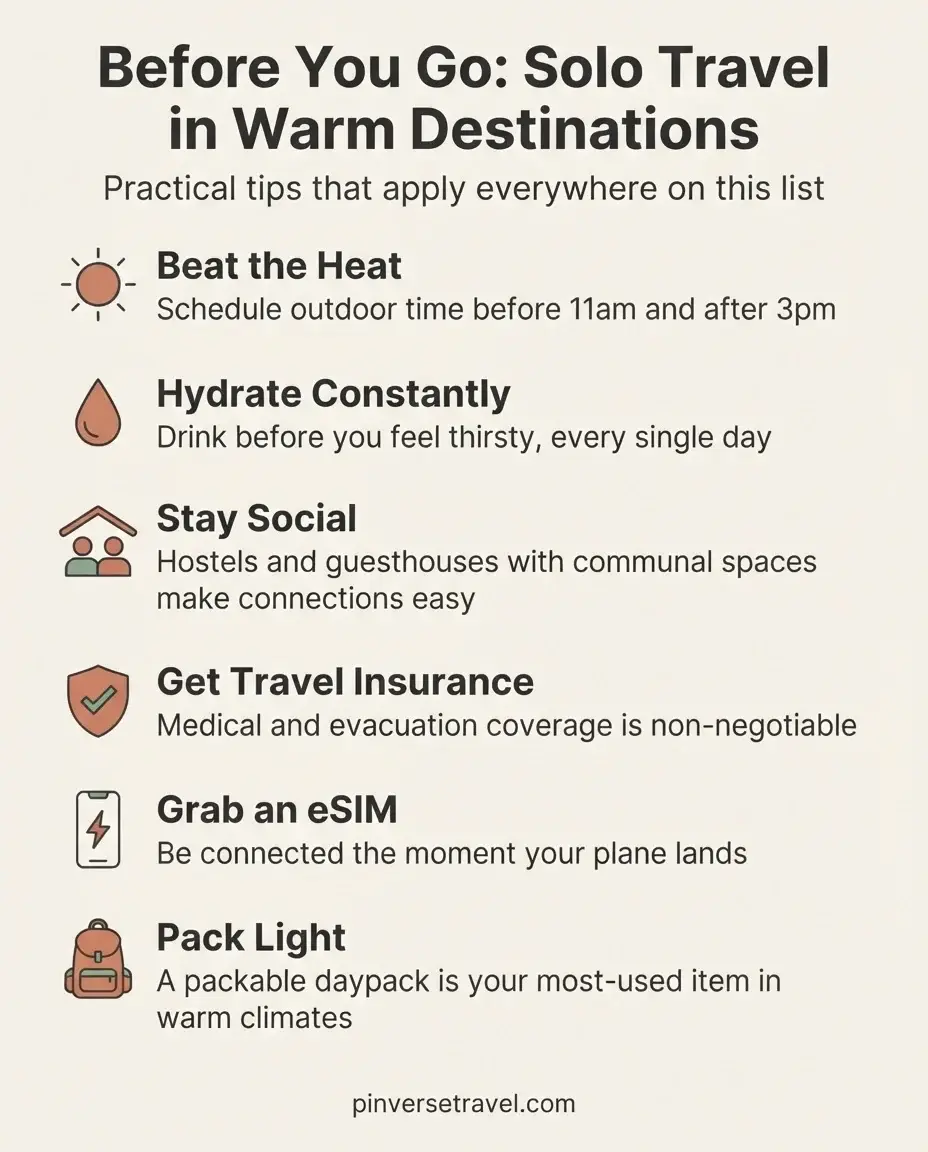
Heat management is real and often underestimated by first-time visitors to tropical or subtropical climates. Drink water constantly, not when you feel thirsty. Carry a small packable hat. In Thailand, Vietnam, and Costa Rica especially, the midday sun from roughly 11am to 2pm is genuinely intense. Schedule your outdoor activities for morning and late afternoon. Use that midday window for museum visits, cafe time, cooking classes, or the kind of long lunches that you will absolutely not regret.
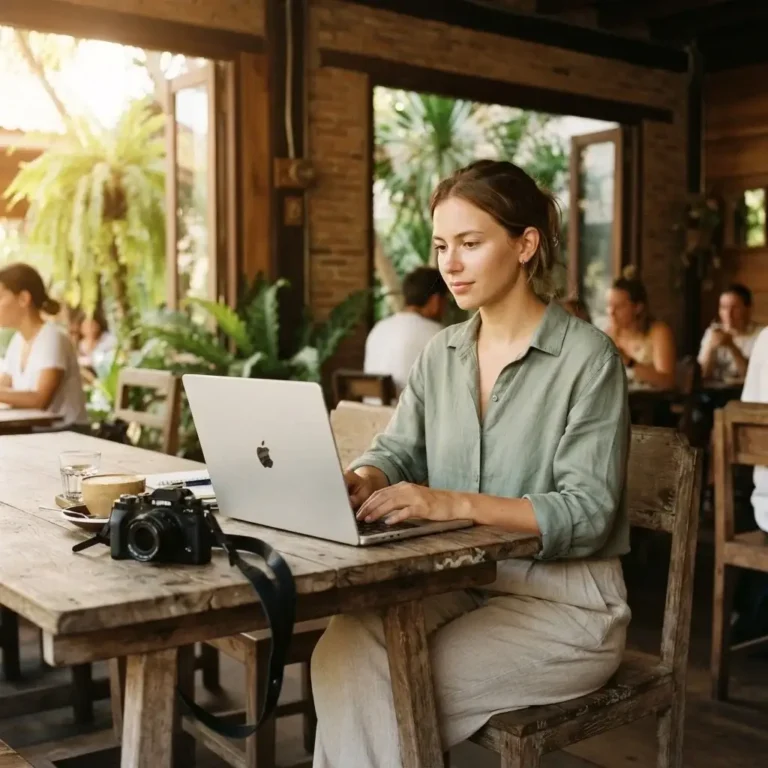
Accommodation in warm destinations at the solo-travel level almost always means having access to social communal spaces, whether that’s a hostel rooftop, a guesthouse garden, or a shared breakfast table. This is one of the underrated advantages of solo travel in these regions: the social architecture of budget and mid-range accommodation makes meeting other travelers genuinely easy. You don’t have to be outgoing. You just have to show up and be open.
Travel insurance is not optional. For any of these destinations, make sure you have coverage that includes medical emergencies and evacuation. Getting sick or injured abroad without coverage is one of the most avoidable ways a solo trip turns into a financial disaster. World Nomads and other providers offer single-trip or multi-trip policies that cover most of what you’d need, and compared to even one night in a foreign hospital, the cost is nothing.
The question I get asked most often is something like: “But what if something goes wrong and I’m alone?” And my honest answer is: things will go wrong, in small ways. You’ll take a wrong turn. You’ll eat something that doesn’t agree with you. You’ll book a guesthouse that doesn’t match its photos. And every single time, you’ll figure it out. That’s not a downside of solo travel. That’s the actual mechanism through which it builds you.
Book the warm trip. Start with whichever destination on this list makes your heart move first. The right moment has been available this whole time.