Best European Cities for Solo Travel: A Real Honest Guide

I remember the exact moment I decided to backpack solo across Europe. I was sitting at my desk in New York, staring at the screen, calculating how many vacation days I had left and realizing the math would never work for the life I actually wanted. I had two weeks, a list of places I’d been dreaming about for years, and absolutely no one to go with. So I went anyway.
That trip changed things for me in ways I still think about. And I want to be straight with you from the start: choosing WHERE to go matters more than most travel articles admit. Not every European city is equally welcoming to solo travelers. Some are brilliant for it. Others can feel isolating if you don’t know what you’re walking into.
So this guide is my honest take. Not a copy-paste of “top 10 cities in Europe” with stock photo captions. I want to walk you through the destinations that genuinely suit solo travel, what makes them work, what to eat, where to stay, how to meet people, and what to expect when you get there. I’ll also cover the practical stuff, getting around, current entry rules for Americans, and what things actually cost, because none of that excitement is useful if you show up underprepared.
Let’s get into it.
Why Europe Is One of the Best Continents to Start Solo Travel
If you’re doing your first solo trip or your first time doing one abroad, Europe is one of the most forgiving places to begin. The infrastructure is excellent. English is widely spoken across most major tourist cities. The train network connects almost everything. And there is a deeply established solo travel community moving through the continent at any given time, which means meeting other travelers is genuinely easy if you put yourself in the right environments.
Europe is also wonderfully varied. You can spend a week in Lisbon eating pastries and watching fado performers in a candlelit bar, then board a train and be in a completely different cultural universe in Prague or Krakow within hours. That variety, without the logistical complexity of long-haul travel, is a big part of what makes it so satisfying.
One thing worth knowing before you plan: as a U.S. citizen, you can visit up to 29 Schengen Area countries for up to 90 days within any 180-day period without a visa. Since October 12, 2025, the EU launched a new Entry/Exit System (EES), which means when you first arrive in a Schengen country, border agents will collect your fingerprints, facial image, and passport details. There is no fee and no advance registration needed. The U.S. State Department’s Europe travel guidance has the most current details on this, including the separate ETA requirement if you plan to visit the UK. A separate EU authorization system called ETIAS is being developed but is not expected until late 2026, so you don’t need to worry about that yet.
Eastern vs. Western Europe: Knowing the Difference Before You Book
One of the most useful things I wish someone had told me before my first Europe trip is that “Europe” is not one experience. Western Europe (Portugal, Spain, France, Italy, the Netherlands) tends to be more expensive, more polished, and more international. Eastern and Central Europe (Poland, Czech Republic, Hungary, the Balkans) is often dramatically cheaper, less tourist-saturated in parts, and offers some of the most layered cultural history on the continent.
For solo travel specifically, this matters in two ways. Budget travelers will stretch their money significantly further in the east. But for pure social ease, first-timer friendliness, and hostel culture, both regions deliver. My advice is not to limit yourself to one side. Mix them. Spend a few days somewhere affordable to balance a splurge in a pricier city.
The Best Cities for Solo Travel in Europe
Lisbon, Portugal: The Perfect Starting Point
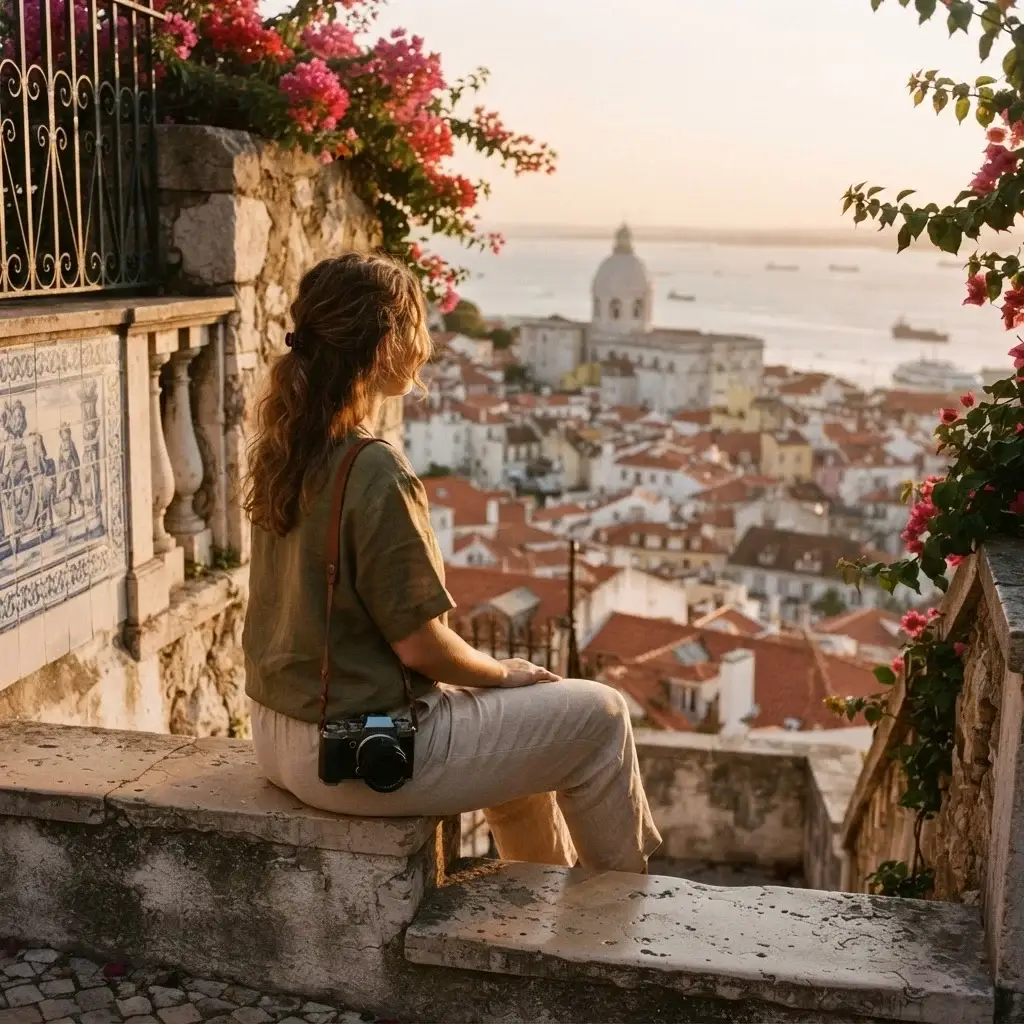
From what solo travelers consistently report, Lisbon is one of the most welcoming cities on the continent to arrive in alone. It is warm in temperature and in atmosphere, relatively affordable compared to Paris or Amsterdam, and built on hills that reward slow exploration. The culture rewards curiosity. Fado music, azulejo tile art, and the kind of neighborhood coffee culture where a single espresso at a counter can turn into a two-hour conversation with a local.
The city is compact enough to walk a great deal of it, but each neighborhood has its own distinct personality. Alfama, the oldest neighborhood, is a maze of narrow alleys climbing upward toward the castle, with laundry strung between buildings and fado drifting out of open windows after dark. Belem sits along the river and holds two of the city’s most iconic sights, the Belem Tower and the Jeronimos Monastery. Chiado and Bairro Alto are livelier, with independent bookshops, cafes, and a nightlife scene that starts late (this is Portugal, dinner rarely begins before 8 p.m.). The Visit Lisboa official tourism site has neighborhood maps and current event listings that are genuinely useful for planning your days.
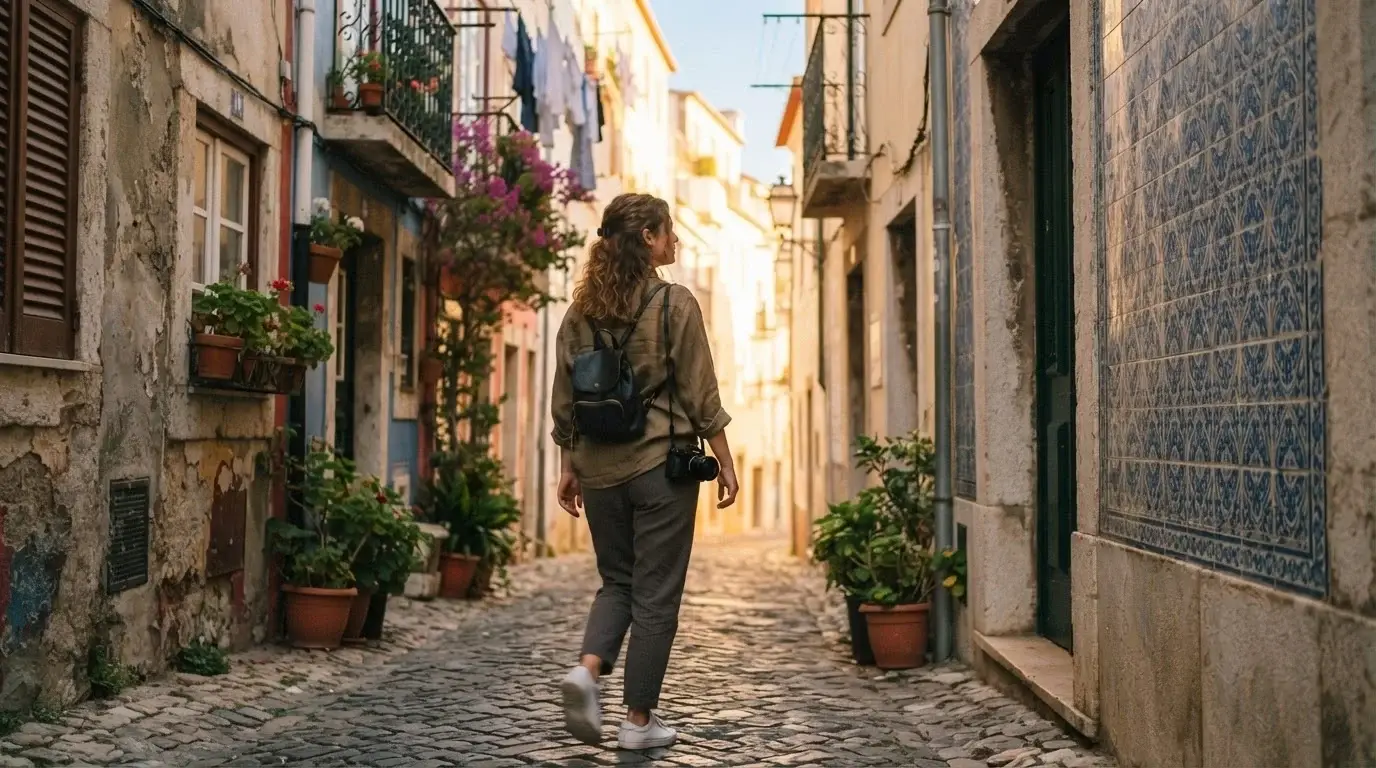
For solo dining, Lisbon is exceptionally relaxed about it. Sit at the counter or a small table in a tasca (a casual tavern), order a bifana (pork sandwich) or a plate of bacalhau (salted cod prepared in what feels like a hundred different ways), and nurse a glass of local wine without anyone giving you a second look. Time Out Market in Cais do Sodre is one of the best food halls in Europe, and is excellent for solo travelers because you can graze across vendors without committing to a full restaurant meal.
Hostel culture in Lisbon is strong, particularly around the Mouraria and Intendente areas. Most offer social events, group dinners, and day trip sign-ups that make meeting people effortless. Lisbon is also one of the few European capitals where the cost of living makes a week feel manageable even on a modest budget.
Prague, Czech Republic: History, Hostels, and a Social Scene Built for Solo Travelers
Prague is one of those cities that immediately earns its reputation. The Old Town is genuinely stunning, with Gothic spires, Baroque facades, and a medieval astronomical clock that draws a crowd every hour on the hour. But beyond the postcard version, Prague has a vibrant local culture, an excellent craft beer scene (Czech beer culture is serious and affordable), and a hostel infrastructure that has been serving solo travelers for decades.
The social side of Prague is one of its biggest advantages for first-time solo travelers. Free walking tours leave from the Old Town Square multiple times daily and are a classic way to get oriented, meet other travelers, and start conversations without any awkwardness. Many of the city’s hostels are openly social spaces with communal meals, pub crawl sign-ups, and rooftop bars where you’ll naturally fall into conversation.
For food, duck into any authentic hospoda (a traditional Czech pub) and order svickova (beef sirloin in cream sauce with bread dumplings) or goulash. Avoid the tourist-heavy restaurants immediately around the Charles Bridge where prices are inflated for foot traffic. Walk a few streets back into Zizkov or Vinohrady, two residential neighborhoods east of the center, and you’ll find excellent local restaurants at half the price.
Pickpocketing is the main thing to stay alert about, particularly on the Charles Bridge and in the metro. Keep your bag in front of you in crowded spots and you’ll be fine.
Krakow, Poland: The Most Underrated Solo Travel City in Europe
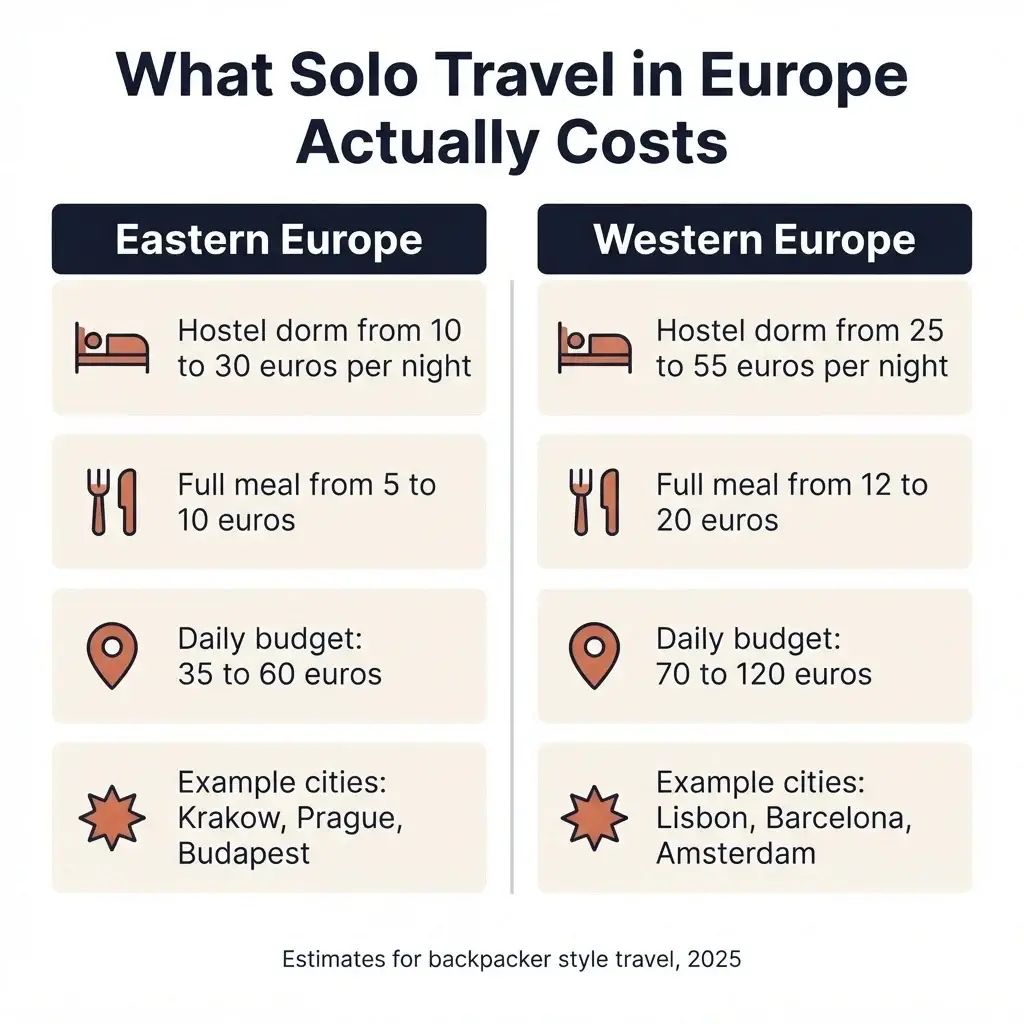
If you haven’t put Krakow on your list, put it on your list. This city delivers more cultural weight, architectural beauty, and human warmth per dollar than almost anywhere else in Europe. It’s consistently rated among the safest city breaks in Central Europe, Poland sits at the U.S. State Department’s lowest advisory tier (Level 1, normal precautions), and the budget reality is genuinely accessible. A hostel dorm runs around 10 to 30 euros a night, a full meal at a traditional milk bar (bar mleczny, a Polish cafeteria-style institution beloved by locals and budget travelers alike) costs roughly 5 to 10 euros, and pierogi on the street will run you 3 to 5 euros.
For the solo cultural experience, Krakow’s UNESCO-listed Old Town and the former Jewish Quarter of Kazimierz are both walkable, layered with history, and full of independent cafes and bars where sitting alone is completely normal. The YourKrakow solo travel guide is one of the most detailed resources available for planning a trip to the city, covering everything from safety specifics to neighborhood choices to budget breakdowns.
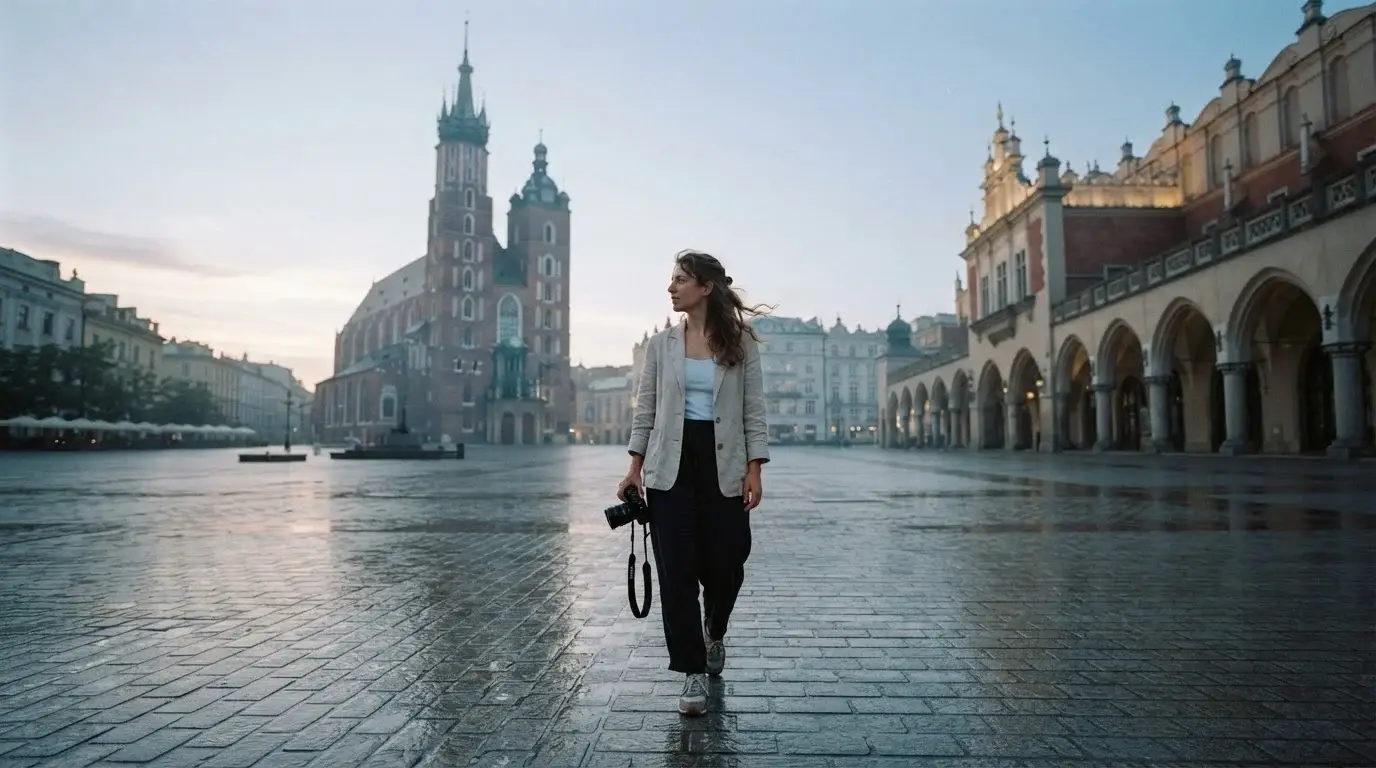
Day trips from Krakow add serious depth to any visit. Auschwitz-Birkenau is about an hour away and is one of the most important historical sites in the world. The Wieliczka Salt Mine, a UNESCO World Heritage Site with underground chapels carved entirely from salt, is extraordinary. Neither requires a car. Group day tours are widely available, affordable, and naturally social because you’ll spend hours alongside other travelers.
Poland uses the Polish zloty (PLN), not the euro. Cards are accepted almost everywhere, but carry some cash for milk bars and market vendors. Always choose to pay in zloty rather than your home currency when given the option at ATMs or card machines.
Lisbon vs. Prague vs. Krakow: A Quick Read
These three cities represent a spectrum. Lisbon is warmer (climate and personality), slower, and more Mediterranean in rhythm. Prague is the classic backpacker city with established nightlife and tour infrastructure. Krakow is the budget champion with the deepest historical and cultural immersion. If you’re planning a multi-city trip, all three connect reasonably well by budget airlines or overnight trains.
Barcelona, Spain: Energy, Architecture, and Smart Street Awareness
Barcelona is magnetic. There is almost no other way to describe it. The Eixample neighborhood’s grid architecture, Gaudi’s Sagrada Familia casting shadows across an entire city block, the food markets, the beach, the late dinners, the music drifting out of bars at midnight. Solo travel here feels alive in a way that some quieter cities don’t quite match.
That said, Barcelona requires a specific kind of street awareness. Petty theft and pickpocketing are genuinely common, particularly on La Rambla, in the metro, and around crowded tourist areas. This isn’t a reason to avoid it; it’s a reason to use a crossbody bag, keep your phone off the table, and stay aware in crowds. Stay in Eixample or Gracia as a solo traveler rather than booking the cheapest place near La Rambla, both neighborhoods are well-lit, walkable, and have a great neighborhood feel rather than a tourist corridor atmosphere.
For food, Barcelona rewards the wanderer. The Boqueria Market is beautiful but overpriced and better for a quick look than a meal. Eat at a neighborhood bar in Gracia instead, order pan con tomate (bread rubbed with tomato and olive oil) and whatever the daily special is. Vermut (vermouth) hour before lunch is one of the great pleasures of Barcelona local culture and is an underrated way to sit at a bar counter alone and feel completely at ease.
Amsterdam, Netherlands: Culture, Canals, and a City That Welcomes Everyone
Amsterdam works well for solo travelers in a different way from the Mediterranean cities. It is orderly, bikeable, and genuinely cosmopolitan, with world-class museums (the Rijksmuseum, the Van Gogh Museum, the Anne Frank House) that you can spend hours in completely on your own without feeling any social pressure. The canal-side streets are wonderful for slow walking and getting genuinely lost in the best sense.
The cafe culture here is serious. Dutch brown cafes (bruine kroegen) are warm, wood-paneled pub spaces that welcome solo patrons completely naturally. Order a jenever (Dutch gin), sit at the bar, and you’ll often find yourself in conversation within twenty minutes. Stroopwafels from a street market, raw herring from a herring cart (a briny, genuinely delicious Dutch street food experience), and rijsttafel (an Indonesian rice table, a legacy of Dutch colonial history that has become one of the country’s most celebrated dining traditions) are all worth seeking out.
Amsterdam is on the pricier end of European cities for accommodation. Book early, and consider staying in the Jordaan or De Pijp neighborhoods rather than the direct city center for a better price-to-atmosphere ratio.
Edinburgh, Scotland: Dramatic, Walkable, and Deeply Friendly
Edinburgh deserves a specific mention for solo travelers because it possesses a quality that not every city has: it is genuinely easy to talk to strangers there. Scottish pub culture is warm and inclusive in a way that makes solo evenings feel social rather than awkward. The Old Town’s cobblestone closes and wynds (the narrow medieval alleyways between buildings), the Royal Mile, Edinburgh Castle watching over everything from its volcanic rock perch, and the dramatic Holyrood Park right at the city’s edge make this one of the most walkable and visually rewarding cities in Europe.
The Fringe Festival in August transforms Edinburgh into one of the most exciting cities on earth for a few weeks, with thousands of free and paid performances in pubs, churches, and streets. Going alone to the Fringe is actually ideal because you can dip in and out of shows on your own schedule without compromise.
Note that Scotland is part of the United Kingdom, which sits outside the Schengen Area. U.S. citizens now need a UK Electronic Travel Authorization (ETA) for short visits, separate from Schengen rules.
Getting Between Cities: The Practical Reality
One of the genuine joys of a solo Europe trip is the freedom to move. No one to negotiate with, no compromise on timing. You want to take a night train from Barcelona to Paris and arrive in the morning with a whole day ahead of you? You can just do that.
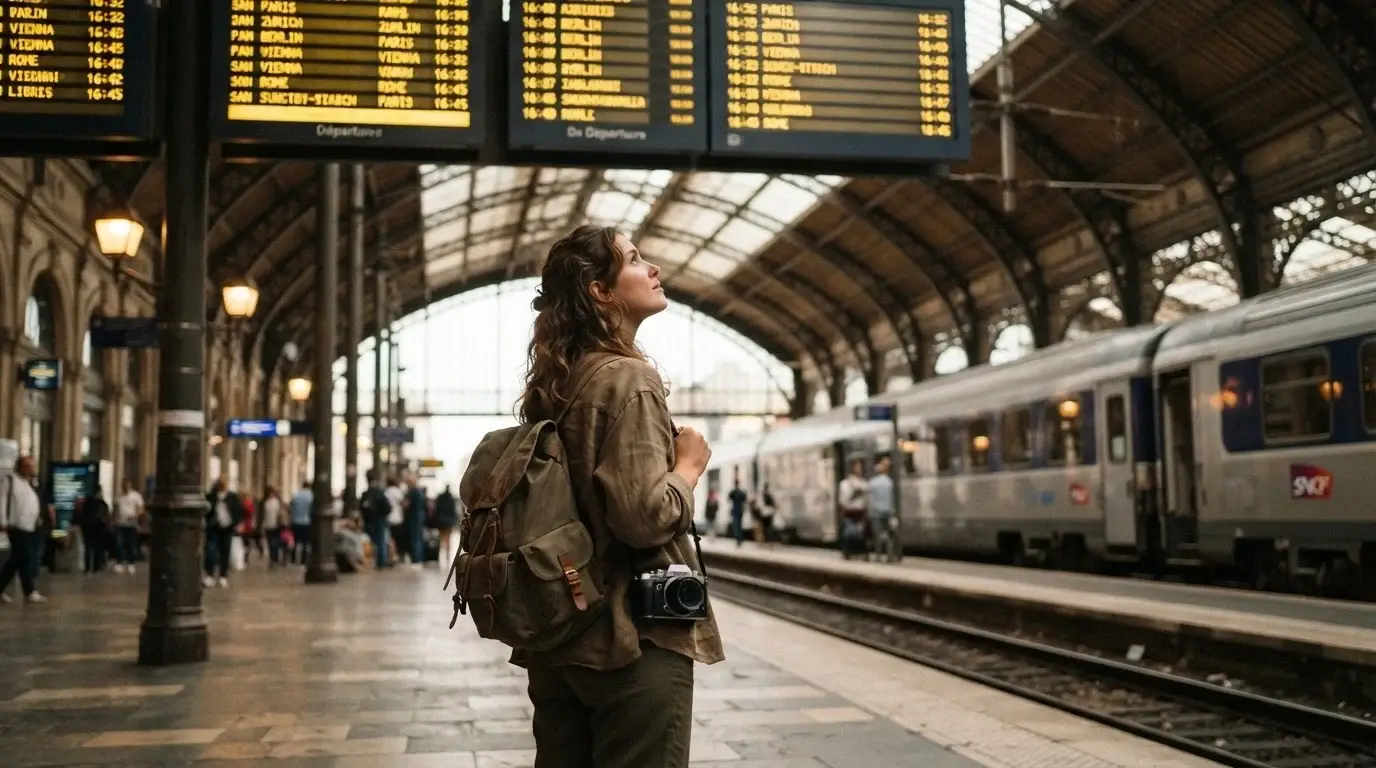
For rail travel across multiple countries, the Eurail Global Pass starts from around €286 for 7 flexible travel days within a one-month window (2nd class, adult price). It covers 33 countries and is available only to non-European residents, so it works for American travelers. Whether it saves you money depends heavily on your route: point-to-point tickets booked early can be cheaper for two or three fixed stops, while a pass earns its value on longer or more flexible multi-country routes. Night trains in particular are a solo traveler’s friend: you travel while you sleep, save on a night’s accommodation, and wake up somewhere new.
Budget airlines like Ryanair and Wizz Air connect most major European cities for very little if you book early and travel light. For routes like Krakow to Lisbon or Edinburgh to Barcelona, flying often beats the train on both time and cost.
How to Actually Meet People (Because Loneliness Is Real)
Nobody talks about this enough. Solo travel is incredible and also, sometimes, genuinely lonely. Arriving in a new city where you know no one and sitting down to dinner alone can feel strange at first, especially if you’ve never done it before. I want you to know that the feeling is almost always temporary, and that Europe’s solo travel infrastructure makes connection easier than anywhere else I’ve traveled.
The most effective tools, consistently: free walking tours (tip-based, available in every major city, brilliant for meeting people on your first day), social hostels with communal kitchens and organized events (even if you’re in a private room, sitting in a common area with a coffee opens doors), and day trips. Joining a small-group day excursion to somewhere like Auschwitz from Krakow or the Sintra palaces from Lisbon puts you alongside other travelers for hours at a time, and conversations happen naturally.
For solo women specifically, Rick Steves has a solid, no-nonsense resource at ricksteves.com/travel-tips/trip-planning/tips-for-solo-women-travelers that covers everything from accommodation choices to how to handle unwanted attention in a practical, non-alarmist way. It’s worth a read before you go.
A Note on Budget: What Solo Travel in Europe Actually Costs
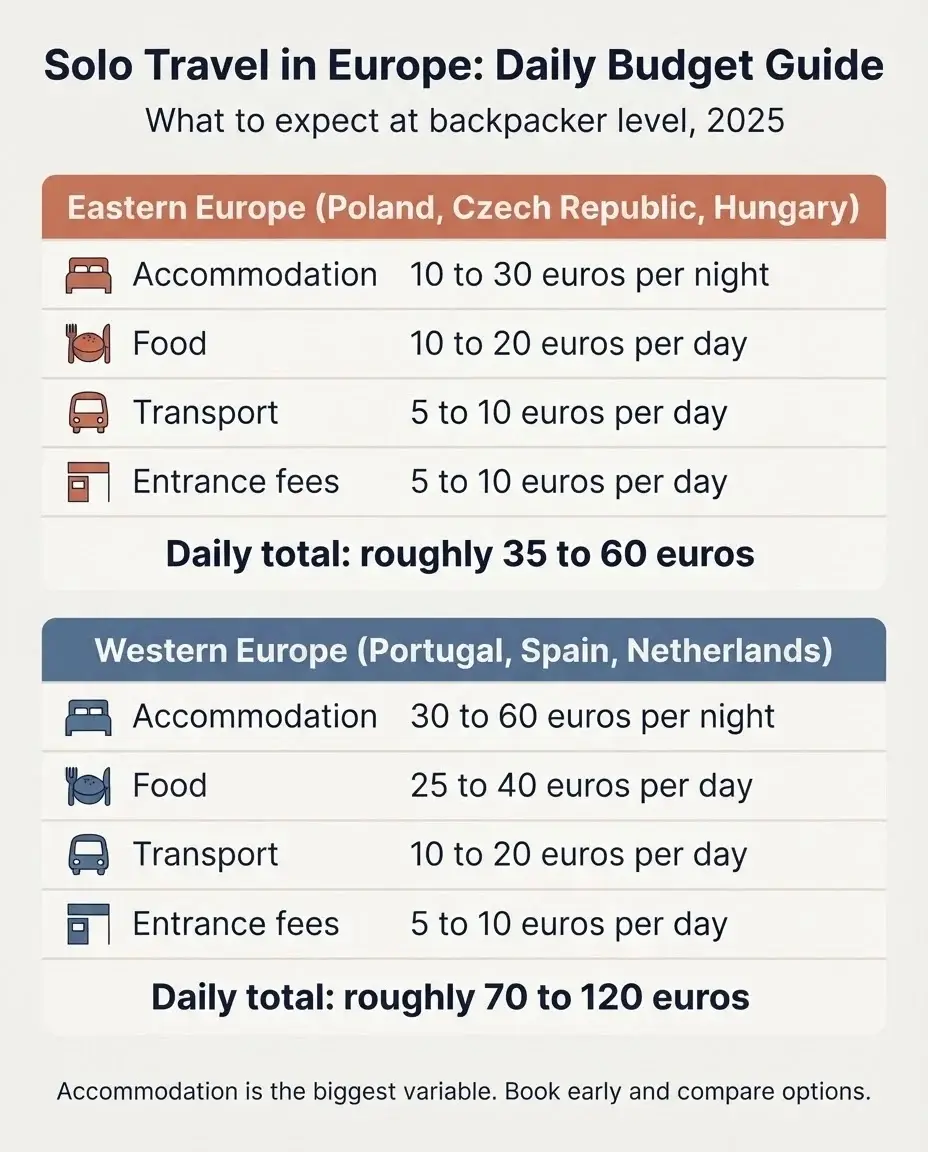
The honest answer is: it depends enormously on where you go and how you travel. Eastern Europe (Poland, Czech Republic, Hungary, the Balkans) runs roughly €35-60 per day on a backpacker budget including accommodation, food, transport, and entrance fees. Western Europe (Lisbon, Barcelona, Amsterdam) will push that to €70-120 per day minimum, and more in major hubs during high season.
The single biggest driver of cost is accommodation. A hostel dorm bed keeps things low; a private room in a boutique hotel changes the math entirely. Solo travelers also miss out on the room-splitting benefit couples and groups enjoy, which is why hostel dorms remain the social and financial backbone of solo Europe travel.
For Americans planning longer trips: the Schengen 90-day rule means you can stay across 29 countries for up to 90 days in any 180-day period without a visa. The European Commission’s Schengen Area page outlines which countries are included. Countries like the UK and Ireland sit outside Schengen and have their own rules.
What to Pack in Your Head Before You Go
More than any specific gear list, there are a few mindset things worth carrying. First: getting lost is not failure, it is the job. Some of my best experiences while backpacking through Europe came from wrong turns. Second: the first day in a new city almost always feels a little disorienting. That feeling passes by day two, almost without exception. Third: you will be fine eating alone. Sitting at a bar counter or asking for a single table is completely normal across European dining culture in a way that can feel less comfortable in some other parts of the world.
Give yourself permission to move slowly. One of the things I’ve come to believe deeply after years of travel is that rushing through five cities in seven days produces memories that blur together. Two or three cities done slowly, with time to wander a neighborhood without a plan, will stay with you far longer.
Where to Begin If You’re Still Deciding
If you’re a complete first-timer, I’d suggest Lisbon or Krakow as starting points. Lisbon for the warmth, the ease, and the approachable culture. Krakow for the budget, the walkability, and the cultural depth that will genuinely surprise you. Prague sits in the middle as a classic that earns its reputation.
If you’re ready for more energy and urban density, add Barcelona. If you want something dramatically different and deeply atmospheric, Edinburgh is hard to beat.
The most important thing, the thing I want you to take from this, is that none of these cities require a perfect plan. They reward showing up, staying curious, and being willing to follow a local recommendation to a cafe you wouldn’t have found otherwise. That is where the real trip lives.
Book the flight. Figure out the rest when you get there.