Best Asian Cities for Digital Nomads: Visas, Costs, and Vibes

I still remember the exact moment I decided that the nine-to-five grind was not the life I wanted. I was sitting at my desk in a New York office, watching the clock, calculating how many years of limited vacation days stood between me and the kind of freedom I was craving. I had no idea then that the answer would eventually involve a one-way ticket, a laptop, and a deep curiosity about the world.
Asia kept coming up. In conversations, in travel forums, in the stories of people who had traded spreadsheets for life in countries where your money stretches, the food is extraordinary, the cultures are layered and fascinating, and the wi-fi, surprisingly, is often better than what you left behind. Whether you are brand new to working remotely or you have been on the road for a while and are ready to try a longer base, Asia genuinely offers some of the most compelling options on the planet.
But here is what most “best places” articles skip: the real questions that matter. Not just “is the internet fast?” but “will I feel welcome here? Can I actually build a life that works? What does the visa situation look like, and is it legal? And honestly, does this city fit who I actually am?” This guide is my attempt to answer those questions properly.
What Actually Makes a City Work for Digital Nomads
Before we get into specific cities, it helps to know what you are actually evaluating. The nomad community at Nomads.com, one of the most data-rich platforms for comparing cities by remote work criteria, scores destinations on a mix of factors: internet speed, cost of living, safety, weather, friendliness, and community. These are all real considerations.
But beyond the scores, there are softer things that matter enormously. Is there a community of other remote workers you can connect with? Is the culture one that makes you feel curious and alive, or does it feel impenetrable and isolating after a few weeks? Are you in a city where you can walk outside, eat well, explore neighborhoods, and feel like you are actually living rather than just surviving in a foreign apartment? These are the questions worth sitting with before you book anything.
With that framing in place, here are the cities that consistently earn their reputation among the global nomad community, along with the honest context you need to make a smart decision.
Chiang Mai, Thailand: The Classic Hub That Earned Its Reputation
If there is one city that genuinely launched the digital nomad movement in Asia, it is Chiang Mai. For well over a decade, this northern Thai city has been drawing remote workers from around the world, and it continues to rank at or near the top of any serious comparison list. The reasons are not complicated: the cost of living is low, the infrastructure is solid, the food is outstanding, and the community of other nomads is enormous.
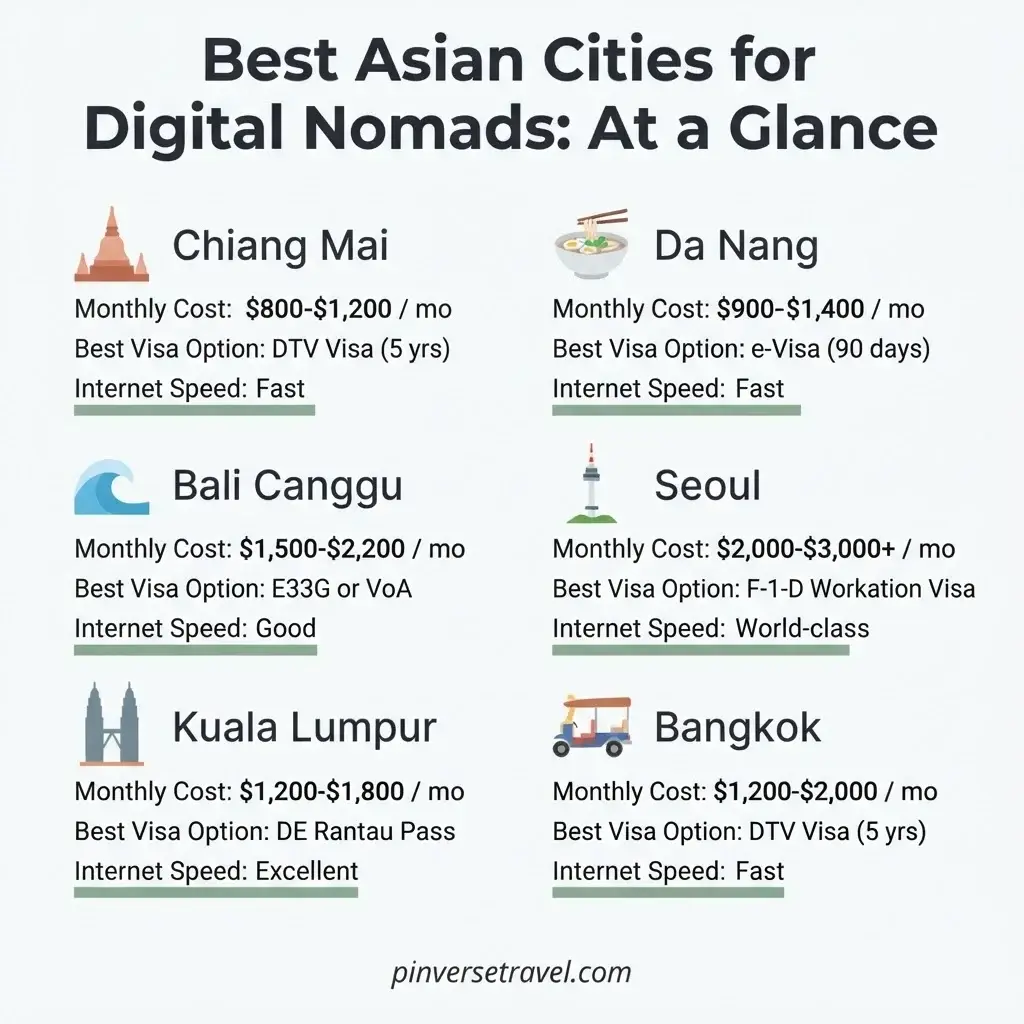
A comfortable lifestyle in Chiang Mai — a private apartment in the Nimman or Old City area, coworking access, daily meals out, scooter rental, and regular temple visits — typically runs between $800 and $1,200 a month. Some people do it for less. A bowl of khao soi, the northern Thai curry noodle dish that locals genuinely love and every visitor quickly becomes obsessed with, costs somewhere around $1.50 at a local shop. You can eat well every single day without watching your budget.
The coworking scene is real and well-established. The CAMP at Maya Mall is a beloved nomad institution, operating on a “buy something and work as long as you like” model that is perfect for days when you want human energy around you without a desk fee. There are also dedicated coworking spaces throughout Nimman Road with fast fiber internet, air conditioning, and monthly memberships that run roughly $80 to $120 USD.
On the visa front, Thailand’s Destination Thailand Visa (DTV) is genuinely exciting for digital nomads. You can apply online through Thailand’s official e-Visa portal before you travel. The DTV is valid for five years with multiple entries, each stay up to 180 days. It covers remote workers, freelancers, and digital nomads, and costs approximately $90 USD. It is one of the most flexible and affordable long-stay options any country has introduced in recent years.
The honest downside? Chiang Mai can feel like a bubble if you are not intentional about stepping outside the nomad zone. The Nimman area, as convenient as it is, can start to feel like an expat village rather than a genuinely Thai neighborhood after a few weeks. Push past it. Visit the Sunday Walking Street on Wualai Road, take a cooking class at a local market, rent a scooter and head into the surrounding hills. Chiang Mai rewards curiosity.

Bali, Indonesia: More Than the Instagram Version
Bali has a complicated reputation in nomad circles. It has been so thoroughly discussed, photographed, and occasionally over-romanticized that it can be hard to separate the reality from the myth. Here is the reality: Bali, particularly the areas of Canggu and Ubud, genuinely works well as a remote work base, but it requires a bit more money and more realistic expectations than some guides suggest.
Monthly costs in Canggu typically land between $1,500 and $2,200 for a comfortable setup, putting it slightly above the Southeast Asian average. Rents have climbed in popular areas as demand has grown. That said, the lifestyle quality is remarkable: fast internet in most coworking spaces and cafes, extraordinary food (both local warungs and international options), proximity to surf breaks and rice paddies, and a deeply spiritual culture that many people find genuinely nourishing.
One thing worth knowing before you go: two of the most commonly cited coworking spaces in older blog posts, Dojo Bali and Outpost Canggu, are no longer operating in their original form. Dojo Bali closed in December 2022. Outpost’s original Canggu coworking floor closed in April 2024. There are plenty of excellent alternatives, but do your current research rather than trusting guides that haven’t been updated.
On the visa side, Bali falls under Indonesian immigration rules. The E33G Remote Worker Visa offers up to a year of legal remote work in Indonesia, but it requires proof of at least $60,000 USD in annual foreign income and costs approximately $600 to process. For many nomads, especially those just starting out, the more practical option is the Visa on Arrival, which gives 30 days and can be extended once to 60 days. The official Bali Provincial Government tourism site is also worth checking for the current tourist levy (IDR 150,000 per person, paid on arrival or online) which came into effect in recent years.
Ubud is Bali’s quieter alternative to Canggu’s surf-and-social scene. If you want to be surrounded by rice terraces, traditional arts, and a more contemplative pace, Ubud delivers. It also has a good selection of cafes and coworking spaces. The trade-off is less immediate community and a quieter nightlife, which for many people is exactly the point.
Kuala Lumpur, Malaysia: The Underrated Serious Option
Kuala Lumpur does not get nearly enough attention in digital nomad conversations, and I think that is because it lacks the romantic narrative of Bali or the legendary status of Chiang Mai. But for remote workers who want urban infrastructure, affordability, excellent English-language capability throughout the city, and one of the most genuinely interesting food cultures in the world, KL deserves serious consideration.
Monthly costs sit comfortably in the $1,200 to $1,800 range for a good lifestyle, including a well-located apartment, meals, and coworking access. The city’s public transportation system is functional and expanding. Internet speeds are among the fastest in Southeast Asia.
The DE Rantau Nomad Pass, managed by Malaysia’s official Digital Economy Corporation and detailed in full on the MDEC DE Rantau program page, is Malaysia’s flagship effort to attract digital talent. The pass allows qualified foreign digital nomads to stay and work in Malaysia for up to 12 months, with a renewal option for another 12 months. Tech professionals need to demonstrate annual income above $24,000 USD, while non-tech professionals face a higher threshold of $60,000 USD. The application fee is MYR 1,000 (roughly $215 USD), and dependents can be included. It is a well-structured, legitimate pathway that families and long-term nomads find particularly valuable.
The food alone is a reason to go. Kuala Lumpur’s hawker centres and kopitiam culture represent one of the most diverse and delicious street food scenes anywhere on earth. Nasi lemak, char kway teow, roti canai with dhal, Hokkien mee, laksa — the culinary overlap of Malay, Chinese, Indian, and Peranakan traditions in one city is extraordinary. Most good hawker meals cost $2 to $4 USD.
If you want a slower-paced alternative to KL, Penang — specifically George Town — offers a similar cultural richness with a smaller city feel, lower cost of living, and a growing but intimate nomad community.
Vietnam: Two Cities, Two Completely Different Experiences
Vietnam deserves its own section because choosing where to base yourself here matters enormously. Ho Chi Minh City (Saigon) and Da Nang attract very different types of remote workers, and treating them as interchangeable does both cities a disservice.
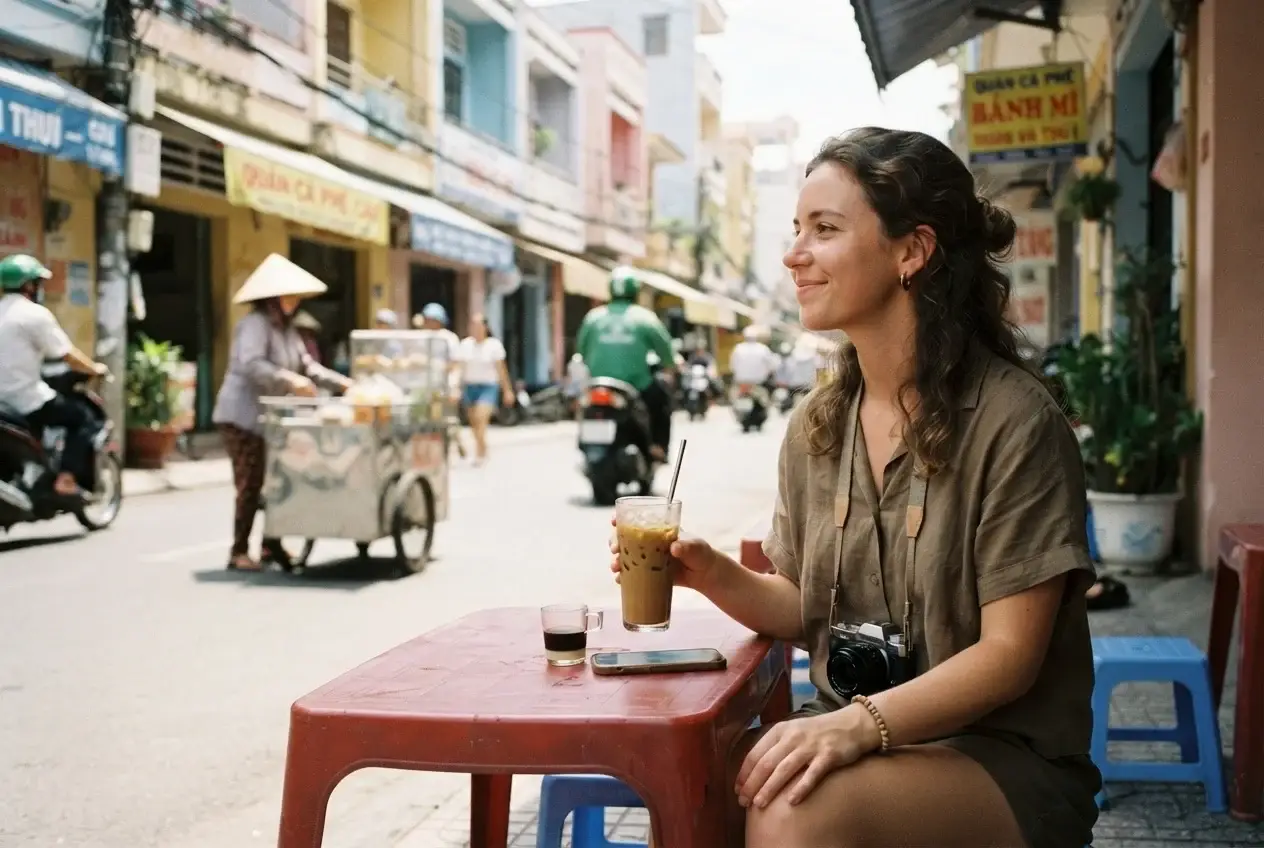
Ho Chi Minh City is fast, energetic, occasionally overwhelming, and completely alive. The city moves at a pace that can feel exhilarating or exhausting depending on your personality. Monthly costs for a comfortable nomad setup hover around $1,200 to $1,900, with a huge range depending on neighborhood and lifestyle choices. The coworking scene is well-developed. The coffee culture is genuinely special — Vietnamese iced coffee (ca phe sua da) is one of the great simple pleasures of Southeast Asian travel, and you can sit with one for an hour in a good cafe for less than a dollar. The street food is endlessly rewarding: banh mi, pho, com tam (broken rice with grilled pork), fresh spring rolls.
Da Nang, by contrast, is quieter, beachside, and increasingly popular with nomads who want a slower pace. Monthly living costs typically run $900 to $1,400. The city sits between Hoi An (a UNESCO heritage town worth a day trip) and the Marble Mountains. Internet is fast and coworking options like Enouvo Space are well-regarded. For nomads who want beach proximity, genuine affordability, and a less frantic pace than HCMC, Da Nang is a strong answer.
Vietnam’s visa situation is straightforward but worth understanding clearly. There is currently no dedicated digital nomad visa. The e-Visa, applied for through the official Vietnamese government e-visa portal, costs $25 USD for a single-entry visa or $50 for multiple entry, and is valid for up to 90 days. The e-Visa cannot be extended from inside Vietnam. Once your 90 days end, you need to leave, reapply, and re-enter. Many nomads manage this with a short trip to a neighboring country, but it requires planning.
South Korea: The New Contender with Real Infrastructure
Seoul is not the cheapest option on this list. Monthly costs for a comfortable lifestyle typically start around $2,000 and can easily reach $3,000 or more depending on neighborhood and habits. But what Seoul offers in exchange is world-class infrastructure, extraordinary public transportation, blazing-fast internet (South Korea consistently ranks among the world’s fastest), and a culture of technology and creativity that many digital workers find genuinely energizing.
The food culture alone justifies serious attention. Korean barbecue, army stew (budae jjigae), bibimbap, street tteokbokki (spicy rice cakes), hand-drip coffee culture, and late-night convenience store culture — Seoul eats extremely well at all price points.
The major news for nomads is that South Korea officially launched its F-1-D Workation Visa, as reported by the Korea Herald when it became available on June 30, 2025. The visa allows foreign nationals employed by overseas companies or who own an overseas business to live and work in South Korea for up to one year. Eligibility requirements were eased considerably compared to the earlier pilot program. This is a significant development for nomads who have always been drawn to Seoul but had no clean legal pathway for an extended stay.
The neighborhoods of Hongdae, Mapo, and Mangwon are popular with younger internationals, with a dense concentration of cafes, coworking spots, and creative energy. Seongsu-dong has emerged as a Brooklyn-adjacent creative district that attracts a lot of remote workers. The city rewards exploration.

Bangkok, Thailand: For Nomads Who Want a Metropolis
Bangkok is Chiang Mai’s big-city sibling, and the two serve very different purposes. Bangkok offers everything a major global city offers — a massive coworking scene, extraordinary food at every price point, world-class public healthcare options, easy international flight connections, and an energy that is relentlessly stimulating. Monthly costs run higher than Chiang Mai, typically $1,200 to $2,000 for a comfortable nomad lifestyle, but still extremely affordable by global standards.
The BTS Skytrain and MRT metro make getting around the city manageable in ways that Bangkok’s street-level chaos might not suggest at first. Neighborhoods like Ari, Thonglor, and Ekkamai have strong communities of remote workers, excellent coffee, and good coworking options. Silom and Sathorn offer a more urban, business-district feel.
The same DTV visa that covers Chiang Mai applies here, giving Bangkok a clean, affordable legal pathway for stays up to 180 days per visit over a five-year window.
How to Choose the City That Actually Fits You
This is the question that matters most, and it is one that generic lists completely skip. Here is a practical framework from what solo travelers and remote workers consistently report across the nomad community:
If you are a first-time international nomad who values community, affordability, and a soft landing, Chiang Mai is the most logical starting point. The infrastructure is built for people exactly like you, costs are low enough that early mistakes don’t feel catastrophic, and the community is vast.
If you want beach proximity, surf culture, yoga, and a creative social scene and your budget is comfortably above $1,500 a month, Canggu in Bali is genuinely excellent. Go into it with realistic expectations and up-to-date coworking research.
If you are a serious professional who values urban infrastructure, excellent English, and a legitimate long-stay visa pathway, Kuala Lumpur is the most underrated choice on this list. The DE Rantau pass is one of the most structured, transparent nomad visa programs anywhere in Asia.
If you care deeply about food, coffee culture, and living in a city that feels fully alive at every hour, Seoul is worth the higher price tag, especially now that the F-1-D visa gives you a legal framework for staying.
If you want to spend under $1,000 a month and still eat well and work productively, Da Nang is your answer — just build your visa strategy around the 90-day e-visa limit.
A Few Things First-Timers Get Wrong
The biggest mistake I see people make when planning their first nomad base in Asia is treating it like a vacation that happens to include a laptop. The mindset shift required is real. You are not checking in for two weeks and heading home. You are building a temporary life, and that means creating routines, finding your grocery store, getting a local SIM card on day one, and investing a little social effort in meeting people beyond your guesthouse or Airbnb.
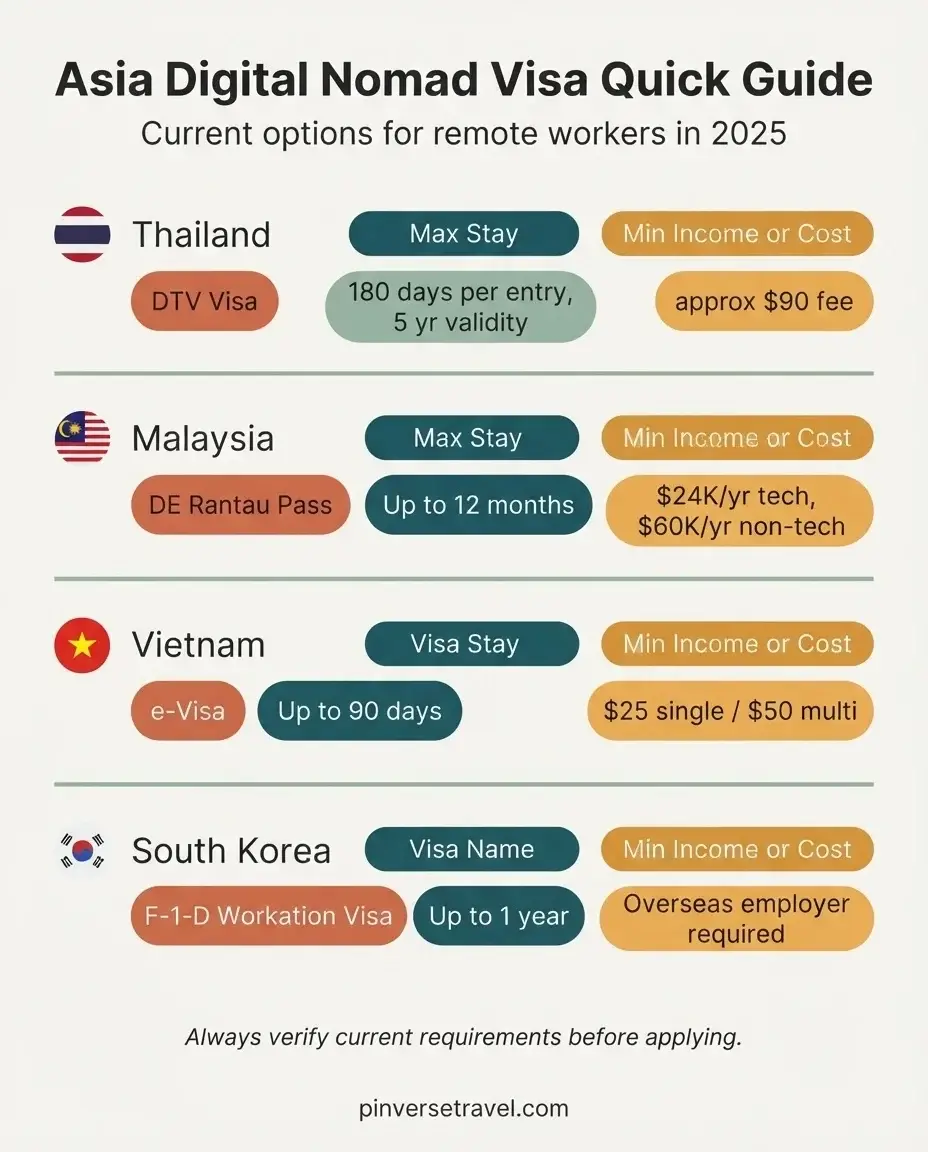
The second mistake is not sorting out the visa situation in advance. Asia has genuinely improved its options for remote workers in recent years, with Thailand’s DTV, Malaysia’s DE Rantau, and South Korea’s F-1-D all offering legitimate legal pathways. Use them. Working on a tourist visa in many countries sits in a legal grey area, and the peace of mind that comes from having the right documentation is worth the small effort of applying properly.
Third: do not skip the cultural layer. The places on this list are not just functional work bases — they are genuinely fascinating places to be human. Eat the local food. Learn a few words in Thai, Bahasa, or Vietnamese. Visit a temple, a market, a community event. That is the part that sticks with you long after your laptop has logged off for the day.
Asia rewards the remote worker who shows up curious, patient, and willing to get slightly lost. That is always been my experience of the places that change you most.
[End of Article Body]