Philippines Beaches for Solo Travelers: What No One Tells You

There is a moment when you first look up “Philippines” on a map and realize that the country is made up of more than 7,000 islands, and your first reaction is probably something close to overwhelmed. I know that feeling. It is the same one I had the first time I opened a search tab while still sitting in an office I was counting the minutes to leave, trying to figure out where in Southeast Asia to go first. Too many options, too much conflicting advice, and not nearly enough clarity about what actually works when you are traveling alone.
Here is what I want to do in this guide: cut through the noise. Not give you a dreamy slideshow of turquoise water with zero practical substance. Actually tell you which beaches in the Philippines work for solo travelers, which ones don’t, what to expect, and how to handle the trip so you walk away with the kind of experience that reminds you why you started traveling in the first place.
Let’s get into it.
Why the Philippines Works So Well for Solo Travelers
Before the beach breakdown, a quick word on why this country stands out for solo travel in particular. The Philippine Department of Tourism describes it simply as “more than just world-class food and beaches,” and that understates it. What makes the Philippines exceptional for solo travelers is the combination of extraordinary nature, genuinely warm Filipino hospitality, a strong backpacker and hostel culture in the main tourist areas, English being widely spoken across the country, and the ability to join group activities (island-hopping tours, surf lessons, diving trips) as a single traveler without feeling out of place.
You will not feel like a third wheel here. The joiner tour culture is built for exactly that. You show up, you pay your share, you spend the day on a boat with other travelers from every corner of the world, and by the time the sun goes down, you have dinner plans. It happens almost every time.
The practical entry details: most nationalities, including U.S. and UK citizens, enter the Philippines visa-free for up to 30 days. Your passport needs to be valid for at least six months from the date of arrival. For the current entry requirements specific to your nationality, the U.S. State Department’s Philippines country information page is the most reliable and up-to-date source to check before you book anything. The currency is the Philippine peso (PHP), and as of mid-2026, one U.S. dollar gets you roughly 61 Philippine pesos, which means the country is genuinely affordable once you are there.
One note on timing: the Philippines has two main seasons. The dry season runs roughly November to April, and this is when beach conditions across Palawan and the Visayas are best. Siargao flips this slightly, with surf season peaking September to March. December through February is the sweet spot for the widest range of destinations. July and August are typhoon season for much of the country, so plan accordingly.
Now, the beaches.
El Nido, Palawan: The One That Lives Up to Its Reputation
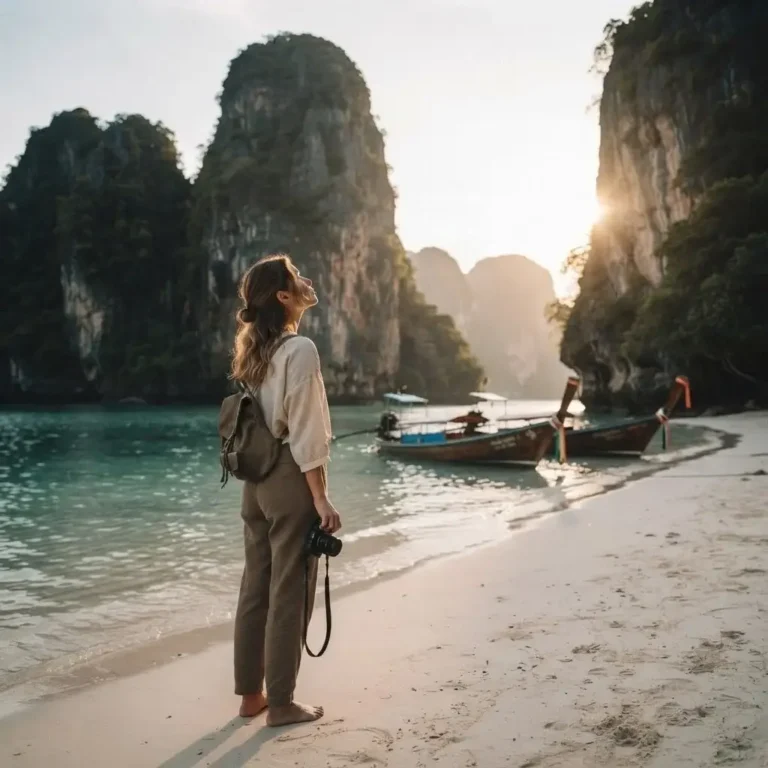
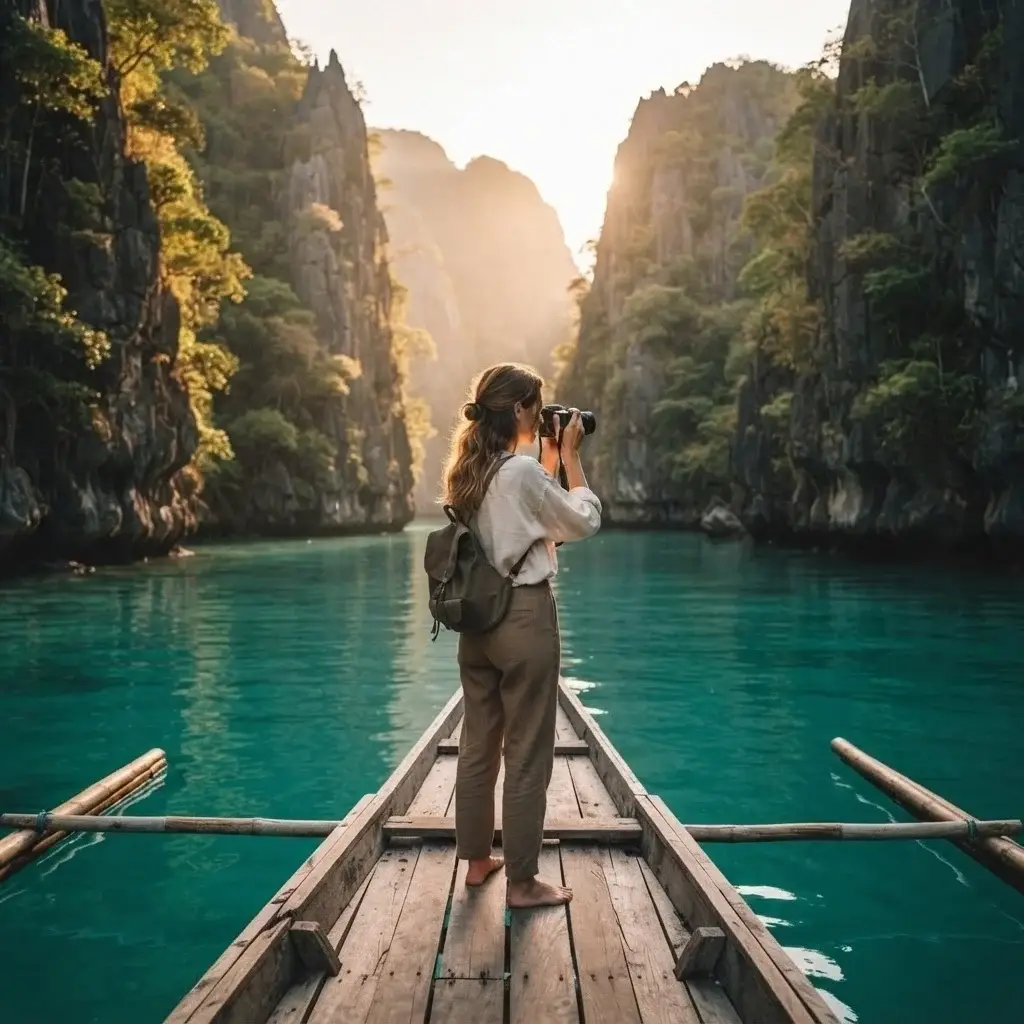
El Nido is, for most solo travelers, the highlight of a Philippines trip. It earns that status. The water is an impossible shade of turquoise, the limestone karsts rise out of the sea in formations that make you stop mid-sentence, and the island-hopping tours are genuinely among the best day trips anywhere in Southeast Asia.
From a solo travel perspective, El Nido works beautifully because of those tours. There are four main island-hopping routes: Tour A, Tour B, Tour C, and Tour D. You can get the full breakdown of each route and what they cover on the El Nido Paradise tours page. Tour A and Tour C are the most popular and the ones locals usually recommend first. You join as a single traveler, pay your portion, and share a Bangka boat with a mix of other travelers for the day. Lunch is typically included. The environmental fee is 200 PHP (around $3.25 USD) and covers you for 10 days, so don’t lose that receipt if you’re planning multiple tours.
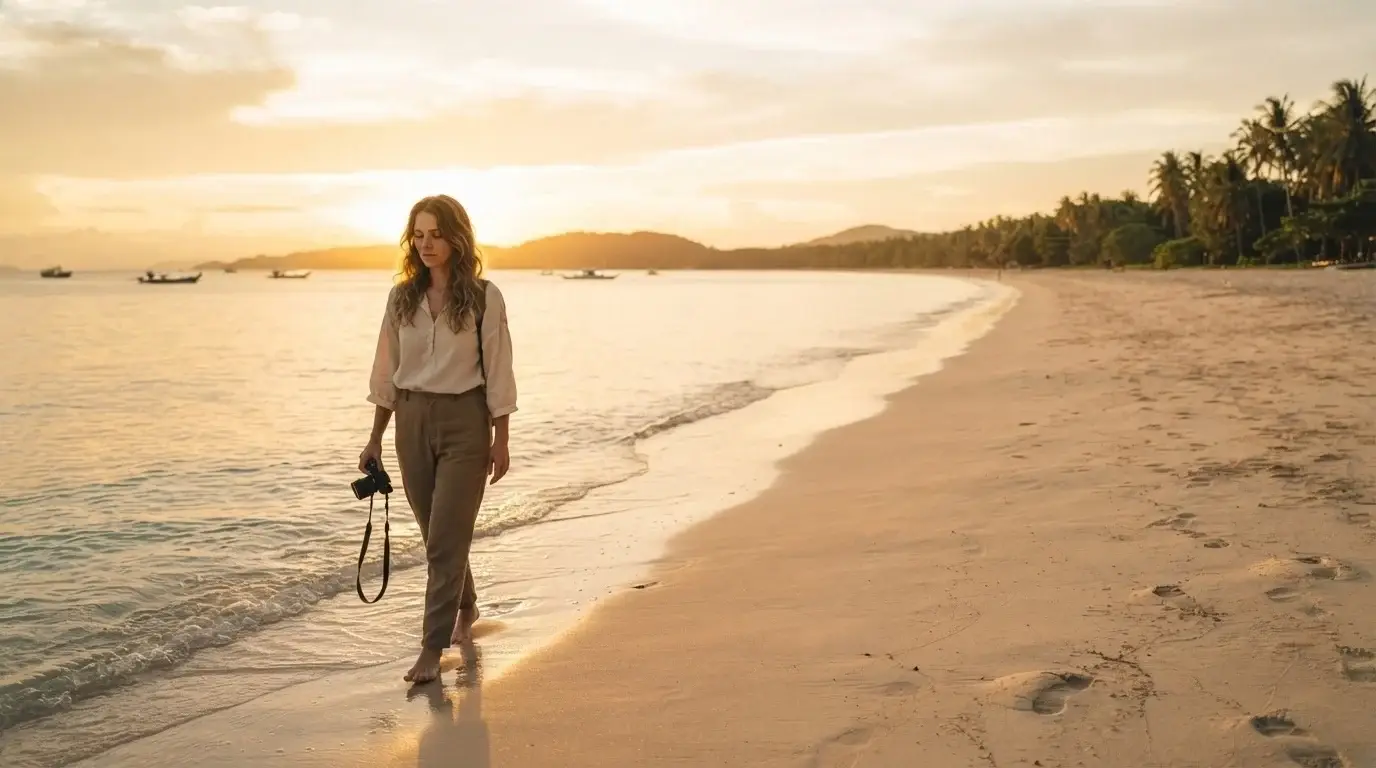
Nacpan Beach is worth singling out as a separate trip. It sits about 17 kilometers north of El Nido town, roughly a 45-minute drive, and it has a completely different energy from the lagoon tours. A long stretch of golden sand with far fewer crowds than you’d expect given El Nido’s reputation, it is a good place to spend a quiet afternoon if you want a break from organized activities. Rent a motorbike in town (very easy, very cheap) and you can get there independently.
For food in El Nido, eat at the local carinderia-style spots along the main drag rather than the tourist-facing restaurants. Fresh seafood grilled to order, rice, and a mango shake costs almost nothing and tastes like everything.
Getting there: most travelers fly into Puerto Princesa and take a 5 to 6 hour van or bus north to El Nido. There is also a small airport in Lio, closer to El Nido, with select flights from Manila.
Siargao: The Social Island With the Best Energy
If El Nido is the nature highlight of a Philippines trip, Siargao is the social highlight. It has a completely different atmosphere, less about dramatic scenery and more about a laid-back surf community that has built up around one of the most famous waves in the world.
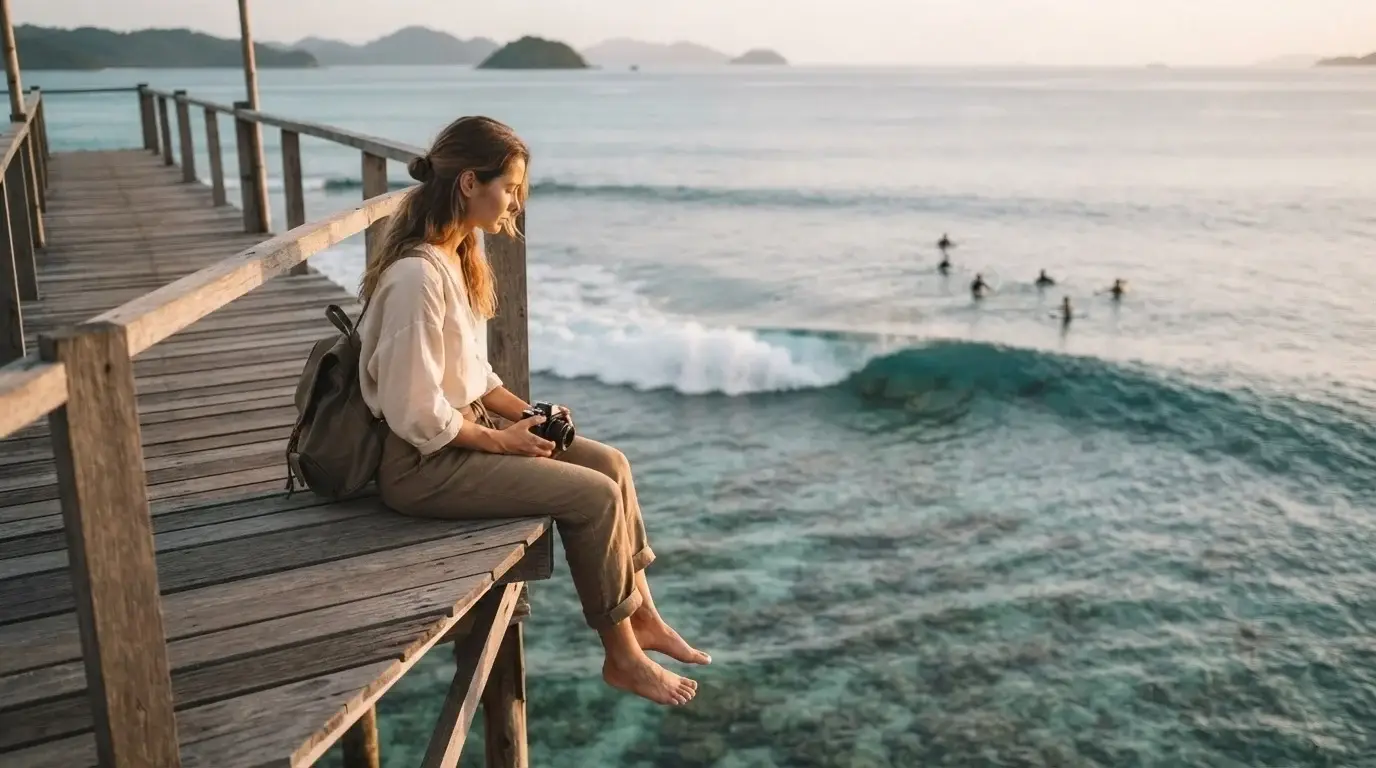
Cloud 9 is that wave. Located in the General Luna area of Siargao, it is a thick, hollow, barreling right-hander that breaks over a shallow coral reef. According to SurferToday, it is genuinely considered one of the best surf spots in the world and is best suited to confident intermediate and advanced surfers. If you are a beginner, do not paddle out at Cloud 9 and expect a fun time. The reef is shallow and the wave is fast. Instead, head to the many gentler breaks nearby in General Luna, where surf schools operate daily and the waves are forgiving enough to actually learn on.
The thing about Siargao that makes it ideal for solo travel is this: it is the kind of place where you meet people. The hostel and guesthouse scene in General Luna is genuinely social. You arrive, check in somewhere with a hammock and a common area, and within 24 hours you probably have people to explore with. The surf culture is welcoming to outsiders who show up with curiosity and respect, and the food scene has evolved into something worth showing up for on its own. Local warungs serve fresh catch, kinilaw (the Filipino version of ceviche) is outstanding, and the smoothie bowl spots around General Luna are a reliable start to any morning.
Siargao sits in the Surigao del Norte province, which falls within Mindanao. This prompts a question worth addressing directly.
A Straight Answer on Safety
The U.S. State Department issued a Philippines travel advisory in May 2025, placing the country at Level 2 overall (Exercise Increased Caution). This is common for many Southeast Asian destinations and should not be a dealbreaker, but it is worth understanding what it actually means for beach travel specifically.
The areas of genuine concern are the Sulu Archipelago and Sulu Sea (Level 4, Do Not Travel), Marawi City (Level 4, Do Not Travel), and most of Mindanao broadly (Level 3, Reconsider Travel). The advisory also explicitly states that Siargao Island is exempted from the Mindanao restrictions. Palawan, Boracay, Cebu, Bohol, and La Union are all in Level 2 territory, which is the baseline Philippines-wide caution. The practical message for beach travelers: stick to the established tourist regions covered in this guide and you are navigating a country where millions of solo travelers, including solo women, move around safely every year. Avoid the Sulu Archipelago entirely, don’t wander into restricted Mindanao areas, stay aware in cities, and use your common sense the same way you would anywhere.

Petty theft is the most common issue in busy tourist areas. Keep your phone off tables in crowded spots, use a daypack with a zipper you can hold rather than an open tote, and store your passport and extra cash in your accommodation’s safe. None of this is unique to the Philippines.
Boracay: The Party Beach That Has More Going on Than You Think
Boracay has a reputation as a party destination, and White Beach does attract that crowd, especially at the southern end. But writing it off as just a spring break island misses the full picture.
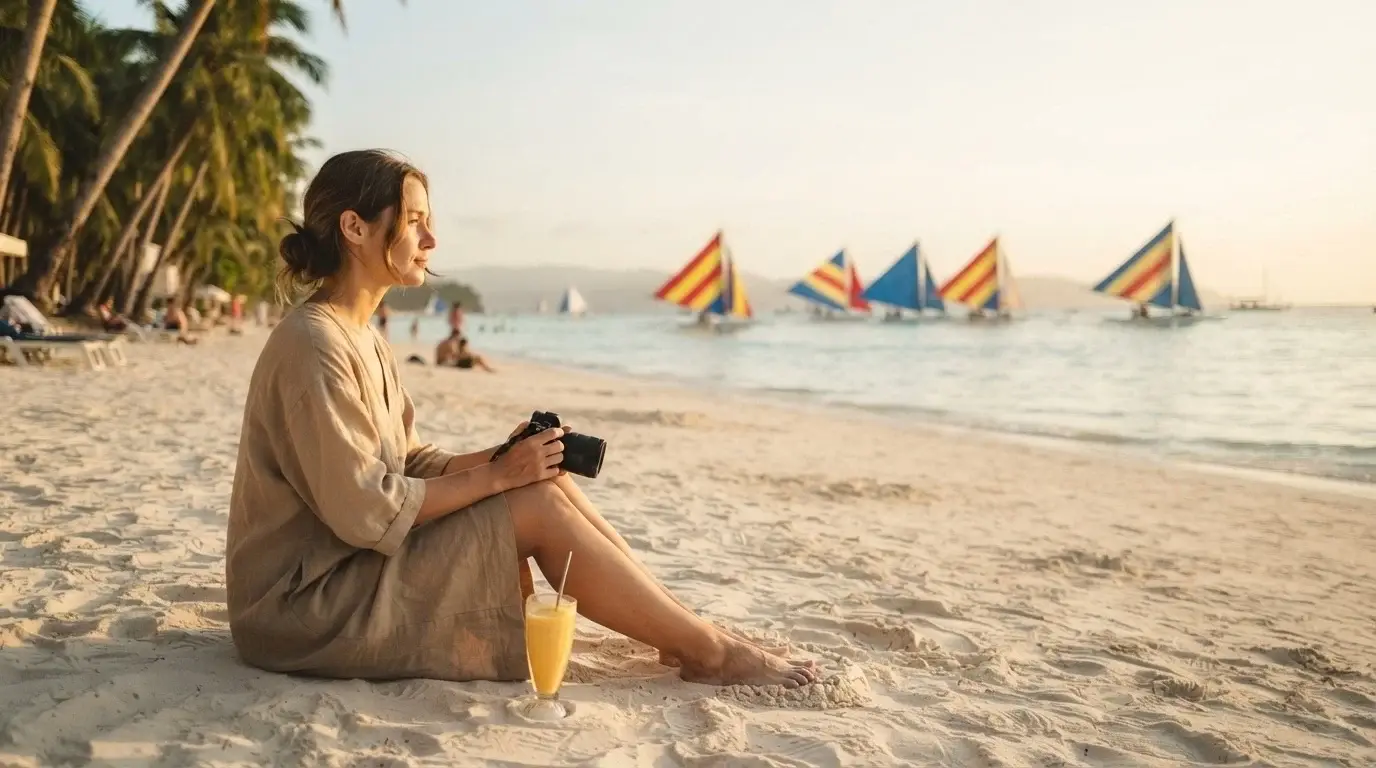
White Beach itself is one of the genuinely beautiful beaches in Southeast Asia, a nearly four-kilometer ribbon of fine white sand that was named among the top 10 beaches in the world by Big 7 Travel in 2025. For solo travelers, the middle section (Station 2) hits the right balance: lively enough to meet people and find things to do, calm enough that you are not fighting through a crowd every time you want to sit down. Puka Shell Beach on the northern end of the island is quieter and worth a half-day trip if you want something with more breathing room.
From a solo logistics standpoint, Boracay is one of the easiest islands in the Philippines to navigate independently. E-trikes (electric tricycles) run up and down the island constantly. Tours, activities, and diving trips are plentiful and easy to book solo. The hostel scene is solid. The food options range from proper Filipino meals to international restaurants, and the fruit shake culture is alive and well.
What Boracay rewards is the traveler who doesn’t fight its personality. If you show up expecting a quiet hideaway, you will be disappointed. Show up ready to be social, eat well, and spend time on one of the world’s best-looking stretches of sand, and it delivers.
Bohol and Panglao Island: The Underrated One
Bohol gets mentioned mostly for the Chocolate Hills and the tarsier sanctuary (both worth seeing), but Panglao Island, connected to Bohol’s mainland by bridge, holds some of the most beautiful beaches in the Visayas and far fewer crowds than Boracay.
Alona Beach on Panglao is the hub for budget travelers and solo backpackers. It is compact enough to walk everywhere, the diving operators there are well-regarded, and the eat-street vibe along the main strip makes solo dining genuinely comfortable. You pick a plastic chair, order fresh tuna or grilled squid, and inevitably end up talking to whoever is sitting at the next table. The official resource for planning time in the province is the Bohol Provincial Tourism Office, which provides information on both Panglao’s beaches and the wider island.
Balicasag Island, accessible by a short boat ride from Panglao, is consistently named one of the best dive sites in the Visayas. Even if you are not a diver, snorkeling around the reef there is an experience that sticks with you.
For solo travelers who want a destination that combines beach time, some cultural depth (the Baroque churches of Bohol are genuinely interesting), easy logistics, and lower crowds, Panglao-Bohol is one of the smartest picks in the country.
Coron, Palawan: For Divers and the Genuinely Curious
Coron is different from the other entries on this list because its main draw is underwater. The World War II Japanese shipwrecks lying in the waters around Coron are among the most famous wreck diving sites on the planet, and the wider Palawan seabed sits within a region that the UNESCO World Heritage listing for Tubbataha Reefs Natural Park describes as part of one of the planet’s most biologically significant marine environments, supporting 360 coral species and nearly 700 fish species. You don’t need to visit Tubbataha directly to appreciate what diving in this corner of Palawan means.
For non-divers, Coron still has plenty to offer. The island-hopping route covers stunning lakes (Kayangan Lake is usually the highlight), shallow coral gardens, and beaches like Bulog Dos that are genuinely beautiful. The joiner tour culture is strong here too, and solo travelers have no trouble filling days with good company. The town of Coron itself is small, navigable on foot, and has a relaxed energy that suits slow travel.
Getting to Coron: fly from Manila to Francisco B. Reyes Airport. The journey takes about an hour.
La Union: The Beginner Surfer’s Favorite and the Easiest Weekend Option
La Union does not have the postcard scenery of Palawan or the open-ocean energy of Siargao, but it earns its spot on this list for one specific reason: it is the most accessible beach destination in the Philippines for solo travelers starting out, and it has the friendliest beginner surf scene in the country.
San Juan in La Union is the surf hub, about five hours north of Manila by bus. The waves are consistent, the surf schools are plentiful and affordable, and the social vibe along the main strip is the kind that makes solo travel easy. Food choices are excellent. The cafe culture is thriving. People come here for a weekend and end up staying a week.
If you are based in Manila or landing there first, La Union is the logical first beach stop before heading south to the bigger islands. The learning curve is low, the community is welcoming, and it is a good place to figure out your rhythm for Philippines travel before the logistics get more complex.
Building Your Trip: How to Actually Sequence This
One of the most practical questions solo travelers have is how to connect these places. Here is a general framework that works for two to three weeks.
Start in Manila for a day or two (eat at the local carinderia spots in Poblacion, explore Intramuros if history interests you, stock up on anything you need). Then fly to either El Nido or Coron for Palawan, spend five to seven days exploring the lagoons and beaches. Fly back to Manila, then catch a flight to Cebu, which is the regional hub for the Visayas. From Cebu you can reach Bohol by fast ferry in about two hours, and Siargao by flight in about an hour. Return to Manila and fly home from there, or use Manila as your exit point after your final island.
Boracay and La Union slot in as add-ons depending on time and travel style. La Union is a quick trip from Manila at the start. Boracay works best as a middle chapter or a final beach wind-down.
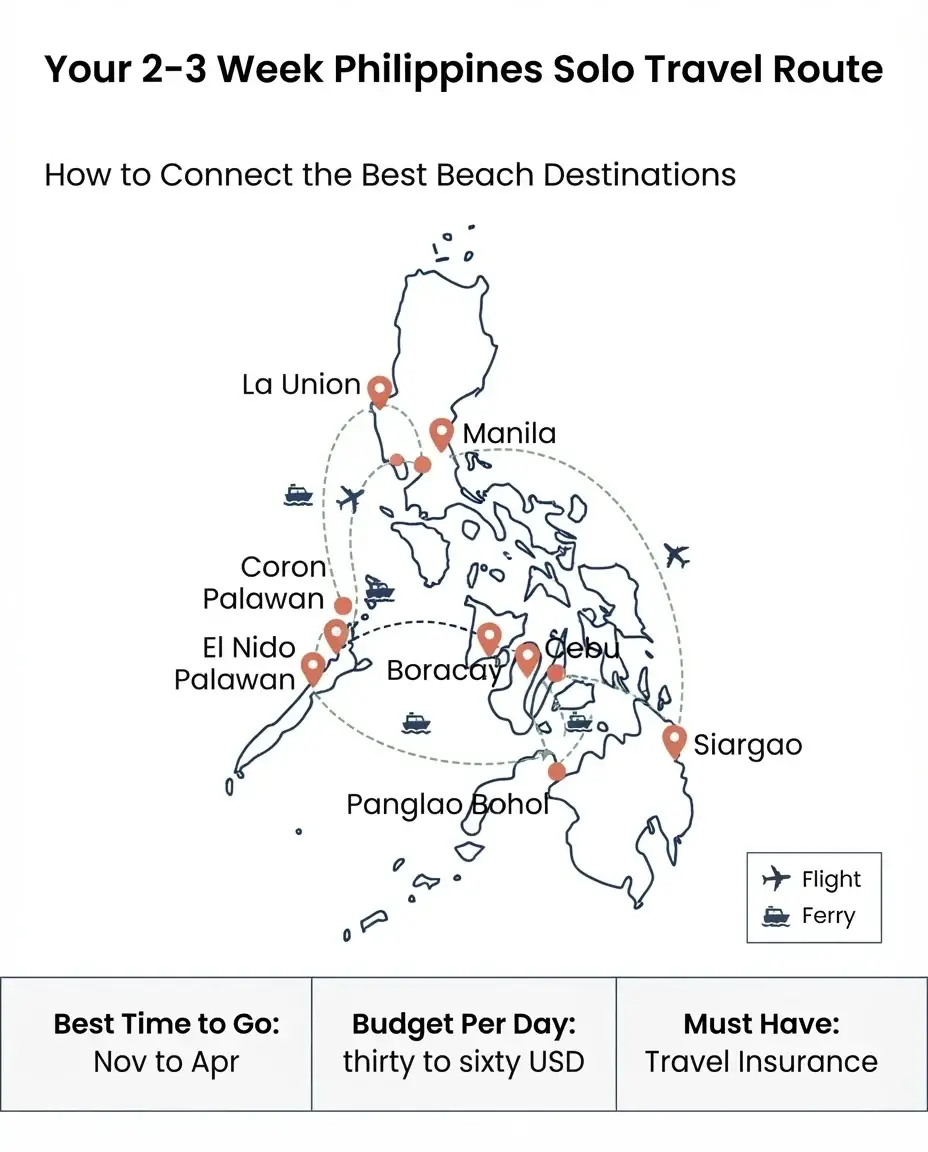
Budget-wise, the Philippines is genuinely affordable. A clean private room in a guesthouse runs roughly 600 to 1,500 PHP per night ($10 to $25 USD) in most beach areas. Local meals cost 100 to 200 PHP ($1.60 to $3.25 USD). Island-hopping joiner tours typically run 1,200 to 1,500 PHP ($19 to $24 USD) per person including lunch. Inter-island flights (Cebu Pacific and AirAsia both serve domestic routes) are cheap if booked a few weeks in advance.
What Solo Travel Actually Feels Like Here
Here is the honest part that most guides skip. The Philippines is one of the easiest countries in Southeast Asia to meet other travelers as a solo person, but it is not a destination where everything falls into your lap without any effort.
You have to show up and be open. The joiner tours do the heavy lifting socially, but you also have to put down the phone at dinner and say hello. You have to be willing to ask the question at the hostel common area: “Anyone want to go to the market tonight?” You will find that most of the time, the answer is yes.
Filipino hospitality is a real thing, not a tourism-brochure phrase. Solo travelers consistently report unexpected kindness: the tricycle driver who waits for you, the restaurant owner who explains the entire menu in detail because you seemed uncertain, the family at the next table who invites you to try their food. These moments are not guaranteed and they cannot be planned. But they happen, and they are often the things you remember most.
Slow travel suits the Philippines beautifully. You could rush through five islands in ten days and come away with a reel of great photos and a persistent sense that you missed it. Or you could spend five days in El Nido, two slow afternoons in Panglao, a week in Siargao learning to surf, and leave with memories that are actually yours. That is the kind of travel worth building your life around.
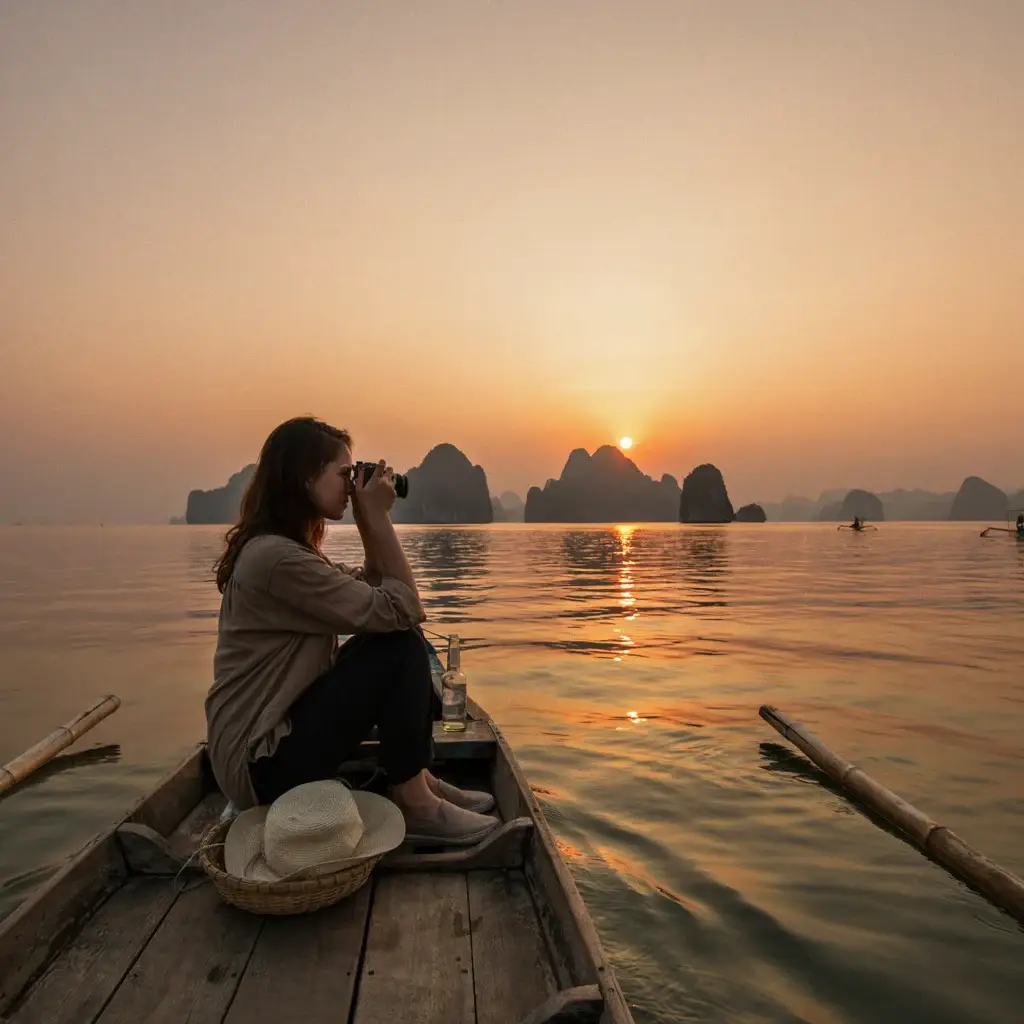
The Philippines is waiting for you. Go find your beach.