I have always believed that how you travel between places matters just as much as the places themselves. When I was backpacking solo across Europe years ago, the train rides were half the adventure. The rhythm of watching landscapes change outside the window, striking up conversations in the dining car, arriving somewhere new with sea legs and a story already forming. The Caribbean, I think, offers something even more extraordinary than that. Here, the journey between islands happens on the water. And the water is everything.
But here is what nobody tells you clearly when you start researching a Caribbean boat trip: “exploring by boat” is not one single thing. It is four or five very different experiences with different price points, different skill requirements, and different vibes. The person who wants to sip rum on a catamaran deck at sunset has completely different needs from the person who wants to sail a bareboat from Tortola to Virgin Gorda, or the budget-conscious traveler who just wants to catch a fast ferry from Martinique down to St. Lucia for the day.
This guide breaks all of it down honestly, so you can figure out which version of “Caribbean by boat” is actually right for you, and then plan it properly.
Understanding the Four Main Ways to Get on the Water
Before we talk about routes, seasons, or islands, let us get the lay of the land, or rather, the lay of the sea. There are four primary ways to explore the Caribbean by boat, and each one serves a different type of traveler.
The first is the ferry, which is the most overlooked and underrated option. Ferries in the Caribbean are not the slow, unreliable boats people imagine. In some corridors they are large modern catamarans running on scheduled routes multiple times a day. They are affordable, they require zero sailing experience, and they let you move between islands the way locals actually do. The second is the day sailing tour, where you book a spot on a crewed boat for a single day. You show up, someone else does all the work, and you snorkel, eat, drink, and soak it in. Third is the charter yacht, which splits into bareboat (you captain the boat yourself) and crewed (a skipper and sometimes a chef come with it). Fourth is the flotilla, a guided group sailing experience that is one of the best-kept secrets for travelers who want to sail independently but with a safety net.
Knowing which one fits your trip changes everything.
The Ferry Network: More Useful Than You Think (and More Limited Than You Hope)
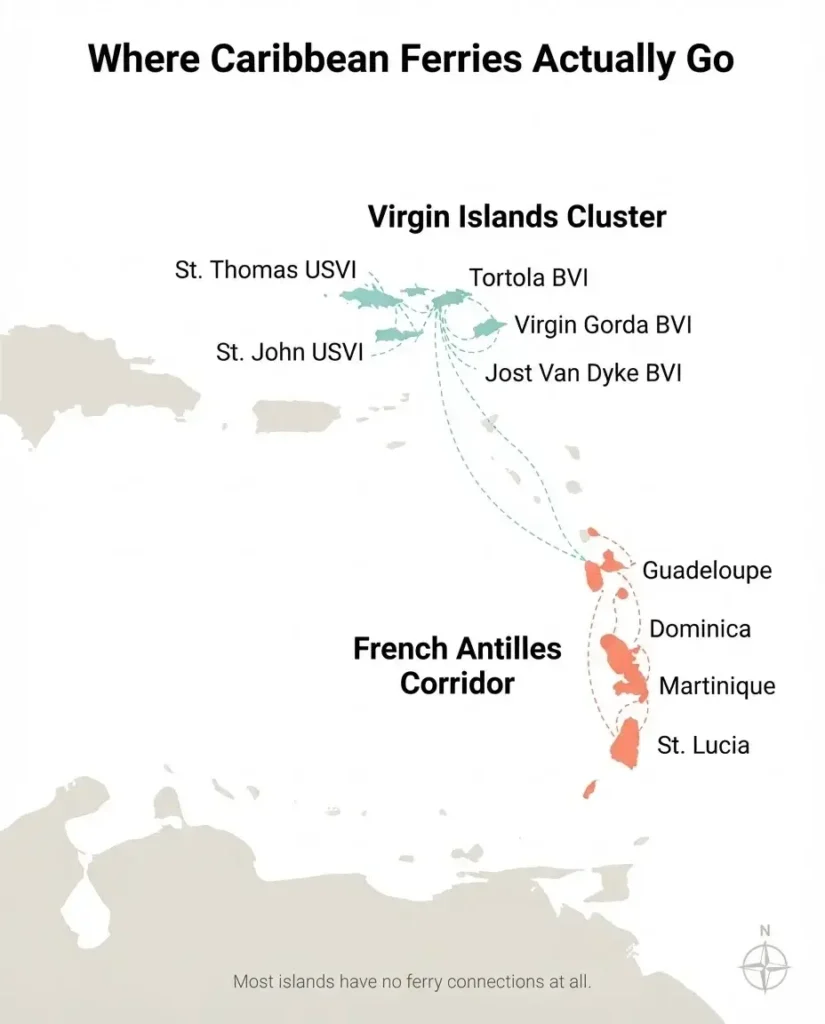
Let me be direct about something most travel content gets wrong. You cannot island-hop the entire Caribbean by ferry. The network is regional, not pan-Caribbean. There are no reliable ferries connecting Barbados, Aruba, Jamaica, or Cuba to other islands. The ferry system is concentrated in specific clusters, and once you understand those clusters, it becomes incredibly useful.
The two main ferry hubs are the Virgin Islands cluster (US Virgin Islands and British Virgin Islands) and the Eastern Caribbean / French Antilles corridor (Guadeloupe, Dominica, Martinique, and St. Lucia). If your trip is built around either of these clusters, ferries become a genuine backbone of your itinerary.
According to Ferrygogo’s Caribbean ferry route map, the most dependable long-distance route in the region is the one connecting Guadeloupe, Dominica, Martinique, and St. Lucia, and it also flags an important reality: many major Caribbean islands have no ferry connections at all. This is the map you want to look at before planning any multi-island trip by sea.
The Virgin Islands Ferry System
This is the most developed ferry network in the Caribbean, and it is genuinely excellent. From Charlotte Amalie (St. Thomas, USVI), you can catch ferries to Road Town on Tortola (BVI) multiple times a day. The standard schedule runs daily departures from Road Town to Charlotte Amalie at 7:30 am, 10:00 am, 11:30 am, and 3:30 pm, with return trips available throughout the day. Within the BVI itself, ferries connect Tortola to Virgin Gorda, Jost Van Dyke, Anegada (three days a week), and Peter Island. Anegada, a flat coral atoll that is wildly different from the volcanic hills of the other BVI islands, is reached via Smith’s Ferry on Mondays, Wednesdays, and Fridays.
One thing you must know: every ferry crossing between the USVI and BVI is an international border crossing, even though the islands are visible from each other. You will pass through Customs and Immigration every single time. As of January 1, 2025, the BVI no longer accepts paper immigration forms. All travelers arriving by sea must complete the online BVI ED card form, which you can fill out at bviedcard.gov.vg starting 36 hours before you arrive. Bring your passport and complete this before you get to the terminal. Ports of entry by sea include Road Town, Tortola (open daily until 8:00 pm), West End Tortola, Great Harbour on Jost Van Dyke, and Spanish Town on Virgin Gorda. All of those details, including current ferry company contacts, are maintained on the BVI Tourism ferry schedules page, which is the most accurate source for current departure times.
The French Antilles Corridor: FRS Express
If you are building a trip around the Eastern Caribbean islands, the FRS Express (formerly L’Express des Iles) is your best friend. This service connects Guadeloupe, Dominica, Martinique, and St. Lucia on modern catamaran ferries. During normal operations, it runs five round trips per week, dropping to three during maintenance periods (typically parts of June, September, and January) and increasing to seven during school holidays. The crossing from Martinique to St. Lucia takes about 90 minutes, which is shorter than most domestic flights once you factor in airport time.
A few important practical details if you use this route. A sea departure tax of EC$33 (roughly $11 USD) per person over 12 is collected in cash at the St. Lucia counter before boarding. This is not included in your ticket price and you must pay it before you can board. Check-in opens two hours before departure and closes 45 minutes before sailing. Schedules do change based on weather and sea conditions, so always check the current timetable on the FRS Express official website before booking anything around a specific sailing.
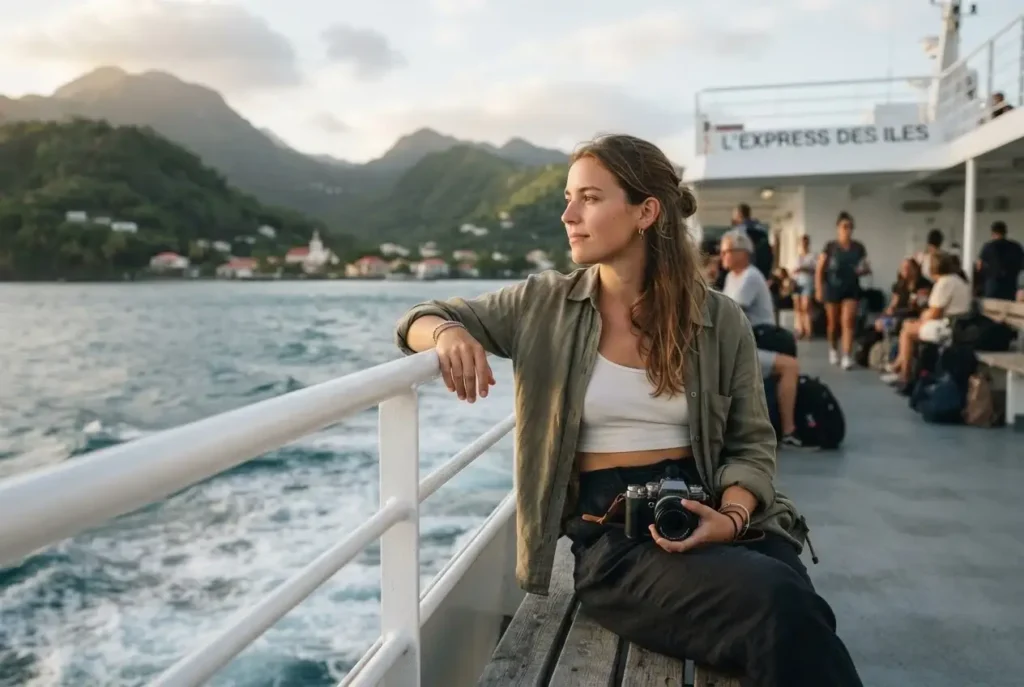
One more thing worth knowing from experience that solo travelers report consistently: these ferries cross open water, and when the Atlantic swell is running, it can get rough. Motion sickness medication is a smart packing choice if you have any sensitivity at all.
Day Sailing Tours: The No-Experience, No-Commitment Gateway
If you have never been on a sailboat in your life, this is your entry point. A day sailing tour puts you on a crewed boat with a captain, often a crew member or two, and a small group of fellow travelers. You contribute nothing to the sailing. You show up at the marina at 8 or 9 in the morning, the boat takes you to snorkel spots, secluded bays, small islands, and beach bars, and you are back at the dock by late afternoon.
These tours run throughout the Caribbean, but they are especially common in the BVI, St. Lucia, Antigua, and the Grenadines. A full-day catamaran charter with shared group spots typically runs between $100 and $200 per person, depending on what is included. Most include snorkeling gear, lunch, and an open bar, which in the Caribbean generally means rum punch starts flowing around 11 am.
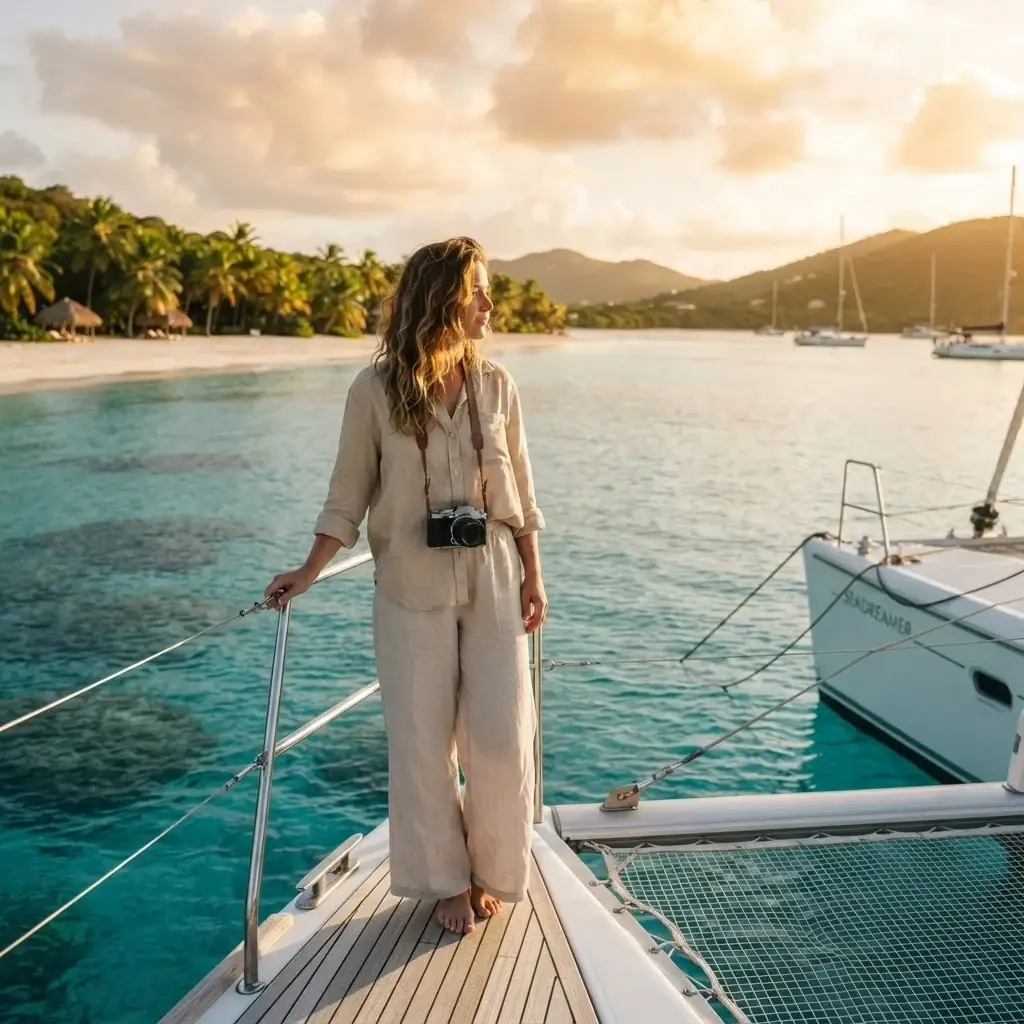
From what solo travelers consistently report, this format is one of the best ways to meet people on a Caribbean trip. You are in close quarters with a small group for six or eight hours. Conversations happen. Plans get made. People end up sharing dinners and exploring the same islands for the next three days. For solo travelers, a day sail is not just a boat trip. It is a social catalyst.
What to actually eat and drink when you stop: look for the beach bars that have been around for decades rather than the new tourist-facing ones. In the BVI, the soggy dollar bar on Jost Van Dyke is legendary. On land, a plate of jerk chicken from a roadside spot, salt fish and fungi (the traditional BVI dish, nothing like what the word suggests), fresh flying fish in Barbados, or a doubles breakfast in Trinidad will tell you more about an island than any guidebook can. The food you eat at port is part of the boat trip.
Bareboat Charter: Sailing the Caribbean on Your Own Terms
This is where things get real for anyone with sailing experience. A bareboat charter means you rent the yacht and captain it yourself. No crew, no guide, just you and whoever is sailing with you. The British Virgin Islands and the Grenadines (St. Vincent and the Grenadines) are the two most celebrated bareboat cruising grounds in the world, and for good reason.
The BVI’s sheltered Sir Francis Drake Channel offers protected sailing between islands, short distances, and clearly marked anchorages. A beginner-friendly route might go Tortola to Norman Island, then on to Jost Van Dyke, Virgin Gorda, and Anegada. None of these legs takes more than a few hours. The BVI Tourism Authority describes the islands as having a network of boat docks and connections that make every leg feel manageable rather than intimidating, which is exactly right for newer sailors.
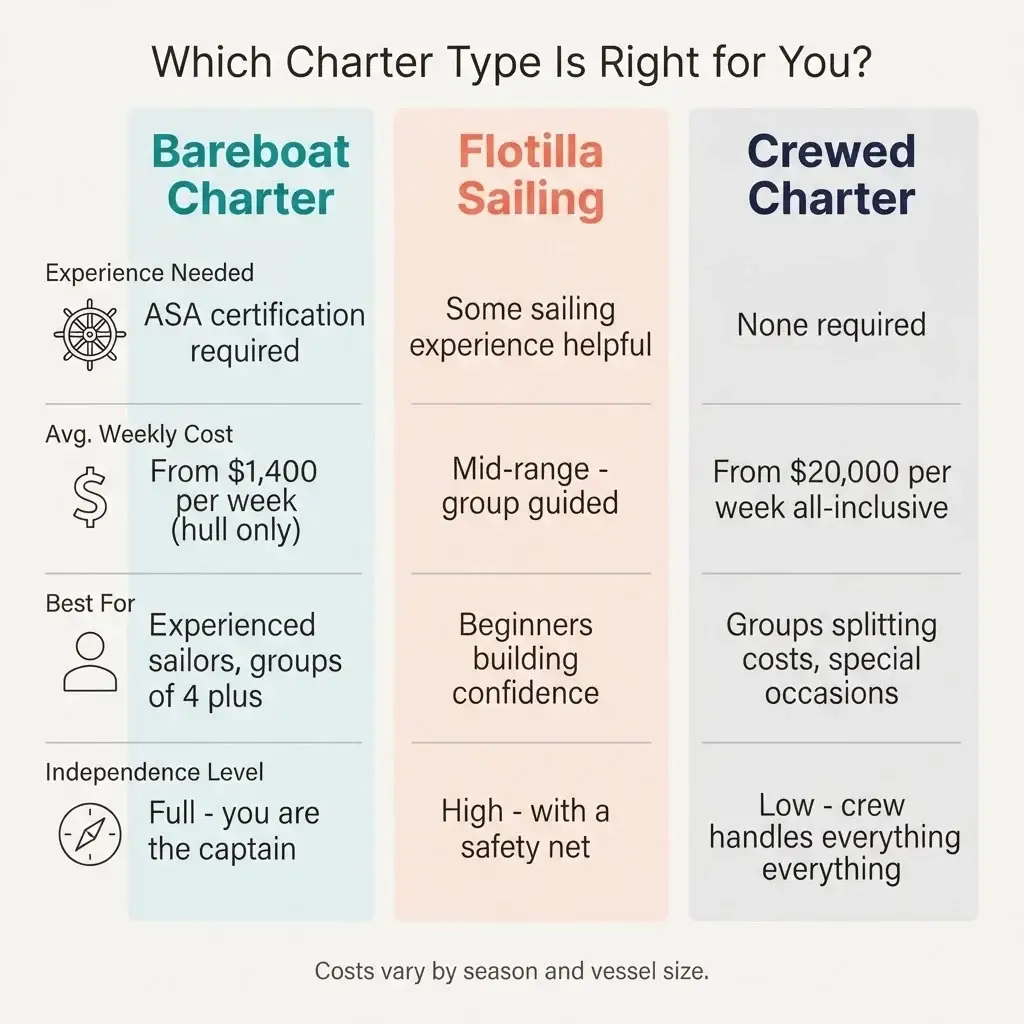
For chartering, you will need to show proof of sailing competence. Most companies ask for a logbook showing offshore experience, an ASA certification (or equivalent), and they may require you to take a local checkout sail before handing over the keys. If you have the credentials and a crew of two or more, bareboat charter costs in the Caribbean start around $1,379 per week for smaller vessels, though a well-equipped catamaran for a week typically runs $5,000 to $15,000+ depending on size, season, and whether you are sailing during the busy December through April period. Keep in mind this is the hull cost alone. Provisioning (food and water for the week), fuel, marina fees, and customs clearance fees for each island entry add up.
The Grenadines offer a slightly wilder, less developed experience than the BVI, with the chain of islands between St. Vincent and Grenada threading through some of the most beautiful water in the Atlantic. NauticEd’s free sailing guide and itinerary for St. Vincent and the Grenadines is one of the most detailed free resources for planning this route, covering anchorages, customs stops, and the specific character of each island.
What you gain from a bareboat week that no resort or cruise ship can give you is the freedom to stop anywhere, to stay an extra day in a bay because it is perfect, to anchor off a beach that has nobody else on it. This kind of slow, self-directed travel is what I fell in love with when I was traveling overland through China: the days when the plan changed because of something beautiful you stumbled into. On a bareboat, every day has that possibility.
Flotilla Sailing: The Best Option Nobody Talks About
If the idea of bareboat chartering sounds amazing but you are not quite confident enough to do it alone, or if you have a group of friends who all want their own boat but would feel better with a guide, flotilla sailing is the answer. A flotilla is a group of private yachts sailing together, led by a lead boat crewed by experienced guides. You have your own vessel and make your own decisions, but you have support if anything goes wrong, and the group reconvenes each evening in the same anchorage.
This format builds sailing confidence faster than almost any other experience. You are responsible enough to have to navigate and make decisions, but you are not truly alone. It is the solo backpacker version of sailing, honestly. You have your independence, but the safety net is there.
Sunsail’s flotilla sailing program operates in the BVI and is one of the most established options in the Caribbean. Their lead boat carries experienced sailing guides who run morning briefings about the day’s route, share local knowledge, and are available by radio throughout the day. A flotilla week in the BVI during shoulder season can be a significantly more affordable entry point into chartering than going bareboat independently, because you require less sailing experience and you can join as a smaller group.
Crewed Charter: When the Experience Comes to You
A crewed charter is the most hands-off option on this list. You rent a yacht that comes with a professional captain and often a chef. You set the rough itinerary, and the crew handles everything from navigation to cooking. This is genuinely wonderful and genuinely expensive. Crewed charters in the Caribbean start around $20,000 per week for the yacht (all-inclusive means food and drinks are typically included in that price), and they climb from there.
I am not a luxury travel blogger, and I will not pretend this is the option most of my readers are working with. But it is worth understanding, because crewed charters occasionally become affordable when split across a large group. Eight people on a 60-foot catamaran at $25,000 per week becomes $3,125 per person per week, which is actually competitive with some resort packages in peak season. If you have a group of eight close friends with compatible travel styles and the ability to coordinate, it is worth the math exercise.
When to Go: Picking Your Season Honestly
The Caribbean sailing season runs from November through April, which is the dry season. Trade winds are consistent, humidity is lower, and hurricane risk is essentially zero. These are also the busiest and most expensive months, particularly December through March.
The sweet spot that experienced Caribbean sailors often mention is April through early June. The winds are lighter and more variable (which some sailors dislike but beginners actually appreciate), prices drop noticeably, anchorages are quieter, and you get to see the islands the way they actually are rather than at peak-tourist-season density.
Hurricane season officially runs June through November, with August, September, and October being the most active months. Sailing during this period requires more vigilance, proper insurance, and a flexible itinerary that can adjust quickly. Some experienced sailors and liveaboards time their Caribbean season to be out of the islands by late July, repositioning to the US East Coast until November. If you are on a charter during early summer, many companies have specific hurricane policies about where you can sail and what happens if a storm develops.
Practical Things to Know Before You Go
A few things come up repeatedly when people start planning a Caribbean boat trip, and I would rather address them directly here than have you discover them mid-trip.
First, every inter-island crossing is typically an international border, even between islands that look close together. Bring your passport on every single ferry or boat, even for day trips. Short hops between, say, Anguilla and St. Martin, or any crossing from the USVI to BVI, will involve immigration checks on arrival. The BVI’s official sea arrival page has a complete breakdown of what is required for private vessels, including SailClear registration for yacht clearance, which is how captains pre-file their crew and documentation digitally before entering port.
Second, cash matters more on the water than in cities. Departure taxes, dinghy dock fees, and some anchorage fees are cash only. Keep a supply of US dollars (the dominant currency across most of the Caribbean) and some local currency if you are in the French Antilles, where Euros are used.
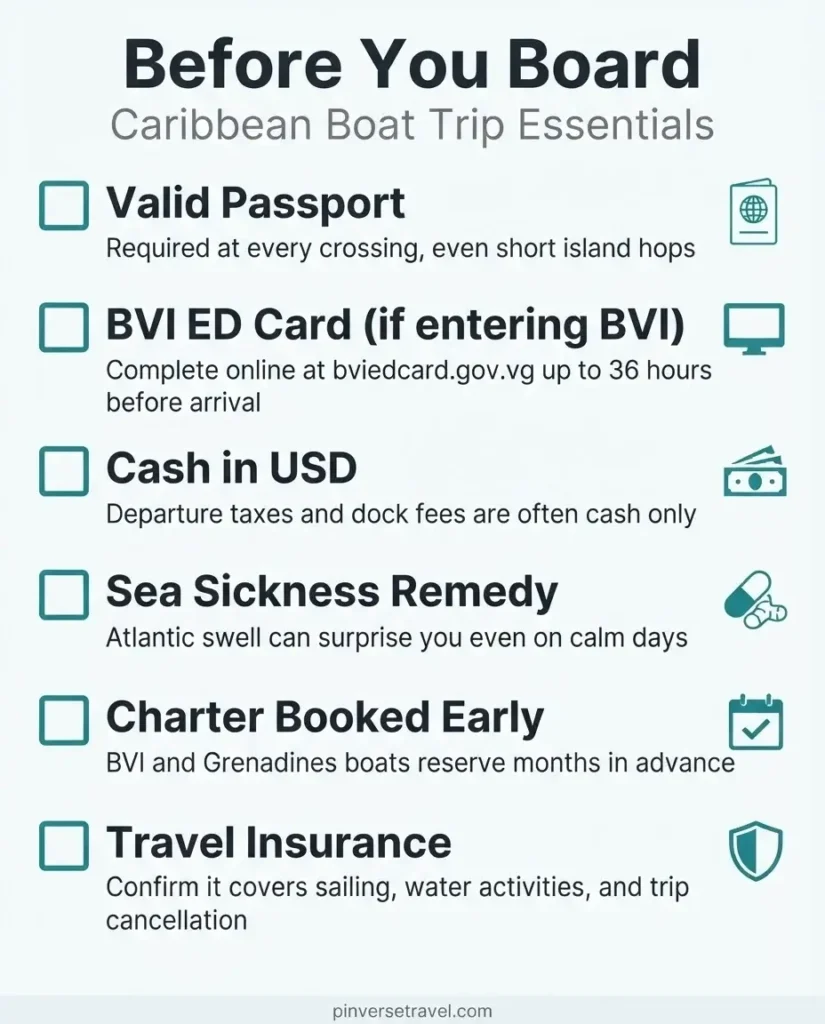
Third, sea sickness is real and unpredictable. Even people who have never been sick on calm water can struggle when a fast catamaran ferry is punching through 2-meter Atlantic swells. Carry Dramamine or a natural ginger remedy, especially if you are taking the Express des Iles on a day when the wind has been running for a while.
Fourth, book your charter or flotilla early. BVI and Grenadines boats get reserved months in advance for the November through April season. If you are planning for December or January, you want your boat locked in by August at the latest.
Where to Start if You Are Completely New to This
The path I would suggest for someone who is seriously curious but has never been on a boat trip like this goes something like this. Start with a day sailing tour on your first Caribbean trip. Use it to see how you feel on the water, to meet other travelers, and to watch how a skipper navigates and communicates. If you love it, look into a flotilla for your next trip. A flotilla builds real skills and confidence. From there, a bareboat is not a leap anymore. It is a natural next step.
The Caribbean has a way of teaching you things about patience and presence that no city can replicate. When your ferry is delayed because the swell is too high and you have to spend another night on Martinique eating accras de morue (salt cod fritters) and drinking Ti’ Punch, that is not a problem. That is the trip.
Stop waiting for the circumstances to be perfect. The perfect sailing experience doesn’t happen in your living room while you read about it. It happens when you book something, get on a boat, and let the Caribbean do what it has always done: change how you see the world.