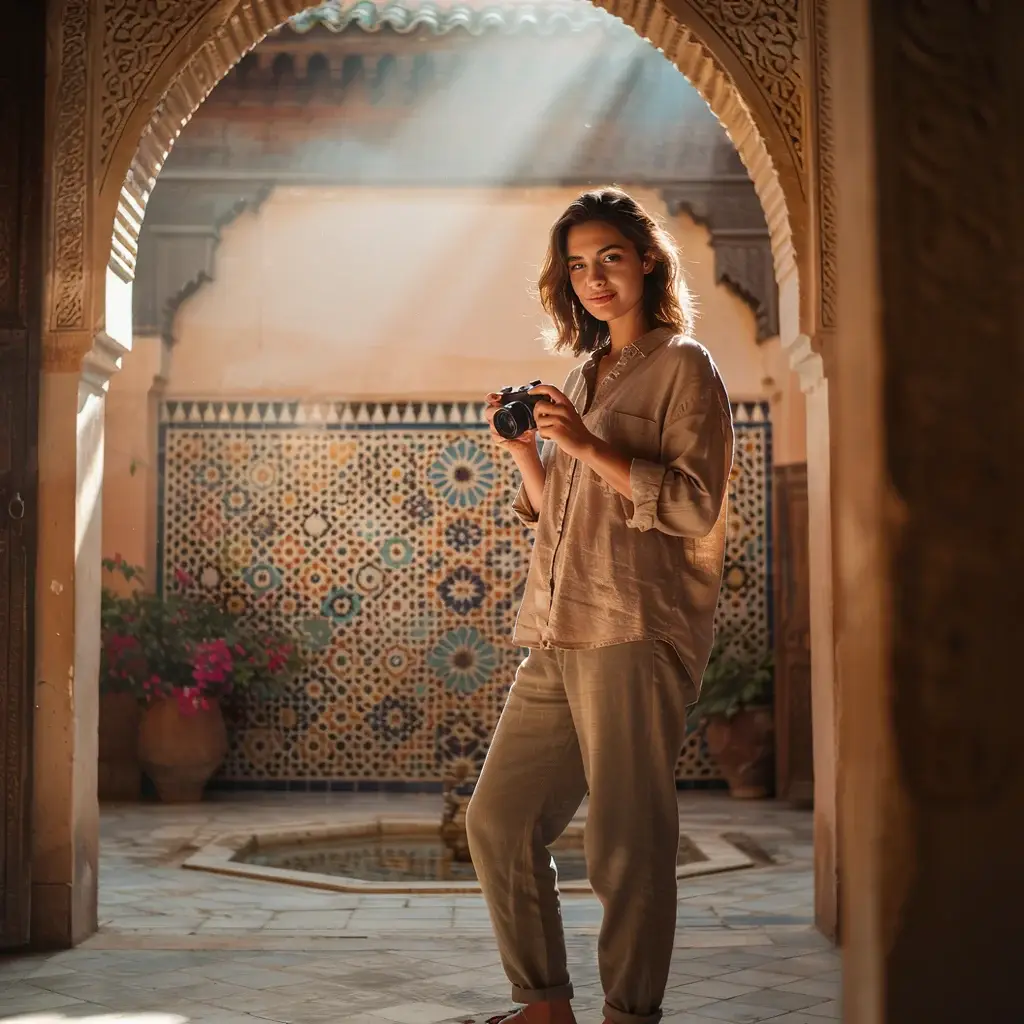
I still remember the first time I stepped out of a taxi into the hot air of Marrakech. The noise was like a wall. Motorbikes zoomed down narrow clay alleys. Carpet sellers shouted from doorways. The smell of cumin, roasting meat, and exhaust fumes filled my nose. To be completely honest, I felt terrified. I wanted to run straight back to my room, lock the door, and look up flights home to New York.
Before I became a full-time travel blogger, I spent years working as a certified sightseeing guide in New York City. I was used to big crowds and loud streets. But Marrakech is a whole different world. It can shock your senses within minutes. It is easy to feel lost, tired, and overwhelmed.
But here is the secret I learned after slowing down and staying a while: you do not have to let the chaos run your trip. You can experience this beautiful city at a peaceful pace.
I created this comprehensive 3-day itinerary for Marrakech, Morocco to help you step out of your comfort zone without burning out. This is not a rushed checklist of tourist sights.
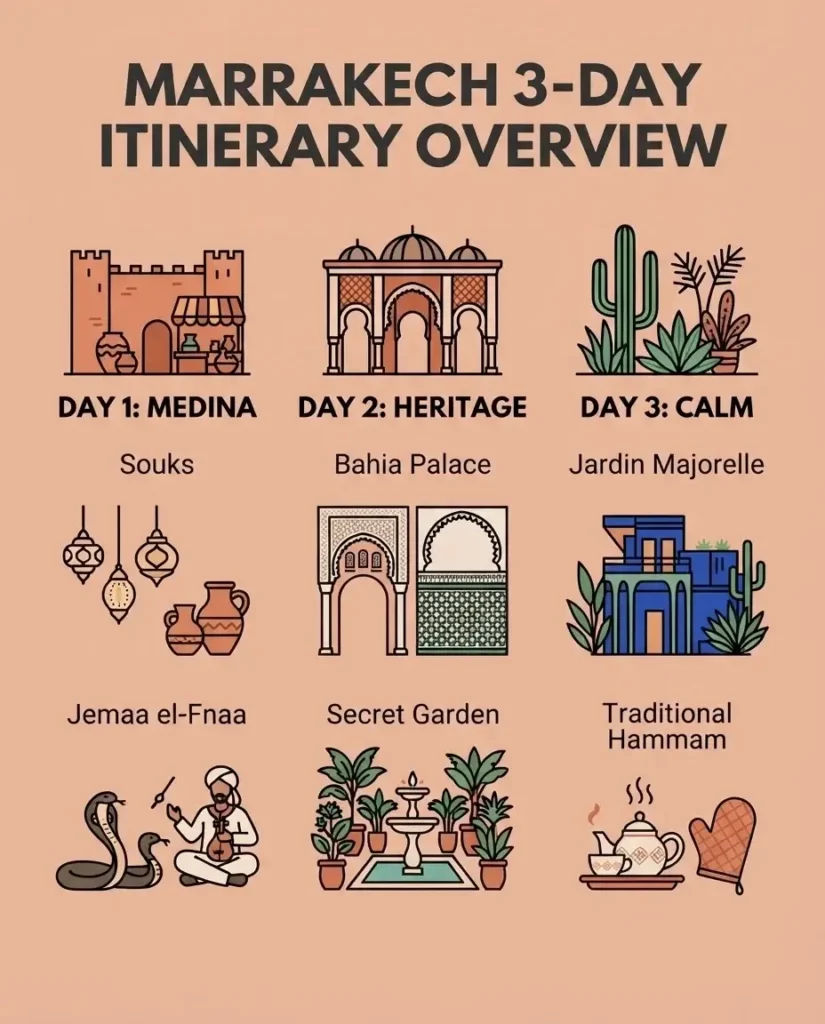
It is a practical, step-by-step plan designed to help you build your solo travel confidence, understand the amazing local culture, and keep your peace of mind. Let’s get you ready for an incredible, calm adventure.
Pre-Trip Preparations: Lowering the Friction Before You Land
The key to a calm trip is taking care of the stressful details before you leave home. When I used to work a rigid office job with tiny vacation windows, I would rush my planning.
That always led to mistakes. Now, I take my time. Taking care of your paperwork, your health plans, and your packing list in advance means you can land in Morocco with a clear mind.
The Paperwork and Passports
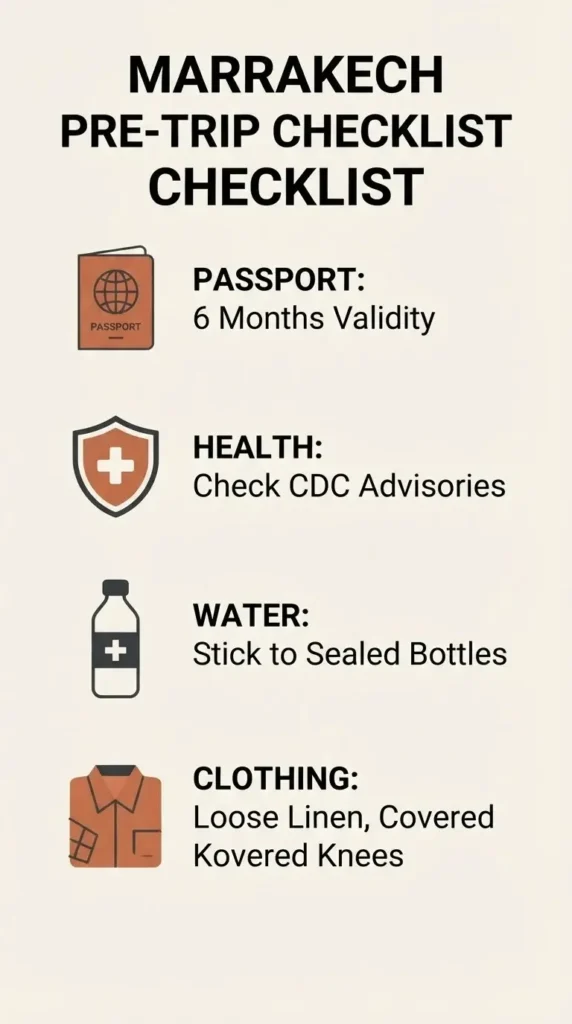
First things first: let’s look at your legal documents. Your passport needs to be valid for at least six months from the day you plan to enter Morocco. Most travelers from the US, Canada, Europe, and the UK do not need a tourist visa for stays under 90 days. However, rules can change quickly. Before I buy any plane tickets, I always check the official US Department of State Travel website for up-to-date entry requirements, safety ratings, and travel alerts. Print out a physical copy of your return ticket and your lodging details. Sometimes passport control officers at the Marrakech airport will ask to see them before stamping you in.
Health and Wellness Planning
Morocco has great food and wonderful weather, but a change in environment can shock your body. You should look into regional health advisories before your departure date. I always review the CDC Travelers’ Health guide to see what vaccines are recommended and to read up on local water safety guidelines.
As a golden rule: do not drink tap water in Marrakech. This includes brushing your teeth. Stick to sealed bottles of mineral water, which you can buy at any small neighborhood corner store for a few dirhams. I also carry a small personal health kit in my daypack. It contains rehydration salts, stomach relief tablets, band-aids for blisters, and a good hand sanitizer.
What to Wear for Absolute Comfort and Respect
Marrakech is an Islamic city, and dressing respectfully is a huge part of cultural understanding. It also helps you blend in and cuts down on unwanted attention from street vendors. You do not need to cover your head, but your clothes should cover your shoulders and your knees.
Leave the tight shirts, short shorts, and thin tank tops at home. Instead, pack loose, lightweight fabrics like linen and cotton. Here is what my daily outfit looks like:
- Loose linen trousers or a maxi skirt
- A plain cotton t-shirt that covers my collarbone
- A lightweight cotton scarf wrapped around my shoulders or tucked in my bag
- Sturdy, closed-toe walking shoes
Do not wear sandals or flip-flops in the ancient medina. The streets are dusty, uneven, and sometimes have puddles of dirty water or animal waste. A good pair of sneakers will protect your feet and keep you moving comfortably.
The Mindset Shift: Drop the Speed, Embrace the Slow
When I was waitressing to save money for my early solo trips, I thought I had to see every single museum and palace to make my trip worth it. That is a trap. In Marrakech, trying to do too much will make you miserable.
Accept right now that you will get lost. The old town is a maze of over nine thousand alleys. Google Maps does not always work perfectly there. When you get turned around, do not panic. Smile, breathe, and treat it as part of the story. The world rewards curiosity and open-mindedness if you just let go of your rigid schedule.
Day 1: Getting Your Bearings in the Ancient Medina
Your first day is all about understanding the rhythm of the city. We will start in the wide-open spaces and slowly work our way into the lively market alleys.
Morning: Jemaa el-Fnaa and the Koutoubia Landmark
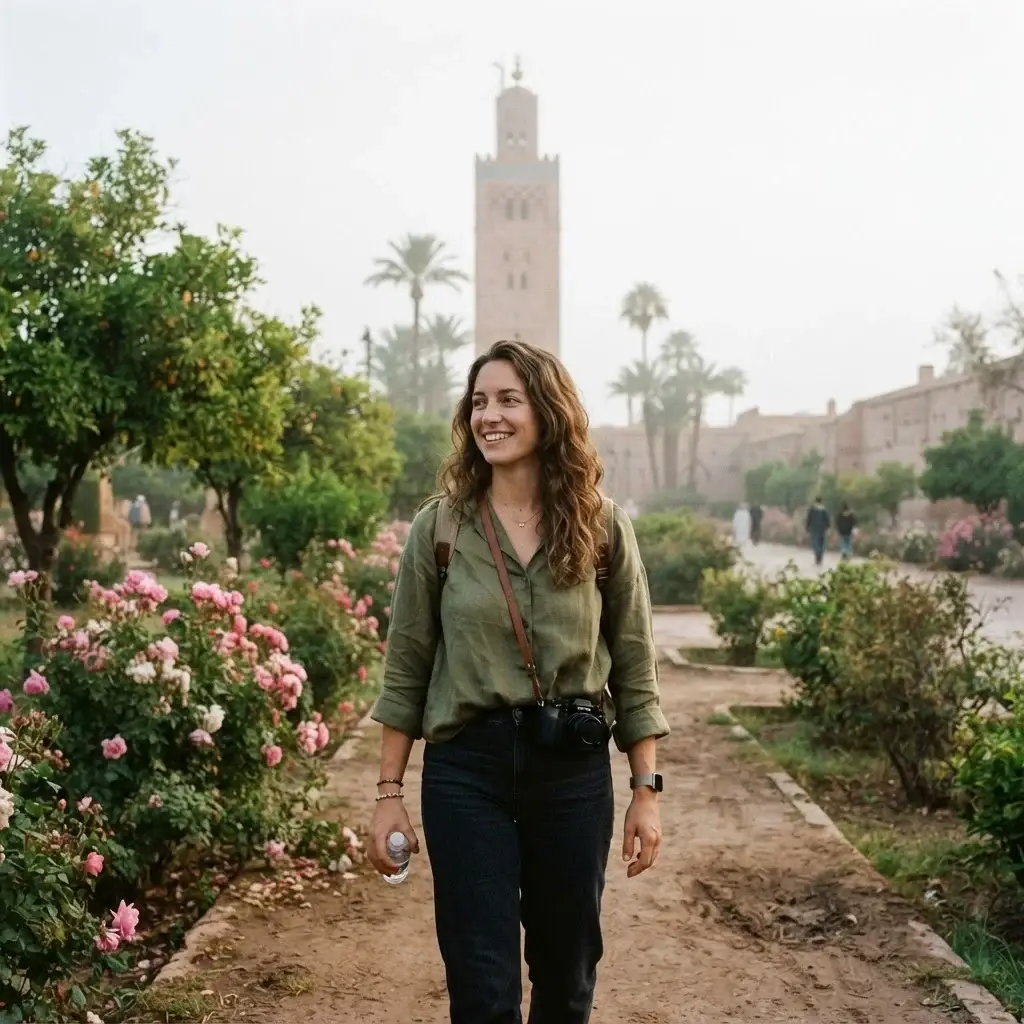
Start your morning around 9:00 AM at the Koutoubia Mosque. This is the tallest landmark in Marrakech. Its beautiful minaret tower stands nearly 250 feet high and can be seen from almost anywhere in the city. Non-Muslims cannot go inside the actual mosque, but the surrounding rose gardens are completely open to the public. Walking through the quiet paths lined with orange trees is a peaceful way to start your morning.
From Koutoubia, cross the main street to enter Jemaa el-Fnaa. This is the giant central square of Marrakech.
In the morning, it is wide, quiet, and sleepy. You will see fresh orange juice stalls lining the edges.
Go ahead and grab a glass from any stall for about 10 to 15 Moroccan Dirhams (MAD). It is sweet, ice-cold, and squeezed right in front of you.
Emma’s Insider Secret: In the morning, snake charmers and monkey handlers will set up in the square. They might try to place a snake around your neck or a monkey on your shoulder without asking. If you stop to watch or take a picture, they will aggressively demand a large sum of money. To keep your morning calm, look straight ahead, say a polite but firm “No, thank you” (“La, shukran” in Arabic), and keep walking.
Lunch: Your First Real Moroccan Tagine
By noon, the sun gets hot. It is time to get off the street level and find a rooftop. Walk to the edge of the square and head toward a local café like Café de France or Le Grand Balcon du Café de Glace.
Walk up the stairs all the way to the top terrace. From here, you can look down at the entire square safely without anyone bothering you.
Order a traditional vegetable or chicken tagine. A tagine is a slow-cooked Moroccan stew named after the conical clay pot it is baked in. It comes to your table bubbling hot with a loaf of crusty local bread called khobz. You use pieces of the bread as your spoon to scoop up the tender vegetables, meat, and rich sauce flavored with ginger, saffron, and olives. Pair it with a fresh pot of hot Moroccan mint tea, which locals affectionately call “Berber whiskey.” It is poured from high above the glass to create a beautiful layer of foam at the top.
Afternoon: The Souks Without the Stress
Now that your belly is full, we are going to enter the souks, which are the traditional covered market pathways. To find the entrance, look up the general layout of the northern side of Jemaa el-Fnaa using a reliable map resource like the Lonely Planet destination portal before you lose cell service. Enter through the main archway called Souk Semmarine.
The lanes are narrow and packed with incredible things. You will pass sections dedicated entirely to bright leather slippers (babouches), hand-woven wool blankets, piles of glowing ground spices, and glittering brass lamps.
It is easy to feel crowded here. Here is my trick for a calm walk: Keep to the right side of the alley. This leaves room for local transport like handcarts and bicycles to pass you by.
If a shopkeeper calls out to you, you do not have to stop. If you are not interested in buying, simply nod, smile, say “La, shukran”, and keep your feet moving.
If you do see something you love, like a small painted ceramic bowl, get ready to bargain. Bargaining is a normal, friendly social interaction in Morocco. The initial price given by the seller is usually double or triple what they expect to get.
Offer about one-third of their starting price, and slowly work your way to a middle number that makes you both happy. If the price stays too high, it is completely okay to smile and walk away. There are hundreds of other shops selling the exact same item just down the road.
Evening: Sunset Magic and Street Food Choices
As the sun goes down, Jemaa el-Fnaa transforms completely. The quiet square fills up with smoke, lights, and music. Storytellers, musicians, and henna artists set up circles of listeners. Dozens of numbered open-air food stalls roll out benches and fire up their charcoal grills.
The smell of grilled meats, spiced sausages (merguez), and boiled snails fills the air. It is wild, loud, and can feel intimidating for your first evening.
If you feel ready to dive in, look for a food stall that is absolutely packed with local Moroccan families, not just foreign tourists. Stall No. 1 and Stall No. 14 are famous for fried fish, while other stalls specialize in grilled chicken skewers (brochettes).
If the energy on the ground feels like too much for your first night, there is no shame in that! Walk back to one of the rooftop restaurants bordering the square, order a simple plate of couscous, and watch the glowing lights of the square from a comfortable distance.
Day 2: Architecture, Hidden Palaces, and Sacred Spaces
On your second day, we will step back in time to explore the incredible history, deep tile artwork, and peaceful gardens hidden behind the tall clay walls of the old town.
Morning: The Tiled Grandeur of Bahia Palace
Set your alarm early and head to the Bahia Palace by 9:00 AM. Arriving early lets you walk through the rooms before the large tour buses arrive. This palace was built in the late 19th century for the grand vizier of the sultan. The name “Bahia” means “brilliance,” and it definitely lives up to it.
As you walk through the vast rooms, look down at the floors and up at the ceilings. The floors are covered in intricate geometric clay tilework called zellij. The ceilings are made of heavy cedar wood carved and painted by hand with brilliant floral patterns.
The heart of the palace is the massive grand courtyard. It is a stunning, wide-open floor made of solid white marble and blue-and-yellow tiles. The entire old town center, including this gorgeous site, is preserved as a treasure of human history. You can read all about its global cultural protection status directly on the UNESCO World Heritage profile page for the Medina of Marrakech.
To navigate here from Jemaa el-Fnaa, walk south down Rue Riad Zitoun el-Jdid for about fifteen minutes. The entry ticket costs 70 MAD. Give yourself at least an hour and a half to wander through the peaceful indoor courtyards filled with banana plants and trickling fountains.
Lunch: The Art of the Perfect Pastilla
After leaving the palace, walk toward the nearby Mellah neighborhood to find a quiet restaurant terrace. Today, you should try one of Morocco’s most interesting dishes: pastilla (sometimes spelled bastilla).
This is a traditional sweet and savory pie. It is made of incredibly thin layers of flaky pastry dough, similar to phyllo. Inside, it is stuffed with shredded shredded chicken (traditionally pigeon cooked with spices), slow-cooked onions, and crushed almonds.
The top of the pie is dusted with a heavy layer of powdered sugar and cinnamon lines. It sounds strange to mix sugar and poultry, but the combination is absolutely incredible.
Pair your pastilla with a side of Moroccan salad. Unlike a Western salad, this is a beautiful spread of small plates featuring cooked vegetables: roasted eggplant puree (zaalouk), sweet tomato jam, and boiled carrots seasoned with cumin and lemon juice.
Afternoon: Saadian Tombs and the Oasis of Le Jardin Secret
Next, walk ten minutes west to visit the Saadian Tombs. This historic burial ground was sealed up for centuries and was only rediscovered by accident from an airplane in 1917. It holds the bodies of the rulers of the Saadian dynasty from the golden age of Marrakech.
The main highlight is the Chamber of the Twelve Pillars. This room features magnificent imported Italian Carrara marble columns and gold-leaf ceilings. It is dark, quiet, and feels like a sacred stepping stone into the past.
After exiting the tombs, we will head back north toward the center of the medina to visit Le Jardin Secret (The Secret Garden). This is an elegant palace garden that was restored by international landscape designers.
The garden is split into two sections: an exotic garden filled with plants from all over the world, and a traditional Islamic garden. The Islamic garden is designed strictly according to descriptions in the Quran. It is divided into four exact quadrants by narrow stone water channels fed by an ancient underground water network called a khattara.
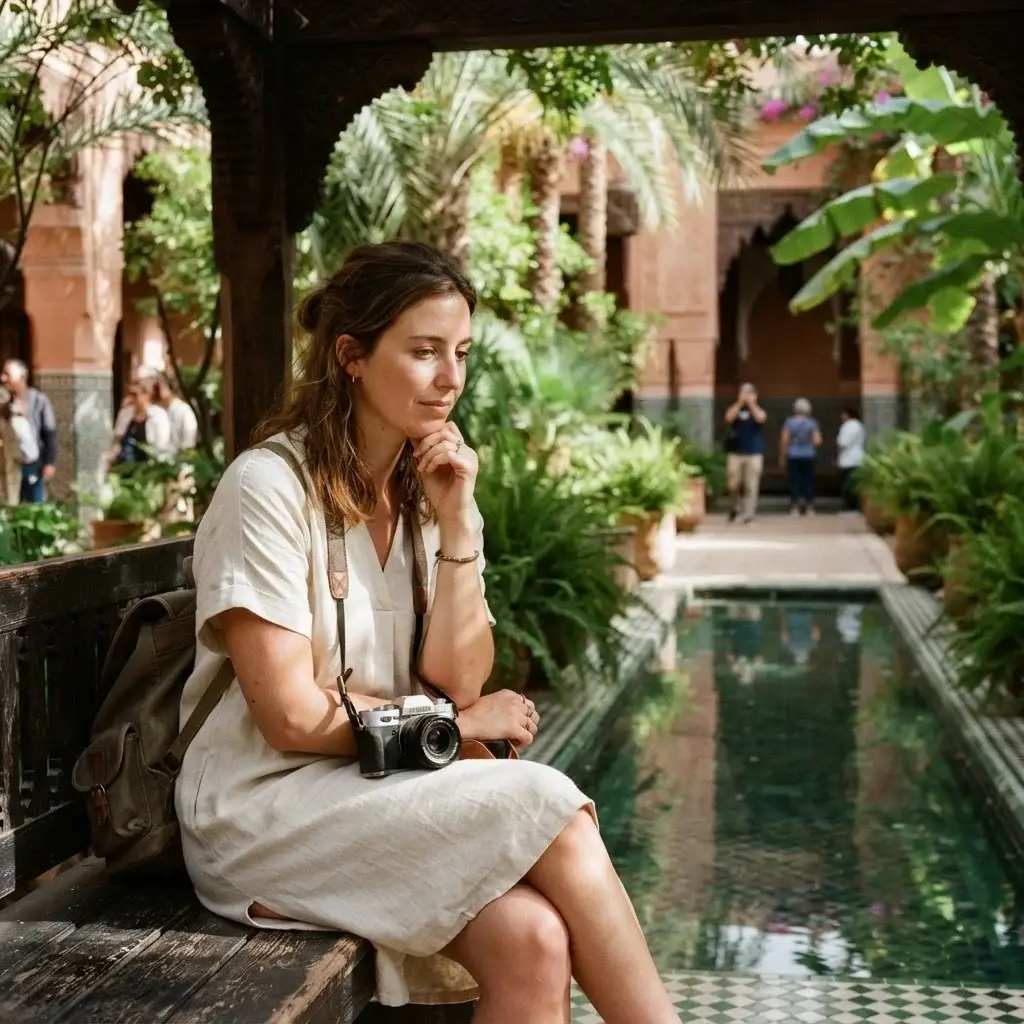
Sit down on one of the wooden benches under the shade of a pergola. Listen to the sound of the running water and the birds singing. It is one of the most peaceful places in the entire city and the perfect spot to read a book or write in your travel journal.
Evening: A Quiet Riad Dinner Away From the Noise
For dinner tonight, skip the busy streets completely. Book a table at a traditional riad. A riad is a traditional Moroccan house built around an open indoor garden or courtyard. From the outside street, a riad looks like a plain, solid clay wall with a simple wooden door. But when you step inside, it opens up into a paradise of orange trees, tiles, and quiet elegance.
Many riads open their courtyard dining rooms to outside guests for dinner if you call or email ahead. Dining in a riad feels like eating in someone’s private home.
The service is slow, gentle, and deeply personal. You will be served a multi-course meal that often includes homemade bread, a slow-cooked beef tagine with sweet prunes and toasted almonds, and a dessert of sliced oranges sprinkled with cinnamon and orange blossom water. It is a wonderful way to experience authentic Moroccan hospitality in a calm, intimate setting.
Day 3: Vibrant Colors, History, and Complete Relaxation
On your final day, we will step outside the ancient city walls to see the modern side of Marrakech, visit a historic neighborhood, and end our trip with a traditional wellness ritual.
Morning: The Striking Cobalt of Jardin Majorelle
Take a short five-minute taxi ride outside the old town walls to the modern neighborhood of Gueliz. Our first stop is the world-famous Jardin Majorelle. This botanical garden was created by French painter Jacques Majorelle over a period of forty years. Later, it was bought and saved from developers by fashion designer Yves Saint Laurent.
The garden is a visual masterpiece. It features giant paths lined with towering bamboo, massive columns of green cactus, and bright pink bougainvillea flowers.
The star of the show is the villa building itself, which is painted in a highly specific, intense shade of cobalt blue known as Majorelle Blue. The contrast between the bright blue walls, yellow plant pots, and green plants is breathtaking.
Critical Booking Tip: You cannot buy tickets at the gate. You must buy your tickets online on the official website at least a day or two in advance. Pick the earliest time slot available (8:00 AM or 8:30 AM). If you show up without an online ticket, security guards will turn you away at the door.
Right next to the garden sits the Yves Saint Laurent Museum. Even if you are not a fashion fanatic, it is worth a quick visit. The building’s exterior is made of red brickwork designed to look like the threads of woven fabric, celebrating the local Moroccan weavers who inspired the designer’s work.
Lunch: A Feast of Grilled Brochettes in Gueliz
Since you are already in Gueliz, take a walk down its wide, modern streets. This neighborhood was built by the French in the early 20th century. It features wide sidewalks, modern apartment buildings, outdoor clothing stores, and Parisian-style outdoor cafés. It feels completely different from the ancient medina.
For lunch, look for a local, casual grill shop like Al Fassia or a simple neighborhood spot filled with workers. Order a plate of mixed brochettes. These are skewers of marinated chicken, lamb, or spiced minced beef (kefta) grilled over hot charcoal. They are served with French fries, charred tomatoes, spicy harissa sauce, and fresh flatbread. It is a simple, delicious, and highly affordable meal.
Afternoon: Exploring the History of the Mellah Quarter
Head back into the south side of the medina to explore the Mellah. This is the historic Jewish quarter of Marrakech, established in the 16th century. The architecture here is visibly different from the rest of the medina.
While Muslim homes feature blank outside walls to keep family life private, the homes in the Mellah feature tall windows and beautiful wooden balconies that hang directly over the street.
Walk through the peaceful Lazama Synagogue, which features a gorgeous blue-and-white courtyard and a small museum detailing the history of Jewish life in Morocco.
Afterward, visit the Miaâra Jewish Cemetery. This is a vast, quiet space covered in rows of white stone tombs that shimmer under the afternoon sun. It is a deeply moving place that reminds you how many different cultures have called this city home over the centuries.
Evening: The Ultimate Decompression at a Local Hammam
You have spent three days walking miles over dusty streets and navigating crowds. The absolute best way to end your trip is with a traditional hammam experience. A hammam is a Moroccan bathhouse ritual, and it is an essential part of local life.
For your first visit, I highly recommend booking a mid-range private hammam spa like Les Bains de Marrakech or Hammam de la Rose. These spots give you the authentic ritual with a bit more privacy and comfort than a busy public neighborhood bathhouse.
Here is what happens during a traditional hammam:
- You are led into a warm, steam-filled room lined with smooth marble.
- An attendant pours warm water over your body and applies savon noir, a thick, dark soap made from crushed olives and eucalyptus oil.
- You lie down on the warm marble stones for fifteen minutes to let the steam and soap soften your skin.
- The attendant returns with a rough, coarse fabric glove called a kessa. They will scrub your entire body from head to toe. You will be amazed (and slightly horrified) by how much dead skin rolls off your body.
- You are rinsed clean with fresh water and washed with a soothing rosewater clay mask called ghassoul.
After the scrub, you are wrapped in a soft robe and led to a relaxation room to drink hot mint tea. Your skin will feel softer than it ever has in your life.
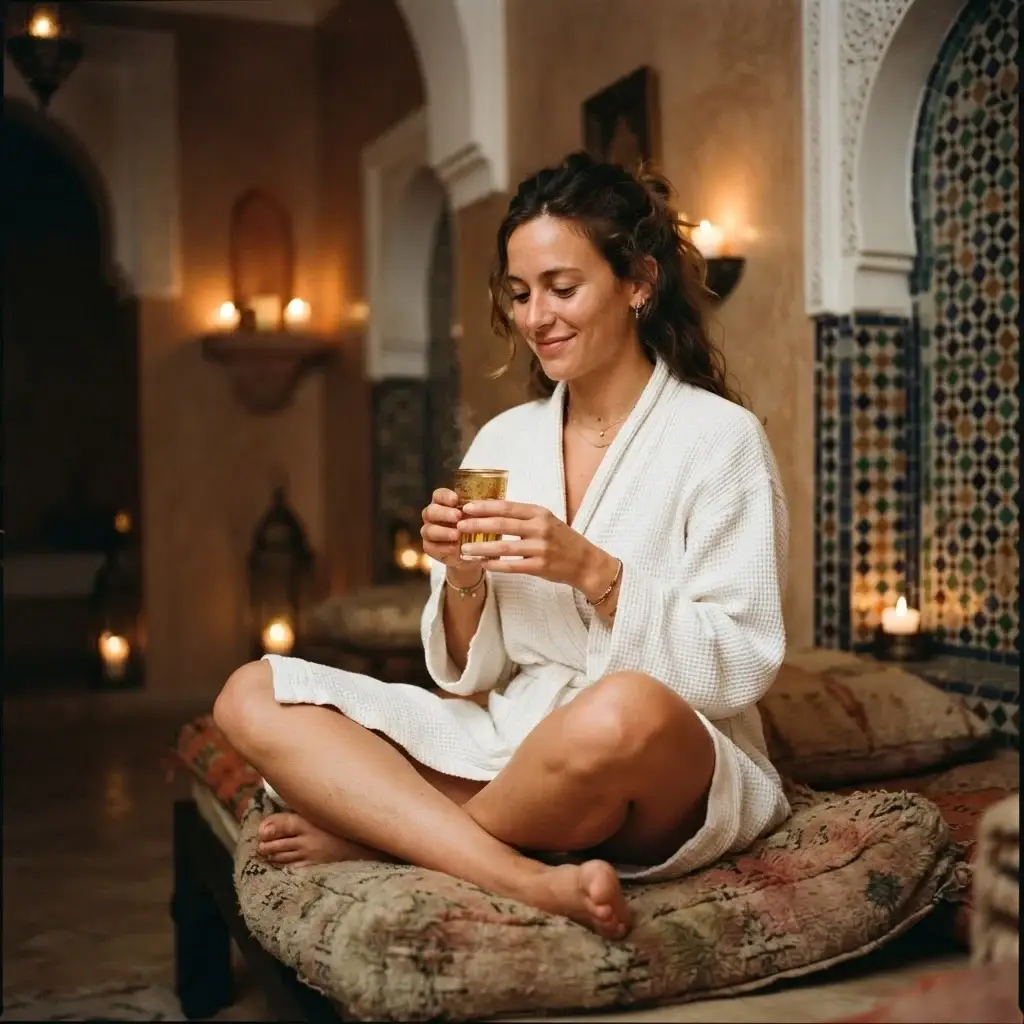
It washes away all the physical dust and mental stress of your travels, leaving you feeling light, peaceful, and completely grounded.
Emma’s Marrakech Survival Kit: Scams, Safety, and Navigation
Marrakech is generally a safe city for solo and independent travelers. Violent crime is incredibly rare. However, petty scams, trickery, and verbal pressure are very common.
When I first transitioned from working a predictable corporate job to traveling alone, these interactions used to ruin my day. Now, I understand them as a system you can navigate if you know the rules.
It is always smart to stay protected while abroad. I use the safety guides and coverage resources on World Nomads Travel Insurance to make sure I am covered for unexpected bumps or medical needs on the road.
The “Closed Street” Scam and How to Handle It
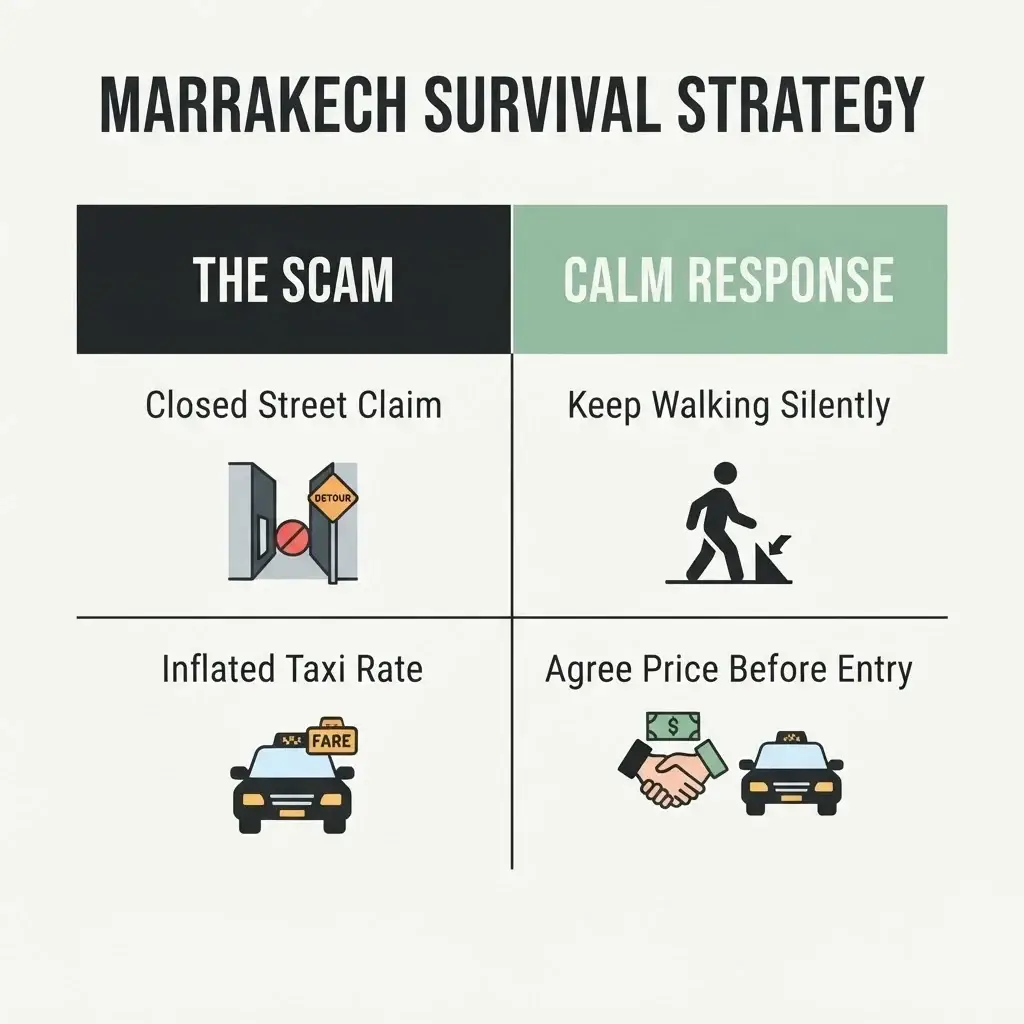
This is the most common scam in Marrakech. As you walk down a narrow medina lane, a young man or teenager will wave his hands and say, “Stop, that street is closed today for prayer,” or “That way leads only to the leather tanneries, it is blocked.”
This is almost always a lie. They are trying to make you stop, turn around, and get confused. Once you are lost, they will offer to guide you back to the main square. When you arrive, they will aggressively demand a large payment (often 100 to 200 MAD) for their “help.”
How to defeat it: If someone tells you a street is closed, do not look at them. Do not stop walking. Simply smile, say “I know the way, thank you,” and keep moving forward. If the street actually is dead-ended, you will find out yourself in a few steps. If you genuinely get lost and need directions, never ask a group of young men hanging out on the street corner. Instead, step inside a physical shop or restaurant and ask the shopkeeper behind the counter for help.
Taxis and App Navigation Secrets
Taxis in Marrakech do not like to turn on their meters for tourists. If you hail a taxi on the street, the driver will often quote an inflated price like 50 or 100 MAD for a ride that should cost 15 MAD.
Always establish the price before you put your bags in the car or sit down. Ask them clearly: “Please turn on the meter” (“Oula el-meter”). If they refuse, state a fair price based on your destination. A ride anywhere within the city center during daytime hours should never cost more than 20 to 30 MAD. If they will not agree, close the door and wait for the next car.
For walking inside the medina, download the app Maps.me before your trip. Download the full offline map file for Morocco. Maps.me has much better mapping of the tiny pedestrian walking shortcuts inside Marrakech than Google Maps, and it works perfectly using your phone’s internal GPS without needing cellular data.
Solo Female Travel Tips for Marrakech
As a solo woman traveler, you will likely experience street harassment in Marrakech. It usually takes the form of catcalling, comments on your looks, or men following you for a block trying to strike up a conversation. It is annoying and uncomfortable, but it is rarely physically dangerous.
The best defense is unshakable confidence. Walk with your shoulders back, your head up, and a purposeful stride—even if you are secretly completely lost. Wear sunglasses to avoid direct eye contact on the street.
If a man starts walking next to you and talking, do not engage. Do not look at him, do not reply, and do not apologize. Total silence and complete eye-contact avoidance is the fastest way to make them lose interest. If someone is being overly persistent or touches your arm, make a loud scene. Turn around, look them in the eye, and shout loudly: “No!” or “Hshuma!” (which means “Shame on you!” in Moroccan Arabic). Local bystanders will instantly step in to yell at the person and protect you.
Final Thoughts on Your Marrakech Journey
Marrakech is a place that challenges you to grow. It forces you to step out of your comfort zone, trust your instincts, and find calm in the middle of a beautiful whirlwind.
When you sit on your last evening, listening to the evening call to prayer echo across the red rooftops while the scent of mint tea rises from your glass, you will realize something wonderful. You did it. You navigated one of the oldest, most intense cities in the world all on your own terms.
You stopped waiting for the perfect moment, you faced the unknown with courage, and you created an unforgettable adventure. That is exactly what travel is all about. Pack your bags, keep an open heart, and let the red city welcome you.