Stop Following the Crowds: Find Trails Only Locals Know

There’s a specific kind of disappointment that every hiker knows but rarely admits out loud. You do your research, drive an hour to a trailhead you saw on a travel blog, and pull into a packed parking lot where someone in flip-flops is arguing about a spot near the porta-potty. You hike the trail, and it’s beautiful, genuinely beautiful, but you’re never more than thirty feet from another group. You stop for water and someone’s dog bounds over before their owner’s apologetic wave can reach you.
The trail was fine. But it wasn’t what you came for.
What you were looking for was the version that feels earned. The one where the only footprints in the mud are yours and one curious deer. Where you can sit at the summit and hear nothing but wind and your own breath. That version exists. Locals hike it every weekend. They just don’t post about it.
Here’s how to find it.
Why Locals Know Trails You Don’t
Before we get into tactics, it’s worth understanding why this gap exists. Travel content, especially online, operates on a feedback loop. Popular trails get written about, which makes them more popular, which gets them written about more. An algorithm rewards a trail that 50,000 people have clicked on more than it rewards one that 200 hikers who live nearby quietly love. The internet is very good at surfacing what is already well-known, and genuinely poor at surfacing what is quietly treasured.
Locals, on the other hand, don’t use the internet the same way you do when you’re planning a trip. They might have stumbled onto a trail because their coworker mentioned it, because they followed a fire road off a main trail one afternoon out of curiosity, or because they’ve lived near that forest for fifteen years and explored it section by section. Their knowledge is accumulated slowly, shared person to person, and never packaged for a blog post.
That gap is the one you’re trying to close, and it’s completely closeable once you know where to look.
The Digital Layer: Apps That Go Deeper Than Google
Most people open AllTrails, search the city they’re visiting, sort by highest-rated, and pick from the top five results. That’s exactly how you end up on the trail with the parking lot problem.
The apps themselves are actually more powerful than most people use them. AllTrails has a filter that lets you sort by “least busy” or lowest foot traffic, a feature buried in the search options that most people never touch. When you flip that filter on, the results look completely different. You’ll find trails with a handful of reviews written by people who live nearby, often with notes like “bring a compass, the junction isn’t marked well” or “the view at the end is worth every scratchy bush.” That’s local knowledge in writing.
For anything more remote or international, Wikiloc is the tool that changes the game. It’s a community-uploaded GPS trail database with over 80 million trails submitted by hikers, cyclists, and runners around the world who simply recorded their own routes and shared them. Many of these trails exist nowhere else. You’ll find farmer’s paths, old shepherd routes, forest tracks, and ridge walks that have never made it into a guidebook. The trails come with actual GPS data you can follow offline, and often include waypoint photos taken by the person who walked it. This is the closest digital equivalent to a local recommendation you can get before you arrive somewhere.
If you’re heading into genuinely remote or backcountry terrain, Gaia GPS is built for that kind of off-grid hiking. It uses topographic maps, satellite imagery, and downloadable offline maps so you can navigate in areas with zero cell service. It’s not for finding trendy trails. It’s for people who want to move through wild country responsibly with accurate data.
Using all three together, AllTrails for community vetting, Wikiloc for off-map routes, and Gaia GPS for backcountry navigation, gives you a far more complete picture than any single platform.

A practical note: when you find a trail through any of these apps, read every single review before you go. Reviews on lesser-known trails are often sparse but gold. Someone may have noted a washed-out section, a locked gate that appeared after a fire restriction, or that the trailhead looks abandoned but the path opens up beautifully half a mile in.
The Land You Probably Don’t Know Exists
Here’s something most travelers don’t realize: a huge amount of publicly accessible land in countries like the United States isn’t inside a national park. The US Forest Service manages over 165,000 miles of trails across national forests in nearly every state, and most of those trails see a fraction of the foot traffic of their national park counterparts. State forests, Bureau of Land Management land, and wildlife management areas add millions more accessible acres on top of that.
These are not secret in a hidden or restricted sense. They are simply underutilized because nobody told you they existed. You can access the full trail network through the USFS Interactive Visitor Map directly on their website, download free maps, and search by forest and activity type. People drive past these forests every day on the way to a crowded national park entrance, and the forest trails are often just as beautiful, sometimes more so, and genuinely quiet.
When you’re planning a trip, don’t just ask “what trails are near [destination]?” Ask specifically “what national forest or state forest is nearest?” then go directly to that forest’s official page. The information is there. Most people just don’t look for it.
The Conversation That Changes Everything
Every practical tool in this article matters. But none of them will match a five-minute conversation with the right person.
I learned this through my own traveling. Whether I was backpacking solo through Europe or spending time with a host family in Ghana, the most extraordinary places I found always came from a conversation, not a search engine. Someone mentioned a path. Someone drew a rough map on a napkin. Someone said “oh, you should talk to…” and that chain of human knowledge led somewhere I could never have planned for.

The best people to talk to when you’re looking for trails that don’t show up on travel blogs are, in rough order of reliability: park rangers, hostel or guesthouse staff, workers at local outdoor gear shops, and anyone who looks like they just came off a trail. Each of these conversations requires only a small amount of social courage.
Rangers are the most reliable source most travelers overlook entirely. They know every trail in their jurisdiction, they know which ones are currently in good condition, they know the ones that get no visitors on a Tuesday, and they genuinely like talking to people who are curious about the land they protect. Walk into a ranger station or visitor center and say something like: “I’ve already seen the main trails. Is there anything you’d recommend for someone who wants a quieter experience?” You will almost always leave with a suggestion that isn’t in any guidebook.
Hostel staff, especially at smaller independently run places, tend to be outdoorsy people who live in the area. They hike on their days off. They know what’s close by, what’s worth it, and what to avoid. Ask them over breakfast. Ask the person checking you in. Ask the other guests too, because someone in the common room may have just come back from exactly the kind of hike you’re looking for.
Gear shop employees deserve a mention because they are consistently underestimated as a resource. These are people who spend their working hours surrounded by people who hike locally. They hear trail recommendations every day. Ask them what their favorite trail is right now, not what they’d recommend for a tourist, but what they’d personally hike this weekend. That distinction matters, and good gear shop staff will give you a completely different answer.
Local Hiking Communities Online (Before You Arrive)
The gap between “I found this on AllTrails” and “I found this through a local” is actually narrower than you’d think, because locals share trail knowledge online in spaces that most travelers don’t know to look.
Facebook groups for regional hiking are surprisingly active and detailed. A group like “[City/Region] Hikers” will have locals posting about trail conditions, recent finds, trail closures, and recommendations every week. Reddit’s hiking communities, including regional subreddits like r/PNWhiking or r/hiking, have the same culture. Before your trip, spend twenty minutes searching these spaces for the area you’re visiting, and post a question. Ask specifically for lesser-known trails. People love sharing their favorites when someone asks thoughtfully rather than just demanding a “best of” list.
If you’re hiking in the Pacific Northwest, the Washington Trails Association is one of the most comprehensive and locally maintained trail databases in the country. Every entry is written or vetted by people who actually hike there, and trip reports are submitted by community members after recent hikes, meaning the information is often more current and specific than what you’d find on mainstream apps.
What to Do When You Find a Trail Through Word of Mouth
So someone tells you about a trail. Maybe it’s a ranger, maybe it’s a Wikiloc upload from two years ago, maybe it’s a Facebook comment from a local hiker. Before you set off solo, spend fifteen minutes vetting it.
Check whether it falls within managed public land. If you’re in the US, a quick search on Recreation.gov will tell you whether any permits are required for the area, whether the land is currently open or under fire restrictions, and whether you need to reserve a backcountry slot in advance. Some of the least-visited trails are in wilderness areas that technically require a free permit you can get at the trailhead. Missing that detail can create an unnecessary headache.
Download an offline map before you go. Cell service disappears on remote trails, and a trail that’s barely marked or partially overgrown becomes much more manageable when you have GPS data downloaded to your phone. This is where Gaia GPS earns its place in your kit.
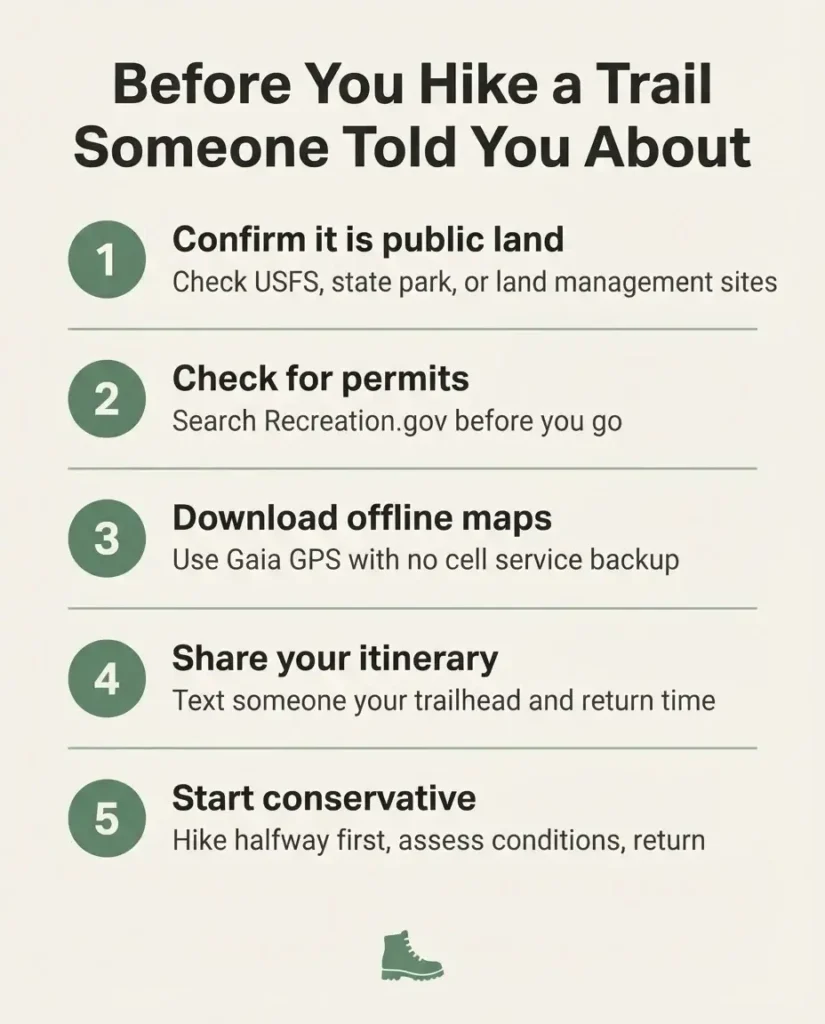
Tell someone your plan. This applies to any solo hike, but it matters more on a trail nobody knows you’re on. Text a friend the trailhead name, your planned route, and a time they should expect to hear from you. This takes ninety seconds and means that if something goes sideways, someone knows where to look.
Finally, start conservative. If you found a trail through word of mouth and you’ve never hiked it before, don’t plan to push deep on your first visit. Hike to a midpoint, get a feel for the terrain, check the condition of the path, then come back better prepared for the full route.
The Responsibility That Comes With Finding the Quiet Ones
There’s an unspoken agreement among people who seek out less-traveled trails, and it’s worth making explicit. When you find a trail that’s quiet, that’s managed, that’s beautiful precisely because most people don’t know about it, you have a responsibility to keep it that way.
This means following the Leave No Trace seven principles, which include traveling on durable surfaces, packing out all waste, leaving rocks, plants, and features exactly as you found them, and keeping noise low enough that the next person to come through has the same experience you did. On a heavily trafficked trail, one person cutting a switchback or leaving a wrapper barely registers in the cumulative damage. On a quiet trail with ten visitors a month, it registers immediately.

It also means being thoughtful about what you share online. I know that sounds counterintuitive coming from a travel blogger. But there’s a real difference between sharing the general area or the method you used to find the trail versus pinning the exact GPS coordinates of a fragile ecosystem on social media. Once a photo goes viral, the trail stops being quiet. You’ve seen what happens to the trails that get their “moment.” Be selective about what you broadcast, and when you do share, focus on the process of finding the trail rather than the exact location.
A Note on Going Solo
Solo hikers, especially women, often hear the same set of warnings about remote trails: don’t go alone, it’s not safe, what if something happens. I understand where those concerns come from, and I also think they can become an excuse not to do something that would be genuinely wonderful.
Solo hiking, including on lesser-known trails, is something people do safely and joyfully all over the world every single day. The key is preparation rather than avoidance. Download your offline map. Share your itinerary with someone. Bring the ten essentials (water, food, navigation, first aid, layers, and so on). Stick to trails that are within your fitness level. And trust your instincts: if a trail feels wrong when you arrive, leave. No trail is worth ignoring your gut.
The quiet trails are not inherently more dangerous than the crowded ones. They’re just less photographed.

The Real Point of All This
When I was working as a sightseeing guide in New York City, I spent my days pointing people toward the famous things. The skyline, the landmarks, the views everyone comes for. That part of my job was wonderful, genuinely. But the questions I loved most were the ones from visitors who’d already seen the famous things and were asking: “Where would you actually go? What would you do if you lived here?”
That’s the question underneath “secret hiking trails only locals know.” It isn’t really about trails. It’s about the desire to experience a place the way it’s actually lived, not the way it’s marketed. It’s about wanting to feel like a traveler rather than a tourist. And honestly, it’s about the quiet confidence that comes from planning something yourself, trusting your own curiosity, and walking somewhere that nobody handed you on a recommendation list.
The trails are out there. They’re not locked behind special knowledge or privileged access. They’re behind a slightly different question, a less obvious app, a five-minute conversation with a ranger, and a willingness to turn left when everyone else turns right.
Start small. Pick one of the tools above, go somewhere new, and ask one person for a recommendation they’d give a friend. See where it leads.
I think you’re going to like it.