

I still remember sitting at my metal office desk back in New York, staring at a computer screen, and dreaming of the world. I was trapped in the traditional 9-to-5 grind. I felt like my life was passing me by. When I finally made the terrifying decision to leave that job, I had to waitress for months and work extra shifts as a city sightseeing guide just to save up enough money for my first big solo trip.
That first long-haul flight was a massive eye-opener. I boarded the plane to Thailand with a backpack full of dreams and a face full of heavy makeup. By the time the plane touched down in Bangkok fourteen hours later, my skin felt like sandpaper. My eyes were bloodshot, my lips were bleeding, and my confidence was completely drained. I looked into the airport bathroom mirror and barely recognized myself.
Since then, I have backpacked across Europe, lived with a host family in Ghana, and spent hundreds of hours in the air. I quickly learned that taking care of your skin on a plane is not about vanity or luxury. When you travel solo, your body is your most important piece of gear. If you feel physically miserable, exhausted, and uncomfortable, your confidence takes a massive hit. That makes it much harder to navigate a brand-new airport, figure out local trains, or find your hostel before dark.
Now, I treat my in-flight skincare exactly like my hiking gear. It has to be light, functional, and highly effective. You do not need an expensive or complicated twelve-step routine. You just need a few multi-purpose items that protect your skin barrier from the harsh elements of an airplane cabin.
Let us break down the exact, non-negotiable, must-have beauty products for long flights that will keep you feeling comfortable, fresh, and ready to take on the world the second you step off the plane.
Why Airplane Cabins Are a Nightmare for Your Skin
To understand why we need specific products, we have to look at what happens to your body when you cross time zones at 35,000 feet. The air inside an airplane is not like the air on the ground. It is a highly controlled, artificial environment designed to keep you safe, but it wreaks total havoc on your skin barrier.
The Extreme Low Humidity Shock
In a normal, healthy indoor environment, the humidity level is usually between 40% and 60%. Inside an airplane cabin, the humidity level drops drastically, often falling below 20%. To put that into perspective, that is actually drier than the Sahara Desert.
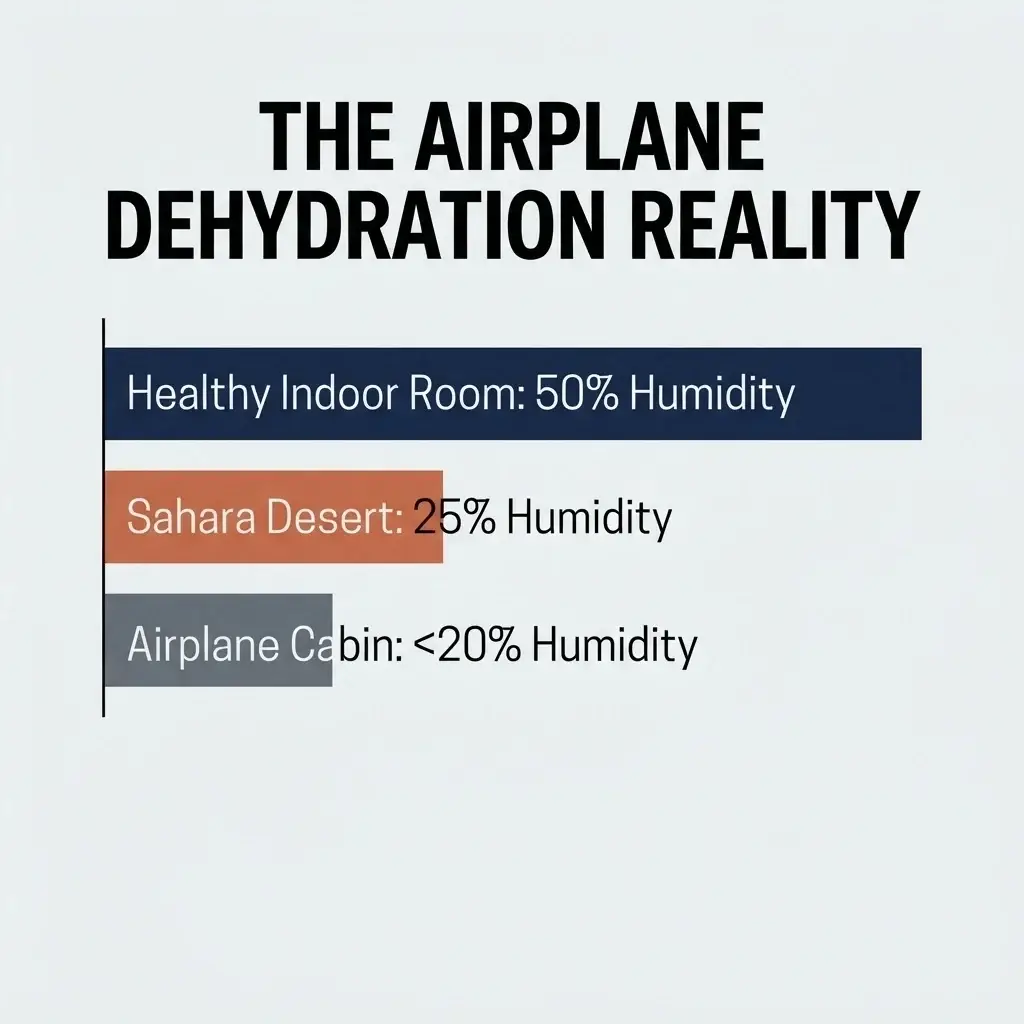
When the air around you is that dry, it acts like a giant sponge. It literally sucks the moisture right out of your skin cells through a process called trans-epidermal water loss. If you do not create a protective seal over your face, your skin will dry out fast.
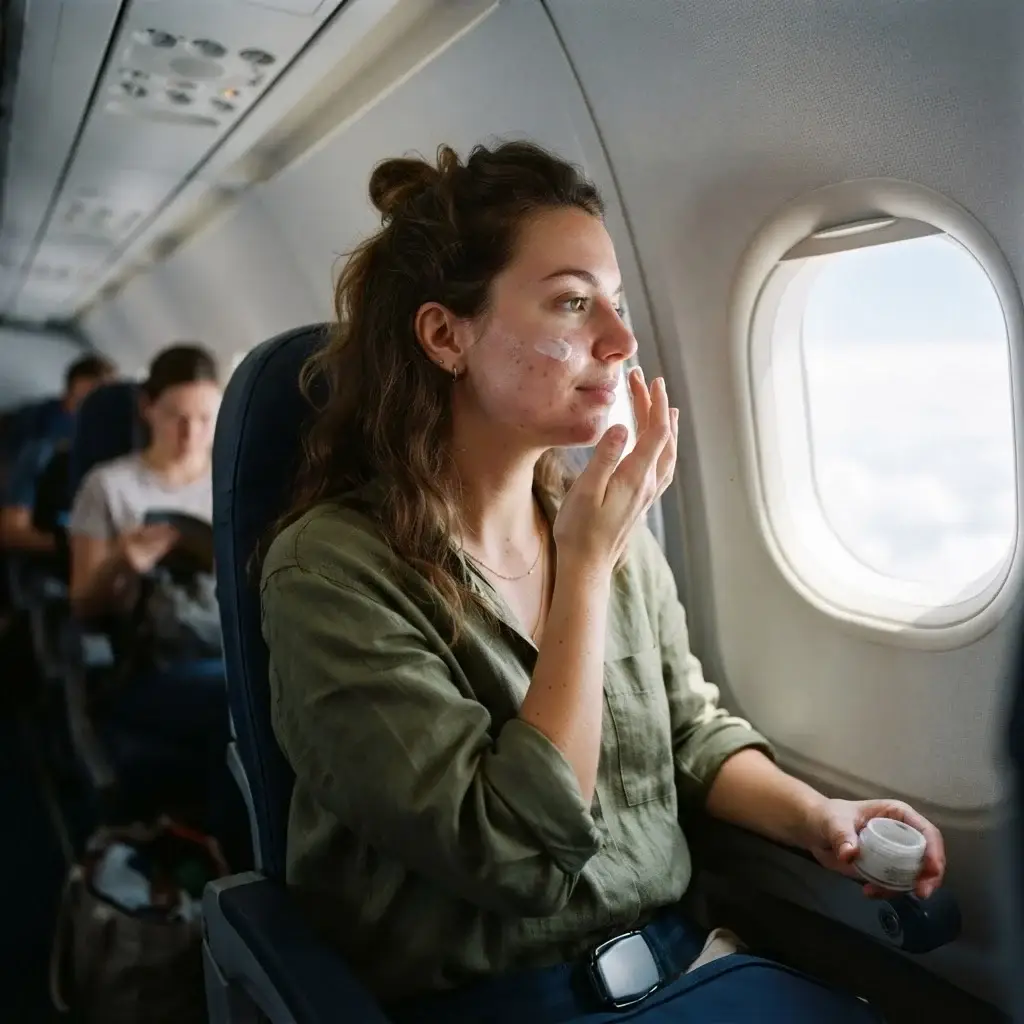
If you naturally have dry skin, you will end up with flaking, itching, and tight skin. If you have oily or acne-prone skin, your body will panic. It will produce an absolute flood of excess sebum to make up for the dryness, leading to clogged pores and major breakouts by the time you land.
Recycled Air and the Skin Barrier
The air in a plane is also continuously recirculated and pressurized. This lower pressure reduces the amount of oxygen flowing through your blood, which instantly makes your complexion look dull, gray, and tired. Combined with the lack of sleep and the stress of moving through crowded airport terminals, your skin barrier becomes highly vulnerable.
When I was teaching English in Thailand, I frequently took long weekend flights to explore nearby regions. I noticed that every time I ignored my skin during the flight, my face would break out into a painful red rash within a day of landing. It was a clear sign that my skin barrier had completely cracked under the pressure of the cabin environment. Taking care of your skin on the plane ensures that your skin remains strong enough to handle the completely new climates, bacteria, and environments waiting for you at your destination.
The TSA Rules: Navigating Airport Security with Your Skincare Gear
Before we talk about the specific products, we have to talk about logistics. There is nothing worse than investing in great skincare items only to watch a security agent toss them into the trash bin at JFK or Heathrow because they violated the liquids rule.
Mastering the 3-1-1 Liquids Rule
As a solo traveler, I highly recommend traveling with a carry-on bag only. It saves you money, keeps you mobile, and ensures the airline cannot lose your luggage. But it also means you must strictly follow the TSA 3-1-1 rule. All liquids, gels, creams, and aerosols must be in containers that are 3.4 ounces (100 milliliters) or smaller. Furthermore, all of these travel-sized containers must fit into a single, clear, quart-sized plastic bag.
To maximize your limited space, you need to be brutal with your editing. Do not pack giant bottles of face wash or lotion. Instead, look for solid alternatives whenever possible. Solid balm cleansers, stick moisturizers, and powder face washes do not count toward your liquid limit. This leaves plenty of room in your clear plastic bag for the absolute essentials that must remain in liquid or cream form.
Smart Decanting Secrets
Never buy pre-packaged travel-sized items from the grocery store drugstore aisle if you can avoid it. They are usually overpriced, and they often contain low-quality ingredients filled with synthetic fragrances that will irritate your skin on a flight. Instead, buy high-quality, reusable silicone travel bottles and decant your favorite everyday products into them.
I use a simple label maker to mark every single bottle clearly. When you are sitting in a dark airplane cabin during an overnight flight, you do not want to accidentally rub shampoo all over your face because the bottles look identical. I also recommend using small cosmetic jars for thick creams and balms. You can scrape the exact amount you need out of your large jars at home using a clean spoon. This keeps your pack incredibly light, which is crucial when you are walking miles through foreign transit hubs or catching budget flights with strict weight limits.
Pre-Flight Prep: The Groundwork for Hydrated Skin
The secret to a successful in-flight skincare routine actually starts the night before you board the aircraft. You cannot expect a tiny dab of lotion to save your skin mid-flight if your cells are already completely dehydrated before you walk through the boarding gate.
The Night-Before Deep Moisture Mask
The evening before my flight, I do a thorough skin-prep routine at home or in my hotel room. I start with a gentle exfoliant to slough off dead skin cells. This ensures that the hydrating products I apply later can actually penetrate deep into the skin instead of just sitting on top of dry flakes.
After exfoliating, I apply a thick, leave-on overnight sleeping mask that contains skin-identical ingredients like ceramides, fatty acids, and cholesterol. These ingredients work hard while you sleep to patch up any microscopic gaps in your skin barrier. Think of it like priming a wall before you paint it. You are building up a massive reservoir of moisture so that your skin is starting the travel day at 100% hydration.
What to Put on Your Face Before Boarding
On the morning of the flight, keep your routine clean and minimal. I strongly advise against wearing a full face of heavy foundation, concealer, and powder to the airport. When you mix heavy makeup with heavy sweat, airport stress, and dry cabin air, you create a recipe for an absolute breakout disaster.
Instead, wash your face with water, apply a lightweight hydrating serum, and put on a generous layer of moisturizer. If you are taking a daytime flight, do not forget your sunscreen. UV rays are significantly stronger and more damaging at high altitudes, and they easily pass right through the airplane windows. I always apply a broad-spectrum SPF 50 before boarding to protect my face from sun damage while looking out at the clouds.
Pre-Flight Culinary Preparation
What you put inside your body before a flight is just as important as what you put on your skin. Airport food terminals are packed with highly processed, high-sodium choices like salty fries, greasy burgers, and sugary pastries. Sodium causes your body to hold onto water in all the wrong places, leading to severe facial puffiness and swollen ankles, while simultaneously dehydrating your skin cells.
Before I board, I make it a point to hunt down healthy, water-rich foods. I look for airport kiosks that sell fresh fruit cups containing watermelon, cantaloupe, or pineapple.
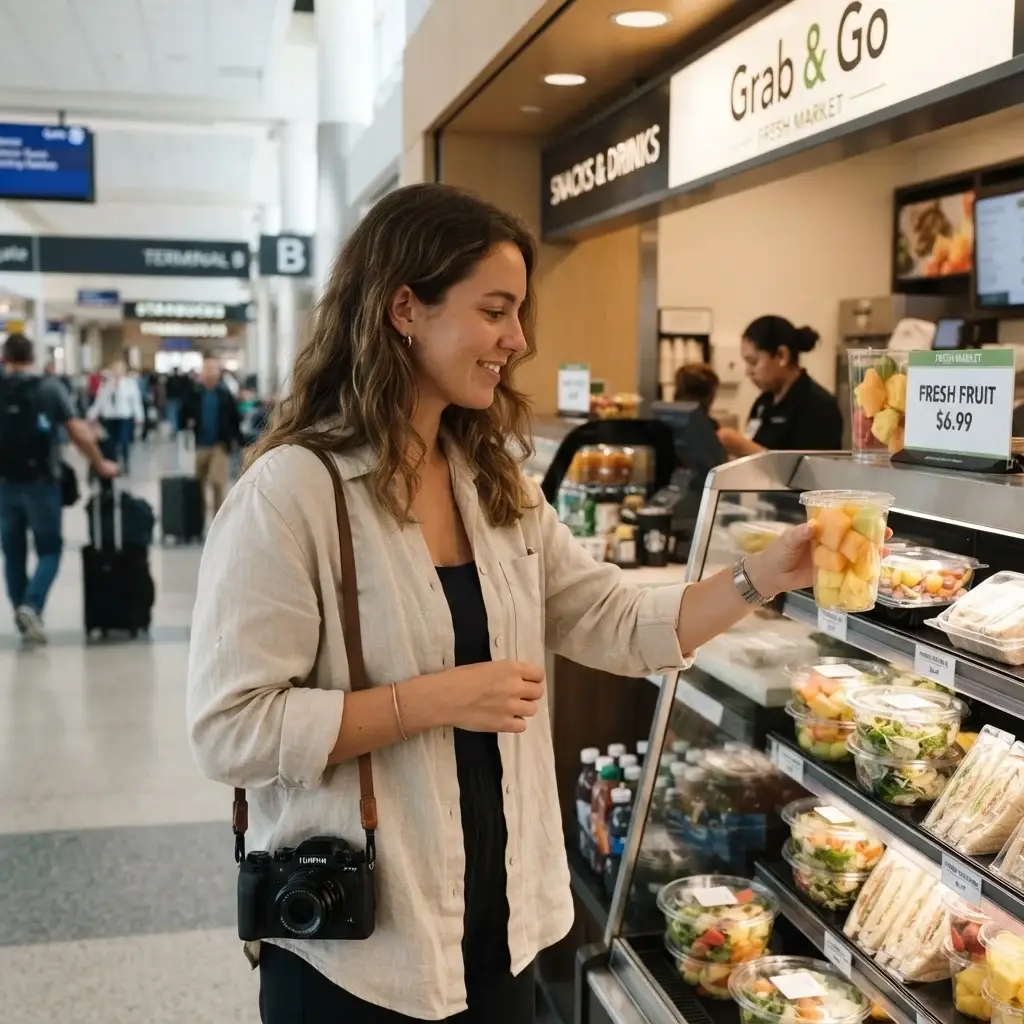
I also look for green salads with simple olive oil dressings. For a satisfying pre-flight meal, I love a hot bowl of oatmeal with bananas or a plain grilled chicken breast with steamed vegetables.
I also carry a large, empty, reusable stainless steel water bottle through security. The moment I pass the security checkpoint, I locate a filtered water station and fill it to the absolute top. I make sure to drink at least one full liter of water before the gate agent even calls my boarding group.
Must-Have Beauty Products for Long Flights: The In-Flight Routine
Once the seatbelt sign turns off and the plane reaches its cruising altitude, it is time to open your personal care kit. This is the core routine that will protect your face over the next eight, twelve, or sixteen hours.
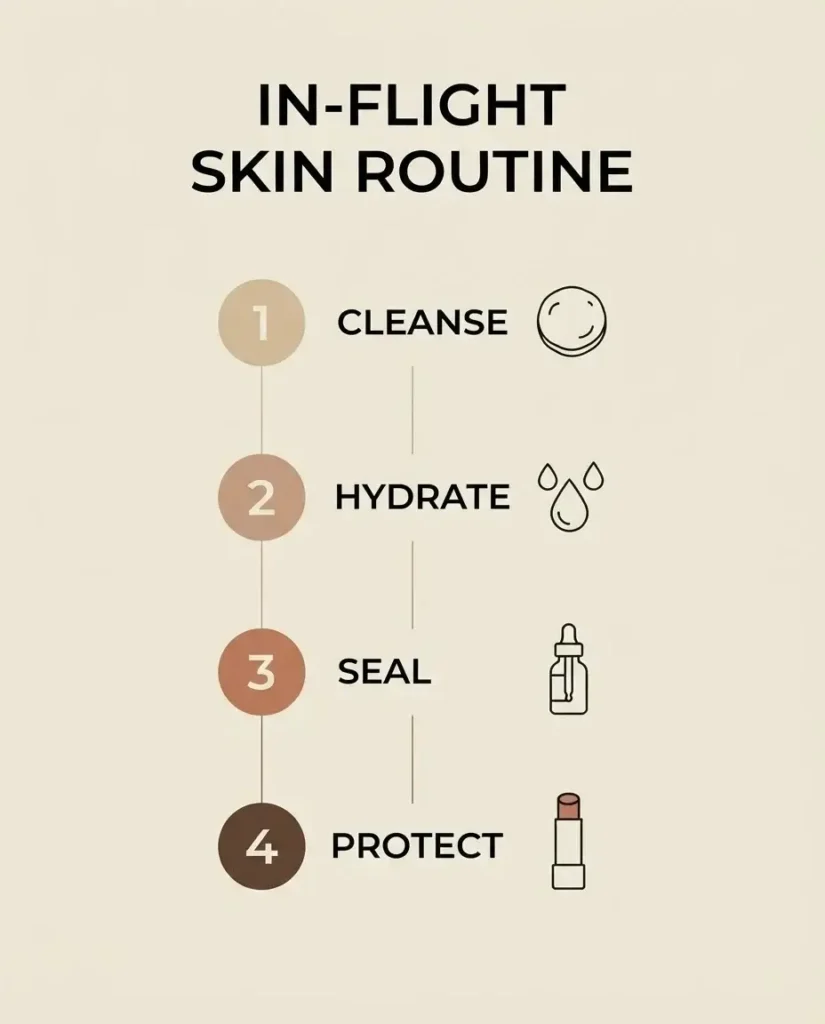
Here are the five must-have beauty products for long flights that I never travel without.
Step 1: The Zero-Water Cleansing Method
The first rule of in-flight skincare is that you must never, under any circumstances, wash your face using the water from the airplane bathroom sink. The water tanks on commercial planes are notoriously difficult to clean thoroughly, and studies have shown that they can harbor a wide variety of unwanted bacteria. Washing your face with that water is a fast track to skin irritation and infections.
Instead, pack a few individually wrapped micellar water cleansing wipes or reusable cotton pads soaked in a gentle, rinse-free micellar water formulas. Micellar water contains tiny oil molecules called micelles that act like miniature magnets. They effortlessly pull away dirt, excess oil, and airport grime from your skin without stripping your natural lipids.
[The In-Flight Cleansing Process]
1. Sanitize hands thoroughly using an alcohol-based gel.
2. Open a sealed micellar water wipe.
3. Gently press the wipe onto the skin (do not scrub or pull).
4. Wipe in upward, circular motions to lift away airport grime.
Before you touch your face, make sure to sanitize your hands thoroughly using a reliable anti-bacterial gel. Gently sweep the micellar pad across your face to remove the layer of grease and dust picked up during transit. Your skin will instantly feel clean, cool, and perfectly prepped for hydration.
Step 2: The Multi-Weight Hyaluronic Acid Hydrator
Once your skin is clean, you need to flood it with moisture. The best way to do this is with a high-quality serum that features multi-weight hyaluronic acid. Hyaluronic acid is a naturally occurring molecule in our bodies that can hold up to one thousand times its own weight in water. It acts like a powerful magnet for moisture.
However, there is a major catch when using hyaluronic acid inside a dry airplane cabin. Because the air contains virtually zero humidity, the hyaluronic acid cannot pull moisture from the environment. If you apply it to a completely dry face, it will actually pull water out of the deeper layers of your skin, making you drier than before.
To prevent this, you must apply your serum to slightly damp skin. Since we cannot use airplane tap water, I use a travel-sized bottle of pure thermal spring water mist. I close my eyes, mist my face generously, and immediately press two or three drops of the hyaluronic acid serum into my skin while it is still wet. This gives the serum plenty of clean water to grab onto and push directly into your parched skin cells.
Step 3: The Heavy-Duty Barrier Cream or Facial Oil
Now that you have forced moisture into your skin, you must lock it down. If you skip this step, the dry cabin air will evaporate your serum within minutes. You need an occlusive product—a thick cream or a rich facial oil that creates a physical shield over your skin barrier.
I highly prefer using a pure, cold-pressed facial oil like jojoba oil, rosehip seed oil, or squalane oil. Squalane is incredible because it mimics your skin’s natural sebum perfectly. It feels lightweight, it does not clog pores, and it provides an incredibly strong protective seal.
If you prefer a traditional cream, look for a formula packed with ceramides and shea butter. Warm a pea-sized amount between your palms and gently press it over your serum.
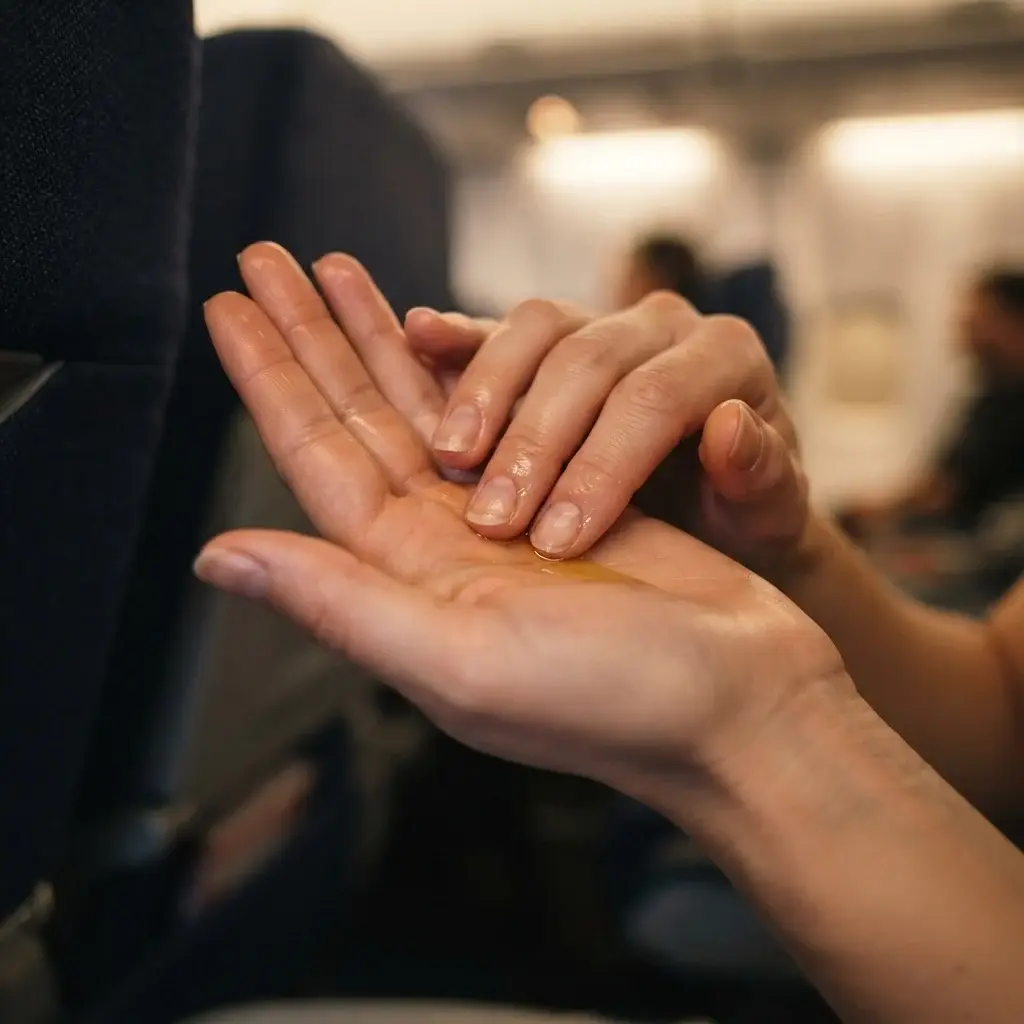
This creates an impermeable barrier that stops trans-epidermal water loss completely. It keeps your skin safe and hydrated for the entire duration of the flight, no matter how hard the cabin fans are blowing above your head.
Step 4: The Targeted Overnight Lip Balm or Treatment
The skin on your lips is significantly thinner than the skin on the rest of your face. It contains no sebaceous glands, which means your lips have no natural way to produce oils and protect themselves from drying out. This is why your lips are usually the very first thing to crack, peel, and become painful on a long-haul flight.
A standard, waxy convenience-store lip balm will not cut it here. Those products often contain ingredients like menthol, camphor, or artificial flavors that feel cooling at first but actually dry out your lips over time, forcing you to reapply constantly.
Instead, look for a thick, medical-grade lanolin ointment or a dedicated overnight lip sleeping mask that uses dense plant butters and beeswax. Apply a thick, visible layer to your lips before you go to sleep on the plane. It should feel almost like a mask. When you wake up before landing, your lips will still be completely soft, smooth, and free of painful cracks.
Step 5: The Unsung Hero: Hydrating Eye Drops and Nasal Saline
When we talk about beauty on a plane, people always focus entirely on skin, but true comfort and brightness come from your eyes and your breathing. The dry air dries out your mucus membranes and your eyes just as fast as your cheeks. Red, bloodshot, itchy eyes will make you look and feel completely exhausted, no matter how glowing your skin is.
I always carry single-use vials of preservative-free lubricating eye drops in my personal care kit. Every three to four hours, I put a drop in each eye to instantly soothe irritation and clear up redness.
Additionally, I pack a small bottle of plain saline nasal spray. A quick spray in each nostril prevents your nasal passages from drying out, cracking, and bleeding. Keeping your nasal passages moist also helps your body trap airborne viruses and bacteria more effectively, which is a major bonus when you are sharing breathing space with hundreds of strangers.
Beyond Skincare: Wellness Essentials That Keep You Glowing
Excellent skin care products are only half of the equation. To truly arrive at your destination feeling energized, confident, and healthy, you need to combine your topical products with a few smart in-flight wellness habits.
Staying Hydrated from the Inside Out
You can apply the most expensive creams in the world, but if your body is severely dehydrated from the inside, your skin will still look flat and tired. The air compression inside the cabin saps moisture from your body with every breath you take.
My strict rule is to drink at least 250 milliliters (about one cup) of water for every single hour that I am in the air. When the flight attendants pass down the aisle with the beverage cart, I always politely ask for a full cup of water, and I avoid the tempting sodas, juices, and alcoholic options.
Alcohol and caffeine are strong diuretics. They force your kidneys to flush water out of your system at an accelerated rate, which instantly dulls your skin and worsens jet lag. If you are serious about arriving with solo travel confidence, stick purely to plain water, coconut water, or herbal teas like chamomile and peppermint.
The Silk Eye Mask and Silk Pillowcase Hack
When you are traveling solo, getting quality sleep on an overnight flight is essential for your safety and awareness the next day, but airplane cabins are full of sleep disruptions. Passengers turn on reading lights, screens flash continuously, and the coarse fabric of the airplane seat headrest can scratch and irritate your facial skin as you toss and turn.
To protect both my sleep quality and my skin, I travel with a high-quality, pure mulberry silk eye mask. Silk is an incredibly smooth, natural fiber that does not absorb moisture from your skin the way cotton or polyester does. It glides gently over your eye area without creating friction or deep sleep creases.
If I am using an inflatable travel pillow, I slide a small silk pillowcase over it. This simple trick keeps my face resting against a clean, hypoallergenic surface all night, protecting my skin barrier and keeping my hair from turning into a frizzy, static mess.
Compression Socks and Blood Circulation
When you sit still in a cramped economy seat for hours on end, gravity causes your blood and fluid to pool down in your lower legs and feet. This lack of movement slows down your overall circulation, which prevents fresh oxygen and vital nutrients from reaching your skin cells, resulting in that classic, puffy “airplane face.”
To keep your blood flowing optimally, invest in a good pair of graduated compression socks. These socks apply gentle pressure to your lower legs, helping your veins push blood back up toward your heart.
I also make it a rule to get out of my seat every two hours to walk up and down the airplane aisles for five minutes. While standing in the galley area, I do a few discreet calf raises and ankle circles. This minor movement gets your lymphatic system pumping, which actively drains fluid from your face and leaves you looking vibrant and awake.
The Post-Flight Fresh Up: Stepping Off the Plane with Confidence
As the captain announces the final descent and the plane dips below the clouds, it is time for the final touch-ups. You do not need a complete makeover in the tiny airplane bathroom. You just need a quick, five-minute refresh at your seat or in the terminal to feel completely human again.
The 5-Minute Airport Bathroom Refresh
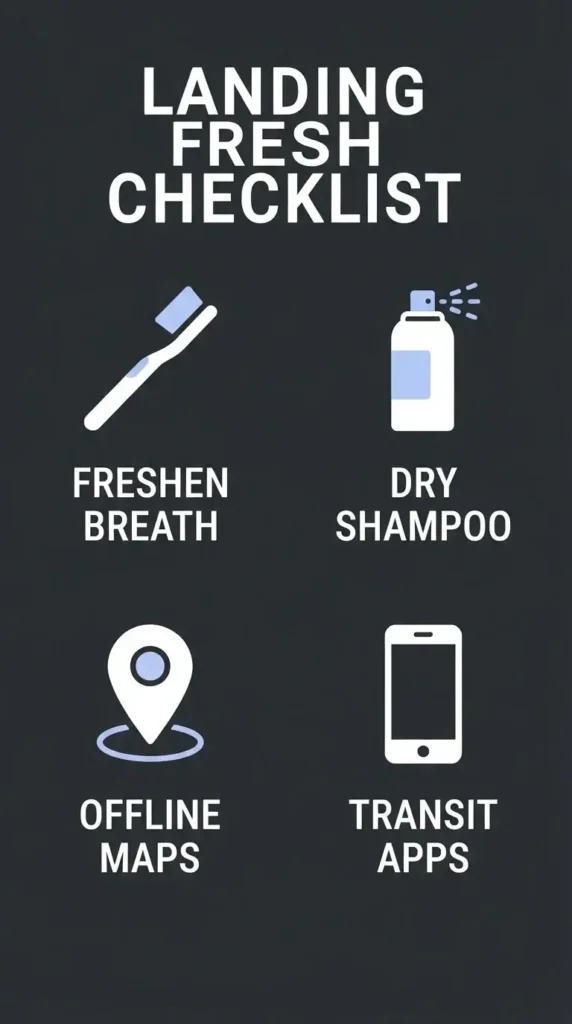
Once the plane lands and I clear customs, I head straight to a spacious airport bathroom to refresh. I brush my teeth immediately; nothing makes you feel cleaner after a long flight than fresh breath. Next, I shake a little bit of natural starch-based dry shampoo into my roots to absorb any excess oils and bring life back to my hair.
For my face, I use a tiny dab of a multi-use cream tint. I pat a soft rose or coral shade onto the apples of my cheeks and a little bit onto my lips.

A cream formula blends beautifully into hydrated skin, giving you a natural, healthy flush of color without looking like heavy makeup. It instantly brightens up your face, making you look like you just enjoyed a restful night in a boutique hotel rather than twelve hours in economy class.
Preparing for Your Next Destination Safely
Before you leave the sanctuary of the airport terminal and head out to find your local transport, take a moment to ensure your body and paperwork are fully ready for the local environment. I always sit down on a bench, take a deep breath, and double-check my destination notes.
If you are traveling to a region with specific health considerations, it is wise to review your health checklists early. I always verify local health advice and regional safety updates by referencing the detailed health advisories and packing tips on the CDC Travelers’ Health website to make sure I am fully prepared for the local climate and conditions. Knowing what to expect regarding food safety and environmental factors before you step outside gives you incredible peace of mind.
[Arrival Success Checklist]
– Fresh breath (brushed teeth)
– Light face tint for a healthy flush
– Filled water bottle for the transit ride
– Local currency cash in pocket
– Offline maps downloaded on phone
– Transportation app open and ready
Next, clear your head and prepare for local navigation. If I am landing in a busy Southeast Asian hub like Bangkok, Jakarta, or Manila, I avoid the stressful and often overpriced airport taxi lines outside.

Instead, I find a spot with stable airport Wi-Fi, open my phone, and arrange a reliable ride by following the safe transit setup steps on the official Grab website to secure a fair, tracked journey directly to my accommodation.
Having your transportation sorted before you walk out into the heat eliminates huge amounts of arrival anxiety. To protect myself against any unexpected travel hiccups, delays, or medical issues while exploring unfamiliar streets, I always make sure my trip is fully backed by the comprehensive safety advice articles by World Nomads Travel Insurance. Knowing that I am completely covered allows me to step out of the airport doors with my head held high, full of curiosity, and completely ready to embrace the beautiful adventures ahead.
Taking care of your skin on a long flight is not about vanity. It is an act of self-respect and practical preparation for the journey ahead. When you step off that plane feeling comfortable, hydrated, and physically refreshed, you are not trapped by exhaustion or discomfort. You have the energy and the quiet confidence to handle whatever the road throws at you. Pack your small kit of must-have beauty products for long flights, protect your body, and go explore this beautiful world with an open heart.