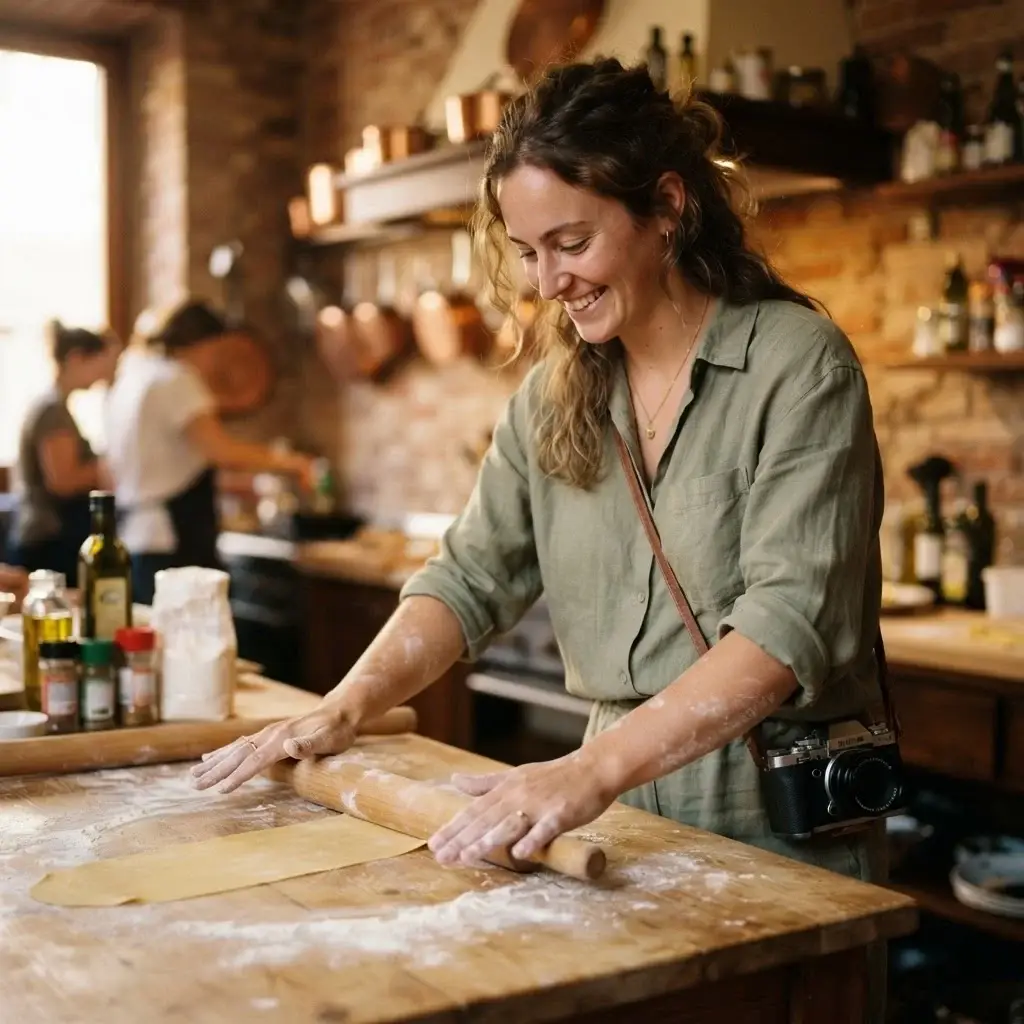
I want to tell you something before we get into the where. The best travel memory I have from teaching English in Thailand was not a temple or a beach. It was a night when a coworker’s mother stood me in front of a mortar and pestle and refused to let me leave until my curry paste smelled right. I had no idea what I was doing. I bruised my thumb. And I have never once forgotten it.
That is the real reason cooking classes are worth your time in Europe. You are not just learning recipes. You are getting a door into how a place actually lives. So let’s figure out where to take cooking classes in Europe based on the food you love, how comfortable you are in a kitchen, and whether you are going with people or on your own.
First, let go of one big fear
You do not need to know how to cook. I want to say that loudly because it is the number one thing that stops readers from booking. Almost every tourist-facing class in Europe is built for beginners. The chef expects you to arrive knowing nothing, and that is completely fine. If you can chop when someone shows you how to chop, you belong there.
The second fear I hear is going alone. Group cooking classes are honestly one of the friendliest things a solo traveler can do. You are all wearing the same silly apron, you are all a little clumsy, and by the time the food hits the table you are eating a meal together like old friends. I have watched strangers exchange numbers at the end of a class. If you have been nervous about solo travel, this is a soft, low-pressure place to start.
Italy: start here if you love pasta and slow food
If you only take one cooking class in Europe, make it pasta in Italy, and if you can, make it in the Emilia-Romagna region rather than the more crowded tourist kitchens. This is the part of Italy that gave the world tagliatelle, tortellini, Parmigiano Reggiano, and real Bolognese ragù. Nearby Parma is officially recognized as a UNESCO Creative City of Gastronomy, which is not a marketing slogan but a formal designation tied to the region’s deep food culture, so you are learning in the actual heartland, not a copy of it.
In Bologna, a hands-on class where you roll fresh egg pasta by hand is the classic first-timer experience. Expect to pay somewhere around 115 euros for a roughly two-and-a-half-hour class with an established operator like Taste Bologna, though shorter small-group classes can be found for less. What you are paying for is real instruction, real ingredients, and usually a sit-down meal of everything you made at the end.
What to eat and make: hand-rolled tagliatelle, tortellini folded one by one, and a slow ragù that will ruin jarred sauce for you forever. Insider tip, if the class includes a walk through Bologna’s Quadrilatero market district first, take it. Watching where the pasta flour and the mortadella actually come from makes the cooking click.
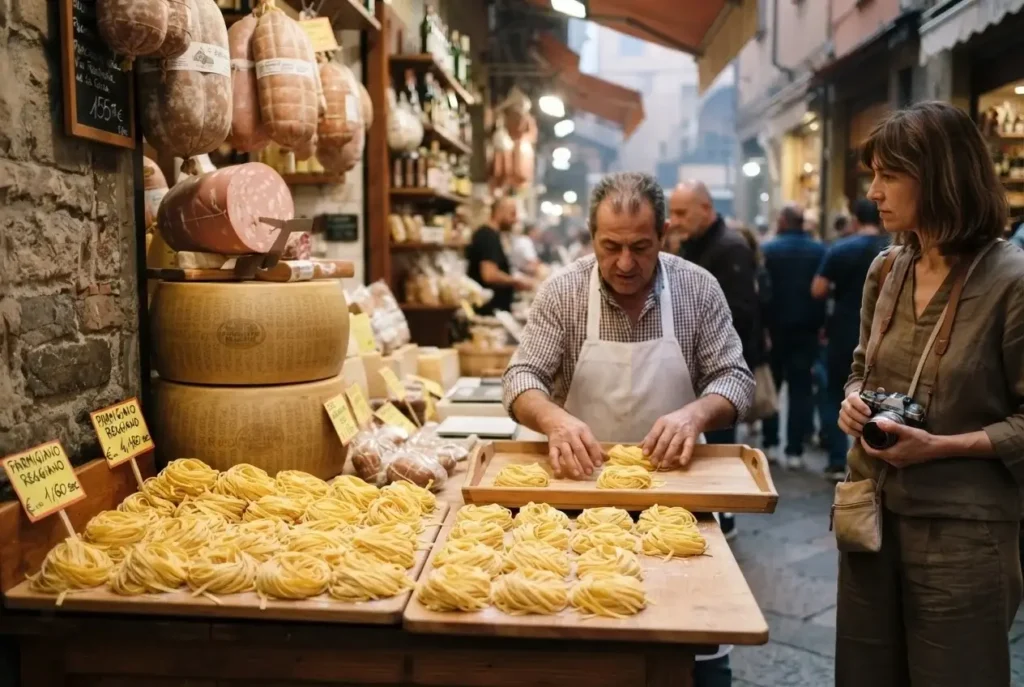
Getting around: Bologna is a major rail hub, so it is easy to reach by high-speed train from Florence, Milan, or Venice, which makes it a smart base for a food-focused trip even if you are not staying long.
France: for technique, pastry, and market culture
France is where you go if you want to feel like you leveled up. French cooking is built on technique, and even a single class can change how you cook at home forever. The official national tourism site, France.fr, leans heavily into gastronomy for a reason, it is genuinely central to the culture.
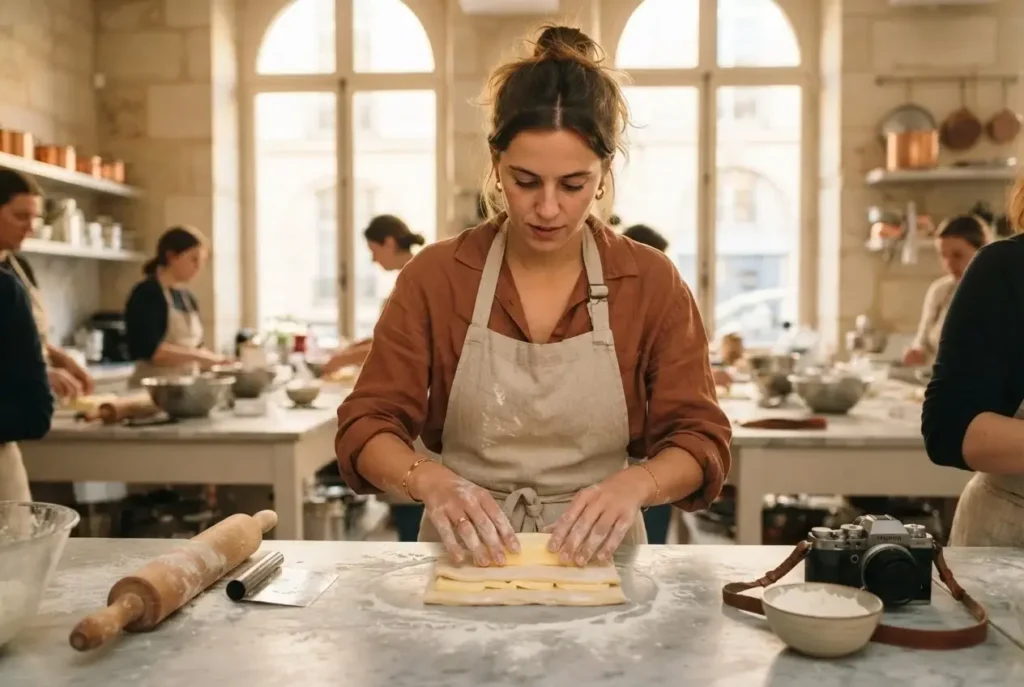
In Paris, English-language schools make this completely approachable for first-timers. A well-regarded option like La Cuisine Paris runs croissant, macaron, and classic French classes starting around 119 euros for a roughly three-hour session. Croissant classes are the ones people rave about, because laminating dough is one of those skills that feels like magic until someone shows you the folds.
If you want the deeper food-city experience, look at Lyon. It is widely considered France’s gastronomic capital, home to the bouchon tradition and the legacy of Paul Bocuse. Classes here often pair a morning market visit with cooking, and the market walk is where the real learning happens. Here’s what to expect if you are anything like me when I first tried to shop a foreign market alone, it feels intimidating for about five minutes, and then a vendor hands you something to taste and you relax completely.
What to eat and make: croissants and macarons in Paris, and in Lyon the hearty bouchon classics like quenelles and coq au vin. Insider tip, always choose the class that includes the market tour if your budget allows. It is the difference between following a recipe and understanding a cuisine.
Spain: Basque Country for pintxos and the friendliest classes
San Sebastián, in the Basque Country, is one of the most food-obsessed cities on earth, and it is a wonderful place to cook. The city’s own tourism board runs a page dedicated to cooking classes and gastronomy workshops, which tells you how seriously the place takes this. You can learn to make pintxos, cook a full Basque menu with a chef, or visit a market first.
Pintxos classes are perfect for nervous first-timers because you are making small, beautiful bites rather than one intimidating showpiece dish. It feels playful. You will likely make a gilda, the little skewer of olive, anchovy, and guindilla pepper that started it all, plus a Spanish tortilla and the famous Basque burnt cheesecake.
What to eat and make: pintxos, tortilla, and burnt cheesecake. Insider tip, after your class, do a self-guided pintxos crawl through the old town, Parte Vieja, so you can taste how the pros plate the same dishes you just learned. Getting around, San Sebastián is small and walkable, and the old town where most classes happen is easy to reach on foot from anywhere central.
Greece: for sun, olive oil, and the Mediterranean way of eating
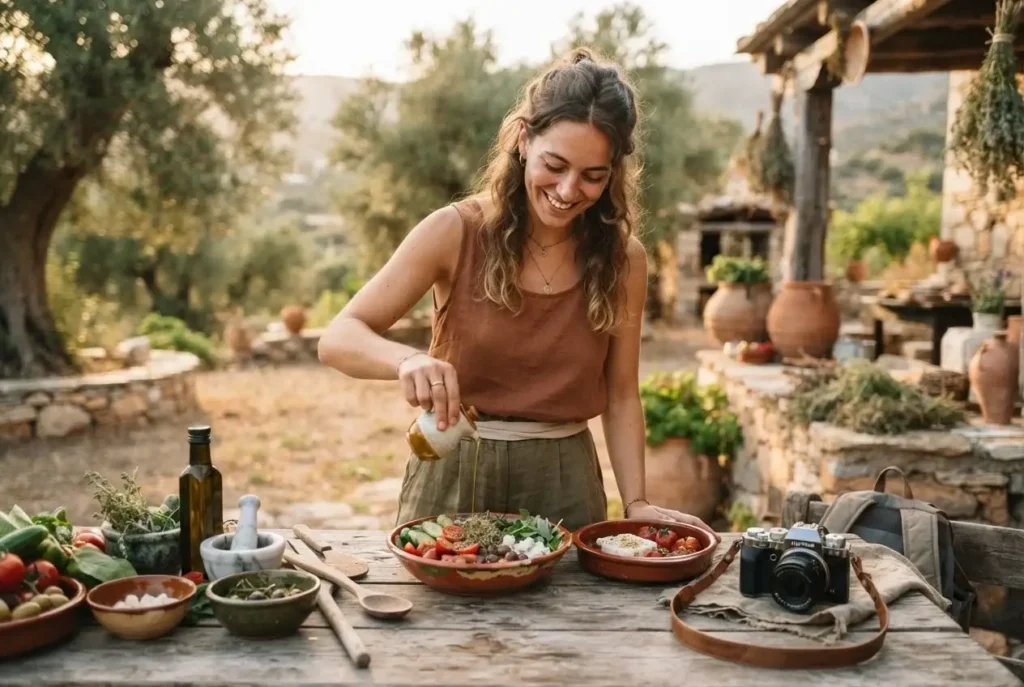
Greek cooking classes are some of the most heartwarming, often taught by a mother-and-daughter team on a farm or in a family kitchen. This is not fussy food. It is generous, seasonal, and built on olive oil, vegetables, and time. The Mediterranean way of eating is actually recognized by UNESCO as an intangible cultural heritage of humanity, shared across Greece, Italy, Spain, and beyond, and a good Greek class makes you feel that heritage rather than just read about it.
In Athens, established schools like The Greek Kitchen walk you through the dishes that define the table, chosen as much for their place in the culture as for their flavor. On Crete, look for farm-based classes where you cook with the family’s own produce and olive oil.
What to eat and make: moussaka, dolmades, fresh tzatziki, and whatever vegetable is in season. Insider tip, tell the class in advance if you are vegetarian, because Greek cooking is naturally rich in plant-based dishes and a good teacher will happily lean into them.
A few more cities worth knowing about
Beyond the big four, Istanbul is a standout for anyone drawn to Turkish and Ottoman cooking, with classes that teach meze, stuffed vegetables, and breads in home kitchens. Vienna, Lisbon, and Marrakech (just across the water and often grouped into European food itineraries) all have strong, well-run classes too. The point is that almost every European food city now has a genuine, beginner-friendly option. Your job is choosing well.
How to spot a great class and skip the tourist trap
After planning a lot of food-focused travel, here is what I look for, and what I tell every reader to check before booking.
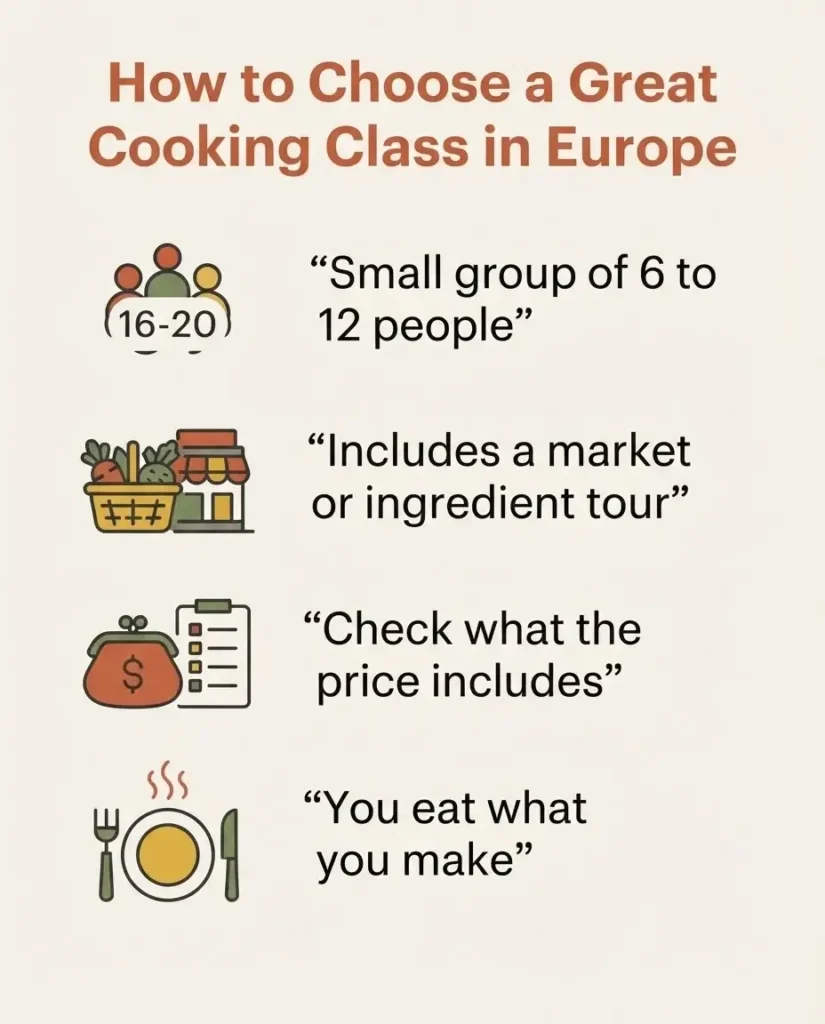
Group size matters most. Small classes, roughly six to twelve people, mean you actually get hands-on time instead of watching a chef perform. If a listing brags about huge groups, that is a red flag.
Look for a market or ingredient element. The classes people remember almost always start with sourcing, because that is where culture lives.
Read what the price includes. A fair price should cover ingredients, instruction, recipes to take home, and the meal you cook. If wine or a market tour costs extra, that is normal, just know before you go.
Check that you eat what you make. It sounds obvious, but the best classes end with everyone sitting down together. That shared meal is half the experience.
What things cost, roughly
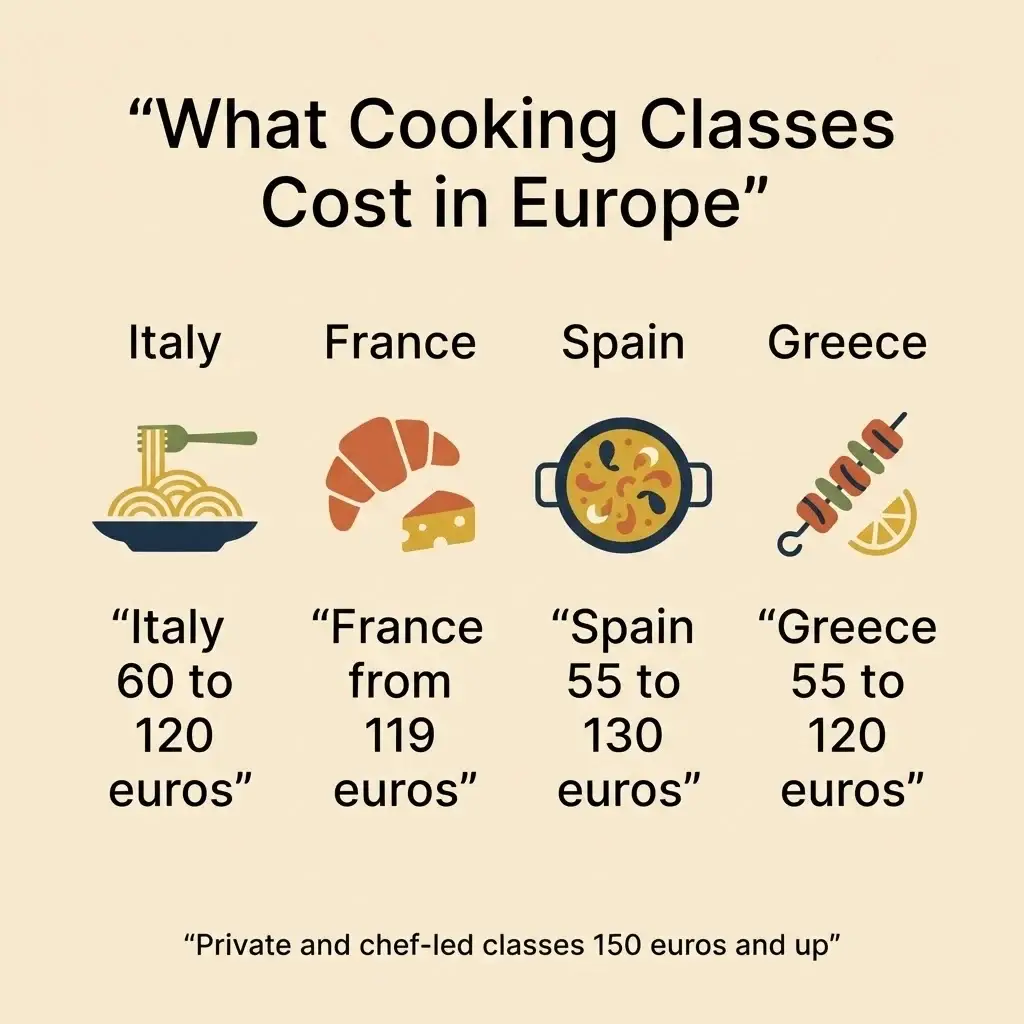
Prices move around, but as a planning guide: group classes across Europe commonly run from about 55 to 130 euros per person. Italy pasta classes cluster around 60 to 120 euros. Paris classes with established schools start around 119 euros. Private and chef-led experiences cost more, often 150 euros and up.
If you are traveling on a budget the way I did when I was working flexible jobs to fund my trips, a small-group class is where the value is, you get the experience without the private-lesson price.
Practical planning: booking, dietary needs, and what to bring
Book ahead. Good classes in popular cities fill up, especially in high season, so aim to reserve one to three weeks out, more for anything at a famous school. Solo travelers, check that the class accepts single bookings, most do, but small private-only classes sometimes have a two-person minimum.
Flag dietary needs when you book, not on the day. Vegetarian, vegan, gluten-free, and allergy adjustments are usually easy if the chef knows in advance. Wear closed shoes and clothes you do not mind getting a little flour on, and skip the fancy outfit. You will be handed an apron anyway.
Language is rarely a problem in tourist-facing classes, which are typically taught in English, but it is worth confirming the class language when you book, especially for smaller local schools.
The part nobody puts in the itinerary
Here is what I really want you to take from this. The reason I keep pushing readers toward cooking classes is the same reason I keep pushing solo travel in general. You walk in unsure of yourself, you fumble through something new with strangers, and you walk out a little more capable than you were that morning. That confidence does not stay in the kitchen. It follows you onto the next train, the next city, the next unfamiliar thing.
So pick the cuisine that makes your mouth water, pick a city that fits your trip, and book the class before you talk yourself out of it. The recipe you bring home is nice. The person you become on the way there is the real souvenir.