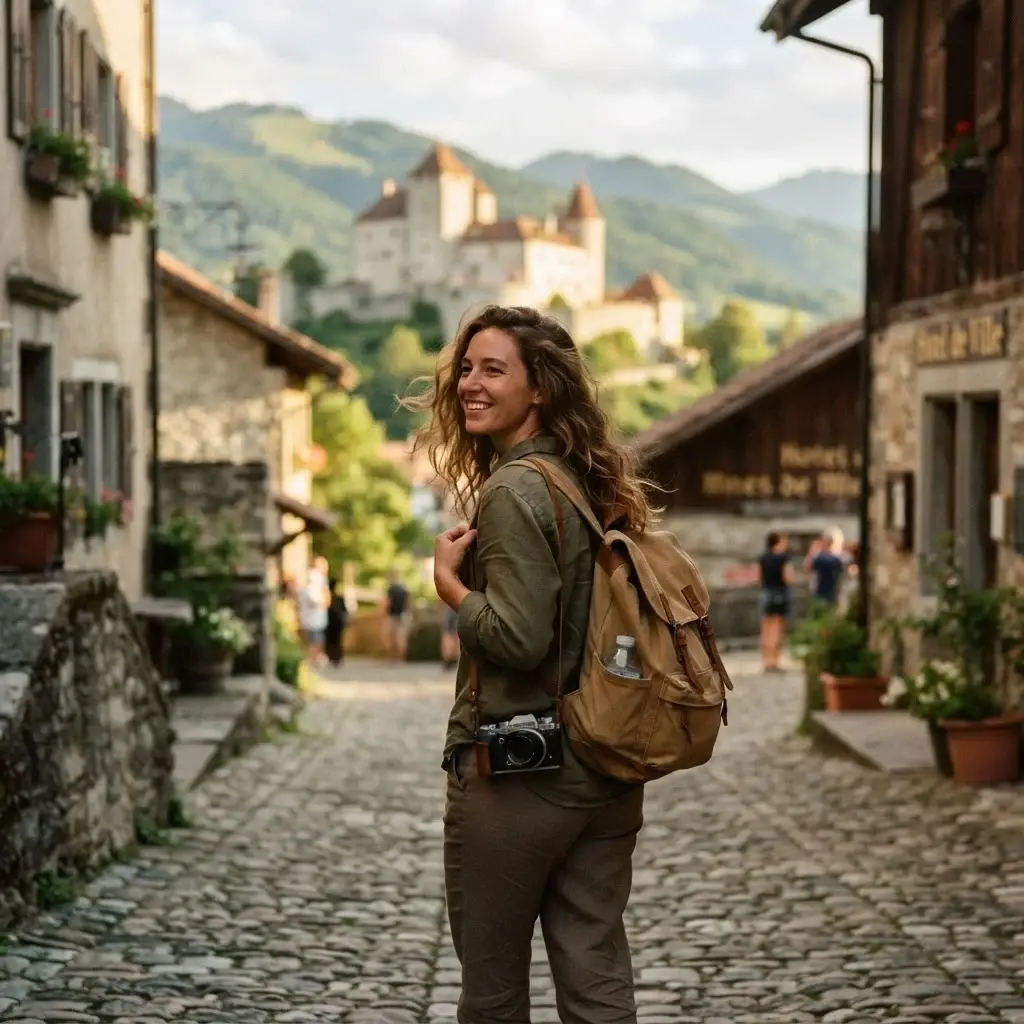
The first time I really understood cheese as a place, and not just a thing in a fridge, I was backpacking solo across Europe with a very small budget and a very large appetite. I’d buy a wedge of something local, a hunk of bread, and sit on a curb like it was a five-star meal. Some of the best food memories of my life cost me almost nothing. That’s the quiet magic of a cheese trip. You don’t need money or status. You need curiosity and a willingness to walk into places that feel a little unfamiliar.
If you’ve been daydreaming about a cheese-focused trip through Europe but you’re not sure where to start, this is your map. I’m going to walk you through the destinations that are actually worth building a trip around, what to eat in each, roughly what it costs, and how to do it even if you’re traveling alone and don’t speak the language. No car required for most of it. No pretending it’s all perfect either.
Let’s get into it.
First, a mindset shift: chase regions, not a checklist
Here’s the mistake I see people make with cheese trips, and honestly the same one I made early on with travel in general. They try to hit six countries in ten days and end up exhausted, having tasted a lot but absorbed nothing. Cheese is slow food. The people who make it think in seasons and years, not minutes. Your trip should borrow a little of that patience.
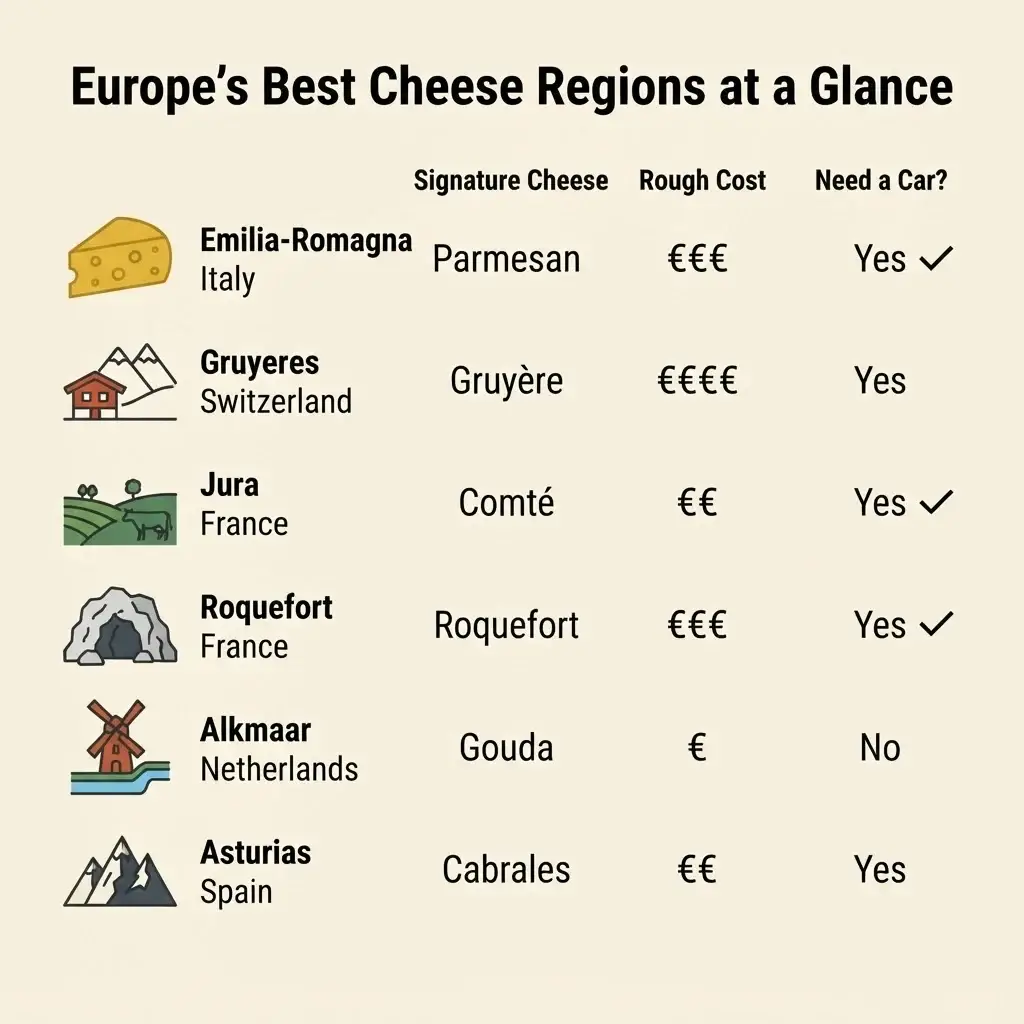
So pick one or two regions and go deep. A working dairy, a market morning, a long lunch, a conversation with the person behind the counter. That’s the trip. The list below is organized by region so you can choose the one that pulls at you, rather than feeling like you have to conquer all of them. If you’re the type who likes a slower pace, you already know this instinct pays off.
Emilia-Romagna, Italy: the home of Parmigiano Reggiano
If you only understand one thing about Italian cheese, understand this: real Parmigiano Reggiano is a protected product that can only be made in a specific zone around Parma, Reggio Emilia, Modena, and parts of Bologna and Mantua. What you grate at home is a distant cousin of what you’ll taste here, aged and cracked open fresh in the place it was born.
The genuinely special thing you can do is tour a working dairy in the morning, because the cheese is made early. You watch the milk transform, see the giant copper vats, then walk into an aging warehouse stacked floor to ceiling with wheels, and finish with a tasting of cheese aged different lengths of time so you can taste how the years change it. When I looked into arranging this, I found the cleanest way to book a real one is straight through the official consortium, and you can browse and reserve legitimate dairy visits directly on the Parmigiano Reggiano guided tour page, where tours run roughly 16 to 22 euros and last around 45 to 90 minutes.
What to eat beyond the obvious: pair the cheese with a few drops of traditional balsamic vinegar from Modena, another local treasure. Order tortellini in brodo, tiny pasta parcels in broth. And don’t skip a shaving of Parmigiano over almost anything.
Getting there without a car: Parma, Modena, and Reggio Emilia all sit on the main high-speed rail line between Milan and Bologna, so trains are frequent and easy. Base yourself in one town, book a morning dairy tour, and you can reach the meeting point by a short taxi or local bus. This is one of the most solo-friendly cheese regions in Europe precisely because the trains do the heavy lifting.
Gruyères, Switzerland: fondue, castles, and Alpine calm
Gruyères is almost unfairly charming. It’s a tiny medieval village on a hill with a real castle, cobbled streets, and mountains all around, and it happens to give its name to one of the world’s great cheeses. This is the kind of place that makes a nervous first-time solo traveler relax within an hour, because it’s small, walkable, and set up for visitors.
At the foot of the village sits the showcase cheese dairy, and it’s an easy, low-pressure introduction to cheesemaking. From my research, the self-guided audio tour costs only about 7 Swiss francs and even hands you a little sampler of Gruyère at different ages, and you can plan your visit on the official La Maison du Gruyère site. For the wider area, including the castle and the nearby chocolate connection, the regional tourism board’s La Gruyère destination page lays out how the sights connect.
What to eat: fondue, obviously, made with Gruyère and often Vacherin. If you’re alone and worried that fondue is a couples-only affair, don’t be. Plenty of solo travelers order a small pot and a glass of white wine and settle in happily. Try raclette too, melted cheese scraped over potatoes and pickles.
Getting there without a car: take a train to the Gruyères station, and the dairy is right by it, with the village a short uphill walk. Switzerland’s rail network is one of the best on earth, so this is genuinely doable as a day trip from cities like Montreux or Bern.
The Jura, France: the quiet cathedral of Comté
If Gruyères is the polished front door, the Jura mountains of eastern France are the soulful back room. This is Comté country, and Comté might be the most beloved cheese in France that most travelers outside Europe have never properly tasted. It’s nutty, complex, and changes character depending on the season the milk was collected and how long the wheel was aged.
What makes the Jura special for a curious traveler is the Routes du Comté, a network of farms, small village dairies called fruitières, and aging cellars that open their doors to visitors. It feels less like a tourist attraction and more like being let into a working world. The regional tourism site does a lovely job explaining how it all fits together on its Comté in the Jura mountains page, which is where I’d start mapping a route.
There’s a deeper layer here too. These mountain landscapes are shaped by centuries of traditional stonework, and the craft of building dry stone walls without mortar is recognized by UNESCO as intangible cultural heritage. Noticing details like that is what turns eating cheese into understanding a place, which is the whole point.
What to eat: Comté at several ages side by side, plus a glass of the region’s distinctive Jura wine, especially vin jaune, which pairs with the cheese almost eerily well.
Getting there without a car: this is the one region where a car genuinely helps, since the dairies are spread across the countryside. If you’re carless, base yourself in a town like Poligny or Arbois, which you can reach by train, and focus on the visitor sites within reach, or join a small organized tasting. If you’re anything like me when I first planned a rural trip, the fear of “but how will I get around” fades fast once you accept a slower, smaller radius.
Roquefort-sur-Soulzon, France: cheese from inside a mountain
Now for the drama. Roquefort is a blue cheese made from sheep’s milk and aged inside natural caves in a limestone cliff, where cool air flowing through cracks in the rock creates exactly the conditions its famous blue veining needs. Walking into those cool, dim cellars after the heat outside is the kind of sensory jolt that stays with you.
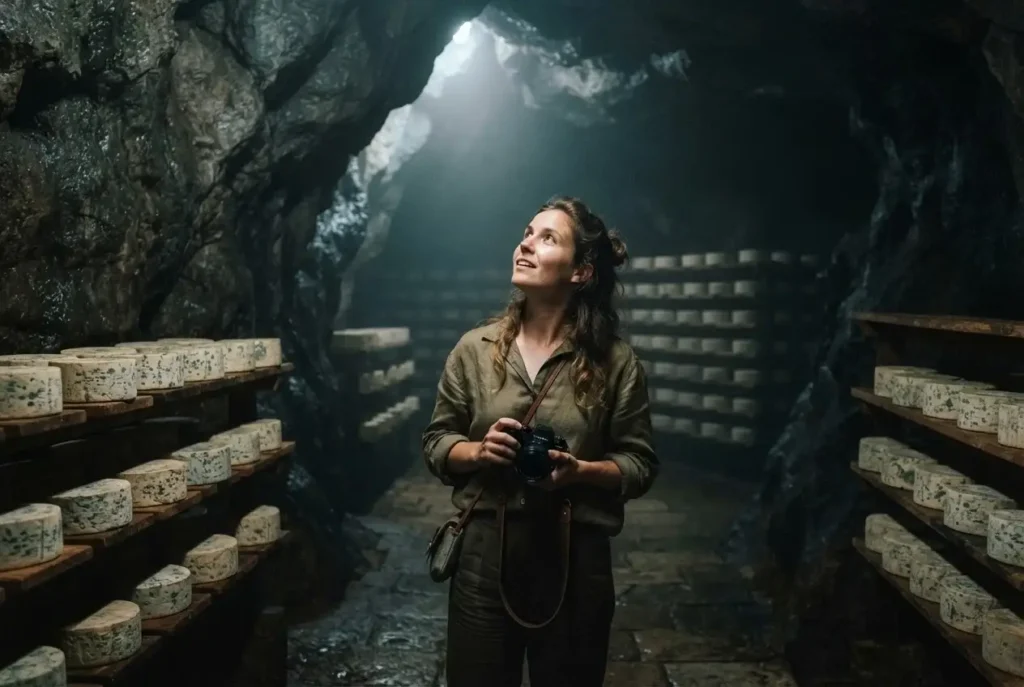
Several producers offer cave tours in the village. From what I found, the Roquefort Société tour runs about 17 euros for roughly an hour and a half and includes a tasting of four of their Roquefort cheeses with wine pairings, and you can see the current details on the official Roquefort Société caves page. A quick honest heads-up that competitors rarely mention: some of the smaller cave tours are conducted mainly in French. If your French is rusty, that’s completely fine. The caves, the smells, and the tasting speak a universal language, and you can read up beforehand so you follow along. Don’t let a language worry talk you out of it.
What to eat: Roquefort itself, ideally with a little honey or a sweet wine to balance its salty punch. If strong blue cheese scares you, start with a small taste. Tasting it where it’s made has converted more than a few skeptics.
Getting there without a car: this is remote, in the Aveyron region of southern France. Realistically you’ll want a car or a guided day tour from a base like Millau or Toulouse. It’s the biggest logistical lift on this list, and also one of the most memorable, so weigh how much the drama is worth to you.
Alkmaar and Gouda, Netherlands: the theater of the cheese market
The Dutch cheese markets are pure joy, and they’re wonderful for solo travelers because you’re part of a lively crowd, not sitting alone at a table. In Alkmaar, porters in white outfits and colored hats carry stacked wheels on wooden sledges in a centuries-old ritual on the main square. It’s part history lesson, part performance, entirely charming.
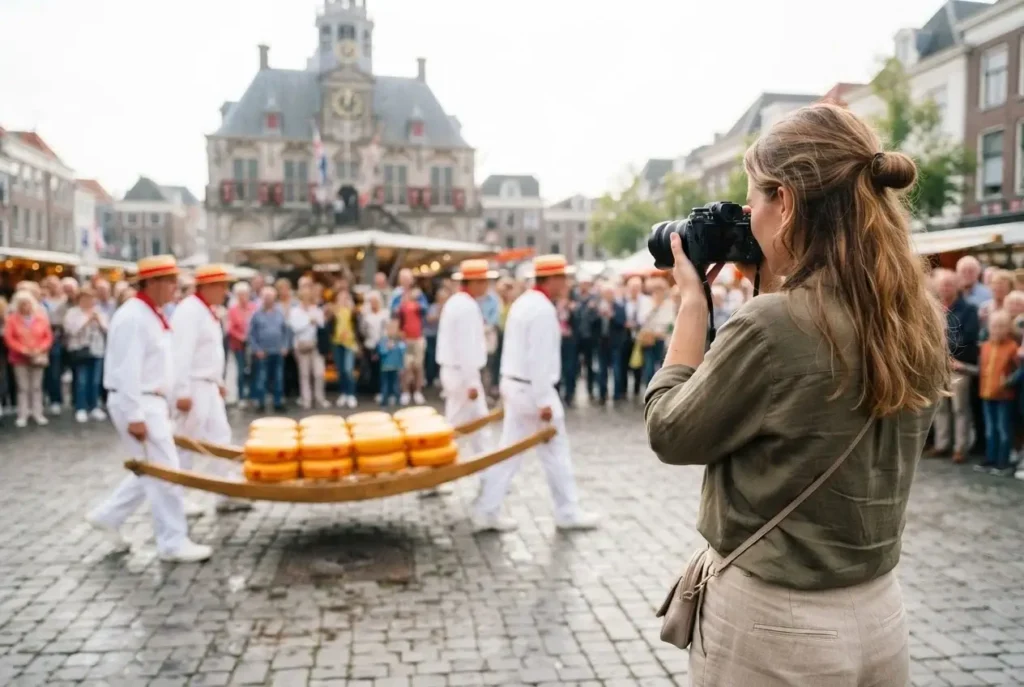
Timing is everything here, and this is where competitors often give outdated information. The traditional Alkmaar market runs on Friday mornings from 10:00 to 13:00, roughly from the last Friday of March to the last Friday of September, with extra Tuesday evening markets in July and August, and you can confirm the exact dates for your visit on the official Alkmaar cheese market schedule. Show up outside those months and you’ll find a pretty square and no market, so plan around it.
What to eat: young Gouda is mild and creamy, while aged Gouda turns deep, caramel-like, and studded with little crunchy crystals. Try both back to back. Grab a stroopwafel from a stall for dessert.
Getting there without a car: Alkmaar and Gouda are both easy train rides, Alkmaar from Amsterdam in well under an hour. This might be the single most beginner-friendly cheese destination in Europe. If you’re taking your very first solo trip and want a gentle start, I’d point you here first.
Asturias, Spain: the underdog with cave-aged blues
Spain rarely makes the headline of cheese-trip articles, and that’s exactly why I want to include it. In the green, mountainous region of Asturias in the north, Cabrales is a pungent blue cheese aged in natural mountain caves, made by small producers who still work by hand. It’s bold, a little wild, and completely unlike the polished tourist experience elsewhere.
In the village of Arenas de Cabrales you can visit a cheese cave and exhibition to see how it’s made and taste it, and from what I found it’s remarkably affordable, around 4.50 to 5 euros including a tasting served with the local cider. For the natural cave experiences in the area, the official regional tourism site describes the Cueva del Quesu Cabrales visit, which pairs beautifully with a day exploring the dramatic Picos de Europa mountains nearby.
What to eat: Cabrales with a drizzle of honey, and don’t skip the ritual of Asturian cider, which is traditionally poured from high above the glass to aerate it. Watching a local do it is half the fun.
Getting there without a car: this is rural, so a car or a guided day tour from a base like Oviedo or Cangas de Onís works best. Go here if you want the road less traveled and a region that still feels like a discovery.
How to plan a realistic route
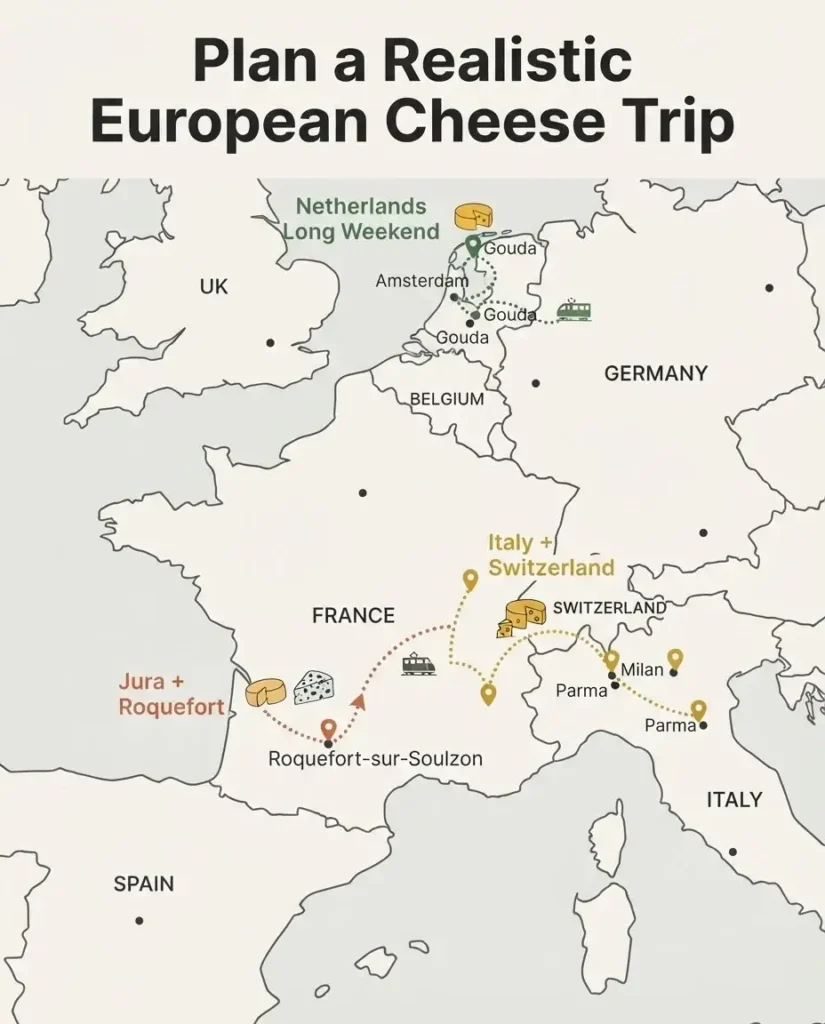
Please don’t try to do all six. A sane and wonderful trip might be Emilia-Romagna plus a swing up to Gruyères, since Italy and Switzerland connect well by train. Or a France-focused loop through the Jura and, if you’re determined, Roquefort. Or the gentlest option of all, a Netherlands cheese-market long weekend that a first-timer can pull off with total confidence.
Give each region at least two or three nights so you can catch a market on the right day, book a morning dairy tour, and still have time to just wander. Rushing a cheese trip defeats the entire purpose.
Can you bring cheese home?
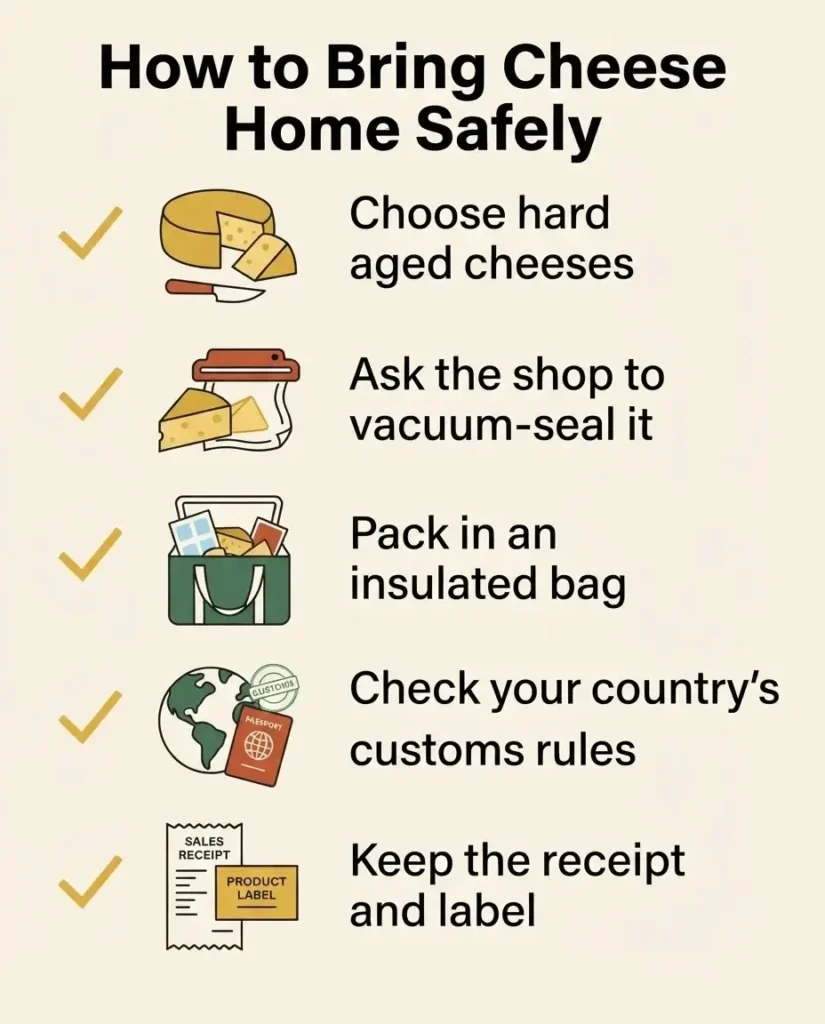
This is the question everyone eventually asks. If you’re traveling within the European Union, moving cheese between countries is generally simple. Bringing it back to countries like the United States is where it gets stricter, because rules distinguish between soft and hard cheeses and between vacuum-sealed and loose products. Before you fall in love with a giant wedge, check your home country’s current customs and agriculture import rules, because they change and enforcement is real. As a practical move, hard aged cheeses that are vacuum-sealed by the shop tend to travel best, and asking the shop to seal it for travel is completely normal.
A little encouragement before you go
I know a cheese trip can sound intimidating when you picture yourself alone, fumbling through a language you don’t speak, unsure whether you’re even allowed to just walk in. I promise you the fear shrinks the moment you’re standing in a cool cave or a busy market square with a sample in your hand. Food is one of the warmest bridges between strangers. Point, smile, try the thing, say thank you in the local language. That’s genuinely most of it.
The best cheese destinations in Europe reward exactly the kind of traveler I hope you’ll become: curious, a little brave, and happy to slow down. You don’t need to wait for the perfect moment or the perfect travel companion. You need one region, a few open days, and an appetite. The rest, you’ll figure out beautifully as you go.